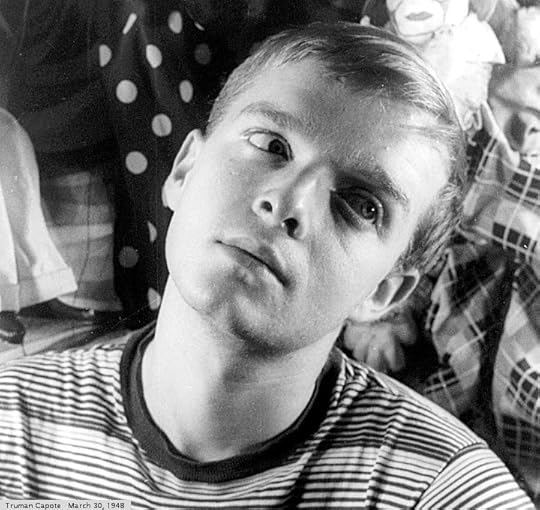
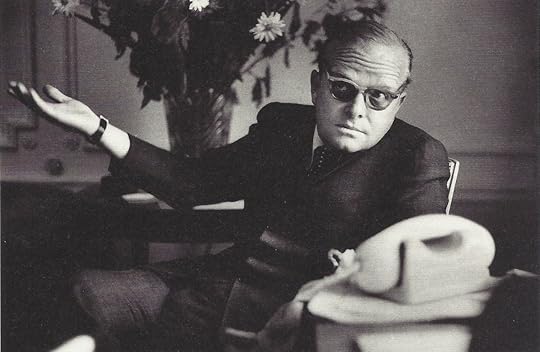
Based on interviews with the author of In Cold Blood and Breakfast at Tiffany's and with nearly everyone who knew him, this absorbing, definitive, and generously illustrated biography follows Truman Capote from his eccentric childhood in Alabama to the heights of New York society. Candidly, too, it recounts a gifted and celebrated writer's descent into the life of alcohol and drugs that would ultimately consume his bulldog spirit and staggering talent.
Usually biographies begin with the more dutiful, laboured and frankly tiresome parts – the family background, the growing up, the education, the roots and the shoots, great author as 10 year old, etc. I always want to get past all that to the start of the action. Capote is a complete exception. The family circumstances, the growing up, the odd microscopically small place that TC grew up in, (which also produced another great novelist, how strange can you get, Harper Lee), the Southern gothic trappings, the lurid characters, the borderline crazy constantly-abandoning parents, and of course being gay but not just gay, being outrageously effeminately screaming-queen-style gay in Alabama in the 1930s and 40s, and never quite growing up, so that he looked eleven when he was 20, and being only 5 feet three, what a story. Gerald Clarke tells it beautifully. Far and away, that’s the best part of the book.
How TC became famous was that he mooched into the New Yorker and tried to get a job and did but got fired then mooched into Harper’s Bazaar, a ladies’ fashion magazine which happened also to publish a lot of top short fiction, and got a little menial job there, then pushed a couple of his short stories at them, which they read from kindness, and then fell of their chairs, and published them. In those days, the late 40s and 50s, short stories were big. We see this when Shirley Jackson wrote "The Lottery" (1948) – it was a major event across America – very hard to believe now, who the hell reads short stories now? So the same thing happened with a story called "Miriam" by TC (1945) – it’s brilliant and he was 20 years old. It was a smash hit.
After that he knocked out more short stories and got busy with his first novel and started on his second, and arguably more important career, which was charming and smarming everyone who was anyone in Manhattan. The major romance between Truman and rich people was underway. It was totally requited. Turns out that New York society was just waiting for a tiny Southern gay wunderkind to smother with their collective bosoms. TC was the boylita of the late 1940s. TC’s real genius was in socialising.
That part is the least fun you can have with this biography. The endless merrygoround of chichi restaurants, ermine-covered yachts, vomitous parties, lots of little dogs, wonderful times in exotic jettery settery places throughout the planet can make the sensitive reader turn several shades of green, which may be caused by envy or bilious reaction.
TC AND MAILER : A FUN COMPARISON
One or the other was the Most Famous Living American Author from the 50s to the 80s but look at the difference in terms of productivity (I know we don’t judge value by volume, but still):
Total pages of fiction by TC, counting Collected Stories, Other Voices, The Grass Harp, Breakfast at Tiffany’s In Cold Blood, Music for Chameleons and Answered Prayers :
Approximately 1500
Number of pages of one single novel by Mailer, Harlot’s Ghost : 1170.
If we throw in all of TC’s journalism, that’s another 500 pages. Mailer could churn out that much in a couple of months. Few giant literary reps have been erected on such slender volumes as Truman’s.
WHAT HAPPENED IN KANSAS
TC : We would drive out to some lonely ranch or farmhouse to interview the people and almost invariably they had a television set on. They seemed to keep it on twenty-four hours a day. They would sit there talking – and never look at us! They would go on looking straight at the TV screen, even if there was just a station break or an advertisement. If the television wasn’t on, if the light wasn’t flickering, they began to get the shakes. I guess television has become an extension of people’s nervous systems.
If ever anything demonstrated Truman’s greatness, the Kansas experience was it. How this effete, precious writer of lapidary prose and frothy concoctions saw a few columns about the slaughter of a family in the mid-west and thought – that’s my next book right there. And how when he went there he took with him Harper Lee. And how the people of Holcombe, Kansas perceived him as a freakish, dwarfish New Yorker who had come to leech off their misery, and how after weeks of meeting and talking and driving and not quitting Truman won all their hearts and in his words practically became the mayor of Holcombe.
And, of course, how he wrote the book itself, and got intimately involved with the murderers, and having spent three years writing the book, and knowing he was sitting on his greatest work, and the world gagging for it, throwing money at him for it, and not being able to publish until there was a conclusion, i.e. the execution of the two killers, and appeal after appeal, until he was creased up with the horror of wanting the appeals to fail so they could be hanged and he could publish his book…
TC : Will Hickock and Smith live to a ripe and happy old age? Or will they swing and make a lot of other folks very happy indeed? For the answer to these and other suspenseful questions tune in tomorrow to your favorite radio program Western Justice, sponsored by the Slow Motion Molasses Company, a Kansas product.
Clarke: His entire future awaited their walk to the Big Swing.
TC: As you may have heard, the Supreme Court denied the appeals (this for the third damn time) so maybe something will soon happen… I’ve been disappointed so many times I hardly dare hope
At the last moment their lawyer suggested to him that they might get a new trial and eventually be released:
TC: And I thought, yes, and I hope you’re the first one they bump off, you sonofabitch
The whole process took six years. They would write him hundreds of letters :
Forty two months without exercise, radio, movies, sunshine, or any physical means of occupation, is a steady strain on a man’s nervous system
In Cold Blood was a book which inspired three entirely separate films, the one with the same name plus Capote plus Infamous.
A STRANGE OMISSION
There's not one word about the persistent rumour that TC had a hand in the writing of To Kill a Mockingbird. You might think Mr Clarke would address this curious part of the TC legend, but no, not a word.
This is an understandable canard by the way – Harper Lee came out of nowhere and wrote America’s favourite novel and went back to nowhere and the only thing anyone knew about her was that she co-incidentally came from the same tiny tiny town and was a friend of TC who was a brilliant author. And she never wrote anything else. It turns out that TC had nothing to do with TKAM but of course Harper Lee had a whole basketful to do with the creation of In Cold Blood.
WHAT HAPPENED AFTER KANSAS
ICB was a huge success. TC got very rich and even more famous because six people died horribly. Well, I guess every journalist makes a living off other people dying. ICB is a great book and an original one too. No one had thought that crime deserved the attention of the literate world before. Crime was previously just for fun, like Miss Marples. ICB was not fun.
Also what happened after Kansas was a long slow and then quick slide into oblivion. He never published anything substantial again. 18 years of footling around. In 1967 he announced he was witing a dark comedy about high society called Answered Prayers (there are more tears shed about answered prayers than unanswered ones) and he received $25 grand advance from the publishers and $350 grand from 20th Century Fox for the picture rights without anyone seeing a line of it. And no one did see a line of it for many many years. In 1969 Random House gave him a $750,000 advance against his next three books, which he didn’t write.
His private life was a series of inappropriate dumpy boring middle aged boyfriends who none of his many glamorous friends could figure out or make conversation with. He became a full time drunk and pillhead. The last 100 pages of this book are a torture to read. Old man Capote smokes his peyote. One little whiff and he’s right back in Tiffany’s. Actually peyote was one drug he didn't try. So, there are stories about wanting to hire heavies to break his ex-boyfriend’s legs, or about threatening to sue an ex-boyfriend to get the capped teeth back TC had paid for (They’re my teeth and I want them! I want to string them on a necklace round my neck!). Stories about TC bragging so much about the physical qualities of his latest boyfriend that when the said guy conked out at a party another guest went into the room where he was sprawled and unzipped him and took a look – “It’s pretty good – TC wasn’t exaggerating!”. Endless hospitalisations, endless brouhahas. TC incoherent on a tv chat show. TC falling down in public. TC crashing cars. TC dead.
Truman Capote died at age 59 in 1984; this 1988 biography by TIME writer Gerald Clarke, despite a welter of Capote books concurrent with the two similar biopic movies a dozen years ago, and continuing interest in the "Tiny Terror," this still is the best general-interest bio (IMO). Clarke set himself the unenviable task of covering all of Capote's life, but he performs marvelously. Rarely have I read a general-interest literary biography that discusses any author, his demons, his sexuality, and his works with equal aplomb. It's also illustrated: here's where, among other people, you can see Truman Mambo-ing with Marilyn Monroe in 1955, and from that same era the placid Herbert Clutter family of IN COLD BLOOD posing before the Christmas tree, not knowing what awaited them.
So many versions of this estimable book have appeared over the years (hardcover, trade pbk., two-movie tie-ins, reissues) that if one could line them up and arrange them, they'd provide a gallery of Capote likenesses running all the way from late youth to late life. The trade paperback has, understandably, been a steady seller in various covers since its introduction; the hardcover is not too difficult to locate used. Sadly, the most recent trade paperback (with Capote back on the cover) dispenses with "slick paper" for its photos, leaving the black-and-white reproductions muddy and vague. Even so, I hope Clarke's masterwork will continue to spur interest in Capote's career and wide variety of screenplays like BEAT THE DEVIL, stories like "Breakfast at Tiffany's," novels like OTHER VOICES, OTHER ROOMS and nonfiction like the magisterial IN COLD BLOOD; there are more of them in print today than at any single time during Capote's life.
It took me a hellishly long time to read this book. Of course, I was reading it in conjunction with a read of Capote's works at the same time. So, I would read a novel, or a few short stories, and I would take back up with Clarke's biography.
But that's rather an excuse. Because Capote's life is often not a pleasant subject--not from childhood up to his last days, lost in a fog of Vodka and drugs.
And I've taken a hellishly long time to absorb what I've read and decide what to say about this book. For my life and Capote's life have shared certain intersections, though we certainly never met. The closest I came to meeting Capote was meeting his father Arch Persons. I was six years old.
Yes, Capote's father lived in Tuscaloosa, Alabama for some time. Older goodreads members may remember a time when penny scales were in front of seemingly every business. Persons had those scales in our town. A friend told me he also raised Pekingese puppies. In fact, Persons gave his family one. But my friend's dad was a County official.
My grandmother and I had been to the A&P. That used to be a grocery store chain. Do any exist anymore? As we drove toward the traffic light, Persons backed into us. "My dear lady, let me give you my card. Why there's no need to call the police. I'll be glad to take care of the damage. Clearly I was careless."
My grandfather was rather perplexed that my grandmother had not called the police. He grew more perplexed when there was no answer at the telephone number and the address turned out to be an empty lot. It took the District Attorney indicting Arch Persons for leaving the scene of an accident to achieve receiving restitution in the case.
Years later as an Assistant District Attorney, I went to the file storage on the unfinished seventh floor of our courthouse. I kept that file with me until I retired from that office after twenty-eight years of service. It was a literary curiosity having Capote's file in my cabinet.
I began my career in juvenile court. It was the prevailing thought that you started a green lawyer in "Juvie" where the least harm could be done and seen. After all, what happens in "Juvie" stays in "Juvie." It's confidential.
My work in juvenile court put me on the trail of child advocacy. The consequences of what happened in juvenile court were not lost on me. As I rose through the ranks at the DA's office I had the ability to assign senior lawyers to that Court which remains the policy of the office I loved so much.
So, it was my work, that frequently made me wince as I read of Capote's childhood. Persons was a con and a grifter. His mother Lillie Mae Faulk was charmed by Persons. Truman was their only child. Persons traveled frequently attempting to hatch get rich schemes. On the road, staying in hotel after hotel, Persons and his mother would leave young Truman locked in their room while they hit the night life of whatever location they happened to be in. They told hotel staff not to let Truman out, even if he screamed. And he did scream.
Persons knew Lillie had men on the side. He didn't seem to object. He stopped counting at 29 affairs. Of course, a tryst with Jack Dempsey might have led to a great promotional event, so maybe he didn't count that one.
Lillie moved North to attend business school. She took Truman with her. Persons continued rambling around the country to grub money however he could.
Persons was shocked when Lillie announced she wanted a divorce. She had met Cuban business man Joe Capote. The child they so willingly left locked alone in strange hotel rooms became the center of a fiercely fought custody suit. The unwanted child was the prize in a contest neither wanted to lose. But Persons did lose.
Having won custody, Lillie preferred spending her time with her new person rather than Truman. It was convenient that the Faulk clan was available to take Truman in back in Monroeville, Alabama. His time there was most likely the most stable period in his life. Of course we know of his beloved Cousin Sook. And, yes, she called him Buddy.
Periodically Lillie would return to Monroeville and take Truman back to New York. He was a disappointment to her. He was a sissy. She told him so.
And, back in Monroeville, Arch would promise to pick up Truman and take him to the beach down at Gulf Shores. Truman would have his bag packed with a new bathing suit. Arch never showed.
Joe Capote adopted Truman. It should come as no surprise that he would write his real father and tell him that he should address him as Truman Capote henceforth.
Sensing that Capote was a sissy, Lillie, who had now changed her name to Nina, decided military school was just what Truman needed. And it was there that Truman experienced his first homosexual activities, euphemistically known as belly rubbing.
The Faulks lived next to the Lees. Amasa was a lawyer. Younger daughter Nelle Harper was Truman's best friend. And their friendship lasted until Harper Lee won a Pulitzer and Capote did not. Harper Lee was of immense help in gaining entry into the homes of the residents of Garden City, Kansas, as no one knew what to make of Truman. Her work on "In Cold Blood" in my opinion should have granted her co-author status. But we will never know why that did not occur. Nor does Clarke explain why Harper Lee disappears from the pages of Capote's biography.
As he matured, Truman seemed to choose lovers most likely to promote his career as a writer. Most influential was Newton Arvin who mentored Truman and provided him with a formal literary education. It was Newton who promoted Capote to Random House. However, Newton's relationship with Capote was very controlled. Capote scheduled his visits with Newton as Newton allowed. Arvin did his best to hide his sexuality.
Clarke's biography is a fine work, emphasizing the significance of each of his works. He charts Capote's rise to success and his climb through the social circles of New York and Europe. And he charts Capote's decline with equal objectivity.
After a long relationship with fellow writer Jack Dunphy, Capote became increasingly addicted to pills and alcohol. He entered into sexual relationships with partners his social circle saw as inferior to them.
The final years were spent in repeated attempts at rehabilitation and repeated hospitalizations. Capote was emphatically told he would die if he continued to drink. He drank, essentially ostracized by all his friends because of his betrayal of them in segments of his unfinished novel "Answered Prayers." I have pondered whether Capote committed a long, slow suicide in the only manner he could face.
Truman Capote was an absurd little troll. He was self-absorbed, self-pitying, envious, and prone to alcohol abuse.He was a nosy little gossip, skilled at prying secrets out of friends and acquaintances. He would then immediately dash out and dish the dirt about things he had been told in confidence. As we used to say, "Telephone, telegraph, tell a Truman." He hurt a lot of people with his wagging tongue, and then drowned his sorrows in alcohol when people started excluding him from the social circles whose affection he craved.
One could never accuse Capote of being boring. He was always creating or inserting himself into debacles and brouhahas large and small. He wanted to be known as someone who was interesting and exciting and the life of every party. When he achieved that adulation and acclaim, it was never enough for him. He had to keep coming up with bigger stunts and insults to keep the social spotlight focused on himself. In the end, he pushed people too far and died a lonely man.
I read this book during my long hiatus from Goo Dreads. The notes I made upon finishing it say "Ten stars! Absolutely top-notch." So if you're interested in Capote, that's about as good an endorsement as you can get from me.
A very well written biography of an enigmatic figure. His orbit touched many others in the art in his time. His life was sad but also intriguing. His relationships with men, and as interestingly the women who found something they couldn't quite define in him, are well worth the read. To be an artist is to be outside the bell curve and, as I often say when I present at writers conferences, that doesn't mean you're on the "good" side of that curve. Addiction is a danger for the creative. As is the influence of others and our own influence on them. Well worth the read.
A very well written and extensive biography of the celebrated American author. Truman Capote was a very gregarious person and was always the life of any gathering or party (except towards the end of his life). When he traveled (whether to New York or Europe) it was not to take in museums or sites, but to meet the inhabitants – particularly if they were famous, wealthy and/or notorious.
As Mr. Clarke points out Truman Capote had a neglected upbringing – he was abandoned by both his parents and to some extent this could account for his later undoing. At a young age he was pre-determined to be a writer.
Due to Truman Capote’s ebullient personality the book makes for an interesting read as we encounter the wide range of individuals who accompanied Truman throughout his life.
He did favour the rich and famous and to some extent this makes for some redundancy in the book. It would also seem that these rich and famous were also lonely and latched onto Truman Capote in their quest for real friendship or maybe he just provided admirable entertainment. Capote did exude warmth and laughter and liked to gossip - so no secrets should have been confided to him, but he was expert at extracting all these hidden parts of their lives (Marlon Brando threatened to kill him after one such session was published).
But these relationships took a toll on Capote and that toll was his writing output. He wrote several short stories and a few novelettes. His only major and lengthy book was ‘In Cold Blood’ which is not a novel, but a significant work nonetheless. Therefore I feel that Truman Capote – compared to Ernest Hemingway or John Steinbeck – is not the most important American novelist of the last century. Truman Capote was also predisposed to inflate his own greatness, comparing himself to the French writer Marcel Proust – whose literary output far exceeds that of Capote. After reading this biography I consider Truman Capote a second rate writer.
He also branched into play-writing, scripts for films and acting – none of these of any lasting significance. His career is a reflection of the American century.
The author does focus on his literary works and the obsession of ‘In Cold Blood’. To quote from Nietzsche - ‘if you gaze for long into an abyss, the abyss gazes also into you’. This is what happened to Truman after his great investigation of the gruesome murders of the Clutter family. His literary art reached the pinnacle but after publication there was a long slow decline leaving him, at the end of his life, a drunken, pill-popping maniac.
On the subject of ‘In Cold Blood’ I seem to remember reading elsewhere that Truman Capote played down Herb Clutter’s domineering personality in order to sustain a sympathetic portrayal of the family. Also there were two older sisters – who I believe inherited by default the estate – I can no longer remember if this was recounted in the book.
The end of Truman’s life from the 1970 to 1984 is a dreadful tale and makes for painful reading – considering all of his potential. He could have been criminally convicted on a few occasions, as he was actually hiring detectives to murder his on again – off again partner John O’Shea. Such is the demise of a once celebrated figure.
In my opinion the author assesses various aspects of his life appropriately, but leaves some areas grossly underrepresented or wrongly assessed. For a concrete example of this, Capote's adolescent experiences of being the victim of coerced sex by boys, is playfully written off as relatively innocent forays (spellcheck) into sexuality. Since when is coerced sex relatively innocent? I guess he's thinking boys will be boys. His experiences with a pedophile teacher, I felt, were also grossly underplayed. DO NOT read this book if you are planning to read Other Voices Other Rooms ...author gives away story! I also had an issue with authors interpretation of Other Voices, I think he missed some crucial elements. Enjoyed the book but found it unbalanced. Read this with a critical eye..it has some glaring flaws... but great nonetheless.
if you are going to read one book on capote, this is it--please excuse the hackneyed phrase, but it will make you laugh and cry. I honestly feel like i understand truman and i wish i wouldve known him. quote by Truman Capote from Conversations with Capote by Lawrence Gorbel: "This man Gerald Clarke who's writing this book about me--do you know him? He's one of the lead writers at Time magazine. He's really a very good writer. His book, it better be fantastic, because he's worked on it for eight years. I've never known such research. This is the first book he's written. I don't want to read it, but he certainly knows more about me than anybody else does, including myself."
Not surprisingly, Truman Capote knew hundreds of famous people.
And Gerald Clarke introduces every single one of them with a mini-bio of his or her own.
Unfortunately, Clarke doesn't use Capote's groundbreaking "nonfiction novel" technique in this biography. It often reads like a textbook, the chronology gets all out of whack and it never feels like a narrative.
Granted, he had an astounding amount of material to work with, including years of interviews with Capote and those closest to him. I have no doubt this is about as comprehensive it can be.
But honestly, it was just exhausting.
Sidenote: It was incredibly interesting to read this and Mockingbird: A Portrait of Harper Lee back to back. Capote plays a huge role in Lee's biography. She's just one of the masses in his. I suspect that's a pretty good metaphor for their relationship, too.
This massive and comprehensive biography of Truman Capote was captivating. As a firm believer tat most biographies are enjoyable if one is a fan of the subject’s work, this book did no disappoint. Clarks’s intimate and detailed portrayal of Capote was certainly unbiased. Clarke held the mirror clearly for all to see Truman Capote’s genius, flaws, foibles, and his even darker side with narcissism, control, alcohol, and abuse. That Truman Capote came from a textbook example of a dysfunctional family is an understatement. Abandoned by his parents at an early age and left in the care of his eccentric relatives in Alabama, there he met and became childhood friends with Nell Harper Lee. In fact, Capote would later serve as the model for Bob Radley in Lee’s award-winning book, To Kill a Mockingbird. As Truman got older and began pursuing a career in writing – as well as a slew of homosexual lovers in a day and age when homosexuality was taboo – Capote began making quite a name for himself and, in a way, a flamboyant and larger than life character. The pinnacle of his success was with the writing of In Cold Blood, a book which arguably created the creative nonfiction genre, if not eh “nonfiction novel,” as Capote called it. Although In Cold Blood marked the high point of hi career, it also signaled the beginning of a long and slow decent in his work and life. Truman’s abuse of drugs and alcohol because more and more profound, and with the publication of “Le Côte Basque” a chapter from Unanswered Prayers, his last book that would remain unfinished, Capote managed to alienate himself from the vast majority of his longtime friends when he divulged their personal secrets and aired their dirty laundry in such a way that left little doubt who he was writing about. Ironically, Capote said that he couldn’t complete In Cold Blood until the drama of the situation ended. These were Clarke’s sentiments as he explained why it took him so long to complete this biography: he couldn’t finish Capote’s life story until it ended and, unfortunately, his life ended tragically.
It is very difficult to criticize any biography of Truman Capote. The man was a first class character and an excellent writer who managed to shape our literary culture in ways we are still talking about. Any biography written about him has to be interesting. It was a good read.
There were a few problems I had with the book, but I think I can attribute that to my own pickiness rather than the author's lack of knowledge or research. My complaints are mostly technical. I consider it a poor editor who doesn't know the difference between "there", "their" and "they're." Perhaps that is because of the software. Computers see the word spelled correctly, but will not recognize the context.
My other technical beef is - if you see someone every other week, you are not seeing them biweekly. You are seeing them bimonthly. If you were seeing them biweekly you would be seeing them twice a week. This, unfortunately, is a mistake I find even in universities and college campuses. If this mistake can appear in our institutions of higher learning, is it really surprising that it would show up in a book? Meh. I consider writing a book Formal Writing, but I think I am becoming the minority in that.
Where Mr Clarke really shined, however, was in his absolutely perfect summaries of the various stories Mr Capote wrote. I also loved the way he made the life scenes surrounding the stories so real and solid, you could imagine yourself there. Mr Clark is definitely a first rate story teller, but he had an awesome story to tell.
All in all, I enjoyed the book, although it did feel rushed in the end. I would still recommend it to anyone curious about Truman Capote.
Obsessively detailed, Clarke had access to Capote himself (or as "himself" as Capote played it) and most of the people who knew him. But I come away from this book feeling that I really didn't know Truman Capote--maybe because he didn't ever really know himself. To Gerald Clarke's credit, I think Capote would have disappeared into ancient history by now except for this book and the motion picture based on it. The idea that Capote is enshrined with Marcel Proust under a café awning on Parnassus, or anywhere else, is simply ludicrous. Time has told that.
Easily one of the best biographies that I have to ever read. I have to say Geralde Clarke did wonderful job on this book. This is a lengthy book but not omce did I ever lost interest or felt even a tiny amount of boredom. Style of writing is marvellous . Complex psychology of Truman has been laid out easily in this book. His Ascend as well as descend of his career is well depicted in this book. If you enjoy reading biographies please pick this one
I normally find that reading a biography is hit or miss, but this one by Gerald Clarke was a hit! It is up there with some of the best biographies I've ever read (along with Hemingway, Picasso, Vivien Leigh). It was just brilliant like Capote himself. Well researched and well written, it really delves into Truman's professional and personal life. The "infant terrible" was both lovable (when he wanted to be) and vindictive. A genius no doubt, and he even compares himself to Proust! Talk about a big ego! But Clarke does show how, in many ways, he was the Proust of the 50's and 60's: he was attempting to do what Proust so cleverly had done, which is ingratiate himself amongst the milieu of the rich and famous. And he came, as an American, the closest to actually achieving that goal if only he had not fallen into the pill-popping and alcohol abuse in his later years. For no other American writer had the style, wit, experience and knowledge, or even the gall, to write what he did. A very clever Edith Wharton. Clarke explains perfectly the ennui and loneliness (themes that dominate many of his writings) that afflict all but the "stupid or insensitive". No surprise that his two big influences, besides Proust, were Flaubert and Guy de Maupassant which a reader, familiar with those French masters, can easily see. The last chapter brought tears to my eyes. A sad early death for such a GREAT talent. Will want to re-read many of his short stories and the ones I still haven't gotten around to yet. We need more people like Capote in our lives, but just be careful what you say to him!! 4.2 stars
This book broke my heart. The man had so much brilliance and too many "red devils."
His rise and fall seems so much like that of his mother Nina (on which the character Holly Golightly was partially based and with whom he had a love/hate relationship). Once he became well known in the 40s (more for who he was and what was anticipated he would do), he spent his recreational time social climbing until he had reached the top of the strata.
Like his mother, he had his face pressed against the window to another, better world. But once he got there, that world was largely unsatisfying. Like Nina, he took his own life in the end. She did it quickly. He did it slowly through a continual abuse of drugs and alcohol.
He spent his life conflicted. He was unwanted as a child. As an adult he tried too hard to please those who didn't want him. He was obviously different, so he became uber-flamboyant and "out there." Yet he was fascinated with the regular or mediocre (as he noted, he preferred his lovers to be stupid).
And ultimately, he'd realize that the lovely swans of his social circle weren't that much better than the rest of society. With some degree of disdain and dreams of matching wits with Proust (ala "Rememberance of Things Past") which was when he wrote the scandalous article that turned the swans against him.
Once they rejected him for his betrayal, he realize he was cut adrift. His moorings were gone. And after the emotional and physical toll that writing "In Cold Blood" took, he didn't have the strength to rebound. Hence a fast slide into drugs, alcohol, bad relationships, and a wasted last 15 years.
I loved the first half of the book, but the last half was so hard to read. It was like losing a friend.
I have mixed feeling about this book, which is why I have given it a three star rating. If you are very interested in Truman Capote, then this is the biography to read. It is a very detailed and well-written book. If you have only a little interest, however, it may be overwhelmingly long. My husband got to page 374, and put it aside, asking me to tell him if he should finish it or not. Being only mildly interested in Capote, I found that I could only read the book for an hour to an hour in a half at a time. Gerald Clarke could very well be the only biographer who really knew Truman. Clarke thought that he would be spending two or three years on the book, and it would be a short book. Instead the book became a 547-page book that he spent more than 13 years researching and writing. He talked to hundreds of people who knew Truman, and even more importantly he spent 9 years observing and interviewing Truman himself, often in restaurants, but also at Truman’s home on Long Island as they both lived only a few minutes apart from each other. Over the years they became close friends. The book covers his unhappy childhood, his rise to fame, his downfall, and his sad death. Expect lots and lots of pages about his relationships with the wealthy and famous people he hung out with. It is because of this that my husband became bored enough to put it down, and the reason why I sometimes laid it aside after only reading for an hour. Still, when I read the last page, I felt I had read as definitive a telling of Truman’s life as could be told. So, did I tell my husband to finish the book? Yes I did. I also told him to read the Afterward, which is only three and a half pages long.
I read most of this thinking it was a four-star read; it was a compelling synthesis of the artist, the private person and the social/sexual animal. But the quality deteriorated toward the end, and it’s obvious because by that point the author was part of the story. He didn’t have the necessary distance. It would have been better to cut back on the accounts of the benders, of the violent breakups and reconciliations; ultimately they were all the same and repetition staled. But the author was there, saw it and got the blow-by-blow descriptions as well and he couldn’t resist including it all. Pity.
Very well written and supremely entertaining...just much too long. I gave up three quarters of the way through Truman Capote's life story. Gerald Clarke is a wonderful writer and held my interest with his smooth, story telling style. I just got bored and still had six hours of reading left on the Kindle version of this I borrowed from the library. Also, knowing how Capote's life unravels slowly into a haze of booze and drugs ending in his death, I may have just wanted to end on a lighter point in his life. I will definitely try reading the rest of this book soon.
I love a biography like this, and by that I mean that each page was interesting, but not in a tawdry, tabloid-like way. There was never a time when I felt that I was having to drag myself through a boring chapter in hope of something better. Of course it helps that the subject was quite eccentric, but credit the author, because a poorly written biography can make any subject a drag to read about.
The plushness of the details in this book rival one of Truman's velvet suits. I feel like I was a fly on the wall of his incredibly dramatic life. I rocket soared with him to the top of literary fame and glory and felt such sadness and frustration that his later years sank into such addiction and dysfunction. Very well written. The only downside: All those details created a very heavy book, but that I can happily deal with.
I wish Gerald Clarke wrote a million biographies. I would read every one of them and be so smart. haha. Really, I would read about anyone he chose to write about, whether or not I had initial interest in that figure. His work is that engaging.
I enjoyed this as an audiobook (at 25 hours!) and the result is a renewed fanboyism for Truman Capote. I've been captivated by the persona, the mystique, after reading "Breakfast at Tiffany's." My early recollections of Capote are those 1970s Johnny Carson appearances: Truman as an oddity, a lisping, effeminate creature, even creepy in my white-bread midwestern living room.
Then came the movie, starring the brilliant (and tragic) performance of Phillip Seymour Hoffman and my curiosity about the writer, about his techniques, his style, reemerged. I was now an adult, gay and a half-assed writer. I still had read nothing of his work, although four titles sit on my bookshelves. What I did read were novels about a fictionalized Truman, "The Swans Of New York," "Capote's Women," and "Capote In Kansas."
I find I enjoy listening to biographies on audio, and checked out "Capote" (which the movie is adapted from, or rather a part of the book was made into a movie). Honestly, 25 hours seemed like a joyride. I've matured since that 1970s living room and I developed a keen appreciation of Capote's genius, and his demons, while listening to this book.
The narrator was okay, attempting to impersonate Capote's high childish speech, which was passable. It did not diminish Capote's biting wit, his sarcasm, or bitchy venomous insults, which often made me laugh out loud.
I also gained an immense appreciation for his genius and talent (surprise! Capote barely finished high school). He was daring, undaunted by current culture, writing his truth, and I'll be reading "Other Voices, Other Rooms" first, his debut novel from 1948, written at the age of 24 and securing his reputation as a wunderkind. It was one of the first novels in contemporary literature to boldly address homosexuality.
Of course, a significant part of the biography deals with "In Cold Blood" (this is the part that was adapted for the film). He spent six years working on this new form, the non-fiction novel. He was consumed with writing the story of murder in a small Kansas town, and he would become smitten by one of the murders. What he didn't realize was that writing the book would also consume him and he was never the same after the murderers were hanged. The book cemented his place in literature, but it fed old demons that he couldn't control and by the end of the 1960s, he was more interested in the glitterati and celebrity and parties than writing.
I'm old enough to remember his death in 1984 at the age of 59 and knew he'd succumbed to various illnesses due to the excesses of drugs and alcohol, and while there is a sense of sadness I have that his genius was lost, or did it simply burn too brightly and hot and run out of fuel? Personally, I think it was genius that killed the author, and I think he understood that more than anyone else and it only made him more despondent, lamenting a talent that he could not reignite.
I watched a documentary the other night, "The Capote Tapes," and Norman Mailer or George Plimpton or Gore Vidal was quoted as saying, that Capote's "In Cold Blood" was the most masterfully written book of our time and will outlive all of us. Nearly 60 years later, it remains a must-read for lovers of literature.