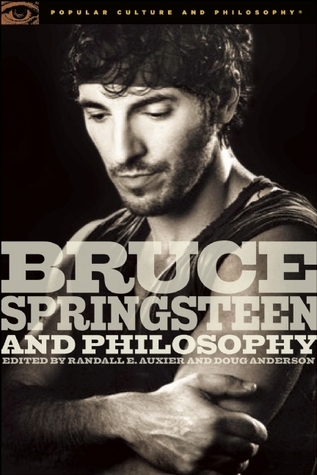
Known as the working man's poet, the Boardwalk prophet, or simply, the Boss. If "love is a banquet at which we feed," Bruce Springsteen has provided much food for thought. In this collection of metaphysical probes, a gang of E-street philosophers will undress Bruce's deeper mysteries like irresistible Jersey girls. Can Springsteen settle the nature-nurture debate through his song "Born to Run"? What do the famous philosopher Ricuoer and Springsteen have in common in their depiction of time?
These die-hard Springsteen fans, who just happen to be philosophers, compile an entertaining handbook to the field of Springsteen studies, covering topics like Springsteen's connection to Marx and the proletariat, Springsteen's concept of the soul, and his status as a poet.
My son-in-law got me this book - boy does he know me! You don't need to be a philosopher to read this book, but you probably need to be a Springsteen fan. This is a collection of essays by philosophy geeks, each of which is related in some degree to Bruce's music and lyrics. I have heard Bruce compared with Dylan and Guthrie, but in this book, parallels are drawn between Socrates and Plato. If those aren't enough to whet your appetite to read this collection, then get this - how does Peter Pan play a roll in the narrative of "Born to Run"? That is the subject of one of the chapters. And the famous Jewish scholar Abraham Joshua Heschel is quoted more than a few times. This is an enjoyable read for any thoughtful enthusiast of Bruce's music. Enjoy!
I think this is the best ...and Philosophy book that I've read so far (and I've read several at this point). The reasons for this conclusion have as much to do with the flaws (well, quirks might be a better word) in the book.
For starters, I've never been a Bruce Springsteen fan. I borrowed the book from the library because it was the only Blackwell series book they had and I was jonesing for a philosophy/pop culture fix. The only songs that I knew of Springsteen's were "Born in the USA" and "Glory Days", and neither song ever moved me. I thought he was a singer for blue collar workers who preferred rock to country. I'd never studied his lyrics or read critical analysis of his work. In the course of the book, I've come to know more about Springsteen's work. When a book turns you on to something new, I think that it has more of an impact than one that tells you more about a subject that you already know. There's an element of sheer gratefulness at work in there.
The book did a good job of balancing different ways to approach the subject. There were the philosophy-heavy ones that sought to use Springsteen as a vehicle to introduce philosophical subjects, there were the personal, subjective essays that dealt with his impact on individuals. There were essays dedicated to songs and lyrics and essays that focused on the iconography and image. This variety allowed for a well-rounded book, although many times, I thought that the editors allowed some frankly zany things in there. For instance, I don't recall another work that features so much interdepartmental sniping from being warned to be wary of anyone who likes Plato too much as it's a sign of being a "crypto-totalitarian" or calling out other philosophers in this manner-"She had the audacity to call the careful, qualified language of responsible scholars "quaint", but, Riane, sweetie, it is careful language that separates women like Harrison and Gimbutas from girls like you." (Meow!). Then there were thinly disguised political pamphlets like the essay about the song "My Hometown", which discusses the idea of living locally or the first essay of the book which seems to gleefully await for a prophet to rail against the United States. I won't even go into the essay about feminism from one of the editors, it's conclusions and positions were that insane. In fact, the two editors were the worst offenders (although their essays were probably the most entertaining and, as a result, this is all forgiveable).
My hands-down favorite essay was Randall E. Auxier's "Blinded by the Subterranean Homesick Muse: The Poet as Virtuous and Virtuoso". The idea of a menage a neuf between the artist and the muses is an interesting way to discuss the idea of different strengths in an artist's work. His essay on Wendy from Peter Pan was also very creative and interesting.
On the whole, this is a strong book and well worth a read.
Uneven collection of essays reflects the range of interests and writing abilities of the writers, almost all of whom are professors of philosophy of apparently accredited institutions of higher education, raising questions as to the current standing and academic rigor of the philosophical field of study in 2008.
Not to say this set of essays is egregiously bad, but the writing and proofreading left numerous errors in the text of the essays, a sure sign for me that I should treat the material with the same level of seriousness that its authors and editors did. There are way too many bad puns and flat attempts at word play on Springsteen songs, characters, and lyrics, starting with the vapid subtitle. Truth has an edge? It's dark there? What does that mean, other than the "yeah, we get it" reference to Springsteen's "Darkness on the Edge of Town"?
And note to most of the writers: dial back (waaaaaaaaay back) on the wanna-be-Bruce vibes already. We get it. We all wanted to be Bruce, cut someplace of our own with these drums and these guitars, but we're not, and we didn't, so let it go, and write with the seriousness and focus and academic abilities that the subject and your positions demand.
A couple of the essays did stand out for their insight and interest:
--Auxier's "Blinded by the Subterranean Homesick Muse: The Poet as Virtuous and Virtuoso" pairs Springsteen and his constant comparator Dylan in this essay introducing the classical Muses and their uses in these great poets' lyrics (as well as tracing the etymological connection between the two adjectives in his essay's subtitle).
--Auxier deconstructs Wendy, the lover to whom Springsteen sings "Born to Run", and places her (and Springsteen) in the literary canon in the essay "An Everlasting Kiss: The Seduction of Wendy."
--"Straight Time: Images of Oppression" by Luke Dick examines that phrase and the use of images in meaning, understanding, imagination and empathy (along the way explaining why Dana Carvey's impression of Jimmy Stewart works).
This is the second book of literary, philosophical and historical examination of Springsteen's music that I have read recently (see Born in the U.S.A.: Bruce Springsteen and the American Tradition), and both fall short. We are still too close the power of his performance and the peak of his musical output to truly and accurately appreciate and define it. Dylan similarly suffers in literary examinations; although Dylan is closer to the end of his oeuvre, both men still have too much to say and a love and compulsion to play that makes it impossible for even the deepest among us to summarize, categorize, or academize them.
Bruce is amazing. I like the approach this book takes to examine his song lyrics for a sense of the man's philosophy on life. Early on, Anderson discusses whether Springsteen is in fact a prophet. I don't think I'd go that far, but he has some amazingly deep stuff.
These "...and Philosophy" books are pretty much hit or miss. If there are one or two worthwhile essays it makes the book worth getting. I liked this one. The essay on the ethics of encores was clever. Worth a read.
This one has much better grammar than some of the other installments. They still need me to edit it though! The chapter on Wendy and Peter Pan is fantastic.
A brilliant analysis of the philosophy behind some of Springsteen's darker albums (Darkness on the Edge of Town, the River, Nebraska). Worth a million reads.
I am sure I would not have read this book if I were not a half-century long fan of Bruce Springsteen, so my bias is already disclosed. The book is a collection of philosophical musings by philosopher fans, so it was quite entertaining to me. The topic range is very broad, evidenced by the titles of some of the essays: “They Played Guitars All Night and All Day: The Ethics of Encores” (the title before the colon is a line from “Rosalita”); “Blinded by the Subterranean Homesick Muse: The Poet as Virtuous and Virtuoso”, “Racing in the Street: Freedom, Feminism, and Collateral Damage”; “Living in ‘My Hometown’: Local Philosophies for Troubled Times”; “A Little of That ‘Human Touch’: Knowledge and Empathy in the Music of Bruce Springsteen”; “Socrates the Sculptor, Springsteen the Singer: Philosophy and Art Against the Tyrants”. Entertaining and thought-provoking, some essays much better than others, so it was a mixed bag; hence, the three-star rating.
Not exactly what I was expecting, but good nonetheless. Several essays proved to be very interesting discussions of American life, what freedom is, the state of democracy, and the collapse of small town communities. It has gotten me interested in doing a proper dive into his whole discography and really listening to what he’s singing. Overall, very good: would recommend to fans of Springsteen and anyone interested in music and philosophy.
A little long winded but cohesive collection of essays on the philosophy of Bruce Springsteens music, a catalogue that is steeped in deep thought and contemplation.