Some cats are good luck. You pet them and good things happen. Woogie is one of those cats. But as Woogie gets into one mishap after another, everyone starts to worry. Can a good luck cat's good luck run out?
The first children's book from an acclaimed poet whose honors include the American Book Award and the William Carlos Williams Award
Celebrates the special relationship between a young girl and her cat
•A modern Native American story from a member of the Muskogee-Creek tribe
Bio Joy Harjo Joy Harjo was born in Tulsa, Oklahoma and is a member of the Mvskoke Nation. She has released four award-winning CD's of original music and won a Native American Music Award (NAMMY) for Best Female Artist of the Year. She performs nationally and internationally solo and with her band, The Arrow Dynamics. She has appeared on HBO's Def Poetry Jam, in venues in every major U.S. city and internationally. Most recently she performed We Were There When Jazz Was Invented at the Chan Centre at UBC in Vancouver, BC, and appeared at the San Miguel Writer’s Conference in San Miguel de Allende, Mexico. Her one-woman show, Wings of Night Sky, Wings of Morning Light, which features guitarist Larry Mitchell premiered in Los Angeles in 2009, with recent performances at Joe’s Pub in New York City, LaJolla Playhouse as part of the Native Voices at the Autry, and the University of British Columbia. Her seven books of poetry include such well-known titles as How We Became Human- New and Selected Poems and She Had Some Horses. Her awards include the New Mexico Governor’s Award for Excellence in the Arts, the Lifetime Achievement Award from the Native Writers Circle of the Americas, and the William Carlos Williams Award from the Poetry Society of America. She was recently awarded 2011 Artist of the Year from the Mvskoke Women’s Leadership Initiative, and a Rasmuson US Artists Fellowship. She is a founding board member and treasurer of the Native Arts and Cultures Foundation. Harjo writes a column Comings and Goings for her tribal newspaper, the Muscogee Nation News. Soul Talk, Song Language, Conversations with Joy Harjo was recently released from Wesleyan University Press. Crazy Brave, a memoir is her newest publication from W.W. Norton, and a new album of music is being produced by the drummer/producer Barrett Martin. She is at work on a new shows: We Were There When Jazz Was Invented, a musical story that proves southeastern indigenous tribes were part of the origins of American music. She lives in the Mvskoke Nation of Oklahoma.
I love cats. I am the proud mother to eight of them. Ironically I thought I was a dog person growing up but my husband and I thought that it would be easier for the kids to take care of cats, so here we are. Last week I was checking Joy Harjo’s author page to make sure that I hadn’t missed reading any of her poetry collections. Harjo was named Poet Laureate of the United States earlier this year and is one of my go to poets as I love her descriptions of Native American life that runs the full gamut of emotions. As it turns out I have not read all of Harjo’s poetry so I have even more to look forward to for next year. I also hadn’t read a kids book she wrote about a lucky cat. With Joy Harjo writing about cats, even in a picture book for kids, I knew it was one I had to read for myself.
Woogie is a good luck cat. Because she has so many good luck gifts, her nine lives went fast. Woogie is striped with green, electric eyes. She helps Aunt Shelley win at bingo and locates missing earrings. She also has a propensity for getting into trouble- hiding under cars, getting stuck in a clothes dryer, and hunting birds. Yet, Woogie somehow prevails unscathed after all of these encounters. Combined with exquisite illustrations by Paul Lee, Harjo paints a picture of Native American life in Oklahoma that her readers are accustomed to. Only this story is told through the eyes of a girl and her special cat.
I am still too rooted in the here and now to believe that cats have nine lives. If compassionate people like Aunt Shelley and her family become the owners of a cat, then cats like Woogie have the opportunity to thrive and live long, productive lives. Anything Joy Harjo does is golden. Now kids can experience her work for themselves and hopefully can convince their parents to get them a good luck cat of their own. No convincing is needed in my house as I am to the point of believing that the cats chose us as much as we chose them. Joy Harjo helps put my feelings about cats to words. I am looking forward to reading more of her poetry next year.
This is a modern Native American story from a member of the Muskogee-Creek tribe.
"Some cats are good luck. You pet them and good things happen. Woogie is one of those cats. But as Woogie gets into one mishap after another, everyone starts to worry. Can a good luck cat's good luck run out?"
This book doesn't teach a lot about a Native American community, but it is a great book to show students that people of different cultures of their own can be very similar.
"When I pet her she purrs as if she has a drum near her heart."
I know Joy Harjo, a member of the Muskogee-Creek tribe, as a poet. But she is also an award-winning musician, and the author of this modern Native American picture book story focused on a young girl's cat's nine lives.The art is good, but the various anecdotes are even better, of the cats surviving an encounter with a large dog, a tumble in the clothes dryer, a fall from a tree.
I have a cat, a stripedy cat with tickling whiskers and green electric eyes. She has the softest fur in the world. When I pet her she purrs as if she has a drum next to her heart.
Every child (or adult) who adores a cat remembers with enormous relief those times when their beloved pet used up one of her nine lives and yet miraculously survived, only to get into yet another fur-raising scrape. It's the stuff of family stories. This tale, beautifully and dynamically illustrated by Paul Lee, centers on family love for a lucky cat named Woogie, and encourages awareness and personal responsibility for the dangers cats can get into. The cat's owner, a young girl, acknowledges her own fault when she inadvertently puts her cat in danger, and learns from her mistakes. Set in a contemporary Native American family, there are subtle hints of Native culture (such as the time when the child tries to smuggle the cat in the car on a trip to the pow-wow, with near-disastrous results) while the main story focuses on a girl and her cat within her family and neighborhood environment. For a cat-lover like me, this was a delightful introduction to Joy Harjo, the new U.S. poet laureate. I look forward to reading her poetry.
This was recommended to me by my friend Abigail, who really enjoyed the story but cautioned that she had also read absolutely scathing reviews of it. Being a cat-lover myself, and lured by the darling cover art, I was curious to form my own opinion. I must say that mine falls somewhere between the two opinions.
Woogie is absolutely the cat-tiest of cats, she is stripedy, spunky, and sweet. I wanted her to somehow leap off the page and settle, purring, in my lap. The young girl's concerns for her cat's safety ring genuine and true--I experienced such worries when my own cat would go a'roming. Paul Lee's illustrations are wonderful! Also, I must say that I am not opposed to the indoor/outdoor cat lifestyle.
However, what I disliked about the story is that the focus was primarily on the negative aspects of Woogie's life—all the scrapes she got into, and narrowly escaped. This, of course, is the point of the story--that Woogie is going through her nine lives--will her luck hold out for more? However, I felt it created an off-balance portrayal of a cat's outdoor lifestyle--no lazy moments under the shade of bushes, or joyful safe adventures chasing bugs or lizards. This off-balance portrayal gives fodder to those who wish to keep all cats indoors (such as the person who wrote the scathing review) and might also traumatize young children who might find here new dangers facing their own outdoor cats. Taken with this caution, however, the story does present a loving portrayal of the bond between a girl and her pet and it's also notable for featuring a present-day Native American family.
Joy Harjo - acclaimed Muskogee-Creek poet and musician, author of such collections as She Had Some Horses and In Mad Love and War - made her children's book debut with The Good Luck Cat, a delightful picture-book published in 2000. Narrated by a young Native American girl, it is the story of Woogie - a "Good Luck Cat" who survives many dangers, only to disappear one day. Has Woogie's good luck finally run out...?
Anyone who has ever loved a cat will recognize the narrator's genuine affection for Woogie, and identify with her grief when he disappears. Paul Lee's charming acrylic illustrations ably convey the many emotions evoked by the narrative, from the opening scene in which Woogie seems to be peeking out from some hidden spot, to the final joyful reunion. An enjoyable animal story, this is also that rarest of finds: a children's book featuring Native Americans living in the modern world, faced with the same problems and experiences we all encounter.
Although I enjoyed both Harjo's text and Lee's illustrations, readers should be aware that The Good Luck Cat is the story of an outdoor animal, and many of the dangers that Woogie faces in his life - fighting with other cats, nesting in a car engine, being chased by boys with BB-guns - might disturb more sensitive readers. I myself grew up with indoor/outdoor cats, and felt that this book accurately reflects the experiences of such animals and their human companions, but those with particularly strong views on the subject would be advised to proceed with caution.
I could relate to this story told by a little Native American girl about her cat's near-misses with death. I've seen some of my cats have close calls myself. I don't know if cats are good luck, but I wouldn't live without them. Cute story!
When it was announced that Joy Harjo, a member of the Muscogee (Creek) Nation, had been named the first Native American Poet Laureate of the United States, I decided to revisit some of her work. Besides writing some of the most beautiful poetry I've ever read, Harjo also wrote one of my three favorite cat books, favorites because they all have one thing in common: the cat is not anthropomorphized and is allowed to behave like a cat.
The Good Luck Cat was published in 2000, and is Harjo's debut children's book (her other children's book is an excellent book of poems called For a Girl Becoming). The Good Luck Cat* has been out of print for a while, and although I don't usually write about books that are hard to find, I decided to make an exception because I know this book can be found in the library, either your local library or through interlibrary loan. I then discovered that Debbie Reese had already suggested people try to get The Good Luck Cat reprinted, and that would be wonderful. She's even posted an image that could be used on social media in the hope a publisher might decide to do a reprint.
The narrator of The Good Luck Cat is a young Native American girl who introduces readers to her beloved cat, Woogie. Apparently, Woogie is a good luck cat, which means, according to the narrator's Aunt Shelly, that when you pet a good luck cat, good things happen to you. Sure enough, Aunt Shelly petted Woogie on her way to bingo and won enough money to buy everyone new shoes. Aunt Shelly also says that good luck cats have nine lives and that's really what this story is about.
But, for all Woogie's good luck gifts, her nine lives went pretty fast. Woogie is a cat that is allowed to go outside and gets into all kinds of accidents and trouble, some of which cost her each one of her lives. There's the time she fell asleep on the car's motor to keep warm, the time she followed the narrator and her brother to school and ran out in front of a car, or the time she ended up in the dryer, spinning and yowling to get out.
Her fourth life was taken by a cousin's dog who almost ate Woogie, then life number five was lost in a fight with another cousin's cat, number six was lost when she fell out of a tree and didn't land on her feet. She lost number 7 to some boys chasing her with a BB gun. The narrator takes responsibility for costing her kitty her eight life. She decided to take Woogie to the fall powwow, but forgot about her in the car. Luckily it wasn't summer, but still...
But when Woogie disappears with only one life left, the narrator really begins to worry. The girl, her Aunt Shelly and all the cousins go looking for her in all the places where Woogie had lost a life, but no luck. After four days, the our sad narrator decides to put out a dish of food, Woogie's catnip mouse, and her ball hoping they will lure her home. Sure enough, the next morning, there's Woogie sound asleep by her empty dish, purring away with half an ear missing, but otherwise, none the worse for wear. According to Aunt Shelly, Woogie is really a lucky cat because she clearly has more than nine lives.
The first thing that attracted me to this story was the language. Harjo is a poet and her prose has the same tender lyrical feel to it as her poetry: "I have a cat, a stripedy cat with tickling whiskers and green electric eyes. She has the softest fur in the world. When I pet her she purrs as if she has a drum near her heart." What a wonderful image.
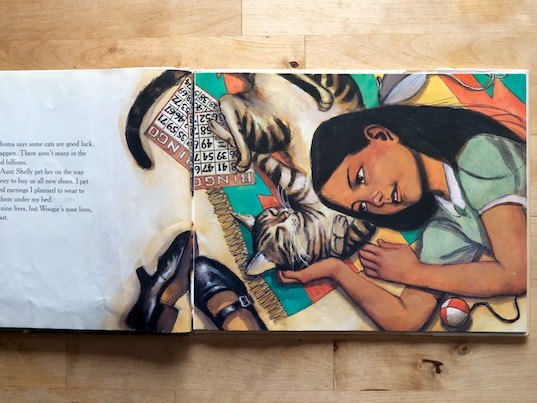
I love cats, particularly tabby cats, and Paul Lee's artistic rendition of Woogie is my perfect kitty. His acrylic illustrations are clearly focused and realistic, and his images of the narrator and Woogie together are full of affection. And although this is Woogie's story, it is also a lovely Native American story, apparent in both illustration and text.
My fingers are crossed for a possible future reprint.
If you would like to know more about Joy Harjo and her work, you can visit her HERE
This book is recommended for all cat lovers This book was borrowed from the library
*If you really want a good second hand copy, Better World Books has one for sale for a mere $1,219.12 + $3.99 shipping.
1. Paintings so beautiful they make me almost want to pet a cat.
2. Sentences like "My dad watched Woogie's seventh life fly by him as she ran after it. She was running from some boys who had shot her in the ear with a BB gun." The author is a poet, but it's not overwrought.
3. Sentences like "The eighth life was my fault. I wanted to take her to the powwow with us." The narrator is Native American, but the book is not about being Native American.
A cute little book about a cats 9 lives. I was looking at books to teach to my ESL middle schoolers and I might try this one if I can find the right lesson.
I don't even know if I can articulate what it is about this book that I love so much. It just warmed my grinchy little heart. Damn it, Woogie - stay out of trouble, you trouble-attracting cat, you. Plus, you can totally tell that Harjo is a poet: "When I pet her she purrs as if she has a drum near her heart". Write a billion more children's books please. Even better if they are about troublemaking cats.
In this sensitive story, there are some cats that are lucky, and some that are not. Woogie is one of the precious few that is very lucky. His owner is a young American Indian girl who recounts the scary and dangerous ways in which Woogie has used up eight of her nine lives. Then Woogie goes missing and the little girl and her family search everywhere for her fearing she has lost her ninth and final life. Throughout the story the author ever so delicately weaves in aspects of the American Indian culture, like closeness of family and powwows. The integration of American Indian culture is so subtle that it will definitely take multiple reads and teacher prompts to help students grasp the full potential of the book. It is nice that there is a book that doesn’t overwhelming beat you over the head about American Indian culture. This story is appropriate for grades K-3 to show a positive example of American Indians in the present, not the past (as per our Debbie Reese article reading this week).
Harjo tells a compelling story about a young Native American girl, Abigail, and her relationship with her cat Woogie. Abigail worries that Woogie has used up all of her nine lives so the focus of this story is a chronological description of Woogie's adventures. Young cat lovers may find Woogie's near-death experiences too distressing, but overall, well-told storytelling with an interesting premise and setting.
Bittersweet. Some of the dangers that can happen to cats, especially outdoor cats, but also the love for a kitty who's purr is like "a drum near her heart." Lee's illustrations are great, and capture the subtle expressions, movements, and body language of cats with just a slight touch of anthropomorphism. I wish the story finished on a different note, such as Woogie chasing a bird again or something like that after the Aunt Shelly last page. It felt a bit abrupt. Overall, I really liked it.
Kind of like a less cruel version of "The Cat Came Back."
A girl owns a cat and the cat is "good luck." Apparently the girl is nominally Native American, as she mentions a powwow. She also mentions her aunt going to play bingo, so we have two stereotypes running there. But it's not about that, it just mentions that.
Basically the the story is entirely the story of this cat and the eight times she almost dies. She gets attacked by a dog. She gets shot at by some kids with BB guns. The girl wants to take her to the powwow, so she hides her in a box in the trunk and then forgets about her. Her mom says it was a good thing it wasn't the summer. And then the cat is missing for four days and she's really worried, because it's been eight times she's escaped death, so they're like, "Okay, she must have lost her ninth life and now she must be dead." The girl leaves out a bowl of food and finally the cat comes back with her left ear bitten in half. And that's it.
There's not really much of a point to this book, just horrible things happening to a cat. A cat repeatedly getting maimed and injured and keeping on going like a champ. As far as the luck goes, the girl found her lost earrings after petting the cat, and her aunt won at Bingo after petting the cat. So we've got some great superstition in there. Plus the whole nine lives of cats thing. So superstition and stereotypes of Native Americans, but also things that people might not necessarily associate with Native Americans like cats, for one. Or clothes dryers, or BB guns.
But it really doesn't go anywhere. It's just a list of terrible things that happen to this cat. It's not really much of a story. The only minor conflict is at the end, but it gets resolved through the passing of time. They're looking for the cat; they can't find the cat; the cat finally shows up. Nobody solved that problem; it just solved itself.
I probably wouldn't read this to kids based on the amount of terrible things that happen to this poor animal, but I wouldn't be that upset if somebody read this to my children. Bad things happen in the world.
It's a good story, though I feel very badly for Woogie and all of the terrible experiences that she has. My only complaint is that the entire focus of the story is on all of the horrible ways that the cat loses its lives. I would have liked to learn more about the family. While you get the impression that they are very close to each other, it is easy to overlook the fact that they are actually Native Americans. I would have liked to learn a little more about some of their traditions. The belief that cats have 9 lives is also not inherently Native American, so it doesn't really give us insight to their beliefs either. It is still a good story with a happy ending.
This was a cute story! A lot of children may be able to relate to losing an animal or having something bad happen to their household pet, just like a lot of the crazy things that Woggie experienced. The description words in this text were amazing! Words like, "stripedy", "electric", and many others! Children like when there is great details included in the story! This is also a way to explain that the nine live saying that goes along with cats is not always true, and some students may understand that, and others may not. The animal illustrations in this text were beautiful and in general they were all very details. A cute story for cat, and non-cat lovers!
I read this book because the author is Joy Harjo. It may reflect the way life was for cats and children 20 years ago in some places. I did appreciate the Native American representation by a Native American author. The illustrations were very nice. The story was very suspenseful. But I did not enjoy the book at all. The poor cat is an indoor/outdoor cat, and has many life-threatening experiences, including instances that involved people being cruel. (I recommend keeping cats indoors.)
Being an animal person, I loved reading this book. I think this book would be perfect for any children who have cats at home, and to introduce them to the myth of cats being good or bad luck, and what they think about it. I think this book would also be informative for children due to it being a Native American story. It shows children different cultures, and how sometimes they are able to relate.
A book about how the nine lives of a little girl's cat were spent in various misadventures. The cat is called "good luck" due to its owners propensity for winning Bingo whenever she gives her good-bye pats and the cats own good luck in avoiding potentially deadly situations. The book is beautifully illustrated with full art, full bleed, double page illustrations that integrate well with the story but do not add any additional information.
This is a very cute story. This story did have me on my tippy toes when the author was going through the nine lives section of the story, it did make me nervous as I kept going through the book. This is one lucky cat, and I am glad I read this book because I have never read it before and now, I have. It's different than the ones I have read before, but I like the different change. The book also shares that the owners really care about the cat, and they would do anything to keep it safe.
The Good Luck Cat was written by Joy Harjo and illustrated by Paul Lee. I did not like this book as much as the other but it is still fairly good. It is good for children to learn about orders or sequencing. It is a good book for sequencing because it goes through each nine lives that cat has and how she used them. Children’s literature is the genre of this story. Overall it was a decent book.
I really liked this book because it weaves American-Indian culture in and out of it, all while keeping an unrelated plot evident. A young girl is afraid her cat has used up 8 of its '9' lives, and it goes missing one night. Throughout the story Harjo mentions clothes and other customs of American-Indian families. The book is very balanced and well-written.
"Some cats are good luck. You pet them and good things happen. Woogie is one of those cats. But as Woogie gets into one mishap after another, everyone starts to worry. Can a good luck cat's good luck run out?" This book doesn't teach a lot about Native Americans, but it is a good book to show students that people of different cultures.
Huge shout-out for Mvskoke OwnVoice showing modern suburban (?) Native people who still celebrate their heritage. Beautiful writing and paintings.
But I cannot enjoy or recommend a book about a cat that is clearly a menace to himself and others. There's even a mention of him killing birds. I love cats, but they are basically an invasive species and out to be sterilized and kept indoors.
In "The Good Luck Cat," there is a girl and a cat who have a wonderful relationship. This is a Modern Native-American story from a member of the Muskogee-Creek tribe. This is good for young readers to express ethnicity in the early years for children.