

What do you think?

Six-Gun Snow White
Forget the dark, enchanted forest. Picture instead a masterfully evoked Old West where you are more likely to find coyotes as the seven dwarves. Insert into this scene a plain-spoken, appealing narrator who relates the history of our heroine’s parents—a Nevada silver baron who forced the Crow people to give up one of their most beautiful daughters, Gun That Sings, in marriage to him.
Although her mother’s life ended as hers began, so begins a remarkable tale: equal parts heartbreak and strength. This girl has been born into a world with no place for a half-native, half-white child. After being hidden for years, a very wicked stepmother finally gifts her with the name Snow White, referring to the pale skin she will never have.
Although her mother’s life ended as hers began, so begins a remarkable tale: equal parts heartbreak and strength. This girl has been born into a world with no place for a half-native, half-white child. After being hidden for years, a very wicked stepmother finally gifts her with the name Snow White, referring to the pale skin she will never have.
154 pages, Paperback
First published February 28, 2013
About the author
Catherynne M. Valente
262 books7,896 followersCatherynne M. Valente was born on Cinco de Mayo, 1979 in Seattle, WA, but grew up in in the wheatgrass paradise of Northern California. She graduated from high school at age 15, going on to UC San Diego and Edinburgh University, receiving her B.A. in Classics with an emphasis in Ancient Greek Linguistics. She then drifted away from her M.A. program and into a long residence in the concrete and camphor wilds of Japan.
She currently lives in Maine with her partner, two dogs, and three cats, having drifted back to America and the mythic frontier of the Midwest.
She currently lives in Maine with her partner, two dogs, and three cats, having drifted back to America and the mythic frontier of the Midwest.
Ratings & Reviews
Friends & Following
Create a free account to discover what your friends think of this book!
Community Reviews
Displaying 1 - 30 of 1,044 reviews

July 6, 2016
Take fairy tale mythology, the sideways structure of Native American folklore, a Wild West setting, weave it through with themes on race and gender and wrap it in Valente's wordsmithing, and you'll have Six-Gun Snow White.
"A body can only deliver up the truth its bones know. Its blood, which is its history. My body is my truth, and I have laid it out as evidence on the table of my father's reputation, for by know you may have guessed my next revelation." --from The Creation of Snow White
This bears thinking on. Where does the anxiety, the joy, the tears come from? My body perhaps knows truths my head won't realize.
"It was not like any of the mirrors... it was like a door into nothing. The glass did not show the buttery light of the house behind me. It did not show the forest or the meadows. It did not even show me. The glass was so full up of dark, it looked like someone had tripped over the night and spilled it all into that mirror." --from Snow White Bites Her Own Reflection
One of my absolute favorite things at my last house--the woodwork was a heavily varnished oak--is the way the setting sun would turn the living room into a buttery glow. Valente writes images that are incredibly resonant with my memory.
"I said I loved her back. I put my hand on the door and I said I loved her back, and when I said it, I thought of kissing her and also of shooting her through the eye." --from Snow White Fights a Lump of Pitch
I loved someone like this once. Or was it?
"The dude hesitates. 'She beat you, I suppose?' Snow White just laughs. The dude feels that laugh in his spine. It saws there on the hard, old bone." --from Snow White Cheats at Cards
The dude should be frightened when he hears that laugh, that almost-humor full of irony and pain. The laugh of someone who has survived hells.
"...until she walked out of the woods and into a town full of banshees with no love for anyone's history. Your past's a private matter, sweetheart. You just keep it locked up in a box where it can't hurt anyone." --from Snow What and the Birds From Heaven
There's constant and loud metaphor here about what one can keep locked up/trapped/hidden in mirrors.
"So if you want it, you can have a nice life here...it's a kind of magic, but then most things are. But story is an eager fucking beaver and someday soon someone will come knocking for you and you'd better just say no thank you is all I'm saying."--from Snow White Dances With Prairie Dog
And here I ask: do we want the story? Or not? Do we open the door or appreciate magic of ordinary life? Can we even choose? One of the themes of the novella seems to be that of stories--of stories we tell ourselves, stories we tell about ourselves, stories we try and force other people to become.
Valente is one of those writers I never know entirely if I'm ready for, because she has that way of finding the boxes in my heart and my memory and opening them up. She did that again. I was quite startled to realize this isn't a "fairy tale retelling" as much as a 'reformulation,' a genre-mash-up, a deconstruction and reconstruction of tales with modern considerations of gender and race. Thank you for that, Valente. As a child, I read everything not-real I could lay my hands on, so it was fun to recognize the 'Just So' folklore style and the animal symbolism of Native American tales that goes into the fairy-tale mashing.
The last segment, however, 'Snow White Holds Up the Sky,' worked less well for me. I felt it didn't adequately resolve Snow's story in a congruent fashion and likely should have ended with 'Snow White and the Story of Death.' Fairy tales--or at least the Disney ones--demand happy endings, but many folktales are much more ambiguous. But perhaps, it was finally Snow White's own story about herself, unconstrained by boxes and coffins.
I'm extremely grateful to my flash read group compadres who came along on this reading adventure, bringing enthusiasm, knowledge and provoking ideas: Athena, Alina, Carly, Naomi, Nataliya and Richard.
https://www.goodreads.com/group/show/...
"A body can only deliver up the truth its bones know. Its blood, which is its history. My body is my truth, and I have laid it out as evidence on the table of my father's reputation, for by know you may have guessed my next revelation." --from The Creation of Snow White
This bears thinking on. Where does the anxiety, the joy, the tears come from? My body perhaps knows truths my head won't realize.
"It was not like any of the mirrors... it was like a door into nothing. The glass did not show the buttery light of the house behind me. It did not show the forest or the meadows. It did not even show me. The glass was so full up of dark, it looked like someone had tripped over the night and spilled it all into that mirror." --from Snow White Bites Her Own Reflection
One of my absolute favorite things at my last house--the woodwork was a heavily varnished oak--is the way the setting sun would turn the living room into a buttery glow. Valente writes images that are incredibly resonant with my memory.
"I said I loved her back. I put my hand on the door and I said I loved her back, and when I said it, I thought of kissing her and also of shooting her through the eye." --from Snow White Fights a Lump of Pitch
I loved someone like this once. Or was it?
"The dude hesitates. 'She beat you, I suppose?' Snow White just laughs. The dude feels that laugh in his spine. It saws there on the hard, old bone." --from Snow White Cheats at Cards
The dude should be frightened when he hears that laugh, that almost-humor full of irony and pain. The laugh of someone who has survived hells.
"...until she walked out of the woods and into a town full of banshees with no love for anyone's history. Your past's a private matter, sweetheart. You just keep it locked up in a box where it can't hurt anyone." --from Snow What and the Birds From Heaven
There's constant and loud metaphor here about what one can keep locked up/trapped/hidden in mirrors.
"So if you want it, you can have a nice life here...it's a kind of magic, but then most things are. But story is an eager fucking beaver and someday soon someone will come knocking for you and you'd better just say no thank you is all I'm saying."--from Snow White Dances With Prairie Dog
And here I ask: do we want the story? Or not? Do we open the door or appreciate magic of ordinary life? Can we even choose? One of the themes of the novella seems to be that of stories--of stories we tell ourselves, stories we tell about ourselves, stories we try and force other people to become.
Valente is one of those writers I never know entirely if I'm ready for, because she has that way of finding the boxes in my heart and my memory and opening them up. She did that again. I was quite startled to realize this isn't a "fairy tale retelling" as much as a 'reformulation,' a genre-mash-up, a deconstruction and reconstruction of tales with modern considerations of gender and race. Thank you for that, Valente. As a child, I read everything not-real I could lay my hands on, so it was fun to recognize the 'Just So' folklore style and the animal symbolism of Native American tales that goes into the fairy-tale mashing.
The last segment, however, 'Snow White Holds Up the Sky,' worked less well for me. I felt it didn't adequately resolve Snow's story in a congruent fashion and likely should have ended with 'Snow White and the Story of Death.' Fairy tales--or at least the Disney ones--demand happy endings, but many folktales are much more ambiguous. But perhaps, it was finally Snow White's own story about herself, unconstrained by boxes and coffins.
I'm extremely grateful to my flash read group compadres who came along on this reading adventure, bringing enthusiasm, knowledge and provoking ideas: Athena, Alina, Carly, Naomi, Nataliya and Richard.
https://www.goodreads.com/group/show/...

November 17, 2017
Reviewed by: Rabid Reads
4.5 stars
When you’re a booklover, you read all kinds of books for all kinds of reasons. Sure, you have your favorite authors and series, but what about the lesser known quantities?
Could be the hype, could be a recommendation, but whatever it is, you go into the reading of it with hope.
Hope that it will make you feel something. Hope that you’ll love it. Hope that it will teach you something about yourself. Hope that it will teach you something about the world.
Hope that this book will change you somehow, for the better.
It rarely works out that way.
But sometimes . . . Sometimes it does.
Any version of Snow White that I’ve read is a variation of the same basic story: a girl’s widowed father remarries, and her new stepmother is the stuff of nightmares.
But in a very generic sense.
Stepmonster wants the kingdom, money, power, whatever, for herself, and she’ll kill her husband and/or Snow White to get it.
Stepmonster bad. Snow-White good. Simple.
Valente’s version, at its core, is just as simple.
BUT.
Mrs. H isn’t a cardboard place holder for evil. Her evil has weight. And Snow-White isn’t a stock damsel in distress. She’s a child left to the mercies of a woman incapable of love.
And it hurts, ye gods, it HURTS. B/c Snow-White so desperately wants to be loved. Only she doesn’t know that’s what she wants, b/c she never learned the word for it.
In Mrs. H, Snow-White gains not only a (truly awful) mother, but also an instructor. And based on that instruction, having no other frame of reference, she develops skewed ideas about things like love:
And what it means to be a woman:
By itself, this would be enough to set SIX-GUN SNOW WHITE apart from other retellings, but fleshing out stock characters is the least of what Valente did.
Snow-White’s father isn’t a king. He’s an acquisitive man with a talent for sniffing out mineral deposits. His first wife was a Native American whom he essentially blackmailed into marrying him, and when she died in childbirth, he hid his halfbreed daughter from the world (<------gross oversimplification).
So you see . . . This is no simple retelling. It’s a commentary on how white colonists treated Native Americans.
Snow-White is the unfortunate product of a union between the two, belonging to neither.
BUT.
Despite the irreparable damage inflicted on her by her father and stepmother, and despite the choice she later makes for herself . . . Her story ends with hope.
Is this story painful?
Yes. Very.
Is it worth it?
Absolutely.

4.5 stars
When you’re a booklover, you read all kinds of books for all kinds of reasons. Sure, you have your favorite authors and series, but what about the lesser known quantities?
Could be the hype, could be a recommendation, but whatever it is, you go into the reading of it with hope.
Hope that it will make you feel something. Hope that you’ll love it. Hope that it will teach you something about yourself. Hope that it will teach you something about the world.
Hope that this book will change you somehow, for the better.
It rarely works out that way.
But sometimes . . . Sometimes it does.
Any version of Snow White that I’ve read is a variation of the same basic story: a girl’s widowed father remarries, and her new stepmother is the stuff of nightmares.
But in a very generic sense.
Stepmonster wants the kingdom, money, power, whatever, for herself, and she’ll kill her husband and/or Snow White to get it.
Stepmonster bad. Snow-White good. Simple.
Valente’s version, at its core, is just as simple.
BUT.
Mrs. H isn’t a cardboard place holder for evil. Her evil has weight. And Snow-White isn’t a stock damsel in distress. She’s a child left to the mercies of a woman incapable of love.
And it hurts, ye gods, it HURTS. B/c Snow-White so desperately wants to be loved. Only she doesn’t know that’s what she wants, b/c she never learned the word for it.
Maybe the new Mrs. H would sit with me the way the fox did. Maybe she would come to my saloon and play cards around the table where no one else ever upped an ante or called. It might be good fun to play with another body. Maybe she would brush my hair and sing to me, and that would be nice. Maybe she liked to shoot. Maybe she would teach me Latin and French and dancing. Maybe she’d want to dress me up as something. Maybe she would love me the way I loved my gun.
In Mrs. H, Snow-White gains not only a (truly awful) mother, but also an instructor. And based on that instruction, having no other frame of reference, she develops skewed ideas about things like love:
Love is what grown folk do to each other because the law frowns on killing.
And what it means to be a woman:
She put jasper-and-pearl combs in my hair and yanked them so tight, I cried—There, now you’re a lady, she said, and I did not know if the comb or the tears did it.
By itself, this would be enough to set SIX-GUN SNOW WHITE apart from other retellings, but fleshing out stock characters is the least of what Valente did.
Snow-White’s father isn’t a king. He’s an acquisitive man with a talent for sniffing out mineral deposits. His first wife was a Native American whom he essentially blackmailed into marrying him, and when she died in childbirth, he hid his halfbreed daughter from the world (<------gross oversimplification).
So you see . . . This is no simple retelling. It’s a commentary on how white colonists treated Native Americans.
Now, I have had a long time to cogitate on this. I guess I know something about magic after everything that’s happened, enough to know you don’t go talking about it when it’s not around. But I think back East they have Puritan magic and out West we have animal magic, and I’ll tell you the truth for nothing: Those goodies and goodwives and poppets and dark woods scare me worse than any crow with the sun in her mouth.
Snow-White is the unfortunate product of a union between the two, belonging to neither.
BUT.
Despite the irreparable damage inflicted on her by her father and stepmother, and despite the choice she later makes for herself . . . Her story ends with hope.
Is this story painful?
Yes. Very.
Is it worth it?
Absolutely.

July 6, 2016
When a half-breed girl saddled with the nickname Snow White has had enough of her wicked stepmother, she goes on the run in the Wild West. As she lives by her gun and her wits, will past catch up with her?
Six-Gun Snow White is a retelling of Snow White as a western. It hearkens to earlier, non-sanitized, pre-Disney versions of the tale. Mr. H, Snow White's father, buys her mother, Gun Who Sings, from her tribe. Gun Who Sings dies in childbirth and things are as good as could be expected until the second Mrs. H moves in.
Valente really made me care about Snow White's hardships, both before she went on the run and after. Her stepmother really needed a bullet to the brain from Rose Red. Catherynne Valente's prose was as kick-ass as usual, although it felt a little wordy for the tale it was telling at times. I really liked the spin she put on the ending.
A lot of the fun of Six-Gun Snow White is seeing how Catherynne Valente has recast familiar aspects of the tale, from the Pinkerton Huntsman to the seven dwarves analogues, the sisters. The story is more like a western with echoes of the early versions of the tale than a straight translation.
Six-Gun Snow White is a well-written little novella, perfect for a short sitting full of grit and violence. 3.5 out of 5 stars.
Six-Gun Snow White is a retelling of Snow White as a western. It hearkens to earlier, non-sanitized, pre-Disney versions of the tale. Mr. H, Snow White's father, buys her mother, Gun Who Sings, from her tribe. Gun Who Sings dies in childbirth and things are as good as could be expected until the second Mrs. H moves in.
Valente really made me care about Snow White's hardships, both before she went on the run and after. Her stepmother really needed a bullet to the brain from Rose Red. Catherynne Valente's prose was as kick-ass as usual, although it felt a little wordy for the tale it was telling at times. I really liked the spin she put on the ending.
A lot of the fun of Six-Gun Snow White is seeing how Catherynne Valente has recast familiar aspects of the tale, from the Pinkerton Huntsman to the seven dwarves analogues, the sisters. The story is more like a western with echoes of the early versions of the tale than a straight translation.
Six-Gun Snow White is a well-written little novella, perfect for a short sitting full of grit and violence. 3.5 out of 5 stars.

October 26, 2015
I think this is an excellent novel with or without its being a retelling of Snow White.
Unfortunately, I'm not and never have been a huge fan of Westerns. That being said, I was only able to get into it as far as Cat Valente could carry it, which was quite far, indeed.
The best things I can say about it is that this was never tongue-in-cheek or a lackadaisical mapping of the fairytale into recognizable parody. It felt like a serious and heartfelt rendition of magical realism, where we are never quite given to believe that the magic is real or a wonderfully metaphorical turn of phrase.
That being said, I loved the horse named *Charming*. Oh, and Cigarettes Kill. :) -Thanks, Lindsay
This isn't the most ambitious of Ms. Valente's writings, but it might be one of the most adult-accessible, adult-intended stories that I've read. It really makes me want to look up the un-sanitized version of the tale and see the real differences.
It's a story with a lot of heart. Um. Literally. Nom nom nom. :)
Unfortunately, I'm not and never have been a huge fan of Westerns. That being said, I was only able to get into it as far as Cat Valente could carry it, which was quite far, indeed.
The best things I can say about it is that this was never tongue-in-cheek or a lackadaisical mapping of the fairytale into recognizable parody. It felt like a serious and heartfelt rendition of magical realism, where we are never quite given to believe that the magic is real or a wonderfully metaphorical turn of phrase.
That being said, I loved the horse named *Charming*. Oh, and Cigarettes Kill. :) -Thanks, Lindsay
This isn't the most ambitious of Ms. Valente's writings, but it might be one of the most adult-accessible, adult-intended stories that I've read. It really makes me want to look up the un-sanitized version of the tale and see the real differences.
It's a story with a lot of heart. Um. Literally. Nom nom nom. :)

February 10, 2016
Catherynne M. Valente must be one of the most imaginative and talented writers in speculative fiction in the last ever so many years.
Six Gun Snow White, her 2013 novella (160 pages) re-tells the old German folk tale made famous by the Brothers Grimm and Walt Disney, but in a similar way that Stephen King did with The Gunslinger, by casting a fantasy story into a western. Unlike King’s surreal fantasy with western themes and settings, though, Valente has this Snow White, as a Native American daughter of a wealthy landowner and her mother Gun That Sings.
Valente keeps many of the familiar Snow White elements such as an evil step-mother and there is a mention of seven outlaws. This story also explores themes of racism, family, and independence. Using elements of magical realism, the author further adds enchantment to this inventive re-creation. Also enjoyable in this edition is the periodic illustrations by Charlie Bowater.

Six Gun Snow White, her 2013 novella (160 pages) re-tells the old German folk tale made famous by the Brothers Grimm and Walt Disney, but in a similar way that Stephen King did with The Gunslinger, by casting a fantasy story into a western. Unlike King’s surreal fantasy with western themes and settings, though, Valente has this Snow White, as a Native American daughter of a wealthy landowner and her mother Gun That Sings.
Valente keeps many of the familiar Snow White elements such as an evil step-mother and there is a mention of seven outlaws. This story also explores themes of racism, family, and independence. Using elements of magical realism, the author further adds enchantment to this inventive re-creation. Also enjoyable in this edition is the periodic illustrations by Charlie Bowater.

January 27, 2020
Find all of my reviews at: http://52bookminimum.blogspot.com/
“Magic is just a word for what’s left to the powerless once everyone else has eaten their fill.”
First things first . . . .

Are you fucking kidding me right now, Goodreads???? Go home, recommendation feature. You. Are. Drunk.
If you couldn’t tell by the title, this is a retelling of the classic. Some changes include Snow White not being quite the damsel in distress the original made her out to be, but instead . . . .

The seven dwarfs not be dwarfs at all, but rather ladies of il repute . . . .

The goings on behind the evil stepmother's magic mirror confirming once again . . . .

And an ending that will leave you saying . . .
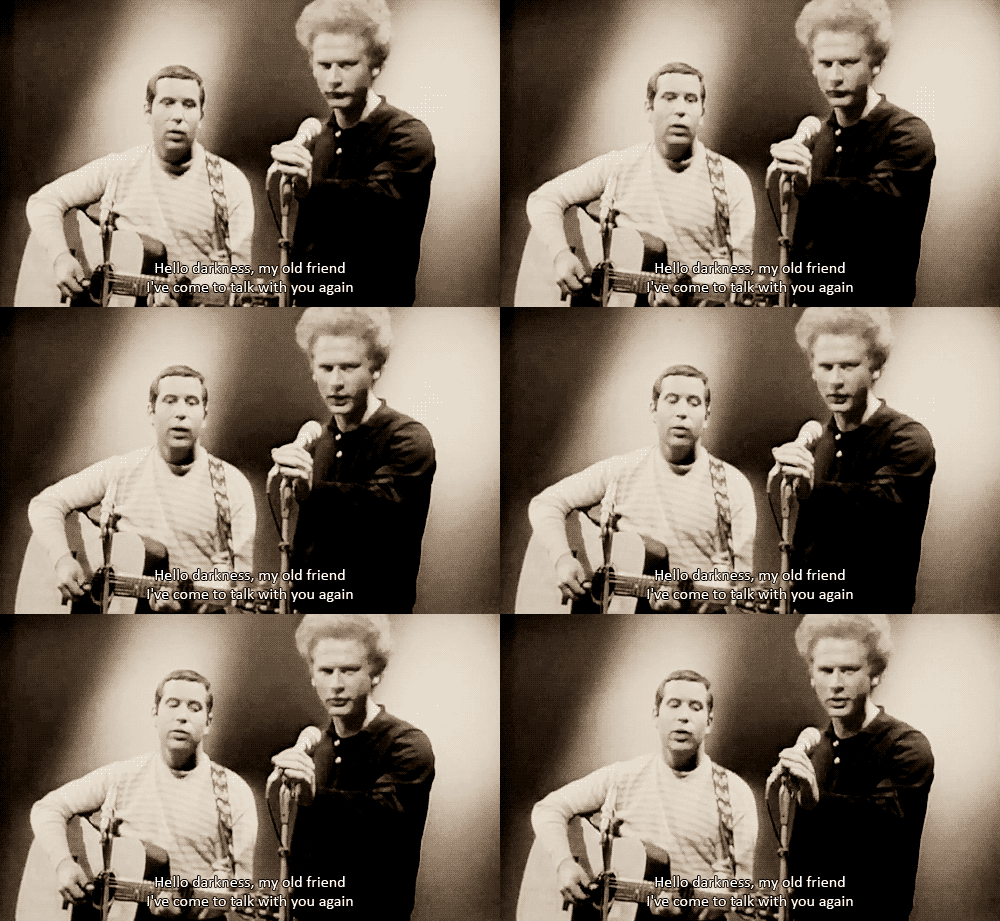
And left Mitchell and I like . . . .
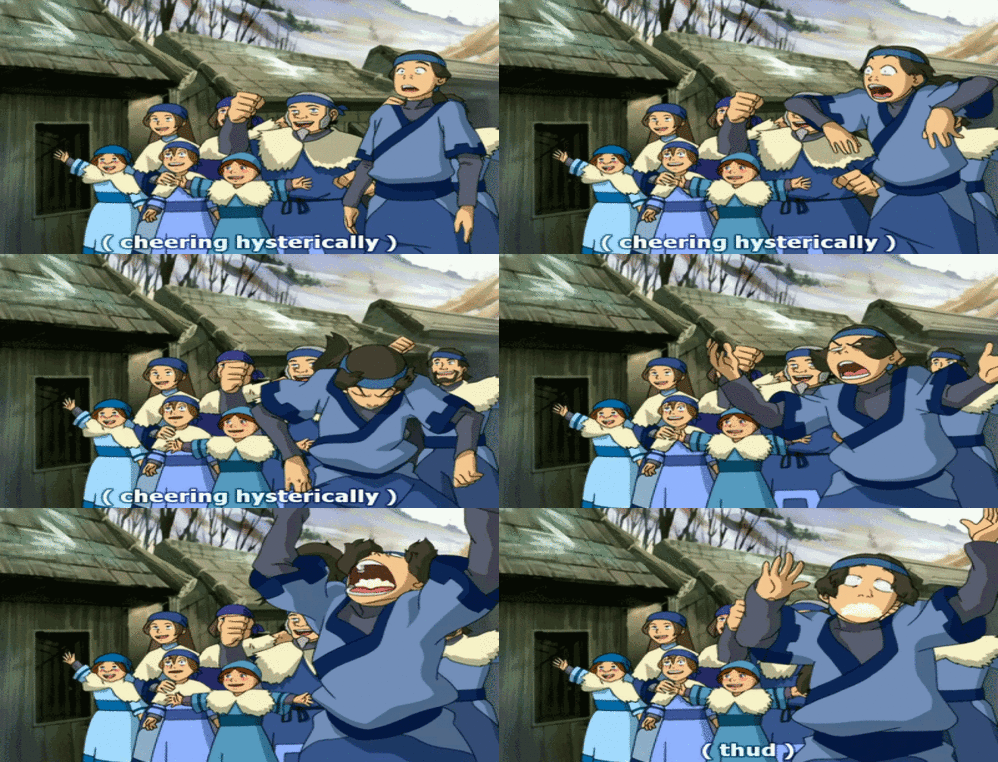
I probably never would have read this one had I not asked for recommendations in order to complete the library challenge. Many thanks to my pal Vivian for putting it on my radar. It’s getting all the stars.

“Magic is just a word for what’s left to the powerless once everyone else has eaten their fill.”
First things first . . . .
Are you fucking kidding me right now, Goodreads???? Go home, recommendation feature. You. Are. Drunk.
If you couldn’t tell by the title, this is a retelling of the classic. Some changes include Snow White not being quite the damsel in distress the original made her out to be, but instead . . . .
The seven dwarfs not be dwarfs at all, but rather ladies of il repute . . . .
The goings on behind the evil stepmother's magic mirror confirming once again . . . .
And an ending that will leave you saying . . .
And left Mitchell and I like . . . .
I probably never would have read this one had I not asked for recommendations in order to complete the library challenge. Many thanks to my pal Vivian for putting it on my radar. It’s getting all the stars.
March 26, 2014
[7/10]
I have noticed recently the popularity of spoof novels, mashing together Jane Austen and zombies or Abraham Lincoln with vampires. I am not much tempted to give them a try, having low expectations from the lack of originality and from the low-brow/cheap type of humor. The reason I mentioned them is that I want to stress that Catherynne Valente doesn't belong in this category. She has found a niche as an
author from re-examining classic fairytales and myths from a modern and usually revisionist / feminist perspective, but she does it with flawless style and her fantasies are closer to drama than to parody, more 'true grit' than Disney candyfloss goes into the recipe. Her use of language and of metaphor is a delight, even in cases like the present novella where Western traditions require a coarser vocabulary and an abundance of cursing.
The title is pretty self-explanatory: Snow White Goes West (even if I'm still baffled at same title because she has one gun with red pearl incrustations instead of six). In the beginning the story follows closely enough the plot line from the original fairytale, but in such unusual disguises that I had to be extra careful to recognize the Hunter for example in his Pinkerton bounty hunter persona. Other examples include the King and father of Snow White as a mining industry magnate (Mr. H.), her birth mother as a dark-skinned Crow woman named Gun That Sings, and the royal palace as a rich California ranch.
One of the best reversals in the story is the interpretation of 'white' not in the literal sense of our heroine's skin pigment, but in her aspiration to emulate her WASP socialite stepmother, in her desire to be accepted and loved by her succesful, beautiful and quintessentially 'white' parents while rejecting her 'dark' native blood.
I do not believe any person is born knowing how to be human. Everyone has to learn their letters and everyone has to learn how to be alive.
A is for Alligator. B is for Beauty.
Snow White learns as a child to shoot straight and to deal a mean hand at poker, courtesy of a father that spoils her with toys as a substitute for the loss of her mother at birth, but who is always absent on business trips, more interested in making money than in raising a child. Her life changes for the worse when her father falls under the spell of a beautiful woman with a hidden (even scandalous) past, arrived from the more sophisticated East Coast and manifesting occult powers. Isolated from her household friends and put daily to perform menial tasks, Snow White despairs of ever winning her stepmother's approval.
You may not know it, but the keeping of a large house by one girl is the hardest work going on earth. I heard there's fire in Hell, but I'll bet the Devil just hands you a bucket and tells you to get moving, this place ain't gonna clean itself.
So she runs away from home and heads for the high country, criss-crossing all over California, Utah, Arizona, Wyoming, Montana, making a name for herself as a fast gun and a cardshark. Yet it's a harsh life on the road, made even harder when she runs out of money and she goes to work in one of her father's mines. She's a tough kid, well able to take care of herself among the outlaws and the rough miners, een able to deal with the Hunter her mother's set out on her trail. But it's a lonely life, especially after even her mother's tribe refuse to let her join them in the Reservation.
When I fed the pigs and two of them got to scrapping over an old soft onion, I thought: that's love. Love is eating. Love is a snarling pig snout and long tusks. Love is the colour of blood. Love is what grown folk do to each other because the law frowns on killing.
Who will save Snow White from despair and cynicism? This being a Valente story, there's no guaranteed Prince Charming riding to the rescue on a white charger( You can't kiss a girl into anything). Not even the nick of time cavalry charge from John Huston's lore. Enter instead the seven dwarves in what is probably the most improbable but also the most fearfully charming incarnations ever imagined, the feminist version of Peckinpah's Wild Bunch , mean and dirty and a law unto themselves:
Seven of them bolt riding down a rill in a spring rainstorm, a bunch of Kates dressed afright and hollering. They've got deerskins and skunk skins and spotted cat skins, pink silk and purple and blue and green, black lace and harlot's satin, cavalry coats with gold braid and tuxedo trousers, widow's veils and stove-pipe hats and one had a whole horse skull on her head like a helmet.
Outcasts one and all from the civilized world, they have carved a refuge for themselves in the high country, away from masculine domination, persecution or domestic violence. They welcome Snow White among themselves, cautioning against opening her door to strangers, advising her to give up her dreams of begging for love that is not freely given, making no demands from her and giving her space and time to decide what she wants to become.
There's a town out there, in the un-land between the dirt America's bought and spat on and the territory they haven't got around to snatching yet. Town goes by the name of Oh-Be-Joyful. Fitted out with run-off catalogue women, whores, cattle Kates, bandits, desert rats and gunslingers. All women; all sour on the whole idea of going back where they came from. No law there, but no mercy neither. Do for outsiders all you please, but never for Joyfolk.
I loved this development of women desperadoes, but I believe it was underused by the author, introduced late and too abruptly, not developed sufficiently in background stories and individuality traits for the Kates to exploit its full potential. I believe the novella could have been developed into a longer novel by focusing more on Oh-Be-Joyful. Not that I had much of a problem with later developments in the story, even if they are not the best finale for a Valente book.
The author decided to go full post-modernist for the ending, mixing comments about the passing of the West with the dissillusionment in our heroine's quest for love. I was slightly disappointed by the ambiguous resolution, but I believe it is in line with other books by same author who never go for the easy way out and require pain before learning any valuable lesson about life or about oneself.
What happens to the West happens to Snow White, which is to say they both turn into jokes. They both get old so often they become pantomime. And then worse.
The story frees itself even from narrative constraints and unreasonable expectations of a fairytale happyending, with cowgirls petitioning their author and their audience to be left to choose their own destiny in another favorite (and last) quote of mine from the text:
Life's still stupid but we got free of story out here under the beeches and the Big Dipper. We had enough of it, of things happening one after another and no end in sight. Of reversals and falling in love and tragic flaws and by God if I see another motif in my business I will shoot it dead. The stories that happen to people like us aren't worth my back teeth.
In conclusion, not the best entry point for readers unfamiliar with Catherynne Valente, but a good addition to the shelves of those already in her camp of fans.
I have noticed recently the popularity of spoof novels, mashing together Jane Austen and zombies or Abraham Lincoln with vampires. I am not much tempted to give them a try, having low expectations from the lack of originality and from the low-brow/cheap type of humor. The reason I mentioned them is that I want to stress that Catherynne Valente doesn't belong in this category. She has found a niche as an
author from re-examining classic fairytales and myths from a modern and usually revisionist / feminist perspective, but she does it with flawless style and her fantasies are closer to drama than to parody, more 'true grit' than Disney candyfloss goes into the recipe. Her use of language and of metaphor is a delight, even in cases like the present novella where Western traditions require a coarser vocabulary and an abundance of cursing.
The title is pretty self-explanatory: Snow White Goes West (even if I'm still baffled at same title because she has one gun with red pearl incrustations instead of six). In the beginning the story follows closely enough the plot line from the original fairytale, but in such unusual disguises that I had to be extra careful to recognize the Hunter for example in his Pinkerton bounty hunter persona. Other examples include the King and father of Snow White as a mining industry magnate (Mr. H.), her birth mother as a dark-skinned Crow woman named Gun That Sings, and the royal palace as a rich California ranch.
One of the best reversals in the story is the interpretation of 'white' not in the literal sense of our heroine's skin pigment, but in her aspiration to emulate her WASP socialite stepmother, in her desire to be accepted and loved by her succesful, beautiful and quintessentially 'white' parents while rejecting her 'dark' native blood.
I do not believe any person is born knowing how to be human. Everyone has to learn their letters and everyone has to learn how to be alive.
A is for Alligator. B is for Beauty.
Snow White learns as a child to shoot straight and to deal a mean hand at poker, courtesy of a father that spoils her with toys as a substitute for the loss of her mother at birth, but who is always absent on business trips, more interested in making money than in raising a child. Her life changes for the worse when her father falls under the spell of a beautiful woman with a hidden (even scandalous) past, arrived from the more sophisticated East Coast and manifesting occult powers. Isolated from her household friends and put daily to perform menial tasks, Snow White despairs of ever winning her stepmother's approval.
You may not know it, but the keeping of a large house by one girl is the hardest work going on earth. I heard there's fire in Hell, but I'll bet the Devil just hands you a bucket and tells you to get moving, this place ain't gonna clean itself.
So she runs away from home and heads for the high country, criss-crossing all over California, Utah, Arizona, Wyoming, Montana, making a name for herself as a fast gun and a cardshark. Yet it's a harsh life on the road, made even harder when she runs out of money and she goes to work in one of her father's mines. She's a tough kid, well able to take care of herself among the outlaws and the rough miners, een able to deal with the Hunter her mother's set out on her trail. But it's a lonely life, especially after even her mother's tribe refuse to let her join them in the Reservation.
When I fed the pigs and two of them got to scrapping over an old soft onion, I thought: that's love. Love is eating. Love is a snarling pig snout and long tusks. Love is the colour of blood. Love is what grown folk do to each other because the law frowns on killing.
Who will save Snow White from despair and cynicism? This being a Valente story, there's no guaranteed Prince Charming riding to the rescue on a white charger( You can't kiss a girl into anything). Not even the nick of time cavalry charge from John Huston's lore. Enter instead the seven dwarves in what is probably the most improbable but also the most fearfully charming incarnations ever imagined, the feminist version of Peckinpah's Wild Bunch , mean and dirty and a law unto themselves:
Seven of them bolt riding down a rill in a spring rainstorm, a bunch of Kates dressed afright and hollering. They've got deerskins and skunk skins and spotted cat skins, pink silk and purple and blue and green, black lace and harlot's satin, cavalry coats with gold braid and tuxedo trousers, widow's veils and stove-pipe hats and one had a whole horse skull on her head like a helmet.
Outcasts one and all from the civilized world, they have carved a refuge for themselves in the high country, away from masculine domination, persecution or domestic violence. They welcome Snow White among themselves, cautioning against opening her door to strangers, advising her to give up her dreams of begging for love that is not freely given, making no demands from her and giving her space and time to decide what she wants to become.
There's a town out there, in the un-land between the dirt America's bought and spat on and the territory they haven't got around to snatching yet. Town goes by the name of Oh-Be-Joyful. Fitted out with run-off catalogue women, whores, cattle Kates, bandits, desert rats and gunslingers. All women; all sour on the whole idea of going back where they came from. No law there, but no mercy neither. Do for outsiders all you please, but never for Joyfolk.
I loved this development of women desperadoes, but I believe it was underused by the author, introduced late and too abruptly, not developed sufficiently in background stories and individuality traits for the Kates to exploit its full potential. I believe the novella could have been developed into a longer novel by focusing more on Oh-Be-Joyful. Not that I had much of a problem with later developments in the story, even if they are not the best finale for a Valente book.
The author decided to go full post-modernist for the ending, mixing comments about the passing of the West with the dissillusionment in our heroine's quest for love. I was slightly disappointed by the ambiguous resolution, but I believe it is in line with other books by same author who never go for the easy way out and require pain before learning any valuable lesson about life or about oneself.
What happens to the West happens to Snow White, which is to say they both turn into jokes. They both get old so often they become pantomime. And then worse.
The story frees itself even from narrative constraints and unreasonable expectations of a fairytale happyending, with cowgirls petitioning their author and their audience to be left to choose their own destiny in another favorite (and last) quote of mine from the text:
Life's still stupid but we got free of story out here under the beeches and the Big Dipper. We had enough of it, of things happening one after another and no end in sight. Of reversals and falling in love and tragic flaws and by God if I see another motif in my business I will shoot it dead. The stories that happen to people like us aren't worth my back teeth.
In conclusion, not the best entry point for readers unfamiliar with Catherynne Valente, but a good addition to the shelves of those already in her camp of fans.

November 16, 2015
I've never used "absolutely disgusted" in a review title before today, but I did precisely that today at my blog, American Indians in Children's Literature. I am absolutely disgusted with SIX GUN SNOW WHITE. There are vile things in the world. Some of them are subtly vile, which makes them dangerous because you aren't aware of what is going into your head and heart.
Some things, like Catherynne M. Valente's Six-Gun Snow White are gratuitously vile. As a Native woman, it is very hard to read Valente's book in light of my knowledge of the violence inflicted on Native girls and women--today.
There is no redeeming Valente's words. There is nothing she could write, as the book proceeds, that will undo what she says in the first half. I quit.
I don't think this is meant to be a young adult novel but I've seen a colleague in children's literature describe it as "fantastic" which is why I decided I ought to see what it is about. As the synopsis indicates, it is a retelling of Snow White. It was first published in 2013 by Subterranean Press as a signed limited edition (1000 signed and numbered hardcover copies), but is being republished in 2015. This time around, the publisher is Saga Press.
Obviously, I don't recommend it. I've never read anything Valente wrote before. I asked, online, if this is typical of her work, and the reply so far is no. So why did she do this? Why would anyone do this?
Six Gun Snow White is not fantastic. It is not brilliant. It is grotesque. It is so disgusting that I will not sully this post with actual quotes from the book. Here's my thoughts on the worst parts:
(1) Valente uses animal-like depictions to describe the main character's genitals. Yes, you read that right, her genitals. Animal-like characteristics are often used in children's literature but none, that I recall, that are anything like these. In children's books, you'll find things like Indians who "gnaw" on bones or have "steely patience, like a wolf waiting." Such descriptions dehumanize us.
(2) Valente has the stepmother bathe the main character in a milk bath to make her skin lighter in tone, but to do the inside parts of her she shoves the main character's head underneath, which echoes the intents of the boarding schools established in the 1800s. A guiding philosophy was 'kill the Indian/save the man' and the idea of the "civilizing" curriculum was to "hold them under until they are thoroughly soaked in the white man's ways."
(3) Valente shows the main character and her mother (her mother was Crow) being lusted after, abused, beaten, and violated by white men. This is especially troubling, given the violence and lack of investigation of that violence that we see in the US and Canada.
I suppose all of that is so over-the-top to make a point of some kind, but that point need not be made in the first place. As the title for this post says, I am absolutely disgusted by what I see in Six Gun Snow White.
Some things, like Catherynne M. Valente's Six-Gun Snow White are gratuitously vile. As a Native woman, it is very hard to read Valente's book in light of my knowledge of the violence inflicted on Native girls and women--today.
There is no redeeming Valente's words. There is nothing she could write, as the book proceeds, that will undo what she says in the first half. I quit.
I don't think this is meant to be a young adult novel but I've seen a colleague in children's literature describe it as "fantastic" which is why I decided I ought to see what it is about. As the synopsis indicates, it is a retelling of Snow White. It was first published in 2013 by Subterranean Press as a signed limited edition (1000 signed and numbered hardcover copies), but is being republished in 2015. This time around, the publisher is Saga Press.
Obviously, I don't recommend it. I've never read anything Valente wrote before. I asked, online, if this is typical of her work, and the reply so far is no. So why did she do this? Why would anyone do this?
Six Gun Snow White is not fantastic. It is not brilliant. It is grotesque. It is so disgusting that I will not sully this post with actual quotes from the book. Here's my thoughts on the worst parts:
(1) Valente uses animal-like depictions to describe the main character's genitals. Yes, you read that right, her genitals. Animal-like characteristics are often used in children's literature but none, that I recall, that are anything like these. In children's books, you'll find things like Indians who "gnaw" on bones or have "steely patience, like a wolf waiting." Such descriptions dehumanize us.
(2) Valente has the stepmother bathe the main character in a milk bath to make her skin lighter in tone, but to do the inside parts of her she shoves the main character's head underneath, which echoes the intents of the boarding schools established in the 1800s. A guiding philosophy was 'kill the Indian/save the man' and the idea of the "civilizing" curriculum was to "hold them under until they are thoroughly soaked in the white man's ways."
(3) Valente shows the main character and her mother (her mother was Crow) being lusted after, abused, beaten, and violated by white men. This is especially troubling, given the violence and lack of investigation of that violence that we see in the US and Canada.
I suppose all of that is so over-the-top to make a point of some kind, but that point need not be made in the first place. As the title for this post says, I am absolutely disgusted by what I see in Six Gun Snow White.
November 23, 2018
About all I knew about Snow White is the Disney version, with the Seven Dwarves. And Prince Charming. None of that here. But the Wicked Stepmother is, in spades!
Lots of interesting stuff, and I got more caught up in the story as I got further into it, and sussed out some of the backstory details she’s using. Mr. H, the mining magnate, was modeled (I'm almost certain) on George Hearst, https://en.wikipedia.org/wiki/George_.... The Blue is the sticky blue clay, that clung to the early gold miners’ tools at Virginia City. The “blue stuff” turned out to be high-grade silver ore, and the great Comstock Lode was the start of Hearst’s fortune ⚒︎. My impression is that, as 19th century rich men went, Hearst was one of the good guys. His RL wife, Phoebe Apperson Hearst, was a noted philanthropist. Hearst’s “castle by the sea”, mentioned in the story as a present-day museum, is based on Hearst Castle, William Randolph Hearst’s (George’s son) wonderful folly from the 1930s. Which you should visit when you’re nearby, when it re-opens. I live a half-hour away. If we're friends, drop me a line, and I'll buy you a beer. On the deck, at social distance.... 😇
Rubies in Nevada, and Colorado diamonds, are strictly products of CMV’s imagination. She may have been aware of a famous 19th-C. diamond scam in Colorado: https://en.wikipedia.org/wiki/Diamond...
None of this stuff has a great deal to do with the story flow, and I’ll point you to Carol’s review for some of the details: https://www.goodreads.com/review/show...
So I found the book (novella-length) a successful and entertaining fantasy-riff on a Western tall tale. And I particularly liked the ending, where Snow White becomes an astronomer! Here's the wonderful last line: "Snow White's pulsar shakes the night sky like iron shoes dancing." And the wonderful cover art, by Charlie Bowater. Bravo!
Lots of interesting stuff, and I got more caught up in the story as I got further into it, and sussed out some of the backstory details she’s using. Mr. H, the mining magnate, was modeled (I'm almost certain) on George Hearst, https://en.wikipedia.org/wiki/George_.... The Blue is the sticky blue clay, that clung to the early gold miners’ tools at Virginia City. The “blue stuff” turned out to be high-grade silver ore, and the great Comstock Lode was the start of Hearst’s fortune ⚒︎. My impression is that, as 19th century rich men went, Hearst was one of the good guys. His RL wife, Phoebe Apperson Hearst, was a noted philanthropist. Hearst’s “castle by the sea”, mentioned in the story as a present-day museum, is based on Hearst Castle, William Randolph Hearst’s (George’s son) wonderful folly from the 1930s. Which you should visit when you’re nearby, when it re-opens. I live a half-hour away. If we're friends, drop me a line, and I'll buy you a beer. On the deck, at social distance.... 😇
Rubies in Nevada, and Colorado diamonds, are strictly products of CMV’s imagination. She may have been aware of a famous 19th-C. diamond scam in Colorado: https://en.wikipedia.org/wiki/Diamond...
None of this stuff has a great deal to do with the story flow, and I’ll point you to Carol’s review for some of the details: https://www.goodreads.com/review/show...
So I found the book (novella-length) a successful and entertaining fantasy-riff on a Western tall tale. And I particularly liked the ending, where Snow White becomes an astronomer! Here's the wonderful last line: "Snow White's pulsar shakes the night sky like iron shoes dancing." And the wonderful cover art, by Charlie Bowater. Bravo!

September 16, 2013
Words. Wordswordswords. Cat Valente is one of those authors that uses lots of words, many of them pretty. But (for me) it's fucking difficult to extract the story from all them thar pretty words.
Are you in there, story? I feel like you must be! Everyone raves about your "gorgeous/lush/elegant/poetic" prose, but what good are all these beautiful sentences if I can't parse their meaning?
Calm down, sentences, you're giving me a headache.
Cat Valente writes books that I want to love. I read what other people have to say about them and think "Yes! I want that, too!" But then I finish them feeling unfulfilled and wishing whatever's missing in this heart of mine would allow me to love them like others do.
Pretty but vacant.
3 stars. Onefor sorrow, two for joy for the story underneath the overdone prose, one for an ending I loved that everyone else seems to hate and a final star because I read most of this in an hour while sitting on my porch on the first autumn feeling mid-morning of the year. It's hard to feel too angry while basking in the sunlight of a day like that.
Are you in there, story? I feel like you must be! Everyone raves about your "gorgeous/lush/elegant/poetic" prose, but what good are all these beautiful sentences if I can't parse their meaning?
Calm down, sentences, you're giving me a headache.
Cat Valente writes books that I want to love. I read what other people have to say about them and think "Yes! I want that, too!" But then I finish them feeling unfulfilled and wishing whatever's missing in this heart of mine would allow me to love them like others do.
Pretty but vacant.
3 stars. One

March 17, 2014
Rating: 4.9* of five
This glittering reimagination of a foundational myth wins an almost-perfect score from me. Go take a gander. Valente is a reliable source of wonderful and creative takes and re-takes on fairy tales, but she's also a wordsmith of astounding facility.
This glittering reimagination of a foundational myth wins an almost-perfect score from me. Go take a gander. Valente is a reliable source of wonderful and creative takes and re-takes on fairy tales, but she's also a wordsmith of astounding facility.

February 22, 2018
Bloody brilliant!
This gun slinging girl is no Snow White….unless red juicy apples are blood pumping hearts and the 7 dwarves are 7 coyotes!
The girl was born with hair black as coal, lips red as blood and skin reflecting that of her mothers. She is the daughter of ‘Gun That Sings’, the Crow Indian Bride her father took from Montana Territory to California.
Living a sheltered live in a zoo that daddy built, she never is allowed to leave the grounds and has a gun she calls Rose Red. Since her mother died at birth, her father remarries a woman from Boston. This new stepmother does not like this girl and calls the “half-breed” Snow White. But despite the stepmother’s greatest efforts, she cannot clean or whiten the girl anymore! Her displeasure for the girl means she abuses her power and treats the girl badly with chores and beatings.
But Snow-White escapes to the Wild West to get away from her stepmother. Along the way she’ll discover what the real world is like and ends up surrounded with all kinds of characters.
***
I really liked this little novella. It had the most brilliant and brash lines with the most expressive vocabulary of its kind that I have read. It was knee slapping at moments as well as heartbreaking when Snow-White makes analogies about race, dominations of power and abuse. The interwoven fairy tale in the Wild West setting where a brilliant idea I thought and made this one unique read I highly recommend.
This gun slinging girl is no Snow White….unless red juicy apples are blood pumping hearts and the 7 dwarves are 7 coyotes!
The girl was born with hair black as coal, lips red as blood and skin reflecting that of her mothers. She is the daughter of ‘Gun That Sings’, the Crow Indian Bride her father took from Montana Territory to California.
Living a sheltered live in a zoo that daddy built, she never is allowed to leave the grounds and has a gun she calls Rose Red. Since her mother died at birth, her father remarries a woman from Boston. This new stepmother does not like this girl and calls the “half-breed” Snow White. But despite the stepmother’s greatest efforts, she cannot clean or whiten the girl anymore! Her displeasure for the girl means she abuses her power and treats the girl badly with chores and beatings.
But Snow-White escapes to the Wild West to get away from her stepmother. Along the way she’ll discover what the real world is like and ends up surrounded with all kinds of characters.
***
I really liked this little novella. It had the most brilliant and brash lines with the most expressive vocabulary of its kind that I have read. It was knee slapping at moments as well as heartbreaking when Snow-White makes analogies about race, dominations of power and abuse. The interwoven fairy tale in the Wild West setting where a brilliant idea I thought and made this one unique read I highly recommend.

May 14, 2014
Catherynne Valente is such a master prose smith that anything she writes is worth reading, but I run hot and cold on the stories she actually tells. Sometimes her stories just seem to get lost in the craft of telling them.
Six-Gun Snow White holds together admirably as a Western retelling of Snow White, with Snow being the half-breed daughter of a rich silver baron and a Crow woman.
Pampered and spoiled and kept hidden away in an upper floor out of sight by Daddy, Snow lives a lonely but untroubled life until daddy marries Mrs. H. Aka the Evil Stepmother.
Eventually she runs away, on Charming, her horse, and with Rose Red, her gem-handled revolver. At this point the book shifts to third-person and lost me a bit, as Snow White's voice, plain-spoken, heartfelt, savage and wise at the same time, made the early chapters engaging even though the story was an old one. As she runs further from home and the story moves further from its fairy tale roots, Catherynne Valente's writing is still a treat, but as is so often the case, some chapters wind up being more about her writing than about what continues or explains the plot.
A hunter is sent by her wicked stepmother to bring back Snow's heart. And she is taken in by seven peculiar companions. And there is a magic mirror, and poisoned apples, and a deathly sleep, and a kiss.
But beneath these fairy tale trappings, Six-Gun Snow White diverges considerably from its roots. Catherynne Valente is always being subversive to some degree, and the ending was both unexpected and delightful in a strange and almost nonsensical way.
I give this novella (which has been nominated for a Hugo) 4.5 stars. It is not quite perfect, and it's not quite original, but anything by Catherynne Valente is guaranteed to be an experience to read, and while not everyone may treasure this particular work, it's certainly a worthy addition to her oeuvre.
Six-Gun Snow White holds together admirably as a Western retelling of Snow White, with Snow being the half-breed daughter of a rich silver baron and a Crow woman.
Pampered and spoiled and kept hidden away in an upper floor out of sight by Daddy, Snow lives a lonely but untroubled life until daddy marries Mrs. H. Aka the Evil Stepmother.
When she hit me, she said she loved me. When she scratched my face, she said she loved me. And let me tell you, Mrs. H loved me most of all the day she locked me in my room with no lamps or candles because I looked too long at a groomsman and that's the mark of a whore, a slattern with a jackal for a mother, hellion trash with an animal heart. For a week I had no bath or books, no light and no food, but she loved me the whole time, whispering through the door that her love could burn the whore out of me. Love could make me pure again.
On account of all this I had some peculiar ideas about love.
Eventually she runs away, on Charming, her horse, and with Rose Red, her gem-handled revolver. At this point the book shifts to third-person and lost me a bit, as Snow White's voice, plain-spoken, heartfelt, savage and wise at the same time, made the early chapters engaging even though the story was an old one. As she runs further from home and the story moves further from its fairy tale roots, Catherynne Valente's writing is still a treat, but as is so often the case, some chapters wind up being more about her writing than about what continues or explains the plot.
Snow White rides him hard, no mistaking. She needs distance, the generosity of miles. Maybe there's no gone that's far enough, but if there is, she aims to find it. She lets Charming snatch up sea-grass, and when the seas's so far behind them she can't smell salt, she directs him to alfalfa and meadowsweet. Snow White portions out a bag of apples she absconded with between herself and her horse. She still does not care for apples but food is food. Sugar is sugar. She has to make them last. All the smarts in the world don't tell you where the next town lies when you've never seen the big open but in pictures. Don't matter much. She's never been happy a day in her life until she lit out hell for Hades, and if she never sees another human face it's just as well by her. Snow White puts her gun on her arm and takes down a beaver for a week's suppers. She's not too sure how to dry it perfect, but she does her best, and the fur sits better on her shoulders than any dress she ever wore to please her daddy. She's careful with her bullets. Gotta miser them good. Her life is weighted out in apples and bullets.
A hunter is sent by her wicked stepmother to bring back Snow's heart. And she is taken in by seven peculiar companions. And there is a magic mirror, and poisoned apples, and a deathly sleep, and a kiss.
But beneath these fairy tale trappings, Six-Gun Snow White diverges considerably from its roots. Catherynne Valente is always being subversive to some degree, and the ending was both unexpected and delightful in a strange and almost nonsensical way.
I give this novella (which has been nominated for a Hugo) 4.5 stars. It is not quite perfect, and it's not quite original, but anything by Catherynne Valente is guaranteed to be an experience to read, and while not everyone may treasure this particular work, it's certainly a worthy addition to her oeuvre.

January 8, 2016
To be honest I didn't really go into this with any specific expectation as the only other book by Catherynne Valente I had read was The Girl Who Circumnavigated Fairyland and that was a truly beautiful but also a very bizarre story. Of course, I did expect at least some parallels to Snow White, but this is quite a lot more than that becuase it's also a weird western take on the whole affair, and again it's beautifully written.
We follow the main character as she narrates her story of her early life and her parents right through to the end of her tale. We see that she has had a rather tragic upbringing with a mother being forced to live with her father (her mother was called Gun That Sings and was a native of the Crow tribes) and then losing both her parental figures in favour of the new step mother Mrs. H. She's a wonderful child and narrator filled with creativity and a desire to learn and explore. As the story goes on becuase she evokes the sense of the Old Western and really shows off the style and time, but she also has beautiful, crystalline ways of thinking about things which are far different from how I myself might consider a situation or moment.
The story does loosely follow that of Snow White, but although we meet characters who could be said to be somewhat like the Seven Dwarves and there is mention of Charming and Rose Red and other fairy tale characters, it's really not what you might expect with Rose Red being a gun and Charming an animal!
On the whole it's a very quick read and a quirky one too. If you like the idea of a Snow White Western then this might be just the thing for you, but I will say to go into it with a little bit of expectation for the 'weird'. I struggled to decide between a 3.5* or a 4* but ultimately went with a 4*s becuase it's just so fascinating and beautifully written at times that I couldn't really give it any lower! :)
We follow the main character as she narrates her story of her early life and her parents right through to the end of her tale. We see that she has had a rather tragic upbringing with a mother being forced to live with her father (her mother was called Gun That Sings and was a native of the Crow tribes) and then losing both her parental figures in favour of the new step mother Mrs. H. She's a wonderful child and narrator filled with creativity and a desire to learn and explore. As the story goes on becuase she evokes the sense of the Old Western and really shows off the style and time, but she also has beautiful, crystalline ways of thinking about things which are far different from how I myself might consider a situation or moment.
The story does loosely follow that of Snow White, but although we meet characters who could be said to be somewhat like the Seven Dwarves and there is mention of Charming and Rose Red and other fairy tale characters, it's really not what you might expect with Rose Red being a gun and Charming an animal!
On the whole it's a very quick read and a quirky one too. If you like the idea of a Snow White Western then this might be just the thing for you, but I will say to go into it with a little bit of expectation for the 'weird'. I struggled to decide between a 3.5* or a 4* but ultimately went with a 4*s becuase it's just so fascinating and beautifully written at times that I couldn't really give it any lower! :)

June 5, 2021
"I gradually understood the truth of my situation: I was a secret." pg 14, ebook.
Catherynne Valente has penned a bewildering and ultimately disappointing western-tinged fairy tale retelling in Six-Gun Snow White. Her reimagining of the classic story has Snow White as an unloved daughter of a mine speculator and an abused, indigenous mother. When her mother ends her own life, Snow White's father marries a mysterious woman from back East, the evil stepmother of fairytale infamy, whom the narrator calls Mrs. H.
"She named me a thing I could aspire to but never become, the one thing I was not and could never be: Snow White." pg 27, ebook
The disappointing part of the story is not the set up or general idea of Snow White as a western, both of which I thought were excellent. The trouble arrives in the magical portions of the story which are, in my opinion, not well written. They felt disjointed and tacked on.
It's curious to me that I didn't like this story because Valente is one of my favorite authors. There is no one like her when it comes to an interwoven story or mysterious magic. Maybe my issue with this tale is that it's so short Valente didn't have a chance to work her usual story telling magic? Perhaps.
The ending was an enormous let down as well.
Not recommended.
Catherynne Valente has penned a bewildering and ultimately disappointing western-tinged fairy tale retelling in Six-Gun Snow White. Her reimagining of the classic story has Snow White as an unloved daughter of a mine speculator and an abused, indigenous mother. When her mother ends her own life, Snow White's father marries a mysterious woman from back East, the evil stepmother of fairytale infamy, whom the narrator calls Mrs. H.
"She named me a thing I could aspire to but never become, the one thing I was not and could never be: Snow White." pg 27, ebook
The disappointing part of the story is not the set up or general idea of Snow White as a western, both of which I thought were excellent. The trouble arrives in the magical portions of the story which are, in my opinion, not well written. They felt disjointed and tacked on.
It's curious to me that I didn't like this story because Valente is one of my favorite authors. There is no one like her when it comes to an interwoven story or mysterious magic. Maybe my issue with this tale is that it's so short Valente didn't have a chance to work her usual story telling magic? Perhaps.
The ending was an enormous let down as well.
Not recommended.

September 21, 2017
Just wonderful.
Valente has a powerful voice and a gift for visceral descriptions, which breathe a vibrancy to the stories and the uncanny ability to take myth and fable and turn them into modern tales. Allegories of womanhood and what it means to be female. The themes are universal and in many ways cautionary tales.
I loved this version of Snow White in the Old West. I was captivated by the concept when I spotted it, but it was even better than I tried to imagine. Valente took the story and turn it inside out. I'll be honest, the ending confused me, I reread it. When I began this the ending would always be a tricky endeavor, and while I like the concept of it, not sure if I loved the execution. I'm still thinking on it, and will be for sometime, but the fact is that it doesn't detract from the strength of the story.
Valente's stories are ones mothers should give their teenage daughters because they do not lie. They tell the paradox of being female. The sacrifice and choices we all make. Discussions of what is danger and being prey, the illusions of fairy tales are deconstructed with the real price shown. How all of these things play into women's lives now is sophisticated and an approachable vehicle.
This is my second Valente book after DEATHLESS earlier this year, and without a doubt not my last. I'll be stalking her backlist, now.
Favorite passage:
Valente has a powerful voice and a gift for visceral descriptions, which breathe a vibrancy to the stories and the uncanny ability to take myth and fable and turn them into modern tales. Allegories of womanhood and what it means to be female. The themes are universal and in many ways cautionary tales.
I loved this version of Snow White in the Old West. I was captivated by the concept when I spotted it, but it was even better than I tried to imagine. Valente took the story and turn it inside out. I'll be honest, the ending confused me, I reread it. When I began this the ending would always be a tricky endeavor, and while I like the concept of it, not sure if I loved the execution. I'm still thinking on it, and will be for sometime, but the fact is that it doesn't detract from the strength of the story.
Valente's stories are ones mothers should give their teenage daughters because they do not lie. They tell the paradox of being female. The sacrifice and choices we all make. Discussions of what is danger and being prey, the illusions of fairy tales are deconstructed with the real price shown. How all of these things play into women's lives now is sophisticated and an approachable vehicle.
This is my second Valente book after DEATHLESS earlier this year, and without a doubt not my last. I'll be stalking her backlist, now.
Favorite passage:
This is what it means to be a woman in this world. Every step is a bargain with pain. Make your black deals in the black wood and decide what you'll trade for power. For the opposite of weakness, which is not strength but hardness. I am a trap, but so is everything. Pick your price. I am a huckster with a hand in your pocket. I am freedom and I will eat your heart.

December 23, 2017
So so
Nice spin on the story but overall it felt cold and distant. The atmosphere was there but it felt like we were being kept at arm's length the whole time. The switch from Snow White's perspective wasn't all bad but felt awkward at times.
I did get a kick out of the hints to the original though.
The ending felt like (to me) the author just wanted to wrap up the story.
Nice attempt but overall lackluster. *shrugs*
2.5 stars
Nice spin on the story but overall it felt cold and distant. The atmosphere was there but it felt like we were being kept at arm's length the whole time. The switch from Snow White's perspective wasn't all bad but felt awkward at times.
I did get a kick out of the hints to the original though.
The ending felt like (to me) the author just wanted to wrap up the story.
Nice attempt but overall lackluster. *shrugs*
2.5 stars
June 18, 2013
You’re in a story and the body writing it is an asshole.
There are stories and there are characters. Then, you also have stories with characters and characters with stories.
But what Valente does is entirely different. She creates her characters, and they move on, swirl around, slowly and surely coalescing into a story, pushing it forward even as they become the story.
Six-Gun Snow White is a retelling and it stays very true to the original fairytale, but it is much more honest and original than any derivation or version of Snow White that I've come across. The story includes the few firm elements of the variable tale, but instead of yielding to them, it twists around and round.
It's a gorgeous story and its humbleness astounds me. It is rich in the way that Valente stories are; however, the writing is from what I've experienced of hers before, in the books I finished and in the ones I only sampled. It's not quirky like in The Girl Who Circumnavigated Fairyland, nor is it prosaic as in Silently and Very Fast, and it's definitely not as precise and intense as in Deathless and The Orphan's Tale.
The writing style here is melancholic and candid; and it flies.
This novella brings about such characters, and in a few short pages. The author writes so finely, so exquisitely, that every word has something crucial to tell you. With just a few lines, Valente makes you sad and with a few less, she makes you wretched.
The worst thing in the world is having to go back to the dark you shook off.
For me, this book renders all retellings null. The story is as richly layered and the hackneyed concept has been revisited with beauteous depth and meaning. More than this, the novella also takes on issues of the past: racism, abuse, neglect, et cetra, et cetra and the most perverse of all, love.
Not romantic love, but an abusive one.
Of Snow White's, our protagonist, love for her Mrs H, the vile step-mother and vice versa. Snow White shies away from her but in the end, she loves this woman too much even as she hates her,; and even as she takes her heart, Mrs H loves and cries for Snow White.
The first half of the story is Snow White's narrative and just as it gets more and more hurtful, Valente turns to third person and changes the pace altogether.
There is no Prince Charming and if there is retribution to be had, it's not clear to me as yet, why?
The ending was munificent of the author, methinks. And it also leaves you ambiguous about the identity of a monster in this tale. In the end, isn't love the biggest of monster of all? Do we really need another skin and bones one? But perhaps, love could be the savior, too and while the evil stepmother poisons the fair maid, she's saving her as well.
I'd urge you all to read this fantastic short story and although, it won't hurt not to, do you really want to miss out on this:
Cross-posted on Books behind Dam{n}s
There are stories and there are characters. Then, you also have stories with characters and characters with stories.
But what Valente does is entirely different. She creates her characters, and they move on, swirl around, slowly and surely coalescing into a story, pushing it forward even as they become the story.
Six-Gun Snow White is a retelling and it stays very true to the original fairytale, but it is much more honest and original than any derivation or version of Snow White that I've come across. The story includes the few firm elements of the variable tale, but instead of yielding to them, it twists around and round.
It's a gorgeous story and its humbleness astounds me. It is rich in the way that Valente stories are; however, the writing is from what I've experienced of hers before, in the books I finished and in the ones I only sampled. It's not quirky like in The Girl Who Circumnavigated Fairyland, nor is it prosaic as in Silently and Very Fast, and it's definitely not as precise and intense as in Deathless and The Orphan's Tale.
The writing style here is melancholic and candid; and it flies.
This novella brings about such characters, and in a few short pages. The author writes so finely, so exquisitely, that every word has something crucial to tell you. With just a few lines, Valente makes you sad and with a few less, she makes you wretched.
The worst thing in the world is having to go back to the dark you shook off.
For me, this book renders all retellings null. The story is as richly layered and the hackneyed concept has been revisited with beauteous depth and meaning. More than this, the novella also takes on issues of the past: racism, abuse, neglect, et cetra, et cetra and the most perverse of all, love.
Not romantic love, but an abusive one.
Of Snow White's, our protagonist, love for her Mrs H, the vile step-mother and vice versa. Snow White shies away from her but in the end, she loves this woman too much even as she hates her,; and even as she takes her heart, Mrs H loves and cries for Snow White.
The first half of the story is Snow White's narrative and just as it gets more and more hurtful, Valente turns to third person and changes the pace altogether.
There is no Prince Charming and if there is retribution to be had, it's not clear to me as yet, why?
The ending was munificent of the author, methinks. And it also leaves you ambiguous about the identity of a monster in this tale. In the end, isn't love the biggest of monster of all? Do we really need another skin and bones one? But perhaps, love could be the savior, too and while the evil stepmother poisons the fair maid, she's saving her as well.
I'd urge you all to read this fantastic short story and although, it won't hurt not to, do you really want to miss out on this:
You can’t kiss a girl into anything.
Cross-posted on Books behind Dam{n}s

November 15, 2015
Valente’s writing can be pretty “out there,” to my mind. The Orphan’s Tales duology is great and Deathless also very good, but I wasn’t able to get past the sample of Radiance. Six-Gun Snow White is deceptively grounded: it’s a retelling of a familiar fairytale, and it’s set in the 19th century American West. Valente shows her extraordinary versatility by writing the book in the language of a western: from other work I know she is capable of lyrical writing heavy on figurative language, but this one is stark, stripped-down and straightforward. Or at least so it appears.
Like any good retelling, this one is told with twists. Valente’s Snow White is a tough young woman of mixed race who is an excellent shot with a pistol and embarks on a journey to find her mother’s Crow tribe. Fairy tale elements appear here in fresh guises: the kiss, for instance, is not a romantic moment (because who kisses a sleeping stranger? A sexual predator, obviously).
But I feel as if much of this book went over my head; many of Valente’s choices left me confused, wondering “but what does this mean? Why is this here?” The chapter titles are perhaps emblematic of my confusion: titles such as “Snow White Juggles Her Own Eyes,” “Snow White Fights a Lump of Pitch,” and “Snow White’s Stepmother Gives Birth to the Sun” neither describe the events of those chapters nor those of pre-existing versions of the tale. In the same way, many of the plot elements and twists confused me because they seemed to have some deeper meaning that was not evident to me. As explained in the comments to this review, many of the references come from Native American folklore, with which I have little familiarity; those with more knowledge of it will surely appreciate this book more.
This is a brief novella – very short chapters, section breaks and a few illustrations make it even shorter than the page count would have you believe – and so I would hardly discourage you from reading it. If nothing else, it’s certainly a well-written book. But although on its face this might appear to be among Valente’s most accessible works, it isn’t the first I’d recommend to a new reader. Three and a half stars.
Like any good retelling, this one is told with twists. Valente’s Snow White is a tough young woman of mixed race who is an excellent shot with a pistol and embarks on a journey to find her mother’s Crow tribe. Fairy tale elements appear here in fresh guises: the kiss, for instance, is not a romantic moment (because who kisses a sleeping stranger? A sexual predator, obviously).
But I feel as if much of this book went over my head; many of Valente’s choices left me confused, wondering “but what does this mean? Why is this here?” The chapter titles are perhaps emblematic of my confusion: titles such as “Snow White Juggles Her Own Eyes,” “Snow White Fights a Lump of Pitch,” and “Snow White’s Stepmother Gives Birth to the Sun” neither describe the events of those chapters nor those of pre-existing versions of the tale. In the same way, many of the plot elements and twists confused me because they seemed to have some deeper meaning that was not evident to me. As explained in the comments to this review, many of the references come from Native American folklore, with which I have little familiarity; those with more knowledge of it will surely appreciate this book more.
This is a brief novella – very short chapters, section breaks and a few illustrations make it even shorter than the page count would have you believe – and so I would hardly discourage you from reading it. If nothing else, it’s certainly a well-written book. But although on its face this might appear to be among Valente’s most accessible works, it isn’t the first I’d recommend to a new reader. Three and a half stars.
November 17, 2023
I understood every word of this. I understood none of it and I need to read it twice more. This is the best straight-up fairytale retelling I’ve ever read. It makes astonishing use of its novella length, carrying all the longterm narrative momentum of a novel, yet it reads like a short story in the way each sentence drops like a heavy, sparkling, perfectly-cut jewel. Each symbol and motif, each narrative archetype and social theme, reflects in on itself a hundred times in an ever-shifting, colorful kaleidoscope of meaning. Meaning and emotion. God, I felt feelings.
“What if Snow White was a half-Native American gunslinging girl in the Wild West?” is the kind of take one of the well-canonized Western fairytales and do a funky genre mash-up premises that tons of authors come up with these days. But Valente is the only author I’ve ever read with the skill to make each added narrative component truly, profoundly matter—and not just matter, but transmute the others into something greater, too. She plants Snow White’s complex familial relationships in the rich soil of my two favorite themes in American literature, 1) exploration of Native American identity and folklore and 2) the 19th century East coast vs. West frontier dichotomy. The result is, obviously, delicious.
idk, y’all, I’m a little chagrined by the mediocre reviews for this novella. I guess I’ll exercise my human right to decide that other people Just Don’t Get It when they don’t love something you think is incredible. But like—what do people mean ‘there’s no romance; she has no prince charming?’ Does butch lesbian outlaw Bang-Up Jackson mean nothing to you???
Anyway, I’ll leave you with one last selling point: the voice of this prose is so strong it forced the voice in my head into an old-timey Western accent, with no effort on my part. If one’s favorite author can get favoriter, that’s what’s happened here.
“What if Snow White was a half-Native American gunslinging girl in the Wild West?” is the kind of take one of the well-canonized Western fairytales and do a funky genre mash-up premises that tons of authors come up with these days. But Valente is the only author I’ve ever read with the skill to make each added narrative component truly, profoundly matter—and not just matter, but transmute the others into something greater, too. She plants Snow White’s complex familial relationships in the rich soil of my two favorite themes in American literature, 1) exploration of Native American identity and folklore and 2) the 19th century East coast vs. West frontier dichotomy. The result is, obviously, delicious.
idk, y’all, I’m a little chagrined by the mediocre reviews for this novella. I guess I’ll exercise my human right to decide that other people Just Don’t Get It when they don’t love something you think is incredible. But like—what do people mean ‘there’s no romance; she has no prince charming?’ Does butch lesbian outlaw Bang-Up Jackson mean nothing to you???
Anyway, I’ll leave you with one last selling point: the voice of this prose is so strong it forced the voice in my head into an old-timey Western accent, with no effort on my part. If one’s favorite author can get favoriter, that’s what’s happened here.

March 5, 2013
By all accounts (in my mind), this book should have irritated the hell out of me.
I'm not sure why it didn't.
I know that the writing is gimmicky. I understand that it's trying to be all hep with the westernizing of a fairy tale because retelling fairy tales is all the rage but retelling them as they mostly haven't been retold is even better and I can totally see the "I'm trying to be cool" in this effort.
But for some reason, it just all worked for me and I really enjoyed this book.
In this retelling, Snow White is half-Crow, half-richwhiteperson. Her step-mother is a witch-ish New Englander who isn't necessarily jealous of SW's beauty but, rather, is offended by her barbaric ways and non-white looks.
The huntsman is a hired gun. The seven dwarves are independent women that range up and down the lawlessness scale, sporting names like Little Mab Volsky (bank robber) and Cocklebur Macaluso (wildcat)(the female, not the feline)
My favorite chapter is called Snow White Stops Speaking in which the story transitions the reader from Snow White's perspective to third person narrative.
Here's why (and this is the entire chapter. It's on page 69)
This is where Snow White gets off. Where she stops telling a story about other folk and starts being in a story other folk tell. It's like crossing a cold stream. You don't even think much about it -- water's not that deep, and only a few miles further on there's a meal and a bed. But you've left one country and hoofed it on into someplace else.
Girl deserves a rest, anyhow. You can tell a true story about yor parents if you're a damn sight good at sorting lies like laundry, but no one can tell a true story about themselves.
It's a super short book at 167 pages but it took me a week to finish. I would read then re-read a page, soaking it all up, letting it play in my head.
I'm a sucker for fairy-tale retellings. There aren't a lot of them that are re-done as Westerns and of those, only Rapunzel's Revenge [et al], have charmed me this much.
I'm not sure why it didn't.
I know that the writing is gimmicky. I understand that it's trying to be all hep with the westernizing of a fairy tale because retelling fairy tales is all the rage but retelling them as they mostly haven't been retold is even better and I can totally see the "I'm trying to be cool" in this effort.
But for some reason, it just all worked for me and I really enjoyed this book.
In this retelling, Snow White is half-Crow, half-richwhiteperson. Her step-mother is a witch-ish New Englander who isn't necessarily jealous of SW's beauty but, rather, is offended by her barbaric ways and non-white looks.
The huntsman is a hired gun. The seven dwarves are independent women that range up and down the lawlessness scale, sporting names like Little Mab Volsky (bank robber) and Cocklebur Macaluso (wildcat)(the female, not the feline)
My favorite chapter is called Snow White Stops Speaking in which the story transitions the reader from Snow White's perspective to third person narrative.
Here's why (and this is the entire chapter. It's on page 69)
This is where Snow White gets off. Where she stops telling a story about other folk and starts being in a story other folk tell. It's like crossing a cold stream. You don't even think much about it -- water's not that deep, and only a few miles further on there's a meal and a bed. But you've left one country and hoofed it on into someplace else.
Girl deserves a rest, anyhow. You can tell a true story about yor parents if you're a damn sight good at sorting lies like laundry, but no one can tell a true story about themselves.
It's a super short book at 167 pages but it took me a week to finish. I would read then re-read a page, soaking it all up, letting it play in my head.
I'm a sucker for fairy-tale retellings. There aren't a lot of them that are re-done as Westerns and of those, only Rapunzel's Revenge [et al], have charmed me this much.

December 1, 2017

"Everything in this world requires a heart in trade," Mrs. H whispers. "There’s no such thing as a good bargain."
Possibly the best fabulist novella you’ll ever read. A retelling to remember.
Catherynne Valente’s words are beautiful knives. You will be beguiled as you bleed out.
When Mrs. H said I was not human, she meant I was not white. She was wrong about the reason but not about the thing. I wasn’t human. I was a small device who knew only how to shoot a gun, play the slots, and dress up in fancy clothes to please a rich man. Nobody ever loved me proper, and if there’s a boring story in this world, that’s it...but I am here to tell you: A stepmother is like a bullet you can’t dig out. She fires true and she fires hot and she fires so quick that metal hits your body before you even know there’s a fight on. I didn’t even know what white was.

February 9, 2016
I think this might be my favorite Valente so far and the first one that I rate higher than the Fairyland books.
Snow White is a half-Crow Indian child with a wealthy father in the late 1800s. She has an odd but indulgent childhood until her father remarries and her horror of a step-mother takes over her life. The parallels to the Snow White fairytale extend from there.
The technique that Valente uses here is something that she's done before. There's a brilliant interweaving of a fairytale told in almost-poetry with a hard and brutal real world story and enough magic to leave the reader wondering which parts are allegory and whether there are actually fantastic elements here. The Snow White elements are used to superb effect, including the Mirror, the Huntsman, the poisoned apple and even the phrase "fairest of them all". And the lapses into poetry, often done in a Valente writing tic (whatever I tell you three times is true) are just beautiful as well.
Superb.
Snow White is a half-Crow Indian child with a wealthy father in the late 1800s. She has an odd but indulgent childhood until her father remarries and her horror of a step-mother takes over her life. The parallels to the Snow White fairytale extend from there.
The technique that Valente uses here is something that she's done before. There's a brilliant interweaving of a fairytale told in almost-poetry with a hard and brutal real world story and enough magic to leave the reader wondering which parts are allegory and whether there are actually fantastic elements here. The Snow White elements are used to superb effect, including the Mirror, the Huntsman, the poisoned apple and even the phrase "fairest of them all". And the lapses into poetry, often done in a Valente writing tic (whatever I tell you three times is true) are just beautiful as well.
Superb.

October 27, 2015
Odlicno prepicavanje jos jedne bajke. Ali dosta i promenjeno i tu ne misaim samo na seting. Osnovna prica je u sustini ista ali sve ostalo je drugacije. A i sam nacin pripovedanja je dosta... uvrnut. Na momente poetican, u drugim momentima konfuzan. Ali drzi paznju.
Slobodno procitajte.
Slobodno procitajte.

January 18, 2015
This is copy 851 of 1000 signed numbered copies.

June 16, 2020
A western-based retelling of Snow White. Valente's text is great, with yummy prose that sounds great (I listened to this book). Snow White is a violent tale, and Valente doesn't stint on the abuse and violence here, with Snow White’s encounters with her new stepmother, who brutalizes her biracial stepdaughter to make her “pretty” and a woman. The young woman who escapes lives a hard life, and then I lost the tale towards the end, and wasn't entirely sure I could appreciate where Valente took her protagonist. As I enjoyed the bulk of this tale, I'm giving it a 4 stars.

February 1, 2017
Six Gun Snow White is a strange story but I expected nothing less from Catherynne Valente I mean all her books are written with lots and lots of description and prose. You can either love it or hate it and I am gratefully on the love side even if it does hurt my head at times.
“A stepmother is like a bullet you can't dig out. She fires true and she fires hot and she fires so quick that her metal hits your body before you even know there's a fight on.”
Snow white as she is dubbed is a bi racial child that fit in nowhere, half native american and half white, with no mother she ever knew. She's never the right shade and is locked away from friends and any company other then her step mother, she prefers her animal friends.
Snow turns 10 and in walks Mrs H her new step mum and the part of the evil witch. Mrs H is evil in every sense of the world but she doesn't have to use magic. She uses racist words and actions, bathes Snow in freezing cold milk and dunks her under repeatedly trying to make her white, dresses her up in finery and scrubs her down with tough brushes always to end with insults of how she just isn't good enough, isn't pretty enough, isn't fair enough.
Once Snow hits 17 shes up and out, on a stolen horse with a bag full of apples she's ready to run with no mind as to where. Snow gets into fights, wins cards, works in a mine, finds her place in a small town and has to deal with the complete disgustingness thrown at her from white men, not only because shes a woman but because shes a woman of colour. Mean while her step mother has sent the Hunter out for her on a paid contract to kill.
Okay now a list because more than a few times did I feel a bit weird reading this and had to search up some reviews by Native American people to confirm my bad feelings.
- This book is full of stereotypes of Native American people and isn't refuted in the story. The step mum is an abusive racist old lady and she dies of natural causes and get ugly- Not really a consequence as this is what happens in the original Snow White story.
- The Men are constantly harassing Snow and by harass I mean rape and multiple attempted rapes and all they get is bashed or shot by her, not one person calls this out.
- Snow is bathed in milk and basically has the "black" washed out of her, they are white washing her identity, they have isolated her from her people as she has no cultural knowledge, she's beaten and made to hide and seen as shameful.
- I mean Snow was even really good at gambling and what little I know of native american culture I know this is one giant stereotype.
- Also a big stereotype I found was Snow constantly being described in animalistic ways, I know the prose and descriptions is one of my favorite parts of Valente's writing but she is so amazing at writing she could have toned down the animalistic descriptions for a Native American character and gone for something else:
" The duded watches another girl come out of the blind mole-skin she was walking around it. This one has muscles like a mountain cat and a kind of pretty he doesn't know what to do with."
I understand that these points we're put in here to show what it was like back then and yes it is horrible but mixed in with magic it makes the whole thing seem a bit fantastical when this actually happened and is a part of history, As someone who isn't even from America if I felt a bit weird then who knows what a Native American would feel when reading this representation.
The part of this story asides from the writing that I loved is the feminism. Snow meets a bunch of independent woman, she grows into herself, she never doubts her self worth, and she sticks up for herself cheating, punching, kicking the men trying to bring her down all the way along.
“Love was a magic fairy spell. Didn't the girls in my books hunt after love like it was a deer with a white tail? Didn't love wake the dead? Didn't that lady love the beast so hard he turned into a good-looking white fellow? That was what love did. It turned you into something else.”
Snow also isn't awakened by a kiss she isn't a princess to be saved, she doesn't need to be loved by a white man, she can choose her own will and make her own paths and she does.
“A stepmother is like a bullet you can't dig out. She fires true and she fires hot and she fires so quick that her metal hits your body before you even know there's a fight on.”
Snow white as she is dubbed is a bi racial child that fit in nowhere, half native american and half white, with no mother she ever knew. She's never the right shade and is locked away from friends and any company other then her step mother, she prefers her animal friends.
Snow turns 10 and in walks Mrs H her new step mum and the part of the evil witch. Mrs H is evil in every sense of the world but she doesn't have to use magic. She uses racist words and actions, bathes Snow in freezing cold milk and dunks her under repeatedly trying to make her white, dresses her up in finery and scrubs her down with tough brushes always to end with insults of how she just isn't good enough, isn't pretty enough, isn't fair enough.
Once Snow hits 17 shes up and out, on a stolen horse with a bag full of apples she's ready to run with no mind as to where. Snow gets into fights, wins cards, works in a mine, finds her place in a small town and has to deal with the complete disgustingness thrown at her from white men, not only because shes a woman but because shes a woman of colour. Mean while her step mother has sent the Hunter out for her on a paid contract to kill.
Okay now a list because more than a few times did I feel a bit weird reading this and had to search up some reviews by Native American people to confirm my bad feelings.
- This book is full of stereotypes of Native American people and isn't refuted in the story. The step mum is an abusive racist old lady and she dies of natural causes and get ugly- Not really a consequence as this is what happens in the original Snow White story.
- The Men are constantly harassing Snow and by harass I mean rape and multiple attempted rapes and all they get is bashed or shot by her, not one person calls this out.
- Snow is bathed in milk and basically has the "black" washed out of her, they are white washing her identity, they have isolated her from her people as she has no cultural knowledge, she's beaten and made to hide and seen as shameful.
- I mean Snow was even really good at gambling and what little I know of native american culture I know this is one giant stereotype.
- Also a big stereotype I found was Snow constantly being described in animalistic ways, I know the prose and descriptions is one of my favorite parts of Valente's writing but she is so amazing at writing she could have toned down the animalistic descriptions for a Native American character and gone for something else:
" The duded watches another girl come out of the blind mole-skin she was walking around it. This one has muscles like a mountain cat and a kind of pretty he doesn't know what to do with."
I understand that these points we're put in here to show what it was like back then and yes it is horrible but mixed in with magic it makes the whole thing seem a bit fantastical when this actually happened and is a part of history, As someone who isn't even from America if I felt a bit weird then who knows what a Native American would feel when reading this representation.
The part of this story asides from the writing that I loved is the feminism. Snow meets a bunch of independent woman, she grows into herself, she never doubts her self worth, and she sticks up for herself cheating, punching, kicking the men trying to bring her down all the way along.
“Love was a magic fairy spell. Didn't the girls in my books hunt after love like it was a deer with a white tail? Didn't love wake the dead? Didn't that lady love the beast so hard he turned into a good-looking white fellow? That was what love did. It turned you into something else.”
Snow also isn't awakened by a kiss she isn't a princess to be saved, she doesn't need to be loved by a white man, she can choose her own will and make her own paths and she does.

December 8, 2015
I really wanted to like this one. Look at that cover. Read that blurb. Can’t go wrong. Right?
Alas, it was not to be. There were small moments I loved, but overall I did not enjoy the writing style or the story.
Alas, it was not to be. There were small moments I loved, but overall I did not enjoy the writing style or the story.

August 2, 2020
This fairy tale does not transition well into a weird west story.
Displaying 1 - 30 of 1,044 reviews