In September 1984, a bomb was planted at the Grand Hotel in the seaside town of Brighton, England, set to explode in twenty-four days when the British prime minister and her entire cabinet would be staying there. High Dive not only takes us inside this audacious assassination attempt--a decisive act of violence on the world stage--but also imagines its way into a group of unforgettable characters. Nimbly weaving together fact and fiction, comedy and tragedy, the story switches among the perspectives of Dan, a young IRA explosives expert; Moose, a former star athlete gone to seed, who is now the deputy hotel manager; and Freya, his teenage daughter, trying to decide what comes after high school. Over the course of a mere four weeks, as the prime minister’s arrival draws closer, each of their lives will be transformed forever.
A bold, astonishingly intimate novel of laughter and heartbreak, High Dive is a moving portrait of clashing loyalties, guilt and regret, and how individuals become the grist of history.
“Achingly good . . . on a par with Martin Amis.” —The New Yorker
"A novel so smart and compassionate and beautifully written that it asks for total immersion." –Lauren Groff, bestselling author of FATES AND FURIES
“THE GREAT MISTAKE is a great New York story.” —Entertainment Weekly
“The best American novel of the year.” —The Guardian
“Seriously entertaining...The detective work is ingenious.” —The Sunday Times (London)
JONATHAN LEE's new novel, THE GREAT MISTAKE (June 2021) dramatizes the mysterious life and murder of a real historical figure — Andrew Haswell Green — who was central to the creation of Central Park, The Met, The New York Public Library, and much more.
Jonathan's previous book HIGH DIVE was named a best book of the year in publications including The New York Times, The Guardian, and The New Yorker.
Jonathan is also editor in chief of the indie publishing house Catapult in NYC, publishing work he loves by authors like Chelsea Bieker, Jon McGregor, Jokha Alharthi, Chloe Aridjis and more.
'High Dive' features fictional characters, interwoven with the very real events of the bombing of the Grand Hotel, Brighton in 1984. The author introduces his characters very early on, as the story weaves between Brighton and Belfast, plenty of time to get to the bones of these people. 18 year old Dan is living with his mother( one of only two Catholic families) in a predominantly Protestant area of Belfast. He feels the need to 'help the cause' and is initiated into the IRA. He is greeted with the words' welcome to your new life', and you realise how prophetic those words will become. After a few 'jobs' for the IRA, he is chosen to plant the bomb which is hoped, will kill Prime Minister Margaret Thatcher and her Cabinet Ministers.
In Brighton, we follow the lives of Philip Finch, otherwise known as 'Moose', Deputy Manager of The Grand, and his daughter Freya, a receptionist at the same hotel. Moose is looking forward to the Conservative Party conference, as he believes it will bring him the promotion he longs for. The characters here are brought vividly to life, and there's a tension as the timer on the bomb quite literally ticks away. The author has a style of writing that feels easy and relaxing, humorous even, which given the tragedy of life changing injuries, and loss of life, is quite remarkable.
*I received a copy from Netgalley in exchange for a review*
From the very beginning of this novel, when eighteen year old Dan is ‘initiated’ into the IRA, I was totally hooked. Author Jonathan Lee has chosen a controversial subject matter; the bombing of the Grand Hotel during the Conservative Party conference in 1984. It is an event that I remember very well indeed and Lee humanises the news story by looking at it through the eyes of several involved characters.
Dan is a young man living in divided city – a Catholic living in a largely Protestant street. A young man who does odd jobs, who is eager to be useful. From the moment he is told, “welcome to your new life,” we are aware what is ahead of him. Roy Walsh was the alias used by the man who checked into the Grand Hotel some time before the conference and planted the bomb which killed five people and injured countless others. However, he was allegedly helped by another man, whose identity has never been discovered, and the author gives the fictional Dan this role.
In Brighton, the storyline revolves around Deputy General Manager Philip Finch (known to all as ‘Moose’). Single father to daughter Freya, Moose is a man who hopes that the Conference will help him gain promotion and earn enough to support Freya at University. Told to report any guests who act, “in any way abnormally,” we sympathise with his problem in untangling the usual bizarre requests and behaviour of guests from suspicious activity.
Weaving the story between Belfast and Brighton, we follow the characters as the time of the conference moves closer. I have never read anything by Jonathan Lee before, but I am sure that I will explore his earlier work as I was very impressed with this novel. This is a poignant and moving book, which would be ideal for reading groups, with so much to discuss.
This book came to my attention during this years Tournament of Books. High Dive didn't make it out of the opening round, after a close match up with the somewhat contentious The Mothers. Nevertheless, the synopsis did appeal to me with its promise of "taking us inside one of the twentieth century’s most ambitious assassination attempts".
I feel, not for the first time this year, to be a victim of some sort of literary bait and switch. The opening chapter of this seemed to promise a taut novel about early 80s Britain, Ireland, "The Troubles" and some interesting morally compromised characters reminiscent of The Glorious Heresies .
However, it really isn't that book at all.
It's is much more about the minutiae of daily life in a hotel in Brighton, sigh, like I need another book about the inside workings of a hotel, looking at you Gentleman in Moscow ;). The hook here is the inevitable drama promised at the end of this novel, which keeps you going through what is, if I am honest, a fairly boring narrative for the most part.
It is undoubtedly poignant to have almost 80% of this book being about a collection of fairly flat characters doing banal day to day life stuff, unaware that life is about to throw them an IRA shaped curve ball. As one character suggests in this book
Sometimes the before is more interesting than the after, no? Heading towards the impact
I am not entirely sure in this case and with this particular style of telling that I agree. And I might hold a little grudge against this author, for holding me ransom to a potentially interesting story of 80s terrorism and then proceeding to bore me silly with details about diving and napkin selection.
Perhaps, this book is not quite as dire as I am making out, the one description of a perfect high dive was excellent. There are some nice sections, particularly the ones set in Ireland, but overall it is just not the book I thought I had signed up for.
The novel, set in 1984, centers around a luxury hotel in Brighton, England, and the IRA's plant of a bomb to detonate in a hotel room which the criminals think is near the room in which Prime Minister Thatcher will stay upon her visit a few weeks thereafter. It's a fictionalization of a bombing that really happened.
The three primary characters: 17-18 year old Irish guy from Belfast streets; a middle-class 17 year old British girl working part time for the luxury hotel in question, and her dad Moose, a manager at the hotel. While the teens travel in very different worlds trying to find each's respective fit, the girl's dad suffers a significant physical event in the midst of his mid-life existential crisis.
It's a thoughtful, well written novel. Really good, not great. No earth-shattering revelations for me. Hits on class and how two kids from different cultures and sides of the socio-economic tracks have coped with losing a parent, he his father in the I.R.A. and she her mother who moved to the U.S. to marry another man. They cross paths only briefly about midway through the novel.
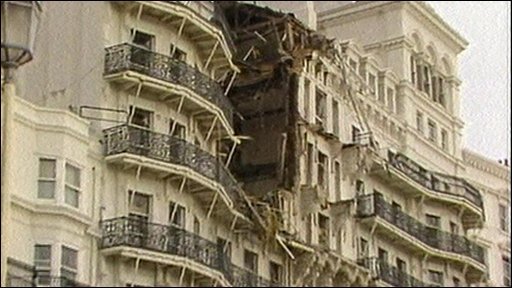
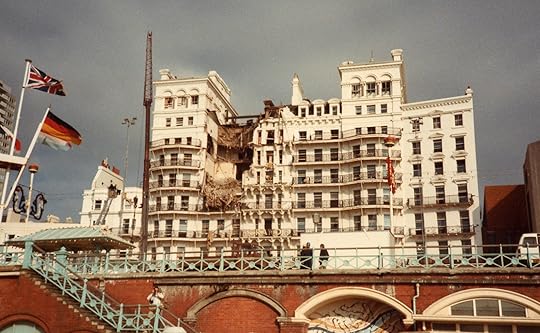
Let’s first look at the facts upon which the novel is based: in October, 1984, an IRA bomb exploded in Brighton’s Grand Hotel, in an audacious attempt to assassinate Margaret Thatcher. She survived and even delivered a keynote address later; others who were present were not so lucky.
Readers who expect a taut political thriller or even an excavation of what led to this dramatic action will not find it here in this book. Although the book is based on the 1984 events, it is mostly interested in exploring people on the brink, poised to perform a high dive but really going through the motions.
Moose, the poignant Grand Hotel deputy manager, is in his mid-forties, bemoaning the glory days when he was poised to become a professional diver. Now he treads water waiting for a promotion that may never come, raising his teenage daughter, Freya, who is similarly treading water. has a temporary job at the hotel while she contemplates life after high school. The third key character, Dan, is a young Belfast man who is tapped to play a supportive role in the eventual bombing.
Always, the water is a metaphor for our immersion in life. In some ways, Moose could be a cousin to John Updike’s Harry Rabbit: a one-time star athlete swimming through the enchantments and disenchantments of life, trying to attain grace under pressure and becoming two-dimensional by his very ordinariness. In fact, all the characters grapple with action versus inertia, unearthing the meaningful, and small acts of kindness versus large transformative gestures which may, at the end, mean nothing at all.
This is a languid and at times, lyrical book. While we readers are aware of the tick-tick-tick of the bomb, it’s the tick-tick-tick of life and its sundry tasks that absorb us. At the end of the day, High Dive contrasts those private moments that history so rarely records – the true achievements of life – against those grand moments that eventually become asterisks in the annals of our collective histories.
I didn't find myself coming back to this even after resolving my Hoopla download issues. I think I'm just not that into the story. Tried it out because of it being on the Tournament of Books.
Jonathan Lee’s novel focuses on the lead up to the Brighton Bombing in 1984. An IRA bomb meant to kill Prime Minister Margaret Thatcher went off in the beachside Grand Hotel during a Conservative Party conference that fall. Lee focuses on three invented characters – Phillip Finch, hotel assistant manager, his 18-year-old daughter Freya, and Dan, a 20-something IRA man from Belfast.
Phillip Finch, or Moose, is a disillusioned man. After his wife left him for another man, he raises his daughter Freya alone. Starting his life as a high diver, he becomes a diving coach, and later ends up in the hospitality business. He hopes that a successful hosting of the Conservative conference, will lead to a promotion to General Manager at the Grand Hotel. His daughter, Freya, is reluctant to go to university, but unhappy working as a receptionist at the Grand Hotel, with her father. Dan lives with his widowed mother in a Protestant neighborhood, where they are one of two Catholic families. His father was a victim of the Troubles, which may have pushed Dan into the IRA.
Despite the terrorism at the center of this novel, Lee constructs portraits of many of the banalities in these characters’ lives. Dan’s mother is concerned about Japanese knotweed in their back garden, and pushes her son to do something about it. Freya avoids a friend who is involved with protestors, and Moose wonders if Coke is one of the sugary things his doctor told him to avoid. Life in Brighton, particularly in the hotel, is ordinary. Moose worries for weeks about getting the exactly right color of napkins for the Conservative gathering. Freya worries about a friendship/romance with another employee. Dan worries if the bomb he planted will go off, and never about the terror it will cause people in the hotel.
It took me several chapters to get a feel for the tone of the book. While the story of a terrorist event could be written as a thriller, the author chooses to remind readers that until these events strike, everyone is caught up in their daily humdrum lives. I found myself unable to put this book down from the middle towards the end. Readers know that a bombing is coming, but just not exactly when.
I was enchanted by the colorful, crazy “Captain” who tells Freda that there is not a better writer alive than Bernard MacLaverty. By 1984, MacLaverty, born in Belfast, but living in Scotland, had written several novels including Lamb and Cal. Reading this line is pushing me to read some of the unread MacLaverty books on my shelf. I also loved it when the character Marina, seemingly not a native speaker of English, misspeaks and says “No man is an Ireland”. Lee writes “He wanted to pick up on the pronunciation, correct the error, but to do so would be petty – and- after all Ireland was an island...”
I tend to be very bothered by anachronisms and such errors in novels. Lee makes a few, but I could not confirm all. Freya and her father apparently enjoy reruns of the American sitcom Rhoda. Rhoda ran from 1974-78 in the US. I couldn’t confirm that it was actually shown on British TV in the 1980’s. It didn’t even become available on VHS until the 1990’s. He also describes a reporter using a moleskin notebook - it's 1984. In 1986, moleskin notebooks stopped being produced and before that seemed to be used primarily by artists, and writers, but probably not journalists. If there were any journalists using them, they would have been very esoteric. Other anachronisms include a reference to vegans. Although the concept existed at the time, some online research revealed in the early 1980’s vegetarianism was considered “out there” and veganism wasn’t part of mainstream conversation.
Lee also quotes a person referring to someone’s “command of Gaelic”. The Irish language is generally referred to as Irish, and it is mostly Americans who call it Gaelic. Gaelic is what is spoken in Scotland, and though it is sometimes called Scots Gaelic, more commonly the terms used are Irish and Gaelic to distinguish the two.
Because this book pulled me in and kept me reading, it is worth a high rating. The author provides enough detail of Dan's IRA life to make it realistic, and appears to ground his details in actual events. The thoughts and feelings of the three principal characters are consistent with their situations and ages. Above all, the book leaves the reader thinking about the impact of terrorism and the ordinary lives it disrupts, and destroys.
I would describe this novel less an historical novel than it is a novel with an historical event that took place in 1984. The IRA bombing/assassination attempt of Margaret Thatcher was planted two weeks in advance, at the Hotel Grand in Brighton, the place where the Iron Lady planned to deliver her keynote speech at the Conservative Party conference. In all other respects, the novel was a study of fictional characters of the author’s imagination. Waiting for the bomb to go off adds foreshadowing, plot progression, and tension toward the end game, and it does it effectively, if not at full tilt. However, while we know that Thatcher and her husband survived the bomb, what we don’t know is which of Lee’s fabricated cast—primarily, the hospitality crew at the hotel--outlived the Provo’s violence against Thatcher and her staff. But, as that happens at the climax, we are more concerned with the main characters’ imminent choices and concerns of everyday life.
The title is used as an extended metaphor throughout the novel, but more specifically it refers to Moose, the mid-forties deputy hotel manager and his lost opportunity as a professional diver in his youth. His ex-wife describes her life to him as him as being “married to a man who preferred to make a living out of falling into water. A man who was content to fall and fall.” Now, he’s out of shape, long divorced, and largely raising their now eighteen-year-old daughter, Freya, by himself, while the reader observes his repeating plunges. He hopes that, by hosting Thatcher successfully (his talent and ambition is what lured her to choose the Grand), he will be in line as the next General Manager. Intelligent, compassionate Freya, who isn’t exactly disaffected, (but plays the part well superficially), has just finished her A-levels and has disappointed her father by announcing she doesn’t want to go to college. She is working the desk at the resort, trying to figure out what comes next in her life.
There are other, secondary characters, as well as a vicious cat, that Lee vividly depicts. Finally, there’s Dan, who we meet in the prologue, a sad, single, but acutely skilled explosives expert in Belfast, working for the Provos, and living with his mentally fragile mother. Getting inside his head was no mean feat; he is as humanized as the “innocents” that surround him, and his cunning superior, Dawson McCartland. The author sets aside boilerplate moral judgment in favor of depth of character. I couldn’t help but empathize with Dan’s losses, as well as all the missteps, defeats, failures, tepid triumphs, and small victories of everyone in this poignant story. Even Dan’s mother, who could easily have been one-dimensional and pathetic, surprised me with her backbone during a drowning moment.
This is not a swift read, nor does it read like a thriller. The story moves along statically at times, as Lee submerges us in his literary embellishments. On a lesser author, I would have complained. But Lee has such vigor and fierceness, and such precision with his metaphors and aphorisms, that these ornamentations didn’t gild the lily; rather, they more often nourished it. But if you like your prose lean, then this could be a problem for you. Lee uses satire at intervals, but never to undermine the moving and emotional core of the characters and story. Thematically, I see the pride before the fall--some falls deep or too late, some lighter and with a more hopeful recovery. The author is wise and sharp, observant and wholly sympathetic. Here’s a passage that sticks with me"
“I am interested in fictions of all sorts…Novels. Poems. Stories…I’ve never found much that’s fruitful in straight-faced facts. Can’t make myself believe in them. Second-hand is what they are, they lack the raw stuff of absurdity…as if life isn’t funny, or all-funny as if life isn’t serious. You can only get at the world if you do both.”
And that’s what this novel does. It gets at both, and leaves you somewhere in mid-air of that high dive.
Though it uses one as its narrative springboard, this is not primarily a book about a bombing. It is a novel about people, not politics. And (to use the frequently-introduced metaphor of springboard diving), it is a story told mainly in the mid-air suspension between take-off and completion. In this case, a three-week suspension, between the time when the Provisional IRA placed a bomb in the Grand Hotel in the seaside resort of Brighton, England, and October 11, 1984, when it exploded at a time when the hotel was hosting Prime Minister Margaret Thatcher and most of her cabinet.
The novel starts with a bang, in a gripping scene in which a young Belfast man named Dan undergoes an ordeal at an isolated Ulster farm as part of his recruitment into the Provos. I think I may have read a similar episode before, possibly in Stuart Neville's Ghosts of Belfast, but Jonathan Lee's scene is still visceral and convincing. As are almost all the sections involving Dan—who is of course one of the eventual bombers. They are set in a Belfast that I recognize (my own birthplace): not my part of the town, though the social and sectarian situation rings very true—except for one scene where I think Lee exaggerates to maximize atrocity that needs no exaggeration.
Most of the book, though, takes place in Brighton, and here the focus is on two people, the Deputy General Manager Moose Finch and his daughter Freya, a high-school leaver who works in reception. For me, the interest of the novel plunged at this point. For now, the selection of these two seemed arbitrary. It also had the effect of making the Grand Hotel, which truly is grand, into something smaller and more petty, with cameo appearances by the holders of various roles: the head of customer relations, the chief chef, the bell-boy, the cat. I was also a little disturbed that this was a real place at a real time, and that Lee was taking liberties by fictionalizing roles that must have been held by real people.
Fortunately, over the course of this three-week period, Lee manages to develop the father and daughter more fully. Moose is a former high-school jock whose plans for greater things never materialized, and he is becoming aware that he may now be stuck in middle-management for ever. But at least something happens to him during this time, which I shall not reveal here, but which knocks him off the all-too-predictable rails. Freya is believable enough as an older teen, but nothing of significance happens to define her, so she remains the least interesting of the three characters. Dan, meanwhile, is back in Belfast, dealing with the problems of being one of the few Catholics in a Protestant neighborhood and waiting for news of the bomb's success or failure.
Well, as history recounts, the bomb did go off, but Thatcher was nowhere near. Lee suggests (correctly, I think) that her hold on the premiership was becoming tenuous, and that if she did not give the speech of her life at the party conference the next day, she would have been ousted. But her defiant speech after the bombing restored her popularity to record heights, so essentially the whole plan was self-defeating. There is indeed an atmosphere of pointlessness that settles over the entire novel in its final chapters. As a comment on strife and even on life, I can see its rather sad validity. But for a reader who saw limited point to the novel to begin with, it made a limp ending to a book that came to life only in fits and starts.
(I'll try to specify later, as soon as I'm done crying)
*** Okay, let's do it.
Действие происходит попеременно то в Белфасте, то в Брайтоне, и основано на реальных событиях, когда в сентябре 1984 года в преддверии ежегодной парламентской конференции в "Гранд-отеле" Брайтона произошел взрыв, который, по расчету ирландских националистов, должен был спасти Британию от Маргарет Тэтчер и заодно от всего нафиг кабинета министров. История охватывает примерно месяц до рокового события и рассказывается с точки зрения молодого ирландца Дэна, рекрута ИРА и специалиста по взрывчатым веществам, замдиректора отеля Филиппа "Лося" Финча и его дочери, выпускницы школы Фреи, подрабатывающей в отеле на ресепшн.
Я уже отвыкла, как на относительно небольшом объеме текста (чуть больше 300 страниц) автору удается детально проработать характеры и создать полную иллюзию погружения в жизнь и устремления главных героев, да и второстепенные, к слову, тоже отрисованы прекрасно. Чего стоит подруга Фреи Сьюзи, активистка, правозащитница и, в общем, так себе подруга: "... and in this moment Freya thought of the time when she'd asked Susie's little sister to name her ten favourite people. Six of them had been animals, two of them were her mum, and the first place went to a plastic doll called Amanda Jane whose eyes were alarmingly large."
Читатель узнает об обряде посвящения Дэна в ИРА, о его жизни с престарелой матерью-католичкой на улице протестантов, о ситуации в Ирландии, обо всем, что привело его, "мелкого предпринимателя на отдыхе", и его веселый чемоданчик с взрывчаткой в Гранд-отель. Все это ужасно интересно, и особенно жутко читать, если вспомнить, что описываемым временам - каких-то тридцать лет.
В Гранд-отеле, Брайтон, тем временем происходит "Гранд-отель "Будапешт": носильщик пакостит, если не предложишь его услуги гостям, "серфер Джон" крутит романы с горничными, горничные пишут картины, а Лось Финч мечтает, как сменит на посту генерального менеджера, и уж тогда они в Фреей заживут по-королевски. Лось Финч -- один из самых по-хорошему жалостных героев этого года: когда-то подающий умеренные надежды спортсмен, а ныне ответственный служащий, добрый отец, терпеливый сын, внимательный и ужасно несчастный муж. Первая глава про отель вдобавок еще и дико смешная.
Фрее, с другой стороны, немного не до смеха: отец настаивает, чтобы со своим хорошим аттестатом она пошла в университет ("откуда ты знаешь, что там классно, ты же туда не ходил!", очередной привет родителям, желающим своим детям всего лучшего и не как у них), а сама Фрея не то чтобы с планами на жизнь - со стрижкой не может определиться. Фрея - отличный книжный образ подростка, умного, вежливого, заботливого, но все равно - подростка, который служить бы рад, но нельзя ли мне, пожалуйста, еще пару минут на размышление.
Книга почти идеально завершается ровно тем событием из реальной жизни, которое и анонсировано в аннотации издательства, а короткое послесловие автора добьет и остальных.
This was a novel about the planning and mostly character background story of fictional characters before the 1984 bombing of the Grand Hotel/ attempted assassination of Margaret Thatcher by the IRA. This novel had potential and the writing was great but it dragged in many parts and I feel like it could have been a lot shorter and had more impact.
I gave this 3 stars on Goodreads.
I received an advanced copy of this book from Penguin's First to Read Program with no requirement to review book.
A promising, fascinating premise...disappointing execution... the net result: one star.
The premise for High Dive drew me in immediately. In 1984, a bomb was planted in an English seaside hotel, and it was set to explode when Prime Minister Margaret Thatcher and her cabinet would be staying there. High Dive promised to weave together fact and fiction to imagine what happened. Since I didn't recall the actual events, I was on board from the beginning, expecting an informative and exciting interpretation of history.
Initially, the book delivered on its premise. The story begins with a bang as Dan, who will become a young IRA explosives expert, is initiated six years before planting the bomb. The initiation is vivid and heart pounding; it's dramatic and well written. Let's just say dog lovers beware.
But from then on, even through the explosion at the end, I was disappointed, feeling betrayed and worst of all, bored. The portions dedicated to Dan are interesting, though somewhat removed from the bomb making and planting. The other portions are devoted to Moose, a feckless deputy hotel manager, and Freya, his teenage daughter, who lacks direction, motivation, and energy. These portions--the bulk of the book--are uninteresting and mostly disconnected from the historical events because much of the book consists of their depressing back stories. Imagine an over-the-hill athlete, who is divorced and lonely, with a daughter struggling with ordinary coming-of-age angst. That their lives touch the bomb plot only occasionally makes for the disconnect between potential premise and actual story.
So High Dive seems less a reimagining of history and more like ordinary life that happens to be contemporary with a dramatic historical event. It's especially disappointing to read a novel that could have flown so high but ultimately remains moored to the ground, never taking flight.
It was GoodReads friend Susan's five star review of 'High Dive' which inspired me to read this. I am very glad I did.
I well remember 12 October 1984, the day the IRA bomb blew up the Grand Hotel in Brighton, and where the Conservative Party was holding its annual conference. I was living in Brighton then and had, coincidentally, been in the hotel a few hours before the device went off.
The genius of this novel is that whilst we know what's going to happen, and how afterwards five people will have died, alongside numerous others who were injured, we don't know who. Quite probably some of the dead or injured will be characters that Jonathan Lee has so beautifully brought to life in the pages of this book.
Teenager Freya is the star of the show, full of the uncertainty and bravado of youth. Her father Moose is the Deputy General Manager at the Grand Hotel, and she works at the hotel too, alongside a host of other well drawn characters.
One of the bombers is Dan, whose sections are the darkest but which are equally credible. Dan lives with his aged mother in a Protestant area of Belfast where some of the neighbours harass them, and the Royal Ulster Constabulary humiliate him and his Catholic friends. Dan blames the police for the death of his father, who was hit by a brick during a civil rights rally.
To say anymore about the plot is to undermine a brilliantly told story which, despite the dark subject matter, is frequently gentle, funny and life reaffirming. Highly recommended.
Es imposible leer este libro y no establecer similitudes con el celebre Patria de Aramburu. En esta ocasión el autor nos lleva al conflicto de Irlanda del Norte con el terrorismo del IRA y igual que ocurría con patria vamos a ver las dos caras de la moneda , el de las victimas y el de los terroristas. Le doy solo 3 estrellas precisamente por haber leído antes el otro porque en la comparación aunque me ha gustado me parece un poco inferior, aunque también esta sensación puede venir provocada por tocarnos a los españoles el terrorismo etarra mas de cerca.
Il Tuffo. Mi è piaciuto abbastanza Il Tuffo, a partire dalla citazione in esergo di un verso dell’Ars Poetica di Czesław Miłosz*. Mi è piaciuta la storia, mi è piaciuta la scelta di affidare alla voce di tre personaggi diversi il compito di ricostruirla, mi è piaciuto il tentativo di farlo attraverso “l’apertura” di una porta interiore che partendo dalla vita dei tre protagonisti (personaggi di fantasia, di cui Lee, in un romanzo corale, ci presenta le vite, le scelte e le aspirazioni nelle tre settimane che precedono “il tuffo”) racconti la genesi di un fatto realmente accaduto a Brighton il 12 ottobre del 1984 quando al Grand (come veniva affettuosamente chiamato il Grand Hotel dai suoi abitanti) esplose una bomba piazzata dall’IRA che ne devastò la struttura (crollarono tre piani) e uccise cinque persone. Non fu una bomba piazzata a caso, perché proprio in quei giorni l’albergo era affollato e quasi interamente occupato dai Tories riuniti per il Conservative Party, e perché proprio quel giorno, quella sera, era fra gli ospiti, in attesa di pronunciare l’indomani il proprio discorso, Margaret Tatcher, che invece scampò fortunosamente (e casualmente) all’attentato. Dell’attentato, rivendicato dall’IRA, venne ritenuto responsabile materiale Patrick Magee**, l’artificiere storico, identificato in Roy Walsh, che affittò una stanza nell’albergo quasi un mese prima per assemblare un ordigno esplosivo con timer a lungo rilascio.
Mi è piaciuto abbastanza, perché il racconto parte da lontano, e cioè dall’affiliazione del giovane Dan all’IRA. Dan di Belfast. Dan come tanti ragazzi irlandesi del Nord, ma meno irruente di tanti suoi omologhi letterari o cinematografici, più taciturno, più riflessivo, un «idealista col cervello». E dalle tante aspettative di Moose Finch, vice direttore dell’albergo, che vede nel convegno l’opportunità per mettersi in luce e avere finalmente il proprio riscatto dopo una vita semi fallimentare, e di sua figlia Freya, giovane e insicura, che nell’albergo lavora saltuariamente in attesa di prendere decisioni di vita più importanti. Sono tre storie destinate a convergere drammaticamente, lo sappiamo sin dall’inizio, eppure l’avvicinamento orchestrato da Lee è dolce, mai brusco; ed è forse questa assenza di tensione, nonostante sia chiaro che l’epilogo sarà quello che la storia ci ha già consegnato, che in parte priva il racconto di incisività: le vicende dei protagonisti finiscono per essere troppo diluite nel racconto, distraggono anziché arricchire, allungano senza disegnare più finemente lo scenario, e si finisce per partecipare poco, emotivamente, ai loro fallimenti o a parteggiare per le loro vicende private o preoccuparsi per le loro sorti. Il tentativo di ricostruire lo scenario sociale dell’epoca - da una parte l’Irlanda di Belfast e dall’altra la tranquilla e placida Brighton - mi sembra non del tutto riuscito, nonostante le brevi incursioni (per bocca dei protagonisti) con cui Lee ce le tratteggia, e se è vero che l’atmosfera rarefatta in cui si muovono tutti dovrebbe delineare proprio quell’attimo di sospensione che nel tuffo (ottima metafora per descrivercelo, quell’attimo) precede l’entrata in acqua, e quindi la deflagrazione della bomba, nel romanzo non ci si riesce mai a sentire con l’acqua alla gola, ad avere la percezione di essere davvero sospesi tra la piattaforma e l’acqua. Quindi mi è piaciuto abbastanza, ma senza coinvolgermi, senza restituirmi tutta la drammaticità e il dolore che quegli anni e quella parte di storia, e questo avvenimento in particolare, meritano sempre nella mia memoria.
*Quanto è difficile rimanere la stessa persona, perché la nostra casa è aperta, la porta senza chiave e ospiti invisibili entrano ed escono.
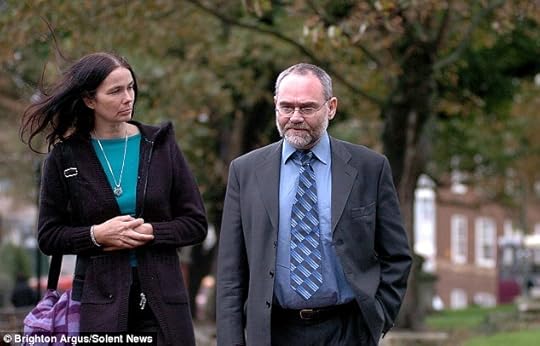
**Patrick Magee, identificato in Roy Walsh, fu l’unico appartenente all’IRA a essere riconosciuto responsabile materiale dell’attentato, anche se - e Jonathan Lee procede secondo questa ipotesi nella sua ricostruzione che usa la fiction per raccontare un avvenimento reale - si sospettò, a causa di impronte digitali non identificate, la presenza di un secondo membro dell’IRA nell’hotel. Magee e Jo Berry, figlia di Sir Anthony Berry, una delle vittime, hanno fondato insieme l’organizzazione no-profit ”Building Bridges for Peace”: ora sono entrambi, insieme, dal lato giusto della storia.
I found bits of myself in all three of the main characters in this empathic novel. Lee makes the inchoate seeking of each of these figures -- an IRA bomb maker, a disappointed hotelier and his late teenage daughter -- a tragedy, a comedy and a plea for greater understanding. Really glad I read this book and hope it does well in the Tournament of Books next month.
Annotazioni pigre in attesa di scrivere la recensione che merita
"Aveva l'abitudine di fare una croce su ogni giorno che passava, riquadri di vita cancellata, a matita, mai a penna, come se a un certo punto avesse potuto ripescare un martedì dal tempo andato".
"Se bisognava restare prigionieri dei propri pensieri, tanto valeva farne un sogno."
"A guardarle attentamente, ci si rendeva conto che gran parte delle persone si comportavano in modo anomalo per gran parte del tempo: Era proprio questo a rendere la vita interessante in un hotel."
HIGH DIVE by Jonathan Lee is an interesting historical novel that develops a number of fascinating characters as it unfolds. The novel seems to travel on two tracks, the first are the Eriksonian identity crisis’ that evolve as each character is forced to ponder their roles in society, their life’s work, and what the future holds. The second are the ever present problems that infect the Irish-British relationship that have gone on for centuries. What makes the novel impactful is that behind the interaction of each character with their environment is the proposed visit of British Prime Minister, Margaret Thatcher to the Grand Hotel, a resort in Brighton, England in 1984, and a possible assassination attempt on her life. The politics of the era are integrated in an accurate fashion as Thatcher’s Conservative Party record is dissected in terms of its onerous effect on Catholics in Northern Ireland and the poor of England in general. The setting is historically accurate as Thatcher did visit Brighton in 1984 and there was an IRA assassination attempt on her life. What Lee tries to do is explore IRA planning involving the real assassin, Patrick J. Magee and the fictitious character, Dan, who is created to be his assistant in planting the bomb with its timing device a few weeks before the visit.
The novel opens with Dan, a handyman-electrician type meeting Dawson McCartland, an IRA operative who tests him whether he is worthy enough for “the cause.” Once he passes his initiation, Dan’s new life has begun as a freedom fighter for the Republican army against the British and their Protestant allies in Ulster. The evolution of Dan’s character is extremely important first using the alias of Roy Walsh, and later in the novel as Lee explains Dan’s relationship with his mother and provides insight into what it was like to grow up dealing with the RUC (Royal Ulster Constabulary) raids and beatings at home and on the street. As the “Thatcher” mission is planned and implemented we witness a person who experiences doubts about his actions and who he is, and has become. Dan interacts a great deal with Freya Finch, a nineteen year old girl, who has a crush on him, and is trying to break away from her father, but is confused about what path to take. She is very bright and her father wants her to enroll in the university, but she is uncertain. Her parents divorced when she was very young and has been raised by her father with whom she has a strong bond. She spends her summers working at the hotel, but that is not enough for her. Her father, Peter Finch, whose nickname is “Moose” runs the Grand Hotel after giving up a career in teaching and must deal with his own identity issues. He grew up as a champion athlete and still practices his high dives in the hotel pool. His entire life is wrapped up in the everyday details of the resort as he tries to fight off his personal demons that date back to Vivienne, the wife who left him. A few weeks before Thatcher’s visit he has a heart attack and must reassess his life. There are many other characters that provide the glue that holds the novel together from surfer John, IRA operatives, and the hotel staff, but it is the three mentioned that form the core of the plot.
Lee has a very distinctive approach in his writing. He can be humorous, sarcastic, and serious all within the same few sentences of dialogue as he describes the plight of Catholics in Northern Ireland. For example, “The whole of your life in Belfast was organized around light and dark, visibility and invisibility, silence and sound, information and secrecy, the private rubbing up against the public and making you feel tired.” Lee repeatedly comments about the politics that infect the “the Irish problem,” as Ireland “at night was a repeated dream,” as well the everyday existence of even famous people, by his reference the birth of Prince Henry, and stating “the baby prince looked tricksy, sardonic, chubby, blotchy, and would hopefully cheer up his sad eyed mum.” Lee also provides an interesting description and insights into how a large resort is managed and what they prepare for such an important VIP visit. Further, Lee offers an account of the Conservative party gathering when many self-important people went about trying to impress their peers. In addition, Lee goes inside the planning of the terrorist attack, from its inception and actual implementation. Once the bomb is placed in the hotel, it seems that the story begins to creep along at a much slower pace as Lee returns to the crisis’ that affect each major character, and at times you feel that the story should speed up and see if the attack will be successful.
The book is more than a recreation of an IRA terrorist planting a bomb at the Grand Hotel. It plies the depth of class disappointment that is the core of Irish Catholic hatred of the British government, and particular the policies of the Conservative party and its Irish Protestant allies. It is more a reflection of the daily humiliation an oppressed people must cope with and its psychological impact. Dan is a key character who at age 24 learns he will be involved with the assassination plot. Dan describes his past as the paras killed his father and on a number of occasions barged into his house and beat his mother, or forced him to dance a “jig” as they attacked a local pub. These events are more than enough to put Dan over the edge and turn him into a terrorist. Having lived in southeast London while conducting research at the Public Records Office in 1987 I witnessed the hatred of the poor against the Thatcher government as each night in this working class neighborhood, men would pour out their hearts at their local pubs. It is easy to understand their frustration and why many turn to violence.
HIGH DIVE is a remarkable read as Lee captures the tension that existed in early 1980s Ulster. He creates sincere characters, and a part from some pacing issues it should be a positive experience for those who put aside the time to engage the story.
3.8* Μόλις τελειωσα την Καταδυση του Τζοναθαν Λη απο τις εκδοσεις Καστανιώτη. Δίκιο εχουν οι κριτικές ότι η τελευτσαια σελιδα του βιβλίου εχει πλέον γίνει κλασσικη και αναφερεται παντου. Κριμα που δεν μπορω να την γραψω εδώ για να μην κανω σπόιλερ. Ένα πολύ καλό βιβλίο με καποιες αδυναμιες που οφείλονται κυριως στο ότι ο μεσος ευρωπαιος αναγνωστης δεν μπορει τοσο να ταυτιστει με την καθημερινοτητα των Iρλανδων αλλά και παλι, κάποιες φορες γίνεται εκπληκτικο.
I'm a sucker for fiction set in Ireland during the Troubles, especially when it has interesting characters, lovely writing, middling levels of suspense, and poignant observations about life and how we deal with what it gives us or doesn't. Extra star when it's an audio book read by Gerard Doyle.
In order to make a high dive, you have to first climb high. Overcome doubt and fear. Trust that you will hit clean. A former champion diver, Moose has taught Freya, his daughter, well, but at 18 she is uncertain whether to go to uni despite higher A levels than anticipated. She's made the climb, should she take the plunge. On the other side of the channel, Dan is "making his bones" with the IRA. His own climb is more metaphorical. The "Troubles" were very much a part of the landscape in Britain, well within many readers' memories, and this blend of fact and fiction is so well realized
By getting under the skin of these three very well developed characters, Jonathan Lee sets the stage for a fictional account of the 1984 IRA bombing of the Grand Hotel in Brighton in an attempt to assassinate PM Thatcher and as many of her ministers as possible, present for a conference. That the actual loss of life did not meet the Provo's expectations is not relevant. It's the anticipation of coming events that lights the charge for the reader. Scenes in Belfast depicting the life of Catholic townsmen under the RCU deliver a punch, which while it doesn't mitigate the impersonality of a bomb's destruction, does explain the conflict from the Provos' point of view. At the Grand, Mooses's position as assistant general manager, pinning his hopes of a promotion on this event, goes all out in the "careful choreography of guest experience, perfect neatness of rooms and attractive symmetry of the meals." Highly recommended.
I've wondered if I've been too stingy with my stars recently, because I've read several good books that only got four stars from me. But there is something I need besides a good story excellently told: I need a brilliance in the use of language -- and I found it in HIGH DIVE. This is the kind of book that causes me to stop often -- too often -- and marvel at how the author manages to find such exact yet original ways of expressing what he, or a character, means, and who manages to create one unique metaphor after another, all of which seem to call up the right image and none of which seem forced.
In short, Lee is a brilliant writer, and the consequence of that is that I read a book about a subject I normally would have found uninteresting and too violent: the true story of an IRA attempt on Margaret Thatcher's life by bombing a hotel where a Conservative Party meeting would be held.
The story is told in chapters alternating between the bomber himself and the various members of the hotel staff. The reader knows what is going to happen because the book jacket tells us -- and if you are British and above a certain age you probably remember the incident anyway -- but of course the characters don't know their future. Even the bomber doesn't know until he gets the assignment. So we anticipate, knowing there will be a bomb but not knowing if any of our characters will die. Thus, on top of all the other virtues of this novel, suspense keeps us turning the pages.
This is Lee's first novel. I predict a brilliant career.
Fictional accounts of actual events seems to be a popular new approach to the novel. Jonathan Lee's book is a prime example. This story is about the IRA's 1984 bombing of the Grand Hotel in Brighton England intended to kill PM Margaret Thatcher and her political upper echelon. She was staying in the hotel for a conference and the bomb had been planted on a long delay.
The book opens with an IRA initiation of a young young man named Dan. I was immediately riveted. The book explores his development along with the lives of those connected to the hotel: father manager, his hapless daughter, and staff. I must admit I was not particularly interested in the hotel staff and longed for the book to get back to the action. Without realizing it I wanted a political thriller which this book really is not. The book clicked on for me again when things got closer to the bombing.
The author sets the stage for the war between the Brits and the IRA but does not provide great historical detail. The author's intention I think was to describe what it was like to live and breath at that exact time in history from two very different and polarized perspectives. I found myself wanting to find out more which is sign that the book did indeed get under my skin.
Me ha gustado. Un tema no demasiado tratado desde este ángulo y un acontecimiento olvidado por muchos pese a lo reciente http://entremontonesdelibros.blogspot...
3.5-4 stars. I read this one for the 2017 Tournament of Books. A pretty good book with decent character development for the three main characters. I listened to it on audio - it may have been a better book for me to read - not that the audio was bad, but I think I would have gotten more from it had I read it. I liked Margaret Thatcher back in the day so the book held my attention. It was not a technical "Tom Clancy" assassination book but more of a literary account of the people involved and possible affected by the assassination attempt. As I write this I think I like it more than I did before putting my thoughts on paper.
For the TOB, it is going against The Mothers. I think I like this one better actually. I think it will be a good match.
I had mixed reactions to this novel: I loved the tense thread following the IRA initiation, training, bomb planting and aftermath, but found the hotel deputy manager and his daughter plot a bit tepid; arbitrary really. The bloke can write.
I can't really think of anything I didn't like about this book, and yet it was just a 3 star for me. The characters were engaging and I felt like I really got to know them, and life in Brighton in the 1980's too. I like the author's writing style - it felt effortless to read but not at all fluffy, and I didn't mind that the bombing itself wasn't the central point of the novel. I think maybe it needed a little more narrative tension.
High Dive by Jonathan Lee 2 out of 5 stars The Brighton Grand Hotel bombing of 1984
‘High Dive’ commences in 1978 with an IRA initiation ceremony for Dan, one of the main characters in this book. The other two main characters are Philip Finch (also known as Moose), the Deputy General Manager of the Grand Hotel in Brighton, and his teenage daughter Freya.
The majority of this book explores the lives of these three people. Dan, with his Belfast upbringing amongst the British occupation and the Catholic and Protestant ‘Troubles’; Moose, with his regrets of failures throughout his life and dreams of promotion to General Manager and Freya, with her hopes for the future, resentment of her mother’s desertion and being a one-parent child.
Despite Jonathan Lee’s command of prose and the scatterings of humour within the book, I must confess that I thought the three main characters were overworked. Their stories meandered far too much for my liking, and I thought it was a case of too many words getting in the way of the storyline. Also, the real hatred of the Catholics, Protestants and the British troops in Northern Ireland was understated and rather sanitised, as was the revulsion by many of Margaret Thatcher and her government.
It wasn’t until the last few chapters where Lee skilfully writes about the actual bombing of the hotel and its aftermath that I felt the book was really moving forward. Sméagol
Breakaway Reviewers received an advanced copy of the book to review
"Sometimes, the before is more interesting than the after, no? Heading towards the impact. What is beautiful about a dive? It isn't the splash, is it?" He thought about telling her a good dive doesn't involve a splash. "I wanted to sing about what the lives were like before the quake. The day-to-day, what gets lost. That's the song I wanted to sing."
Jonathan Lee has done just that - created a song about the before, the details that get lost once the event happens. The story leads up to the Brighton Hotel Bombing of 1984. We meet the IRA member in charge of the bombing, the hotel manager and his daughter, and those surrounding them. The premise may seem boring - the day-to-day, mundane events in a few characters' lives - but it's done so well and with such a sense of suspense that I ended up enjoying it much more than I though I would in the beginning. It does have its slow spots, and I occasionally zoned out from the audio. Overall, a solid 3-3.5 star book.