

What do you think?

Ancient Lives
Perpetua: The Woman, the Martyr
An intimate and human portrait of Perpetua, a third-century woman author who was idealized as a Christian martyr
On March 7, 203, in the monumental amphitheater at Carthage, Vibia Perpetua was one of five Christians who met their deaths after refusing to venerate the Roman emperor Septimius Severus and his son. Perpetua stood out from the other four, and in fact from all the other martyrs of her era and she was an aristocratic married woman with an infant son, and she is the first female prose author whose work survives.
Offering a probing new translation of Perpetua's extraordinary prison diary and situating the life behind that diary within the turbulent late Roman Empire, Sarah Ruden tells the story of Perpetua's remarkable feat of self‑invention as a martyr. As she builds on Perpetua's own words and integrates them into their religious and historical contexts, Ruden shines a light on Perpetua's disarming candidness, her brashness, and her naïvété. In contrast to traditional portrayals of the saint as a brave but submissive young woman, Ruden's narrative reveals a complex individual who flaunts a vivid public persona as a martyr while at the same time navigating the emotions of a mother, daughter, sister, and friend approaching death.
On March 7, 203, in the monumental amphitheater at Carthage, Vibia Perpetua was one of five Christians who met their deaths after refusing to venerate the Roman emperor Septimius Severus and his son. Perpetua stood out from the other four, and in fact from all the other martyrs of her era and she was an aristocratic married woman with an infant son, and she is the first female prose author whose work survives.
Offering a probing new translation of Perpetua's extraordinary prison diary and situating the life behind that diary within the turbulent late Roman Empire, Sarah Ruden tells the story of Perpetua's remarkable feat of self‑invention as a martyr. As she builds on Perpetua's own words and integrates them into their religious and historical contexts, Ruden shines a light on Perpetua's disarming candidness, her brashness, and her naïvété. In contrast to traditional portrayals of the saint as a brave but submissive young woman, Ruden's narrative reveals a complex individual who flaunts a vivid public persona as a martyr while at the same time navigating the emotions of a mother, daughter, sister, and friend approaching death.
Audible Audio
First published September 2, 2025
About the author
Sarah Ruden
28 books126 followersSarah Elizabeth Ruden is an American writer of poetry, essays, translations of Classic literature, and popularizations of Biblical philology, religious criticism and interpretation.
Ratings & Reviews
Friends & Following
Create a free account to discover what your friends think of this book!
Community Reviews
Displaying 1 - 8 of 8 reviews
February 11, 2026
A Life of Vidia Perpetua
A review of the Yale University Press - Ancient Lives series hardcover (September 5, 2025) with reference to the eBook edition.
So I was pleased to read a further volume in the series with Perpetua: The Woman, The Martyr, which incorporates a biography with Ruden's translation of Passio sanctarum Perpetuae et Felicitatis (c. 203 AD), usually translated as The Passion of the Saints Perpetua and Felicity.
As with her earlier biography of the otherwise little known life of Vergil, Ruden had to extrapolate on the life of Vidia Perpetua (c. 182 AD-c. 203 AD) from the clues in the Passion text and from the lives of people in Ancient Rome and Carthage. Spread throughout the book are various interesting asides that range from the lives of people living in those times to the later historical fiction books which also portrayed the lives of early Christian martyrs. I had the book from the library but found so many passages worth highlighting that I added an eBook for that convenience. You can read those here.
The extraordinary thing about the imprisonment portion (which includes the description of four visions) of the Passion text is that its tone and character really does come across as being written by (or more likely narrated to and written down by a scribe) the actual woman. This is so much so that Ruden even says that "she appears to be the first female prose author in Western history whose work we still possess." The introductory text and the description of the later martyrdom in the arena is of course written by a so-called redactor.
Trivia and Links
Perpetua: A Woman, A Martyr is part of Yale University Press's Ancient Lives series which also has a Goodreads series listing here (2022 - 2026 ongoing).
Sarah Ruden's next book to be published will be Reproductive Wrongs: A Short History of Bad Ideas About Women (expected March 3, 2026). It is described as:
A review of the Yale University Press - Ancient Lives series hardcover (September 5, 2025) with reference to the eBook edition.
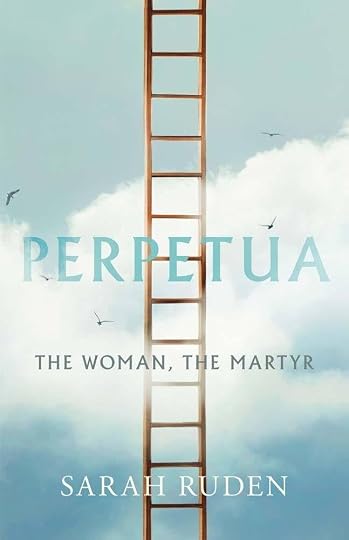
I saw a bronze ladder, amazingly long, and reaching all the way to the sky, but narrow, so that people could go up it only one at a time. And on the sides of the ladder iron gear of all kinds was stuck in. ... And below this ladder a snake was lying, amazingly big, waiting in ambush.- Excerpt from The Suffering of the Holy Perpetua and Felicitas, translated from the Latin language original by Sarah Ruden.I've become a fan of classicist Sarah Ruden and her sometimes unorthodox translations which attempt to capture the nuances of ancient Greek and Roman vernacular. This was particularly striking in her version of The Gospels: A New Translation (2021) where lines such as John 19:5's "Behold the man!" became "Look at this guy!" I've since read several of her other works including an earlier book in the Ancient Lives series Vergil: The Poets Life (2023).
So I was pleased to read a further volume in the series with Perpetua: The Woman, The Martyr, which incorporates a biography with Ruden's translation of Passio sanctarum Perpetuae et Felicitatis (c. 203 AD), usually translated as The Passion of the Saints Perpetua and Felicity.
As with her earlier biography of the otherwise little known life of Vergil, Ruden had to extrapolate on the life of Vidia Perpetua (c. 182 AD-c. 203 AD) from the clues in the Passion text and from the lives of people in Ancient Rome and Carthage. Spread throughout the book are various interesting asides that range from the lives of people living in those times to the later historical fiction books which also portrayed the lives of early Christian martyrs. I had the book from the library but found so many passages worth highlighting that I added an eBook for that convenience. You can read those here.
The extraordinary thing about the imprisonment portion (which includes the description of four visions) of the Passion text is that its tone and character really does come across as being written by (or more likely narrated to and written down by a scribe) the actual woman. This is so much so that Ruden even says that "she appears to be the first female prose author in Western history whose work we still possess." The introductory text and the description of the later martyrdom in the arena is of course written by a so-called redactor.
Trivia and Links
Perpetua: A Woman, A Martyr is part of Yale University Press's Ancient Lives series which also has a Goodreads series listing here (2022 - 2026 ongoing).
Sarah Ruden's next book to be published will be Reproductive Wrongs: A Short History of Bad Ideas About Women (expected March 3, 2026). It is described as:
In Reproductive Wrongs, acclaimed translator and cultural historian Sarah Ruden exposes how ideologies that oppress women and families in the service of power took hold. Ruden traces a sweeping history through her trenchant analysis of seven pieces of literature that, she argues, marked key inflection points across two thousand years. From propagandistic poetry written by Ovid in the early Roman Empire to the biography of an evangelical American “abortion survivor,” Ruden lays bare how doctrines of control over women were invented and propagated.

June 4, 2026
Sarah Ruden has accomplished the impossible, writing a captivating biography of a famous female martyr from Carthage whose story (with some sections written by her) never captivated me, being filled with zealous piety from the cult of martyrs. Ruden is an accomplished translator of ancient works and somehow she mines fascinating discoveries from the text. She shows how martyr narratives were one of the few expressions open to women, who were otherwise kept silent and in the background due to both Christian and Roman misogyny. But martyr narratives were the LEFT BEHIND novels of their days, providing sensational, violent, and tawdry content that were justified because they were said to promote the Christian faith. We discover that Perpetua was a strong-willed self-indulgent young woman (around age 24) from a respectable family who died around AD 203. She was also married with a child, though there is no mention of a husband. She has visions, quotes the Bible, all supporting her view of herself as a heroic figure willing to die for Christ--which she does. Why I enjoyed the book so much is that Ruden strips away the pious rhetoric and the attempts of Perpetua's male cowriters, who try to mold the story for their own ends, so that we are left with a realistic portrait of a real troubled young woman in a time of dramatic change who somehow manages to make her voice heard. That is quite a feat, considering hers is the first Christian testimony written by a woman that we know of.

May 2, 2026
First, while Ruden makes some good points when she compares the actions, lives and writings of Saint Perpetua and Anne Frank, she fails to also state the obvious difference in that Perpetua had a choice to go to her death, and made that choice multiple times when various people gave her a simple out, a choice that Anne Frank very much did NOT have.
That said, this is a fascinating and detailed analysis of the life, death, and post-life of Vibia Perpetua of Carthage, examining her words, sorting through what she said versus what her editors said, the possible behind the scenes machinations in play, the importance of her dreams, and how Christianity's version of the afterlife brought in so many converts, as well as its promise in its early days of true equality in life for everyone.
I would have liked more context of the then-current events, as well as getting more into the latest brain chemistry research to examine what was happening both when Perpetua was awake and asleep, but for someone so overlooked and - literally - overwritten, this biography was an excellent start.

September 8, 2026
Four stars. Sarah Ruden's Perpetua: The Woman, the Martyr is a short, rigorous, and genuinely moving biography of one of the most remarkable figures in early Christian history: a 22-year-old aristocratic woman in Roman Carthage who in 203 AD walked into an amphitheater and died for her faith, leaving behind a prison diary that makes her the first female prose author in Western history whose work we still possess.
I have now read essentially the complete works of Sarah Ruden: her translations of The Gospels , Virgil's Aeneid, Aristophanes' Lysistrata, the Homeric Hymns, Apuleius' The Golden Ass, Plato's Hippias Minor, Augustine's Confessions, and Aeschylus's Oresteia; her scholarly works The Face of Water and Paul Among the People ; her biography Vergil: The Poet's Life ; and her more recent I Am the Arrow and Reproductive Wrongs . Her first book, a collection of her poetry titled Other Places is long out of print. She is among my favorite authors. Her writing style is always a pleasure — precise, witty, and genuinely literary in a way that academic writing rarely is.
The Literary Biography Approach
Ruden explicitly describes Perpetua as a literary biography: the same approach she used in Vergil: The Poet's Life, another entry in Yale University Press's Ancient Lives series. The problem with both subjects is the same: we know almost nothing about their lives beyond what survives in their own texts. For Perpetua, that means the prison diary she wrote in the weeks before her execution, preserved within the larger text known as The Suffering of the Holy Perpetua and Felicitas.
Ruden's solution is to build a biography around the text rather than from it — using her deep knowledge of Roman history, ancient literature, and early Christian culture to reconstruct the world Perpetua inhabited, and then reading the diary against that world to illuminate what she would have known, felt, and understood. As Ruden writes, "She has had no real biography prior to this attempt of mine, even though, among other distinctions, she appears to be the first female prose author in Western history whose work we still possess."
The result is less a conventional biography than an extended act of close reading — which is exactly what the material demands and what Ruden is uniquely qualified to provide.
Perpetua as a Writer
The most important argument Ruden makes is about Perpetua's literary achievement. The prison diary is not merely a historical document. It is genuinely good prose — intimate, direct, and startlingly modern in its voice:
"If the main narrator's style in The Suffering of the Holy Perpetua and Felicitas is arresting but not odd to our ear, it is because, centuries before modern writers thought they were inventing it, she had the intimate literary voice down flawlessly."
And: "She is not like a literary disciple: not traditional, not institutional, not collegial, and not emulative. She is just strikingly herself on paper."
Ruden is particularly good on the question of what it means for a woman in 203 AD to write in the first person with this kind of unapologetic self-assertion. The Latin word for "I" — ego — "clangs through her assertion," as Ruden puts it. This was not a modest or conventionally feminine text. Perpetua was announcing herself.
Early Christianity as a Radical Movement
One of the most interesting aspects of the book is its portrait of Christianity as it actually was in 203 AD — not the dominant institution of Western civilization but a small, cultish sect perceived by Roman authorities as dangerous extremists. The Romans were not wrong about the danger, exactly; they simply misunderstood its nature. Christians were, in Ruden's framing, militant pacifists. They refused to venerate the emperor, refused to participate in the civic religious life that held Roman society together, and appeared willing to die rather than comply. From a Roman administrative perspective, this was a genuine law-and-order problem.
The rumors that circulated about Christians were predictable products of misunderstanding: "rumors puffed up Christian language — the 'love feast' of 'brothers and sisters,' the ritual 'eating of flesh and drinking of blood' — into evidence of mass depravity that threatened the whole polity." The early Christians were perceived as a threat not because of what they believed but because of what they refused to do.
What fascinates me, and what Ruden captures well, is how completely Christianity transformed once it gained power. The faith that produced martyrs like Perpetua, who went eagerly to her death as an act of devotion, became within a few centuries the faith that justified persecution, crusade, and inquisition. The Dominion by Tom Holland, which I am currently reading, traces this transformation in detail. Early Christianity brought genuine innovations — a radical focus on the poor, on the dignity of every human being, on the equality of souls before God — that permanently transformed Western civilization. But the movement that began with Perpetua's willing death ended up authorizing the deaths of many others. This is one of the more troubling ironies in Western religious history.
Perpetua's Race
A brief but important note that Ruden does not address directly but that the historical evidence makes clear: Perpetua was Roman or of Romanized Berber descent — not Black African by any contemporary understanding of that term. She was described as "well born" and "liberally educated," a member of the Roman provincial upper class in Carthage. Her name, her education, her social position, and her Latin prose all point to a Romanized family of Italian or Berber ancestry.
This matters because of a common modern assumption that anyone from the African continent must be Black. As works like Zeinab Badawi's An African History of Africa make clear, Africa is and has always been a racially and ethnically diverse continent. Roman North Africa in 203 AD was predominantly Berber, Phoenician, and Roman in its population. Perpetua was a North African woman, not a sub-Saharan African woman. The distinction is historically important.
The Translation
The book concludes with Ruden's own translation of The Suffering of the Holy Perpetua and Felicitas — the complete text of which Perpetua's prison diary is a part. This is exactly the right way to end a literary biography: having built the context, Ruden gives you the text itself in her rendering. Her translations are always remarkable for their combination of scholarly accuracy and literary quality. The Wall Street Journal described her translation as capturing "the nuances of the Latin with remarkable skill." I would simply say it reads as literature rather than as an academic exercise, which is her consistent achievement across a remarkable body of work.
Verdict
Four stars. Perpetua is a short book — 208 pages including the translation — but it is dense with learning and genuine critical intelligence. Ruden brings to this subject everything she has developed across decades of translating and interpreting ancient texts: the ability to read between the lines of fragmentary evidence, to hear the living voice in the dead language, and to connect the ancient world to the present without anachronism or sentimentality. Perpetua herself — too vivid, Ruden writes, "to become entirely the vehicle of a cause, even a cause of her own choosing" — deserves exactly this kind of attention.
[Image: Book Cover]
Citation:
Ruden, S. (2025). Perpetua: The woman, the martyr [audiobook]. Tantor Media. https://www.audible.com/pd/Perpetua-A...
Title: Perpetua: The Woman, the Martyr
Author(s): Sarah Ruden
Year: 2025
Genre: Nonfiction — Biography, Ancient History, Religion
Page count: 208 pages
Date(s) read: 9/7/26–9/8/26
Book 179 in 2026
I have now read essentially the complete works of Sarah Ruden: her translations of The Gospels , Virgil's Aeneid, Aristophanes' Lysistrata, the Homeric Hymns, Apuleius' The Golden Ass, Plato's Hippias Minor, Augustine's Confessions, and Aeschylus's Oresteia; her scholarly works The Face of Water and Paul Among the People ; her biography Vergil: The Poet's Life ; and her more recent I Am the Arrow and Reproductive Wrongs . Her first book, a collection of her poetry titled Other Places is long out of print. She is among my favorite authors. Her writing style is always a pleasure — precise, witty, and genuinely literary in a way that academic writing rarely is.
The Literary Biography Approach
Ruden explicitly describes Perpetua as a literary biography: the same approach she used in Vergil: The Poet's Life, another entry in Yale University Press's Ancient Lives series. The problem with both subjects is the same: we know almost nothing about their lives beyond what survives in their own texts. For Perpetua, that means the prison diary she wrote in the weeks before her execution, preserved within the larger text known as The Suffering of the Holy Perpetua and Felicitas.
Ruden's solution is to build a biography around the text rather than from it — using her deep knowledge of Roman history, ancient literature, and early Christian culture to reconstruct the world Perpetua inhabited, and then reading the diary against that world to illuminate what she would have known, felt, and understood. As Ruden writes, "She has had no real biography prior to this attempt of mine, even though, among other distinctions, she appears to be the first female prose author in Western history whose work we still possess."
The result is less a conventional biography than an extended act of close reading — which is exactly what the material demands and what Ruden is uniquely qualified to provide.
Perpetua as a Writer
The most important argument Ruden makes is about Perpetua's literary achievement. The prison diary is not merely a historical document. It is genuinely good prose — intimate, direct, and startlingly modern in its voice:
"If the main narrator's style in The Suffering of the Holy Perpetua and Felicitas is arresting but not odd to our ear, it is because, centuries before modern writers thought they were inventing it, she had the intimate literary voice down flawlessly."
And: "She is not like a literary disciple: not traditional, not institutional, not collegial, and not emulative. She is just strikingly herself on paper."
Ruden is particularly good on the question of what it means for a woman in 203 AD to write in the first person with this kind of unapologetic self-assertion. The Latin word for "I" — ego — "clangs through her assertion," as Ruden puts it. This was not a modest or conventionally feminine text. Perpetua was announcing herself.
Early Christianity as a Radical Movement
One of the most interesting aspects of the book is its portrait of Christianity as it actually was in 203 AD — not the dominant institution of Western civilization but a small, cultish sect perceived by Roman authorities as dangerous extremists. The Romans were not wrong about the danger, exactly; they simply misunderstood its nature. Christians were, in Ruden's framing, militant pacifists. They refused to venerate the emperor, refused to participate in the civic religious life that held Roman society together, and appeared willing to die rather than comply. From a Roman administrative perspective, this was a genuine law-and-order problem.
The rumors that circulated about Christians were predictable products of misunderstanding: "rumors puffed up Christian language — the 'love feast' of 'brothers and sisters,' the ritual 'eating of flesh and drinking of blood' — into evidence of mass depravity that threatened the whole polity." The early Christians were perceived as a threat not because of what they believed but because of what they refused to do.
What fascinates me, and what Ruden captures well, is how completely Christianity transformed once it gained power. The faith that produced martyrs like Perpetua, who went eagerly to her death as an act of devotion, became within a few centuries the faith that justified persecution, crusade, and inquisition. The Dominion by Tom Holland, which I am currently reading, traces this transformation in detail. Early Christianity brought genuine innovations — a radical focus on the poor, on the dignity of every human being, on the equality of souls before God — that permanently transformed Western civilization. But the movement that began with Perpetua's willing death ended up authorizing the deaths of many others. This is one of the more troubling ironies in Western religious history.
Perpetua's Race
A brief but important note that Ruden does not address directly but that the historical evidence makes clear: Perpetua was Roman or of Romanized Berber descent — not Black African by any contemporary understanding of that term. She was described as "well born" and "liberally educated," a member of the Roman provincial upper class in Carthage. Her name, her education, her social position, and her Latin prose all point to a Romanized family of Italian or Berber ancestry.
This matters because of a common modern assumption that anyone from the African continent must be Black. As works like Zeinab Badawi's An African History of Africa make clear, Africa is and has always been a racially and ethnically diverse continent. Roman North Africa in 203 AD was predominantly Berber, Phoenician, and Roman in its population. Perpetua was a North African woman, not a sub-Saharan African woman. The distinction is historically important.
The Translation
The book concludes with Ruden's own translation of The Suffering of the Holy Perpetua and Felicitas — the complete text of which Perpetua's prison diary is a part. This is exactly the right way to end a literary biography: having built the context, Ruden gives you the text itself in her rendering. Her translations are always remarkable for their combination of scholarly accuracy and literary quality. The Wall Street Journal described her translation as capturing "the nuances of the Latin with remarkable skill." I would simply say it reads as literature rather than as an academic exercise, which is her consistent achievement across a remarkable body of work.
Verdict
Four stars. Perpetua is a short book — 208 pages including the translation — but it is dense with learning and genuine critical intelligence. Ruden brings to this subject everything she has developed across decades of translating and interpreting ancient texts: the ability to read between the lines of fragmentary evidence, to hear the living voice in the dead language, and to connect the ancient world to the present without anachronism or sentimentality. Perpetua herself — too vivid, Ruden writes, "to become entirely the vehicle of a cause, even a cause of her own choosing" — deserves exactly this kind of attention.
[Image: Book Cover]
Citation:
Ruden, S. (2025). Perpetua: The woman, the martyr [audiobook]. Tantor Media. https://www.audible.com/pd/Perpetua-A...
Title: Perpetua: The Woman, the Martyr
Author(s): Sarah Ruden
Year: 2025
Genre: Nonfiction — Biography, Ancient History, Religion
Page count: 208 pages
Date(s) read: 9/7/26–9/8/26
Book 179 in 2026

March 3, 2026
Perpetually Seeking St. Perpetua’s Story
Sarah Ruden’s Perpetua: The Woman. The Martyr introduced me to the life and prison diary of Vibia Perpetua, executed in Carthage with Felicity in 203 CE. Ruden promises a biography that “rescues” the saint from forces in the church and culture who misrepresented and even exploited her life and story, but the book never quite fulfills that aim. Instead, Perpetua disappears behind dense linguistic analysis—at one point, a page and a half is spent on her use of the pronoun “I.”
What does stand out is Ruden’s new translation of Perpetua’s extraordinary diary, the earliest surviving prose text by a woman in Western history. Her voice is vivid, her faith unwavering, and her inspiration deeply human as she recounts visions, faith, and her transformation from young mother (who even weaned her infant while in prison) to martyr: “I understood that I wasn’t going to fight the wild animals but the devil.”
The translation alone makes the book worthwhile, but Perpetua deserves a fuller, more accessible biography. Jennifer Rea and Liz Clarke’s Perpetua’s Journey offered me a far more engaging and comprehensive portrait.
Sarah Ruden’s Perpetua: The Woman. The Martyr introduced me to the life and prison diary of Vibia Perpetua, executed in Carthage with Felicity in 203 CE. Ruden promises a biography that “rescues” the saint from forces in the church and culture who misrepresented and even exploited her life and story, but the book never quite fulfills that aim. Instead, Perpetua disappears behind dense linguistic analysis—at one point, a page and a half is spent on her use of the pronoun “I.”
What does stand out is Ruden’s new translation of Perpetua’s extraordinary diary, the earliest surviving prose text by a woman in Western history. Her voice is vivid, her faith unwavering, and her inspiration deeply human as she recounts visions, faith, and her transformation from young mother (who even weaned her infant while in prison) to martyr: “I understood that I wasn’t going to fight the wild animals but the devil.”
The translation alone makes the book worthwhile, but Perpetua deserves a fuller, more accessible biography. Jennifer Rea and Liz Clarke’s Perpetua’s Journey offered me a far more engaging and comprehensive portrait.
August 8, 2026
Christianity is usually a topic that leaves me cold when it comes respect to ancient Rome, but I'm a big fan of the Yale Ancient Lives series. Sarah Ruden's Virgil biography is, for me, the very best of the series, so I added Perpetua to my reading list. Thank goodness I did. The same ingredients that made Vergil: The Poet's Life so compelling - an ability to creatively and intelligently fill in the gaps in an ancient life for which we have little solid detail without overstating the evidence, the empathy for her subject - made this a book that has left a lasting impression on me.
The Catholic church's traditional representation of martyrs makes them appear otherworldly, perfect, their fates preordained. They appear to set a standard that is impossible to emulate, with the result that their stories - horrific, tragic and, frankly, titillating - are difficult to empathise with. Ruden shatters this image of the martyr by presenting a very young woman whose character mixes resolve, passion and naivete. The central question posed by the book - which the author refuses to answer for us - is precisely where on the spectrum between young victim of grooming and courageous believer Perpetua ultimately sits. The horror of early religious leaders encouraging martyrdom in idealistic young followers is as vividly drawn as Perpetua's own conviction and joy in her faith.
This is also one of the most effective evocations of the cruelty of the ancient world I have read. While the Virgil biography was a tribute to a gentler life, one filled with beauty and reflection, the author uses the same humanising techniques to bring us face to face with a young and vibrant life ended in the most sickening circumstances. I may have known the broad outline of Christians being sentenced to die in the arena, but the detailed account of Perpetua's experience based on the ancient sources left a deep sense of how abhorrent these executions were.
The Catholic church's traditional representation of martyrs makes them appear otherworldly, perfect, their fates preordained. They appear to set a standard that is impossible to emulate, with the result that their stories - horrific, tragic and, frankly, titillating - are difficult to empathise with. Ruden shatters this image of the martyr by presenting a very young woman whose character mixes resolve, passion and naivete. The central question posed by the book - which the author refuses to answer for us - is precisely where on the spectrum between young victim of grooming and courageous believer Perpetua ultimately sits. The horror of early religious leaders encouraging martyrdom in idealistic young followers is as vividly drawn as Perpetua's own conviction and joy in her faith.
This is also one of the most effective evocations of the cruelty of the ancient world I have read. While the Virgil biography was a tribute to a gentler life, one filled with beauty and reflection, the author uses the same humanising techniques to bring us face to face with a young and vibrant life ended in the most sickening circumstances. I may have known the broad outline of Christians being sentenced to die in the arena, but the detailed account of Perpetua's experience based on the ancient sources left a deep sense of how abhorrent these executions were.
April 3, 2026
This had a poetic flair, a beautiful biography.
It was the right kind of feminism, both subject and biographer — historical, intellectual, irenic, uncompromising, humanizing (hagiography free) — the ideals of which skirt modern, foul-tempered protests and grievances, but uphold the ennobling testimony of Christian saints, of which we can all be jubilant celebrants.
It was the right kind of feminism, both subject and biographer — historical, intellectual, irenic, uncompromising, humanizing (hagiography free) — the ideals of which skirt modern, foul-tempered protests and grievances, but uphold the ennobling testimony of Christian saints, of which we can all be jubilant celebrants.
January 5, 2026
.I was frustrated by this book. It was not what I was looking for
Displaying 1 - 8 of 8 reviews