

What do you think?

I Saw the TV Glow
"Sometimes The Pink Opaque feels more real than real life."
Book 016 in the Screenplay Book Collection includes an introduction by Atom Egoyan, essays by Jeanne Thornton and Eva Victor, an excerpt from The Pink Opaque episode guide, a mixtape by Jane Schoenbrun, and storyboard sketches by Albert Birney.
Book 016 in the Screenplay Book Collection includes an introduction by Atom Egoyan, essays by Jeanne Thornton and Eva Victor, an excerpt from The Pink Opaque episode guide, a mixtape by Jane Schoenbrun, and storyboard sketches by Albert Birney.
200 pages, Hardcover
First published April 6, 2026
About the author
Jane Schoenbrun
2 books249 followersJane Schoenbrun is an award-winning filmmaker and writer. Their films include I Saw the TV Glow and We’re All Going to the World’s Fair. Their newest film, Teenage Sex and Death at Camp Miasma starring Gillian Anderson and Hannah Einbinder, releases in 2026. Public Access Afterworld is their first novel.
Ratings & Reviews
Friends & Following
Create a free account to discover what your friends think of this book!
Community Reviews
Displaying 1 - 13 of 13 reviews

September 1, 2026
Five stars. I Saw the TV Glow is my favorite film of 2024 — quite to my surprise, since it breaks so many rules I normally appreciate. This screenplay book, published by A24 as part of their ongoing series of film companions, helped me understand why Jane Schoenbrun's third feature has resonated so deeply with me. It is a beautiful addition to any film lover's library.
What the Book Contains
The screenplay itself runs from pages 11 to 97. Beyond that, the book contains an introduction by filmmaker Atom Egoyan, two essays (An Act of Faith" by Jeanne Thornton and "A Note from the Shadow" by Eva Victor), storyboard sketches by Albert Birney, cinematography stills from cinematographer Erik Yue, and a fictional episode guide for The Pink Opaque (the supernatural teen show within the film) written by Renee Charles and Camille Cushman. Together these elements make the book a genuine companion to the film rather than simply a script reprint.
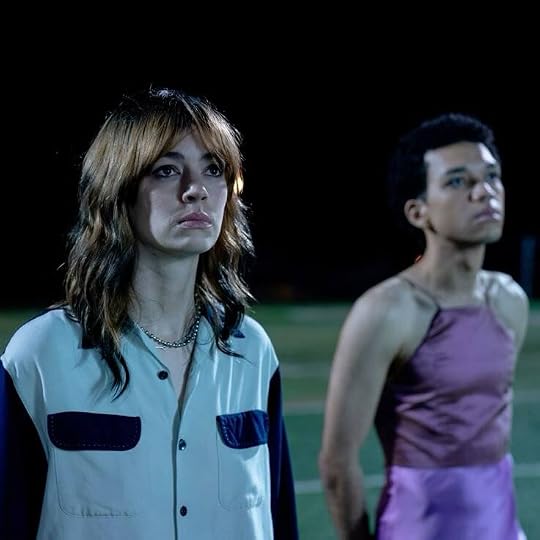
[An Image from the Film]
A Note on Gender
The book's gender composition is worth noting, partly because it connects to the film's central themes. The primary author, Jane Schoenbrun, is transfeminine and nonbinary, using they/them pronouns. Schoenbrun grew up identifying as a boy and used their birth name into early adulthood — their first documentary, A Self-Induced Hallucination (2018), was made under that name. By the time We're All Going to the World's Fair premiered at Sundance in 2021, they were publicly identified as nonbinary. The name Jane, typically associated with girls and women, reflects a feminine-leaning gender identity that does not claim full womanhood — a distinction between being transfeminine and being a transwoman that matters for understanding the film's thematic concerns.
Several of the book's contributors are women: Jeanne Thornton is a transgender woman and novelist, Eva Victor is a comedian and actress, and Renee Charles and Camille Cushman appear to be women based on available information. In tracking my reading for gender balance I found myself uncertain how to categorize this book — and that uncertainty is itself thematically appropriate. The film is about a protagonist who cannot name what they are, and the book resists easy categorization for similar reasons.
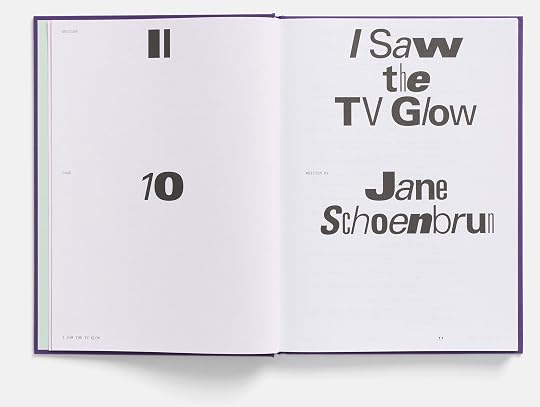
[Image: Pages 10-11]
The Screenplay Versus the Film
This book is a reminder that there are three versions of a feature film: what is written, what is shot, and what is edited. I first encountered this idea from the audio commentary track on Detroit Rock City (1999) by director Adam Rifkin — a guilty pleasure that sparked my interest in filmmaking when I first watched it at fifteen.
The screenplay plays with chronology far more than the finished film. Owen's key decision — the first refusal that I argue ends Act One — appears as a flashback on page 64 of the script, whereas in the film it occurs in chronological sequence and carries considerably more weight. In the script, Owen feels more passive: things seem to happen to him, whereas in the film his refusals feel active, decisive, and structurally load-bearing.
In the finished edit, the filmmakers made a strong choice to build a clear three-act structure with a robust Act One (exposition) rather than distributing the chronological material across multiple flashbacks. This was the right decision. The script is more confusing; the film is a better-told story — albeit still quite surreal and unsettling.
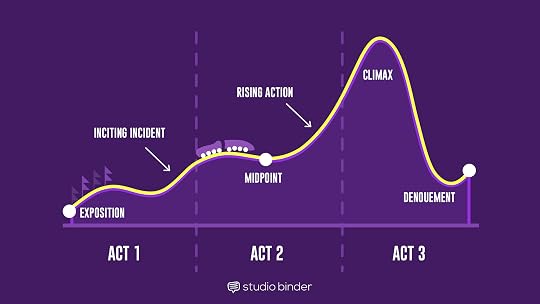
[Image: A 3-Act Structure Chart]
The Three-Act Structure Hiding in Plain Sight
I have watched I Saw the TV Glow four times and written extensively about its structure. The film has a reputation for being slow, atmospheric, and shapeless — but I do not think this is accurate. Laid out by its actual turning points, the film sits comfortably at three acts, each ending at a genuine point of no recourse. What is unconventional is not the count but the mechanism: both act breaks are refusals rather than events done to Owen. In models provided by Syd Field and going back to Aristotle, the point of no recourse is usually a door slamming on the hero. Here, the door is slammed by Owen, twice, in the same way both times: offered a chance to leave, he declines.
Act One ends with Owen's first refusal — Maddy asks him to run away with her, and not only does he decline, he tells on himself to a neighbor to ensure he is grounded and the option is permanently closed. Act Two ends with his second refusal — Maddy returns years later and offers him the chance to follow her into the world of the show, and again he says no. Act Three shows what those refusals cost, made visible as years you do not get back.
Owen's inaction is not a lack of plot. It is the plot. Read this way, the film's most sustained subject is a person who never transitions — and the two act breaks are the two moments he is offered the chance and chooses safety over acknowledgment instead. Martin Scorsese called the film "emotionally and psychologically powerful and very moving," adding that "it builds on you, in a way." Coming from someone with no stake in queer coming-of-age horror, that is the right description of how this structural choice works: the refusals compound across time, and the accumulation is what you feel.
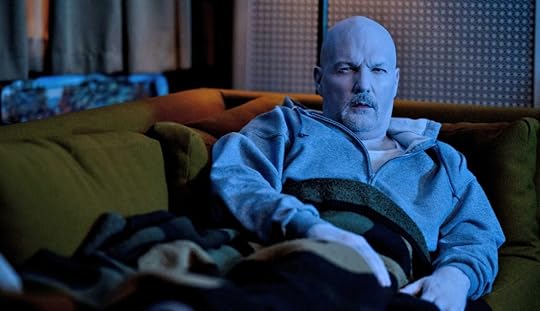
[Image: Fred Durst (as Frank) stares at us. And yes, he was the frontman of the ‘90s band Limp Bizkit]
Social Anxiety Horror
One formal device I noticed in the screenplay that I had registered less consciously in the film: the sheer number of dead-eyed stares directed at Owen, often straight into the camera. "She stares up at Owen, unsure who this younger kid speaking to her is" (p. 20). "The kid just stares at him, dead-eyed" (p. 35). "There's something intimidating and disquieting about Frank's stare. Like he only half recognizes his son" (p. 39). Even the neighbors get in on it: "Even though it is the middle of the night, the owners of each house on this street are STANDING OUT ON THEIR FRONT LAWNS, staring blankly at Owen's car as he drives by" (p. 86).
As a socially anxious person, I find this pattern deeply recognizable — the experience of people staring at you without explanation and you having to attempt to figure out what they are silently conveying. The screenplay makes explicit what the film renders as atmosphere: this is social anxiety rendered as horror.
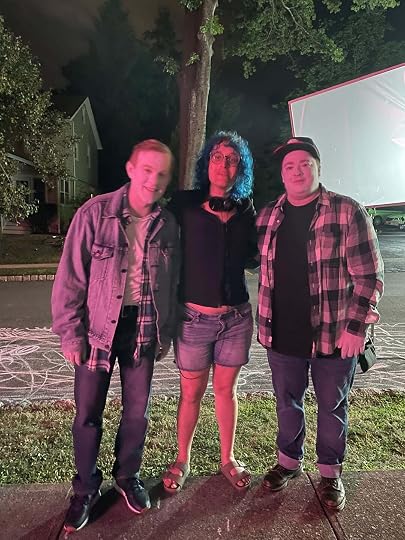
[Behind the scenes photo of director/writer Jane Schoenbrun between actors Michael Maronna (left) and Danny Tamberelli (right). Maronna and Tamberelli starred in the ‘90s Nickelodeon program The Adventures of Pete & Pete as kids]
Pete & Pete and the Tone of the Thing
Buffy the Vampire Slayer (1997–2003) is the biggest acknowledged influence on the film and its pastiche series The Pink Opaque. But I see a strong influence of Nickelodeon shows — particularly The Adventures of Pete & Pete (1989–1996) and Are You Afraid of the Dark? (1991–2000) — and for grown-up television, the David Lynch series Twin Peaks (1990–1991, 2017).
Greg Stevens of Nick Knacks, in his feature-length video essay about Pete & Pete (2024), identifies the show's tone as "funny, sad, strange, beautiful" — words drawn directly from what creators Will McRobb and Chris Viscardi said they were aiming for. Not surprisingly, Stevens also loved I Saw the TV Glow. I think those four words apply to Schoenbrun's film too, even if the humor is consistently subdued. My wife and I rewatch Pete & Pete once a year. It holds up. And I Saw the TV Glow is doing something very similar — using the texture of '90s suburban teen television to excavate what that texture concealed.
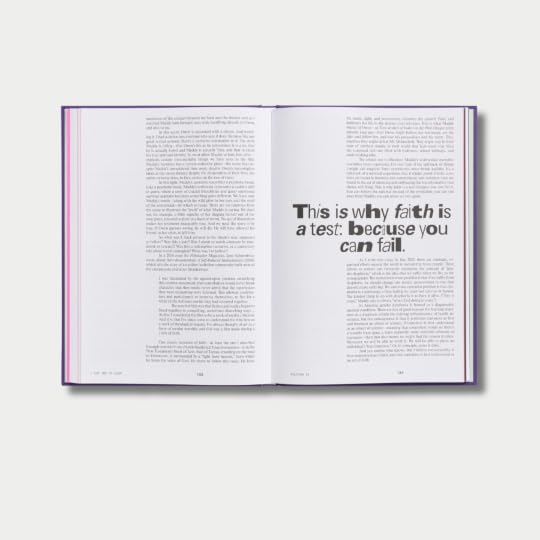
[Image: Pages 132-133]
The Essays
Jeanne Thornton's essay "An Act of Faith" is the book's most important supplementary piece. She reads Maddy's requests of Owen — first to run away with her, then to be buried alive — as comparable to the leaps of faith required to transition your gender. "Faith's comforts are found in intensity and commitment, not certainty; they are found in the act of choosing and embracing the transformation that choice will bring" (p. 133). And: "Transition is unsafe, as is any act of faith. Transition isn't about butterflies and chrysalises or waking up one day as a magical girl: it is about maybe your friend is going to bury you alive, how perhaps you are going to piss yourself. Transition is something for which you must prepare your soul" (p. 134).
Owen refuses his own allegorical transition and finds that his future — Act Three (pages 86-97 of the script) — is bleak and unfulfilling. This is a hero's journey where the hero steadfastly refuses the call. Most of us refuse the call, to tell the truth.
Eva Victor's essay "A Note from the Shadow" gives us Schoenbrun as a person as much as a filmmaker. The line "Your film is allowed to be beautiful. A shot can exist for beauty's sake" (p. 143) is a sentiment I do not fully agree with — I think beauty in film is always tied to context and story — but it illuminates something about how the film was made. Victor's description of Schoenbrun on set — cackling over an actor's ad-libs, eating a burrito at lunch, biting their nails on the monitor — is warm and specific. "Because of this confluence of intense purposefulness and joy-to-be-here levity, Jane created a piece that tonally holds all of that in one thing. As a witness to its inception, I can confirm that I Saw the TV Glow feels like Jane" (p. 143).
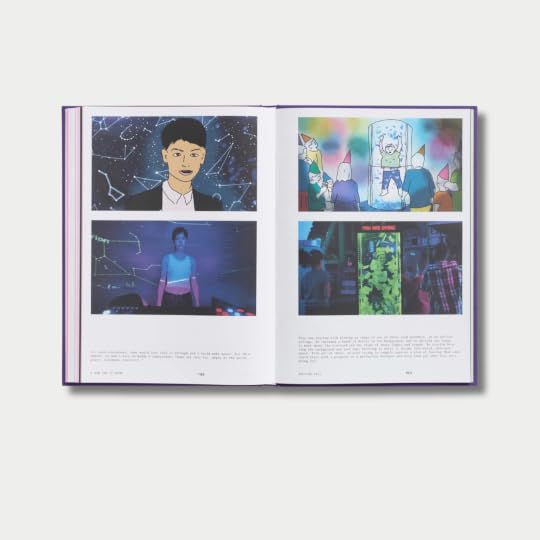
[Image: Pages 192-193]
The Storyboards
Albert Birney's storyboard section deserves a mention. Birney acknowledges he was "just tracing" (p. 188) and that his purpose was simply "to get the shapes and the general feeling of these images in Jane's head out of Jane's head" (p. 188). The drawings are not great art. That is entirely the point. The more prepared a director and crew are before shooting — the most expensive and other-people-intensive part of filmmaking — the better. You do not have to be a skilled visual artist to make useful storyboards. Birney's collaboration with Schoenbrun is proof.
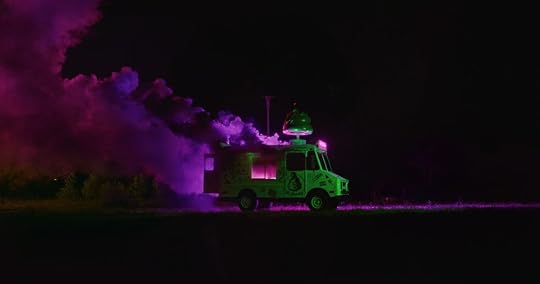
[Image: My favorite shot in the film, available on page 107]
Verdict
Five stars. This is exactly the kind of film companion book I love: generous with supplementary material, honest about the gap between what was written and what was made, and genuinely illuminating about a film I already cared about. The Thornton and Victor essays earn their place. The storyboards are instructive. And having the screenplay in hand confirms what four viewings of the film had suggested: Schoenbrun knew exactly what they were doing, and the editorial decision to linearize the chronology was the right one.
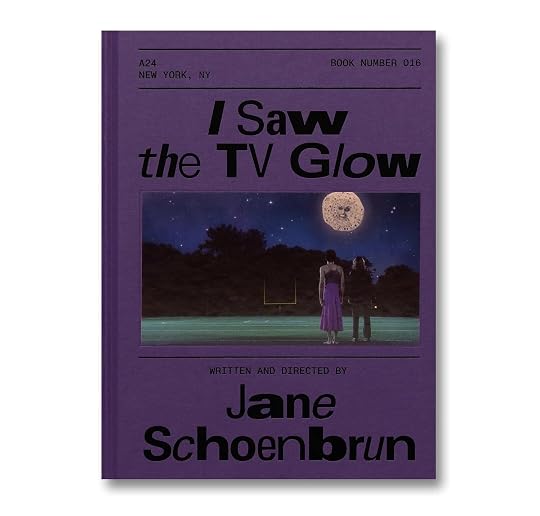
[Image: Book Cover]
Citation:
Schoenbrun, J. (2026). I saw the TV glow screenplay book (A. Egoyan, Introduction; J. Thornton & E. Victor, Essays; A. Birney, Storyboard sketches; R. Charles & C. Cushman, Episode guide). A24.
Title: I Saw the TV Glow Screenplay Book
Author(s): Jane Schoenbrun (screenplay), Atom Egoyan (introduction), Jeanne Thornton (essay), Eva Victor (essay), Albert Birney (storyboard sketches), Renee Charles & Camille Cushman (the fictional The Pink Opaque episode guide)
Year: 2026
Series: A24 Screenplay Book Collection Book 016
Genre: Nonfiction — Screenplay and Film Companion
Page count: 200 pages
Date(s) read: 8/30/26–9/1/26
Book 173 in 2026
What the Book Contains
The screenplay itself runs from pages 11 to 97. Beyond that, the book contains an introduction by filmmaker Atom Egoyan, two essays (An Act of Faith" by Jeanne Thornton and "A Note from the Shadow" by Eva Victor), storyboard sketches by Albert Birney, cinematography stills from cinematographer Erik Yue, and a fictional episode guide for The Pink Opaque (the supernatural teen show within the film) written by Renee Charles and Camille Cushman. Together these elements make the book a genuine companion to the film rather than simply a script reprint.
[An Image from the Film]
A Note on Gender
The book's gender composition is worth noting, partly because it connects to the film's central themes. The primary author, Jane Schoenbrun, is transfeminine and nonbinary, using they/them pronouns. Schoenbrun grew up identifying as a boy and used their birth name into early adulthood — their first documentary, A Self-Induced Hallucination (2018), was made under that name. By the time We're All Going to the World's Fair premiered at Sundance in 2021, they were publicly identified as nonbinary. The name Jane, typically associated with girls and women, reflects a feminine-leaning gender identity that does not claim full womanhood — a distinction between being transfeminine and being a transwoman that matters for understanding the film's thematic concerns.
Several of the book's contributors are women: Jeanne Thornton is a transgender woman and novelist, Eva Victor is a comedian and actress, and Renee Charles and Camille Cushman appear to be women based on available information. In tracking my reading for gender balance I found myself uncertain how to categorize this book — and that uncertainty is itself thematically appropriate. The film is about a protagonist who cannot name what they are, and the book resists easy categorization for similar reasons.
[Image: Pages 10-11]
The Screenplay Versus the Film
This book is a reminder that there are three versions of a feature film: what is written, what is shot, and what is edited. I first encountered this idea from the audio commentary track on Detroit Rock City (1999) by director Adam Rifkin — a guilty pleasure that sparked my interest in filmmaking when I first watched it at fifteen.
The screenplay plays with chronology far more than the finished film. Owen's key decision — the first refusal that I argue ends Act One — appears as a flashback on page 64 of the script, whereas in the film it occurs in chronological sequence and carries considerably more weight. In the script, Owen feels more passive: things seem to happen to him, whereas in the film his refusals feel active, decisive, and structurally load-bearing.
In the finished edit, the filmmakers made a strong choice to build a clear three-act structure with a robust Act One (exposition) rather than distributing the chronological material across multiple flashbacks. This was the right decision. The script is more confusing; the film is a better-told story — albeit still quite surreal and unsettling.
[Image: A 3-Act Structure Chart]
The Three-Act Structure Hiding in Plain Sight
I have watched I Saw the TV Glow four times and written extensively about its structure. The film has a reputation for being slow, atmospheric, and shapeless — but I do not think this is accurate. Laid out by its actual turning points, the film sits comfortably at three acts, each ending at a genuine point of no recourse. What is unconventional is not the count but the mechanism: both act breaks are refusals rather than events done to Owen. In models provided by Syd Field and going back to Aristotle, the point of no recourse is usually a door slamming on the hero. Here, the door is slammed by Owen, twice, in the same way both times: offered a chance to leave, he declines.
Act One ends with Owen's first refusal — Maddy asks him to run away with her, and not only does he decline, he tells on himself to a neighbor to ensure he is grounded and the option is permanently closed. Act Two ends with his second refusal — Maddy returns years later and offers him the chance to follow her into the world of the show, and again he says no. Act Three shows what those refusals cost, made visible as years you do not get back.
Owen's inaction is not a lack of plot. It is the plot. Read this way, the film's most sustained subject is a person who never transitions — and the two act breaks are the two moments he is offered the chance and chooses safety over acknowledgment instead. Martin Scorsese called the film "emotionally and psychologically powerful and very moving," adding that "it builds on you, in a way." Coming from someone with no stake in queer coming-of-age horror, that is the right description of how this structural choice works: the refusals compound across time, and the accumulation is what you feel.
[Image: Fred Durst (as Frank) stares at us. And yes, he was the frontman of the ‘90s band Limp Bizkit]
Social Anxiety Horror
One formal device I noticed in the screenplay that I had registered less consciously in the film: the sheer number of dead-eyed stares directed at Owen, often straight into the camera. "She stares up at Owen, unsure who this younger kid speaking to her is" (p. 20). "The kid just stares at him, dead-eyed" (p. 35). "There's something intimidating and disquieting about Frank's stare. Like he only half recognizes his son" (p. 39). Even the neighbors get in on it: "Even though it is the middle of the night, the owners of each house on this street are STANDING OUT ON THEIR FRONT LAWNS, staring blankly at Owen's car as he drives by" (p. 86).
As a socially anxious person, I find this pattern deeply recognizable — the experience of people staring at you without explanation and you having to attempt to figure out what they are silently conveying. The screenplay makes explicit what the film renders as atmosphere: this is social anxiety rendered as horror.
[Behind the scenes photo of director/writer Jane Schoenbrun between actors Michael Maronna (left) and Danny Tamberelli (right). Maronna and Tamberelli starred in the ‘90s Nickelodeon program The Adventures of Pete & Pete as kids]
Pete & Pete and the Tone of the Thing
Buffy the Vampire Slayer (1997–2003) is the biggest acknowledged influence on the film and its pastiche series The Pink Opaque. But I see a strong influence of Nickelodeon shows — particularly The Adventures of Pete & Pete (1989–1996) and Are You Afraid of the Dark? (1991–2000) — and for grown-up television, the David Lynch series Twin Peaks (1990–1991, 2017).
Greg Stevens of Nick Knacks, in his feature-length video essay about Pete & Pete (2024), identifies the show's tone as "funny, sad, strange, beautiful" — words drawn directly from what creators Will McRobb and Chris Viscardi said they were aiming for. Not surprisingly, Stevens also loved I Saw the TV Glow. I think those four words apply to Schoenbrun's film too, even if the humor is consistently subdued. My wife and I rewatch Pete & Pete once a year. It holds up. And I Saw the TV Glow is doing something very similar — using the texture of '90s suburban teen television to excavate what that texture concealed.
[Image: Pages 132-133]
The Essays
Jeanne Thornton's essay "An Act of Faith" is the book's most important supplementary piece. She reads Maddy's requests of Owen — first to run away with her, then to be buried alive — as comparable to the leaps of faith required to transition your gender. "Faith's comforts are found in intensity and commitment, not certainty; they are found in the act of choosing and embracing the transformation that choice will bring" (p. 133). And: "Transition is unsafe, as is any act of faith. Transition isn't about butterflies and chrysalises or waking up one day as a magical girl: it is about maybe your friend is going to bury you alive, how perhaps you are going to piss yourself. Transition is something for which you must prepare your soul" (p. 134).
Owen refuses his own allegorical transition and finds that his future — Act Three (pages 86-97 of the script) — is bleak and unfulfilling. This is a hero's journey where the hero steadfastly refuses the call. Most of us refuse the call, to tell the truth.
Eva Victor's essay "A Note from the Shadow" gives us Schoenbrun as a person as much as a filmmaker. The line "Your film is allowed to be beautiful. A shot can exist for beauty's sake" (p. 143) is a sentiment I do not fully agree with — I think beauty in film is always tied to context and story — but it illuminates something about how the film was made. Victor's description of Schoenbrun on set — cackling over an actor's ad-libs, eating a burrito at lunch, biting their nails on the monitor — is warm and specific. "Because of this confluence of intense purposefulness and joy-to-be-here levity, Jane created a piece that tonally holds all of that in one thing. As a witness to its inception, I can confirm that I Saw the TV Glow feels like Jane" (p. 143).
[Image: Pages 192-193]
The Storyboards
Albert Birney's storyboard section deserves a mention. Birney acknowledges he was "just tracing" (p. 188) and that his purpose was simply "to get the shapes and the general feeling of these images in Jane's head out of Jane's head" (p. 188). The drawings are not great art. That is entirely the point. The more prepared a director and crew are before shooting — the most expensive and other-people-intensive part of filmmaking — the better. You do not have to be a skilled visual artist to make useful storyboards. Birney's collaboration with Schoenbrun is proof.
[Image: My favorite shot in the film, available on page 107]
Verdict
Five stars. This is exactly the kind of film companion book I love: generous with supplementary material, honest about the gap between what was written and what was made, and genuinely illuminating about a film I already cared about. The Thornton and Victor essays earn their place. The storyboards are instructive. And having the screenplay in hand confirms what four viewings of the film had suggested: Schoenbrun knew exactly what they were doing, and the editorial decision to linearize the chronology was the right one.
[Image: Book Cover]
Citation:
Schoenbrun, J. (2026). I saw the TV glow screenplay book (A. Egoyan, Introduction; J. Thornton & E. Victor, Essays; A. Birney, Storyboard sketches; R. Charles & C. Cushman, Episode guide). A24.
Title: I Saw the TV Glow Screenplay Book
Author(s): Jane Schoenbrun (screenplay), Atom Egoyan (introduction), Jeanne Thornton (essay), Eva Victor (essay), Albert Birney (storyboard sketches), Renee Charles & Camille Cushman (the fictional The Pink Opaque episode guide)
Year: 2026
Series: A24 Screenplay Book Collection Book 016
Genre: Nonfiction — Screenplay and Film Companion
Page count: 200 pages
Date(s) read: 8/30/26–9/1/26
Book 173 in 2026
May 10, 2026
One of the few screenplay books I’ve read where the additional content is actually beneficial and gives insight into the film and filmmaking process and not just pointless bonuses.
The script here is also great because it’s clearly one of the first drafts and takes some huge differences in pacing from the film that makes it compelling. I won’t spoil the details because the film is absolutely worth a watch but the most heartwrenching moments and the ending especially are near identical from page to screen and they still resonate even when you just read them.
I realise I’m talking more about my emotional reaction to this book instead of the book itself but that’s just how it is. It’s really great and a great piece of insight into one of my favourite films.
The script here is also great because it’s clearly one of the first drafts and takes some huge differences in pacing from the film that makes it compelling. I won’t spoil the details because the film is absolutely worth a watch but the most heartwrenching moments and the ending especially are near identical from page to screen and they still resonate even when you just read them.
I realise I’m talking more about my emotional reaction to this book instead of the book itself but that’s just how it is. It’s really great and a great piece of insight into one of my favourite films.

April 21, 2026
A beautiful volume all around - great layout/design. I bought this book for the script, but ended up loving the additional content - essays, an "episode guide", production stills, storyboards. A great companion book to a great film.
June 16, 2026
Hypnotic fever dream existential sadness insane nostalgia gloriousness
Reading this and being able to take my time with it was such a treat, such a delight. I can't wait to go watch this again now. Each watch, and now, with this read, each intake of this piece leads to some new revelation, some new lens, some new take. I can't get enough. I love this so much.
Fantastic additional content as well (not the intro), loved the two letters at the back.
Special book, special script, special film, special Jane! Wow! A ball of emotions!
Reading this and being able to take my time with it was such a treat, such a delight. I can't wait to go watch this again now. Each watch, and now, with this read, each intake of this piece leads to some new revelation, some new lens, some new take. I can't get enough. I love this so much.
Fantastic additional content as well (not the intro), loved the two letters at the back.
Special book, special script, special film, special Jane! Wow! A ball of emotions!
July 18, 2026
Love this film and loved reading the screenplay, plus the additional material is very insightful and fun!
August 10, 2026
One of my favorite movies. Really interesting to see the differences between this script and the final product; a lot of the changes were for the best I think, but the spirit of the things remains the same. The afterwards and storyboard sketches provided a lot of insight to the production and to Jane Schoenbrun themself; it’s always nice when something can make you see something you’ve seen so many times in a new way. One of my favorite pieces of art ever.
Review of advance copy
Reading the screenplay for one of my favorite movies of all time made me realize how brilliant the film actually is. You can tell how personal this is but also how much of it is just Schoenbrun having a blast from riding a wave of nostalgia. The script is incredible, so I’m so glad it got made into an even better movie. Schoenbrun is one of the most interesting filmmakers working today.
September 4, 2026
god i love jane schoenbrun's mind i hope to meet them someday and explain to them just how much i love their mind. unfortunately i'm not half as verbose or smart as them so i'll just be a blubbering mess but i can pull something off. there is still time.

Review of advance copy
Excellent job from A24 packaging one of the best screenplays of the last several years.
April 22, 2026
Loooooved it. So interesting to see what was cut out/changed from script to final edit.
July 16, 2026
anything to do with TV Glow is guaranteed to make me cry. Jane Schoenbrun you fucking genius.
July 28, 2026
I have no words for this, it cuts me open and leaves me breathless every time
August 26, 2026
best birthday gift ever thank you ryan gosling
Displaying 1 - 13 of 13 reviews