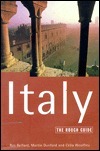
INTRODUCTION Of all European countries, Italy is perhaps the hardest to classify. It is a modern, industrialized nation, with companies like Fiat and Olivetti market- leaders in their field. It is the harbinger of style, its designers leading the way with each season's fashions. But it is also, to an equal degree, a Mediterranean country, with all that that implies. Agricultural land covers much of the country, a lot of it, especially in the South, still owned under almost feudal conditions. In towns and villages all over the country, life grinds to a halt in the middle of the day for a siesta, and is strongly family-oriented, with an emphasis on the traditions and rituals of the Catholic Church which, notwithstanding a growing scepticism among the country's youth, still dominates people's lives here to an immediately obvious degree. Above all Italy provokes reaction. Its people are volatile, rarely indifferent to anything, and on one and the same day you might encounter the kind of disdain dished out to tourist masses worldwide, and an hour later be treated to embarrassingly generous hospitality. If there is a single national characteristic, it's to embrace life to the in the hundreds of local festivals taking place across the country on any given day, to celebrate a saint or the local harvest; in the importance placed on good food; in the obsession with clothes and image; and above all in the daily domestic ritual of the collective evening stroll or passeggiata - a sociable affair celebrated by young and old alike in every town and village across the country. Italy only became a unified state in 1861 and, as a result, Italians often feel more loyalty to their region than the nation as a whole - something manifest in different cuisines, dialects, landscape, and often varying standards of living. There is also, of course, the country's enormous cultural Tuscany alone has more classified historical monuments than any country in the world; there are considerable remnants of the Roman Empire all over the country, notably of course in Rome itself; and every region retains its own relics of an artistic tradition generally acknowledged to be among the world's richest. Yet there's no reason to be intimidated by the art and architecture. If you want to lie on a beach, there are any number of places to do unlike, say, Spain, development has been kept relatively under control, and many resorts are still largely the preserve of Italian tourists. Other parts of the coast, especially in the south of the country, are almost entirely undiscovered. Beaches are for the most part sandy, and doubts about the cleanliness of the water have been confined to the northern part of the Adriatic coast and the Riviera. Mountains, too, run the country's length - from the Alps and Dolomites in the north right along the Apennines, which form the spine of the peninsula - and are an important reference-point for most Italians. Skiing and other winter sports are practised avidly, and in the five national parks, protected from the national passion for hunting, wildlife of all sorts thrives. Italy's regional the North and the South Italy breaks down into twenty regions, which in turn divide into different provinces. Some of these regional boundaries reflect long-standing historic borders, like Tuscany, Lombardy or the Veneto; others, like Friuli-Venezia Giulia or Molise, are more recent administrative divisions, often established in recognition of quite modern distinctions. But the sharpest division is between North and South. The North is one of the most advanced industrial societies in the world, a region that despite recent hiccups is one of extraordinary economic dynamism. Its people speak Italian with the cadences of France or Germany and its "capital", Milan, is a thoroughly European city. The South, derogatively known as il mezzogiorno, begins somewhere between Rome and Naples, and is by contrast one of the economically most depressed areas in Europe; and its history of absolutist regimes often seems to linger in the form of the spectre of organized crime and the remote hand of central government in Rome. The economic backwardness of the South is partly the result of the historical neglect to which it was subjected by various foreign occupiers. But it is also the result of the deliberate policy of politicians and corporate heads to industrialize the North while preserving the underdeveloped South as a convenient reservoir of labour. Italy's industrial power and dynamism, based in the North, has been built on the back of exploited southerners who emigrated to the northern industrial cities of Turin, Milan and Genoa in their millions during the Fifties and Sixties. Even now, Milan and Turin have very sizeable populations of meridionali - southerners - working in every sector of the economy. This north-south divide is something you'll come up against time and again, wherever you're travelling. To a northerner the mere mention of Na...
This was useful for historical previews while on the train to each city. Most of the food/drink recommendations were great if we were stuck for somewhere to go, the guide was good at pointing out which places were going to be too busy and where we might need to book/avoid. V handy scanning the QR code and having this on our phones. A little heavy on old churches, but that’s Italy!
I checked this one out for research not having particularly high expectations. I was pleasantly surprised. It seems pretty obviously geared toward travelers. This books is little bigger than a palm and somehow manages to pack in quite a bit of historical background for this very interesting country. True, it was not very deep and offered little analysis, but for what it was, something that pretty much gives you highlights for a given year dating back to Roman times, I thought it pretty impressive.
There's a ton of information here, but this is like a college text book - zero pictures & dense text. I prefer having at least some pictures/maps in my guide books.
I'd recommend this if you are planning a trip a year from now, are prepared to look up things on your phone/computer while you're reading, and are going to buy another "easier" guide book to take on your actual trip (lugging this thing around in Italy seems like a non-starter).
In early February I finished the Rough Guide to Sicily. This book follows a similar format but encompasses the whole of Italy, including Sicily. Some of the Sicily information is obviously repeated, and some is left out in this guide, which clearly needed to pare back the detail so as to keep the guide manageable. It still ran to 1065 pages, so it is pretty massive, covering everything you need to know for a visit to any part of Italy.
The most interesting parts for me were the sites the writer thought as the most outstanding in the country, as well as notes on food, culture and history. There is even a language guide in this book, although it is not the best place to go if you want to learn Italian.
All in all it was too detailed for one reading and I confess I skipped through as many as 300 pages or so of detailed notes about individual towns. That, no doubt, is what the writer expected though. If visiting those locations you need that information, and if not, then the overviews are better.
There is certainly nothing wrong with this excellent guide to Italy.
Fundamentally, don't buy this in Kindle as it is too much abridged to be of any use.
The print edition is excellent although aimed at a younger generation than me in terms of accommodation, drinking houses and restaurants. Its descriptions of cities towns and the country are unbeatable in a single volume; you might not necessarily always agree but that is one of the joys of the Rough Guide series.
Translated bits of this one. It's really well-researched and useful, plus it's accesible and has a lot of cultural info available. Useful tool. Hopefully, out this winter sometimes at the Niculescu Publishing House.
My copy of this book has crinkly pages from being used out in the rain, falls open spontaneously at the maps of Florence and Rome, and is full of annotations next to the names of ice cream shops. I can't imagine my trip to Italy in 2002 without it. Rough Guides are the bomb.
The Rough Guides are usually my favorite - I've used them for Europe, Costa Rica, Italy, Greece, Toronto, among others. I like their mix of culture, history, and touristy stuff, and find their maps much easier to follow than many others.
Very briefly as noted before on other Rough Guides this is the one for me - few pics (why buy a book filled with pics of things you're going to see in the flesh?) lots of history, info well-written - I used these along with Rick Steves, both on kindle, and my trip becomes much easier.
My reading has been really boring lately, but exciting to me - guidebooks like this one, snippets of books that take place or are about Italy, etc.... Can't wait!