

What do you think?

Arpan
This Series represents the brightest of young imaginative voices in contemporary Korean fiction. Each issue consists of a wide range of outstanding contemporary Korean short stories that the editorial board of Asia carefully selects each season. These stories are then translated by professional Korean literature translators, all of whom take special care to faithfully convey the pieces’ original tones and grace. We hope that, each and every season, these exceptional young Korean voices will delight and challenge all of you, our treasured readers both here and abroad.
136 pages, Paperback
First published January 1, 2014
Ratings & Reviews
Friends & Following
Create a free account to discover what your friends think of this book!
Community Reviews
Displaying 1 - 5 of 5 reviews

July 26, 2016
아르판 / Arpan by 박형서 (Park hyoung su) and translated by Sora Kim Russell (김소라), is another in the Asia Publisher bilingual series of Korean fiction.
For my general comments on the series, see https://www.goodreads.com/review/show....
Park hyoung su is a new author to me, and I believe in English translation, although he made his debut in Korea in 2000.
Sora Kim-Russell however is a well known translator, particularly for I'll Be Right There but also the BTBA longlisted Nowhere to Be Found and Our Happy Time, and does her usual excellent job.
The eponymous Arpan is from the Waka, a fictitious hill tribe from the border between Thailand and Myanmar, a tall people that prize height above anything else:
"A rich person was not someone with vast stretches of land but someone who owned a towering home. The abundance of one's harvest was not judged in volume but by how high the grain had been perilously sacked and piled. A high position within the community was likewise signified by a seat atop a skillfully stacked tower of cushions,
and even wedding gifts were transported to the in-laws home in a towering stack atop the bride's head."
" 심지어는 결혼 예물까지도 신부가 죄다 머리에 쌓아 올려 사집으로 운반했다."
The Waka speak there own distinctive nasal language ("it's the kind of language where pronunciation is much improved by catching a cold") but have little written tradition. Indeed Arpan, an author, is the sole person who writes in the language. As his guide tells the narrator:
"No one uses our alphabet any more. Well, except for that fool Arpan who lives on the other side of the mountain."
The narrator is a Korean author who, in his earlier life, spent time living with the Waka while seeking artistic inspiration. Following the conversation above he tracked down Arpan, watching him write and he "learned the Waka language through his writing. I'd memorised all of his booms. And I mean all of them - every last sentence."
Now, years late, as "the most famous author in Korea", the narrator manoeuvres himself to the Chair of a Third World Writers Festival in Seoul, and use his prerogative to invite Arpan to the festival to present his story.
Arpan's sells only seven copies at the book signing, but the narrator himself is beseiged by people asking him to sign copies of the novel that made him famous.
Following the book signing, our narrator though has a confession to make to Arpan about the origin of his novel. And in turn Arpan surprises the narrator.
This is a story about the conflicts between preserving and transmitting cultural identity:
"Everyone says we have to preserve indigenous cultures...but what do you suppose happens when we insist on cultural purity? The culture disappears ... Those who insist only on influencing themselves and only accepting influences from themselves do not survive."
and about plagarism and the grey line that defines it:
"The human arts have never once been pure. Every act of creation we undertake is footnoted and amended with respect to an existing point of view. It builds up layer by layer."
Arpan was an enjoyable read, but the meaning of the story is laid on a little too heavy handedly for my taste, including an extended monologue from the narrator to Arpan setting out the issues above.
For my general comments on the series, see https://www.goodreads.com/review/show....
Park hyoung su is a new author to me, and I believe in English translation, although he made his debut in Korea in 2000.
Sora Kim-Russell however is a well known translator, particularly for I'll Be Right There but also the BTBA longlisted Nowhere to Be Found and Our Happy Time, and does her usual excellent job.
The eponymous Arpan is from the Waka, a fictitious hill tribe from the border between Thailand and Myanmar, a tall people that prize height above anything else:
"A rich person was not someone with vast stretches of land but someone who owned a towering home. The abundance of one's harvest was not judged in volume but by how high the grain had been perilously sacked and piled. A high position within the community was likewise signified by a seat atop a skillfully stacked tower of cushions,
and even wedding gifts were transported to the in-laws home in a towering stack atop the bride's head."
" 심지어는 결혼 예물까지도 신부가 죄다 머리에 쌓아 올려 사집으로 운반했다."
The Waka speak there own distinctive nasal language ("it's the kind of language where pronunciation is much improved by catching a cold") but have little written tradition. Indeed Arpan, an author, is the sole person who writes in the language. As his guide tells the narrator:
"No one uses our alphabet any more. Well, except for that fool Arpan who lives on the other side of the mountain."
The narrator is a Korean author who, in his earlier life, spent time living with the Waka while seeking artistic inspiration. Following the conversation above he tracked down Arpan, watching him write and he "learned the Waka language through his writing. I'd memorised all of his booms. And I mean all of them - every last sentence."
Now, years late, as "the most famous author in Korea", the narrator manoeuvres himself to the Chair of a Third World Writers Festival in Seoul, and use his prerogative to invite Arpan to the festival to present his story.
Arpan's sells only seven copies at the book signing, but the narrator himself is beseiged by people asking him to sign copies of the novel that made him famous.
Following the book signing, our narrator though has a confession to make to Arpan about the origin of his novel. And in turn Arpan surprises the narrator.
This is a story about the conflicts between preserving and transmitting cultural identity:
"Everyone says we have to preserve indigenous cultures...but what do you suppose happens when we insist on cultural purity? The culture disappears ... Those who insist only on influencing themselves and only accepting influences from themselves do not survive."
and about plagarism and the grey line that defines it:
"The human arts have never once been pure. Every act of creation we undertake is footnoted and amended with respect to an existing point of view. It builds up layer by layer."
Arpan was an enjoyable read, but the meaning of the story is laid on a little too heavy handedly for my taste, including an extended monologue from the narrator to Arpan setting out the issues above.

June 17, 2016
Arpan begins with a clever misdirection; a successful Korean author remembering his time in Waka and the differences in culture there including the importance stacking thing up to prove social importance. The author finds the last Wakan “writer.” The “Wakan” author named Arpan visits Seoul for a book fair and is roundly ignored. After his talk the Wakan author sells 7 copies of his work, while the Korean author, supposedly merely a host, signs copies of his own book until his wrist becomes numb.
As the story develops it becomes clear that the Korean author is not who you might think and his ‘kindness’ in helping Arpan proceeds from different motives than at first seem likely. The ending is clever, with a kind of crime revealed and a remarkable response from the victim.
The conclusion should make a reader think about the effects of globalization, where and how cultures can collide, coincide, and in a way collude so that one culture can continue to live on in the other. necessitates.
As in the previous book of this series the translation (in this case by the usually seamless Sora Kim-Russell) is grand: There are one or two small bumps getting into the story, but then a smooth flow of description and conversation that, as noted above, covers issues that concern the entire world (the loss of cultures), issues that are currently at play in Korea (what is plagiarism and what is respect for a previous author), and the relationship between creativity and cooptation.
As the story develops it becomes clear that the Korean author is not who you might think and his ‘kindness’ in helping Arpan proceeds from different motives than at first seem likely. The ending is clever, with a kind of crime revealed and a remarkable response from the victim.
The conclusion should make a reader think about the effects of globalization, where and how cultures can collide, coincide, and in a way collude so that one culture can continue to live on in the other. necessitates.
As in the previous book of this series the translation (in this case by the usually seamless Sora Kim-Russell) is grand: There are one or two small bumps getting into the story, but then a smooth flow of description and conversation that, as noted above, covers issues that concern the entire world (the loss of cultures), issues that are currently at play in Korea (what is plagiarism and what is respect for a previous author), and the relationship between creativity and cooptation.

March 5, 2017
A little heavy-handed but original and thought-provoking.

June 16, 2016
It's a book about writers and writing, which honestly turned me off at first. (Maybe or maybe not ironic being a writer myself...) Arpan is the eponymous character the writer meets while doing a sort of cultural immersion in the Waka people's region of Southeast Asia. The Waka have a language spoken by less than 200 people and are obsessed with stacking things, the pursuit of height. The writer is a dude looking for authenticity and goes to some icky means to get it while befriending Arpan and Michu, both Waka people.
The story unfolds as the narrator ushers Arpan to an international, third world literature festival held in Seoul. Really brisk and sharp writing, if not a work that wowed me in theme.
The story unfolds as the narrator ushers Arpan to an international, third world literature festival held in Seoul. Really brisk and sharp writing, if not a work that wowed me in theme.
June 16, 2016
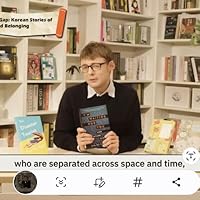
You can watch my review on YouTube here - https://www.youtube.com/watch?v=kdTXD...
Displaying 1 - 5 of 5 reviews