

What do you think?

I Shot a Man in Reno: A History of Death by Murder, Suicide, Fire, Flood, Drugs, Disease and General Misadventure, as Related in Popular Song
"Death music" is not merely a byword for bookish solemnity, or the glorification of murder, drugs and guns.
Over the course of the last hundred years it has also been about teenage girls weeping over their high school boyfriend's fatal car wreck; natural disasters sweeping whole communities away; the ever-evolving threat of disease; changing attitudes to old age; exhortations to suicide; the perfect playlist for a funeral; and the thorny question of what happens after the fat lady ceases to sing. Which means that for every "Black Angel's Death Song" there is a "Candle in the Wind," and for every "Cop Killer" there is "The Living Years." Death, like music, is a unifying force. There is something for every taste and inclination, from murderous vengeance to camp sentimentality and everything in between.
Ask the gangsta rap devotee. Ask the grizzled blues fanatic and the bearded folk fan. Ask the goth and the indie kid. Ask and they will all tell you the same thing: death and popular music have forever danced hand-in-hand in funereal waltz time.
The pop charts and the majority of radio stations' playlists may conspire to convince anyone listening that the world spins on its axis to the tune of "I love you, you love me" and traditional matters of the heart. The rest of us know that we live in a world where red roses will one day become lilies and that death is the motor that drives the greatest and most exhilarating music of all.
Drawing upon original and unique interviews with artists such as Mick Jagger, Richard Thompson, Ice-T, Will Oldham and Neil Finn among many others, I Shot a Man In Reno explores how popular music deals with death, and how it documents the changing reality of what death means as one grows older. It's as transfixing as a train wreck, and you won't be able to put it down.
As an epilogue, I Shot A Man In Reno presents the reader with the 40 greatest death songs of all time, complete with a brief rationale for each, acting as a primer for the morbidly curious listener.
Over the course of the last hundred years it has also been about teenage girls weeping over their high school boyfriend's fatal car wreck; natural disasters sweeping whole communities away; the ever-evolving threat of disease; changing attitudes to old age; exhortations to suicide; the perfect playlist for a funeral; and the thorny question of what happens after the fat lady ceases to sing. Which means that for every "Black Angel's Death Song" there is a "Candle in the Wind," and for every "Cop Killer" there is "The Living Years." Death, like music, is a unifying force. There is something for every taste and inclination, from murderous vengeance to camp sentimentality and everything in between.
Ask the gangsta rap devotee. Ask the grizzled blues fanatic and the bearded folk fan. Ask the goth and the indie kid. Ask and they will all tell you the same thing: death and popular music have forever danced hand-in-hand in funereal waltz time.
The pop charts and the majority of radio stations' playlists may conspire to convince anyone listening that the world spins on its axis to the tune of "I love you, you love me" and traditional matters of the heart. The rest of us know that we live in a world where red roses will one day become lilies and that death is the motor that drives the greatest and most exhilarating music of all.
Drawing upon original and unique interviews with artists such as Mick Jagger, Richard Thompson, Ice-T, Will Oldham and Neil Finn among many others, I Shot a Man In Reno explores how popular music deals with death, and how it documents the changing reality of what death means as one grows older. It's as transfixing as a train wreck, and you won't be able to put it down.
As an epilogue, I Shot A Man In Reno presents the reader with the 40 greatest death songs of all time, complete with a brief rationale for each, acting as a primer for the morbidly curious listener.
- GenresMusicNonfiction
272 pages, Paperback
First published August 15, 2008
Ratings & Reviews
Friends & Following
Create a free account to discover what your friends think of this book!
Community Reviews
Displaying 1 - 18 of 18 reviews

August 19, 2011
i don't read a lot of rock crit or even listen to a lot of music anymore, but i really did enjoy this book which is like a crash course in the history of the murder ballad, and the teenage death song (i have to track down that one about the shark attack!) and the body count in gangsta rap etc. sometimes i think he lets his prose get away with him: "Black Angel's Death Song is what an Elizabethan madrigal would sound like after being mugged by highwaymen, dragged on horseback to a subterranean dungeon, and then beaten about the flesh by the bones of dead pirates for three hundred years." you have gone too far, rock critic! but almost all of the chapters about the seductive power of the death-song to the goth and emo teen was well-put, and a little uncomfortable, ifyaknowwhatimean...i should read more of this stuff—it is a great contextualization.
so these are just my favorite death-songs that i can think of while sitting here, many of which were not included in the book. lyrics are in the spoiler-click, youtube is at your disposal if you are interested in hearing any of these songs, but i've also added the links in this review as it appears over on blog, where there is UNLIMITED SPACE for such things.
Way Away—Toad the Wet Sprocket. i can't think of a better song about the hypocrisy of a funeral, and just how awkward it makes everyone involved. except the corpse.
Millie and Billie—Alice Cooper. my favorite murder song. my dad sat me down when i was way little and played this song for me on those oversized headphones from distant times...life-changing. and i don't know how you write a book about death and murder in music and never once mention alice cooper, who made it very fashionable indeed.
No One Lives Forever—Oingo Boingo. a happy carnival of a death-song. they have never shied away from the theatrical elements of rock and roll, and they have always had a massive day of the dead influence shoring them up. chill out, death isn't a big deal—have a little dance before you go...
Keep Me In Your Heart—Warren Zevon. the other side of the coin is the saddest song ever written by someone so close to death; there was a very real chance he wasn't going to live long enough to finish this album. but he did. and it is powerful stuff. he wrote a lot of songs about death during his life, but the ones written when he was sick are themselves killers.
Diamond Smiles—The Boomtown Rats. thomson mentions I Don't Like Mondays, of course, but i have always liked this song better. a poor little rich girl suicide with great musical moves.
Old and Wise —The Alan Parsons Project. this song always got to me when i was little. it is wonderful melodrama, and perfect for those "look at me, i'm sad" teenage years when you assume you will never be old and are already wise.
Tomorrow, Wendy—Concrete Blonde. her voice has always lacerated me, emotionally. i honestly have no idea what this song is about, but i have put it on nearly a thousand mix tapes growing up. yes, tapes.
God Loves a Drunk—Richard Thompson. this one gets a mention in the book, but it is such a good song, that i will have to re-mention it here. it ain't pretty.
Who by Fire—Leonard Cohen. both Dress Rehearsal Rag and Chelsea Hotel #2 get a mention, but this song is so much spookier and still wryly-funny, that i gotta put it here.
Song of Joy—Nick Cave. i don't know if there is a nick cave song that isn't about death. but this one wins for me because of its sly lyrical confession built in, its subtlety. hats off to him for this one.
Hell's Ditch—The Pogues. i just love this song. end of story. the contrast of the jolly music with the filthy, horrible imagery. glorious.
there a hundreds more, and i invite you to share your own, whether they have been covered in the book or not, it is always nice to talk about this kind of music, and teach me new songs.
and i do want that oingo boingo one played at my funeral. by danny elfman himself, please.
 come to my blog!
so these are just my favorite death-songs that i can think of while sitting here, many of which were not included in the book. lyrics are in the spoiler-click, youtube is at your disposal if you are interested in hearing any of these songs, but i've also added the links in this review as it appears over on blog, where there is UNLIMITED SPACE for such things.
Way Away—Toad the Wet Sprocket. i can't think of a better song about the hypocrisy of a funeral, and just how awkward it makes everyone involved. except the corpse.
Millie and Billie—Alice Cooper. my favorite murder song. my dad sat me down when i was way little and played this song for me on those oversized headphones from distant times...life-changing. and i don't know how you write a book about death and murder in music and never once mention alice cooper, who made it very fashionable indeed.
No One Lives Forever—Oingo Boingo. a happy carnival of a death-song. they have never shied away from the theatrical elements of rock and roll, and they have always had a massive day of the dead influence shoring them up. chill out, death isn't a big deal—have a little dance before you go...
Keep Me In Your Heart—Warren Zevon. the other side of the coin is the saddest song ever written by someone so close to death; there was a very real chance he wasn't going to live long enough to finish this album. but he did. and it is powerful stuff. he wrote a lot of songs about death during his life, but the ones written when he was sick are themselves killers.
Diamond Smiles—The Boomtown Rats. thomson mentions I Don't Like Mondays, of course, but i have always liked this song better. a poor little rich girl suicide with great musical moves.
Old and Wise —The Alan Parsons Project. this song always got to me when i was little. it is wonderful melodrama, and perfect for those "look at me, i'm sad" teenage years when you assume you will never be old and are already wise.
Tomorrow, Wendy—Concrete Blonde. her voice has always lacerated me, emotionally. i honestly have no idea what this song is about, but i have put it on nearly a thousand mix tapes growing up. yes, tapes.
God Loves a Drunk—Richard Thompson. this one gets a mention in the book, but it is such a good song, that i will have to re-mention it here. it ain't pretty.
Who by Fire—Leonard Cohen. both Dress Rehearsal Rag and Chelsea Hotel #2 get a mention, but this song is so much spookier and still wryly-funny, that i gotta put it here.
Song of Joy—Nick Cave. i don't know if there is a nick cave song that isn't about death. but this one wins for me because of its sly lyrical confession built in, its subtlety. hats off to him for this one.
Hell's Ditch—The Pogues. i just love this song. end of story. the contrast of the jolly music with the filthy, horrible imagery. glorious.
there a hundreds more, and i invite you to share your own, whether they have been covered in the book or not, it is always nice to talk about this kind of music, and teach me new songs.
and i do want that oingo boingo one played at my funeral. by danny elfman himself, please.
come to my blog!
June 23, 2008
Note - my actual review of this book is now here
http://www.goodreads.com/review/show/...
***********
One day I'll review this book properly, it's a great subject, but until then here's a little something. There's a great set of old time music on Tompkins Square Records called People Take Warning! Murder Ballads and Disaster Songs 1913 to 1938.
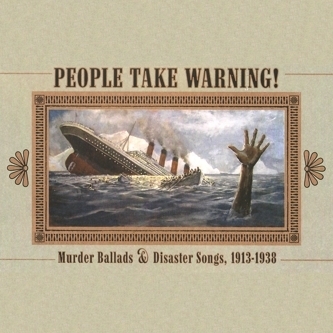
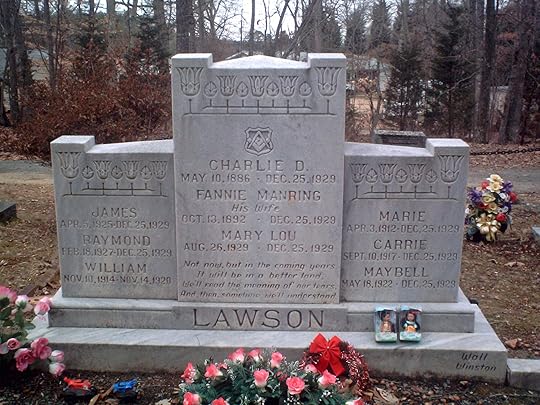
Mostly the music is terrible, but the whole thing is a wonderful psycho-sociological investigation to be filed alongside that weirdo book "Wisconsin Death Trip". Anyway, from People Take Warning! we find that on Christmas Day 1929, a guy named Charlie Lawson shot and killed his entire family of eight, including himself. This was in Lawsonville, North Carolina. The following month local singer-songwriter Walter Smith wrote a doleful ballad called "The Murder of the Lawson Family"
They say he killed his wife at first and the little ones did cry
"Please papa, won't you spare our lives for it is so hard to die"
But the raging man would not be stopped, he would not heed their call
And kept on firing fatal shots until he'd killed them all
He sang this with his band The Carolina Buddies both at the graveside and at the Lawson house, which had been turned into a local exhibition, since no one was living there anymore. Then they recorded it on 25 March 1930, exactly 3 months after the event.
Flash forward.
On 8 December 2011 in Melton Mowbray, a small town in the middle of England, a police inspector who had just been fired stabbed to death his wife and youngest daughter and tried to kill his two other daughters, who escaped; then he killed himself.
On 11 December 2011 in Pudsey, a small Nothern town in England, a guy stabbed his wife, two sons and himself to death.
On 1st January 2012 in Peterlee, Durham, England, a guy shot his wife, sister, neice and himself to death. This one was unusual because it involved guns, which are hard to acquire in England. Three similar events in close chronological proximity.
No one will be writing songs about these English tragedies, no records, no family death homes as exhibits because times have changed. Even in the soft hideous underbelly of tabloid tastelessness, gawking at and poking around in this kind of stuff isn't done. There's a flurry of speculation on the day and then nothing. I guess one lesson might be drawn from the above however. The connecting thread, the thing which was either just coming up, or there right now, or had just passed, was
CHRISTMAS
Christmas is when you're supposed to be having a great time and when the family is supposed to be all together grinning like jackanapes and yodelling I Wish it Could be Christmas Every Day.
Flashback
In 1930 Reverend J M Gates recorded a sermon/song called
Death May Be Your Santa Claus
http://www.youtube.com/watch?v=AP75ID...
(It was later recorded by Mott the Hoople, but that wasn't the reverend's fault.)
I believe Rev Gates was onto something.
********************
And who by fire, who by water
who in the sunshine, who in the night time
who by high ordeal, who by common trial
who in your merry merry month of May
who by very slow decay
and who shall I say is calling?
And who in her lonely slip, who by barbiturate
who in these realms of love, who by something gloved
and who by avalanche, who by powder
who for his greed, who for his hunger
and who shall I say is calling?
And who by brave assent, who by accident
who in solitude, who in this mirror
who by his lady's command, who by his own hand
who in mortal chains, who in power
and who shall I say is calling?
Thanks to Mr Leonard Cohen for that one.
http://www.goodreads.com/review/show/...
***********
One day I'll review this book properly, it's a great subject, but until then here's a little something. There's a great set of old time music on Tompkins Square Records called People Take Warning! Murder Ballads and Disaster Songs 1913 to 1938.
Mostly the music is terrible, but the whole thing is a wonderful psycho-sociological investigation to be filed alongside that weirdo book "Wisconsin Death Trip". Anyway, from People Take Warning! we find that on Christmas Day 1929, a guy named Charlie Lawson shot and killed his entire family of eight, including himself. This was in Lawsonville, North Carolina. The following month local singer-songwriter Walter Smith wrote a doleful ballad called "The Murder of the Lawson Family"
They say he killed his wife at first and the little ones did cry
"Please papa, won't you spare our lives for it is so hard to die"
But the raging man would not be stopped, he would not heed their call
And kept on firing fatal shots until he'd killed them all
He sang this with his band The Carolina Buddies both at the graveside and at the Lawson house, which had been turned into a local exhibition, since no one was living there anymore. Then they recorded it on 25 March 1930, exactly 3 months after the event.
Flash forward.
On 8 December 2011 in Melton Mowbray, a small town in the middle of England, a police inspector who had just been fired stabbed to death his wife and youngest daughter and tried to kill his two other daughters, who escaped; then he killed himself.
On 11 December 2011 in Pudsey, a small Nothern town in England, a guy stabbed his wife, two sons and himself to death.
On 1st January 2012 in Peterlee, Durham, England, a guy shot his wife, sister, neice and himself to death. This one was unusual because it involved guns, which are hard to acquire in England. Three similar events in close chronological proximity.
No one will be writing songs about these English tragedies, no records, no family death homes as exhibits because times have changed. Even in the soft hideous underbelly of tabloid tastelessness, gawking at and poking around in this kind of stuff isn't done. There's a flurry of speculation on the day and then nothing. I guess one lesson might be drawn from the above however. The connecting thread, the thing which was either just coming up, or there right now, or had just passed, was
CHRISTMAS
Christmas is when you're supposed to be having a great time and when the family is supposed to be all together grinning like jackanapes and yodelling I Wish it Could be Christmas Every Day.
Flashback
In 1930 Reverend J M Gates recorded a sermon/song called
Death May Be Your Santa Claus
http://www.youtube.com/watch?v=AP75ID...
(It was later recorded by Mott the Hoople, but that wasn't the reverend's fault.)
I believe Rev Gates was onto something.
********************
And who by fire, who by water
who in the sunshine, who in the night time
who by high ordeal, who by common trial
who in your merry merry month of May
who by very slow decay
and who shall I say is calling?
And who in her lonely slip, who by barbiturate
who in these realms of love, who by something gloved
and who by avalanche, who by powder
who for his greed, who for his hunger
and who shall I say is calling?
And who by brave assent, who by accident
who in solitude, who in this mirror
who by his lady's command, who by his own hand
who in mortal chains, who in power
and who shall I say is calling?
Thanks to Mr Leonard Cohen for that one.
August 2, 2013
You might think that popular music would avoid the subject of DEATH like the – well, the plague. I mean, it’s kind of a downer. But it doesn’t. Popular music always embraces death with a ghoulish relish. I’m looking far in my mind, Lord, I feel like I’m fixing to die. There’s just one kind favour I’d ask of you. Please see that my grave is kept clean. He blew his mind out in a car. A crowd of people stood and stared. Be the first one on your block to have your boy come home in a box. And who in solitude, who by barbiturate, who in your merry merry month of May? Who by very slow decay? Dock Boggs and later Camper van Beethoven imagined Death talking right at them -
I'll fix your feet so you can't walk
I'll lock your jaw so you can't talk
Close your eyes so you can't see,
This very hour, come go with me.
The Pogues, quoting the old children’s schoolyard rhyme, reminded us that the worms crawl in thin but they crawl out stout.
Jacques Brel peered at his own funeral -
Oh I can see them now clutching a handkerchief
Discreetly asking how come he died so young
The singers, dozens of them, are eager to list all the myriad ways you might meet your sticky end: by trains (The Newmarket Wreck) and boats (When that Great Ship went Down) and planes (Deportees); by extreme weather (Florida Hurricane, The Cyclone of Rye Cove); by flood (When the Levee Breaks); by fire (The School House Fire); and by disease, all kinds - aids (Halloween Parade), tb (Whippin’ that Old TB), syphilis (VD City); and by being unfortunate enough to earn your crust as a miner (Diglake Fields, The Gresford Disaster, The Caves of Jericho).
Children are not exempt from this morbid contemplation. Hank Williams produced two lamentations, The Funeral, a mawkish and weirdly moving recitation about a poor black child’s funeral, and The First Fall of Snow (I bet you can imagine what that's about) which is just mawkish. In blues, death letters were received with terrifying regularity, they weren’t asking the postman to look and see if there’s a letter in your bag for me, instead
I grabbed my suitcase, went on down the road
When I got there she was laid on the cooling board
(that's what you do after you get a Death Letter).
In the 60s there was a craze for killing off boyfriends and girlfriends (Leader of the Pack, Give Us your Blessings, Ebony Eyes, El Paso, Paint it Black).
And I haven’t even mentioned the murder ballads yet. So many of them beloved by the folk, that was you and me once. Let the Oxford Girl stand for them all, all the Pollys and Coreys and Marias
Look how she goes, look how she floats,
She's a-drowning on the tide,
And instead of her having a watery grave
She should have been my bride
Well, you shouldn’t have catched up a stick from out the hedge and gently knocked her down, then. Too late now.
As well as documenting these cruel tricks of fate, the singers try to wrench some kind of meaning out of our terminal responses. They lecture us for our indifference (Lady in Green, A Most peculiar Man); they show how you can run but you can’t hide (Ode to Billy Joe, I Can Never Go Home Anymore); and of course the Christians want to be always telling you of what’s awaiting on you all. Some times for the Christians the vision is dreadful to behold (Death Don’t Have No mercy, Death May Be Your Santa Claus, Pale Horse and his Rider), but sometimes it’s seen as the gateway to paradise (When God comes and Gathers his Jewels, Death is only a Dream).
So everyone cops it in the end including…. Animals. Especially dogs. Singers love dead dogs (only Loudon Wainwright bothered with skunks) - and here is where I will end. Is there anything as heartfelt as Joe Jackson , his voice almost cracking, singing these lines about his old friend :
But old Blue died and I dug his grave.
I dug his grave with a silver spade.
I laid him down with a golden chain.
And at every link I called his name.
Go on Blue, you good dog, you.
Go on Blue, you good dog, you.
I'll fix your feet so you can't walk
I'll lock your jaw so you can't talk
Close your eyes so you can't see,
This very hour, come go with me.
The Pogues, quoting the old children’s schoolyard rhyme, reminded us that the worms crawl in thin but they crawl out stout.
Jacques Brel peered at his own funeral -
Oh I can see them now clutching a handkerchief
Discreetly asking how come he died so young
The singers, dozens of them, are eager to list all the myriad ways you might meet your sticky end: by trains (The Newmarket Wreck) and boats (When that Great Ship went Down) and planes (Deportees); by extreme weather (Florida Hurricane, The Cyclone of Rye Cove); by flood (When the Levee Breaks); by fire (The School House Fire); and by disease, all kinds - aids (Halloween Parade), tb (Whippin’ that Old TB), syphilis (VD City); and by being unfortunate enough to earn your crust as a miner (Diglake Fields, The Gresford Disaster, The Caves of Jericho).
Children are not exempt from this morbid contemplation. Hank Williams produced two lamentations, The Funeral, a mawkish and weirdly moving recitation about a poor black child’s funeral, and The First Fall of Snow (I bet you can imagine what that's about) which is just mawkish. In blues, death letters were received with terrifying regularity, they weren’t asking the postman to look and see if there’s a letter in your bag for me, instead
I grabbed my suitcase, went on down the road
When I got there she was laid on the cooling board
(that's what you do after you get a Death Letter).
In the 60s there was a craze for killing off boyfriends and girlfriends (Leader of the Pack, Give Us your Blessings, Ebony Eyes, El Paso, Paint it Black).
And I haven’t even mentioned the murder ballads yet. So many of them beloved by the folk, that was you and me once. Let the Oxford Girl stand for them all, all the Pollys and Coreys and Marias
Look how she goes, look how she floats,
She's a-drowning on the tide,
And instead of her having a watery grave
She should have been my bride
Well, you shouldn’t have catched up a stick from out the hedge and gently knocked her down, then. Too late now.
As well as documenting these cruel tricks of fate, the singers try to wrench some kind of meaning out of our terminal responses. They lecture us for our indifference (Lady in Green, A Most peculiar Man); they show how you can run but you can’t hide (Ode to Billy Joe, I Can Never Go Home Anymore); and of course the Christians want to be always telling you of what’s awaiting on you all. Some times for the Christians the vision is dreadful to behold (Death Don’t Have No mercy, Death May Be Your Santa Claus, Pale Horse and his Rider), but sometimes it’s seen as the gateway to paradise (When God comes and Gathers his Jewels, Death is only a Dream).
So everyone cops it in the end including…. Animals. Especially dogs. Singers love dead dogs (only Loudon Wainwright bothered with skunks) - and here is where I will end. Is there anything as heartfelt as Joe Jackson , his voice almost cracking, singing these lines about his old friend :
But old Blue died and I dug his grave.
I dug his grave with a silver spade.
I laid him down with a golden chain.
And at every link I called his name.
Go on Blue, you good dog, you.
Go on Blue, you good dog, you.

August 27, 2013
The book was at times funny, and generally interesting, but it was also often frustrating and annoying.
At first I was going through it too slowly because I was trying to keep up with the different songs mentioned, listening to ones I did not know. Then, I realized they didn't matter. He throws a lot of songs out there, and if they aren't exactly random, they still aren't exactly necessary. At the end he provides a playlist that is carefully selected and specific and well thought out, and by then I no longer cared.
I think there were two basic problems here. The first one may have been evident before page 15, but really hit home then when he referred to The Black Parade as a cancer-themed concept album. No, it is a death-themed album with a cancer song. It seemed like a bad omen that someone who was specifically studying music about death could make such a glaring error.
Later on a different statement seems to indicate some understanding that the theme was more general, but there was still a lack of appreciation for that and many other songs and albums are mentioned dismissively, especially regarding music classified as emo, but not limited to that.
The impression that I got was that the author was generally comfortable deciding that some music did not deserve much thought, so he would delve into gangsta rap, and metal, but missed a lot of contemporary rock and punk.
Some of the songs omitted completely omitted were glaring, but I get that you can't know everything. There is too much music out there. However, if you are going to listen, and make a judgment, then you at least ought to be judicious. And hey, being biased and dismissive is a thing with professional music writers, but it's an annoying thing.
The other problem that I think weakened the book is that I think Thomson still doesn't know how he feels about death and how it should be treated. It could just be that, with the purpose of examining how others treat the subject, leaving out his own opinion was necessary to maintain objectivity. I could see the point in that, but there was some vacillation that makes me think that he remained unsettled himself.
And that could be totally fine. If there is any topic where it makes sense to remain inconclusive, that is death. Therefore, the real weakness of the book was the contempt.
At first I was going through it too slowly because I was trying to keep up with the different songs mentioned, listening to ones I did not know. Then, I realized they didn't matter. He throws a lot of songs out there, and if they aren't exactly random, they still aren't exactly necessary. At the end he provides a playlist that is carefully selected and specific and well thought out, and by then I no longer cared.
I think there were two basic problems here. The first one may have been evident before page 15, but really hit home then when he referred to The Black Parade as a cancer-themed concept album. No, it is a death-themed album with a cancer song. It seemed like a bad omen that someone who was specifically studying music about death could make such a glaring error.
Later on a different statement seems to indicate some understanding that the theme was more general, but there was still a lack of appreciation for that and many other songs and albums are mentioned dismissively, especially regarding music classified as emo, but not limited to that.
The impression that I got was that the author was generally comfortable deciding that some music did not deserve much thought, so he would delve into gangsta rap, and metal, but missed a lot of contemporary rock and punk.
Some of the songs omitted completely omitted were glaring, but I get that you can't know everything. There is too much music out there. However, if you are going to listen, and make a judgment, then you at least ought to be judicious. And hey, being biased and dismissive is a thing with professional music writers, but it's an annoying thing.
The other problem that I think weakened the book is that I think Thomson still doesn't know how he feels about death and how it should be treated. It could just be that, with the purpose of examining how others treat the subject, leaving out his own opinion was necessary to maintain objectivity. I could see the point in that, but there was some vacillation that makes me think that he remained unsettled himself.
And that could be totally fine. If there is any topic where it makes sense to remain inconclusive, that is death. Therefore, the real weakness of the book was the contempt.

April 22, 2025
I got this book via bookcrossing because the title was intriguing. I wasn't sure if this was a humorous look or something else. It turned out to be an extensive examination of death songs from the 1920s to the mid-2000s. The author traces its roots in folk songs through rock, rap, and even a little country. There's the teen songs involving auto / motorcycle accidents (Teen Angel and Leader of the Pack) and suicide (Fade to Black) and even the occasional shark attack (The Water Was Red). I wondered if the obscure DOA (by Bloodrock) would be discussed but this one (about a plane crash victim who dies in the ambulance) was not there. I think it was not played in many areas because it was so gruesome. There's murder songs (I Shot the Sheriff, Indiana Wants Me, Cop Killer) and memorial songs (Candle in the Wind/Goodbye England's Rose). He discusses gangsta rap and the deaths of Tupac Shakur and Biggie Smalls (at the time this was written neither murder was solved - I think Tupac's murderer is awaiting trial for the 1996 murder. Talk about justice delayed.) I knew many of these songs, but there were several more obscure or niche that had me searching the internet. It was interesting and not depressing.
Some of my favorite songs that he discussed were:
O Death (Ralph Stanley) - the song was featured in the movie O Brother Where Art Thou and Stanley nails this performance.
Meet on the Ledge
Angels (Robbie Williams)
Try Not to Breathe (REM)
Paint It Black (Rolling Stones)
Last Kiss (Frank Wilson & the Cavaliers) - I remember the first time I heard this and just cried (I was *8*)
Ode to Billie Joe (Bobbie Gentry)
Will the Circle be Unbroken?
I Will Follow You into the Dark (Death Cab for Cutie)
Quotes & other interesting tidbits from the book:
...there can be no bountiful spring without the barren winter.
I find something a little more hopeful, and solid, and simple to which to nod a quiet assent in "Take It with Me," the one that says "all that you've loved / Is all you own."
Some of my favorite songs that he discussed were:
O Death (Ralph Stanley) - the song was featured in the movie O Brother Where Art Thou and Stanley nails this performance.
Meet on the Ledge
Angels (Robbie Williams)
Try Not to Breathe (REM)
Paint It Black (Rolling Stones)
Last Kiss (Frank Wilson & the Cavaliers) - I remember the first time I heard this and just cried (I was *8*)
Ode to Billie Joe (Bobbie Gentry)
Will the Circle be Unbroken?
I Will Follow You into the Dark (Death Cab for Cutie)
Quotes & other interesting tidbits from the book:
...there can be no bountiful spring without the barren winter.
I find something a little more hopeful, and solid, and simple to which to nod a quiet assent in "Take It with Me," the one that says "all that you've loved / Is all you own."

January 5, 2012
"Death music is not merely a byword for bookish solemnity, or the glorification of murder, drugs and guns. Over the course of the last hundred years it has also been about teenage girls weeping over their high school boyfriend's fatal car wreck, natural disasters sweeping whole communities away, the ever-evolving threat of disease, changing attitudes to old age, exhortations to suicide, the perfect playlist for a funeral and the thorny question of what happens after the fat lady ceases to sing. Which means that for every 'Black Angel's Death Song' there is a 'Candle in the Wind,' and for every 'Cop Killer' there is 'The Living Years.' Death, like music, is a unifying force. There is something for every taste and inclination, from murderous vengeance to camp sentimentality and everything in between.
"Drawing upon original and unique interviews with artists such as Mick Jagger, Richard Thompson, Paul McCartney and Neil Finn among others, Graeme Thomson explores how popular music deals with death, and how it documents the changing reality of what death means as both audiences and artists grow older. It's as transforming as a train wreck, and you won't be able to put it down.
"As a Epilogue, Graeme Thomson presents the reader with the 40 Greatest Death Records of all time, complete with a brief rationale for each, acting as a primer for the morbidly curious listener."
~~back cover
An interesting book, but I found it less than compelling -- I was able to put it down in spite of the back cover hype. This is a subject I was unaware of -- I thought the book was going to be about folk songs and Americana songs. It was interesting nonetheless, but in spite of providing two quotes I found funny, imho this book is quite forgetful.
"Drawing upon original and unique interviews with artists such as Mick Jagger, Richard Thompson, Paul McCartney and Neil Finn among others, Graeme Thomson explores how popular music deals with death, and how it documents the changing reality of what death means as both audiences and artists grow older. It's as transforming as a train wreck, and you won't be able to put it down.
"As a Epilogue, Graeme Thomson presents the reader with the 40 Greatest Death Records of all time, complete with a brief rationale for each, acting as a primer for the morbidly curious listener."
~~back cover
An interesting book, but I found it less than compelling -- I was able to put it down in spite of the back cover hype. This is a subject I was unaware of -- I thought the book was going to be about folk songs and Americana songs. It was interesting nonetheless, but in spite of providing two quotes I found funny, imho this book is quite forgetful.
March 27, 2026
I read a lot of books on the subject of music and reserve highest ratings for only the truly exceptional. This is a keeper. You may come across reviews who take issue with Thomson's middle age take on things, but to them I say: "Wait, you'll feel differently in years to come. I myself am 72, grapple with the issue of mortality and do look to the artists with whom I have grown up, many of whom are rapidly dwindling in number, to gain insights from their perspectives. Thomson interviews many of them and reveals they've put considerable time and thought into the subject, Richard Thompson in particular. The author divides the book into categories such as teenage tragedies, gangsta rap, the spiritual aspect and my favorite, Sweetness Follows, a gathering of more positive approaches to facing death. Many songs are analyzed but there were, I thought, some glaring omissions. Where is mention of Brian Wilson's 'Til I Die"? Lou Reed's "Street Hassle"? Richard Thompson's "Wall of Death"? But that's just my opinion. He also includes his own funeral playlist and invites you to make your own. (He cautions you, however, to consider your audience and why.) If I have one criticism, it's his tendency to write sentences so lengthy I often had to go back and re-read before I even finished them, just to keep track of what he was talking about. I don't recall that happening in his books on Kate Bush, Elvis Costello or Willie Nelson. Apparently he just had a lot to say. The book is unique, taking on a universal subject without milking it for sensationalism. It's a thoughtful and thought-provoking examination of how death has been dealt with in popular song and I recommend it without question.

April 5, 2010
This short book is not long on musical analysis, nor is it a rigorous scholarly treatise* on death in popular music. It is instead an entertaining and illuminating meditation on murder, suicide, disease, and death in popular music, mostly of the 20th century, but reaching a little bit beyond in either direction. Thomson ably covers a multitude of genres, from traditional ballads to gangsta rap and emo with insight and admiration. A lot of the songs he discusses are personal favorites of mine, especially the work of Tom Waits and the traditional ballad "O Death". I especially liked the way he connects contemporary genres and trends, particularly gangsta rap, to long standing traditions of death in song. Thomson constructs an endlessly fascinating journey through the way popular music has approached death. His prose style is really engaging, too.
*Not that Thomson didn't do a lot of great research - a lot of the material comes from interviews he personally conducted with a vast array of songwriters and pop artists.
*Not that Thomson didn't do a lot of great research - a lot of the material comes from interviews he personally conducted with a vast array of songwriters and pop artists.
June 9, 2010
Like many people, it was on my "I'll get around to reading this someday" shelf for some time. The cover blurb makes it sound so potentially intriguing and so potentially depressing, all at the same time, that it took a while to get my nerve up to read it.
Once I did so, it was hard to put down. Each chapter is a thoughtful, insightful examination of some aspect of the relationship between popular music and death. Thomson examines not only songs about death, but the ways in which we listen to songs when thinking about death. He tells the stories behind some of our most famous songs, and some of those stories are more fascinating than the songs themselves.
Even if you don't get around to reading the book itself, any fan of pop music should read the appendix, with its list of the top 40 songs related to death. The musical history and commentary there was worth the price of the book, even without the rest.
Once I did so, it was hard to put down. Each chapter is a thoughtful, insightful examination of some aspect of the relationship between popular music and death. Thomson examines not only songs about death, but the ways in which we listen to songs when thinking about death. He tells the stories behind some of our most famous songs, and some of those stories are more fascinating than the songs themselves.
Even if you don't get around to reading the book itself, any fan of pop music should read the appendix, with its list of the top 40 songs related to death. The musical history and commentary there was worth the price of the book, even without the rest.

November 22, 2013
The title is so promising but this book had a hard time holding my attention.
I did learn a little piece of trivia that I'd never heard before.
Paul McCartney wrote the song "Helter Skelter" about an amusement park ride.
(Page 113) "The Helter Skelter is a British fairground attraction that involves sliding down a spiral chute on a mat."
Hmmm ... I wonder if anyone has ever told Charlie Manson that ?
I did learn a little piece of trivia that I'd never heard before.
Paul McCartney wrote the song "Helter Skelter" about an amusement park ride.
(Page 113) "The Helter Skelter is a British fairground attraction that involves sliding down a spiral chute on a mat."
Hmmm ... I wonder if anyone has ever told Charlie Manson that ?

March 24, 2011
This is an innovative, entertaining and well argued book that explores the role of death in popular music history. It is the right mix of carefully selected songs with a well presented overaching analysis.

May 10, 2011
You wouldn't believe the pervasiveness of death stuff throughout the canon of American song! From Appalachian murder songs of 100 or more years ago, to treacly pop, with stops in all genres along the way, it's everywhere -- and the author's dot-connecting and cultural explications are fascinating.

February 3, 2012
Not as grand as the extended title would lead you to believe, there is still an allure to this book. Well researched, engaging and spanning centuries in some cases, Thomson reminds us regardless of our well chosen bumper stickers, we all return to the same place.

February 9, 2016
An interesting reflection on how popular music has coped with the concept of death, in its various forms. While I didn't agree with every one of the author's conclusions, I did find much to think about and to consider.
September 16, 2009
A book that ranges over some wide territory, but draws some brilliant conclusions about murder ballads and culture that I will be exploring further in my own work.

August 3, 2011
A really interesting book. You'll never look at the top 40 music the same way again.

November 13, 2012
Better subtitled "A middle-aged rock critic faces his own mortality and pretends to write a music book." Ratio of music-to-self righteous hand-wringing is disappointingly low.
Displaying 1 - 18 of 18 reviews