Elizabeth Moon was born March 7, 1945, and grew up in McAllen, Texas, graduating from McAllen High School in 1963. She has a B.A. in History from Rice University (1968) and another in Biology from the University of Texas at Austin (1975) with graduate work in Biology at the University of Texas, San Antonio.
She served in the USMC from 1968 to 1971, first at MCB Quantico and then at HQMC. She married Richard Moon, a Rice classmate and Army officer, in 1969; they moved to the small central Texas town where they still live in 1979. They have one son, born in 1983.
She started writing stories and poems as a small child; attempted first book (an illustrated biography of the family dog) at age six. Started writing science fiction in high school, but considered writing merely a sideline. First got serious about writing (as in, submitting things and actually getting money...) in the 1980s. Made first fiction sale at age forty--"Bargains" to Marion Zimmer Bradley's Sword & Sorceress III and "ABCs in Zero G" to Analog. Her first novel, Sheepfarmer's Daughter, sold in 1987 and came out in 1988; it won the Compton Crook Award in 1989. Remnant Population was a Hugo nominee in 1997, and The Speed of Dark was a finalist for the Arthur C. Clarke Award, and won the Nebula in 2004.
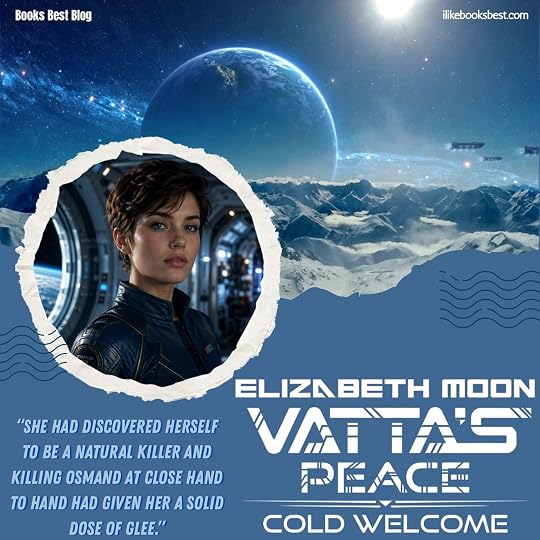
It's really hard to review this one because I really liked it and then I really liked it and then I just didn't really care. And I'm not sure if that's my fault, for not having the read the original novel before jumping into the graphic audio, or if it's the story itself.
Apparently, Vatta's Peace is a spinoff to a prequel series called Vatta's War. If I had known that, I likely would not have picked this one up. However, my lack of knowledge of the original series did not seem to impact my ability to understand this story - Moon gave a basic overview of all pertinent information as it was needed and I didn't feel like I was missing anything major. However, without reading the first series, I can't say I felt particularly connected to any of these characters - but that could, again, be linked to jumping straight to graphic audio instead of the novel itself.
In this story, Admiral Ky Vatta, a hero of the first series, is coming to the planet of Slaughterkey for commendations. Despite preferring to enter via her own aircraft, decorum requires she come down upon a Slaughterkey shuttle. When that shuttle is sabotaged, causing it to crash into the ocean, Ky is forced to take command, keep the survivors of the crash alive, and figure out who among them might be a saboteur before it's too late. Meanwhile, back in civilization, Ky's friends and family scramble to save her, protect themselves, and unwind a conspiracy that may end this newly-wrought peace before it's truly taken hold.
As far as the story itself goes, my main issue is that it lacked consistency in the pacing and storytelling. The first 25-50% of the novel was detailed and exciting, excellently portraying the sabotage, crash, and dangerous conditions that unfolded. I didn't find the parts of the story following Ky's friends and family as exciting, but her storyline more than made up for it. But then, around the middle, it became less of a compelling battle for survival and more a checklist of "on this day, so-and-so did this and this" and "day whatever, this person was instructed to create a chore rotation, so we know we can probably go find this person in this location since they should be doing this task according to their current assignment." And, while I might have been able to get past that if the paring down of Ky's plotline had been partnered with a ramping up of everyone else's, it seemed like what we did get was completely lacking in stakes. Even when things happened that seemed like they were going to be very, very bad for our characters, they just ... weren't instead. Or they were resolved quickly and with relative ease.
Again, having not read the source material, I don't know if the original novel expresses it in that way or if it's simply how the script was written and narrowed for a dramatized production, but it took me from being deeply intrigued by and invested into this story to feeling pretty apathetic about it all. It didn't help that Ky is described, repeatedly, as being young - with this even being a major plot point - while the voice actor chosen to narrate her sounds like she's in her 60s.
Over all, I'm not sure if I would recommend the graphic audio to someone who isn't already familiar with this series, but I'm definitely interested in giving the first book in the original series a try.