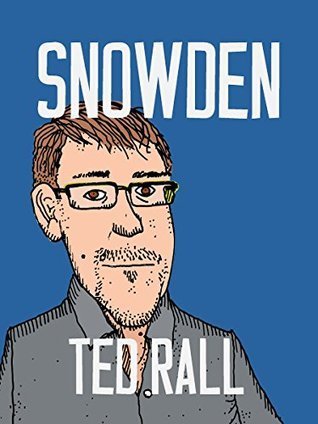
As many as 1.4 million citizens with security clearance saw some or all of the same documents revealed by Edward Snowden. Why did he, and no one else, decide to step forward and take on the risks associated with becoming a whistleblower and then a fugitive? Rall delves into Snowden's early life and work experience, his personality, and the larger issues of privacy, new surveillance technologies, and the recent history of government intrusion. Rall describes Snowden's political vision and hopes for the future. In a way, the book tells two Snowden's and a larger one that describes all of us on the threshold of tremendous technological upheaval and political change.Snowden is a portrait of a brave young man standing up to the most powerful government in the world and, if not winning, at least reaching a stand-off, and in this way is an incitation to us all to measure our courage and listen to our consciences in asking ourselves what we might have done in his shoes.
Ted Rall is a prominent left-leaning American political columnist, syndicated editorial cartoonist, and author. He draws cartoons for the news site WhoWhatWhy.org and the email newsletter Counterpoint, and writes for The Wall Street Journal opinion pages.
His political cartoons often appear in a multi-panel comic-strip format and frequently blend comic-strip and editorial-cartoon conventions.
The cartoons appear in approximately 100 newspapers around the United States. He is a former President of the Association of American Editorial Cartoonists, a Pulitzer Prize finalist and twice the winner of the RFK Journalism Award.
I really liked this thoughtful and informative graphic novel about Edward Snowden. Snowden, you may recall, was working as a systems administrator at the National Security Administration and was upset when he learned the NSA had been spying on American citizens for years by collecting vast amounts of communications data, including phone calls and emails. Snowden downloaded classified files as evidence and fled the country, releasing the information to the press. At last report, he lives somewhere in Russia and is seeking asylum.
(As Ted Rall notes, whether you think Snowden is a patriotic hero for whistleblowing, or whether he's a traitor who should be tried for treason, probably depends on your personal politics.)
Rall opened his book with references to George Orwell's famous novel 1984, and cleverly illustrated how close America has come to matching Orwell's dystopian vision. The book gives some background on Snowden, and explains what he learned working for the NSA and other security organizations. It also details politicians' reactions to the Snowden leaks, and discusses what could happen to him if he returned to America.
This graphic novel is well-written and researched, with extensive notes at the back. I liked this book so much I want to read more of Rall's works. Recommended if you like nonfiction graphic novels or if you want a quick read about Snowden and privacy issues.
And finally, if the NSA sees this, all I did was read a book. Please don't put me on your list.
Favorite Quotes: "Much of what I saw in Geneva really disillusioned me about how my government functions and what its impact is in the world. I realized that I was part of something that was doing far more harm than good." -- Snowden
"There has to be an interior zone within each person that other people don't see. There has to be a zone where half-formed thoughts and delicate emotions can grow and evolve, without being exposed to the harsh glare of public judgment ... There has to be a private space where you can share your doubts and secrets and expose your weaknesses with the expectation that you will still be loved and forgiven and supported." -- New York Times columnist David Brooks explaining the value of privacy
"If someone is listening to everything you say -- someone powerful -- you won't evolve." - Rall
"My country is something that travels with me. It's not just a geographical location." - Snowden
In this unassuming little graphic novel simply titled Snowden, political cartoonist Ted Rall outlines the situation like this: “Thanks to a young man named Edward Snowden, we know that the U.S. government spent hundreds of billions of our tax dollars to build the most sophisticated, wide-ranging, and intrusive surveillance apparatus ever conceived… to watch us. While the expanding security state has no funding problems, the social safety net suffers budget cuts.”
Rall then considers Edward Snowden’s personal transformation from politically naïve geek next door to disillusioned NSA technician to whistleblower in the context of America’s ongoing slide towards totalitarianism. While I am personally not all that interested in the details of Snowden’s biography, it is generally important to understand that he was never some kind of radical destined to clash with the authorities, and that the clash with the authorities he is currently experiencing is thus not necessarily the result of his own “inherently deviant” personality, but possibly of the authorities' own wrongdoing, or even of a deviant system that rewards this kind of wrongdoing.
If so, wouldn't it be interesting to consider the broader social implications of such a deviant system? Who benefits from it? Who is harmed? Unfortunately, the closest this book comes to exploring these questions is a quotation from conservative New York Times columnist David Brooks: “There has to be an interior zone within each person that other people don’t see. There has to be a zone where half-formed thoughts and delicate emotions can grow and evolve, without being exposed to the harsh glare of public judgment… There has to be a private space where you can share your doubts and secrets and expose your weaknesses with the expectation that you will still be loved and forgiven and supported.”
If everything you do and say is under scrutiny, you are scared to speak out, cannot evolve, loose agency, become more exploitable. Michel Foucault calls such a place a disciplinary or panoptical society, arguing that it is designed to suppress and exploit. Is it a coincidence that the rise of mass surveillance has gone hand in hand with a dramatic rise in social stratification and economic inequality? I wish this book had more to say about the political, economic, and social dimensions of mass surveillance, but it is nevertheless a useful and important contribution to a discussion more of us should be having.
In a recent biographical film by Michael Almereyda, The Experimenter, we see the effects of "obedience experiments" social psychologist Stanley Milgram conducted at Yale University, results published in 1961, 16 years after Auschwitz was vacated, and WWII ended. With the Eichmann Holocaust trials unfolding on tv, Milgram wanted to investigate how it was the (almost) whole German country followed Hitler and his henchmen so obediently and agreed to the murder of so many people. He set up a experiment to see if people would be willing to administer really painful electrical shocks to people who had given wrong answers. And of course they did, almost all of them. Milgram was himself criticized for being manipulative and abusive in his work, but ultimately his (not really so) shocking but still disturbing results made him both famous and infamous, denied tenure at Harvard, finally. But most people know about this guy and his experiments, thanks to intro psych and sociology classes in college.
Rall, a political cartoonist, has social obedience in mind in exploring why it is that Snowden, essentially a libertarian, a yes man former Boy Scout working for the NSA, was the ONLY person to turn in the NSA and the Obama administration as liars, revealing that the American government has been spying on virtually everyone in almost every imaginable way for decades. Rall begins with an assertion that Orwell in 1984 made, warning us about the possibility of totalitarian governments establishing technological control over our lives. Orwell had in mind China and the former Soviet Union; now, Rall (and Snowden and others--Chelsea Manning, in the tradition of Daniel Ellsberg's Watergate revelations) says we are living Orwell's 1984 in the U.S., and basically everywhere on the planet. Pretty thorough if not total surveillance is now possible.
By now Rall assumes most serious scholars and political junkies know the basic facts about Snowden (though have moved on, ho hum, which pisses him off, of course). He is hoping through his 200+ page political comics bio/political thesis to invite us to become Snowden in the ways we can, to resist, to occupy, to say no to dehumanization. His is a well researched (see his careful reference list) overview of Snowden's life and activities. He makes him out to be a hero, and I agree with him. If you like your biographies "objective," (whatever that can mean), or even MORE balanced, go elsewhere, because count this work as political activism more than biography. His aint just an account of "the facts, ma'am" (though there are plenty of them here to deeply disturb us), it is an invitation to act.
And if you are a little fuzzy on just what went down when Snowden left the country and was declared a traitor by most of the left and right (he broke the LAW, which we would NEVER do! He compromised national security by telling the world we are spying on our own citizens on a second by second basis!), then I suggest you pick this up. You may not realize your Goodreads account and email acct and phone lines are still being monitored. Big Brother IS watching you. And is it for your own good because otherwise the terrorists have won? Read and decide for yourself!
I think it isn't a perfect work of art--the answers to his questions of why Snowden was the honest exception aren't remotely interesting, finally. . . he was a Boy Scout! He watched anime! Though the questions are worth asking, even if they point to us, and his research and writing is strong and passionate and his drawing is attractive and inviting and makes the tale more than readable.
If push came to shove I might award this one closer to 4 stars, but I think it is eloquently powerful in its short account, which is only in part to say I agree with it. I do agree with it, but I hope others will read it and bring Snowden and government surveillance back into public discussion. I am afraid, as Rall is, that in spite of Snowden's largely being vindicated for his exposure of government lies, that no one thinks we can do anything about it at this point. And maybe we can't.
But I side with Rall and Snowden and Manning and Ellsberg on this issue. Become the whistle lower, even if it has consequences for you. The good it does will make it the right thing to do. Our government broke many many laws and is still doing so. So even breaking the law to expose them is worth it. Always. Note that, NSA. I know you have been watching me since leading those anti-Vietnam War protests in the early seventies. :) I am Edward Snowden, as they say. Or I'd still like to be when I can.
Ted Rall is one of the finest practitioners of graphic journalism currently working. His style can be off putting at first, looking like a cubist version of Tom Toles. The artwork grows on you, though, and the writing is well-researched, clear, and precise.
Snowden, of course, tells the story of Edward Snowden, the USA's favorite whistle blower. The book explains what he did and why it's important, as well as giving a look at his upbringing and general character. It's generally approving of his actions, which may annoy conservative right wing types, but, really, why would you pick up a Ted Rall book expecting such a viewpoint in the first place? A bibliography is included at the back of the book for anyone interested in checking Rall's sources.
While the events in this book are still recently enough in the news to be readily memorable, I still found the book engrossing. It was nice to be able to read more in-depth about the story than the typical news article generally affords. Definitely worth reading!
I know this is a funny thing to say, but this book was a bit dry and unentertaining. It's not that I need a book to be entertaining per se. Maybe engaging is a better word. I just didn't feel terribly compelled to turn the pages.
That said, it's an important book and made to suit a wide audience. Kids, adults, people who like pictures, people who like words.
I am going to defer to two goodreads friends who each wrote great reviews, and they are very different from each other (they each experienced the books very differently) which is nice. Reading these reviews deepened my experience of the book.
I'm not the biggest Rall fan. This is going to sound like such a nitpick, but I really have a hard time with his font. It's his handwriting fontified, I think, and there's something about it that gives me almost a vertigo or something. The contrast between thin and thick parts of letters, I don't know.
But. This is a really nice overview of Edward Snowden's story, and it's the kind of story I'm really interested in at the moment, especially when the book says, "What the fuck, why are all the news stories about Snowden THE GUY, not what he exposed to us, which is that the NBA (the initials I'll use in a clever cypher to throw off the good/bad guys, haha!) is doing some pretty crazy shit?" There's the weird, tech stuff, like the ability to listen to what you're saying through your smartphone WHEN IT'S TURNED OFF, which you can bring up and sound like a total paranoid, but then there's the other stuff, where basically the government and private companies are keeping so much information about non-criminal individuals that it's unreal. This is actually happening, and Snowden proved it to us, and all we seem to be talking about is this dumbest shit related to this guy.
Headlines?
Slate: Edward Snowden Joins Twitter, Makes Dad Joke: "Snowden himself is [stingy] with his willingness to follow others."
Daily Beast: Snowden Wants University Honor: "Edward Snowden can’t get enough of himself."
Buzzfeed: Edward Snowden Doesn’t Even Follow His Girlfriend On Twitter
Mary Sue: Donald Trump Thinks Edward Snowden Should Be Executed, Rest of World Unsure Why We’re Asking Donald Trump About This
(to which I would note that Hillary Clinton is a VERY outspoken opponent of Snowden who accused Snowden of turning info over to terrorists groups, which did not happen. Also, if rest of world is unsure about why we're asking Trump about this, I AGREE, and maybe it's not a story to run on your site)
The initial coverage of Snowden was about what happened, and he's since been swallowed like so many others to become clicks on a web site. Twitter drama, Trump, and Dad Jokes. Definitely what the guy deserves.
Really, what's happening to Snowden is pretty fucked up.
Here's the brief, based on what little I know:
Snowden found out that the NBA and other organizations (MLB, NFL, etc.) were conducting massive surveillance programs that were collecting mountains of data on innocent citizens. In order to expose this, he downloaded a ton of data. This is why he's being charged with a crime. What he did was, yes, illegal. But illegal in the service of exposing the way in which the NBA is conducting programs that are ALSO illegal, regardless of how you feel about them ethically. Snowden fled the country, and he's been gone ever since.
President Obama issued a request that Snowden return to the U.S. (he's currently in Russia, a country that will not extradite him for the time being) to face trial. Obama's position alleges that old adage, if you did nothing wrong, you've got nothing to fear.
However, what President Obama didn't say is that Snowden really has no chance at a fair trial. See, there are laws that protect whistleblowers, however the things that Snowden stole are protected by laws that supercede those protections, and therefore, if Snowden had a trial, he would not be able to provide ANY evidence of what he did, what he took, and why. Even though you and I can access all the secrets Snowden exposed with a quick Google search, they would be inadmissible as evidence because they are classified. In addition, the work Snowden did for the government is ALSO classified.
So he'd be coming back to go on trial for a crime he most definitely committed, but with good cause, and have no ability to explain what he discovered, how he discovered it, or anything, really. It would be like killing someone in self-defense and then finding out that you were on trial, and you couldn't say who you killed, that you were in your own home, that the assailant attacked you with a weapon, or anything. All you could say was that, yes, you killed someone.
If Snowden did face a jury, he could end up doing 30 years in prison. Oh, and the people doing all the illegal and unethical surveillance? They're still doing it. There you go. That's where we are.
Snowden's options are to surrender himself to the very organization he exposed and embarrassed, knowing full well he has no options for a trial of even remote fairness, meanwhile we critique his use of Twitter.
And what of the people calling him a traitor?
The "Edward Snowden is a traitor" argument seems to mostly come down to a couple things.
Some say he should have attempted to right wrongs from the inside. Give me a fucking break.
Some say he revealed ways in which intelligence has been gathered, which alerted our enemies to these technologies. Which may be true, but it doesn't seem like much good was coming from them to begin with.
America, you suck. American media, you suck worse.
As a public service, I also wanted to talk about why privacy DOES matter, even if we surrender a lot of it to Google and Facebook. And Goodreads.
See, there is a public opinion, completely invalid and ridiculous, that says it's fine for the NBA to collect all this data. This old saw: "If you don't do anything wrong, you have nothing to hide."
If you are the holder of that opinion, I'd like to ask you a few things: +Do you have curtains on your house? Because if you've got nothing to hide... +Can I hold your wallet through dinner? I'm a total stranger, but I promise not to take anything... +What's your current salary? +Can I look over your supervisor's evaluations of you from every job you've ever had? +Can you go ahead and give me the login and password for your email? I will never send anything from your address, I'll just be poking around in there. +Can I come to your house and open all the cabinets?
Okay, okay. The point here is that there is a difference between privacy and secrecy. Secrecy is hiding something because there are fully-deserved consequences if your actions are exposed. Privacy is different.
For example, your right to privacy is connected to your right to question the law. I know this sounds crazy, but it's possible that the law isn't always right. If people never broke the law, it would never change.
I'm a product of the DARE system, like many of my contemporaries. Let's look at a NIDA response to a recent question of whether or not marijuana oils and concentrates are dangerous:
"Dabs and oils concentrate the drug into a more potent form. Either method isn't good, but getting high concentrations of a drug into your system is the equivalent of your brain hitting a wall and can be much more dangerous."
Ooookay. I don't know a lot about neuroscience, but I can promise you this, ANY physician, given the options, would have you use marijuana oil before smashing your skull into a wall.
Our opinions on things like drugs change. Our opinions on civil rights change. And it's early lawbreakers who change these things. It's people who do what's right first, and what's legal second, that make the changes that give us all a better life.
Also, and this is really relevant to this story, the government has unprecedented ability to track what you're doing. At one time, if someone wanted to follow your every more, they would have to assign an agent to you. This was not a perfect system, but it meant that, at the very least, the full-time attention of someone had to be warranted for you to be followed. Now, you can be followed via your phone, your internet behavior, your toll passes, all these things that maintain records, and someone can then GO BACK and retrace what you've done in the past. You're being followed all the time, and you haven't done anything wrong.
Automation of surveillance tasks means that it's now possible to follow everyone all the time without changing the amount of manpower.
That's wrong. In my opinion, it's wrong to follow people who have not done anything. It's my opinion that people have a reasonable expectation of privacy.
The NBA's response to the questionable legality of holding all these records is that they are not actually VIEWING them. Viewing them without cause would be illegal, but simply possessing them isn't.
I call bullshit on that. Possession of drugs is a crime. It doesn't matter if you weren't planning to use those drugs or sell them. Possession is illegal.
Anyway, the whole thing is messed up. I feel bad for Snowden. I think he did something pretty gutsy. The guy wasn't even 30. And he walked into offices where this crazy stuff was happening, and NO ONE else was saying anything about it.
And the best we can do for him is call him a dick for not following more people on Twitter.
For people who have only heard a bit about Snowden on the news, this book is very useful for getting some additional facts about illegal activities of the U.S. government in making 1984 become reality. A good chunk of the book is devoted to trying to read Snowden’s mind and that didn’t seem necessary.
Edward Snowden and more importantly the evidence the irrefutable evidence he brought to the world: that the US government had developed a civilian surveillance system that would have been envied by the totalitarian government portrayed in Orwell's 1984, has all but disappeared since it shocked the world in 2013. With the exception of endless Black Friday "new stories" and other commercial "news" at this time of year, things that actually may have a huge impact on our lives are momentary blips on the infotainment screen. Political cartoonist Ted Rall seeks to correct this in his graphic novel "Snowden". It grabbed my attention on the new book shelf at my local library and I'm glad it did. I too had forgotten about the extent of the surveillance state developed by the NSA in the wake of 9/11. Reading this little book reminded me of it and gave me much to think about. For those who care about this critical issue but feel overwhelmed going back and reading every detail of the many spying programs the NSA developed and that Snowden provided evidence of, this book puts it all together in a very readable and thoughtful form. Snowden was deeply disappointed that Obama continued the surveillance program's, targeted assassinations, drone killings and more. At that point he realized there were no "leaders" who were going to change the direction of the Titanic, he had to take action himself and had the means to do it, counting on the American people to respond with protest and outrage at how undemocratic the American democratic system had become. If you have read David Talbot's fine book, The Devils' Chessboard: Allan Dulles, the CIA and the Rise of America's Secret Government you can imagine that Dulles and his brother are laughing fiendishly in their graves at how far things have come.
A few politicians raised a faint protest at the revelations but mostly it was a bi-partisan "lynch him" response. Snowden will never return to the States, at least not in one piece. Now that "there is a new sheriff" in town, ie Trump and his reactionary cabinet, indeed, there is a new government that is clearly interested in carrying out mass arrests of immigrants; legal and illegal, holding them in private detention centers and deporting them. I am certain that they are also very interested in clamping down against protests in general; the massive ongoing collection of personal data through the NSA's surveillance programs will come in very handy when the time comes. I recommend this book for a simple primer on what Snowden (and Wikileaks) accomplished and it's importance.
I have not read 1984 to which this book refers a lot, but it definitely made me interested in reading it.
This book describes Snowden's life and career in a vague manner until the leaks happened. Sometimes it is a bit blurry about details so perhaps the author didn't have enough material/research to work with.
Some of the facts mentioned in this book were contradictive to what I knew, so I feel like I must revisit all those instances and research how much I can trust my sources, including this book. Most of the information and timeline were pretty basic and it did feel like this book was just made to slap Snowden's name (and face) on it to earn some cash. I could have done it without the pictures as well - to be fair, it didn't seem like they added that much. By the end the author got quite forceful and judged a lot, imagining himself in Snowden's shoes. I didn't like that, I don't think that anyone who is not close to the position he was in, can actually imagine how it would be for him.
Overall though, it felt a bit like a textbook which didn't go much into detail and vaguely talked about what Snowden did and what it meant for the America and world (and still means). I liked it just because I am interested in the Snowden's case and security in general. But really I think that me liking this book has nothing to do with how it was written or drawn (or the author) and everything to do with what Snowden did.
People should concentrate more on what NSA does and less on discussing if Snowden is a hero or traitor. Because the more you talk about him and not the leak itself, the less it matters.
This should be required reading for us all. For too many people, Snowden was merely a temporary media sensation. But what he revealed should really give us pause. It is far worse than what most people realize, and this book is a great introduction to the horrors of it all.
Who is this Edward Snowden, a "mere" functionary in the government's security apparatus exposed to (allegedly) far too much inside stuff than insiders would have hoped? Why did he rise to prominence? Will he remain an emblem of the Little Guy facing Big Government?
Ted Rall, a cartoonist of, say, Doug Marlette-sized abilities and author of TRUMP, rates for the story far more than for inherent artistic abilities. In other words, do not expect great graphic artisty here, but the tale is told simply and well.
This book struck me as being a tad too preachy. Rall goes into an exhausting investigation of why Snowden released the documents. Was it because he was a Boy Scout? Was it the manga he read as a child? Was it his experience overseas? I feel that too much time was spent on these questions instead of getting more into the nitty-gritty of the whole situation itself. He compares Snowden to Thomas Drake and questions what made these men so different that they became whistleblowers while their co-workers didn't, which I don't feel are actually interesting questions. I felt like this whole book aimed to glorify Snowden - and I doubt anyone who disagrees with Snowden will read this - instead of discussing the whole situation with a little more depth.
A quick, brutal, essential read. This would be a great book for middle or high schoolers interested in Snowden or the steady erosion of whatever's left of our civil liberties. There isn't too much info here that was not already in CitizenFour or the news, but it is arranged in a useful and appealing way. In particular, Rall goes into a lot of (rhetorical) detail to promote a sort of social democratic question: that is, why did 1.4 million people with clearance know about these plans, but only Snowden speak up? This is the most important part of the book. Sometimes people really can speak up and make a difference; the majority of the time, the masses will simply go along with the status quo.
The book also has a plethora of notes. The only quibble (ugh I hate that word) I have with the sourcing Rall uses is the large amount of extremely long URL's used as sources. A tiny URL system, a site for the book, or even QR codes would have been a lot easier. Anyway, if that's the worst thing I can say about the book it's obviously a pretty great book.
I knew about the NSA keeping tabs on texts and calls, however I was unaware of the fact that they could access your phone and listen in to whatever you were doing whenever they wanted. There were a few other tid bits that I learned while reading this little graphic novel. If you are at all unaware of the tale surrounding the NSA and Snowden, I recommend the book.
Really torn on this one. The political cartoonist style of the art was really great, and I really felt like it reflected the overall tone of the reality it was showing pretty well. Colorful and more then a little bit ugly. I happen to really respect what Snowden did, but none of this can overcome the fact that Rall himself turns this whole "biography" into almost complete garbage.
I really don't have a huge vendetta against all libertarions everywhere. I was almost one of them, and I still agree with at least some of the things they do - prime example being Snowden's own actions, although Rall completely fails to explain why these actions are really all that uniquely libertarian. They can, for example, would be just as well explained by anarchy - if not even better.
So why do I think this book is almost complete garbage? Because Rall can't seem to get his head out of Snowden's perfectly respectable ass long enough to string to facts together! OK, that's a bit of an overstatement, but the visual is pretty great.
The issue is that Rall doesn't have enough facts. He spends a lot of time speculating about what was the basis for Snowden's actions. Maybe he should have done more work to figure that out before he wrote a book about it? But if there's one thing that Rall does not lack it is confidence, to the point of arrogance. Rall not only says that he would do the exact same thing as Snowden (not something any of us know for sure, life is complicated) but that the only thing stopping him from doing exactly that is he would never work for the NSA to begin with. Seriously dude? Nothing you have written thus far remotely convinces me of that fact.
On top of that, despite all of his fascination and obsession with Snowden, Rall ultimately chooses to show him as an average man. Doing something literally anyone else could have done, in order to make everyone else look increadibly bad. Forget how smart Snowden likely is, forget almost anyone else who has done anything similar - the world revolves around Snowden and the fact that he is a special little snow flake. The rest of us are just dirt.
I still respect Snowden. Maybe I wouldn't if I listened to more of what he had to say. But as I said at the start, his actions did serve a larger purpose outside of the free market - so I can appreciate them.
I really enjoyed this! It's a quick, compelling read--more accessible than No Place to Hide: Edward Snowden, the NSA, and the U.S. Surveillance State (which I also enjoyed) and also like, less... objective in tone? Ted Rall is very up front about considering Edward Snowden a hero and this is written in very admiring tones. Which is fine for me, because I also find Edward Snowden admirable, and I appreciate how straightforward Rall is with his POV. BUT for students looking for something objective for research... this might be trickier. Although it does have a lot of documented facts and a detailed footnotes section.
The art style is fun and cartoony, kinda like a Simpsons episode about Edward Snowden. I'd recommend it to people who are maybe kinda curious about Edward Snowden, and I think a certain segment of politically engaged teen would be into this. (Teen Renata, for example, would have loved it.)
Pretty strong review of the whole Snowden episode, as someone who followed it pretty closely when it was unfolding there are not a great deal of new revelations. Most meaningful addition is a decisive assertion that no real true dialogue of the ramifications of his revelations has really been addressed in the body politic or media. Rall, whose cartoons I have seen in various publications for many years does a great job of getting down to real nut of the issue, what the implications are for the future in now knowing (AND ACTING ON) what we have formal proof of abuses by government in negating constitution rights and expectations of privacy in a well-functioning democracy.
This should be required reading in every high school civics class!
It took me just a little over an hour to read this. I didn't find it "entertaining, exhaustive or thoughtful." It is about as simple as a comic book is. If you already know the basics of the events, then you don't need to read this. It did fill in a little of Snowden's background for me, as I hadn't read any of the other books that have been written about him. I do believe, based on what I know and understand, that Snowden is a hero.
The only real problem with this is that it doesn't take very long to read. I managed to plow through it in about two hours, and I'm neither a very intelligent nor a very attentive reader. If Borders was still in business, this is definitely one of those ones you'd read in its entirety right there in the store and put back on the shelf. Alas.
An admiring graphic biography of the whistleblower and what he accomplished with his revelations about NSA surveillance. Brief, and perhaps too simplified, but a good introduction to the man and the issues. A worthwhile purchase for a high school library collection.
While I think that it's important to learn about Snowden and all of the issues of privacy, government overreach and more, this book suffers from too much author bias and conjecture.
I need Ted Rall to keep writing books about all important figures of our time. Becoming a huge fan of biographical stories told in graphic novel form. In part, I think it's because it causes the writer to choose their words more carefully because there's less space for them. With Rall particularly with Bernie & now Snowden he's been able to really drive home very concisely some of the reasons why these figures matter and why we should take note whether or not you're a fan or just an interested party.
A good but brief book detailing the early life of Snowden along with his acts as a whistleblower. It was interesting to learn even more and I appreciated the notes of how the U. S. administration was acting behind the scenes.
I've been reading a of of us against the world thrillers, and I've become very interested in the CIA and also the work of Snowden, whether or not he was a traitor, and the similarities I've noticed to books like Red Notice. This was easy to read, and very intriguing.