

What do you think?

Nomadic Empires
Nomadic Empires sheds new light on 2,000 years of military history and geopolitics. The Mongol Empire of Genghis-Khan and his heirs, as is well known, was the greatest empire in world history. For 2,000 from the fifth century b.c. to the fifteenth century a.d., the steppe areas of Asia, from the borders of Manchuria to the Black Sea, were a "zone of turbulence," threatening settled peoples from China to Russia and Hungary, including Iran, India, the Byzantine empire, and even Syria. It was a true world stage that was affected by these destructive nomads. This cogent, well-written volume examines these nomadic people, variously called Indo-Europeans, Turkic peoples, or Mongols. They did not belong to a sole nation or language, but shared a strategic culture born in the a highly mobile cavalry which did not require sophisticated logistics, and an indirect mode of combat based on surprise, mobility, and harassment. They used bows and arrows and, when they were united under the authority of a strong leader, were able to become a deadly threat to their sedentary neighbors. Chaliand addresses the subject from four perspectives. First, he examines the early nomadic populations of Eurasia, and the impact of these nomads and their complex relationships with settled peoples. Then he describes military fronts of the Altaic Nomads, detailing events from the fourth century b.c. through the twelfth century a.d., from the early Chinese front to the Indo-Iranian front, the Byzantine front, and the Russian front. Next he covers the undertakings of the great nomad conquerors that brought about the Ottoman Empire. And finally, he describes what he calls "the revenge of the sedentary peoples, exploring Russia and China in the aftermath of the Mongols. The volume includes a chronology and an annotated bibliography. Now in paperback, this cogent, well-written volume examines these nomadic people, variously called Indo-Europeans, Turkic peoples, or Mongols. They did not belong to a sole nation or language, but shared a strategic culture born in the a highly mobile cavalry that did not require sophisticated logistics, and an indirect mode of combat based on surprise, mobility, and harassment. They used bows and arrows and, when they were united under the authority of a strong leader, were able to become a deadly threat to their sedentary neighbors.
- GenresHistory
252 pages, Paperback
First published April 1, 2001
About the author
Gérard Chaliand
156 books28 followersGérard Chaliand is a French expert in geopolitics who has published widely on irregular warfare and military strategy.
Ratings & Reviews
Friends & Following
Create a free account to discover what your friends think of this book!
Community Reviews
Displaying 1 - 5 of 5 reviews

February 17, 2015
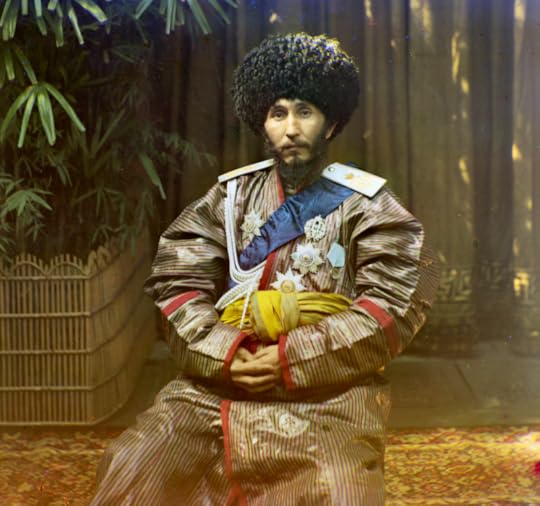
Le Khan de Khiva, début XXème siècle
Ce livre est un vaste et ambitieux synoptique de l'histoire des empires fondés par les nomades d'Asie depuis l'Antiquité, jusqu'à ce que la Russie se rende maître de ces territoires au cours du XIXème siècle, comme les États-Unis l'ont fait en Amérique à la même époque.
La thèse de l'auteur est que l'affrontement entre les peuples nomades et les peuples sédentaires a été le véritable moteur de l'histoire pendant des siècles. Les nomades avaient une puissance militaire contre laquelle le sédentaire ne pouvait pas rivaliser, mais le sédentaire absorbe et civilise par degré ses vainqueurs, avant qu'une nouvelle vague n'arrive. Les seuls coins d'Asie à avoir échappé pendant plus de mille ans à ces invasions sont l'Europe occidentale et le Japon.
On trouve de nombreuses cartes, de longues transcriptions d'auteurs comme Hérodote, et une foule d'informations intéressantes qui donnent envie d'aller plus loin, car on se laisse facilement submerger par l'immense quantité de peuples cités. J'ai trouvé le livre intéressant et stimulant, mais peut-être desservi par un trop grand nombre de répétitions, ainsi qu'un déséquilibre dans les différentes parties. Pas mal.

August 18, 2014
Un tout petit bouquin pour tant de siècles et de personnages. L'auteur a voulu faire une très grosse synthèse de ceux que l'on étudie presque jamais : les peuples nomades d'Asie et d'Europe de l'est. Bien que cette perspective de voir enfin de l'autre côté du spectre soit vraiment enthousiasmant, le projet est à mon avis bien trop ambitieux : l'auteur se perd dans les dédales des légendes de chaque nouveau personnage, de tous les peuples nomades (et là vous devez absorber une foule de noms compliqués ou qu'on a du mal à situer dans l'espace et le temps par rapport aux autres peuples qui se juxtaposent) qui finissent par embrouiller le lecteur. C'est bien dommage.

February 17, 2021
A pretty bad book, written in a confusing style, with several big mistakes and potentially misleading claims.
The topic itself is of great interest, but the author does not seem to have put any effort in any but the most superficial research.
When I buy a book, I expect to be able to trust the author with what they say; I don't expect having do double check everything they say.
To give just the clearest example of false claims, the author claims that an Avar-Sassanid siege of Constantinople happened in 582, during which ships belonging to the Kievan Rus were burnt by Greek Fire in the Golden Horn.
Now, there's a lot to unpack, there - the siege he refers to did, in fact, happen, but no earlier than 626.
Also, the first reference to Greek Fire is much later in Byzantine history, but that all pales in front of the realization that the Kievan Rus ships the author has taking part to the siege belong to an episode much later in history (we're talking a full couple of centuries), as the Kievan Rus did not yet exist, not even in embryonic form, not in 582, nor in 626.
And that's just the clearest example of poor or entirely absent research; there are several other points that I could bring up.
The fact is, I know that the specific mistakes I've spotted are things that have not happened just because they happened to be things I knew about; but, when it comes to Mongol history, or Xiongnu history, or Gokturk history, there I would have to trust the author - something that normally would come naturally, but, in this case, I cannot do, as mr. Chaliand does signify in multiple occasion that he's not a trustworthy author.
The author seems also to be very confused regarding what is and what is not to be subject of the book; how else can you explain the fact that the Ottomans get more space than, say, the Khazars, which is to say, that a non-nomadic empire firmly based in cities gets more space than one of the most notorious khaganates of the pontic steppe?
To give a quick look to the Ottomans as descending from nomadic people is more than understandable (as the author does with Babur and the Mughals, later, summing them up, quite rightly, in just a few lines); to give them space in the book that could have been occupied by any actually nomadic civilization is just a waste.
Also the level of detail that the author is willing to indulge in is extremely inconsistent throughout the book - the battle of the Catalaunian Fields, for example, gets about as much space as the entire history of the Magyars; the description of the Byzantine thematic system about as much as the arrival of the Proto-Bulgarians (in this case, also, again the history of a settled people taking space that could have been given to the nomads).
To sum up - the best use for this book is as a very generic guideline to a portion of the nomadic empires, but one that cannot be fully trusted on dates, facts or even on just stating events in a non-misleading manner, and also one that's been very badly written.
Do not buy it, it's a total let down.
The topic itself is of great interest, but the author does not seem to have put any effort in any but the most superficial research.
When I buy a book, I expect to be able to trust the author with what they say; I don't expect having do double check everything they say.
To give just the clearest example of false claims, the author claims that an Avar-Sassanid siege of Constantinople happened in 582, during which ships belonging to the Kievan Rus were burnt by Greek Fire in the Golden Horn.
Now, there's a lot to unpack, there - the siege he refers to did, in fact, happen, but no earlier than 626.
Also, the first reference to Greek Fire is much later in Byzantine history, but that all pales in front of the realization that the Kievan Rus ships the author has taking part to the siege belong to an episode much later in history (we're talking a full couple of centuries), as the Kievan Rus did not yet exist, not even in embryonic form, not in 582, nor in 626.
And that's just the clearest example of poor or entirely absent research; there are several other points that I could bring up.
The fact is, I know that the specific mistakes I've spotted are things that have not happened just because they happened to be things I knew about; but, when it comes to Mongol history, or Xiongnu history, or Gokturk history, there I would have to trust the author - something that normally would come naturally, but, in this case, I cannot do, as mr. Chaliand does signify in multiple occasion that he's not a trustworthy author.
The author seems also to be very confused regarding what is and what is not to be subject of the book; how else can you explain the fact that the Ottomans get more space than, say, the Khazars, which is to say, that a non-nomadic empire firmly based in cities gets more space than one of the most notorious khaganates of the pontic steppe?
To give a quick look to the Ottomans as descending from nomadic people is more than understandable (as the author does with Babur and the Mughals, later, summing them up, quite rightly, in just a few lines); to give them space in the book that could have been occupied by any actually nomadic civilization is just a waste.
Also the level of detail that the author is willing to indulge in is extremely inconsistent throughout the book - the battle of the Catalaunian Fields, for example, gets about as much space as the entire history of the Magyars; the description of the Byzantine thematic system about as much as the arrival of the Proto-Bulgarians (in this case, also, again the history of a settled people taking space that could have been given to the nomads).
To sum up - the best use for this book is as a very generic guideline to a portion of the nomadic empires, but one that cannot be fully trusted on dates, facts or even on just stating events in a non-misleading manner, and also one that's been very badly written.
Do not buy it, it's a total let down.
August 22, 2026
«Los imperios nómadas: de Mongolia al Danubio» («Les empires nomades, de la Mongolie au Danube» en el original francés) es un libro entretenido e interesante pero al que, quizás, le falta un foco o un hilo conductor más definido o ambicioso. El contenido es de calidad pero, a mi parecer, está descompensado.
Se nos presenta como una obra que va a rescatar del olvido a los pueblos nómadas y su impacto en el mundo a partir de investigaciones que hizo el autor a propósito de un tratado bélico. Así, esperaba encontrar un desarrollo más consecuente de, precisamente, los aspectos bélicos, estratégicos o tácticos de los pueblos nómadas. Sin embargo, no se llega a profundizar en estos aspectos más de lo que lo han hecho ya otros tratados.
Además, el libro se focaliza sobre unos pueblos nómadas muy concretos (a pesar de lo amplio del espectro temporal): aquellos que vienen de las estepas asiáticas. Salvo algunas menciones breves a los pueblos árabes y los vikingos, la cosa se restringe a ellos, se adivina, porque tuvieron un gran impacto en la sociedad euroasiática y, así, en la Europea (aunque la parte más occidental quedara relativamente protegida del fenómeno).
Así mismo, tampoco se explican las particularidades de las sociedades nómadas (economía, sistemas de creencias, organización social, no sé) más allá de una panorámica muy generalista.
Entonces, ¿en qué se nos van las 200 páginas del libro? Principalmente en un desarrollo cronológico de pueblos e invasiones al que, a mi parecer, le falta algo de chicha. No es que la información no sea de calidad o que esté mal presentada, sino que no veo muy bien a dónde quería ir el autor más allá de una tesis que se despacha ya en las primeras páginas: que los pueblos nómadas asiáticos tuvieron un gran impacto en la Antigüedad y la Edad Media eurocéntrica.
Así, en conjunto, una obra entretenida, con cronologías y mapas que me han resultado de gran utilidad, pero a la que se le podría haber dado una vuelta de tuerca para hacer justicia, precisamente, a los pueblos nómadas y su cultura.
Se nos presenta como una obra que va a rescatar del olvido a los pueblos nómadas y su impacto en el mundo a partir de investigaciones que hizo el autor a propósito de un tratado bélico. Así, esperaba encontrar un desarrollo más consecuente de, precisamente, los aspectos bélicos, estratégicos o tácticos de los pueblos nómadas. Sin embargo, no se llega a profundizar en estos aspectos más de lo que lo han hecho ya otros tratados.
Además, el libro se focaliza sobre unos pueblos nómadas muy concretos (a pesar de lo amplio del espectro temporal): aquellos que vienen de las estepas asiáticas. Salvo algunas menciones breves a los pueblos árabes y los vikingos, la cosa se restringe a ellos, se adivina, porque tuvieron un gran impacto en la sociedad euroasiática y, así, en la Europea (aunque la parte más occidental quedara relativamente protegida del fenómeno).
Así mismo, tampoco se explican las particularidades de las sociedades nómadas (economía, sistemas de creencias, organización social, no sé) más allá de una panorámica muy generalista.
Entonces, ¿en qué se nos van las 200 páginas del libro? Principalmente en un desarrollo cronológico de pueblos e invasiones al que, a mi parecer, le falta algo de chicha. No es que la información no sea de calidad o que esté mal presentada, sino que no veo muy bien a dónde quería ir el autor más allá de una tesis que se despacha ya en las primeras páginas: que los pueblos nómadas asiáticos tuvieron un gran impacto en la Antigüedad y la Edad Media eurocéntrica.
Así, en conjunto, una obra entretenida, con cronologías y mapas que me han resultado de gran utilidad, pero a la que se le podría haber dado una vuelta de tuerca para hacer justicia, precisamente, a los pueblos nómadas y su cultura.

Did Not Finish
May 18, 2026Trop complexe pour moi, je n'ai pas su aller plus loin que l'introduction : il y a mention d'une foule de noms de peuples et de lieux que je ne connais pas, j'ai probablement pas les connaissances de base pour arriver à ce que ce qui est raconté face sens pour moi.
Displaying 1 - 5 of 5 reviews