Jump to ratings and reviews
Rate this book

A Giant Fairy Story

Дикие лебеди

Rate this book
Сказка, вошедшая во все хрестоматийные сборники Андерсена. История прекрасной принцессы и ее заколдованных братьев-лебедей, которым она во исполнение заклятия шьёт рубашки, не в силах проронить ни слова в свою защиту.

20 pages, Kindle Edition

Published January 1, 2014

16 people are currently reading
216 people want to read

About the author

Hans Christian Andersen

7,798 books3,548 followers
Hans Christian Andersen (often referred to in Scandinavia as H.C. Andersen) was a Danish author and poet. Although a prolific writer of plays, travelogues, novels, and poems, Andersen is best remembered for his fairy tales. Andersen's popularity is not limited to children; his stories — called eventyr, or "fairy-tales" — express themes that transcend age and nationality.

Andersen's fairy tales, which have been translated into more than 125 languages, have become culturally embedded in the West's collective consciousness, readily accessible to children, but presenting lessons of virtue and resilience in the face of adversity for mature readers as well. Some of his most famous fairy tales include "The Little Mermaid", "The Ugly Duckling", "The Nightingale", "The Emperor's New Clothes" and many more. His stories have inspired plays, ballets, and both live-action and animated films.

Ratings & Reviews

What do you think?
Rate this book

Friends & Following

Create a free account to discover what your friends think of this book!

Community Reviews

5 stars
173 (38%)
4 stars
142 (31%)
3 stars
101 (22%)
2 stars
21 (4%)
1 star
13 (2%)
Displaying 1 - 30 of 61 reviews
Profile Image for Anne.
4,765 reviews71.3k followers
September 29, 2025
How did I end up here?
And by here, I mean this somewhat obscure fairy tale.
Well, I'm reading Daughter of the Forest, which is a retelling of this, The Six Swans, and maybe a few other stories. So I thought it would be good to take a peek at the source material.
Andersen's fairytale is longer and goes into a bit more depth than the version of The Six Swans I listened to, which was a bit of folklore collected by the famous Grimm brothers.
Keep in mind, I believe there may be more than one version.

description

In this one, you have a king with 12 children, who marries a witch. Obviously, unbeknownst to him. We don't set out to marry red flags, do we?
Regardless, she's your typical evil stepmother, and starts her reign off by turning her 11 stepsons into swans. I mean...yeah. That's one way to go, right?
Now, they can transform back into humans at night, but during the day? Birds.

description

So what about her stepdaughter, Elisa?
Well, for a while, things are ok. But as Elisa gets a bit older, the stepmother starts up her shenanigans again and tries to put her under an evil spell. However, the girl is so pious that the damn thing bounces right off of her. So the wicked queen resorts to putting dirt on her face and messing up the princess's dress, so that she becomes unrecognizable.
Because that's a thing in fairy tales.

description

Around this time, she and her brothers find each other, and they fly her to safety in another kingdom. And this is where she finds out that to turn her bros back to humans, she'll need to sew them all shirts made out of stinging nettles that are going to fuck up her hands, AND take a vow of silence until said shirts are all done and thrown over the heads of the swans.
Thank goodness she's such a great sister because I can't see either one of my girls doing this for their older brothers. I think the best my boys could hope for would be to get tossed a bit of off-brand bread while they swam about at the pond.

description

So here she is, picking these nettles and turning them into shirts in a cave somewhere by herself, silently weeping over this DIY project from Hell. Terrible.
But it gets worse!
Or maybe better?
A hot king wanders through her neighborhood and spies her. And while her silence has him a bit flummoxed, her beauty is too much to resist, and he carts her off to his kingdom to continue her jacked-up craft project in a nice cozy room in his castle.
And promptly falls in love with her.
And then marries her.

description

But the life of a young woman is fraught with danger, and the local religious leader thinks something is hinky about this chick who spends her days knitting these Frankenstein sweaters and her nights in the graveyard collecting the nettles to do it.
She's probably in league with the Devil, amiright?
Now her husband takes up for her at first, but after a while, the overwhelming "evidence" coupled with his wife's silence leads to only one conclusion - witchcraft!
Welp. Gotta burn her.

description

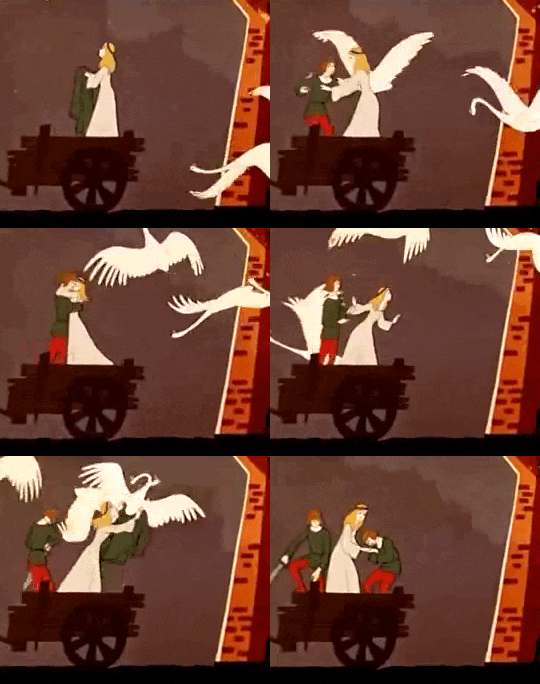
In their defense, her brothers do try to save her, but in their bird state, they can't do much. Lucky for them, little sis keeps on sewing right till the bitter end when they're loading her up on the burn pile. At the last possible moment, they come swooping down like a fairy tale version of Angry Birds, she tosses shirts over each of their heads, and they turn back into men.
Mostly.
She didn't have time to completely finish the last shirt, so one of the guys gets stuck with a wing in lieu of an arm.

description

On the bright side, after witnessing this miracle, the angry villagers, the archbishop, and her lovely husband all decide that she's A-ok and welcome her back into the community with open arms.

description

The moral of the story?
Pray you're an only child.

I listened to the audiobook from Dreamscape Media narrated by Emma Fenney
Profile Image for Bionic Jean.
1,396 reviews1,586 followers
September 9, 2023
The Wild Swans is a short story by Hans Christian Andersen, which was first published in 1838. It is one of his earliest and longest stories, and very involved. Ostensibly it is about a princess who rescues her eleven brothers from a spell cast by an evil queen. There are obvious themes of loyalty, trust, and hoping almost beyond hope. However, there is evidently an additional subtext. The underlying message is a religious one about virtue and self-sacrifice.

As it is a fairy story, none of the plot is deliberately concealed in this review. Indeed, it would be difficult to know what should not be revealed in such a random series of events. Here then follow the main developments of the story, as I understood it, before my more personal comment.

The tale starts in a kingdom far away, where a princess called Elise lived with her father, the king, whose wife had died, and her eleven brothers, who were princes. They were all very happy, living in the lap of luxury, and their lives seemed perfect. But the king decided to remarry, and his new wife hated the king's children. She turned out not only to be a wicked queen, but also a witch. Spitefully, the queen sent Elise away to be raised by peasants. She tried to get rid of her eleven stepsons too, commanding them to, "Fly away as great voiceless birds!" But her spell did not work quite as well as she expected, as they were transformed into wild mute swans; royal birds, very noble and majestic, "with golden crowns on their heads". Also, they mysteriously retained the ability to resume their human form by night. The princes, now swans, obeyed her command and,

"With a strange cry, they flew out of the castle window, across the park and over the wood."

When Elise reached the age of fifteen, she had to go home to the palace, where her stepmother proceeded to make her life a misery in various unpleasant ways. The queen kissed three toads, and put them in Elise's bath in order to turn her lazy, ugly, and evil. But Elise was so pure and good that the spells didn't affect her, and the toads were turned into poppies. The evil queen then smeared her with dirt and walnut juice to turn her black. Nobody wanted to know Elise any more, and when the king saw her, he was so horrified that he didn't believe it could possibly be his own daughter. Elise said nothing, but she was so unhappy that she ran away. She guessed that her brothers must have been cast out, and ran away to the forest resolving to find the eleven princes.

The next day, washing in the stream, she was taken aback,

"When Elise saw her face reflected in the water she got a shock - it didn't look like her at all ... In the whole world there was no one as lovely as Elise."

"She thought of God, who would surely not forsake her"
.

Yearning to see her brothers again, Elise dreamed about them all, and asked a passing old woman if she had seen eleven princes riding through the forest. The old woman replied that she hadn't - but that she had seen eleven wild swans. She described where they were, and Elise went there.

Sure enough, as night fell, the swans transformed back into the princes again. Elise and her brothers were all so happy to be one family again. The prince brothers then decided to carry Elise to safety in a foreign land, where she would be out of the reach of their evil stepmother. But as they flew far into the distance, carrying Elise, they battled a heavy storm,

"Oh it was all her fault if they could not fly fast enough! When the sun set they would become human beings again, and then they would fall into the sea and be drowned. She prayed to God from the bottom of her heart"

"They all sang a hymn, and it gave them courage."


The next day the storm had dispersed and the swans continued on their journey as Elise slept.

"She prayed so hard; yes even in her dreams she was praying."

In her dreams she met the fairy queen, Morgana, who seemed oddly to remind her of the old woman who had given her the berries, and directed her to the place where the swans lived. The story does not explicitly state that Morgana is the “fairy godmother” of Elise, but it is evident that in a literary sense this is exactly who she is, just as the queen is the "evil stepmother", a common theme in many fairy tales. Certainly Morgana fills the function of an older, wiser, and other-worldly being, who guides the younger, less experienced character to maturity. The fairy queen, or "godmother", listened to Elise's plight, and said,

"You have the power to set your brothers free, but have you the courage and determination?"

Morgana tells Elise how she can turn the princes back into humans for ever, therefore guiding Elisa to a better future and adulthood. She advises her to gather stinging nettles of a certain type, which only grow in graveyards, to knit into shirts which will eventually help her brothers regain their human shapes. Elisa has to endure painful burns and blisters on her hands from the nettle stings, and then break them into flax with her bare feet. Then she must weave the flax into eleven shirts by hand - and (as if all that were not enough), she must also take a vow of silence for the duration of her task. Presumably this is connected with the original curse, since the brothers are mute swans,

"The first word that falls from your lips will strike like a dagger at your brother's hearts. Remember!"

Elise settles to her task, and spends as much time as she can, enduring all the pain in complete silence. Her brothers are unhappy to see her distress, and the tears of the youngest brother do assuage her pain a little, but they can do nothing much to help her. Months pass. Eventually, the king of another faraway land happens to see Elise and he falls in love with her beauty. (This is a fairy story.) He cannot understand why she is so silent, but he is kind, and allows her to stay in his castle and continue her work, in the hope that she will eventually talk to him. He gives her many gifts - beautiful finery and furnishings - but none of it makes any difference to Elise. Eventually he proposes, wanting to make her his queen by marrying her, and Elise accepts.

The Archbishop hates the idea, as he is sure that Elise is a witch, but the king will not believe him. The Archbishop is subsequently very unkind to Elise, and at the coronation jams her crown down on her head so it really hurts her, but Elise still does not cry out.

One night Elisa runs out of nettles and is forced to collect more in a nearby church graveyard. Many witches are gathered there,

"They were stripping off their rags as if to bathe, and digging with their bony fingers into the newly dug graves; they were scrabbling out the corpses and feasting on their flesh."

(Clearly these are Lamiae, monsters of folklore, child-eating demons who hunt and devour the children of others. Apart from their thirst for blood, the Lamiae were thought to be very unclean, stupid, and gluttons.)

Elise is very frightened, but has no choice but to pick more stinging nettles with her raw, burned hands. The Archbishop had been spying on her all the while, and he reports back to the king, saying that this is proof of her witchcraft. The statues of the saints all shake their heads in protest, but the Archbishop merely indicates that this is a sign of Elise's guilt, saying that the statues were "shaking their heads in horror".

The king refuses to believe such a thing of his beautiful Elise. But after a while, she once again runs out of stinging nettles, so has to make yet another trip to the graveyard, past the hag-like Lamiae, sitting on the tombs. This time the Archbishop insists that the king accompanies him, to see it all with his own eyes. Brokenhearted, the king is now convinced that Elise must be one of the witches, and allows the Archbishop to put Elise on trial for witchcraft. She still speaks not one word in her own defence and is sentenced to death by being burnt at the stake.

The brothers discover Elisa's plight and try to speak to the king but fail. Even as the cart is taking her away to her execution, she continues with her work,

"The ten shirts lay at her feet and she worked at the eleventh, while the rabble mocked and jeered" convinced too by now, that Elise was a witch.

Elise was determined to keep on with her work, right up to the last moment of her life. But this enraged the people, who were about to snatch and tear the shirts. Then all of a sudden the eleven swan brothers swooped down and settled on the cart, flapping their great wings. The crowd were terrified, assuming that it must be a sign from heaven that Elise was innocent. The executioner however was still preparing for the burning. Quickly Elise managed to throw the shirts over the swans, and immediately the brothers returned to their human forms. Eleven handsome princes stood in front of her - all fully restored except one who still had a swan's wing intead of an arm, as his shirt had not been quite finished.

Elise was now at last free to speak, and to tell the truth. She cried out,

"Now I may speak! I am innocent!"

The people all bowed down to her, as to a saint, "but Elise worn out by worry, fear and grief, sank back lifeless into her brothers' arms".

As her brothers started to explain the whole story, the firewood around Elise's stake magically, or miraculously, started to take root, and the branches soared high, before bursting into flowering red roses. The king plucked the highest, single flower, which was pure white, and laid it on Elise's breast, whereupon she was restored to life. The church bells rang out, and everyone was full of joy.

Illustration by Vilhelm Pedersen (1850), Hans Christian Andersen's first illustrator


Everyone except me. I think it is a horrible story.

Yes, I understand that it must be a Christian allegory, but it goes so so very long, and the pain and suffering just piles on without respite. Is this really a children's story? The whole timbre of the story is perplexing, and it raises so many questions, to say that it is not a traditional tale but a 19th century invention.

Hans Christian Andersen had grown up almost as a social outcast, so was always keenly sensitive to the odd person, misfit or non-conformist in the community. In many of his stories Hans Christian Andersen seemed to be obsessed with writing about sin. We know that he considered himself to be unlovable, and possibly he feared that this was because he was a sinful person. He seemed to believe that the human race was broken by sin and tainted in blackness. Almost all of his stories dwell on the darker side of humans; the fact that people sin in the eyes of God. He believed that all humans are sinners and should live in fear of God, and his characters continually pray. He keeps reinforcing the redemptive powers of love and faith, optimistic about redemption, because his belief was that this would enable him to get to heaven.

In this story particularly, Hans Christian Andersen reflects on wickedness, and the nature of God, love, and forgiveness. What does it take to get into heaven? How much suffering could he make Elise undergo? Hans Christian Andersen seemed to be exploring the human's capacity for silently sacrificing themselves for others. Perhaps he considered this to be the best - or even the only - way to get to heaven. But if that is so, why did he choose the one female out of twelve humans who was to sacrifice herself? The question of the impotent brothers keeps raising its head here. Why was Elise so isolated by virtue of her gender? Was this part of a female martyr concept? Throughout the story Elise demonstrates a strong trust in prayer and Providence.

Interestingly, Elise is the only character in the whole tale with a name, apart from the fairy queen, Morgana. Is this significant? Are the others "demoted" in Christian terms, to the rank of mere animals, or humans without souls? The only way she could save her brothers, was for Elise to suffer great pain without uttering a single word, and also without the possibility of defending herself when she was condemned to death. It is a martyr's sacrifice; a Christ-like sacrifice. Elise is innocent, steadfast, loving and pious. She has no defects, and epitomises virtue. She is in fact presented as a perfect female.

There are so many unmistakably Christian motifs in the story, the free spirits, white birds, twelve royal children to parallel the twelve disciples of Jesus Christ ... The twelve royal children live peacefully under the love and affection of their benevolent father, the king of the land. Kings usually choose their country’s religion, and by now in parts of Europe, the ruler was the head of the church. Could this benevolent king in this story be an embodiment of the uncorrupted Church?

Everything was good in this storybook world until the arrival of the evil stepmother - a common theme in fairy stories. But reading this as an allegory, the stepmother could represent the evil that corrupts the incorruptible Church. She uses magic to turn the princes, true followers of God, into swans and sends Elise away by turning her father against her. Thus evil has turned the Church to darkness, and expelled its true followers.

It is the king’s ignorance to any evil which has allowed it in. Therefore, the Church is still innately good, merely tainted. When Elise goes into the forest away from the corrupted church for good, her real journey begins as a follower of the true Church. She is to create a new, spotless Church and bring with her the followers of the true faith. Cue for the fairy godmother, the only other person with a name. Morgana, the fairy God-mother possibly represents God, or Christ, here. She will guide Elise to restore her real faith.

Or is this interpretation completely bizarre? Perhaps knowing Hans Christian Andersen's religious beliefs might put these tangled problems into some sort of framework.

A little research reveals that Hans Christian Andersen was a Lutheran, but rarely went to church. He once wrote in his diary,

“I believe that God and Jesus are one; and that the Virgin Mary is the chosen one among humans. In our humble way we can pray to her to plead with God on our behalf.”

There are clear indications here of his views on the perfect idealised woman. When he died, his funeral service was held at "Our Lady’s Church" in Copenhagen, the cathedral of Copenhagen, and the National Cathedral of Denmark. But is this a Catholic cathedral? No, in fact. After the Reformation of 1536, Denmark became predominantly a Protestant country, and even now Catholicism comprises less than 1% of the population. "Our Lady’s Church" became a national church after the Reformation. All future services was conducted after the Evangelical Lutheran order, and in the Danish mother tongue. To an outsider, the two branches of Christianity seem very similar. With particular respect to this story, Lutheran and Catholic theologians now agree (since 1968) that the celebration of the Eucharist (or Mass) involves a sacrifice of praise and self-offering, which unites the believer with the sacrifice of Christ.

So it does look very much as though this story could really be a story discussing the Reformation of the Catholic Church. There are many textual details which would support this theory. When Elise finds her brothers, they reunite as a family body, mirroring the metaphor of the body of the Church. The youngest brother stays with Elise with his head in her lap, like a lamb, while the other brothers fly in a circle overhead. (Jesus Christ was sometimes portrayed as a sacrificial lamb.) The younger brother seems to be an archetypal Jesus Christ figure, especially at the end of the story when he sacrifices an arm. The younger brother is also the one who takes care of Elise, giving her branches of ripe berries, shading her with his wings, and leading her to a cave, hoping that she will, “dream well”. Here he enacts Jesus Christ's loving care in the Gospels: feeding the hungry, defending the weak, and leading the blind.

The motif of nettles, through which pain Elise is directed to remain silent, equates to Jesus Christ's crown of thorns on the cross. In this way Elise too represents a Christ figure, working through her own bodily pain to restore the purity of religion. The younger brother comes to Elise and cries on her hands, taking away her pain.

The evil Archbishop stands in her way and accuses her of being a witch. This recalls a time when people of power in the Catholic Church often abused their superior positions by taking advantage of those they should be caring for. In the end Elise turns her brothers back into humans, with the exception of the arms of the younger brother. He instead has wings, symbolising the dual nature of Jesus, the man, and God. Elise has therefore both saved the Church from corruption, and restored humanity. Her sainthood and the inclusion of the Archbishop suggest that the type of Christianity being explored is Catholicism.

Some of the details here may be misfires, or mere conjecture, but surely there are enough parallels for it not to be pure coincidence?

The question remains though, why would Hans Christian Andersen write such a horrible story for children? Many folk and fairy tales are sanitised versions of grim, and sometimes gruesome, tales; tales handed down over the generations, from an oral tradition meant to teach the people who listened to them how to behave, and often to put the fear of God into them. But this is not such a tale. It is less than two hundred years old, and has been adapted time and time again ever since, as a children's book.

I havered between one and two stars for this gloomy, cruel, depressing story. I know that many consider it beautiful, mournful, or poignant; one of his best. But I cannot agree. I cannot see that because it ends happily it excuses all the pain and waste of life earlier. The pain and torment never let up. I could not believe that after all Elise had gone through, the author would threaten this main character with being burnt at the stake. In a children's fairy story? It made no difference to me as a reader that Elise was tacitly promised a wonderful life in paradise. Even escaping this terrible death did not make it alright. Elise was by now an adult, her only experience so far being a lifetime of suffering and pain. I cannot view this as a moral tale, which is how a child would see it, nor as a cautionary tale. Elise was perfect. She had done nothing wrong. But if you believe the idea that she was suffering for all mankind's sins, then you may of course disagree.

Despite its cleverness and layers of hidden meaning, of which I am sure there must be more than I have picked up, this story made me feel that life was not worth living. I cannot therefore say it was "good" (3 stars) or even "OK" (2 stars). It should come with a dire warning. If you read this to your children, or allow young children to read this, then be prepared for them to burst into tears. Sorry, Mr. Andersen, but I really hated it.

One star. ("I did not like it.")
Profile Image for LUNA.
836 reviews200 followers
August 3, 2020
PERO QUE CUENTO MAS BONITO
Enlace al canal por si queréis saber mas https://www.youtube.com/watch?v=Yj9m5...
Por favor que alguien lo saque en físico ahora para poder tenerlo bonito...esta edicion no es la mia me lo he leido online como podía.
Tampoco se como no han hecho una película, porque tiene magia, amor fraternal, aventuras, brujas malvadas (y buenas) y una protagonista muy primorosa que sigue adelante aun con todo lo malo.
Profile Image for Miku.
1,751 reviews21 followers
March 13, 2021
"Dzikie łabędzie" to baśń skupiająca się na siostrzanej miłości do swych braci oraz poświęceniu, by zdjąć z nich zły urok. Czytałam ją z zaciekawieniem oraz przyjemnością.
Profile Image for Magda.
300 reviews52 followers
November 29, 2016
This lovely edition contains two of the loveliest fairy tales from my childhood. First of them - "The wild swans" tells us a story of bewitched princes and their younger sister who tries to save them. I don't know if it's just this edition, or if I used to read a little bit different version, but there are few things that were not exactly as I remembered them. Still, the essence of the story is the same and it is a lovely tale about faith, devotion, and determination. The little girl is willing to do anything to save her brothers

I don't know if it's just this edition, or if I used to read a little bit different version, but there are few things that were not exactly as I remembered them. Still, the essence of the story is the same and it is a lovely tale about faith, devotion, and determination. The little girl is willing to do anything to save her brothers, no matter what stands in her way.

The second tale - "The Nightingale" is the one I like more, but this edition treats it like some kind of bonus story that didn't even get one image... Anyway, this story is pretty much about freedom and nature being a superior comparing to technology. As much as I love computers, I have to admit that in nature is a powerful and lovely force and taming it is not always the right way to go.

I should probably write few words about this edition since that is what brought this review as I knew both of these stories since childhood. The cover is lovely and so fitting, but it's concentrated on one of two stories. Well, most of the books is, the illustrations also cover only the Wild Swans tale, but the images are lovely even if not colored. Actually, the images looked like they were meant to be colored, like in a coloring book - just take come color pencils and have a go at them. If the paper editions have appropriate paper, they might be a fantastic gift for kids who'd love to color their favorite storybook.

~~~~

If you have never read these stories, or if you have a child in need of a lovely storybook, this would be a really nice edition to have.


I received a copy of this book from the publisher via NetGalley in exchange for an honest review.
Profile Image for Laura.
3,254 reviews102 followers
October 27, 2016
There are two stories in this book, The Wild Swans and the Nightingale. Of the two, I prefer the nightingale, because it doesn't beat us over the head with g*d talk. It is just the story of an emperor wanting to cage a wild bird. Beautiful language. But sadly, no pictures. :(

The first story, The Wild Swans, does have simple line drawings, that could have done with a bit of color. It is a faithful translation, from what I can tell of Hans Christian Anderson, and therein lines the problem.

This is a bit of a hard one to judge, but being non-christian (I'm pagan), it is amazing how much g*d and christianity, and piety get into what most people would think of as a simple fairy tale. This is a new translation, and I don't believe I have read Hans Christian Anderson in a while, and certainly not a close to the original version of this story.

If you can get past the injection of piety and praying that is thrown in, it is a sweet fairy tale. I suppose that is his explanation for good magic.

So, while I love fairy tales, and love the language when it is not preachy, the black and white illustrations, and lack of illustrations for the second story make me feel it is only three stars.

Thanks to Netgalley for making this book available for an honest review.
Profile Image for Voldemort's  Wife.
11 reviews1 follower
June 24, 2024
¿Es posible hacer de un cuento infantil una historia poderosa en cuanto a estructura y sentimientos? Sí, es posible, y en este libro lo veremos reflejado. Hans creo una historia que marca la diferencia entre otros tantos cuentos infantiles, con una estructura sencilla pero llena de imaginación logra crear una trama que nos lleva a interiorizar y reflexionar sobre el amor hacia el prójimo y los sacrificios que estamos dispuestos a hacer por los mismos. En mi opinión una historia emotiva, me conmovió un poco, ya q sólo el hecho de que un cuento infantil de género fantástico llegue a tocar tan a fondo los sentimientos que en la vida real están presentes día a día y que transmita esos sentimientos tan bien en tan pocas páginas es admirable. Lo recomiendo, y si eres adulto más aún, ya que lograrás comprender a la perfección los sentimientos que plasma el autor en la obra.
Profile Image for Osama Siddique.
Author 10 books351 followers
July 4, 2020
A Hans Christian Andersen classic this is a beautiful and imaginatively illustrated graphic novel. A childhood favorite. The proverbial/cliched stepmother is actually a witch and not merely like one and turns eleven young princes into swans while banishing their youngest sibling - a sister, soon after marrying their father, a king. She finds them and then has to stay silent and weave coats for them out of nettles to permanently transform back into human shape. Meanwhile, a prince discovers her, his minister plots against her and she is suspected of witchcraft - a favorite medieval preoccupation. A feast for the eyes.
Profile Image for Maggie Gordon.
1,914 reviews162 followers
February 18, 2017
The Wild Swans is one of the lesser known Hans Christian Andersen fairy tales. Not so fond of the whole "you're beautiful and therefore good" or "kidnapping is a good way to show that you love beautiful strangers!". Yeah, some fairy tales have aged less well than others... However, this edition is rather unique. The story is a series of wordless illustrations that are all attached together like a super long poster. Interesting concept! I wish it had been applied to a fairy tale I liked more ^^;
Profile Image for DelAnne Frazee.
2,027 reviews25 followers
September 7, 2017
Title: The Wild Swans
Author: Hans Christian Anderson
Publisher: Pushkin Children's Books
Published: 2-12-2017
Pages: 65
Genre: Children's Fiction, ,
Sub-Genre: Fairy Tales, Children's EBooks, Folk Tales, Classic, Fantasy & Magic
ISBN: 9781782691228
ASIN: B01FPGU5NU
Reviewed For NetGalley & Pushkin Children's Books
Reviewer: DelAnne
Rating: 4.5 Stars


A princess tries to save her eleven brothers who have been cured by their evil stepmother. A story many of us her as children ourselves is now available to share with our own children and grandchildren. Book has beautiful illustrations and includes the bonus story of "The Nightingale".


My rating of "The Wild Swans" is 4.5 out of 5 stars.


Amazon Link: https://www.amazon.com/dp/B01FPGU5NU/...

B&N Link: https://www.barnesandnoble.com/w/wild...

Books-A-Million Link: http://www.booksamillion.com/p/Wild-S...

Google Play Link:

Indigo Link: https://www.chapters.indigo.ca/en-ca/...

Kobo Link: https://www.kobo.com/us/en/ebook/the-...

GoodReads Link: https://www.goodreads.com/book/show/3...

The Reading Room Link: https://www.facebook.com/permalink.ph...

Twitter Link: https://twitter.com/DelAnne531/status...
Profile Image for Stephanie Tournas.
2,743 reviews38 followers
April 4, 2017
The classic tale by Hans Christian Andersen, embellished with delicate, whimsical line drawings. In this impossibly complicated story, the princess Elisa must rescue her eleven brothers who have been turned into swans by their evil stepmother. It is very much a 19th century story, with beleaguered men, women who are either evil as sin or innocent as a child, Christian themes, and long drawn out suffering. Also includes a shorter tale, The Nightingale, about a Chinese emperor who prefers a mechanical bird to the live bird imprisoned for his pleasure.

This rendition is problematic for several reasons. One is a slightly awkward translation. Another is one of Elisa's early trials, when she is punished by the evil Queen by having her skin turned an "ugly, burnt color" of blackish-brown. Sigh. I just wouldn't want a little brown or black child worrying about this judgement, even though it's a fairy tale. Maybe a different choice of words would have helped. The drawings are lovely designs, but all slightly off the mark of the text.

I wouldn't recommend this for purchase for children's collections.
Profile Image for Sammm.
880 reviews116 followers
November 24, 2016
2 for perhaps 2.5; but even that may be a stretch, and that was solely due to the save the story The Nightingale brought. To be honest, the story The Wild Swans itself probably isn't that bad, either, but the presentation of this particular edition is really a huge letdown, hence the rating.

A digitized ARC of this book was provided by the publisher via NetGalley in exchange for an honest review.

I'm actually REALLY confused about the ARC copy provided... If anyone has the physical copy when it's published, let me know if the finished product is also like this: Only 64 pages in total, with mere 8 illustrations and a suspicious/generous amount of blank pages in the beginning.
(Updated: Just checked, the publisher's website also lists it as 64 pages, so I've changed the data on Goodreads, which formerly had it as 96 pages)
I admit I'm slightly disappointed.

Review WIP
Profile Image for Earl.
4,109 reviews42 followers
February 17, 2012
When I first saw "The Wild Swans" in the children's book section, I didn't know what it was. Cased in a beautifully illustrated box (by Thomas Aquinas Maguire), I thought it was a misplaced gift item. It didn't help when I opened it and all I saw was the seemingly endless accordion-booklet of wordless illustrations. Luckily, I saw the little booklet and took some time to read the Hans Christian Andersen adapted fairy tale.
Profile Image for The Book Girl.
780 reviews40 followers
July 26, 2017

I never can tire of Hans Christain Anderson.

Two great fairy tales by Hans Christian Andersen, this book contains The Wild Swans and The Nightingale. I would dissect the meaning, symbolism, underlying themes, but I won't. I really enjoyed the cover is completely bright and super fun.

I did feel like it was very long, but honestly, it was good.

Disclaimer: I received a copy of this book from the publisher via NetGalley in exchange for an honest review.
Profile Image for Brave.
1,319 reviews73 followers
December 28, 2016
Two excellent fairytales by Hans Christian Andersen, with excellent translations, in my opinion. The perfect little stories to read before bed.

**Forgot to mention, I received this for free in exchange for an honest review. (But tbh I already knew these fairytales and knew I would love them so...I was already biased.)**
Profile Image for Jeimy.
5,645 reviews32 followers
November 21, 2016
I have been spoiled by reading Hans Christian Andersen with illustrations by Sanna Annukka.
Profile Image for Haley.
119 reviews
July 8, 2024
Our family loves fairy tales and this did not disappoint! It's one of Anderson's longer ones, but it could honestly be one of his best. My daughter who is also named Eliza especially loved it.
298 reviews
June 12, 2025
Hmmm I need a better translation and an edition with prettier illustrations.
Profile Image for Анатолій Волков.
720 reviews2 followers
June 9, 2024
Очень красивые иллюстрации Антона Ломаева.
История в духе «Золушки», «Белоснежки» и «Спящей красавицы», в ней присутствуют те же главные ингредиенты. Это и принцы с принцессой, это и злая мачеха-колдунья, и безвольный король, проклятия и волшебство, путешествие и чудесное спасение, встреча прекрасного принца и снятие чар. В общем все в духе средневековых сказок про принцесс. Интересно какая была первой и послужила основной для всех остальных.
История в прочем несет и много нового, как не странно особо в последующем не заимствованного. Так 11 молодых принцем проклятием мачехи колдуньи превращаются в 11 лебедей и улетают, вместе с мачехой и отцом остается последний ребенок – девочка. Которая со временем тоже вынуждена сбежать из родного дома опасаясь, как бы ее не убила мачеха за ее красоту. В этом меня всегда поражала безвольная роль отца, куда он спрашивается смотрит, когда с его детьми такое происходит?
Скитаясь маленькая, принцесса встречает фею или эльфа от которой узнает, как снять проклятие с ее братьев, а чуть позже встречает и самих братьев. Чтоб снять проклятие ей нужно пошить 11 пар рубашек из крапивы и начав работу нужно молчать чтобы с тобой не происходило, а тут, как назло, повстречался прекрасный принц, который взял в жены некому не известную, девушку живую в пещере (где спрашивается такое видано?). Но этож сказка, какие претензии к сказкам?
В общем история хорошая, но кроме всего прочего меня всегда в ней удивляло то, что зло так и осталось ненаказанным, злая мачеха так и осталась без ответного удара молота кармы, а это вовсе не сказочный прием.
Profile Image for Alberto Erazo.
103 reviews
March 31, 2025
Los cisnes salvajes es un cuento de hadas clásico de Hans Christian Andersen que aborda temas de sacrificio, amor fraternal y resiliencia. La historia sigue a Elisa, una princesa que debe enfrentar la maldad de su madrastra, quien convierte a sus once hermanos en cisnes. Desterrada y sola, Elisa encuentra la manera de romper el hechizo a través de un acto de sacrificio: tejer camisas con ortigas mientras guarda absoluto silencio.

El cuento es una representación arquetípica de la lucha contra la injusticia y el triunfo del bien sobre el mal. Elisa encarna la virtud y la determinación, soportando el dolor físico y el peligro sin quejarse. Su valentía la lleva a salvar a sus hermanos y a demostrar su inocencia, subvirtiendo la idea de la pasividad en los personajes femeninos de los cuentos tradicionales.

La narrativa es conmovedora y mantiene el tono melancólico característico de Andersen, con momentos de gran emotividad, como la escena en la que sus hermanos vuelven a su forma humana o la incomprensión del rey al verla acusada de brujería. Sin embargo, el cuento también ofrece un final esperanzador, en el que la bondad y la perseverancia son recompensadas.

En términos simbólicos, Los cisnes salvajes puede interpretarse como una historia de transformación y redención, donde los personajes deben atravesar duras pruebas para alcanzar la felicidad. La historia ha inspirado numerosas adaptaciones y sigue siendo un referente dentro de la literatura infantil y juvenil.
Profile Image for Patricia.
868 reviews5 followers
November 15, 2016
Thank you Netgalley for this digital ARC for an honest review.

Growing up I loved Hans Christian Anderson. I loved his stories for the very reason many people seem to dislike him in that the tales are dark and sometimes scary. Just what a fairytale should be (well to me at least). That said now I'm a mother I do cringe a bit at some of the darker moments. I was reading this to my 5 year old when I glanced at her to gauge her reaction. She was loving it but I decided maybe we'd finish it another night.....and that other night is somewhere in her future. Because the thing is we think of fairytales been for little kids. But these ones are really not. I finished this and it transported me back to my childhood. I loved the illustrations, which are beautifully simple. The only reason I have given 4 rather than 5 is The Nightingale is not my favourite Anderson story and in my copy at least there were no illustrations. I think I would rather have had The Red Shoes or a less known one such as The Philosopher's Stone. All that been said this is a striking and faithful adaptation, worthy of a place on any kids bookshelf.
Profile Image for Yamila Barrientos.
133 reviews
August 5, 2024
Bueno, muchos pensarán que no debería ser tan dura con un libro infantil y que no debería juzgarlo con mentalidad adolescente. Pero:
a. Muchas veces tengo cinco años mentales.
b. He reseñado otros libros infantiles, algunos que leí por primera vez siendo adolescente y me han gustado, la edad no tiene nada que ver aquí. De igual forma, seré justa y no seré exigente, es un cuento para niños pequeños, después de todo.
Teniendo esto en cuenta, proseguiré.
Es un cuento que leí por primera vez el año pasado, siendo una adolescente, pero, aunque no soy el público meta de este cuento me gustó y me trajo lindos recuerdos de cuando era pequeña y leía libros infantiles. También me gustó el final feliz, sin mencionar que las ilustraciones (que el audiolibro mostraba) también estaban lindas.
No obstante, me veo en la necesidad de decir:
¿Por qué tanta cosa loca? Yo sé que las historias dedicadas a niños pequeños no deben tener mucha lógica. Ejemplos sobran, pero con este se pasaron. ¿Recomendado? Eso sin duda ¿Quiero de lo que se fumó el autor? También.
Profile Image for Mark Will Never Cry.
598 reviews2 followers
August 18, 2024
The first time I read this book (when I was young), I was kind of impressed by it. It was a story, that did not have a prince to save the girl and she got it all figured out by herself, so I was as happy as I could be. However, by now I realise that if one wanted, one could teach a lot about feminism using this book (as the main character saves her brothers (shout out to all of the older sisters) by a skill, that they are not expected to know and she is not allowed to be appreciated for her labour while she is doing it), however, it is still a pretty good story about how everyone has a possibilty to save someone, it just might take a while.

On a different note, all of the hate to the husband of the girl, he is a dick for believing that his wife is a witch just because + the way they met is really sus.

Also, as a specific note to this edition - the art is really good, if you are not really interested in reading through the story again - just browse through it and look at the art, it is great.
Profile Image for Biblioteca Alma.
11 reviews1 follower
October 29, 2018
Los Cisnes salvajes
Autor: Hans Christian Andersen
Ilustradora: Joanna Concejo
Editorial: Fondo de Cultura Económica
Sala Infantil Juvenil; literario.

Los cisnes salvajes es un cuento del conocido autor H. Christian Andersen. La historia cuenta la vida de unos niños que a causa de un hechizo se convierten en cisnes, menos uno. Recorren así varios lugares tratando de salir adelante y buscando la manera de romper el hechizo.

A pesar de no ser uno de los cuentos más conocidos de este autor, se puede disfrutar de este bello cuento ya que cuenta con la esencia distintiva de él.

Esta historia va acompañada de ilustraciones que reflejan un sentido abstracto de la historia y dejan fluir la imaginación. Si te gustan los cuentos en donde el bien siempre triunfa, este libro es una buena recomendación.

Puedes encontrar este libro en sala de la biblioteca Infantil Juvenil de la Biblioteca Alma (Puebla, México)
Displaying 1 - 30 of 61 reviews

Can't find what you're looking for?

Get help and learn more about the design.