Jump to ratings and reviews
Rate this book

Man-Eater: The Life and Legend of an American Cannibal

Rate this book
In the winter of 1873, a small band of prospectors lost their way in the frozen wilderness of the Colorado Rockies. Months later, when the snow finally melted, only one of them emerged. His name was Alfred G. Packer, though he would soon become infamous throughout the country under a different name: “the Man-Eater.”

After the butchered remains of his five traveling companions were discovered in a secluded valley by the Gunnison River, Packer vanished for nine years, becoming the West’s most wanted man. What followed was a saga of evasion and retribution as the trial of the century worked to extricate fact from myth and Polly Pry, a once-famed pioneering journalist, took on the cause of Packer. Man-Eater is the definitive story of a legendary crime—a gripping tale of unspeakable suffering, the desperate struggle for survival, and the fight to uncover the truth.

374 pages, Paperback

First published July 2, 2015

994 people are currently reading
3140 people want to read

About the author

Harold Schechter

79 books1,395 followers
Aka Jon A. Harrald (joint pseudonym with Jonna Gormley Semeiks)

Harold Schechter is a true crime writer who specializes in serial killers. He attended the State University of New York in Buffalo, where he obtained a Ph.D. A resident of New York City, Schechter is professor of American literature and popular culture at Queens College of the City University of New York.

Among his nonfiction works are the historical true-crime classics Fatal, Fiend, Deviant, Deranged, and Depraved. He also authors a critically acclaimed mystery series featuring Edgar Allan Poe, which includes The Hum Bug and Nevermore and The Mask of Red Death.

Schechter is married to poet Kimiko Hahn. He has two daughters from a previous marriage: the writer Lauren Oliver and professor of philosophy Elizabeth Schechter.


Ratings & Reviews

What do you think?
Rate this book

Friends & Following

Create a free account to discover what your friends think of this book!

Community Reviews

5 stars
306 (18%)
4 stars
605 (35%)
3 stars
602 (35%)
2 stars
152 (8%)
1 star
34 (2%)
Displaying 1 - 30 of 191 reviews
Profile Image for Kristin.
329 reviews
Want to read
May 21, 2015
"I never met a meal I didn't like"


I mean seriously, the man is buried somewhere close to where I live apparently, how can I not be curious.

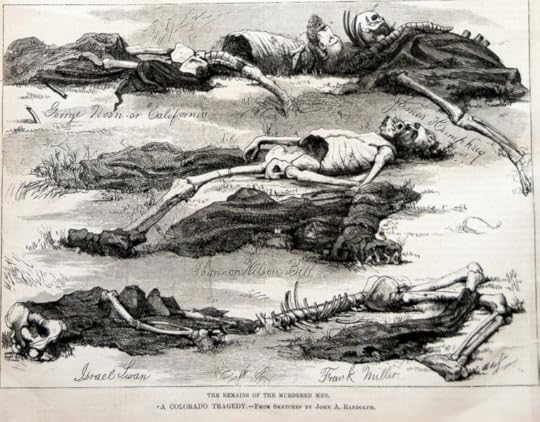
"The bodies were left at the campsite; however, the following August the remains were discovered by Harper’s Weekly Magazine Artist John Randolph on a bank above the Lake Fork of the Gunnison, just up from Lake City. Randolph reported the finding and, after being examined by the Hinsdale County Coroner, the skeletons were buried in a shallow grave near where they died.

In 1989 Dr. James Starrs, forensic scientist and Professor of Law at George Washington University, decided to come to Lake City and exhume the bodies to try to determine exactly what happened on that cold winter night. The grave site was supposedly located on Vickers Ranch just outside Lake City. Perk Vickers was sure this was the burial site but Joel Swank, another Lake City old timer, wasn’t so sure. Byrne Smith was called in with his backhoe and the digging began. On the second swipe with the hoe shouting was heard, the first bones had been found. Shovels and brushes were used from then on and all the bodies were found.

After Professor Starrs' team excavated the graves of the five victims and examined the bones in an anthropology lab, they found cuts on arm and hand bones possibly indicative of defensive wounds, as well as nicks that supported the account that the men had been defleshed. But the question still remained: who used the ax? Packer, in his second conviction, served 15 of his 40 year sentence for five counts of manslaughter but was paroled after a Denver Post reporter convinced of his innocence got the governor involved. He lived out his days near Littleton, Colorado and is buried there."
Profile Image for Montzalee Wittmann.
5,213 reviews2,340 followers
July 31, 2020
Man-Eater: The Life and Legend of an American Cannibal by Harold Schechter is a true story about a crazy character from the wild west! The author did a wonderful job with the research and presenting it without boring the reader to death. The book revolves around Parker who claims he ate his buddies because he was starving. This book goes through all the craziness about Parker, the justice system, and newspapers article's effect on the stories Parker tells. Very interesting on a creepy subject!
Profile Image for Mauoijenn.
1,121 reviews119 followers
August 25, 2015
This is the stuff that movies are made of.
It was a very interesting book.
Opened my eyes a bit and made me think twice about some things.
I wouldn't read this if you had a weak stomach.
Profile Image for Steve.
962 reviews112 followers
May 18, 2016
I received this from Netgalley in exchange for an honest review.

Interesting true-life tale of Alfred Packer, a man known as the American Cannibal. The book was obviously well-researched, providing an incredible amount of detail not only about the case, but about various other cases of cannibalism in the 1800s.

The one downfall of this book is that it got really tedious about halfway through the book.
Profile Image for ♥Milica♥.
1,868 reviews735 followers
May 9, 2023
Six miners went into the mountains
To hunt for precious gold;
It was the middle of the winter,
The weather was dreadful cold.
Six miners went into the mountains
They had nor food nor shack -
Six miners went into the mountains
But only one came back.


I liked this one more than Harold Schechter's other book I read, it was more interesting and better written.

It's possible I heard about Alfred (Alferd) Packer before, but if so I forgot. Now I'll remember for sure, one doesn't just forget about someone who very likely murdered 5 men and ate them!!

3.5
Profile Image for Hilary "Fox".
2,154 reviews68 followers
August 25, 2015


Man-Eater: The Life and Legend of an American Cannibal follows the life of Alfred Packer as best it can manage. This man lived at the tail end of the 19th century, fought in the civil war, worked as a tracker, had horrible epilepsy, and ultimately may have murdered and eaten five of his travelling companions in the Colorado mountains.

May have. But the evidence is pretty damning.


So, let's name a grill after him.

The book is extremely accessible. It's easy to read, even with the subject matter at hand, and tells the story with ample reference back to the source material. While it has no pictures, somewhat disappointing considering the number of woodcuts referenced, the author does an admirable job of describing all that he wishes to convey.


The court cases themselves were interesting. I enjoyed the high number of quotations, the rich vocabulary, and the ample history given not simply of the figures themselves, but of the towns they grew up in. The murders that took place happened at a time when the West was still being settled, and Harold Schechter conveys the changing America spirit well. The frontier days are done by the end, and it's amazing how quickly such a change can take place in national character.

While I would be slightly hesitant to recommend this book to just anyone by virtue of its subject matter alone, I would feel slightly better doing so knowing that the main source of reference I had for this historical event was Cannibal: The Musical.


So, if you ever want to know the true story behind that - or are simply interested in cannibalism for some reason, this is a wonderful book containing not only story of Alfred Packer but quite a bit more tales of madness from those frontier days.
Profile Image for April Cote.
264 reviews65 followers
April 5, 2018
I found this very interesting. Who doesn't want to hear the details of a man eating his fellow travelers?
I gave it three stars because it was very repetitive.
Profile Image for DAISY READS HORROR.
1,121 reviews168 followers
September 16, 2015
One of my favorite true crime books was written by Harold Schechter. It's called Deviant & it's about the life and crimes of Ed Gein. So you can imagine my excitement when I was given the opportunity to read one of his new releases!

I find the era in which bold text: Man- Eater took place to be very interesting. I think life was much more simpler in many ways. I guess I never really thought about murders taking place during the Wild West days though. This book will make you realize that people were coo koo even back then!

My only complaint was that my copy of the book on Kindle did not have pictures. I love to see pictures in my true crime books. I am not sure if this was because it was an advance copy or not, but that would have made a huge difference to me. The story of Alfred Packer was an interesting read. It was gory so it is not for the weak of stomachs. If you love history and true crime then this is just the book for you. I personally do think Alfred Packer ate his fellow companions out of desperation. Nothing surprises me about what humans are capable of any more.

Copy provided by Publisher in exchange of a review
Profile Image for David Allen Hines.
418 reviews56 followers
September 4, 2017
The case of Alfred Packer is one of the most imfamous episodes of cannibalism in the Old West. In 1873 in Colorado, Packer and 5 other men got lost and delayed while traveling in rugged winter terrain. Spring came, and only a well-nourished Packer emerged. He admitted to becoming starved and eating the bodies of his 5 associated, after he said, he returned from a reconnoitering hike to find that one of them had become mad, killing the other 3 and coming at him with a hatchet before he shot and killed him. After an investigation however, Packer was charged with murder and cannibalism.

He escaped and was on the run for a number of years before being apprhended. Convicted at his first trial, his murder conviction was later overturned on a technicality when the state legislature amended the murder statute and made a mistake in the writing of the law. He was tried again and convicted of manslaughter, and sentenced to 40 years.

While I knew the general story of Packer, I did not know until I read this book that late in his life Packer became an object of sympathy and a pardon campaign was led by a female reporter who had evidently come to sympathize with with. I also did not know that Packer was in fact later released by the Colorado governor to live his last few years quietly.

Schechter includes a lot of anectodes and asides that really don't focus on Packer, but I learned a lot of additional history reading them and they do give you a better understanding of the times. You get frustrated when the story drifts from a focus on Packer, but each one of these asides does educate and inform you, so they are not a waste of time.

At this remoteness in time from the events, it is doubtful the entire truth about Packer will ever be known. He suffered from severe epilepsy and lied to the point he was delusional, so he may well have had mental problems. Archaeology of the remains of his victims in the late 1980s showed indisputably the men had been killed by repeated viscious blows to the head, but one set of remains showed what could have been bullet holes, which would support what Packer said about shooting a man after he killed the others. An old rusted pistol was also found at the site.

But regardless of who killed the men, it is undeniable that Packer spent weeks and weeks carefully butchering and eating them. He admitted to it, and the bones showed signs of having been butchered. If there is doubt whether Alfred Packer killed all 5 men, and not just one, there is no doubt at all that he was a cannibal.

This is a very informative, very interesting, very worthwhile book.


Profile Image for ♥ Marlene♥ .
1,697 reviews146 followers
couldn-t-finish
July 17, 2016
Listening to my second )3rd) audiobook. As I mentioned in my review yesterday this makes doing chores in my house less of a choir and more fun.

Love this reader. He sometimes talks like they used to in the South. At first I was not sure if I could keep on listening. My stomach was making a pirouette when he described what the Anasazi did with their prisoners. Cut them all apart drank their blood Oh I cannot even think of it and had to stop for a bit (I was going to have dinner but had to postpone lol)

Update: I do not know why but I can't stomach this book. I have read many cruel stories but it is not even the cruelty but that it is described how humans were eaten. It makes me feel sick. Especially how the indians ate them while they were still alive.

That being said I think if I would have to eat human meat to survive I think I probably would. Never understood the anger the Andes boys received after they were rescued.


https://en.wikipedia.org/wiki/1972_An...
Profile Image for Jane.
Author 11 books965 followers
December 30, 2015
This review originally appeared on the Historical Novel Society website.

Alfred (or possibly Alferd) Packer was a former Union soldier turned drifter who sought his fortune in Colorado by prospecting for silver. He joined up with a group of men in 1873 and was one of six prospectors who decided to brave the winter snows and strike out into the wilderness. The following spring only Packer emerged, having subsisted on the bodies of his companions.

The question of whether Packer had murdered the others for their money or whether his version of events was true—he never denied the cannibalism, but claimed self-defense—kept lawyers and journalists busy until his death in 1906 and he is still a Colorado legend. Harold Schechter’s entertaining and lucid account of the Packer case, set against the background of a swiftly changing American West, paints a vivid picture of evolving frontier justice and the shifting of public opinion over the years. Filled with detail and stocked with entertaining stories of murder and riot, this is nonetheless a serious study with a good bibliography and will be a keeper on my research shelf.
38 reviews
July 13, 2016
Who knew cannibalism, prison breaks, and sensational trials could be so boring? I hate not finishing books, but after weeks of finding reasons not to keep reading this book I had to give up. The material is interesting, the writing got tedious very quickly.
Profile Image for J.D. Sutter.
288 reviews26 followers
October 13, 2024
What a gripping narrative! The author does a fantastic job of laying out the details of the case and all the subsequent related events in an easy-to-follow and interesting way that kept my attention the entire time.
Profile Image for Read With Chey.
655 reviews1 follower
December 25, 2021
Here’s what I loved: I find the pioneer West era SO interesting. When they say there is nothing quite like that time period they really mean it. So I thought the discussions of the pioneer West was really great. I loved all the details the author put in when talking about the actual crime itself and all the information of the story was so engrossing.

Here’s what I didn’t love: it kind of just fizzled out for me. Once we got to the trial and then the years following it felt really drawn out for me.

Great start but a bit long winded for my taste.
Profile Image for Katherine Addison.
Author 18 books3,675 followers
June 11, 2016
I first heard of Alfred Packer in The Thin Man. For reasons that I admit aren't entirely clear to me, Hammett interrupts his own narrative at one point to provide the complete precis of Packer's crimes given in Duke's Celebrated criminal cases of America. According to Schecter, Hammett's claim was that he did it to pad an overly skinny book, which I don't believe for a second. Gilbert asks Nick more than once about what you might call hidden crimes like cannibalism and incest. Which may, now that I'm thinking about it, have some relevance to the thing that happened to Gilbert's sister Dorothy when she was a child, the thing she wants to confess to Nick, and Nick won't let her. (I love Nick for this, because Dorothy is clearly trying to shift both the attention and the genre of the narrative away from Nick and the detective novel and toward Dorothy herself and the gothic or the romance, with Dorothy as the heroine of a Mary Roberts Rinehart novel, and Nick just says, nope, not right now, and keeps going.)

However. This is not a discussion of The Thin Man.

Duke's version of Alfred Packer is, not surprisingly, wrong in many of its particulars, and Schecter's principal goal is to correct this and many other versions of Packer's story. One of the problems he runs into is that Packer's story is much too malleable (Packer himself told at least three different versions) and there's very little hard evidence: enough to prove that Packer's companions were murdered and eaten, not enough to prove that Packer, though indisputably the cannibal, was the murderer and not poor Shannon Wilson Bell. Schecter does have the important bit at the very end of his discussion, the piece I always look for in true crime books and only have about fifty-fifty odds of finding, where he pulls back and assesses. Schecter's opinion is that Packer was the murderer, but that there were mitigating circumstances, including the temporary insanity of starvation and the effect of Packer's epilepsy, which is itself hard to assess at this remove.

Schecter is competent enough in putting his facts together; my problem with him is that he fails to make Packer in any way interesting. The only life in this narrative is brought there by Leonel Ross Campbell, a.k.a. Polly Pry, and her reprobate bosses at the Denver Post. There does seem to have been a kind of negative charisma to Packer, as even Polly Pry admitted on their first meeting, although she quickly changed her tune, but a book the central events of which are murder and cannibalism should be more compelling than this book, which is competent and certainly readable but which, like Packer himself, remains flat and uncharismatic. It's a book that should be interesting and isn't.
Profile Image for Lori L (She Treads Softly) .
2,951 reviews117 followers
August 8, 2015
Man-Eater: The Life and Legend of an American Cannibal by Harold Schechter is a highly recommended nonfiction narrative about Alfred (Alferd) G. Packer, a prospector who was accused of cannibalism.

Six miners went into the mountains
to hunt for precious gold;
It was the middle of the winter,
the weather was dreadful cold.
Six miners went into the mountains,
they had nor food nor shack—
Six miners went into the mountains,
But only one came back.
"The Lost Miners"(or the Ballad of Alferd Packer; nineteenth century)

In 1873 Packer and a group of five other men set off through the high mountains of Colorado to seek their fortune in gold or silver. It was winter, a brutal time to be traveling through the mountains, and the men were lost and starving. Packer was the only man to make it out alive. Though he changed his story several times, it was widely believed that he killed the others and ate them in order to survive. Packer claimed, at one point, that the men were killed by another member of the group, Shannon Wilson Bell, who Packer in turned shot before Bell killed him. Then he did eat the flesh of his deceased companions to ward off starvation. It was also believed that he may have killed the other men to rob them; he did admittedly take money from the dead men.

Schechter covers Packer's two trials, along with a plethora of historical information to place the legendary crime story in context. He includes Polly Pry's efforts on Packer's behalf, and the cultural impact of Packer's story. For example, a cafeteria at the University of Colorado Boulder is named after Packer, several films and a musical based on the story have been made, and songs have been written about it. Schechter also discusses James Starr's efforts in to use modern forensic science techniques to resolve the questions surrounding Packer's case.

This is one of those books that is simply interesting to read. If you enjoy nonfiction about the late 1800s, prospectors, cases of cannibalism in US history, and sensational historical figures, this may be a good choice for you. Written in 50 short, well organized chapters, the book includes chapter notes and a bibliography.

(The spelling of the name Alfred as “Alferd” is because Packer didn’t know how to spell his name when younger and used the alternate misspelling.)

Disclosure: My Kindle edition was courtesy of Little A for review purposes.
Profile Image for Miranda.
37 reviews
May 6, 2021
This book was a very thoroughly researched account of the life of Alfred Packer; most specifically, the events surrounding his claim to fame in history, and the aftermath, leading up until his death. It does a very good job of presenting the facts in as unbiased of a way as possible, openly acknowledging several times towards the end that even now in the modern age, it's impossible for us ever to know what happened on the day Packer and five other men, undoubtedly pushed past their physical limits, stopped to rest on one freezing cold Colorado mountain night in February 1874. The most intriguing question of the book, beyond whether or not he was committed the murders he was accused of was whether or not he could truly be held accountable or "guilty" of them, given the extenuating circumstances around the situation. It was interesting to see public opinion around him and the case change over decades during his imprisonment, first one direction then the other And I thought that in the later chapters, which explored modern attempts to resolve some of the greatest mysteries of the case, there is even now divided opinion, due to simple lack of evidence over time. If you like your true crime with a wild-west flavor and the extra spice that comes from sensationalized pulp stories, this book is for you.
Profile Image for Leigh.
343 reviews7 followers
February 13, 2019
I really really really wanted to like this book more. The story begins with cannibal factoids, delves into the early history of the United States, ultimately introducing the title character, Alfred (or Alferd) Packer. Then...

Well... I feel like ol Harold Schechter got a little caught up in a wheel of repetitiveness. There are more than just a few moments in this story that feel like the same thing over and over and over again, to the point, I did find myself skimming a portions, because I already knew what he was going to say.

If you like history, you'll find things to enjoy in this book. I learned quite a few new little tidbits, particularly about Colorado, and discovered people like Polly Pry. If you're not exactly crazy about history, avoid this book. There probably will not be enough interesting cannibal stuff to keep your attention. :)
Profile Image for Brad.
Author 2 books1,920 followers
June 19, 2019
An excellent audio performance by Eric G Dove made this a quick listen. But I did find myself growing tired of Schechter's intrusion into the story of Alferd Packer. Rather than simply reporting the information we have on Packer's cannibalism in the post-civil war Rocky Mountains, and the competing contemporary opinions of Packer's innocence or guilt, Schechter passes his own judgement on the case, albeit subtly, and I found myself wondering why this particular case garnered his personal opinion. It was an unfortunate distraction from a true crime writer I usually enjoy thoroughly. Still, this is work a listen.
Profile Image for Toni.
1,964 reviews25 followers
June 27, 2018
Really interesting tidbit from the thousands of stories from the American wild west/expansion days. I think the author did a great job in researching the material concerning the life/imprisonment of Alfred Packer.

Using today's standard - I believe Mr. Packer was innocent of most of the crimes attributed to him and that he was truthful of the crimes he acknowledges. The evidence at the time (the 1800's) was like a 'snow foundation' which the passage of time has melted away and may have proven that Mr. Packer was unfairly judged by history.

Makes for great American lore all the same.
Recommend reading/listening - worth the investment.
Profile Image for Comtesse DeSpair.
25 reviews4 followers
March 16, 2019
I love true crime books by Harold Schechter. He is so good at cutting through to the details of the case without leaving anything essential behind. Here, he cuts through to the bone of the Alfred Packer case. You remember Alfred? He went into the Colorado mountains in 1873 with 4 other men, but he was the only one who walked out; the rest were found butchered and devoured. Packer admitted cannibalizing the men but insisted that one of the other men had gone crazy and killed three of them while Packer was away, and that Packer had to kill him in self-defense when he came back to camp. A likely story, and one that was not believed in court.

This book also talks about several other famous cases of cannibalism which I will undoubtedly be using for Morbid Facts in the near future. The only less than stellar thing about the book is its primary subject matter. There really wasn't a lot to Packer once you got past the cannibalism, so some of the book drags a bit. But hey, at least we got 'Cannibal: the Musical' out of Packer's primal brutality!
Profile Image for Meg.
718 reviews22 followers
October 8, 2019
This book is very interesting, but very detailed and gruesome. I would not recommend to anyone who is easily grossed out because this book describes the murders and cannibalism in great detail. About halfway the book transforms into detailing the trial and moved a lot slower than I would have liked. The book also provides a lot of background information on other instances of cannibalism the history of it. I would recommend this book to anyone who is a fan of history books or true crime books.
Profile Image for J.M..
Author 301 books567 followers
December 31, 2017
This was surprisingly good. I couldn't put it down. When I started reading it, I thought the guy sounded familiar, so I looked up Alferd Packer -- of course it was familiar, I saw "Cannibal! The Musical!" years ago, which is about him.

A fascinating read.
Profile Image for Craig.
Author 12 books21 followers
May 9, 2018
A thoroughly researched and well-written account. My only real complaint is that it may in fact be too thorough, as Schechter seems to have incorporated every piece of his research, making the book often slow and sometimes repetitive. Also, not nearly as funny as Cannibal! the Musical.
Profile Image for Andrea Winn.
6 reviews
April 19, 2018
Slow reading. I was not too engaged and had to force myself to plow through. The subject matter is fascinating, but the writing left much to be desired. Sorry, Harold Schechter. 🤨
Profile Image for Connie.
116 reviews18 followers
March 27, 2019
A mystery, for sure, but what I really enjoyed about this book was the historical content of the courts and reporting at this time in history. I loved the language the attorneys and judge used, and even the defendent. I waffled back and forth all thru the book on Mr. Packer’s innocence or guilt, but in the end, finally agreed with the conclusion of the author. Could it be proved in a court of law......not in those days, but one just had to use their common sense, which isn’t grounds for conviction.
Displaying 1 - 30 of 191 reviews

Can't find what you're looking for?

Get help and learn more about the design.