"The Gentle Vultures" is a science fiction short story by Isaac Asimov. The story first appeared in the December 1957 issue of Super-Science Fiction, and was reprinted in the 1959 collection Nine Tomorrows.
The story is one of a number that Asimov wrote expressing his abhorrence of the cold war nuclear arms race, but its lightly ironic flavor has earned it more positive critical responses than those drawn by the bitter moralism of Silly Asses and Darwinian Pool Room.
The Hurrians, a small, tailed, vegetarian primate species have found on their space travels that large, non-tailed omnivorous intelligent ape species always end up destroying themselves in a nuclear war. The Hurrians adopted the policy of helping to rebuild the remains of these planetary societies after their nuclear wars, while extracting tribute and genetically modifying the inhabitants into more peaceful races. They are not acting completely selflessly, either: as is discovered in the subsequent conversation with a captured human, each race "helped" in this fashion pays the Hurrians a "modest" contribution, choosing the product that this race is best at. In one case, an otherwise poor race pays in its own members, by forfeiting a set number of individuals into servitude each year.
Publication: Super-Science Fiction, December 1957 Editor: W. W. Scott Cover: Kelly Freas
Works of prolific Russian-American writer Isaac Asimov include popular explanations of scientific principles, The Foundation Trilogy (1951-1953), and other volumes of fiction.
Isaac Asimov, a professor of biochemistry, wrote as a highly successful author, best known for his books.
Asimov, professor, generally considered of all time, edited more than five hundred books and ninety thousand letters and postcards. He published in nine of the ten major categories of the Dewey decimal classification but lacked only an entry in the category of philosophy (100).
People widely considered Asimov, a master of the genre alongside Robert Anson Heinlein and Arthur Charles Clarke as the "big three" during his lifetime. He later tied Galactic Empire and the Robot into the same universe as his most famous series to create a unified "future history" for his stories much like those that Heinlein pioneered and Cordwainer Smith and Poul Anderson previously produced. He penned "Nightfall," voted in 1964 as the best short story of all time; many persons still honor this title. He also produced well mysteries, fantasy, and a great quantity of nonfiction. Asimov used Paul French, the pen name, for the Lucky Starr, series of juvenile novels.
Most books of Asimov in a historical way go as far back to a time with possible question or concept at its simplest stage. He often provides and mentions well nationalities, birth, and death dates for persons and etymologies and pronunciation guides for technical terms. Guide to Science, the tripartite set Understanding Physics, and Chronology of Science and Discovery exemplify these books.
Asimov, a long-time member, reluctantly served as vice president of Mensa international and described some members of that organization as "brain-proud and aggressive about their IQs." He took more pleasure as president of the humanist association. The asteroid 5020 Asimov, the magazine Asimov's Science Fiction, an elementary school in Brooklyn in New York, and two different awards honor his name.
My first reading of this well-written, pithy short story was as a kid in the early 60s. It had been published in 1957 in one of the SF pulp magazines of that day, and a friend had passed that back issue on to me. (Goodreads uses that magazine's cover as its image for the story --but the cover art was for a completely different selection, so has absolutely nothing to do with this one!) As with many of my reads in those years, I forgot the author/title information; but the story itself stayed with me very well, a testament to the quality of the writing. Recently, I downloaded a different story from the same era as a free e-story (and hope to review it as well soon), based on a review by a Goodreads friend, in the belief that it might be this one. Instead, it proved to be a later thin and inferior rip-off of this one; but by then my interest in Memory Lane was piqued enough to search seriously for the real one. Here's the link where it can be read online for free: https://www.you-books.com/book/I-Asim... . Last night, I read it for the second time, now from an adult's perspective, and appreciated it even more.
Isaac Asimov (1920-1992), of course, was one of the leading luminaries of American SF's "Golden Age," a friend and protege' of legendary pulp editor John W. Campbell Jr., whose long career was loaded with the genre's honors. Despite my long-standing interest in SF, though, my own tastes lie mostly outside the technophilic optimism and secular humanism of the genre's "hard" school that dominated the ghetto of magazine-based fandom in Asimov's youth (he started writing while still quite young) and shaped his style and vision. His acclaimed Foundation trilogy never interested me, and I couldn't get into his robot fiction; so what I've read of his corpus is a handful of short stories (and I find those a mixed bag). But this one is, IMO, the best work I've read from his pen, and one of the 20th century's master works of speculative fiction. Like much SF written in the late 40s and the 50s-60s, it's strongly influenced by the fear of possible nuclear war, which occupied the minds, not only of the literary community, but of many people in the general population (me included, at that age). Here, though, he takes that theme and writes a serious tale that grapples with ideas, not an arid tract.
Our primary setting is Earth's moon, about 15 years after World War II, where protagonist Devi-en heads the Hurrian colony. An uncritical evolutionist as always, Asimov here imagines that our galaxy has developed life on many planets, and evolution has always culminated in intelligent primates --almost always large, tailless, omnivorous primates with strong competitive instincts. Normally, once they develop nuclear technology, they proceed to largely destroy themselves and their world in a nuclear war. Only Hurria produced a dominant race of shorter, tailed and vegetarian primates whose dominant social instinct was cooperation. Never having had a nuclear war, they survived to develop space travel. For a very long time, they've waited for the galaxy's various other primate species to have their nuclear war, then moved in to rehabilitate and colonize the planet, dominate the survivors and collect tribute. But on Earth's moon, they've been waiting an unprecedented 15 years. Now, an Archadministrator has been sent to investigate the question of why the Earthlings aren't getting with the program.
In keeping with the hard SF tradition, Asimov doesn't depict anything here that's scientifically impossible (except for the basic implication of faster-than-light interplanetary travel, which was such an ingrained staple trope in the genre that even hard Sf purists wink at it). But his focus isn't on presenting a science lecture or extrapolating, from present knowledge, speculations on what technology might plausibly do in the future. Rather, his interest is social and moral/philosophical (as has been the interest of the best writers since the dawn of literature). He's primarily telling a meaningful, plotted story with high stakes (the fate of a world, and perhaps the galaxy), about characters you can relate to --even if they mostly happen to be three feet tall and furry, with tails. His Hurrians (they call themselves Humans) are intelligently and coherently drawn in a realistic way, and though their psychology is alien to ours, the author brings it to life and makes it totally understandable. That's a significant achievement of world-building in the scope of a short story; and this is one of the more thought-provoking works of fiction (of any length) that I've ever read.
4★ “But fifteen times, the planet had revolved about its sun. During each revolution, the satellite had rotated thirteen times about the primary. And in all that time the nuclear war had not come.
Nuclear bombs were exploded by the large-primate intelligences at various points on the planet’s surface. The planet’s stratosphere had grown amazingly warm with radioactive refuse. But still no war.”
Devi-en is the captain of a colonizing mission, which is to help people after . . . after they have weakened themselves by nuclear war. He can’t seem to get the ‘large primates’ to follow the path of the other civilisations they have ‘helped’.
This is Asimov demonstrating his loathing of war, particularly nuclear war. It’s a very short story. The Goodreads listing is of a publication in which it appears.
Asimov deserves real credit for the amount of world building he achieves in this short story. We have a race of creatures called Hurrians who spend their time assisting planets recover after they have acquire nuclear science and used it in war. This is at a cost to the planets of course. Earth has been in a state of cold war for fifteen years and the Hurrians are tempted to speed things up a bit.
The author manages to tell a decent sci fi story as well as propounding on his own views of the nuclear arms race of the day. It is very readable, interesting and thought provoking. An enjoyable, quick read.
Thanks to Werner for the link to this short story https://www.you-books.com/book/I-Asimov/The-Gentle-Vultures. As with other Asimov short stories such as 'Nightfall', this one is full of psychological insight and social commentary but in an indirect way rather than the preaching that sometimes came across in the work of other Golden Age of Science Fiction writers. Asimov also manages to bring to life characters that on the face of it are alien, and make them relatable. So a 5 star rating from me.
This piece caught me quite by surprise with the deeply fascinating critique of society and a peculiar analysis of our history. The story takes the point of view of an intergalactic species that has set camp on the moon and is waiting for the humans to destroy their planet with the nuclear weapons discovered after World War 2. The hurranians have witnessed thousands of planets destroyed by its competitive inhabitants and patiently waits for this moment every time to save the remnants for a fair compensation. However earth is fixed in a stalemate, and has been for 15 years, in an unforeseen cold war. Therefore, the hurranians might need to take action for the first time in their peaceful existence.
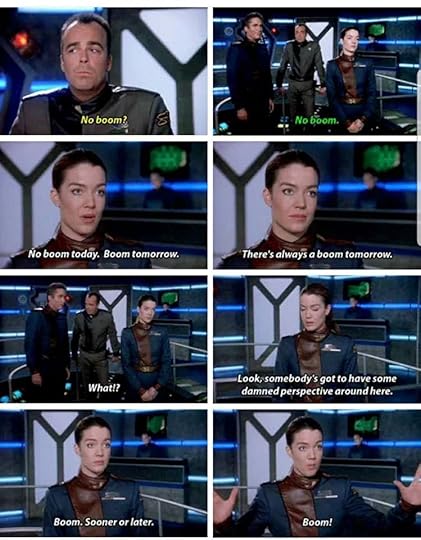
Collected in Nine Tomorrows, an alien species watches Earth, waiting for the inevitable nuclear war, with seemingly altruistic motives. This immediately made me think of this scene from Babylon 5.
So they abduct a denizen from Earth, in an effort to find out why Nuclear war has not happened yet. This interaction changes everything. It is clear from the story that Asimov is very anti-nuclear bomb, probably as a result of having lived through the bombing of Pearl Harbor, Nagasaki and Hiroshima. The story is still relevant today as it doesn't take a genius to surmise that there will be far reaching future consequences as a result of the altruistic actions of the Gentle Vultures alluded to in this story.
This book needs to get points for its unique and deeply fascinating critique of society and a peculiar analysis of our history which we had until this book was written.
And the whole perspective or rather said view in this book on stuff like how small monkey-like aliens from space let one man and how they can change the entire structure their society is based with one word.
In the end this book is a typical science fiction book about intergalactic species which makes contact with humans and analysis the history of our species.
Muy buena historia entretenida e interesante, algo larguita pero se te la pasas bastante bien, en su época habrá sido todo un boom, a leerla es totalmente reomendadísima.
I thought this a very interesting view on how small monkey-like aliens from space let one man (who they refer to as an ape as they refer to all humans) change the entire structure their society is based with one word. That word is "vulture." The race of Hurrians have waited ten years for humans to blow themselves up with nuclear bombs, and that's when they swoop in to offer their assistance. They have performed this same action thousands of times throughout the years on every planet that has reached nuclear development in the galaxy. Of course, they expect payment for this help, and have tricked themselves into believing they are extremely benevolent beings. They run into a snag when the earth doesn't want to play ball and doesn't follow the regular rules of nuclear bombardment. The book was published in 1957, and the aliens have waited on the dark side of the moon since WWII, so they abduct a man camping alone, and try to find out why war hasn't started. After hearing how the aliens expect tribute from our dying planet after the war--the earthling becomes incensed and calls them a race of vultures. They know the meaning of the word, and this hits them so hard they feel sick and leave for home. I believe at this point they give up the pursuit of taking from fallen worlds, and who knows, maybe they take up gardening.
Yet another fantastic thought provoking short story from evergreen author Isaac Asimov. More than being a science fiction, this one got me thinking. I really recommend this to everyone as it is a simple yet a mind opening read.
Очень добротно написанный рассказ с тонким, фирменным юмором Азимова. Это именно тот случай, когда фантастика не только заставляет задуматься, но и дарит искренние эмоции. Это редкость для жанра, где юмор нередко подаётся сухо или чрезмерно иронично.
Рассказ короткий, читается быстро и легко, но при этом оставляет после себя приятное послевкусие. Азимов, как всегда, умело играет с идеями и характерами, создавая одновременно умную и лёгкую историю. Если вы любите фантастику — особенно с лёгкой ироничной подачей — обязательно прочитайте.
Another little masterpiece of a genius. The author, as always, is a seer and, in his magnificent manner with a taste of great subtle humor, tells us that there are thousands of civilizations of intelligent primates in the universe, but all large primates go through general regular stages in their development. In particular, having developed to a certain level, civilization self-destructs by nuclear war... How do you like this? Brilliant.