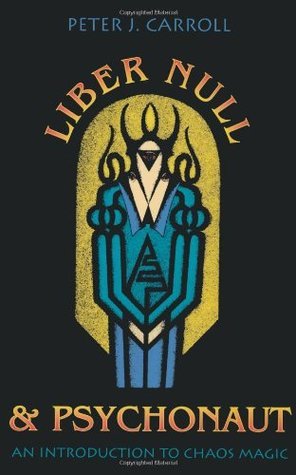
I first rated this book three stars, and I have since raised it to four. On a first reading it seemed to be an edgy fanfic, and its reincarnation rites, blood rituals and similar excesses nearly made me put it down. What kept me reading were the sections on astral projection and altered states that surround that material, because they overlap with my interest in the US Army's 1983 assessment of the Monroe Institute's Gateway Process and in the declassified research on psychoactive substances. I read it in parallel with Elizabeth Clare Prophet's Kabbalah: Key to Your Inner Power, and the parallels between the two sent me into further reading on Kabbalah, ritual and Romanian folk practice. It also kept connecting to the books that shaped me long before this one, from Fight Club to Nietzsche and the Stoics to modern political, economic and social theory. A book that keeps reorganising how I read other books has earned a higher rating than I first gave it. I read the revised and expanded edition, and much of what I discuss here comes from its "Magical Perspectives" essays, which the original edition does not contain.
Carroll's central claim is that belief is a tool. The magician adopts a belief for as long as it produces results and then discards it, and results are the only measure of a practice's worth. Coming from a computer science background, I read the book as an abstraction layer over religion, mysticism and metaphysics. It separates the methods of a tradition from its claims about the world, so that very different traditions can be compared as different implementations of the same underlying operations. This answered a question that had long puzzled me, namely why cultures with no contact with one another arrive at such similar myths, rituals and institutions. Carroll attributes the similarity to a common shamanic origin. My own reading is closer to convergent design in engineering: people share the same cognition and the same needs (belonging, meaning, a sense of control), so they arrive at similar solutions independently. Either way, the book supports his observation that once local symbolism is stripped away, "all systems show a remarkable uniformity of method."
The part of the book I valued most is its account of consciousness, which rests on the concept of Kia. Carroll argues that will and perception only appear to be separate functions to the thinking mind, and that the unity behind them is Kia, the "elusive 'I'" at the centre of experience. Kia has no fixed qualities, so it can never be observed directly, and in the expanded essays he adds that consciousness arises only at the point where this formless centre meets matter, meaning the ego, the mind, the senses and the body. In his account we have both of these things but are neither of them. I found this one of the clearest models of the self I have come across in an occult text, because it explains why the self feels completely real and yet impossible to locate. It lines up with Kashmir Shaivism, which pairs pure awareness with an active power in much the same way, and with current philosophy of mind that treats the ego as a model the brain builds of itself. It is also close to the Gateway report, which describes consciousness as an energy field that can be tuned, through sound-induced brain synchronisation, towards an "Absolute" behind all experience, much as Carroll's gnosis lets Kia reach towards Chaos.
From this model Carroll derives a view of change that I found persuasive. Because Kia has no built-in nature, every belief, habit and identity a person holds has been acquired, and anything acquired can be changed. He defines free behaviour as whatever "increases one's possibilities for future action" and limiting behaviour as whatever narrows a person's options, which is a practical and almost measurable definition of freedom. He describes the ego as a castle built against reality that eventually becomes a prison, because every belief commits its holder to rejecting its opposite. He then turns the theory into a method with the "dice of belief," an exercise in which the reader rolls a die and lives inside the worldview it selects (paganism, monotheism, atheism, nihilism or one of two chaoist options) for a set period. The deliberate rebuilding of one's own beliefs is, for me, the most useful idea in the book.
This part of the book made me realise how much Fight Club, both Palahniuk's novel and Fincher's film, shaped my resistance to social programming and my path towards working out who I am, and returning to it with Carroll in mind, the parallels are closer than I remembered. The narrator is practising chaos magic without knowing it. He joins support groups for illnesses he does not have and adopts their beliefs for the one result he wants, which is to cry and finally sleep, and the guided meditations in those groups open his chakras and send him into a cave to meet his power animal, a penguin. Months of insomnia, an exhausted state in which everything feels like "a copy of a copy of a copy," then produce Tyler Durden, a personality built out of the narrator's own desires that goes on to act in the world by itself, which is very close to what Carroll calls a servitor. Tyler even repeats Carroll's critique of monotheism when he tells the narrator that a man's father is his "model for God." What stayed with me most is how the story ends. Project Mayhem strips the space monkeys of their names and their consumer identities, only to bind them to a new messiah, and the narrator can only get himself back by destroying the figure he created.
Fight Club is also what led me to Nietzsche, and at times Carroll reads like it condensed both into an occult field guide. Carroll's motto, "nothing is true, everything is permitted," is the maxim of the medieval Assassins that Nietzsche quotes in On the Genealogy of Morals. His treatment of belief as a tool is Nietzsche's perspectivism, the view that there are only interpretations and no view from nowhere, put into practice, and his rebuilding of the self is a working version of Nietzsche's self-overcoming. Zarathustra tells his disciples to lose him and find themselves, which is exactly the lesson the space monkeys never learn and the one that kept me from becoming one.
The same ideas take on a political edge when read next to John Stuart Mill. Carroll's dice of belief is close to a literal programme of what Mill, in On Liberty, calls "experiments of living," and the ego as a prison is an internal version of the "despotism of custom" that Mill saw as the main threat to individuality. Carroll's own politics lean further than Mill's, towards Hayek and even Herbert Spencer, since his liberation chapter rates personal flexibility above any "reorganization of political power" and claims that the most adaptable creatures, cultures and ideas always win out. His formless Kia is also almost identical to Max Stirner's description of the self as a "creative nothing" that owns its ideas without being owned by them. There is a less flattering reading as well. Critics of neoliberalism, from Michel Foucault to Byung-Chul Han, argue that a self treated as an endlessly revisable project becomes a form of self-exploitation, in which people optimise themselves for the market in place of pursuing their own ends. Carroll's book supports both readings, and I think the difference lies in whose purposes the practitioner is rebuilding themselves for.
The techniques themselves correspond to psychological research more closely than I expected. Carroll's use of belief resembles open-label placebo studies, in which a placebo keeps working even when the patient knows it is a placebo. His sigils, which compress a goal into a symbol that is then deliberately forgotten, work much like implementation intentions, where a goal is attached to a specific trigger and handed over to automatic processing. His states of gnosis, reached through either stillness or overstimulation, match findings that even arbitrary rituals reduce anxiety and improve performance, and his banishing rituals read naturally as clearing state between operations. His idea of the egregore is broader than the one I had picked up elsewhere. Carroll uses the word for the psychic field of an entire species, and says the human egregore is what people perceive as God, while later chaos magicians use it for the collective belief of any group. In that later sense it explains a great deal about why churches, lodges, armies, brands and Project Mayhem all rely on ritual, costly commitment and a division between inner and outer circles.
The book also kept reminding me of the Romanian folk tales and practices I grew up with, and reading further about them made the parallels hard to ignore. Carroll's inhibitory gnosis, in which the mind is quietened until only one point of focus remains, is close to the Jesus Prayer repeated on the knotted prayer rope until thought stops, and to the strict black fast. His excitatory gnosis has a direct counterpart in the Căluș, a trance dance once performed to heal people believed to have been struck by the Iele, the fairies of Romanian folklore. The sign of the cross works as a reflex banishing, Psalm 90 carried as an amulet for centuries behaves like a charged sigil, and the pomelnic, the slip of paper with names handed to the priest for prayer, is a written intent passed to a collective power. Folk charms against the evil eye and garlic rubbed on the doors on the Night of St Andrew fill in the rest, while feasts such as Boboteaza (Epiphany) and Sânziene (Midsummer) set the timing for protection, blessing and love divination, much as Carroll times his own operations. Even the old warning that a curse returns to the person who casts it has its counterpart in Carroll's insistence on banishing. None of this appears in his book, which made the resemblance all the more striking.
The expanded essays push Carroll's model further. In "Baphomet," he describes Baphomet as the composite egregore of all life on the planet, and argues that the dragons and serpents slain by gods in mythologies across the world come from the oldest layers of the human brain. Evolution, in his account, added new structures on top of old ones without removing them, leaving us with "an ape, a wolf, and a crocodile" living in our skulls, so that gods subduing titans and dragons becomes a story about human consciousness suppressing its own older drives. As a developer I recognise this as legacy code still running beneath newer systems. Paul MacLean's "triune brain," the model Carroll relies on, is now considered outdated, but later models still describe the brain as older systems modified and extended over time, so the core of the argument survives the correction.
Baphomet is also where the Stoics fit, and where I understood why Marcus Aurelius and Epictetus had resonated with me as quickly as Nietzsche had. Among Baphomet's older names Carroll lists the anima mundi, the soul of the world, and Stoic physics rests on the same idea: a single living cosmos animated by pneuma and ordered by the Logos, which reads like Carroll's Chaos and aether without the occult vocabulary. Marcus's exercise of viewing human affairs from above, as one small part of a living whole, is close to Carroll's picture of each Kia as a fragment of the planet's life, and Carroll's line that "a denial of death is also a denial of life" is the Stoic memento mori in another form. Marcus's summary in the Meditations, that the universe is change and that our life is what our judgements make of it, could stand as a one-line version of Carroll's whole programme, and Epictetus begins the discipline of the self from the same place, teaching that what disturbs us is our judgement about events. The difference lies in the anchor. The Stoics rebuild the self around virtue and reason, while Carroll leaves Kia without any fixed nature, and I find the Stoics useful as the ballast that keeps Carroll's freedom from turning into mindless hedonism.
The remaining essays return to the individual mind. "The Psychic Censor" argues that the mind filters out most of reality so that ordinary life remains possible, and that gnosis is the means of slipping past the filter. The idea resembles Aldous Huxley's description of the brain as a "reducing valve" and current predictive processing accounts of perception, although Carroll loses me when he claims the censor also blocks telepathy and precognition. "The Demon Choronzon" then argues that there is "nobody at home," and that any identity can be rebuilt by sufficiently strong persuasion. At first this seemed to contradict Carroll's earlier chapter on the Holy Guardian Angel, which treats the magician's true will as the purpose of his existence. On a closer reading the two fit together, since Choronzon identifies the real Holy Guardian Angel with Kia itself and only attacks the names, images and missions that magicians attach to it, which the earlier chapter had already warned against. Tyler Durden is the clearest image I know of that failure: a product of one's own mind mistaken for a saviour.
Kabbalah was the clearest example of Carroll's approach to symbol systems. He treats the Tree of Life, the framework most of Western occultism has organised itself around since the Golden Dawn, as one filing system among many, interchangeable with the Taoist trigrams or the Vedic elements. From a CS perspective the Tree is a graph of ten nodes joined by twenty-two paths, and the Sefer Yetzirah, the early text behind it, describes creation as the combination and permutation of the twenty-two Hebrew letters, which reads remarkably like an encoding scheme. Carroll's approach makes it possible to study the Tree as a data structure for organising experience without accepting the theology attached to it.
Prophet's book made the comparison much richer. The two make an unusual pair, since Prophet writes as the devotional teacher of her own syncretic movement and Carroll writes as an iconoclast, yet the parallels kept accumulating. Ein Sof, the hidden "Cause above all causes" from which the ten sefirot emanate, occupies the same place as Carroll's Chaos, an unknowable ground that he says could just as well be called God or Tao. Prophet points out that the Hebrew letters of Ayin, "Nothingness," also spell Ani, "I," which is almost exactly Carroll's Kia, a void at the centre of the self. The Zohar's accounts of souls ascending at night to study in celestial academies sit beside Carroll's chapters on astral projection, and the Lurianic image of divine light shattering into sparks scattered through the world echoes his picture of Kia breaking apart at death and reforming in new beings. Prophet's practice of cultivating the quality of each sefirah in turn, working towards "forgetting the self," is a devotional version of Carroll's deliberate rebuilding of belief. Her blend of Kabbalah, Christianity, Hinduism and the teachings of her own movement is, in practice, close to the chaos magician's approach, even though she presents the result as revealed truth. Both books also try to borrow the authority of physics, Prophet by comparing the Kabbalistic creation to the big bang and Carroll by appealing to quantum indeterminacy. The parallels are interesting, but I treat them as educated guesses and move on to more tangible ground.
Following this thread into history changed how I read the Bible as well. I started with the suspicion that Christianity was a diluted version of Kabbalah, and the history turned out to be more interesting than that. Kabbalah only appeared as a written system in twelfth and thirteenth-century Provence and Spain, more than a thousand years after the Gospels, so it cannot be Christianity's source. Both instead draw on the older Jewish mysticism of the Second Temple period, with its divine Logos, its heavenly "Son of Man" and its visions of God's throne-chariot, and what separates them is how they handled that material. The rabbis restricted mystical teaching to a few qualified students at a time, while Christianity preached closely related ideas to everyone, and the Council of Nicaea in 325 turned them into a binding creed, defining Christ's divinity with homoousios ("of the same substance"), a technical term from Greek philosophy. One tradition kept its mystical material esoteric and the other made it public and doctrinal, which goes a long way towards explaining why Christianity can feel like a simplified version of something deeper.
Carroll makes the political side of this explicit in the Baphomet essay, where he argues that in the monotheistic age religion "became a fully institutionalized instrument of the state." His sequence of historical aeons (shamanic, pagan, monotheist, atheist) resembles Frazer's progression from magic to religion to science, and it is speculative as history, but as a model of how belief systems displace one another and attach themselves to power it holds up well. The historical record offers plenty of support. Polybius wrote that religion was what held the Roman state together, Constantine convened Nicaea partly to unify his empire, Rome turned the Jewish Temple tax into a levy for the temple of Jupiter, medieval Europe ran on compulsory church tithes, and the sale of indulgences helped trigger the Reformation. The Talmud shows the other side of the same relationship, since it allowed Jewish communities to govern themselves for centuries without a state of their own. The split between an inner, initiatory tradition and an outer, public one also reappears in the ritual societies that politicians, officers and wealthy families have joined, from the Freemasons to the Italian P2 lodge. Taken together, these examples suggest that control over ritual has historically been as closely tied to authority as control over force.
Edward Herman and Noam Chomsky's Manufacturing Consent carries the same argument into modern media. Their "propaganda model" describes a set of filters, among them ownership, dependence on advertising and reliance on official sources, that shape what reaches the public and produce a consistent worldview without anyone coordinating it, much as an egregore does. Carroll's psychic censor works as the individual version of those filters, and his Choronzon chapter, with its claim that persuasion can rebuild anyone, is the extreme case of the same mechanism. His aeon chapter even predicts that technological super-states will try for "a stranglehold on human consciousness" as a consumer religion of the masses comes to dictate politics, which reads like a magician's version of Chomsky, with the Fight Club narrator's IKEA catalogue as its scripture. Edward Bernays built modern public relations on the same tools Carroll gives the individual magician, namely symbols, emotion and staged events, which is why the book works as self-defence as much as practice: the techniques that let a person rebuild their own beliefs also make it easier to notice when someone else is building them.
Three things keep the book from five stars. The reincarnation rites, blood rituals and similar excesses obscure the psychological framework that gives the rest of the book its value. The appeals to quantum physics in support of the "aether" have aged badly and add nothing to the parts that work. The book also leaves most of the synthesis to the reader, although that may well be deliberate in a text that refuses to offer a fixed worldview.
I would recommend this book to readers who think in terms of systems and who have found religion either too literal to accept or too significant to dismiss, ideally read alongside a book on Kabbalah, since each makes the other easier to understand. The two together have left me with far more to read than I have time for, but I'm a sucker for diving into rabbit holes.