What Israelis and Palestinians – and everyone else – can learn from South Africans and Rwandans about ending conflict and healing and rebuilding in the aftermath.
All conflicts end. It’s in their nature. The only question is how much time and how many lives will be lost, and when the hard but necessary work of healing begins. Maya Savir, an Israeli professional in humanitarian and development work and peacebuilding, and a mother, spent years working in Rwanda and South Africa, countries that went through successful reconciliation processes many had thought impossible. In this book, she dares to ask whether what she observed and learned there can be applied to the Israeli-Palestinian conflict.
Reconciliation is an artichoke. It’s not an onion, made up of layer upon layer you peel away until nothing is left. It has layers, yes, but at its center is a heart. This book peels away those characteristics that are not essential for reconciliation until all that is left is the heart. But before examining this heart, we take a close look at the outer layers in specific conflicts, because although they vary with context and may not all be necessary to bring about reconciliation, they are among the most noble and inspiring human expressions and can be part of the dynamics of reconciliation.
Savir invites readers to explore this process of reconciliation candidly and soberly, showing what it takes for peacemaking and restoration to unfold between peoples and within individuals after conflicts. She leads the reader on this journey with compassion, intellectual precision, literary skill, and conviction. Though healing is difficult to imagine in the wake of October 7 and the war in Gaza, On Reconciliation helps us to reconsider the limits of what is possible.
The Publisher Says: What Israelis and Palestinians – and everyone else – can learn from South Africans and Rwandans about ending conflict and healing and rebuilding in the aftermath.
All conflicts end. It’s in their nature. The only question is how much time and how many lives will be lost, and when the hard but necessary work of healing begins. Maya Savir, an Israeli professional in humanitarian and development work and peacebuilding, and a mother, spent years working in Rwanda and South Africa, countries that went through successful reconciliation processes many had thought impossible. In this book, she dares to ask whether what she observed and learned there can be applied to the Israeli-Palestinian conflict.
Reconciliation is an artichoke. It’s not an onion, made up of layer upon layer you peel away until nothing is left. It has layers, yes, but at its center is a heart. This book peels away those characteristics that are not essential for reconciliation until all that is left is the heart. But before examining this heart, we take a close look at the outer layers in specific conflicts, because although they vary with context and may not all be necessary to bring about reconciliation, they are among the most noble and inspiring human expressions and can be part of the dynamics of reconciliation.
Savir invites readers to explore this process of reconciliation candidly and soberly, showing what it takes for peacemaking and restoration to unfold between peoples and within individuals after conflicts. She leads the reader on this journey with compassion, intellectual precision, literary skill, and conviction. Though healing is difficult to imagine in the wake of October 7 and the war in Gaza, On Reconciliation helps us to reconsider the limits of what is possible.
I RECEIVED A DRC FROM THE PUBLISHER VIA EDELWEISS+. THANK YOU.
My Review: Extended in this translated edition by one chapter, "Reconciliation After October Seventh," dealing with the heinous crimes that figleafed the ongoing war against the Palestinians and thus addresses the biggest reason this book is so urgently needed. It is in Africa that Savir finds her models for a better way forward, one that begins the world's healing process by acknowledging harms done, presenting rational means of defining them, and maintaining a focus on achieving peace with ongoing dialogue within structured boundaries of behavior.
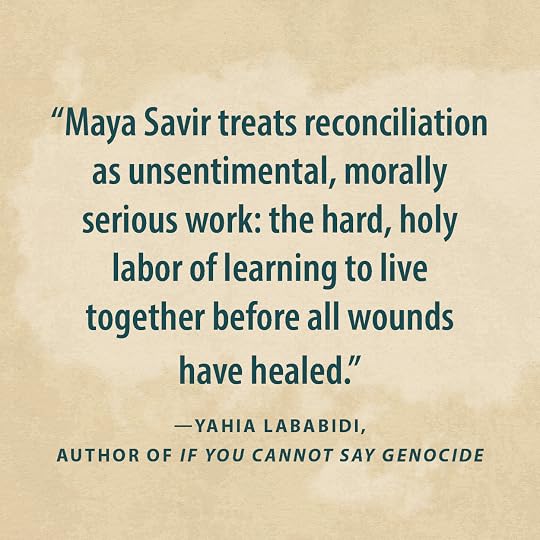
It will be a miracle if Savir's excellent words make the world better on their own, a miracle I myownself will herald as an Act of God with joyous tears should it occur. My more modest, more reality-based hope is that people will pick the book up to see what help they themselves can find for conflicts in their own lives. If it worked in South Africa and Rwanda it will work with your MAGAt cousin or your religious homophobe aunt. This pull-quote is precisely and exactly correct about Maya Savir; it is for this reasn I want all y'all to read the work it's discussing to feel wistfully hopeful as well as to get real-world tested advice on managing conflict resolution.
I received a free copy of,On Reconciliation, by Maya Savir, from the publisher and Netgalley in exchange for an honest review. Reconciliation and Peace on Earth could it happen? Can everyone forgive and forget past wrongs? Can the Middle East live in Peace? I dont know, will have to wait and see.
When thinking people on both sides of a long-standing conflict agree that living with the status quo in perpetuity is unthinkable, then it is time for new thinking. No, it is way past time.
It is precisely new thinking that Maya Savir offers in her book On Reconciliation: What Israelis and Palestinians Can Learn from South Africa and Rwanda.
You may pick a number and choose to disagree with the corresponding percentage of this book, but you can’t disagree with its central theme – that it’s way past time for a fresh look at the intractable conundrum that forms its subject. Nor can you argue with the sheer audacity of Aavir’s gripping prose.
Recently translated from the original Hebrew, with an added chapter “Reconciliation After October Seventh” that adds currency and immediacy to this volume, On Reconciliation deserves a place on your bookshelf. But be careful, it won’t stay there. Instead, it will live in your heart and ignite a flame of hope though there is no reason to hope and no evidence on which to base even a glimmer of hope. Except there is. If you doubt me, read this book.
What happens after a bloody conflict ends? Do people just come back to their homes and carry on? I'm sure some do, but that's not the general rule. If a conflict is relatively short, that might be the case for a larger percentage of people. But what if we're talking about generations upon generations filled with fear, terror, trauma, and fanatical hatred? Let's say that from now on we have a State of Palestine and a State of Israel living side by side. Both are well-governed, with no antagonistic parties in power. Would people suddenly become happy just because they finally got what they wanted? I don't think so. There are many reasons why I believe that, and some of them the authors completely omitted. Perhaps because addressing them would have made the book seem too inflammatory or controversial. The bottom line is simple: we all want peace, happy lives, and the chance to live without fear. Most people sincerely wish that for everyone, everywhere. But the authors are, in my opinion, too naïve. Peace and harmony will not be achievable in the region for as long as fanatics remain influential and foreign states continue meddling in everyone else's politics. This conflict is deeply rooted in political interests and agendas. While the powerful play their games, ordinary people are the ones who suffer.
On Reconciliation by Maya Savir, with the subtitle "What Israelis and Palestinians Can Learn from South Africa and Rwanda,"is a book that makes you really think! Maya Savir is a brilliant woman. I had to stop and think through the philosophical parts. She writes very succinctly. I know that President Obama was deeply affected by the Rwanda tragedy; now I have more of the horrifying details.
The author is a humanitarian and peace activis, and worked in South Africa and Rwanda; both countries came to a Reconciliation. The fighting stopped, although in a lot of ways, life did not improve. She is desperate for a kind of reconciliation between Israel and Palestine. To end the terror attacks, bombing, etc., and she is calling for a solution. But she is also realistic and knows the pain and suffering of both sides for several generations makes the goal more elusive. This is a very tough subject to read about, but now I am more aware of how much more difficult it will be to even have a partial solution. To me she is the Einstein of Human Rights!
This is not so much a spiritual or religious book. The author is a human rights activist, and not a religious figure. I write this review ending a week of electoral uncertainty, indeed a hazy future, for Israel and the Palestinian people. Maya Savir has penned a hopeful work for the region's future based upon the experience, the reconciliation, in the wake of violence and divisiveness in South Africa and Rwanda. This work and her assumptions were directly impacted by the events of October 2023. Reading this I had the shaky feeling that reconciliation in South Africa and Rwanda-a source of some pride for those nations-is not a deeply rooted as one may hope. I had the distinct feeling that despite the bitter divides fueled by politics in the United States, I would not desire to live in either country. Whether the experience in those places is a template for the peoples of Israel and Palestine, amid the horror of October 2023 and the death and destruction in Gaza-I am skeptical. Maybe the message of his book is one of hope. Thank you Plough for my review copy.