Jump to ratings and reviews
Rate this book

Intimate Journals of Paul Gauguin

Rate this book
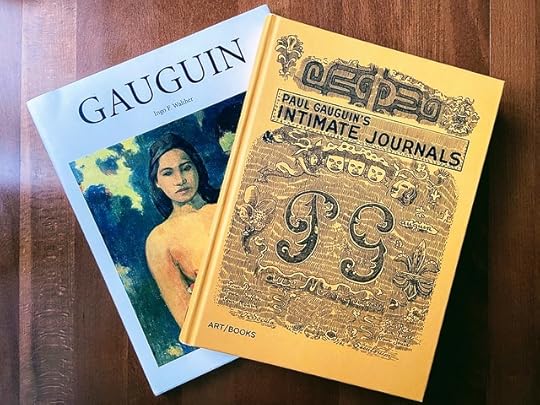
The Intimate Journals of Paul Gaugui, depicts the experiences of the French artist while living on a Polynesian island and discusses the culture of the natives of the island.

138 pages, Paperback

First published January 1, 1958

10 people are currently reading
220 people want to read

About the author

Paul Gauguin

323 books49 followers
Gauguin was a financially successful stockbroker and self-taught amateur artist when he began collecting works by the impressionists in the 1870s. Inspired by their example, he took up the study of painting under Camille Pissarro. Pissarro and Edgar Degas arranged for him to show his early painting efforts in the fourth impressionist exhibition in 1879 (as well as the annual impressionist exhibitions held through 1882). In 1882, after a stock market crash and recession rendered him unemployed and broke, Gauguin decided to abandon the business world to pursue life as an artist full-time.

In 1886, Gauguin went to Pont-Aven in Brittany, a rugged land of fervently religious people far from the urban sophistication of Paris. There he forged a new style. He was at the center of a group of avant-garde artists who dedicated themselves to synthétisme, ordering and simplifying sensory data to its fundamentals. Gauguin's greatest innovation was his use of color, which he employed not for its ability to mimic nature but for its emotive qualities. He applied it in broad flat areas outlined with dark paint, which tended to flatten space and abstract form. This flattening of space and symbolic use of color would be important influences on early twentieth-century artists.

In Brittany, Gauguin had hoped to tap the expressive potential he believed rested in a more rural, even "primitive" culture. Over the next several years he traveled often between Paris and Brittany, spending time also in Panama and Martinique. In 1891 his rejection of European urban values led him to Tahiti, where he expected to find an unspoiled culture, exotic and sensual. Instead, he was confronted with a world already transformed by western missionaries and colonial rule. In large measure, Gauguin had to invent the world he sought, not only in paintings but with woodcarvings, graphics, and written works. As he struggled with ways to express the questions of life and death, knowledge and evil that preoccupied him, he interwove the images and mythology of island life with those of the west and other cultures. After a trip to France (1893 to 1895), Gauguin returned to spend his remaining years, marred by illness and depression, in the South Seas.

Ratings & Reviews

What do you think?
Rate this book

Friends & Following

Create a free account to discover what your friends think of this book!

Community Reviews

5 stars
21 (17%)
4 stars
41 (34%)
3 stars
42 (35%)
2 stars
12 (10%)
1 star
2 (1%)
Displaying 1 - 11 of 11 reviews
Profile Image for Shane.
Author 12 books298 followers
June 8, 2019
“This is not a book,” says Paul Gauguin as he opens his intimate journals, and I agree. But I have to say I was held enthralled by the complex and talented man who emerges from these pages of reflection, observation, personal philosophy, confession and instruction.

The preface, written by his son, quickly dispels the myth that Gauguin woke up one day, abandoned his family in France, and took off for the South Seas where he cavorted with the natives, while painting until he dropped dead at his easel of a morphine overdose, taken to lessen the pain of a profligate life. On the contrary, he left with the full agreement of his wife, the marriage having broken down. After two sojourns in Tahiti, he settled in the remoter Marquesas Islands, defined a post-Impressionist art form that captured the essence of the Pacific islands, was active in local politics, more often as a dissenter against the Church and the corrupt colonial administration, and quietly contributed to a reputation-in-absentia back home in Europe.

This journal appears to have been written during his final years in the Marquesas, when he was trying to assemble the pieces of learning from his nomadic life, for the recollections of his early life in Europe (and childhood in Peru) are sketchier than those recorded on the islands. Yet, he spends some time detailing his relationship with Van Gogh and the last days that he spent in the company of this other tortured genius who committed suicide while they were sharing rooms in France. He also spends a few pages on his relationship with Degas who was a mentor.

Experts and academics had difficulty boxing Gauguin into a particular school of art—was he an Impressionist like his colleagues, a post-Impressionist, or a Primitivist—for he lived at a time when art was bursting out of traditional boundaries into something yet undefined. Gauguin resisted categorization: “The difference between a painter and a mason is that the mason builds to a plan, a frame, a model. The painter paints from memory, sensation, and intelligence, and his soul will triumph over the eye of the amateur.”

His quotes of personal philosophy characterize the man best, and I’d like to quote a few gems from this book :
1) Precision often destroys a dream.
2) Take care not to step on the foot of a learned idiot. His bile is incurable.
3) No one is good, no one is evil. Everyone is both.
4) Toil endlessly. Otherwise what would life be worth?
5) The tenderness of intelligent hearts are not easily seen.
6) The lower genius sinks, the higher talent rises.

Yet, despite these incisive observations, he claims that the subterfuges of language and the artifice of style are not suited for his barbaric heart, although he does not disdain such. “There are savages who like to cloth themselves now and then.”

He rambles on in this book, just like he did in life: taking a walk through an art gallery and critiquing the paintings therein, discussing their respective styles; reliving the storm that flooded his house upon arrival in the Marquesas; talking about the process of making Japanese Cloisonné, discussing the finer points of fencing and boxing; he talks at length of his dislike of Denmark, from the habits and customs of the Danes to their localization of art: “Venuses turned Protestant, modestly draped in damp linen”; he recounts his youthful voyage as a seaman to Rio De Janeiro where he had a series of sexual escapades with older women; he laments for the Marquesan islanders ravaged by western diseases, corrupted by colonial officials, lacking efficient services, burdened by crushing taxes, and helpless against the proliferation of prostitution.

And although he was unconsciously building this aura and reputation that was to follow him to this day, his last days were spent in debt, in pain, and forgotten at the far reaches of the French colonial empire.

“This is not a book,” he maintains after this circulatory journey through his intimate journal. And then stubbornly defends what he has written by concluding, “It is my right to write, and the critics cannot prevent it.”


Profile Image for Anna P (whatIreallyRead).
900 reviews567 followers
June 23, 2020
Paul Gauguin's Intimate Journals

Gauguin is a controversial figure. What does he say, if you hear him out?

No one is good; no one is evil; everyone is both, in the same way and in different ways. It would be needless to point this out if the unscrupulous were not always saying the opposite. It's so small a thing, the life of man, and yet there is time to do great things, fragments of the common task. I wish to love, and I cannot. I wish not to love, and I cannot.

After reading The Moon and Sixpence - a fictional book based on Gauguin's life, and Gauguin non-fiction book about Gauguin and his art, I was intrigued to find out there are his own journals to be read.

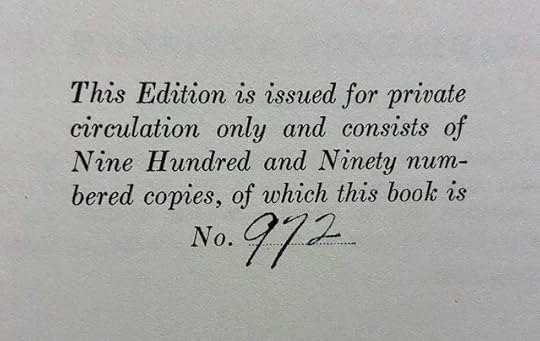
I came across this book by accident in a Dutch museum. The book is beautiful. Comfortably large print, great thick paper. It's a facsimile of the first edition, which was only available to members of a closed society. So I was delighted to see this page in it:

Paul Gauguin's Diary

The book is not a memoir in a sense that it's not a thought-out narrative, organized to tell a single story. It reads more like a bunch of diary entries: random everyday life stories; memories about Degas and Van Gogh; musings about art, society, colonialism, religion, nature, work, justice, customs and habits of native Tahitians, etc.

Brave as you may be, wise even as you may be, you tremble when the earth trembles. That is a sensation common to everybody and which no one would ever deny.


I was surprised by how beautiful and poignant some observations were. I bookmarked many of them. I wonder if these were indeed Gauguin's words, or if Gauguin was quoting someone else, or if an editor made the writings more beautiful. If not, Gauguin certainly had a way with words, besides a keen eye.

It takes very little to bring about a woman's fall, but you have to lift the whole world in order to lift her.

Paul Gauguin's memoir sketches

To a man who has not succeeded we say 'You made a mistake'.
To a man who ha lost at the lottery, 'You had bad luck'.

Be stingy of nothing but the name of friend, and take care not to waste your insults.


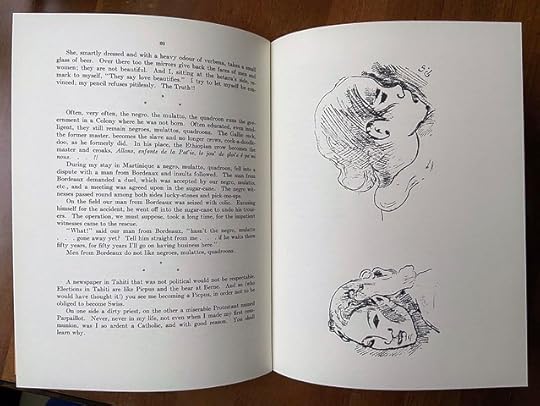
The book includes many black-and-white sketches. I suppose these were simply sketched within the manuscript of the journals, so they were published the same way.

I enjoyed this book thoroughly.
Profile Image for Jale.
120 reviews43 followers
October 16, 2016
Van Gogh'un günlüklerinden okuduğumuz ikilinin ilişkisini, kulak kesme olayını diğer taraftan nasıl olduğunu görmek açısından kıymetli günlük. Zamanın sanat dünyasına, ressamlara, felsefecilere dair Gauguin'in düşüncelerini de yazdıklarından öğrenebiliyoruz. Aynı zamanda Gauguin'in iyi bir edebiyatçı olabileceğini fark ettiriyor günlük.
Profile Image for Dara Salley.
416 reviews5 followers
January 11, 2021
I'm not a huge fan of Gauguin's paintings, but it's clear that he was a better painter than writer.
Profile Image for James F.
1,682 reviews124 followers
August 20, 2020
The book titled Gauguin's Intimate Journals is a translation of Avant et Après, one of the journals he wrote in the Marquesas, apparently during the last year or two of his life. I don't know when the French edition was published; the translation is from 1921 and has a preface by his son Emile. It consists of fairly miscellaneous but often quite interesting observations on life and art, and like his paintings is not particularly concerned with factual accuracy.
Profile Image for Merra.
69 reviews3 followers
January 12, 2018
Si bien nos advierte que justamente "no es un libro", su escritura divaga mucho y no tiene coherencia alguna. Me gustaron los comentarios sobre otros pintores como Van Gogh, Manet, Cezanne o Degas, pero son un 5% de la totalidad del libro.
Profile Image for Amy.
Author 2 books160 followers
January 17, 2009
I admit it. I got a bit impatient with this. The man may have had artistic genius, but his writing is all over the place. (But then he repeatedly tells us "This is not a book" so it's my own darn fault for placing expectations of coherency on it.)

I did like when he spoke about some of my favorite artists- Degas, Monet-- there was a great story about Manet from the days before Gauguin had left stockbroking for art. Manet praised one of his paintings, to which he said he was only an amateur. Manet replied, "there are no amateurs but those who make bad pictures,"

Or the time he and his wife were reading, and she needed to go get more coal in the cellar. She had been reading Edgar Allen Poe's "The Black Cat". When she went out the door, there was a black cat sitting in her path. Somewhat shaken, she went on and began to fill the coal scuttle. The house was one they were renting from another artist (I forget who and I forgot to mark the passage. Sue me.) As she dug, a skull rolled out of the pile of coal in the basement. Nearly did the poor lady in, but it turned out to be an old skeleton the artist had used in sketching and then discarded.

All in all, it was a fairly interesting journey to read this "not a book"-- not the organization my brain craves at the moment, but still interesting.
Profile Image for Elle.
32 reviews2 followers
January 19, 2008
You'll never look at his Tahitian paintings the same way again.
Profile Image for Melike.
57 reviews
February 4, 2017
Resim sanatına ilgi duyanların daha çok hoşlanacağı bir "günlük" elimizdeki. Gauguin 'in sık sık tekrarladığı gibi "Bu bir kitap değil"
Displaying 1 - 11 of 11 reviews

Can't find what you're looking for?

Get help and learn more about the design.