

What do you think?

The Politics of Lonely: Why Is Friendship So Hard?
Friendship is hard because everything is hard. This book examines social structures to demonstrate how people mend an unravelling social fabric.
Why is it hard to make and keep friends as an adult? Even if you finally find time to see each other, can you connect more deeply than just catching up over coffee? How many do you count as ride-or-die pals who’ll always show up with effervescent banter and deep conversation — your “chosen family?”
Widespread loneliness reflects a world of crappy jobs and unaffordable housing that makes it almost impossible to have close, interwoven friendships. A dwindling social safety net takes a toll on us and on our relationships. Particularly for queer people, friendships can be crucial relations of equality, constancy, and care. Still, we disappoint each other and fall into irreparable conflict.
A less lonely world is possible. Through interviews, research, and personal narrative, this book shows how people build tight connections despite living in the austere conditions of colonial capitalism — boldly weaving a new social fabric as this one unravels.
Why is it hard to make and keep friends as an adult? Even if you finally find time to see each other, can you connect more deeply than just catching up over coffee? How many do you count as ride-or-die pals who’ll always show up with effervescent banter and deep conversation — your “chosen family?”
Widespread loneliness reflects a world of crappy jobs and unaffordable housing that makes it almost impossible to have close, interwoven friendships. A dwindling social safety net takes a toll on us and on our relationships. Particularly for queer people, friendships can be crucial relations of equality, constancy, and care. Still, we disappoint each other and fall into irreparable conflict.
A less lonely world is possible. Through interviews, research, and personal narrative, this book shows how people build tight connections despite living in the austere conditions of colonial capitalism — boldly weaving a new social fabric as this one unravels.
- GenresNonfiction
254 pages, Paperback
Published September 10, 2026
Ratings & Reviews
Friends & Following
Create a free account to discover what your friends think of this book!
Community Reviews
Displaying 1 - 7 of 7 reviews

September 3, 2026
A digital advance review copy was provided by the publisher via NetGalley in exchange for an honest review.
Is friendship Marxist praxis? Lee Arden says yes. And they make a convincing case.
This is not a new idea, exactly. What Arden is describing has gone by other names. Coalition building. Organizing. Mutual aid. Labor unions were, at their core, friendship. People united around shared conditions and took care of each other. But I think the reason this book is so radical is that it strips all that language back to the simplest version: make friends. Be a good friend. That is the work.
Being a good friend means dealing with people you do not like, too. It means showing up when it is inconvenient. It means learning how to sit with discomfort. To have friends you have to be a good one first. Arden lays out what that actually looks like with personal anecdotes, stories from friends, and real-life examples.
I came to this book through engagement with Arden's zine distro, Sheer Spite Press. I’ve read and loved Making Friends With Zines, which reads more like field notes about their experience with connection via zine-making. I personally know that sharing zines and being able to make zines side-by-side with strangers are a good way to make friends.The Politics of Lonely is my first real dive into Arden's longer work.
-
There is undoubtedly a loneliness epidemic. I see it constantly, especially in rural Vermont where I live. Online, people are posting that it is hard to make friends. Putting out open calls to make friends by sharing their interests and hoping someone else will read that and connect. It sounds almost desperate sometimes. Arden doesn’t just acknowledge this - they break down why it is harder now like the systemic setbacks and the things that eat our time.
Neoliberalism gets a thorough examination in this book. It has reshaped our inner lives. It taught us to buy services instead of asking friends for help. It taught us we do not owe each other care. Insurance rules, leave policies, bureaucratic hierarchies: all of these make it genuinely hard to center friendship, which rarely counts as a "real" relationship in any official sense. Dismantling social safety nets did not just remove support. It eroded our ability to even see ourselves as a collective with mutual responsibility.
The book starts out critical about the legal structures that made everything marriage-centered. This is part of what kicked the epidemic off. It is a lot to put on one person. What about everyone else? People abandon friends when they get married or start dating. That pattern is so normalized we barely question it.
Arden makes a sharp point here. Insular, inward-turned friendships start to resemble romantic pairings. They become more vulnerable to abuse, resentment, and disappointment. Relationships are healthier inside a network. More people can notice problems and can help pull individuals back on track. Loading all your interpersonal needs onto one person sets the relationship up to fail. In straight couples, this often burns out women specifically.
This is why the book draws so heavily from queer and trans communities. Queer people have long built networks out of necessity, especially during the AIDS epidemic. In terms of getting away from couple-centered relationships, we have a lot to learn from asexual and polyamorous people. Arden spends real time with those histories throughout this book. They also draw significantly from Indigenous perspectives, which feels important and honest. Arden approaches this as an outsider and a learner, and I really love the earnestness present in the whole work.
Another one of my favorite things about the book: the quotes. Arden pulls from BIPOC, disabled, and mad organizers and thinkers. The sourcing is relevant and makes me want to do even more research. But the way the quotes are used matters just as much. They read like quoting from friends. There is a familiarity to it and it never feels academic.
Arden writes like a friend, too. I know that when you put something like this book out there, people think they know you. And I know there is emotional labor in that. People probably message them on Instagram to unload their feelings. But that kind of openness is also the magic of the book. The tone is warm and direct, not pretentious at all, in the same way that zines are comforting.
And here is where the book challenged me the most. Young leftists often cancel people for not using the right pronouns or not knowing the right language. Arden pushes back on that. To be a good friend is to be friends with all types of people, even the ones who don’t say the right or cool thing. They also draw meaningfully from religious communities, which is brave. I have been in circles where religion gets immediately dismissed. But Arden connects it to something real: rising loneliness tracks with declining religious attendance. Religious communities instill a sense of obligation across generations.
Obligation is load-bearing. You cannot strip it out and still enjoy the benefits of community. That was a big takeaway for me. To support that, a community needs ritual. Any kind of ritual. Arden suggests a few, some religious, mostly secular to help readers get started.
Difference makes small ruptures inevitable. Same with misunderstandings and mismatched expressions of care. So the capacity for repair is the price of diverse relationships. You need experience with small conflicts before you can handle big ones.
Lastly, Arden ends with something I keep thinking about in my day-to-day life and organizing practice. The seductive fantasy that enough therapy and self-work can make us invulnerable to hurting or protect us from friendships that genuinely suck. Sharing a world means inevitable friction. Real solutions come from engaging with each other through the hurts.
That is the whole argument of this book, really. Friendship is not a soft topic. It is structural. It is political. And it is something Arden says we have to practice, badly and imperfectly, together.
Is friendship Marxist praxis? Lee Arden says yes. And they make a convincing case.
This is not a new idea, exactly. What Arden is describing has gone by other names. Coalition building. Organizing. Mutual aid. Labor unions were, at their core, friendship. People united around shared conditions and took care of each other. But I think the reason this book is so radical is that it strips all that language back to the simplest version: make friends. Be a good friend. That is the work.
Being a good friend means dealing with people you do not like, too. It means showing up when it is inconvenient. It means learning how to sit with discomfort. To have friends you have to be a good one first. Arden lays out what that actually looks like with personal anecdotes, stories from friends, and real-life examples.
I came to this book through engagement with Arden's zine distro, Sheer Spite Press. I’ve read and loved Making Friends With Zines, which reads more like field notes about their experience with connection via zine-making. I personally know that sharing zines and being able to make zines side-by-side with strangers are a good way to make friends.The Politics of Lonely is my first real dive into Arden's longer work.
-
There is undoubtedly a loneliness epidemic. I see it constantly, especially in rural Vermont where I live. Online, people are posting that it is hard to make friends. Putting out open calls to make friends by sharing their interests and hoping someone else will read that and connect. It sounds almost desperate sometimes. Arden doesn’t just acknowledge this - they break down why it is harder now like the systemic setbacks and the things that eat our time.
Neoliberalism gets a thorough examination in this book. It has reshaped our inner lives. It taught us to buy services instead of asking friends for help. It taught us we do not owe each other care. Insurance rules, leave policies, bureaucratic hierarchies: all of these make it genuinely hard to center friendship, which rarely counts as a "real" relationship in any official sense. Dismantling social safety nets did not just remove support. It eroded our ability to even see ourselves as a collective with mutual responsibility.
The book starts out critical about the legal structures that made everything marriage-centered. This is part of what kicked the epidemic off. It is a lot to put on one person. What about everyone else? People abandon friends when they get married or start dating. That pattern is so normalized we barely question it.
Arden makes a sharp point here. Insular, inward-turned friendships start to resemble romantic pairings. They become more vulnerable to abuse, resentment, and disappointment. Relationships are healthier inside a network. More people can notice problems and can help pull individuals back on track. Loading all your interpersonal needs onto one person sets the relationship up to fail. In straight couples, this often burns out women specifically.
This is why the book draws so heavily from queer and trans communities. Queer people have long built networks out of necessity, especially during the AIDS epidemic. In terms of getting away from couple-centered relationships, we have a lot to learn from asexual and polyamorous people. Arden spends real time with those histories throughout this book. They also draw significantly from Indigenous perspectives, which feels important and honest. Arden approaches this as an outsider and a learner, and I really love the earnestness present in the whole work.
Another one of my favorite things about the book: the quotes. Arden pulls from BIPOC, disabled, and mad organizers and thinkers. The sourcing is relevant and makes me want to do even more research. But the way the quotes are used matters just as much. They read like quoting from friends. There is a familiarity to it and it never feels academic.
Arden writes like a friend, too. I know that when you put something like this book out there, people think they know you. And I know there is emotional labor in that. People probably message them on Instagram to unload their feelings. But that kind of openness is also the magic of the book. The tone is warm and direct, not pretentious at all, in the same way that zines are comforting.
And here is where the book challenged me the most. Young leftists often cancel people for not using the right pronouns or not knowing the right language. Arden pushes back on that. To be a good friend is to be friends with all types of people, even the ones who don’t say the right or cool thing. They also draw meaningfully from religious communities, which is brave. I have been in circles where religion gets immediately dismissed. But Arden connects it to something real: rising loneliness tracks with declining religious attendance. Religious communities instill a sense of obligation across generations.
Obligation is load-bearing. You cannot strip it out and still enjoy the benefits of community. That was a big takeaway for me. To support that, a community needs ritual. Any kind of ritual. Arden suggests a few, some religious, mostly secular to help readers get started.
Difference makes small ruptures inevitable. Same with misunderstandings and mismatched expressions of care. So the capacity for repair is the price of diverse relationships. You need experience with small conflicts before you can handle big ones.
Lastly, Arden ends with something I keep thinking about in my day-to-day life and organizing practice. The seductive fantasy that enough therapy and self-work can make us invulnerable to hurting or protect us from friendships that genuinely suck. Sharing a world means inevitable friction. Real solutions come from engaging with each other through the hurts.
That is the whole argument of this book, really. Friendship is not a soft topic. It is structural. It is political. And it is something Arden says we have to practice, badly and imperfectly, together.

Read
September 9, 2026This got its hooks in me fast, mostly because I've felt the loneliness epidemic in my own life without having the language for why it's so hard to keep friendships going as an adult.
Arden's core argument is that friendship isn't just personal, it's structural. Unaffordable housing and crappy jobs leave people with no slack to give each other, and coupledom quietly absorbs all the care work that used to spread across a wider circle. The queer and chosen family histories woven throughout gave it real depth instead of abstract theory, and Arden's honesty about their own failed attempts at community made this land differently than most books in this space. I really enjoyed all of this and it gave the book more depth.
Where it lost me a little was the density. So much ground gets covered that some points get made, illustrated, and illustrated again before moving on.
Still, this reframed something I'd been feeling but couldn't name, that friendship needs infrastructure, not just good intentions.
Thank you to NetGalley and Fernwood Publishing for the ARC.
Arden's core argument is that friendship isn't just personal, it's structural. Unaffordable housing and crappy jobs leave people with no slack to give each other, and coupledom quietly absorbs all the care work that used to spread across a wider circle. The queer and chosen family histories woven throughout gave it real depth instead of abstract theory, and Arden's honesty about their own failed attempts at community made this land differently than most books in this space. I really enjoyed all of this and it gave the book more depth.
Where it lost me a little was the density. So much ground gets covered that some points get made, illustrated, and illustrated again before moving on.
Still, this reframed something I'd been feeling but couldn't name, that friendship needs infrastructure, not just good intentions.
Thank you to NetGalley and Fernwood Publishing for the ARC.

Review of advance copy received from NetGalley
More Soup, More Spare Keys, Fewer Heroics: What Lee Arden Wants from a Less Lonely World
In “The Politics of Lonely,” friendship matters most after it stops being asked to replace the partner, the family, the clinic, the neighborhood, and everything else that should have been there too.
By Demetris Papadimitropoulos | September 4th, 2026

“The Spreadsheet Couldn’t Make an Afternoon” – A care spreadsheet can divide an afternoon into cells; it cannot manufacture the time, space, money, or stamina friendship needs in order to become care.
During Lee Arden’s recovery from top surgery in 2017, friendship became a spreadsheet. Arden had once watched a boyfriend’s surgical care fall almost entirely to them and did not want their own partner drafted into the same exhausting role. Friends volunteered. Arden divided the work into shifts. Chosen family acquired cells and columns. Then nearly everyone bailed. The girlfriend Arden had hoped to spare became the default caregiver anyway, bringing food, running errands, getting them to appointments, calming fear and pain. “The Politics of Lonely: Why Is Friendship So Hard?” begins inside this tiny failure of care infrastructure. The spreadsheet can assign a Tuesday afternoon; it cannot conjure an afternoon nobody has, a spare room rent has already filled, or energy already spent surviving the week.
Even years later, Arden refuses the cleaner story in which everyone else simply failed. They admit to selfishness, carelessness, avoidance, and the humiliating gap between the ideals one publishes and the relationships one manages. A friend eventually offers another explanation for those empty shifts: Arden had a romantic partner, so everyone assumed somebody else would be there. Arden thinks the friend was right. Coupledom had quietly reassigned the work. The partner remained the person presumed to have the spare key, answer the emergency call, absorb whatever everyone else left undone. The friends’ failure was personal, but it had a script.
Much recent writing on friendship presses against romance’s monopoly on seriousness. Rhaina Cohen’s “The Other Significant Others,” for instance, examines lives built around friendships granted forms of commitment usually reserved for couples. Arden shares the impatience but eventually worries at the premise underneath it. Why should intimacy need a center at all? The opening chapters test friendship’s negotiable terms, the freedom they permit and the hurt that follows when two people discover they have been living under different contracts. Then rent, work, law, money, and frayed public supports enter the calculation. Eight of the book’s sixteen numbered chapters belong to its final section, where friendship opens into shared resources, organizing, repair, ritual, community, and collective provision. Arden starts by wanting friendship promoted. They end up questioning the architecture that makes promotion seem necessary.
Early on, Arden gives the burden a compact material name: slack. Money left after rent can become a loan. An uncrowded home can supply a couch. An afternoon not consumed by work can become childcare, moving help, a hospital visit, or the luxury of sitting around with somebody for no reason at all. Love can motivate those acts; it cannot mint time, square footage, health, or cash. Arden’s failed surgery plan hurts because care appears to have been promised and then withdrawn, yet the surrounding chapters trouble that verdict. People can love one another sincerely while having almost nothing left from which to act on that love. Arden is not sentimental about scarcity. People with the least often give ferociously. Six years after the failed top-surgery plan, another surgery goes differently: older friends, more experience with illness and disability, somewhat greater resources, and this time the floor holds. The contrast matters because it keeps Arden from turning hardship into destiny. The objection is to arrangements that make ordinary help feel like sainthood.

“What Love Cannot Mint” – Arden’s “slack” becomes an open room: a couch, a key, and enough unclaimed time and space for affection to become practical help.
The shortages show up before the abstractions do. A rent increase eliminates the spare room. Work consumes the afternoon in which someone might have helped a friend move or waited beside a hospital bed. Money allows dependence to disappear behind a transaction: hire someone, order something, solve the problem without admitting another person was needed. Arden names neoliberalism, austerity, precarious work, privatized support, and the prestige of self-reliance, sometimes with a causal confidence that will later become a problem. More often the argument works because politics acquires household dimensions. Individualism becomes emergency food hidden in a backpack in case you need to bolt. A safety net becomes who catches you and whether there is anything solid under them.
Rather than pose as someone who has escaped these habits, Arden remains an unreliable convert to their own argument. They want interdependence and still retreat when frightened; want community and become exhausted by people; believe in repair and admit to letting relationships die because one more painful conversation felt impossible. They distrust self-sufficiency while keeping emergency supplies close. Arden can recognize a bad arrangement and still find it emotionally convenient. Anyone who has ever known exactly what would be good for them and then done something else will recognize the genre.
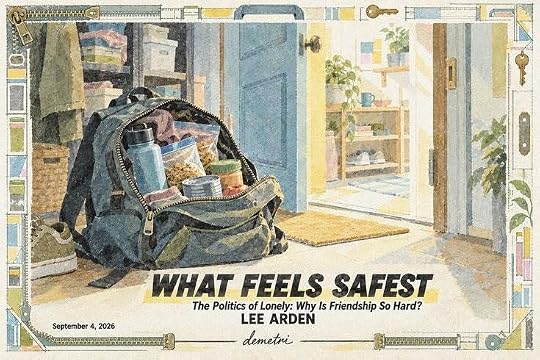
“What Feels Safest” – A packed bag waits beside the door, holding the book’s stubborn contradiction: self-reliance can feel safest precisely when durable safety requires other people.
If there is a stylistic equivalent to Arden’s politics, it is accumulation. Sentences gather clauses the way obligations gather around a life: rent, work, illness, somebody else’s emergency, one more thing to remember. Then the pressure releases, often in a short sentence that behaves like somebody finally setting down the grocery bags. Memoir slides into history, interviews, zines, queer theory, policy, a joke, then back to the humiliations of ordinary logistics without much strain. Arden can move from specialized political vocabulary to profanity with the casualness of changing tabs. A book this earnest could easily become airless; Arden keeps cracking a window. Community is inconvenient. Friends are annoying. People cancel. Even Arden’s recurring metaphors resist solitary grandeur: threads, nets, braids, quilts, objects whose strength depends on what touches what. “Annoying” interdependence is allowed to stay annoying rather than being perfumed into virtue.
Part of the same appetite makes the book overfull. Arden collects roommates, mutual aid, labor history, disability justice, emergency planning, religious community, ritual, then sometimes keeps collecting after the pattern has already arrived. A point is made, illustrated, sourced, illustrated again, then explained once more. The effect is rarely dull, but several chapters would be stronger with one chair taken out, perhaps two. Arden’s generosity toward evidence occasionally becomes reluctance to leave anything in the hallway.
Across the three parts, friendship keeps receding from close-up. At first Arden is near enough to inspect the ambiguity of a promise between two people. The middle chapters pull back until housing, wages, law, work, and public provision enter the frame. The final chapters pull back farther, toward neighborhoods, organizations, rituals, and institutions. Friend becomes network, household, community. Five interview interludes interrupt Arden’s monologue with other people’s accounts of giving and receiving care, while the back matter turns each chapter into a summary, a question, and an action. The apparatus can be earnest, but it fits a book suspicious of the isolated self: Arden keeps handing the floor to somebody else. By then, asking how to strengthen friendship has become too small a question.
Potlucks prove the point more neatly than theory does. Bruised by unreliable friendships, Arden and a partner decide to “build community” through a monthly gathering where friends might meet friends and one-on-one ties could thicken into a network. People promise to come, cancel, disappoint; eventually the potlucks stop. Arden had been trying to cure a lack of community by intensifying friendship, although the two are not interchangeable. Friendship can begin in affinity and choice. Community requires repetition, obligation, difference, inconvenience, sometimes the company of people one would never have selected. More friends do not automatically add up to a world.
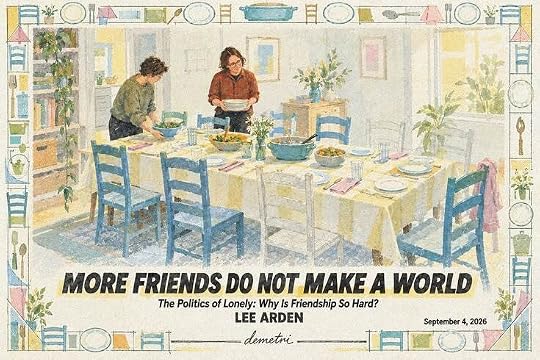
“More Friends Do Not Make a World” – A table set for more people than arrive turns social hope into negative space: friendship can multiply invitations without yet producing community.
A couple and a chosen family can both become too small for the amount of need routed through them. Law and habit load security onto romantic partnership; queer countercultures can answer by loading similar hopes onto another private circle. Networks distribute responsibility, but even they contain an escape hatch: when many people might show up, each person can imagine somebody else will. This is the less flattering conclusion Arden reaches after beginning with the appealing instruction to take friendship seriously. Moving friendship into romance’s old seat would change the occupant more than the arrangement. A few beloved people cannot be asked to impersonate an entire infrastructure.
Diagnosis sometimes arrives too early. Neoliberalism explains depleted time, privatized support, the prestige of self-reliance, the moralization of convenience, even some habits of withdrawal and disposability. Much of this is persuasive. At times, though, the explanation reaches the scene before the people in it have finished becoming strange. Friends also fail because they are envious, avoidant, incompatible, resentful, frightened of intimacy, casually selfish, or simply unreliable. Arden usually lets those possibilities into the room, but context sometimes hardens into cause. The book knows relationships are messy; its political vocabulary can make them look tidier than they are.
In the repair chapter, the mess pushes back. Arden distrusts advice that treats difficult relationships as disposable while conceding that some relationships absolutely should end. Repair asks us to hold two truths without turning either into an acquittal: I hurt someone and am still worth loving; someone hurt me and is not reducible to the injury. Scarcity matters because a person who is broke, sick, frightened, overworked, or stretched thin may have little appetite for one more difficult conversation. Yet no housing policy can apologize for us. No social program can supply curiosity, patience, or the ability to survive shame without fleeing. Politics can set the weather. It cannot have the conversation.

“Stay There on Purpose” – Two people remain on opposite sides of an unresolved interval, where repair begins not with harmony but with the decision not to leave.
Much of what Arden calls loneliness therefore begins outside the lonely person. It begins in the shortage of places, schedules, institutions, and public goods that make intimacy easier to sustain. A park, a library, affordable housing, a clinic: none is friendship, but each changes what friendship must absorb. This is why Arden’s occasional joke about AI companionship has more bite than a topical aside usually earns. A culture can become remarkably efficient at selling contact without scheduling, compromise, cancellation, or reciprocity while making the slow logistics of actual attachment harder to manage. Arden is not nostalgic for a lost communal Eden. Public systems can exclude and harm; friends still should not have to audition as emergency infrastructure whenever those systems fail.
In the final stretch, Arden remembers a fantasy from the first year of the pandemic. Desperately lonely, they imagined a Friendship Hospital: somewhere soft and warm, open to everyone, where a person could be held, fed, talked with, laughed with, helped without first proving the correct relationship to the helper. At first the fantasy enlarges friendship into utopia. Then clinics, co-ops, mutual-aid projects, community kitchens, peer-support spaces, and older histories of collectively organized support crowd into the picture. Arden has spent the book reading about such places and, at one point, catches themself wondering what a free clinic has to do with friendship. The question is the answer. The fantasy survives only by ceasing to be exclusively about friends. What Arden wants is care uncoupled from relational rank.
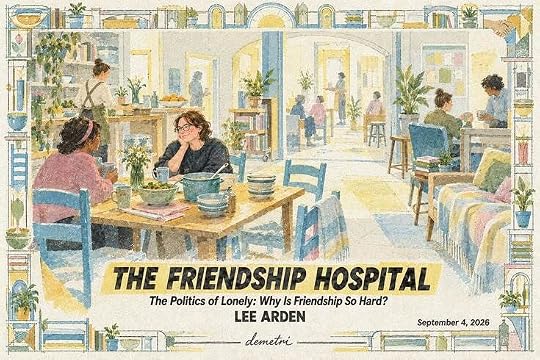
“The Friendship Hospital” – Arden’s fantasy expands until friendship itself is no longer the point: the room becomes a commons for care without relational rank.
The ending does not fulfill the wish that started the book so much as revise it. Arden never stops valuing friendship; they stop requiring friendship to prove its seriousness by becoming sufficient. Early heartbreak comes from discovering that chosen family cannot always replace romantic or biological care. By the end, replacement itself looks like the wrong ambition. A dense social life might include close friends, roommates, neighbors, lovers, acquaintances, organizers, public resources, rituals, institutions, and fleeting encounters that still carry reciprocal regard. No single tie needs the throne. Friendship becomes smaller in Arden’s argument and, oddly, more important for it.
Reckoned against what it attempts, “The Politics of Lonely” earns 84/100, or 4/5 Goodreads stars. Its architecture, voice, emotional candor, and willingness to revise its own premise outweigh the repetition and the moments when one political explanation is asked to carry too many bags. Arden begins by asking why friends did not show up. They end by asking why showing up was organized as such a private emergency. Between those questions, the meaning of the failure has changed.
Once the spreadsheet is seen that way, a better grid starts to look almost beside the point. It would not have created afternoons nobody possessed, spare rooms rent had already filled, money nobody could lend, or energy spent elsewhere. What Arden wants instead is more places for care to come from, more slack so affection does not have to perform miracles on schedule, more room for obligation to circulate without collapsing onto the nearest partner. The result will be inconvenient and annoying as often as it is lovely. A less lonely world would probably contain more soup, more spare keys, more people needing things at bad times – and fewer spreadsheets pretending any one of us can manage the whole arrangement alone.

“More Places for Care to Come From” – Keys, bowls, books, couches, thresholds, and neighbors distribute care across the closing image, replacing the search for one sufficient relationship with a denser social world.

Full-Body Relevant-Person Watercolor Study
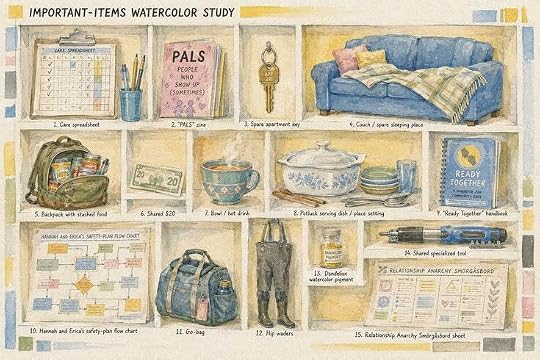
Important-Items Watercolor Study

Cover-Palette Proportion Ledger

Cover-to-Watercolor Material Grammar Study
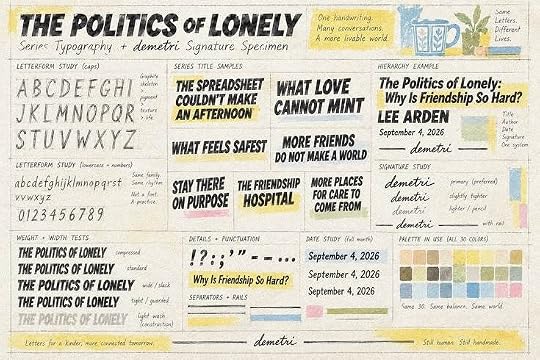
Series Typography + “demetri” Signature Specimen
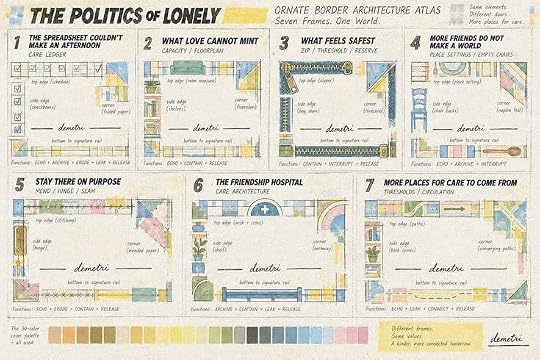
Ornate Border Architecture Atlas

Emblematic Composition Thumbnail Sheet
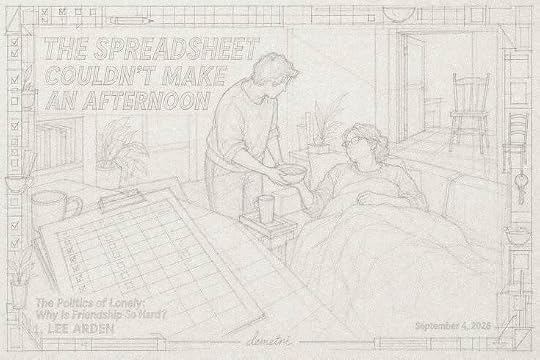
First Underdrawing

First-Wash Study

Alternate Full-Jacket Study
All watercolor illustrations by Demetris Papadimitropoulos.
Watercolors are done on 140lb vellum and then scanned into the computer using an Epson scanner. From there, they are finalized in Procreate. No AI was used in writing this review — all art and opinions are my own.
In “The Politics of Lonely,” friendship matters most after it stops being asked to replace the partner, the family, the clinic, the neighborhood, and everything else that should have been there too.
By Demetris Papadimitropoulos | September 4th, 2026
“The Spreadsheet Couldn’t Make an Afternoon” – A care spreadsheet can divide an afternoon into cells; it cannot manufacture the time, space, money, or stamina friendship needs in order to become care.
During Lee Arden’s recovery from top surgery in 2017, friendship became a spreadsheet. Arden had once watched a boyfriend’s surgical care fall almost entirely to them and did not want their own partner drafted into the same exhausting role. Friends volunteered. Arden divided the work into shifts. Chosen family acquired cells and columns. Then nearly everyone bailed. The girlfriend Arden had hoped to spare became the default caregiver anyway, bringing food, running errands, getting them to appointments, calming fear and pain. “The Politics of Lonely: Why Is Friendship So Hard?” begins inside this tiny failure of care infrastructure. The spreadsheet can assign a Tuesday afternoon; it cannot conjure an afternoon nobody has, a spare room rent has already filled, or energy already spent surviving the week.
Even years later, Arden refuses the cleaner story in which everyone else simply failed. They admit to selfishness, carelessness, avoidance, and the humiliating gap between the ideals one publishes and the relationships one manages. A friend eventually offers another explanation for those empty shifts: Arden had a romantic partner, so everyone assumed somebody else would be there. Arden thinks the friend was right. Coupledom had quietly reassigned the work. The partner remained the person presumed to have the spare key, answer the emergency call, absorb whatever everyone else left undone. The friends’ failure was personal, but it had a script.
Much recent writing on friendship presses against romance’s monopoly on seriousness. Rhaina Cohen’s “The Other Significant Others,” for instance, examines lives built around friendships granted forms of commitment usually reserved for couples. Arden shares the impatience but eventually worries at the premise underneath it. Why should intimacy need a center at all? The opening chapters test friendship’s negotiable terms, the freedom they permit and the hurt that follows when two people discover they have been living under different contracts. Then rent, work, law, money, and frayed public supports enter the calculation. Eight of the book’s sixteen numbered chapters belong to its final section, where friendship opens into shared resources, organizing, repair, ritual, community, and collective provision. Arden starts by wanting friendship promoted. They end up questioning the architecture that makes promotion seem necessary.
Early on, Arden gives the burden a compact material name: slack. Money left after rent can become a loan. An uncrowded home can supply a couch. An afternoon not consumed by work can become childcare, moving help, a hospital visit, or the luxury of sitting around with somebody for no reason at all. Love can motivate those acts; it cannot mint time, square footage, health, or cash. Arden’s failed surgery plan hurts because care appears to have been promised and then withdrawn, yet the surrounding chapters trouble that verdict. People can love one another sincerely while having almost nothing left from which to act on that love. Arden is not sentimental about scarcity. People with the least often give ferociously. Six years after the failed top-surgery plan, another surgery goes differently: older friends, more experience with illness and disability, somewhat greater resources, and this time the floor holds. The contrast matters because it keeps Arden from turning hardship into destiny. The objection is to arrangements that make ordinary help feel like sainthood.
“What Love Cannot Mint” – Arden’s “slack” becomes an open room: a couch, a key, and enough unclaimed time and space for affection to become practical help.
The shortages show up before the abstractions do. A rent increase eliminates the spare room. Work consumes the afternoon in which someone might have helped a friend move or waited beside a hospital bed. Money allows dependence to disappear behind a transaction: hire someone, order something, solve the problem without admitting another person was needed. Arden names neoliberalism, austerity, precarious work, privatized support, and the prestige of self-reliance, sometimes with a causal confidence that will later become a problem. More often the argument works because politics acquires household dimensions. Individualism becomes emergency food hidden in a backpack in case you need to bolt. A safety net becomes who catches you and whether there is anything solid under them.
Rather than pose as someone who has escaped these habits, Arden remains an unreliable convert to their own argument. They want interdependence and still retreat when frightened; want community and become exhausted by people; believe in repair and admit to letting relationships die because one more painful conversation felt impossible. They distrust self-sufficiency while keeping emergency supplies close. Arden can recognize a bad arrangement and still find it emotionally convenient. Anyone who has ever known exactly what would be good for them and then done something else will recognize the genre.
“What Feels Safest” – A packed bag waits beside the door, holding the book’s stubborn contradiction: self-reliance can feel safest precisely when durable safety requires other people.
If there is a stylistic equivalent to Arden’s politics, it is accumulation. Sentences gather clauses the way obligations gather around a life: rent, work, illness, somebody else’s emergency, one more thing to remember. Then the pressure releases, often in a short sentence that behaves like somebody finally setting down the grocery bags. Memoir slides into history, interviews, zines, queer theory, policy, a joke, then back to the humiliations of ordinary logistics without much strain. Arden can move from specialized political vocabulary to profanity with the casualness of changing tabs. A book this earnest could easily become airless; Arden keeps cracking a window. Community is inconvenient. Friends are annoying. People cancel. Even Arden’s recurring metaphors resist solitary grandeur: threads, nets, braids, quilts, objects whose strength depends on what touches what. “Annoying” interdependence is allowed to stay annoying rather than being perfumed into virtue.
Part of the same appetite makes the book overfull. Arden collects roommates, mutual aid, labor history, disability justice, emergency planning, religious community, ritual, then sometimes keeps collecting after the pattern has already arrived. A point is made, illustrated, sourced, illustrated again, then explained once more. The effect is rarely dull, but several chapters would be stronger with one chair taken out, perhaps two. Arden’s generosity toward evidence occasionally becomes reluctance to leave anything in the hallway.
Across the three parts, friendship keeps receding from close-up. At first Arden is near enough to inspect the ambiguity of a promise between two people. The middle chapters pull back until housing, wages, law, work, and public provision enter the frame. The final chapters pull back farther, toward neighborhoods, organizations, rituals, and institutions. Friend becomes network, household, community. Five interview interludes interrupt Arden’s monologue with other people’s accounts of giving and receiving care, while the back matter turns each chapter into a summary, a question, and an action. The apparatus can be earnest, but it fits a book suspicious of the isolated self: Arden keeps handing the floor to somebody else. By then, asking how to strengthen friendship has become too small a question.
Potlucks prove the point more neatly than theory does. Bruised by unreliable friendships, Arden and a partner decide to “build community” through a monthly gathering where friends might meet friends and one-on-one ties could thicken into a network. People promise to come, cancel, disappoint; eventually the potlucks stop. Arden had been trying to cure a lack of community by intensifying friendship, although the two are not interchangeable. Friendship can begin in affinity and choice. Community requires repetition, obligation, difference, inconvenience, sometimes the company of people one would never have selected. More friends do not automatically add up to a world.
“More Friends Do Not Make a World” – A table set for more people than arrive turns social hope into negative space: friendship can multiply invitations without yet producing community.
A couple and a chosen family can both become too small for the amount of need routed through them. Law and habit load security onto romantic partnership; queer countercultures can answer by loading similar hopes onto another private circle. Networks distribute responsibility, but even they contain an escape hatch: when many people might show up, each person can imagine somebody else will. This is the less flattering conclusion Arden reaches after beginning with the appealing instruction to take friendship seriously. Moving friendship into romance’s old seat would change the occupant more than the arrangement. A few beloved people cannot be asked to impersonate an entire infrastructure.
Diagnosis sometimes arrives too early. Neoliberalism explains depleted time, privatized support, the prestige of self-reliance, the moralization of convenience, even some habits of withdrawal and disposability. Much of this is persuasive. At times, though, the explanation reaches the scene before the people in it have finished becoming strange. Friends also fail because they are envious, avoidant, incompatible, resentful, frightened of intimacy, casually selfish, or simply unreliable. Arden usually lets those possibilities into the room, but context sometimes hardens into cause. The book knows relationships are messy; its political vocabulary can make them look tidier than they are.
In the repair chapter, the mess pushes back. Arden distrusts advice that treats difficult relationships as disposable while conceding that some relationships absolutely should end. Repair asks us to hold two truths without turning either into an acquittal: I hurt someone and am still worth loving; someone hurt me and is not reducible to the injury. Scarcity matters because a person who is broke, sick, frightened, overworked, or stretched thin may have little appetite for one more difficult conversation. Yet no housing policy can apologize for us. No social program can supply curiosity, patience, or the ability to survive shame without fleeing. Politics can set the weather. It cannot have the conversation.
“Stay There on Purpose” – Two people remain on opposite sides of an unresolved interval, where repair begins not with harmony but with the decision not to leave.
Much of what Arden calls loneliness therefore begins outside the lonely person. It begins in the shortage of places, schedules, institutions, and public goods that make intimacy easier to sustain. A park, a library, affordable housing, a clinic: none is friendship, but each changes what friendship must absorb. This is why Arden’s occasional joke about AI companionship has more bite than a topical aside usually earns. A culture can become remarkably efficient at selling contact without scheduling, compromise, cancellation, or reciprocity while making the slow logistics of actual attachment harder to manage. Arden is not nostalgic for a lost communal Eden. Public systems can exclude and harm; friends still should not have to audition as emergency infrastructure whenever those systems fail.
In the final stretch, Arden remembers a fantasy from the first year of the pandemic. Desperately lonely, they imagined a Friendship Hospital: somewhere soft and warm, open to everyone, where a person could be held, fed, talked with, laughed with, helped without first proving the correct relationship to the helper. At first the fantasy enlarges friendship into utopia. Then clinics, co-ops, mutual-aid projects, community kitchens, peer-support spaces, and older histories of collectively organized support crowd into the picture. Arden has spent the book reading about such places and, at one point, catches themself wondering what a free clinic has to do with friendship. The question is the answer. The fantasy survives only by ceasing to be exclusively about friends. What Arden wants is care uncoupled from relational rank.
“The Friendship Hospital” – Arden’s fantasy expands until friendship itself is no longer the point: the room becomes a commons for care without relational rank.
The ending does not fulfill the wish that started the book so much as revise it. Arden never stops valuing friendship; they stop requiring friendship to prove its seriousness by becoming sufficient. Early heartbreak comes from discovering that chosen family cannot always replace romantic or biological care. By the end, replacement itself looks like the wrong ambition. A dense social life might include close friends, roommates, neighbors, lovers, acquaintances, organizers, public resources, rituals, institutions, and fleeting encounters that still carry reciprocal regard. No single tie needs the throne. Friendship becomes smaller in Arden’s argument and, oddly, more important for it.
Reckoned against what it attempts, “The Politics of Lonely” earns 84/100, or 4/5 Goodreads stars. Its architecture, voice, emotional candor, and willingness to revise its own premise outweigh the repetition and the moments when one political explanation is asked to carry too many bags. Arden begins by asking why friends did not show up. They end by asking why showing up was organized as such a private emergency. Between those questions, the meaning of the failure has changed.
Once the spreadsheet is seen that way, a better grid starts to look almost beside the point. It would not have created afternoons nobody possessed, spare rooms rent had already filled, money nobody could lend, or energy spent elsewhere. What Arden wants instead is more places for care to come from, more slack so affection does not have to perform miracles on schedule, more room for obligation to circulate without collapsing onto the nearest partner. The result will be inconvenient and annoying as often as it is lovely. A less lonely world would probably contain more soup, more spare keys, more people needing things at bad times – and fewer spreadsheets pretending any one of us can manage the whole arrangement alone.
“More Places for Care to Come From” – Keys, bowls, books, couches, thresholds, and neighbors distribute care across the closing image, replacing the search for one sufficient relationship with a denser social world.
Full-Body Relevant-Person Watercolor Study
Important-Items Watercolor Study
Cover-Palette Proportion Ledger
Cover-to-Watercolor Material Grammar Study
Series Typography + “demetri” Signature Specimen
Ornate Border Architecture Atlas
Emblematic Composition Thumbnail Sheet
First Underdrawing
First-Wash Study
Alternate Full-Jacket Study
All watercolor illustrations by Demetris Papadimitropoulos.
Watercolors are done on 140lb vellum and then scanned into the computer using an Epson scanner. From there, they are finalized in Procreate. No AI was used in writing this review — all art and opinions are my own.

September 15, 2026
thanks to the publisher for the early copy!
A lot of solidarity but also not a lot of helpful info for me personally, since my daily life and community are pretty different from the author's - 99% of my friends are married w/ multiple kids and thus our friendship is maybe 15th on their priority list (i did like how they characterized the web of support). Also I wanted to hear more about the story of how they weren't supported following their surgery, I had a similar situation (though my friends never signed up to help with a 'meal train' etc!) but just the realization that there's not built-in support following a major medical event; that most everyone couldn't carve time out of their schedule to even stop by for 10 minutes to see me.
anyway, beautiful writing but I'm not sure I garnered any ways to convince people to pursue relational growth with me instead of only partner-family-growth.
A lot of solidarity but also not a lot of helpful info for me personally, since my daily life and community are pretty different from the author's - 99% of my friends are married w/ multiple kids and thus our friendship is maybe 15th on their priority list (i did like how they characterized the web of support). Also I wanted to hear more about the story of how they weren't supported following their surgery, I had a similar situation (though my friends never signed up to help with a 'meal train' etc!) but just the realization that there's not built-in support following a major medical event; that most everyone couldn't carve time out of their schedule to even stop by for 10 minutes to see me.
anyway, beautiful writing but I'm not sure I garnered any ways to convince people to pursue relational growth with me instead of only partner-family-growth.

September 10, 2026
Have you ever wondered how to make (and keep) friends as an adult?
Life can feel lonely at times when it's so hard to make new friends as an adult and maintain friendships when everyone is busy with work, kids, etc.
This book calls us to move towards a society where friendship is more valued. But also, simply put, we need to practice at friendship. We all make mistakes but we need to keep showing up. You have to be a good friend yourself if you want to keep friends.
I enjoyed the stories in this book and I appreciated that the initial premise shifted by the end. But I found the material pretty dense and often repetitive. Shorter paragraphs would've made it a little easier to consume. But the topic did keep me interested.
Life can feel lonely at times when it's so hard to make new friends as an adult and maintain friendships when everyone is busy with work, kids, etc.
This book calls us to move towards a society where friendship is more valued. But also, simply put, we need to practice at friendship. We all make mistakes but we need to keep showing up. You have to be a good friend yourself if you want to keep friends.
I enjoyed the stories in this book and I appreciated that the initial premise shifted by the end. But I found the material pretty dense and often repetitive. Shorter paragraphs would've made it a little easier to consume. But the topic did keep me interested.

Review of advance copy received from NetGalley
I read this book partly, and read bits and pieces there. I couldn't really get into it. There was so much text, that was not broken up into little paragraphic or bullets lists. I did find the stories from people about friendship nice, but they could've been longer.
It just didn't interest me as much as I thought when I requested the book to read as a #ARC through #NetgalleyUK.
It just didn't interest me as much as I thought when I requested the book to read as a #ARC through #NetgalleyUK.

Did Not Finish
September 6, 2026not my type of book but it starts off really well! the format in my kindle app is a little weird but I hope it's just due to how the ARC has transferred across.
The writing is quick, entertaining, and relatable I just struggle to keep my attention on books like this to read through continuously. I plan to chip away at it slowly when I need to feel a little more uplifted
The writing is quick, entertaining, and relatable I just struggle to keep my attention on books like this to read through continuously. I plan to chip away at it slowly when I need to feel a little more uplifted
Displaying 1 - 7 of 7 reviews