

What do you think?
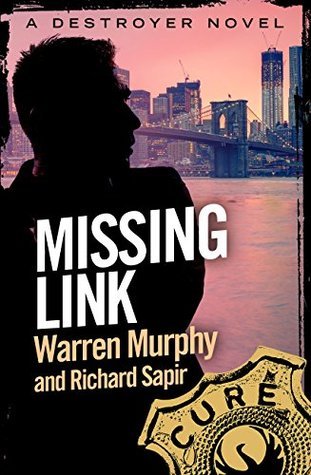
The Destroyer #39
Missing Link
Beer for Breakfast
That's how the brother-in-law of the President of the United States started his day. Beer was his food, his fuel, and his future, if not his finale.
His sudsy philosophy immersed him in continuing controversy, embarrassed the White House, and made him a media personality. It also got him some very lucrative consulting jobs for foreign governments.
Like the Libyans. They wanted his help in obtaining plutonium...For peaceful purposes, of course...a Holy War against Israel being the furthest thing from their minds.
Suddenly good old Buddy-Jack is missing. And the list of suspects seems endless. America's number-one beer drinker is finally muzzled. But by whom? The Bad Guys or the Good Guys? Terrorists or patriots? The Libyans or the Israelis? The Secret Service of the Mafia? The Destroyer?
That's how the brother-in-law of the President of the United States started his day. Beer was his food, his fuel, and his future, if not his finale.
His sudsy philosophy immersed him in continuing controversy, embarrassed the White House, and made him a media personality. It also got him some very lucrative consulting jobs for foreign governments.
Like the Libyans. They wanted his help in obtaining plutonium...For peaceful purposes, of course...a Holy War against Israel being the furthest thing from their minds.
Suddenly good old Buddy-Jack is missing. And the list of suspects seems endless. America's number-one beer drinker is finally muzzled. But by whom? The Bad Guys or the Good Guys? Terrorists or patriots? The Libyans or the Israelis? The Secret Service of the Mafia? The Destroyer?
112 pages, Kindle Edition
First published January 1, 1980
About the author
Warren Murphy
303 books126 followersWarren Murphy was an American author, most famous as the co-creator of The Destroyer series, the basis for the film Remo Williams: The Adventure Begins. He worked as a reporter and editor and after service during the Korean War, he drifted into politics.
Murphy also wrote the screenplay for Lethal Weapon 2. He is the author of the Trace and Digger series. With Molly Cochran, he completed two books of a planned trilogy revolving around the character The Grandmaster, The Grandmaster (1984) and High Priest (1989). Murphy also shares writing credits with Cochran on The Forever King and several novels under the name Dev Stryker. The first Grandmaster book earned Murphy and Cochran a 1985 Edgar Award for Best Paperback Original, and Murphy's Pigs Get Fat took the same honor the following year.
His solo novels include Jericho Day, The Red Moon, The Ceiling of Hell, The Sure Thing and Honor Among Thieves. Over his career, Murphy sold over 60 million books.
He started his own publishing house, Ballybunion, to have a vehicle to start The Destroyer spin-off books. Ballybunion has reprinted The Assassin's Handbook, as well as the original works Assassin's Handbook 2, The Movie That Never Was (a screenplay he and Richard Sapir wrote for a Destroyer movie that was never optioned), The Way of the Assassin (the wisdom of Chiun), and New Blood, a collection of short stories written by fans of the series.
He served on the board of the Mystery Writers of America, and was a member of the Private Eye Writers of America, the International Association of Crime Writers, the American Crime Writers League and the Screenwriters Guild.
Murphy also wrote the screenplay for Lethal Weapon 2. He is the author of the Trace and Digger series. With Molly Cochran, he completed two books of a planned trilogy revolving around the character The Grandmaster, The Grandmaster (1984) and High Priest (1989). Murphy also shares writing credits with Cochran on The Forever King and several novels under the name Dev Stryker. The first Grandmaster book earned Murphy and Cochran a 1985 Edgar Award for Best Paperback Original, and Murphy's Pigs Get Fat took the same honor the following year.
His solo novels include Jericho Day, The Red Moon, The Ceiling of Hell, The Sure Thing and Honor Among Thieves. Over his career, Murphy sold over 60 million books.
He started his own publishing house, Ballybunion, to have a vehicle to start The Destroyer spin-off books. Ballybunion has reprinted The Assassin's Handbook, as well as the original works Assassin's Handbook 2, The Movie That Never Was (a screenplay he and Richard Sapir wrote for a Destroyer movie that was never optioned), The Way of the Assassin (the wisdom of Chiun), and New Blood, a collection of short stories written by fans of the series.
He served on the board of the Mystery Writers of America, and was a member of the Private Eye Writers of America, the International Association of Crime Writers, the American Crime Writers League and the Screenwriters Guild.
Ratings & Reviews
Friends & Following
Create a free account to discover what your friends think of this book!
Community Reviews
Displaying 1 - 9 of 9 reviews

August 16, 2017
His name was Remo and he was going to do something about pollution in America.
This is one of the sillier entries in the Destroyer, and for me that makes it one of the more enjoyable ones. Not only is Missing Link totally bereft of any mystical Sinanju “I am Shiva” subplots, it is also completely devoid of killer robots, Bond villains, or sci-fi gadgetry. What we’re left with is some good old-fashioned political/cultural satire, funny dialogue, and – of course – plenty of well-intended violence.
Since the top-secret organization CURE works directly for the President of the United States, the president occasionally makes a brief appearance, and mild allusions are made to the president currently residing at the time of publication, usually through a turn of phrase or a vague connectable reference. In the case of Missing Link, however, any attempts at subtlety are immediately abandoned. The plot involves the sudden disappearance of the President’s brother-in-law Bobby Jack Billings (the novel’s titular “Missing Link”), a beer-swilling alcoholic redneck who spits out racist/sexist slurs as frequently as he urinates in public. With the publication date occurring at the end of the Jimmy Carter administration, it doesn’t take a huge leap to connect the fictional President’s brother-in-law to President Carter’s real-life brother Billy Carter, who was also in trouble with the media at the time for some rather poorly chosen words about “Arabians” and “Jews” (Google it). Bobby Jack Billings is also portrayed as making behind-the-scenes deals with foreign entities in exchange for influencing Presidential decisions, another direct reference to Billy Carter’s direct dealings with Libya.
Murphy’s satirical look at current events also takes us into the imagined struggles of Jimmy Carter, as the Destroyer Universe’s version of Carter is shown as a fairly serious and intelligent man dealing not only with a rogue brother-in-law, but a country on the brink of economic collapse and international cataclysm, a completely oblivious press, and internal struggles as well. The latter results in yet another direct reference to current events in a one-sided Newhart-style phone conversation between the president and Andy, during which he attempts to explain to Andy that “We’re the good guys. They’re the bad guys.” In this case, “Andy” is Andrew Young, who at the time was the US Ambassador to the UN, and the conversation is a satirical take on the controversy that arose when Young drew criticism for responding to Russia’s treatment of political prisoners buy stating that “America has its own political prisoners,” imprisoned African-American activists.
The interesting thing about all of this is that, even though most Destroyer novels have a decidedly right-leaning ideology (left-wing activist groups appear as clueless aggressors twice in the book), and half of the satire of this particular novel is directed at the Carter White House, this fictional version of Jimmy Carter is actually sympathetic, portraying him as a genuinely logical and sane man attempting to fill the role of leader in a world gone mad. It’s a refreshing counterpoint to a story filled with almost universal disdain, and that combined with the somewhat atypical ending seems to inform Remo’s loss of faith later in the series, as the author appears to concede that in a world this broken, the only people losing are the ones trying to make sense of it all.
Political intrigue aside, the reality-based plot combined with the lack of Sinanju mysticism clears the stage for Remo and Chiun to do what they do best – kill people while arguing with each other. This results in the greatest joy of Missing Link, for while the political and cultural satire can be a bit heavy-handed and predictable at times, the constant smart-ass bickering between them – this time revolving around Chiun’s new obsession with competing in the Olympics – is a constant delight that makes the whole adventure one of the more enjoyable light-hearted Destroyer novels.
This is one of the sillier entries in the Destroyer, and for me that makes it one of the more enjoyable ones. Not only is Missing Link totally bereft of any mystical Sinanju “I am Shiva” subplots, it is also completely devoid of killer robots, Bond villains, or sci-fi gadgetry. What we’re left with is some good old-fashioned political/cultural satire, funny dialogue, and – of course – plenty of well-intended violence.
Since the top-secret organization CURE works directly for the President of the United States, the president occasionally makes a brief appearance, and mild allusions are made to the president currently residing at the time of publication, usually through a turn of phrase or a vague connectable reference. In the case of Missing Link, however, any attempts at subtlety are immediately abandoned. The plot involves the sudden disappearance of the President’s brother-in-law Bobby Jack Billings (the novel’s titular “Missing Link”), a beer-swilling alcoholic redneck who spits out racist/sexist slurs as frequently as he urinates in public. With the publication date occurring at the end of the Jimmy Carter administration, it doesn’t take a huge leap to connect the fictional President’s brother-in-law to President Carter’s real-life brother Billy Carter, who was also in trouble with the media at the time for some rather poorly chosen words about “Arabians” and “Jews” (Google it). Bobby Jack Billings is also portrayed as making behind-the-scenes deals with foreign entities in exchange for influencing Presidential decisions, another direct reference to Billy Carter’s direct dealings with Libya.
Murphy’s satirical look at current events also takes us into the imagined struggles of Jimmy Carter, as the Destroyer Universe’s version of Carter is shown as a fairly serious and intelligent man dealing not only with a rogue brother-in-law, but a country on the brink of economic collapse and international cataclysm, a completely oblivious press, and internal struggles as well. The latter results in yet another direct reference to current events in a one-sided Newhart-style phone conversation between the president and Andy, during which he attempts to explain to Andy that “We’re the good guys. They’re the bad guys.” In this case, “Andy” is Andrew Young, who at the time was the US Ambassador to the UN, and the conversation is a satirical take on the controversy that arose when Young drew criticism for responding to Russia’s treatment of political prisoners buy stating that “America has its own political prisoners,” imprisoned African-American activists.
The interesting thing about all of this is that, even though most Destroyer novels have a decidedly right-leaning ideology (left-wing activist groups appear as clueless aggressors twice in the book), and half of the satire of this particular novel is directed at the Carter White House, this fictional version of Jimmy Carter is actually sympathetic, portraying him as a genuinely logical and sane man attempting to fill the role of leader in a world gone mad. It’s a refreshing counterpoint to a story filled with almost universal disdain, and that combined with the somewhat atypical ending seems to inform Remo’s loss of faith later in the series, as the author appears to concede that in a world this broken, the only people losing are the ones trying to make sense of it all.
Political intrigue aside, the reality-based plot combined with the lack of Sinanju mysticism clears the stage for Remo and Chiun to do what they do best – kill people while arguing with each other. This results in the greatest joy of Missing Link, for while the political and cultural satire can be a bit heavy-handed and predictable at times, the constant smart-ass bickering between them – this time revolving around Chiun’s new obsession with competing in the Olympics – is a constant delight that makes the whole adventure one of the more enjoyable light-hearted Destroyer novels.

May 3, 2021
President Carter’s brother-in-law, who I think (based on my elementary school recollections) is loosely (at least I hope it’s loosely) based on his brother, Billy Carter, disappears under mysterious circumstances and Remo has to find him. Frankly, there isn’t a lot in most of this book that required Remo’s skills, but it was still fun from beginning to end. The side plot was in many ways more memorable than the main storyline. Chiun has been watching Olympic Trials on television and realized that his Sinanju training makes him capable of winning in every category. It’s a delightful image—a ninety-year-old Korean man outlifting the weightlifters, out sprinting the runners, out jumping the jumpers, and so on. Chiun is, for all intents and purposes, superhuman. However, it would be difficult to keep the low profile required for their work for CURE if Chiun was on the cover of every magazine and cereal box. So Remo has to talk him out of this by convincing him that it would be against the rules for him to compete in his kimono. This only momentarily diverts Chiun who then realizes that Remo could compete for Sinanju instead. I presume that this is setting up the next novel which will occur during the Olympic Games in the Soviet Union.
If you liked this review, you can find more at www.gilbertstack.com/reviews.
If you liked this review, you can find more at www.gilbertstack.com/reviews.

August 15, 2025
Remo and Chiun are tasked with finding the boozing brother-in-law of the president who has apparently been kidnapped by an organization called PLOTZ. The are also competing with a tall and beautiful blonde free agent spy who is on the same mission. However, she has a $200K bounty to win, so she is desperate to find him first. Remo has a brief encounter with her, but that is all it takes for her to appreciate his diverse skill set. The effect he has on her pays off for him later in the story.
The body count continues to pile up as the pair of CURE agents jet around the country interviewing, and dispatching the characters who try to foil their efforts to find the BIL. Several novel means of disposal are used in this episode of The Destroyer; death by immolation, death by train track, death by elevator, and death by open heart surgery--sans anesthesia.
The banter between Remo and Chiun is hilarious. Chiun gets it in his head somehow that he wants to compete in the Olympics, leaving it to Remo to try and talk him out of it. Sadly, there are the occasional racial slurs, not by our heroes, but by other seedy characters.
3/5
The body count continues to pile up as the pair of CURE agents jet around the country interviewing, and dispatching the characters who try to foil their efforts to find the BIL. Several novel means of disposal are used in this episode of The Destroyer; death by immolation, death by train track, death by elevator, and death by open heart surgery--sans anesthesia.
The banter between Remo and Chiun is hilarious. Chiun gets it in his head somehow that he wants to compete in the Olympics, leaving it to Remo to try and talk him out of it. Sadly, there are the occasional racial slurs, not by our heroes, but by other seedy characters.
3/5
September 22, 2018
Rating 3
For me definitely one of the lesser destroyer stories.
It plays out out as a straight (well almost) action adventure story and seems lacking some how compared to the best stories.
The ending happened very suddenly and felt truncated to me. The story was speeding along and suddenly hit the buffers the end.
I’m not sure if the novel was written by both authors sharing work or only by one of them . I have always had the feeling that the best ones had input from both of them, whereas the lesser ones were mainly the work of one only with minimal input from the other. No idea if true but would explain the ups and downs in the series for me.
So overall an okay story but not essential and would only read if no more available or like me you are trying to read complete series in order.
For me definitely one of the lesser destroyer stories.
It plays out out as a straight (well almost) action adventure story and seems lacking some how compared to the best stories.
The ending happened very suddenly and felt truncated to me. The story was speeding along and suddenly hit the buffers the end.
I’m not sure if the novel was written by both authors sharing work or only by one of them . I have always had the feeling that the best ones had input from both of them, whereas the lesser ones were mainly the work of one only with minimal input from the other. No idea if true but would explain the ups and downs in the series for me.
So overall an okay story but not essential and would only read if no more available or like me you are trying to read complete series in order.

June 1, 2020
My new favorite Destroyer novel, still remarkably timely after 45 years. Remo and Chiun battle leftist domestic terrorists following the kidnapping of the President’s brother (modeled after Billy Carter). There’s a great interlude where they take down two characters modeled on Jane Fonda and Tom Haydn. A recommended satire of misguided progressives.

May 20, 2017
A weaker link in the series, a very straight-forward story. Unfortunately, the series seems to suffer from the absence of Sapir and even Remo's and Chiun's skills seem to change from book to book to serve the story. Not a must read at all and the same is true for the series until book 44.
June 18, 2022
I didn't think this book was that great until I found out how many of the characters were based on real people, e.g., Bill Carter, Jane Fonda, etc. That got it an extra star.

February 12, 2016
One of the big men's adventure series from the 70's than ran an impressive 145 books. The series while an adventure/action story is also full of satire toward much of the mainstream fads and icons of the time. An interesting main character and the sarcastic mentor makes this a funny action/adventure read. The Team must find the president's missing brother. Recommended

October 12, 2016
I'm really enjoying these old Remo Williams books when I can find them. This one was the best so far. What hoot.
Displaying 1 - 9 of 9 reviews