Celebrate 65 years of Peanuts with this deluxe paperback edition!
Sixty-five years of Peanuts , generations of fans, a gang of beloved characters, but only one the legend, Charles M. Schulz.
Andrews McMeel is proud to showcase the paperback edition of Celebrating Peanuts . It is packed with commentary from throughout Schulz's career, making this book not only a heartwarming tribute but also a true collector's item.
This special tribute is arranged by decade, to spotlight the highlights and development of this world favorite classic.
Charles Monroe Schulz was an American cartoonist, whose comic strip Peanuts proved one of the most popular and influential in the history of the medium, and is still widely reprinted on a daily basis. Schulz's first regular cartoons, Li'l Folks, were published from 1947 to 1950 by the St. Paul Pioneer Press; he first used the name Charlie Brown for a character there, although he applied the name in four gags to three different boys and one buried in sand. The series also had a dog that looked much like Snoopy. In 1948, Schulz sold a cartoon to The Saturday Evening Post; the first of 17 single-panel cartoons by Schulz that would be published there. In 1948, Schulz tried to have Li'l Folks syndicated through the Newspaper Enterprise Association. Schulz would have been an independent contractor for the syndicate, unheard of in the 1940s, but the deal fell through. Li'l Folks was dropped from the Pioneer Press in January, 1950. Later that year, Schulz approached the United Feature Syndicate with his best strips from Li'l Folks, and Peanuts made its first appearance on October 2, 1950. The strip became one of the most popular comic strips of all time. He also had a short-lived sports-oriented comic strip called It's Only a Game (1957–1959), but he abandoned it due to the demands of the successful Peanuts. From 1956 to 1965 he contributed a single-panel strip ("Young Pillars") featuring teenagers to Youth, a publication associated with the Church of God. Peanuts ran for nearly 50 years, almost without interruption; during the life of the strip, Schulz took only one vacation, a five-week break in late 1997. At its peak, Peanuts appeared in more than 2,600 newspapers in 75 countries. Schulz stated that his routine every morning consisted of eating a jelly donut and sitting down to write the day's strip. After coming up with an idea (which he said could take anywhere from a few minutes to a few hours), he began drawing it, which took about an hour for dailies and three hours for Sunday strips. He stubbornly refused to hire an inker or letterer, saying that "it would be equivalent to a golfer hiring a man to make his putts for him." In November 1999 Schulz suffered a stroke, and later it was discovered that he had colon cancer that had metastasized. Because of the chemotherapy and the fact he could not read or see clearly, he announced his retirement on December 14, 1999. Schulz often touched on religious themes in his work, including the classic television cartoon, A Charlie Brown Christmas (1965), which features the character Linus van Pelt quoting the King James Version of the Bible Luke 2:8-14 to explain "what Christmas is all about." In personal interviews Schulz mentioned that Linus represented his spiritual side. Schulz, reared in the Lutheran faith, had been active in the Church of God as a young adult and then later taught Sunday school at a United Methodist Church. In the 1960s, Robert L. Short interpreted certain themes and conversations in Peanuts as being consistent with parts of Christian theology, and used them as illustrations during his lectures about the gospel, as he explained in his bestselling paperback book, The Gospel According to Peanuts, the first of several books he wrote on religion and Peanuts, and other popular culture items. From the late 1980s, however, Schulz described himself in interviews as a "secular humanist": “I do not go to church anymore... I guess you might say I've come around to secular humanism, an obligation I believe all humans have to others and the world we live in.”
Great collection, recommended if you at all like Good Ol' Charlie Brown. Very interesting to follow the changes in art and material from the early days to the end. Quite impressive what Schulz did over 50 years--actually quit brilliant.
The actual book is thick and awkward--would be nice to have something like this split into two or three smaller volumes the size of the Fantagraphics collections.
The best years really are from about 58-63 but the Charlie Brown was good from the beginning to the end. I was surprised at how dark some of the work was in the 50s. Schulz was given greater creativity in format in the late 80s and it is impressive that he played with the format up until the end. He was not happy forced into four uniform panels in the daily strip and there are many up through the 60s that feel like they would be better with the last panel cut.
Out of curiosity, I tallied the strips I that I like above the others by decade: 50s-60 marks 60s-104 marks 70s-53 marks 80s-50 marks 90s-28 marks
Though the 90s had the lowest number, the floor was higher that decade, especially the latter half. Schulz had some really clever strips in the late 90s. Rerun and Sally have their best material. The last few years had more joy, a return to the cynicism and some of the darkness of the early strips--all around more variety and creativity. The art and style are better than 70-90 (Snoopy, especially). 96-2000 is the second best period after 58-63.
The floor was lowest from the mid/late 70s through the late 80s--the Joe Cool era. I liked that run more when I was a kid--perhaps it was over-marketed. There are some great stories from that period--Charlie Brown's head taking the aspect of the baseball, for example.
Like many of you, I've been finding ways to keep myself entertained during the Covid-19 pandemic. One of those ways was reading this entire collection from start to finish. Seriously, there are 533 pages and almost 2,000 comics in this book. What else better time would I have to read this than during quarantine?
It's been nearly two months and I've finally reached the first the last page. When I first saw this, my heart may have broken a little.
This isn't the first time I've read the Peanuts comics, and I seriously doubt it'll be the last. There's just something so comforting about curling up on the couch and laughing at all the antics Charlie Brown and his friends find them in.
In fact, that's the thing that sticks out most to me about Peanuts: the characters. Every single one of these characters, I love like crazy. I love Linus. I love Shermy. I love Schroeder. I love Lucy. I love Rerun and Marcie and Peppermint Patty and Woodstock and Snoopy. Even the characters we don't see, like the Little Red-Haired Girl and Charlie Brown's dad, I love.
But most importantly, I love Charlie Brown. I think 1969's A Boy Named Charlie Brown and 2015's The Peanuts Movie illustrate what's so great about this character. He's just a good kid trying his best, and for some reason, the world just seems against him.
Maybe it's just bad luck, but I think all of us can relate to that one way or another. Sometimes things just don't work out. You can't fly that kite, you can't win that baseball game, you can't get any letter in the mail.
And when that happens, well, I'd like to quote Linus. "But did you notice something, Charlie Brown? The world didn't come to an end."
There's also this strong sense of childhood within the comics and the Peanuts franchise in general. It's so charming to me, reading about these kids go about their everyday lives, their biggest problems being the upcoming spelling bee or the tree that'll eat your kite.
They're not secret superheroes, they're not double agents, they're not magic wizards from another world. They're just ordinary, everyday kids, with problems that don't really leave you once you become an adult.
It's all just so comforting to me. When I'm having a rough day, happiness is forgetting about the world and getting lost in the daily lives of kids just navigating their way through childhood.
With that said, I don't think the Peanuts characters will ever grow old. For starters, the comics went on for 50 years and the characters have aged maybe 3 years during that timeframe, so I don't think they're aging more anytime soon.
But more than that, I think these kids will remain beloved kids for a great deal of people. Charles M. Schulz has created so many iconic things through this franchise. Even if you've never read a single Peanuts comic in your life, you know these things.
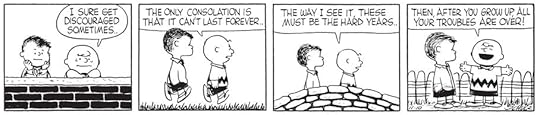
You know Snoopy falling asleep on his red house. You know Charlie Brown and Linus thinking deep thoughts on the brick wall. You know Lucy and her psychiatric booth. You know Schroeder playing on his toy piano. You know what'll happen when Charlie Brown tries to kick the ball from Lucy's grip.
(By the way, I 100% read the comic above as Charlie Brown finally kicking the ball.)
In many ways, Charlie Brown, Snoopy, and the whole gang are kind of immortal. I can see myself being 50 and still having fond memories of them all.
Also, I should mention that even 50 years later, a lot of these comics are still really funny. They were funny when I first read them, they're still funny now, and I get the feeling they'll still be funny even when I'm older. That's the best kind of humor, I think - timeless humor.
I suppose I'll end this review with a Charles M. Schulz quote from the 70s:
"To create something out of nothing is a wonderful experience. To take a blank piece of paper and draw characters that people love and worry about is extremely satisfying. I hope very much that I will be allowed to do it for another twenty-five years."
A wonderful journey through all 50 years of Peanuts. It's amazing how many of the strips are still funny and enough to make you chuckle despite their age. It just demonstrates the timeless humor of Schulz. I loved the way that the strips were broken down by decade and I loved the brief introduction to each decade, detailing the changes the decade brought.
B.C., Wizard of Id, Calvin & Hobbs, Andy Capp, & Doonesbury have long held their firmly established places in my life as the pinnacles of cartooning. However, they are all standing behind the acme of excellence, Peanuts by Charles M. (Monroe) Schulz. As a testament to this, of all the bric-a-brac stuck to my fridge door, the only cartoons are those penned by by the immortal Sparky. (So nicknamed by an uncle who thought the newborn bore a resemblance to another comic character. Unfortunately, a horse!) This is due to the fact that Schulz wrote about life and experiences. Many of which we have all undergone ourselves. Some were philosophical musings, others were man's inhumanity to man, while more were outright fantasy and to coin Johnny Hart, "Who said the absurdity has not gone out of comics?" showed his fondness for occasional irreverence.
In this volume, we trace the highlights of a career spanning more than 5 decades and are able to view the evolution of a strip as both its writer and society around it matured and changed. (Well, except for Lucy's psychiatric help, which always cost just 5 cents.) We watch characters, who are often reflections of traits we see in others and in ourselves, deal with issues from relationships, education, phobias, fears, uncertainties, and guilt to love and ambition. Will their team ever win a ball game? Will Charlie Brown ever meet the little red haired girl? Does Linus ever give up his security blanket? Will Snoopy ever shoot down the dreaded Red Baron, or will he just have to settle for an autograph? As we know, things do not always work out in life, so the small victories are cherished, sometimes out of proportion to their importance. So it is with Peanuts, and when they do succeed, we are there to cheer with them, even if it only means getting a kite to fly.
This volume contains quotes from Schulz himself, sprinkled throughout the text. Breaking the sections down into decades, the book is edited to show off the major themes and some no doubt personal favorites over the years. My all-time favorite Sunday is not in here, but my favorite daily is, so that is something. There were strips I did not remember, some that were poignant, and some that made me laugh out loud. This is a book that I hope to come back to in another 20 years, when the memory fades, so I can enjoy the immense pleasure I had reading it, again.
As a late Baby Boomer, "Peanuts" has always existed for me. Mine was the generation that needed to be bathed and in pajamas by 8 p.m., to turn on the TV to view "A Charlie Brown Christmas" and "It's the Great Pumpkin, Charlie Brown"; woe to the neighborhood kid who missed the show, because it would be a year before they'd have a chance to see it again. No VCRs in 1966! Thirty years later, my precocious four-year-old second son carried around paperback copies of "Peanuts" collections, as his reading material of choice. I have met one person who declared distaste for "Peanuts," but I honestly cannot fathom antipathy towards a comic strip that speaks to the angst, frustration, confusion, and occasional triumphs with which we are all familiar. I place Charles Schulz in the same category as Fred Rogers: genius.
Not only do you get to read a great collection of the Peanuts strips, but you get some inside quotes from Schulz himself. A great evolution of Peanuts, I recommend reading!
A review from my free e-magazine: PopFam.com - Pop Culture for Families http://www.popfam.com
Celebrating Peanuts 65 Years (Andrews McMeel Publishing)
A collection of over 2,000 Peanuts cartoons - what more do you need to know?!
Author: Charles M. Schulz Genre: Comic Strips / Cartoons Reader Appeal: All Ages
October 2, 1950, marks the date that Charles Schulz (“Sparky” to his friends and family) published the first Peanuts comic strip about a society of children trying to navigate the treacherous waters of growing up. It launched somewhat inauspiciously, in seven American newspapers. For the next five decades, until his death in the year 2000, ol’ Sparky faithfully told daily stories of the Peanuts gang that we grew to know and love.
We learned about Charlie Brown, the lovable loser and hero of Schulz’s strip; about Linus, the blanket-toting philosopher who was Charlie Brown’s best friend; about Linus’s sister, Lucy, the “fussbudget” who wreaked havoc wherever she went. We learned about Schroeder (piano player!), Peppermint Patty, Sally, Snoopy, and of course, The Little Red-Haired Girl. Today, the whole Peanuts gang that Sparky created lives on, still appearing in over 2,000 newspapers in 75 countries in 25 languages.
In honor of this legacy, 2015 marked the release of the oversized, collectible book, Celebrating Peanuts 65 Years. Here are the top four things you need to know about this fun collection:
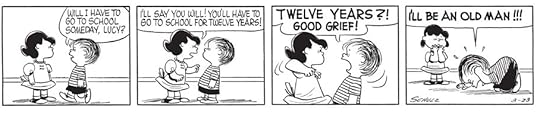
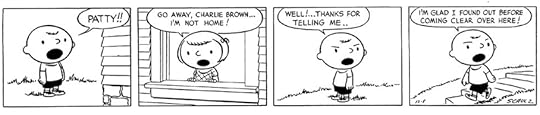
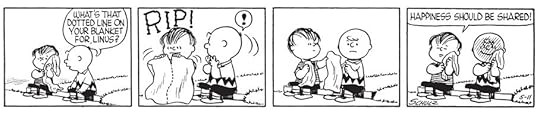
1) There are over 2,000 Peanuts cartoons in this book! They run the gamut of styles, from simple line art, to four-panel gags, to color-filled Sunday comics. Hours and hours of entertainment.
3) All the comic strips included here are arranged chronologically by decade, meaning the book begins with Peanuts comics from the 1950s, and then progresses through the 1960s, 1970s, and so on, until they end with strips created in 2000.
4) Each decade of cartoons is prefaced with an introduction that highlights the introduction and background of specific characters and how they reflected the times they were created in. (For instance, did you know that Snoopy’s imaginary battles with the Red Baron didn’t debut until October 10, 1965—full 15 years after Peanuts first began?)
2) Sprinkled within the pages are quotes from Charles M. Schulz himself, drawn from his thoughts recorded in interviews or his writings, revealing interesting behind-the-scenes insights from the creation of his beloved characters and stories. (For the scholar and/or historian in your family, sources for these quotes are all documented on the final page of this book.)
Ready? Enjoy Celebrating Peanuts 65 Years with your whole family today.
Let's Talk About It Use these questions to spark discussion among family members who are interested in this book:
• When you read Peanuts, which character seems most like you? Why? • Why do you think Peanuts has stayed so popular for so many years? Defend your answer. • If you met Charlie Brown, what would you say to him? What do you think he’d say to you?
A nice overview of the whole comic. Found out some things happened a lot earlier than I thought. For example, something I thought happened in the 80's actually happened in the 60's.
This had to be checked out several times to get through it, tops out at more than 500 pages and each is so glorious. Well chosen strips show the evolution not just of the style of the strips in appearance and the way the characters look especially Snoopy. There is also a timeline for each decade and sprinkled throughout are the comments of Charles M. Schulz about his art form and his characters.
If you're a Peanuts fan, hopefully your favorite strip or storyline is here. I adore Snoopy as the novelist and my favorite strip is here from 1983. In panel one Snoopy is on top of his dog house with his typewriter with Lucy, she tells him "You should try writing an adventure story"; panel 2 Lucy outstretches her arm as Snoopy ponders "Try writing about a real hero type"; panel 3 is Snoopy alone thinking; panel 4 with the payoff, Snoopy types: He was a dark and stormy knight.