Jump to ratings and reviews
Rate this book

The Moth Snowstorm: Nature and Joy

Rate this book
Nature has many gifts for us, but perhaps the greatest of them all is joy; the intense delight we can take in the natural world, in its beauty, in the wonder it can offer us, in the peace it can provide - feelings stemming ultimately from our own unbreakable links to nature, which mean that we cannot be fully human if we are separate from it.

In The Moth Snowstorm Michael McCarthy, one of Britain's leading writers on the environment, proposes this joy as a defence of a natural world which is ever more threatened, and which, he argues, is inadequately served by the two defences put forward hitherto: sustainable development and the recognition of ecosystem services.

Drawing on a wealth of memorable experiences from a lifetime of watching and thinking about wildlife and natural landscapes, The Moth Snowstorm not only presents a new way of looking at the world around us, but effortlessly blends with it a remarkable and moving memoir of childhood trauma from which love of the natural world emerged. It is a powerful, timely, and wholly original book which comes at a time when nature has never needed it more.

272 pages, Hardcover

First published May 21, 2015

145 people are currently reading
2683 people want to read

About the author

Michael McCarthy

418 books56 followers
Michael McCarthy is an English writer on the environment and the natural world. He was formerly Environment Editor for the Independent and is now its Environment Columnist.

Ratings & Reviews

What do you think?
Rate this book

Friends & Following

Create a free account to discover what your friends think of this book!

Community Reviews

5 stars
291 (35%)
4 stars
320 (39%)
3 stars
155 (18%)
2 stars
35 (4%)
1 star
16 (1%)
Displaying 1 - 30 of 138 reviews
Profile Image for Rebecca.
4,185 reviews3,448 followers
September 28, 2016
Known in the UK as a veteran environmental journalist for the Independent, McCarthy offers here a personal view of how the erstwhile abundance of the natural world has experienced a dramatic thinning, even just in England in his lifetime (roughly the last 70 years). He gives both statistical and anecdotal evidence for that decline; as a case study of how technological ‘advancement’ destroys nature, he also discusses the construction of a sea wall at Saemangeum in South Korea, responsible for decimating a precious estuary habitat for shorebirds.

As if to balance his own pessimism about the state of the world, McCarthy remembers the singular natural encounters that have filled him with joy and wonder – first discovering birdwatching as a lad near Liverpool, seeing a morpho butterfly in South America and later seeking out all England’s native butterfly species one summer – but also the annual displays that rekindle his love of life: the winter solstice, spring blossom, the arrival of cuckoos, and bluebells.

There’s something of a debate about nature going on in the UK: is it something that has monetary value? The fields of sustainable development and “ecosystem services” would seem to suggest it does. That’s all well and good, McCarthy says, but there’s an innate human bond with nature that goes much deeper than anything economic. His memoir is perhaps more sentimental than I would expect from an English author, but I admired his passion and openness.

Favorite passage:
Hyperbole? You could say so, I suppose. But what can I do, other than speak of my experience? Once, on a May morning a few years ago, I came out on to the banks of the Upper Itchen, at Ovington in Hampshire, and the river with its flowers and willows and the serenity of its flow and its dimpling trout in its matchless, limpid water, all gilded by the sunshine, seemed to possess a loveliness which was not part of this world at all.

Yet it was part of it; and there, once again, was the joy.
Profile Image for Tony.
1,030 reviews1,911 followers
August 16, 2021
It's been a long time since I've seen a sparrow. I saw plenty as a child, saw them more than any other bird. Now, in my yard, there are robins a-plenty, bluebirds, cardinals, mourning doves, finches, hummingbirds. A woodpecker wants inside my daughter's bedroom. And a red-tailed hawk does high loops, taking it all in. But not a sparrow to be found.

I may not even or ever have noted their absence but for this book. Their veritable extinction from London is discussed here. While the potential causes may be many, Michael McCarthy blames Farmer Giles, meaning pesticides. Kill the insect, thin the bird. A distinguished bird expert who he befriends, however, thinks it's psychological: sparrow suicide. It's just a hypothesis, the expert says; what's yours?

McCarthy's love (joy, he insists) of nature came early. Maybe it was when he was staying with an aunt and uncle (Mom had had a breakdown), and got tea cards with bird drawings by C.F. Tunnicliffe. See, here:


Or a moth he happened upon on a hike. Or a butterfly. Or perhaps it is within his DNA, and not just his. But it is not in any way my contention that the love of nature is universal. What is universal, I believe, is the propensity to love it; the fact that loving it is possible for people.

He writes of Joy and Wonder, but also Doom: We were the generation who, over the long course of our lives, saw the shadow fall across the face of the earth.

The destructive directions came from Genesis, he says: and God said unto them, be fruitful, and multiply, and replenish the earth, and subdue it: and have dominion over the fish of the sea, and over the fowl of the air, and over every living thing that loveth upon the earth.

Which we have done.

Think about this:

. . . it is clear that the earth did not have to be beautiful for humans to evolve; we could have had a planet which perfectly well sustained us with air and water and food and shelter, without offering us aspects of itself which also lift the spirit and catch at the heart.

He means a time before flowers, a time when the world was just shades of green. Then some plants began to use insects instead of the wind to move their pollen around. Voila! It didn't have to happen, he says. Nothing said it had to happen before we came along: we might well be living happily - in so far as we can live happily at all - in an all-green world still, and perhaps we would never miss what we never had.

I liked that.

I mentioned above that for a short period in his formative years, McCarthy's mother had a mental breakdown. He writes about her absence and a subsequent bond that formed between them. I found it gripping reading, just as I wondered at its inclusion in a book about nature. McCarthy tried to connect the two themes by writing about his one-year quest to find every know variety of moth in the British Isles. Each time he found one he would internally intone something like: here's the chequered skipper. It's for you

So he had some corny moments. And some inconsistencies. He spends considerable effort proving that China is by far the worst pollutant country in the world. Then he blames capitalism for global warming.

And now a digression.

I ordered this book through a third-party seller on Amazon. When I got it, right on the cover was the warning: ADVANCE UNCORRECTED PROOFS - NOT FOR SALE. Yet Juanita Underwood sold it to me anyway. So I wrote to Ms. Underwood and asked why she would sell me a book that said NOT FOR SALE on its cover. She replied that she was sorry I was disappointed, but that she sells those books all the time. Which was not what I expected or wanted to hear. So when Amazon sent me the usual what did I think of my purchase email, I filled out the survey thingy and told them what I thought of my purchase, without any profanity or over-the-top sarcasm. A day later I received an e-mail informing me that my review was rejected because I wrote about the seller, not the product. I thought I was writing about both.

Which brings me to another digression.

When I first joined Goodreads fourteen years ago (it feels longer) I entered many of the giveaways and was the happy winner of seventeen books. I dutifully wrote a review for each one, even a few cookbooks. Then, seven years ago, the winning stopped. (No more sparrows?) Seventeen books in the first seven years; zero books in the next seven years. This is probablistically impossible. This is long before I pissed Ms. Underwood off. Perhaps it's because I ignored instructions and quoted from an uncorrected proof.

Uh-oh, I've done it again.

Please forgive the nit-picking and digressions. This a beautiful, poetic, personal book which I highly recommend.
Profile Image for Paul.
2,230 reviews
May 3, 2016
Being out and about in the countryside has lots of positives; the views, the fresh air, the sound of bird song and restores our deep connections with the natural world. In The Moth Snowstorm he argues that we cannot be fully human if we lose those connections; for McCarthy the greatest gift that nature gives him is joy. The connections that link us to the outdoors run far back in our DNA, surveys have demonstrated that people subconsciously prefer the open savannah landscapes above all others and that patients in hospital heal faster when they have a view of the natural world through a window. Using various examples, he provides evidence of the damage that we are causing to the animals and landscapes of this world in the pursuit of profit and control. He describes pointless civil engineering projects in the South China Sea, blocking mud flats from the sea and stopping millions of birds having a place to feed on their long migratory routes.

McCarthy takes time to describe those pivotal points that changed his life. These moments of joy are deftly woven with the pain that the family suffered when he was young when his mother was admitted to an asylum and as his father was away at sea a lot, they were moved to his uncle and aunts house. His brother was traumatised by it; Michael sought solace in bird watching to avoid thinking of the pain and the loss. The family were reunited, though the relationships were fragile and strained. It took years for him to understand his exact feelings properly.

It is a beautifully written book by an accomplished author. You are not left in any doubt by his fury at the destruction of habitats and places that creatures are totally dependent on them for survival. Whilst we still have some fantastic things left to see, he remind us of what we have lost. The title of the book is a recollection of the masses of moths that people remember driving through a few decades ago that were attracted to the headlights. The decline of some species has reached 90% and they are the lucky ones; others are no longer with us. He is critical of some of the attempts to reverse the trends, explaining why he thinks that they don’t go far enough.

Frankly it is a worrying book; if we mess this up we don’t have another planet. 4.5 stars
Profile Image for Jackie (Farm Lane Books).
77 reviews7 followers
August 3, 2016
I have now read all the books on the 2016 Wainwright’s Prize shortlist and I certainly saved the best for last. The Moth Snowstorm is a beautifully written book which explains the crisis facing our planet. I like to think I am well informed about environmental issues, but many of the facts were new to me and some were disturbing in their magnitude.

The Moth Snowstorm begins by explaining how the author fell in love with wildlife – particularly river estuaries. His descriptions were filled with passion and I admired the way he conveyed his joy at being surrounded by the natural world. His interest in wading birds enabled him to discover the crisis effecting estuaries around the world. Many are being destroyed for shipping and leisure purposes, but nobody seems to care much about these muddy flat lands. I was shocked to discover that South Korea recently built a sea wall 21 miles long, destroying the migratory feeding ground for 50 million birds.

The book also highlighted the massive reduction in the population numbers of everything from insects to wildflowers. McCarthy interviewed older people who recalled a time when wildlife was abundant. They described events such drivers stopping to clean their windscreen after driving through a cloud of moths. Sadly numbers have dropped so much that this rarely happens now. I especially liked the way that anecdotes like these were backed up with scientific data. This brought meaning to the tables of statistics, showing what large drops in population mean for our experience of the world.

Details of McCarthy’s private life were also included. These were beautifully written and only added to the emotional impact of the text.

The Moth Snowstorm could easily have become a depressing book, but instead it is a joyful one, encouraging us to appreciate the beauty of the nature around us. It is an inspiring call-to-arms and I hope that increased exposure for this book will raise awareness of the natural catastrophes that are happening globally right now.
Profile Image for Penny.
342 reviews90 followers
September 28, 2015
"It is clear that more than half of all Britain's wildlife, as it existed at the end of the Second World War, has now gone".

Where do I start when trying to review this book? I've given it 5 stars - pretty rare for me - so maybe I should attempt to say why. When I picked it up I expected another book in a genre I have grown to love in the last couple of years. And that is some nature writing mixed up with personal memoir, maybe some social history or travel.

I got all I was expecting, and a whole lot more. I was frequently shocked into exclaiming facts and figures out loud to my ever patient husband (who is going to read the whole book next). The way we are destroying our planet is truly breath taking, and McCarthy frequently mentions the 'terrible century ahead'.

Maybe I've become complacent. I live in England, in North Yorkshire, in the countryside, where we are surrounded by Conservation and Preservation Societies for one thing and another. I have fields and sheep and beautiful views all around me. Maybe I think it is all under control? That other people are dealing with the 'problems'. I'm clearly very much mistaken. For goodness sake, there's only a handful of the famous Cockney Sparrows left in London!

The chapter called the Great Thinning probably affected me the most. In the author's own lifetime he recalls the great abundance of wild flowers, butterflies and other insects, birds etc etc. All gone, mainly due to 'modern' farming methods introduced in the last 50 years.

As McCarthy keeps reminding us - we only have one home, one earth, one Planet. Destroy it and we destroy ourselves - we have nowhere else to go.
Profile Image for Agnes Goyvaerts.
71 reviews14 followers
June 1, 2017
I just finished reading Michael McCarthy's book "The Moth Snowstorm" in which he describes and talks about the decline in biodiversity of birds, moths, butterflies, and other creatures worldwide but especially in his own Britain. He gives examples of his own experiences and that of other nature lovers, where they have witnessed this decline.
His emphasis, though, is on the intense joy that the natural world can and does bring to humankind. The book is also part memoir, his reasoning about wildlife decline is interspersed with his own memories, and of how his childhood trauma played a role in his discovery and his passion for the natural world, the joy that nature stirs inside us humans. And this resonated with me so well, I too developed this passion at an early age, mainly through the inspiration of my mother. The point that McCarthy makes is that this is something very innate in us, that we have developed this over the thousands of years of life when our ancestors were hunter gatherers, living lives in very close contact with nature. This joy, I used to think of it as my very own when I was still a young woman until I discovered that it was just out there for anyone to tap into; watching a beautiful sunset, the opening of a beautiful flower, seeing a marvellous butterfly, listening to the dawn chorus, or indeed the sound of the cuckoo in early spring, all of these scents, sounds, observations, experiencing the natural world with our senses can bring intense joy into our lives, the natural world is very good for us, essential even, and studies have showed that too now, scientists agree on this, worldwide there is a trend from professionals to advise walks in nature for mental and physical well being and health, happiness even.
This book also highlights the destruction of our planet which has been going on for over one hundred years and he gives many details of this - but it never becomes a depressing read as McCarthy always bring us back to this joy that nature gives us and shows why he believes we are wired for this and how it will be the best resource for survival in that when more and more people realise this they will unite to save the planet starting with saving its biodiversity, its birds, its animals, its insects, and all the wonderful creatures.
I would like to highly recommend this book.
Profile Image for Lisa.
46 reviews
January 10, 2019
As far as I can tell, the author is advocating for the romanticization of nature in order to improve conservation. I found the whole thing a little self-obsessed (for example, why is there a multi-page detour to discuss his repressed feelings about the death of his mother in the final pages of the conclusion!) Kolbert's The Sixth Extinction does a much better job of explaining and putting into context this current moment of biodiversity loss. This author, on the other hand, seems more concerned with waxing poetic about how great nature was when he was a child and bemoaning that it's different now. I found it particularly strange that while he kept mentioning how humans have fine-tuned our love of nature during our hunter-gather days, and now evil humans are ruining this connection, all his examples of what we're all missing out on now are times when nature was inextricably tied with human development (moths in car headlights, sparrows that thrive in urban areas). There are just too many strange asides. He appears to believe he’s the only person who appreciates nature ‘these days’; he can think of only one novelist who has ever “noticed” flowers (?!). He’s offended that we don’t (or can’t... not PC) praise “feminine beauty” which somehow tracks with our loss of appreciation for nature’s beauty more generally. This felt like a eulogy for peak nature, circa 1954.
Profile Image for Margaret.
904 reviews36 followers
May 10, 2017
How to describe this book? It's part nature writing, part memoire, part polemic, and a powerful and affecting read.

The book first got under my skin when defining 'joy', which is perhaps summed up as a moment of true happiness, with a spiritual, selfless, outward looking dimension. McCarthy's first experience of joy was as a boy, leaning to love the landscape and wildlife of the Dee Estuary. Later, it was bluebell woods, chalkland streams ... and so on.

Alongside this joy is anger, impotent anger, as he describes the pointless despoilation and destruction of Saemangeum in South Korea by the construction of a 23 mile long seawall which has annihilated the rich mudflats upon which countless thousands of migrating birds had depended.

McCarthy's nature writing is richly observed, pictorial, highly sensory. He is angry at the galloping pace of destruction of so many species and habitats. He demands that we observe too, and experience joy in our own ways as we explore the natural world.

Experiencing and observing however, is not enough. This is also a call to action.

A beautifully written book, often elegiac, and one which engaged me from the first to the last page.
Profile Image for Christina.
209 reviews5 followers
January 31, 2021
"It is this: there can be occasions when we suddenly and involuntarily find ourselves loving the natural world with a startling intensity, in a burst of emotion which we may not fully understand, and the only word that seems to me to be appropriate for this feeling is joy, and when I talk of the joy we can find in nature, this is what I mean...That the natural world can bring us peace; that the natural world can give us joy: these are the confirmations of what many people may instinctively feel but have not been able to articulate; that nature is not an extra, a luxury, but on the contrary is indispensable, part of our essence. And now that knowledge needs to be brought to nature's defence."

When McCarthy was young his mother suffered multiple mental breakdowns. This flipped his young world upside down, but it was also when McCarthy discovered his joy in nature, the wonder of it, the mystery. Dangers, as well, but thrilling, life-affirming ones at times, reminders to appreciate our brief stays on this planet.

As well as being a memoir (partly a touching tribute to his mother Norah), this book is a manifesto about the need to protect the natural world. When nature is destroyed, so are we. Nature's losses are our losses. He gives examples and statistics of environmental destruction that are far beyond alarming, but more than that, rather than appealing to fear, McCarthy appeals to some essential human essence. Our connection to nature "lies buried in our genes" but has been covered over by modernity, by greed, by relentless pursuits which, ultimately, will just deprive us. Protecting nature, he stresses, is not just for the privileged few, the comfortable elite, but is a way to protect "the natural resting place for our psyches." To have a full human experience, we need the experience of being in the natural world. When we recognize our capacity to love nature, to care for it, we become the best of what humanity can be.

He is not romanticizing nature (though nature can be romantic at times) as some claim, so much as appealing to the personal. When so many other attempts and appeals, over decades and by various individuals and organizations, have failed to rouse enough people into action, perhaps appealing to the ways nature can make us feel will make us want to protect it.
Profile Image for Tuck.
2,264 reviews252 followers
February 13, 2017
For the most part cogent and beautifully written personal long form essays of defense of nature and environment. Thesis is that maybe the joy and awe and thrill nature invokes in a human will be a mighty tool to fight for cleaner water air earth and abundant snd diverse flora and fauna.
Profile Image for Kate Savage.
758 reviews180 followers
March 29, 2024
I couldn't make it past the first chapter. Iconic boomer-generation nature writing. Instead of writing about the other species and ecosystems that bring him joy (I could read about that for days), he writes his Big Idea, which is that artists need to write about beauty and joy instead of the economic use of nature.

All nothing new, but he adds the arrogant assertion that loving nature is a uniquely human trait. He specifically insists that otters don't love their rivers. Michael McCarthy has somehow peered into the hearts of all other species and found only emptiness there. More human hubris toward other species, trying to turn around the damage done to other species by human hubris. The book also has a conservative bent that sees secular humanism as the main culprit of ecocide, rather than capitalist greed.

My conclusion is surely over-hasty, but it remains: might have been better to leave the trees unfelled, rather than pulp them to print this book.
Profile Image for Gail.
164 reviews12 followers
February 17, 2019
I enjoyed this book. His personal story throughout the book was very interesting. He argues that the desire for nature is hard-wired inside us, and that we need it. Yet, we've passed the 50% mark where now many of us are never exposed to nature. I loved seeing glimpses of his joys. It's sad to hear of the failures, the losses, and how certain things we do cause the downfall of not only nature, but ourselves as well. I don't know that we will ever turn away from intensive farming and all its detriments. I can only hope...
Profile Image for Steve Gillway.
935 reviews11 followers
July 4, 2015
This book speaks to me. In that when the author talks about the skylarks and lapwings I can remember them. He is a real zealot with respect to the joy nature brought to him and brings to us. He straddles the pessimism over what has been/is being lost with the fantastic things that are all around us, so the is hope, but that tunnel seems to be getting longer.
Profile Image for Valerie.
2,031 reviews183 followers
June 18, 2023
I was hoping for a book about the unbounded joy that I feel when I see a yellow rumped warbler, or a butterfly flits across my awareness. The absolute wonder I feel when I behold all things dappled…as Gerard Manly Hopkins says. The perfectness of a weedy wildflower in the crack of a sidewalk' or a redwood tree, as my gaze follows it up to the sky.

I wanted to share that feeling with a fellow human, and know that I am not alone in that upwelling. That is a part of this thoughtful book, along with some solid points about the evolution of humans as a part of the world. The connections to our mental health and the world around us are also well spoken for here.

There are, however, several tropes that I wish could be left out of such books. This is just one of several books about the glory of nature to be, in part, about the complicated adult relationships we have with our parents. I wonder what it is about the reverie of nature that surfaces those feelings as well?

Another trope for these books is the sense of loss. I feel that sense of loss daily already, I remember fruit orchards full of frogs, birds, and flowers where now tech buildings sit. Vacant lots, that were never really vacant. I do not want to read about it in a book about joy. I want to revel in the appreciation and joy of what we still have, to bring people’s attention to the glory that still exists, and to celebrate life and abundance.
Profile Image for Jennifer.
1,899 reviews63 followers
February 16, 2024
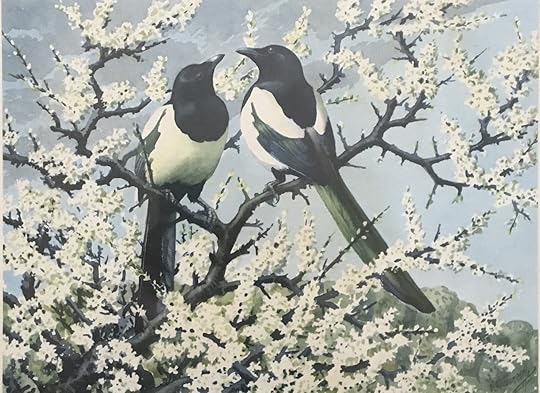
My 2023 holiday had a lot of rain and a lot of someone with a very bad back in it and unusually I read all the books I took with me. This book on the shelves of Ferry Cottage Cliveden was swapped with one of mine... and then ended up carried around in my bag for months (life for my bag books being very unpredictable) The glorious cover carries the potential of what may lie within.

And now I have finished it and I have to give it five stars although I feel as though I have read any number of nature-involved memoirs now... because on five or so occasions in the book, the writing, the joy, delivered a hefty thump to the heart, often accompanied by a prickling sensation around the eyes.

He's no Fotherington-Thomas, and I would not say that he is on the optimist wing of commentators on nature. The book has a lot to say about grief and about unacknowledged, even unconscious grief - whether that's populations at the loss of abundance or his own trajectory from a childhood affected by his mother's severe mental illness. His description of his childhood coping mechanisms, repeated again after her death, superficially rather intruding upon the whole book, in practice I suspect says much about why too many people for its safety appear unconcerned about nature.
Profile Image for Stephen.
16 reviews
October 28, 2018
Great content, and a revelation for me personally about inspiring myself and others to change behaviors that affect the natural world in a negative way.

I will say, the rhythm of McCarthy’s writing was hard and took 2-3 chapters before I could sit back and enjoy.
Profile Image for Emily Anderson.
97 reviews5 followers
October 25, 2024
I was finally bamboozled by a beautiful NYRB cover. I honored the algorithm of “read 100 minus your age” pages. It was tough as in boring and too hard to connect with. Don’t know if it’s because I’m not a Brit, but this isn’t the first time an older white man failed to draw me in with nature writing.
Profile Image for Lori Koppelman.
543 reviews
January 17, 2021
I heard the author interviewed by Krista Tippett on her On Being podcast and wanted to hear more from him. I learned so much about what's going on in the natural world that I either don't pay attention to or isn't widely published. So many fascinating stories, including many from his life.

One thing that struck me was his point that the bond between humans and nature is "at the very heart what it means to be human; that the natural world where we evolved is no mere neutral background, but at the deepest psychological level it remains our home, with all the intense emotional attachment which that implies - passionate feelings of belonging, of yearning and of love." And we're destroying it. Human are destroying our home. That is the heavy part, and for sure it's heavy. But the book also strives to share the joy and hope that we can get from nature.

It was slow reading for me - many pages with few paragraphs - nothing I could zip through, but well worth the read.

Book aesthetics: The cover on my edition is perhaps the worst one in the history of book covers. The title is small and jammed up near the very top with an awful, murky photo taking up 95% of the space. I'm glad to see later editions corrected this grievous error. The title isn't the greatest, so something else has to give it life. This one makes it worse.
6 reviews
August 15, 2018
This is a wonderful powerful book which shows the need to be aware of our environment. It was an evocative trip down memory lane for me, as I remembered so much of what Michael describes. Essential reading.
Profile Image for Mark Avery.
74 reviews95 followers
September 6, 2015
Nice cover!

This is a book about loss – and about joy, and about wonder, and about hope. There’s a lot about the loss of nature over the last few decades and the author mixes this with memories of personal loss. A love of nature can be a support and strength during one’s life.

And it’s a book about wonder. The loss of nature matters, at least in part, because we lose the opportunity to have ‘Wow!’ moments where we see things that we couldn’t have imagined and that are so beautiful and are part of our, yes our, world. Our only world.

And it’s a book about hope, because Michael McCarthy offers the hope that if only we loved nature more, and faced up to that love, and acted on that love, then we wouldn’t make such a mess of the world we live in, and it would be a better place.

The author is maybe best at writing about the joy that nature has brought to his life, from the time he was a small boy on Wirral, to his travels as environment editor of the Independent. He recounts the people he has met and the sights of nature which have given him joy; from the discovery of a small colony of House Sparrows in London to the first sight of a Morpho butterfly in the Amazon, and much else besides.

Mike writes really well and he tells a good tale. I smiled once or twice when I read accounts which I have also heard from the author’s own mouth as we have quaffed claret with others over a good dinner.

But there was plenty that was new to me and I’ll be asking him about the woman with the heart-stopping face and fire-red hair some time soon (for there is more in this book than just nature).

This is a very good read from one of our finest writers about the natural world. I think Mike could write well about anything – certainly anything he cared about. But notice, that he is not, and would not claim to be, an expert on nature. Maybe that’s one reason why he sees the joy more clearly than some of us who ‘know’ more. Perhaps that knowledge compromises how much we can feel for nature. Does the head too often get in the way of the heart? I hope not, but if it does then this book reminds us of the richness of nature from an emotional point of view as well as an intellectual one.

George Osborne should read this book – but he just wouldn’t get it. Or maybe he would – it is very engagingly written.

this review first appeared on Mark Avery's blog http://markavery.info/2015/05/24/sund...
Profile Image for Nathalie (keepreadingbooks).
327 reviews49 followers
May 23, 2017
"Joy has a component, if not of morality, then at least of seriousness. It signifies a happiness which is a serious business"
- Michael McCarthy

It is truly closer to a 3.5 star read for me, but I couldn't with a clear conscience give it a 4. For a book with joy in its title, it was surprisingly depressing for at least the first 100 pages - and to be honest, a little in the last 10 as well. McCarthy spends half the book going into detail about how we are destroying nature at an alarming rate, alternating between statistics and particular instances. He is at his best when he gets personal; when he goes on a hunt for the London sparrow, for example, after explaining (or wondering about) its rapid disappearance. But the book only got truly enjoyable when the listing of calamities was over with; I almost rejoiced out loud when I read the sentence "so let us leave them behind, the unbearable losses, and go where the bond can be found: let us journey into joy." JOY AT LAST.

Yet I am not so naive that I do not recognise how necessary the depressing part is to his purpose. I would perhaps not have understood or valued the second half as much, if I hadn't just been exposed to the grim reality. Indeed, it would be difficult to understand why a 'moth snowstorm' is such a spectacular phenomenon, if you did not know why it now (almost) no longer takes place. It is an important book with an important message, and if you hang on through the first 100 pages, it gets rather good. I would even say you feel joy in some instances.

I have a few issues regarding his writing (there was some repetition of points) and his overall point - I wholeheartedly agree, but it felt like he didn't base it on anything but intuition. And intuition is rarely enough if you want to convince the rest of the world, even if your intuition is right.

McCarthy has definitely inspired me to seek out more nature writings - perhaps for now with a less depressing message, though.

/NK
Profile Image for Drew Pyke.
227 reviews5 followers
October 9, 2017
whilst it's well written and easy to read, the substance for me was lacking.

the narrative is essentially saying that to save the world from man-made obliteration isn't utilitarianism (monetising the value of natural assets) because it essentially kills everything else off that doesn't provide any common benefit (that we know of).

his argument is that we have to learn to love nature, again. Because for 5,000 generations from the plesteceine period we lived off the tundra and survived because of nature it is our ancestral home but within a generation we have become computer dependent.

his personal story regarding his mother who had a breakdown and brother who committed suicide was a sad one but I struggled to marry the two narratives together.

other interesting stories were how Taiwan dried up a large wading area by building a concrete wall to prevent the sea flooding the mud to the detriment of the birds and to the potential benefit of more land (except it was never built on). A similar example was in the Thames how we lost salmon because of pollution. I also learnt about the "savannah hypothesis" which says we find certain landscapes beautiful because they are areas which gave us the greatest benefits (food and shelter etc)
378 reviews4 followers
June 29, 2019
I loved this book, everything about it. the moment l started reading this book l felt a fellow nature lover. From the age of four l can remember sitting in the vegetable garden and loving every minute of it, l remember loving flowers from a young age. This book reminded me of my childhood and there were so many parts of the book that l felt l had had the same feeling as the author. l loved all the facts and research quoted. l particularly enjoyed learning about the chalk rivers and have put that on my list to visit. The story of Michael's childhood and Mother's illness was interwoven throughout the book and gave the book depth and substance that showed the Author's background and growth toward his interest in nature and the environment. Another part l really loved was the mention of the movie of A River Run's through it, produced by Robert Redford. l watched that movie years ago and l was mesmerised by the fly fishing and l have thought of fly fishing as if watching poetry. l have only ever seen it in movies, but it looks the most beautiful thing to watch. Everyone should read this book, it is so full of soul, and if ever a book encourages people to look after the environment this one will.
Profile Image for Chris.
10 reviews
June 29, 2017
I've read a few reviews where the reviewer has complained that there is little joy to be found in this book despite having the word joy in the title. I disagree with this notion. What I took away from this book is to seek out your joy in nature while you can. Because we are ruining our planet. In our current political climate we often hear how one particular political philosophy is more beneficial to the environment than another but McCarthy makes it clear is that it really doesn't matter who is sitting in this or that political house. As he says, our planet is "being destroyed by the runaway scale of the human endeavour". I totally agree. We may have our little pockets of wilderness, and indeed in my own country, Canada, we have no shortage of them but we are on a course that we cannot seem to step away from. Unsustainable growth in every form is dooming the planet. Rather than a clarion call for action, this book can be seen as more of a eulogy to our natural world.
298 reviews1 follower
April 25, 2022
This felt like a very long opinion piece. The bits I find strange are the idea that joy of beauty is not valued due to essentially HR rules against sexual harassment, the lack of how trade plays a part in environmental destruction so it is not as simple as pointing to individual countries economic growth and the really basic view about global population while not including changes in diets that would not rely on further intensive versions of the current mix of agriculture and kind of sounding like Native American nations did not exist, instead North America was a wilderness. Basically the portrait it creates feels like a view from a very specific perspective that does not cut across classes, ages, genders, cultures or even accurately portrays the current relationships with the natural world.
Profile Image for Gv.
359 reviews2 followers
October 18, 2016
Quite a disappointment, so much so I gave up after a few chapters. For a book with the word "joy" in the title it was surprisingly depressing, much more about things that are not working, that will disappear, that will die, than what is beautiful.
So, it may be good if you want to suddenly feel super guilty and become more environment-friendly out of fear and guilt, but I did not feel any love for nature and the world while reading.
Profile Image for Anne.
123 reviews1 follower
February 2, 2018
Describing how our spontaneous joy and love of the natural world may be the key to saving all the threatened diversity and wild places. The writer explains what these moments of joy have meant to him, and how thay have helped him accept the difficulties in his childhood, as well as expounding the huge losses that have already changed our countryside and the wider environment.
Profile Image for Sophy H.
1,901 reviews110 followers
October 30, 2021
Well I abandoned this bugger! It was making my brain ache!

I couldn't be bothered to be honest. A rambling, boring, self-indulgent mess.

Yes, there is joy in nature. Yes, we should all learn to appreciate nature if we don't already. No, McCarthy, you're not the one who needs to tell us.


Off to the library for donation for you kidder!
103 reviews
May 8, 2020
This book is a mixture of personal stories, nature observations and facts about nature’s destruction in the last decades, some of which are very alarming. Despite this, the book has an optimistic positive tone. I really enjoyed it, especially in audio format.
Displaying 1 - 30 of 138 reviews

Can't find what you're looking for?

Get help and learn more about the design.