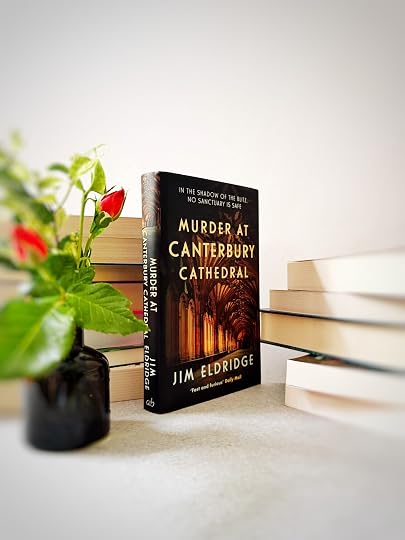
Kent, May 1941. The towns and countryside south of London continue to take a battering from German bombers. Canterbury, with the focal point of its distinctive cathedral, is among the hardest hit. The landmark and holy site is the scene of further tragedy when Canon Walter de la Coeur is found savagely bludgeoned to death on the exact spot where Thomas Becket also met his end centuries before.
Detective Chief Inspector Coburg and Sergeant Lampson are called in from Scotland Yard and must sift through the dead man's responsibilities for the cathedral's finances, as well as his private life. But their quest to find the killer is hampered when the deadly force of the Blitz strikes very close to home.
Jim Eldridge is the author of many books for children, including titles in the My Story series, the Warpath books, and How to Handle Grown-Ups. He has had 250 TV scripts broadcast in the UK and internationally for children's and teen television, and is also the creator and writer of Radio 4's long-running comedy-drama series, King Street Junior.
This is the second novel in Eldridge’s ‘Cathedral Mysteries Series’. Set during World War II, it features the same detective pairing (the aristocratic Detective Chief Inspector Edgar Saxe-Coburg and Sergeant Ted Lampson) as those I have previously reviewed in the author’s ‘London Underground Station Mysteries Series’.
It is May 1941. London and the south east are taking a hammering from German bombing raids. In Canterbury a canon of the cathedral, Walter de la Coeur, is found battered to death on the spot where Thomas Becket had been murdered almost 800 years previously. The influence of the Archbishop and his vicar general (the latter went to school with Coburg) ensures that Coburg is dragged reluctantly into leading the investigation. In Canterbury Coburg and Lampson come across a network of mostly unappealing characters. Henry Duckworth, a young man with a history of pilfering from his employers, has been found a job at the cathedral by his uncle, a canon like de la Coeur, in an attempt to curb his tendencies. It is a failure. Duckworth becomes associated with Percy Abernathy, an apparently dodgy solicitor who seems well acquainted with the local low life, including two potentially violent young tearaways. Abernathy is also related by marriage to Gerald Evans who has managed to extract money from the cathedral after he accused de la Coeur of molesting his son. Duckworth’s widowed mother is found to be carrying on with a married local shopkeeper. The scope for blackmail and extortion is everywhere.
Becket and his history hangs over the whole investigation. Some people have a genuine interest in the saint and being close to where he died. Others see his martyrdom as a path to making money and are not too concerned how they do it (‘Becket is big business’ is one comment). Scams including pilgrimages, indulgences and the provenance of relics are central to this. Working out exactly who is behind criminal activity is just one of the problems facing Coburg whilst he tries to identify de la Coeur’s murderer. Another is that there are three further deaths which wipe out one or two suspects in the process.
There is an ultimately heart-warming subplot. Lampson’s young son, Terry, is very badly injured when a previously unexploded bomb goes off in London. This brings Coburg’s brother, the Earl of Dawlish, into the story. His influence (via Churchill, a friendship we know from earlier novels) leads to Terry being treated by Sir Harold Gillies, a ground-breaking plastic surgeon (he is another person who actually existed that Eldridge brings into his fiction). Coburg is married to Rosa Weeks, a well-known jazz singer who works as an ambulance driver and who we have also met in previous stories. She and her friends provide a positive ending to the novel.
As always with Eldridge, this is an intricately plotted, convincing and fast paced mystery. The wartime setting is thoroughly researched (a conscientious objector in the police force provides an added dimension, for example) as are the medieval connections, and the author gives us plenty of background, something he further develops in his acknowledgements at the end. I don’t imagine any reader will be disappointed. ------ Reviewer: David Whittle For Lizzie Sirett (Mystery People Group)
WW2 crime mystery set in Canterbury, Kent (and London)
1941 and WW2 is raging. Rudolf Hess has just landed in Scotland, suggesting peace is on the cards, but the destruction in London and surrounding areas indicates otherwise.
The investigating duo DCI Edgar Saxe-Coburg and DS Lampson – normally based in London at Scotland Yard – are asked to look into the case of Canon Walter de la Coeur, who has been found bludgeoned within the walls of Canterbury Cathedral, at the same point where Beckett was murdered by four knights in 1170.
De la Coeur happened to be the Cathedral Treasurer and as the investigators know, most murders seem to revolve around money, sex or power.
The author inserts various characters into the narrative, all of whom could have a valid motive and as the sleuths probe ever more deeply into – sometimes sinister – avenues of exploration, the whole picture of the murder becomes more complex and murky, with several interlacing elements.
The author is always at delightful pains to slip in interesting facts for the audience and this cathedral, as it happens, was the first Christian cathedral in Britain. And further interesting insights and snippets dot the narrative.
WW2 is apparent everywhere and the author creates an event where a young man is in need of plastic surgery, a skill that became all too necessary as the war went on. The inspiration for this, he explains in the Acknowledgements, is the pioneering work of Archibald McIndoe and Harold Gillies, who deserve wider recognition for the work they did with wounded servicemen and civilian casualties.
A good read that is strong on plot and setting.
This is the second novel in the Cathedral Mysteries Series (the first is Murder at St Paul’s Cathedral, and there are occasional references in this book to events that took place in that volume). The author is quite prolific, having published over a 100 books, including the following series: Museum Mystery Series, London Underground Station Mysteries series and Hotel Mysteries Series.
On the front cover there is a quote by the Daily Mail which states: “Fast and furious”. I disagree, this is a sedate story that takes its time to explore the options, it’s reflective and it certainly doesn’t race around as one might assume from that headline. It feels very appropriately paced for the time in which it is set.
Great pace, but feels too modern and reads like a textbook. Jim Eldridge's Murder at Canterbury Cathedral is an okay addition to the series, but it carries his typical flaws. On the positive side, the story runs along at a machine-gun pace with an endless stream of twists, turns, and red herrings to keep you guessing.
Unfortunately, the historical immersion is broken by highly anachronistic dialogue and behaviour. Eldridge projects 21st-century social mores and attitudes onto 1941; having a 17-year-old boy confront an elder with "you are having sex with my mum" feels entirely unrealistic for a generation raised on strict generational respect. Furthermore, the book is overly didactic. The narrative frequently halts for textbook-like lectures on the dissolution of the monasteries, Thomas à Becket and wartime plastic surgery. Even the subplot with the wounded boy feels shoehorned in just to showcase historical facts about reconstructive medicine. A bit of history adds flavour, but this went on and on. A decent mystery, but a bit frustrating.
At times this felt far too much like a lecture, about plastic surgery, or Thomas Beckett, info dumps were slid into the narrative for no real reason, then there's the fact that everyone in Canterbury seems to feel the solution to minor inconvenience is just to murder someone, rather simplistic and far fetched really, but what really lost a star is the sheer incompetence in the timeline of a planned charity concert. The star, chats away confidently about the arrangements to her husband, despite the fact he should have no idea what she's talking about, as it's never been mentioned to him before, she then gives him the date, August 30th, except, she isn't actually given that date until another conversation, over 30 pages later...
DI Coburn and sergeant Lampson are requested in Canterbury following the death of a clergyman. A little different from previous outings being that they’re away from London. However, the blitz is still raging with a personal tragedy for the pair and the regular band of characters make an appearance.
There were quite a few murders here, and I was able to guess parts of the solution. Overall, another great mystery, and interwoven with a lot of interesting facts about early plastic surgery.
(If you’re new to the characters, this series starts with the hotel murders, then the underground murders. The cathedral murders are the third series outing for the pair)
I enjoy the series with the two Scotland Yard detectives - the underground’ stations and the cathedrals. Although there is a lot of historical information for those who know little about the period it helps put everything in context. For those who do know, there’s always something new, wrapped in a fast paced story.