

What do you think?

Blacktail
A twisting and apocalyptic dark fantasy novel, Blacktail is the long-awaited second novel from Scott Hawkins, the critically acclaimed author of The Library at Mount Char.
Who does your dog pray to?
Blacktail, a half-breed wolf, knows only the language of the hunt. When men kill his mate and unborn pups, he answers with a slaughter that is absolute. In his violence, Blacktail draws the gaze of an ancient and terrible feline witch. She sets him on a path south – to wake the sleeping Forest God and end the plague of humankind.
As Blacktail journeys farther from his wild home and deeper into the world of man, he encounters strangers – animal, mortal, and otherworldly – who want to help him rid the world of humans. From the blood-slicked wilderness to a burning confrontation with Archangels, this is a feral odyssey of vengeance – brutal, heartbreaking and unlike anything else in fiction.
The Forest God sleeps. But what will be the price of waking him?
* * *
Praise for Scott
‘Utterly resistant to categorization’ – V. E. Schwab, author of Bury Our Bones in the Midnight Soil
‘Sprawling, epic . . . Unputdownable’ – Cory Doctorow, author of Walkaway
‘Funny, horrifying and original’ – Jason Pargin, author of John Dies at the End
‘Extravagant, beautifully imagined’ – Booklist
Who does your dog pray to?
Blacktail, a half-breed wolf, knows only the language of the hunt. When men kill his mate and unborn pups, he answers with a slaughter that is absolute. In his violence, Blacktail draws the gaze of an ancient and terrible feline witch. She sets him on a path south – to wake the sleeping Forest God and end the plague of humankind.
As Blacktail journeys farther from his wild home and deeper into the world of man, he encounters strangers – animal, mortal, and otherworldly – who want to help him rid the world of humans. From the blood-slicked wilderness to a burning confrontation with Archangels, this is a feral odyssey of vengeance – brutal, heartbreaking and unlike anything else in fiction.
The Forest God sleeps. But what will be the price of waking him?
* * *
Praise for Scott
‘Utterly resistant to categorization’ – V. E. Schwab, author of Bury Our Bones in the Midnight Soil
‘Sprawling, epic . . . Unputdownable’ – Cory Doctorow, author of Walkaway
‘Funny, horrifying and original’ – Jason Pargin, author of John Dies at the End
‘Extravagant, beautifully imagined’ – Booklist
289 pages, Kindle Edition
First published September 1, 2026
About the author
Scott Hawkins
8 books3,644 followersI'm forty-nine and I live in the Atlanta suburbs with my wife and a whole bunch of dogs.
Ratings & Reviews
Friends & Following
Create a free account to discover what your friends think of this book!
Community Reviews
Displaying 1 - 30 of 661 reviews

May 16, 2026
Fucking hell.

Review of advance copy received from Publisher
11 years since the wonderful The Library at Mount Char.
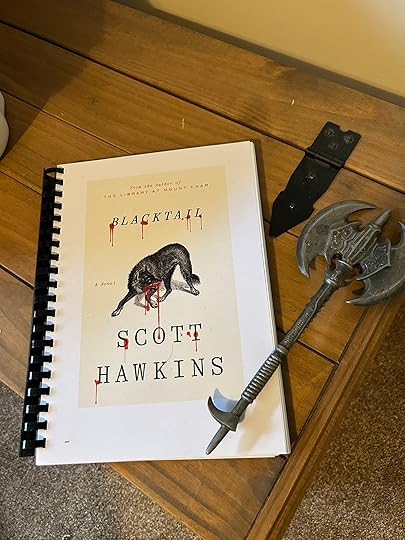
This is a very different book from TL@MC and also from almost every other book I know.
It does have strong vibes of Watership Down and The Plague Dogs, both by Richard Adams. The focus is on a particular wolf/dog half-breed, the eponymous Blacktail. And there is definitely an element of the chaotic/weird mythology that we saw in TL@MC. There is mention of the tiger Nobununga, and there are large scale mythology-level events/conflicts that echo the climax of TL@MC. But it's very definitely a different book without a single human point-of-view (that I remember).
Speaking of point-of-view: the book's written in an unusual style that's part fairytale/story telling and we do slide from one point-of-view to another in-paragraph on occasion. Also, we're given a handful of minor points-of-view alongside the main one (Blacktail).
It's an engaging tale that takes us in unexpected directions. It's at many times pretty gory with violence from and against animals. Although there's an over-riding "humans bad" message, it's delivered from an animal point-of-view and the harsh justice can seem ... harsh ... given the reader's greater (or different) understanding of the various encounters.
Like TL@MC there's a deeply uncompromising thread running through the story with harsh justice dispensed, the good/innocent suffering as they're variously steamrollered by chance, malice, or in the name of a greater cause.
The net effect is touching, horrifying, and entertaining. In many places it's impossible - as with any well written account of animals suffering because of our deeds - to not be moved. But the undercurrents of humour, and the wildly unpredictable paths Hawkins' imagination takes us down, mean that this is far from a mawkish look at animals enduring the cruelty of men.
It's one of those books I'll have to sit with to fully understand my feelings about it - but there's zero doubt that it's a 5* read, so I can hit the rating button right now.
You should all get excited for this book and hope that Mr Hawkins doesn't keep us waiting 10 years for another one.
It's very definitely a stand-alone though, so you'll not be left hanging. It's a completely complete story that has left me satisfied and with plenty to think on.
Join my Patreon
Join my 3-emails-a-year newsletter #prizes
.
Join my Patreon
Join my 3-emails-a-year newsletter #prizes
.
This is a very different book from TL@MC and also from almost every other book I know.
It does have strong vibes of Watership Down and The Plague Dogs, both by Richard Adams. The focus is on a particular wolf/dog half-breed, the eponymous Blacktail. And there is definitely an element of the chaotic/weird mythology that we saw in TL@MC. There is mention of the tiger Nobununga, and there are large scale mythology-level events/conflicts that echo the climax of TL@MC. But it's very definitely a different book without a single human point-of-view (that I remember).
Speaking of point-of-view: the book's written in an unusual style that's part fairytale/story telling and we do slide from one point-of-view to another in-paragraph on occasion. Also, we're given a handful of minor points-of-view alongside the main one (Blacktail).
It's an engaging tale that takes us in unexpected directions. It's at many times pretty gory with violence from and against animals. Although there's an over-riding "humans bad" message, it's delivered from an animal point-of-view and the harsh justice can seem ... harsh ... given the reader's greater (or different) understanding of the various encounters.
Like TL@MC there's a deeply uncompromising thread running through the story with harsh justice dispensed, the good/innocent suffering as they're variously steamrollered by chance, malice, or in the name of a greater cause.
The net effect is touching, horrifying, and entertaining. In many places it's impossible - as with any well written account of animals suffering because of our deeds - to not be moved. But the undercurrents of humour, and the wildly unpredictable paths Hawkins' imagination takes us down, mean that this is far from a mawkish look at animals enduring the cruelty of men.
It's one of those books I'll have to sit with to fully understand my feelings about it - but there's zero doubt that it's a 5* read, so I can hit the rating button right now.
You should all get excited for this book and hope that Mr Hawkins doesn't keep us waiting 10 years for another one.
It's very definitely a stand-alone though, so you'll not be left hanging. It's a completely complete story that has left me satisfied and with plenty to think on.
Join my Patreon
Join my 3-emails-a-year newsletter #prizes
.
Join my Patreon
Join my 3-emails-a-year newsletter #prizes
.

Want to Read
January 30, 2026ur telling me the author of library at mount char is releasing another book after TEN YEARS?? and it’s like a funky wolf pov?? we used to pray for days like these

September 8, 2026
What the hell was this 😭
(in a mostly positive way, more thoughts to come)
(in a mostly positive way, more thoughts to come)

September 14, 2026
3.5! Blacktail is a story about a half-wolf living in wilderness encroached by humans. He wants a peaceful life but upon experiencing human violence, Blacktail responds with rage and revenge, calling on the sleeping Forest God to help him bring down humanity and their dominion.
The story is entirely told through animals perspective and gets very dark and violent. It's not a simple 'animals vs humans' story, it's about what happens when grief literary consumes you.
Hawkins imagination is weirdly wild. It's not gentle, it's not kind. It's gory, blood thirsty, vengeful and cruel. It's a story that may come off as grotesque and graphically violent, but I think deep down, this is a story about pain we feel when something unimaginable happens to us. When hurt and pain is too much to bear and when our darker, inner thoughts take over.
Full review to follow.
Many thanks to NetGalley, Crown Publishing and the author, Scott Hawkins for an early ARC.
Publication date: September 1, 2026
The story is entirely told through animals perspective and gets very dark and violent. It's not a simple 'animals vs humans' story, it's about what happens when grief literary consumes you.
Hawkins imagination is weirdly wild. It's not gentle, it's not kind. It's gory, blood thirsty, vengeful and cruel. It's a story that may come off as grotesque and graphically violent, but I think deep down, this is a story about pain we feel when something unimaginable happens to us. When hurt and pain is too much to bear and when our darker, inner thoughts take over.
Full review to follow.
Many thanks to NetGalley, Crown Publishing and the author, Scott Hawkins for an early ARC.
Publication date: September 1, 2026

September 1, 2026
Do you ever wish—while petting your well-trained, sweater-wearing, purebred dog—that you could return him to the joyful, untamed wildness of nature? That you could break all the cages and untether all the leashes and free all the animals who are shackled to human will? That you could understand the elusive “language of the hunt”—that primal language known to all beasts, which goes beyond human grammar and vocabulary? And which maybe, just maybe, in the inky-dark cover of night, as you let out a guttural howl of anguish for all the madness that humanity has wrought upon the land—roads and cars and pesticides and farms—you begin to remember once more?
Blacktail (the character) is a wolf with a bone to pick with two-legs everywhere, a wolf who despises domestication and hates how humans hunt without hunger. Blacktail (the novel) will make you question whether humans can ever truly love our furry friends—or whether we are necessarily the oppressor, our love morally compromised by the stink of possession.
Blacktail (the character) is a wolf with a bone to pick with two-legs everywhere, a wolf who despises domestication and hates how humans hunt without hunger. Blacktail (the novel) will make you question whether humans can ever truly love our furry friends—or whether we are necessarily the oppressor, our love morally compromised by the stink of possession.

June 16, 2026
4.5 ⭐️ An absolute unexpected delight! A unique work of speculative fiction that is such a breath of fresh air! So much was packed into a relatively short book but it never felt rushed. Instead there was an episodic or dreamlike quality to each chapter especially as we got closer to the end. The ending was the main reason I knocked half a star off. It was fine but it didn’t have me glued to the page like the rest of the book.
TW Cruelty & violence against animals are main themes and are portrayed liberally. If graphic depictions turn your stomach stay away!
TW Cruelty & violence against animals are main themes and are portrayed liberally. If graphic depictions turn your stomach stay away!
Want to Read
May 8, 2026Omg, OHH MAH GAWDDDD. You know sometimes I would randomly think "Library at Mt Char was such a banger, has he written anything else yet?", and then I would check and it would just be that darn Linux manual. NOT TODAY, I'm so excited.
August 6, 2026
Blacktail is a wolf whose world is being slowly eroded by the encroachment of men. He meets a domesticated dog who becomes his mate. Learning she is pregnant, he makes plans to help her escape from her owners so that they can live together in the wild. Before the plan can be implemented both his mate and their puppies are killed, sending Blacktail into a rage. He quickly enacts revenge against her human owners and finds himself fleeing for his life. Blacktail then meets an ancient cat who convinces him to continue his war against humanity by waking the Forest God. His goal is nothing less than the eradication of humans. He meets animals along his journey and reminds them that their true nature does not consist of being subjugated to humans, but rather being part of the hunt.
This book is very thought provoking and is told completely from the perspective of Blacktail and other animals. While there are a few humans in the story who treat animals with love and kindness, most are presented as cruel and sadistic. Sections of the book are emotionally difficult to read due to descriptions of violence committed against the animal characters or toward one another. The other major theme of the book centers around the frequent lack of concern for how the growth of human infrastructure negatively impacts natural habitats. Something as simple as the building of roads can have significant consequences for the life of animals.
Blacktail is a story that will linger with me for some time. Recommended for fans of folk horror and dark fantasy.
Thanks to NetGalley and the publisher for an advance reading copy of this book.
This book is very thought provoking and is told completely from the perspective of Blacktail and other animals. While there are a few humans in the story who treat animals with love and kindness, most are presented as cruel and sadistic. Sections of the book are emotionally difficult to read due to descriptions of violence committed against the animal characters or toward one another. The other major theme of the book centers around the frequent lack of concern for how the growth of human infrastructure negatively impacts natural habitats. Something as simple as the building of roads can have significant consequences for the life of animals.
Blacktail is a story that will linger with me for some time. Recommended for fans of folk horror and dark fantasy.
Thanks to NetGalley and the publisher for an advance reading copy of this book.

Want to Read
July 8, 2026Dear Mr. Hawkins,
I’ve waited 11 years for this.
Thank you.
How dare you.
But mostly thank you.
I’ve waited 11 years for this.
Thank you.
How dare you.
But mostly thank you.

September 11, 2026
The Library at Mount Char is one of my all-time favorites, so after eleven years of waiting, I was very curious to see what Scott Hawkins would come up with next. Following up a book as strange and brilliant as TLaMC is no easy task.
Blacktail is a very different book, but it still feels unmistakably like Hawkins. It's whimsical, brutal, philosophical and absurd, sometimes all within a few pages. It's also weird, with the kind of ideas and turns that made me keep wondering where the hell he was going to take the story next.
This time we're following Blacktail, a half-wolf who sets out on a rather bloody quest after losing his mate and unborn pups. The entire story is told from animal perspectives, which works well. Hawkins gives the animals their own way of understanding the world, and seeing humans from that perspective is... well, we're not exactly coming out of this looking good.
Most humans in this book are pretty much scum. We destroy habitats, hurt animals, kill for convenience and generally behave like the planet belongs to us. And because we're mostly seeing the story through the eyes of animals, some of the things that humans consider completely normal suddenly look rather horrifying. There are exceptions, of course, but Hawkins clearly isn't interested in giving humanity the benefit of the doubt.
The book is also very violent. Animals get hurt and animals die, sometimes in pretty horrible ways, so if you're particularly sensitive about that, be warned. At the same time, there's a lot of humor and absurdity mixed into all the brutality. Squirrels have a death cult, cats have witches, dogs worship food, and all of this fits together into the same story.
I also loved how the story gradually takes on a more mythic quality. What starts as a fairly straightforward story of grief and revenge grows into something much bigger, while still keeping almost fairytale-like quality throughout.
So yes, Blacktail worked for me. It's not The Library at Mount Char, and I wouldn't want it to be. But it has that same sense that you're reading something completely unlike whatever else is sitting on your shelf, and that's exactly what I was hoping for.
Whatever Hawkins writes next, I'll be reading it. Hopefully we don't have to wait another eleven years this time.
Blacktail is a very different book, but it still feels unmistakably like Hawkins. It's whimsical, brutal, philosophical and absurd, sometimes all within a few pages. It's also weird, with the kind of ideas and turns that made me keep wondering where the hell he was going to take the story next.
This time we're following Blacktail, a half-wolf who sets out on a rather bloody quest after losing his mate and unborn pups. The entire story is told from animal perspectives, which works well. Hawkins gives the animals their own way of understanding the world, and seeing humans from that perspective is... well, we're not exactly coming out of this looking good.
Most humans in this book are pretty much scum. We destroy habitats, hurt animals, kill for convenience and generally behave like the planet belongs to us. And because we're mostly seeing the story through the eyes of animals, some of the things that humans consider completely normal suddenly look rather horrifying. There are exceptions, of course, but Hawkins clearly isn't interested in giving humanity the benefit of the doubt.
The book is also very violent. Animals get hurt and animals die, sometimes in pretty horrible ways, so if you're particularly sensitive about that, be warned. At the same time, there's a lot of humor and absurdity mixed into all the brutality. Squirrels have a death cult, cats have witches, dogs worship food, and all of this fits together into the same story.
I also loved how the story gradually takes on a more mythic quality. What starts as a fairly straightforward story of grief and revenge grows into something much bigger, while still keeping almost fairytale-like quality throughout.
So yes, Blacktail worked for me. It's not The Library at Mount Char, and I wouldn't want it to be. But it has that same sense that you're reading something completely unlike whatever else is sitting on your shelf, and that's exactly what I was hoping for.
Whatever Hawkins writes next, I'll be reading it. Hopefully we don't have to wait another eleven years this time.

September 3, 2026
Damn! Watership Down grew up and got nasty.
Fans have been waiting a loooooooooonnnnnggg time for this, a new book from the author—well, co-author—of, you know the book, The Complete Linux Shell Programming Training Course.
It is magnificent.
I went in mostly blind, ignoring the book flap and previews but not dodging advance knowledge that it's narrated by a wolf (a half-wolf, really), but the book reveals its nature quickly. By the end of Chapter Two you'll know exactly what you're in for, should you continue.
Did you read The Library at Mount Char? Do you remember it well? Do you remember the oven? Because this new book is all oven. It's been seven years and I remember so many things from Mount Char, but what brought me back to it most acutely was the sense of dread, fascinating, captivating dread and horror that this story also produced.
It's brutal, to animals and humans alike, and when I tried to look the book up on https://www.doesthedogdie.com/ my computer starting screaming and crying and I had to turn the power off.
It's propelling, horrific, and undeniable in its examination of humanity's relationship with animals and nature, both individually and collectively. It's weird and unpredictable fantasy from an obviously stable and intelligent mind.
I kind of hope that there's another 10 years until Hawkins' next book comes out, because I will immediately put aside all other books when it does and I have a lot of lingering reading to work through.
Fans have been waiting a loooooooooonnnnnggg time for this, a new book from the author—well, co-author—of, you know the book, The Complete Linux Shell Programming Training Course.
It is magnificent.
I went in mostly blind, ignoring the book flap and previews but not dodging advance knowledge that it's narrated by a wolf (a half-wolf, really), but the book reveals its nature quickly. By the end of Chapter Two you'll know exactly what you're in for, should you continue.
Did you read The Library at Mount Char? Do you remember it well? Do you remember the oven? Because this new book is all oven. It's been seven years and I remember so many things from Mount Char, but what brought me back to it most acutely was the sense of dread, fascinating, captivating dread and horror that this story also produced.
It's brutal, to animals and humans alike, and when I tried to look the book up on https://www.doesthedogdie.com/ my computer starting screaming and crying and I had to turn the power off.
It's propelling, horrific, and undeniable in its examination of humanity's relationship with animals and nature, both individually and collectively. It's weird and unpredictable fantasy from an obviously stable and intelligent mind.
I kind of hope that there's another 10 years until Hawkins' next book comes out, because I will immediately put aside all other books when it does and I have a lot of lingering reading to work through.

Review of advance copy received from Publisher
Review in the July 2026 issue of Booklist and on the blog: https://raforall.blogspot.com/2026/07... (link live on 7/8/26 at 7am central)
4.5
Three Words That Describe This Book: animal point of view, dark fantasy quest/journey, nature is not happy with us
First things first, this is not Library at Mount Char, it is very different but it is also very good. It is lyrical and fairytale/mystical. But it is also practical in many ways.
Blacktail, a wolf who is out for revenge against all humans, is the main narrator. He is not the only narrator, but he is the main one. No humans get the pov, only animals.
This book makes us humans look VERY bad. All of us. And Hawkins meters out judgement and punishment on all humans through Blacktail and there is no mercy. None. I cannot stress this enough. Even humans who we readers think don't deserve to die, will be brutally hunted by Blacktail. Animals are hunted too, but it all makes sense through Blacktail's world view-- which is very clear to readers.
To see him react to seeing "car" kill animals and leave them on the pavement -- killing just for fun and not a reason. To see the way he looks at houses, people's impact on the land. His reaction to pets who he calls slaves. How the animals work, interact and communicate and the spirits and witches that bind them all. It is riveting and original.
I also loved that Hawkins uses Blacktail's journey to break the story into vignettes. Each of his stops/passing through a new territory, gives readers the chance to meet new animal characters. The rhythm of this keeps the story moving at a good pace.
There is one "good human" here and kudos to Hawkins for sticking with the POV and Blacktail's sense of right and wrong because wow is it uncomfortable for the human reader.
Seething with rage and seeking vengeance -- appetite for revenge not satiated, only growing. This is a violent, in your face revenge novel.
The storytelling has a mystical/dark fairy tale feel.
Very similar to Watership Down by Adams in the storytelling, the dark fantasy, the environmentalism, but it is dark and filled with blood thirsty revenge of Pearl by Josh Malerman. A great mix of the two.
I thought about Lord of the Rings as well. Frodo's quest seems impossible but it is dire. Many will help or hurt him along the way.
4.5
Three Words That Describe This Book: animal point of view, dark fantasy quest/journey, nature is not happy with us
First things first, this is not Library at Mount Char, it is very different but it is also very good. It is lyrical and fairytale/mystical. But it is also practical in many ways.
Blacktail, a wolf who is out for revenge against all humans, is the main narrator. He is not the only narrator, but he is the main one. No humans get the pov, only animals.
This book makes us humans look VERY bad. All of us. And Hawkins meters out judgement and punishment on all humans through Blacktail and there is no mercy. None. I cannot stress this enough. Even humans who we readers think don't deserve to die, will be brutally hunted by Blacktail. Animals are hunted too, but it all makes sense through Blacktail's world view-- which is very clear to readers.
To see him react to seeing "car" kill animals and leave them on the pavement -- killing just for fun and not a reason. To see the way he looks at houses, people's impact on the land. His reaction to pets who he calls slaves. How the animals work, interact and communicate and the spirits and witches that bind them all. It is riveting and original.
I also loved that Hawkins uses Blacktail's journey to break the story into vignettes. Each of his stops/passing through a new territory, gives readers the chance to meet new animal characters. The rhythm of this keeps the story moving at a good pace.
There is one "good human" here and kudos to Hawkins for sticking with the POV and Blacktail's sense of right and wrong because wow is it uncomfortable for the human reader.
Seething with rage and seeking vengeance -- appetite for revenge not satiated, only growing. This is a violent, in your face revenge novel.
The storytelling has a mystical/dark fairy tale feel.
Very similar to Watership Down by Adams in the storytelling, the dark fantasy, the environmentalism, but it is dark and filled with blood thirsty revenge of Pearl by Josh Malerman. A great mix of the two.
I thought about Lord of the Rings as well. Frodo's quest seems impossible but it is dire. Many will help or hurt him along the way.
September 1, 2026
I've struggled so much with how I could possibly even describe Blacktail, let alone my feelings and criticisms of it. I cannot describe how disappointed I was in this experience. Scott Hawkins is not afraid to alienate a reader. He will write events that are inexplicable, strange, and off-putting. This aspect of his writing persists in Blacktail, but in a much more confusing, disgusting, and difficult-to-accept way. Everything from the line-by-line writing to the characters to the world-building is significantly worse, and despite the amount of sex and violence, more immature. It's a crazy comparison, but I legitimately felt like I was reading the Warrior Cats series by Erin Hunter, just with more dog sex.
A young wolf named Blacktail is the last of his kind in the forest he calls home. Encroachment from the world of men shrinks his territory every year, and these men bring weapons that no wolf can counter. The wolf follows a scent down from the mountain and into the territory of men, meeting a house dog named Renren. He offers to take her away from her world and into his, but before he can, Renren is killed by humans. Blacktail fills with a rage he has never felt before and swears vengeance on all humankind, starting with Renren's owners.
His fury calls out to an ancient feline witch, The Great Kitty Mother, who believes Blacktail might finally fulfill a long-held desire for the animals of The Hunt. She offers him the opportunity to kill the human race if he can find and wake the ancient Forest God. Blacktail's bloodlust is not sated, so he agrees. His journey takes him across hundreds of miles and encounters with strangers who all seek the same goal: the end of the human race and the rise of the Forest God.
I wrote a very long review about Blacktail, so if you'd like to read my in-depth thoughts with many evidentiary quotes, check out my blog, A Literary Apothecary, through the link below.
https://aliteraryapothecary.com/2026/...
There are a LOT of characters in Blacktail, but they aren't overwhelming. Each set of characters is typically featured for only a single chapter as they meet and influence Blacktail, and then they disappear from the story. I did like the personification of the animals. Lower, prey animals refer to hunters as Lord, and Blacktail is considered the Lord of his forest as the apex predator on the mountain. I especially liked some of the characterization of marking behavior. Wolves mark using poetry and lyricism.
Blacktail himself is a character that I feel conflicted about. I found him likable at first. He's young, and he's unsure about his belief in the Forest God. He's certainly not devoted to him, even once he begins his journey to wake the god. Many of the characters that he runs across are devout, and Blacktail does begin to adopt these beliefs. However, halfway through the novel, there's a very jarring pivot in Blacktail's beliefs and he becomes a deeply entrenched, dogmatic despot for The Forest God and The Hunt.
Blacktail's actions are also confusing in their morality. I don't know what kind of character he's supposed to be, but Blacktail regularly abuses his power to rain violence down upon others. He kills innocents over and over, and the narrative never really interrogates it. It's incredibly easy to hate Blacktail by the end of the story, and I'm not sure if the audience is supposed to hate him.
There is a significant problem that marred the reading experience for me and was incredibly distracting. The number of times urine or urinating is mentioned is truly unacceptable. After a while, it felt like Hawkins couldn't think of any other way to express fear except by someone pissing. I actually counted how many mentions of piss there were because it was starting to become genuinely shocking. There are sixteen mentions of "piss," three mentions of "urine," four mentions of "wetting oneself," and 4 mentions of "pee." That's twenty-seven mentions of urine in some way or another. That's one mention every ten pages!
The other thing that was fairly uncomfortable to read about was the amount of dog horniness contained in these pages. The actual sex itself isn't necessarily described in graphic detail, but the insinuation is still more than I would prefer. It's natural. Sex is natural. However, I can hold all of those opinions and still be uncomfortable reading about how pleasurable sex was for an animal.
There are some passages of prose that I enjoyed, and overall the writing maintains a level of gravitas that makes the story feel like a fable or myth. That works quite well with the way the story is framed. The dialogue between characters is more noble than everyday vernacular. All of that contributes to making the world of the animals feel much different and antiquated compared to the modernity of the humans in the novel.
The pacing of the story is a bit odd. This is structured less like a traditional novel and more like The Odyssey, with several vignettes following a central character through an overarching journey. That's not necessarily a bad thing. Some of the vignettes are more enjoyable than others, but they do contribute to the overall plot and development of Blacktail as a character. It does mean that the book is very segmented, and Blacktail can occasionally feel like a very different character between chapters.
The world-building of Blacktail is one of the highlights. The Library at Mount Char had so many fantastic concepts, and this book is no different. This author is entirely unafraid of his own ideas, and it makes the world entirely unique.
I did also enjoy many of the more supernatural elements, to a point. Cats in this world are essentially witches, able to weave spells, literally. All cats are of a coven who serve one known as The Great Kitty Mother. Their magic is literally able to affect the world. Heaven exists, Hell exists, angels exist. Again, this book has never met an idea that it turned away. That's all quite fun, and this level of absurdity is totally acceptable and expected to me. The absurdity that I couldn't abide lay with the themes.
The section on themes ended up being incredibly long and detailed, so this is going to just be the basics, but I deeply elaborated on them in my longer review. There will be some spoilers in this section.
Renren is the female dog that Blacktail mates with. When she falls pregnant, he offers to take her away from her home and into the woods with him to start a wolf pack. Renren agrees to this, but before she's able to leave with him, she dies. Renren's death is not tied to any human action that is evil. Her owners take her to the vet to be spayed, and as is the case with many dogs, the vet aborted her and Blacktail's puppies to perform the procedure. There was an issue with the surgery, and Renren dies from internal bleeding.
I'm not accusing the author of any specific political leanings, but there is a certain reading of this story that is anti-abortion. The dog fetuses are always referred to as Blacktail's children or his puppies. They're described as being murdered by humans. These are the talking points and language that anti-abortion activists use to try to make pregnant people seeking abortions feel guilty and to enact legislation banning abortion access.
There are two factions that are warring within these pages: The Hunt and Reason. The Forest God is of The Hunt and believes that all creatures should follow the laws of the natural world. The Christian God is of Reason, which has allowed humanity to think and create tools that subvert The Hunt, like weapons, traps, cars, etc. Blacktail's journey to embrace The Hunt and wake the Forest God is the core of the story, and as I've said, each vignette provides a deeper exploration of the principles of The Hunt.
My problem with this entire concept is that The Hunt makes no sense. Humanity, without Reason, falls into a very particular spot in the hierarchy of The Hunt. We don't have sharp teeth or claws. We specifically evolved Reason to build our arsenal of tools. The logic of The Hunt doesn't allow for that. How would a rabbit ever rise up against a wolf? It's impossible. So, within the philosophy of the Forest God, some creatures are just better and more powerful than others, and the ones who don't have power should simply submit to those who do. Attempting to counter oppression goes against the natural order and must be punished with near eradication.
The chapter about Mercy, more than anything else in the book, filled me with confusion, anger, and disappointment. Mercy is a human woman who feeds the animals of the forest, and she takes in any stray, hurt, or lost animals to nurse them back to health and provide a good home for them. Obviously, these animals love and want to protect Mercy. Blacktail, with darkness and vengeance in his heart, vows to kill Mercy and all those who protect her because they are violating the natural order.
This is a very difficult scene to witness because Blacktail is explicitly in the wrong here. This human was no threat to him and was causing no harm to him or any other animals. Among the crowd of animals is a beagle named Babykins. While the other animals are attempting to hold off Blacktail, Babykins runs to Mercy to try to warn her about Blacktail, telling her to run. Blacktail fatally injures the beagle, but keeps him alive to watch as he mauls Mercy, an act of abject cruelty.
Babykins keeps yelling for Mercy to run, and Blacktail allows her to, trying to prove to Babykins that Mercy never really cared about the animals. She does run from the room, and Blacktail turns to the beagle, expecting him to be heartbroken that his mother has left him to die, but all Babykins feels is relief. He would rather his mother, whom he loves deeply, survive than try to save him.
And then, Mercy comes back for him.
The love and fearlessness of Mercy as a protector is something that touches Blacktail deeply, and he lets her live. I thought this was going to be a turning point for Blacktail as he realized that humans are not an emotionless, evil monolith. They can love and protect just as fiercely as he was able to, and perhaps his quest is not as righteous as he believed. However, this event doesn't affect him beyond the last two pages of this chapter. Blacktail literally never mentions any deeper thoughts about the confrontations with Mercy.
Blacktail's belief and dogma do not eventuate in the world becoming a paradise for the Animal, predator or prey. So, in that way, was his quest doomed? Is this a tragedy in disguise? Is the audience supposed to differentiate the consequences for Blacktail—that being a happy, peaceful ending with his loved ones—and the consequences for those he left behind: starvation and overpopulation? What in the hell is this book trying to say?
Everything about it thematically is so confused, and I became very quickly frustrated with the book as a whole. If you're trying to make a point, make it. Interrogate it. Have your protagonist grapple with the implications of his stance. I just need something that indicates what all of this was for. The worst answer, in my opinion, is that it's for nothing. This doesn't mean anything. It's just a story, and anything you're trying to read into it is overthinking.
I have no idea if I recommend Blacktail or not. It was a difficult, slow read with little to no reward at the end, and the plot rose to a level of ridiculousness that didn't feel engaging or interesting. It was like the Sharknado of books, except that Sharknado is aware of its own ridiculousness.
I did not like Blacktail.
Don't forget you can read the full review on my blog, A Literary Apothecary, through the link below.
https://aliteraryapothecary.com/2026/...
Trigger Warnings
Animal death, animal cruelty, blood, abortion, death of a child, cannibalism, car accident, death, starvation, murder, medical content, violence.
Does the Dog Die?
A young wolf named Blacktail is the last of his kind in the forest he calls home. Encroachment from the world of men shrinks his territory every year, and these men bring weapons that no wolf can counter. The wolf follows a scent down from the mountain and into the territory of men, meeting a house dog named Renren. He offers to take her away from her world and into his, but before he can, Renren is killed by humans. Blacktail fills with a rage he has never felt before and swears vengeance on all humankind, starting with Renren's owners.
His fury calls out to an ancient feline witch, The Great Kitty Mother, who believes Blacktail might finally fulfill a long-held desire for the animals of The Hunt. She offers him the opportunity to kill the human race if he can find and wake the ancient Forest God. Blacktail's bloodlust is not sated, so he agrees. His journey takes him across hundreds of miles and encounters with strangers who all seek the same goal: the end of the human race and the rise of the Forest God.
I wrote a very long review about Blacktail, so if you'd like to read my in-depth thoughts with many evidentiary quotes, check out my blog, A Literary Apothecary, through the link below.
https://aliteraryapothecary.com/2026/...
There are a LOT of characters in Blacktail, but they aren't overwhelming. Each set of characters is typically featured for only a single chapter as they meet and influence Blacktail, and then they disappear from the story. I did like the personification of the animals. Lower, prey animals refer to hunters as Lord, and Blacktail is considered the Lord of his forest as the apex predator on the mountain. I especially liked some of the characterization of marking behavior. Wolves mark using poetry and lyricism.
Blacktail himself is a character that I feel conflicted about. I found him likable at first. He's young, and he's unsure about his belief in the Forest God. He's certainly not devoted to him, even once he begins his journey to wake the god. Many of the characters that he runs across are devout, and Blacktail does begin to adopt these beliefs. However, halfway through the novel, there's a very jarring pivot in Blacktail's beliefs and he becomes a deeply entrenched, dogmatic despot for The Forest God and The Hunt.
Blacktail's actions are also confusing in their morality. I don't know what kind of character he's supposed to be, but Blacktail regularly abuses his power to rain violence down upon others. He kills innocents over and over, and the narrative never really interrogates it. It's incredibly easy to hate Blacktail by the end of the story, and I'm not sure if the audience is supposed to hate him.
There is a significant problem that marred the reading experience for me and was incredibly distracting. The number of times urine or urinating is mentioned is truly unacceptable. After a while, it felt like Hawkins couldn't think of any other way to express fear except by someone pissing. I actually counted how many mentions of piss there were because it was starting to become genuinely shocking. There are sixteen mentions of "piss," three mentions of "urine," four mentions of "wetting oneself," and 4 mentions of "pee." That's twenty-seven mentions of urine in some way or another. That's one mention every ten pages!
The other thing that was fairly uncomfortable to read about was the amount of dog horniness contained in these pages. The actual sex itself isn't necessarily described in graphic detail, but the insinuation is still more than I would prefer. It's natural. Sex is natural. However, I can hold all of those opinions and still be uncomfortable reading about how pleasurable sex was for an animal.
There are some passages of prose that I enjoyed, and overall the writing maintains a level of gravitas that makes the story feel like a fable or myth. That works quite well with the way the story is framed. The dialogue between characters is more noble than everyday vernacular. All of that contributes to making the world of the animals feel much different and antiquated compared to the modernity of the humans in the novel.
The pacing of the story is a bit odd. This is structured less like a traditional novel and more like The Odyssey, with several vignettes following a central character through an overarching journey. That's not necessarily a bad thing. Some of the vignettes are more enjoyable than others, but they do contribute to the overall plot and development of Blacktail as a character. It does mean that the book is very segmented, and Blacktail can occasionally feel like a very different character between chapters.
The world-building of Blacktail is one of the highlights. The Library at Mount Char had so many fantastic concepts, and this book is no different. This author is entirely unafraid of his own ideas, and it makes the world entirely unique.
I did also enjoy many of the more supernatural elements, to a point. Cats in this world are essentially witches, able to weave spells, literally. All cats are of a coven who serve one known as The Great Kitty Mother. Their magic is literally able to affect the world. Heaven exists, Hell exists, angels exist. Again, this book has never met an idea that it turned away. That's all quite fun, and this level of absurdity is totally acceptable and expected to me. The absurdity that I couldn't abide lay with the themes.
The section on themes ended up being incredibly long and detailed, so this is going to just be the basics, but I deeply elaborated on them in my longer review. There will be some spoilers in this section.
Renren is the female dog that Blacktail mates with. When she falls pregnant, he offers to take her away from her home and into the woods with him to start a wolf pack. Renren agrees to this, but before she's able to leave with him, she dies. Renren's death is not tied to any human action that is evil. Her owners take her to the vet to be spayed, and as is the case with many dogs, the vet aborted her and Blacktail's puppies to perform the procedure. There was an issue with the surgery, and Renren dies from internal bleeding.
I'm not accusing the author of any specific political leanings, but there is a certain reading of this story that is anti-abortion. The dog fetuses are always referred to as Blacktail's children or his puppies. They're described as being murdered by humans. These are the talking points and language that anti-abortion activists use to try to make pregnant people seeking abortions feel guilty and to enact legislation banning abortion access.
There are two factions that are warring within these pages: The Hunt and Reason. The Forest God is of The Hunt and believes that all creatures should follow the laws of the natural world. The Christian God is of Reason, which has allowed humanity to think and create tools that subvert The Hunt, like weapons, traps, cars, etc. Blacktail's journey to embrace The Hunt and wake the Forest God is the core of the story, and as I've said, each vignette provides a deeper exploration of the principles of The Hunt.
My problem with this entire concept is that The Hunt makes no sense. Humanity, without Reason, falls into a very particular spot in the hierarchy of The Hunt. We don't have sharp teeth or claws. We specifically evolved Reason to build our arsenal of tools. The logic of The Hunt doesn't allow for that. How would a rabbit ever rise up against a wolf? It's impossible. So, within the philosophy of the Forest God, some creatures are just better and more powerful than others, and the ones who don't have power should simply submit to those who do. Attempting to counter oppression goes against the natural order and must be punished with near eradication.
The chapter about Mercy, more than anything else in the book, filled me with confusion, anger, and disappointment. Mercy is a human woman who feeds the animals of the forest, and she takes in any stray, hurt, or lost animals to nurse them back to health and provide a good home for them. Obviously, these animals love and want to protect Mercy. Blacktail, with darkness and vengeance in his heart, vows to kill Mercy and all those who protect her because they are violating the natural order.
This is a very difficult scene to witness because Blacktail is explicitly in the wrong here. This human was no threat to him and was causing no harm to him or any other animals. Among the crowd of animals is a beagle named Babykins. While the other animals are attempting to hold off Blacktail, Babykins runs to Mercy to try to warn her about Blacktail, telling her to run. Blacktail fatally injures the beagle, but keeps him alive to watch as he mauls Mercy, an act of abject cruelty.
Babykins keeps yelling for Mercy to run, and Blacktail allows her to, trying to prove to Babykins that Mercy never really cared about the animals. She does run from the room, and Blacktail turns to the beagle, expecting him to be heartbroken that his mother has left him to die, but all Babykins feels is relief. He would rather his mother, whom he loves deeply, survive than try to save him.
And then, Mercy comes back for him.
The love and fearlessness of Mercy as a protector is something that touches Blacktail deeply, and he lets her live. I thought this was going to be a turning point for Blacktail as he realized that humans are not an emotionless, evil monolith. They can love and protect just as fiercely as he was able to, and perhaps his quest is not as righteous as he believed. However, this event doesn't affect him beyond the last two pages of this chapter. Blacktail literally never mentions any deeper thoughts about the confrontations with Mercy.
Blacktail's belief and dogma do not eventuate in the world becoming a paradise for the Animal, predator or prey. So, in that way, was his quest doomed? Is this a tragedy in disguise? Is the audience supposed to differentiate the consequences for Blacktail—that being a happy, peaceful ending with his loved ones—and the consequences for those he left behind: starvation and overpopulation? What in the hell is this book trying to say?
Everything about it thematically is so confused, and I became very quickly frustrated with the book as a whole. If you're trying to make a point, make it. Interrogate it. Have your protagonist grapple with the implications of his stance. I just need something that indicates what all of this was for. The worst answer, in my opinion, is that it's for nothing. This doesn't mean anything. It's just a story, and anything you're trying to read into it is overthinking.
I have no idea if I recommend Blacktail or not. It was a difficult, slow read with little to no reward at the end, and the plot rose to a level of ridiculousness that didn't feel engaging or interesting. It was like the Sharknado of books, except that Sharknado is aware of its own ridiculousness.
I did not like Blacktail.
Don't forget you can read the full review on my blog, A Literary Apothecary, through the link below.
https://aliteraryapothecary.com/2026/...
Trigger Warnings
Animal death, animal cruelty, blood, abortion, death of a child, cannibalism, car accident, death, starvation, murder, medical content, violence.
Does the Dog Die?
January 23, 2026
My hopes and prayers have been answered. September can’t come soon enough.
Edit 09/26/2026:
Everyone say thank you to Scott Hawkins for gifting us once more with his writing.
What a fucking wild read. I really appreciated the ride that was Blacktails ascension. There is something pleasant in knowing the ending and just focusing on the journey towards it. I know that’s not everyone’s cup of tea, but it certainly is mine. In typical Hawkins fashion, he made it brilliantly gruesome, bizarre, and hilarious. Like genuinely laugh out loud funny. A fucking squirrel death cult? Yes. Sign me up. I’m all for that shit.
They say all dogs go to heaven. But that’s a myth, because Blacktail fucked gods shit up and made a haven of his own.
Edit 09/26/2026:
Everyone say thank you to Scott Hawkins for gifting us once more with his writing.
What a fucking wild read. I really appreciated the ride that was Blacktails ascension. There is something pleasant in knowing the ending and just focusing on the journey towards it. I know that’s not everyone’s cup of tea, but it certainly is mine. In typical Hawkins fashion, he made it brilliantly gruesome, bizarre, and hilarious. Like genuinely laugh out loud funny. A fucking squirrel death cult? Yes. Sign me up. I’m all for that shit.
They say all dogs go to heaven. But that’s a myth, because Blacktail fucked gods shit up and made a haven of his own.
This entire review has been hidden because of spoilers.

September 21, 2026
Hawkins spins a tale that's like if Watership Down was a revenge story. A wolf seeks old gods in order to make a pact that will destroy his greatest enemy: mankind. It's a doozy!

September 4, 2026
Read Etna instead

September 3, 2026
Blacktail is such a unique Dark Fantasy story. Admittedly, not something I would typically gravitate towards, however, I've heard such great things about Scott Hawkins writing, I had to jump on board for his latest work.
This story follows a wolf named Blacktail, in a world beseiged by men, who sets out on a journey of revenge for the death of his mate.
The entirety of the story is told via a cast of animal characters. I know books like this exist, but this is the first one I've ever read. I'm generally super sensitive to animal content, so never really dare, but this kept me captivated.
The tone is that of a Dark Fable, and while I feel like the meaning went way over my head, I was enamored by the quality of the writing and the uniqueness of the content.
I loved how we followed Blacktail on this journey, and it felt like every place he stopped, the other animals he encountered, he was always learning something new. Through those experiences it almost felt like little vignettes. I enjoyed that.
I'm truly in awe of how Hawkins made these characters feel so stunningly realistic. Here I am reading from a perspective of a squirrel like, yeah, that makes sense.
So, while I wouldn't chose to the lead the discussion in book club on this one, I still had a great time with it. It did make me feel a little simple. LOL
Thank you to the publisher, Crown Publishing, for providing me with a copy to read and review. This was certainly a unique reading experience!
This story follows a wolf named Blacktail, in a world beseiged by men, who sets out on a journey of revenge for the death of his mate.
The entirety of the story is told via a cast of animal characters. I know books like this exist, but this is the first one I've ever read. I'm generally super sensitive to animal content, so never really dare, but this kept me captivated.
The tone is that of a Dark Fable, and while I feel like the meaning went way over my head, I was enamored by the quality of the writing and the uniqueness of the content.
I loved how we followed Blacktail on this journey, and it felt like every place he stopped, the other animals he encountered, he was always learning something new. Through those experiences it almost felt like little vignettes. I enjoyed that.
I'm truly in awe of how Hawkins made these characters feel so stunningly realistic. Here I am reading from a perspective of a squirrel like, yeah, that makes sense.
So, while I wouldn't chose to the lead the discussion in book club on this one, I still had a great time with it. It did make me feel a little simple. LOL
Thank you to the publisher, Crown Publishing, for providing me with a copy to read and review. This was certainly a unique reading experience!

Review of advance copy received from NetGalley
Somehow this was the perfect combination of Open Throat + Princess Mononoke + Monstress, and it’s like yeah, no wonder I loved it.
I thought I knew what this book would be about (a wolf on a quest), but then it took on a whole new direction, and the second half really evolved into a magnificent feat of craft. Since it’s mostly written from the perspective of animals, it can feel a bit surreal at times (much like Open Throat) to the point that it almost feels like reading a children’s book, but the content is so dark and violent and intense that the surrealism adds to the horror and fantasy of it all. As far as fantasy goes, I like that this leans into fabulism and abstraction, that we know the shape of some of the “magic,” but if you look too closely you don’t really have a lot of details to fall back on. You’re not supposed to look too close but rather inspect it from the macro, use the aerial view to get the full picture.
What I did not expect and what drove the whole thing home, was the religious tone that grew louder and louder as the book went on. It reminded me so much of the cats in Monstress and the Forest God (ha, yes) of Princess Mononoke, and yet it was so different than both of those. I would love to hear more from the author about what influenced him specifically because coming from a Christian background it all felt very Jesus-y…but not in a preachy way. The point of it wasn’t Christianity or Jesus, that was just used as a vessel (though never mentioned or spoken of directly) to create something else.
It’s a wonderful allegory, in part because it feels so episodic, as if you’re reading a twisted children’s book that tells bible stories about how humans are wicked and heaven is a Far Hill in spring. It speaks to the power of nature, how we should be returning to nature, and it also forces you to reckon with how humans interact with nature and animals as a whole. (Again, Princess Mononoke.) At one point I forgot that animals aren’t sentient and this book is actually being written by a human because holy cow, that ending.
Overall, this was such a surprising gem, and even though I dragged my feet picking it up, I knew my gut instinct was right to request it from NG because it has wormed its way into my brain and I fear it will not let go.

I thought I knew what this book would be about (a wolf on a quest), but then it took on a whole new direction, and the second half really evolved into a magnificent feat of craft. Since it’s mostly written from the perspective of animals, it can feel a bit surreal at times (much like Open Throat) to the point that it almost feels like reading a children’s book, but the content is so dark and violent and intense that the surrealism adds to the horror and fantasy of it all. As far as fantasy goes, I like that this leans into fabulism and abstraction, that we know the shape of some of the “magic,” but if you look too closely you don’t really have a lot of details to fall back on. You’re not supposed to look too close but rather inspect it from the macro, use the aerial view to get the full picture.
What I did not expect and what drove the whole thing home, was the religious tone that grew louder and louder as the book went on. It reminded me so much of the cats in Monstress and the Forest God (ha, yes) of Princess Mononoke, and yet it was so different than both of those. I would love to hear more from the author about what influenced him specifically because coming from a Christian background it all felt very Jesus-y…but not in a preachy way. The point of it wasn’t Christianity or Jesus, that was just used as a vessel (though never mentioned or spoken of directly) to create something else.
It’s a wonderful allegory, in part because it feels so episodic, as if you’re reading a twisted children’s book that tells bible stories about how humans are wicked and heaven is a Far Hill in spring. It speaks to the power of nature, how we should be returning to nature, and it also forces you to reckon with how humans interact with nature and animals as a whole. (Again, Princess Mononoke.) At one point I forgot that animals aren’t sentient and this book is actually being written by a human because holy cow, that ending.
Overall, this was such a surprising gem, and even though I dragged my feet picking it up, I knew my gut instinct was right to request it from NG because it has wormed its way into my brain and I fear it will not let go.

August 7, 2026
Though I love when authors show us range, but woof– someone needs to do a mental health check on Hawkins. (Or needs a literary mentor to get him back on a more confident track.)
Man, that sounds awful. But let me talk through my worry.
It’s been 10 years since The Library at Mount Char was released so I was expecting something spectacular to be brewing.
It starts off strong but plot wise, and surprised by the level of anthropomorphism because I went in blind. Unfortunately, I was bored 1/2 way through. It was like he was in an adventure hamster wheel and forgot his destination.
I don’t want to rain on this completely- my favorite thing was the communication by pee smells.
It felt like cats vs. dogs connected through short stories. Semi-poetic, preachy and repetitive.
I’m so sad this was not a TBR win, but hoping will still see cool things from Hawkins in the future.
Man, that sounds awful. But let me talk through my worry.
It’s been 10 years since The Library at Mount Char was released so I was expecting something spectacular to be brewing.
It starts off strong but plot wise, and surprised by the level of anthropomorphism because I went in blind. Unfortunately, I was bored 1/2 way through. It was like he was in an adventure hamster wheel and forgot his destination.
I don’t want to rain on this completely- my favorite thing was the communication by pee smells.
It felt like cats vs. dogs connected through short stories. Semi-poetic, preachy and repetitive.
I’m so sad this was not a TBR win, but hoping will still see cool things from Hawkins in the future.
This entire review has been hidden because of spoilers.

September 12, 2026
Blacktail is a strange, brutal, and moving dark-fantasy novel. Hawkins takes the familiar idea of a revenge story and turns it into something much more mythic and unsettling, following Blacktail, a wolf whose grief and anger lead him on a journey involving ancient powers, the Forest God, and a growing war between the natural world and humanity.
What I liked most is how Hawkins tells the story entirely from animal perspectives. The animals have their own ways of understanding humans, technology, religion, and the world around them, which gives the novel a wonderfully strange atmosphere. There’s also an unusual mix of dark humor and disturbing moments that feels very much in keeping with Hawkins’ style.
The book can occasionally feel deliberately bizarre, and the pacing may not work for everyone. But the ideas about nature, humanity, revenge, and the consequences of destroying the world around us give the story more depth than a simple revenge tale.
Overall, Blacktail is weird, dark, imaginative, and unlike much else I’ve read. It won’t be for everyone, but if you enjoy dark fantasy, folk-horror atmosphere, unusual animal protagonists, it’s definitely worth checking out.
What I liked most is how Hawkins tells the story entirely from animal perspectives. The animals have their own ways of understanding humans, technology, religion, and the world around them, which gives the novel a wonderfully strange atmosphere. There’s also an unusual mix of dark humor and disturbing moments that feels very much in keeping with Hawkins’ style.
The book can occasionally feel deliberately bizarre, and the pacing may not work for everyone. But the ideas about nature, humanity, revenge, and the consequences of destroying the world around us give the story more depth than a simple revenge tale.
Overall, Blacktail is weird, dark, imaginative, and unlike much else I’ve read. It won’t be for everyone, but if you enjoy dark fantasy, folk-horror atmosphere, unusual animal protagonists, it’s definitely worth checking out.

June 14, 2026
4.5
First and foremost thank you to NetGalley and Crown Publishing for the eARC of this novel!
I was ecstatic when I found out that Hawkins had written another book, as I absolutely loved The Library at Mount Char. And let me just say, Blacktail did not disappoint. Another genre blender FTW. This book is just as weird, fantastical, horrific and humorous as TLaMC but on a totally different level. Its blatant and obvious message will be appreciated by many (if you can stomach it).
In this story we follow a wild wolf called Blacktail during his epic, revenge driven journey and it’s pretty much all gas no breaks the entire time. I laughed, I gasped, I teared up…
Just as I was hoping, it’s woven with strange mythical fantasy vibes, set in the real world, with rich atmosphere and hilarious dialogue. The best part is that it’s all told from animal perspective and set in the wild.
This story was engaging from beginning to end and is not your typical dark fantasy book. Its graphic, vividly rendered gore lends the novel a horror like quality that I found to be incredibly effective. This is an unflinching and well executed tale of what would happen if animals decided that they’d had enough of us humans and our narcissistic claim on all the animals, lands and resources. I appreciated how unflinching and deliberate the message was. There were even a few parts of this that had me clutching my pearls and momentarily wanting to defend a few of the humans. It’s freakin brutal.
Honestly the only part that didn’t fully resonate with me was the ending. It felt a little rushed and didn’t quite bring everything together the way I expected but overall I absolutely loved this reading experience.
There’s so much more to unpack and take away but man this was good. The writing is beautiful. Animal loving horror fans need to read this.
Thank you Scott Hawkins for delivering another wild and unpredictable novel. Please don’t make us wait another 10 years again though?
First and foremost thank you to NetGalley and Crown Publishing for the eARC of this novel!
I was ecstatic when I found out that Hawkins had written another book, as I absolutely loved The Library at Mount Char. And let me just say, Blacktail did not disappoint. Another genre blender FTW. This book is just as weird, fantastical, horrific and humorous as TLaMC but on a totally different level. Its blatant and obvious message will be appreciated by many (if you can stomach it).
In this story we follow a wild wolf called Blacktail during his epic, revenge driven journey and it’s pretty much all gas no breaks the entire time. I laughed, I gasped, I teared up…
Just as I was hoping, it’s woven with strange mythical fantasy vibes, set in the real world, with rich atmosphere and hilarious dialogue. The best part is that it’s all told from animal perspective and set in the wild.
This story was engaging from beginning to end and is not your typical dark fantasy book. Its graphic, vividly rendered gore lends the novel a horror like quality that I found to be incredibly effective. This is an unflinching and well executed tale of what would happen if animals decided that they’d had enough of us humans and our narcissistic claim on all the animals, lands and resources. I appreciated how unflinching and deliberate the message was. There were even a few parts of this that had me clutching my pearls and momentarily wanting to defend a few of the humans. It’s freakin brutal.
Honestly the only part that didn’t fully resonate with me was the ending. It felt a little rushed and didn’t quite bring everything together the way I expected but overall I absolutely loved this reading experience.
There’s so much more to unpack and take away but man this was good. The writing is beautiful. Animal loving horror fans need to read this.
Thank you Scott Hawkins for delivering another wild and unpredictable novel. Please don’t make us wait another 10 years again though?

Review of advance copy received from NetGalley
Lynx that speak in platitudes, wolves that write poetry in urine, and house cats that worship the Forest God. In Blacktail, Scott Hawkins’s (very) dark fantasy, we see our world through the eyes of a wolf-dog whose personal quest for revenge becomes much stranger and more mythic as it moves toward its conclusion.
There’s an intentional discordance between the brutality and disturbing imagery of the main quest and the absurdity interwoven throughout the narrative. House cats with names like “Miss Prissy Pants” show up. Dogs worship their piles of “food-rocks” (kibble). Car demons controlled by “two-legs” (humans) stalk the “black path” (road). This discordance is amusing but often jarring, as these sillier elements undercut the dark edge of the story.
It’s a quest novel, but the pacing is somewhat stilted, with Blacktail jumping from one interaction to another as new creatures are placed in his path. This keeps the quest from gaining enough narrative momentum to earn its final denouement. Ultimately, I was consistently engaged and quite gripped by the tale, but it never quite fulfilled its promise for me.
My thanks to NetGalley and the publisher for an advanced reader copy in exchange for an honest review.
Blog | Twitter | Instagram | Bluesky
There’s an intentional discordance between the brutality and disturbing imagery of the main quest and the absurdity interwoven throughout the narrative. House cats with names like “Miss Prissy Pants” show up. Dogs worship their piles of “food-rocks” (kibble). Car demons controlled by “two-legs” (humans) stalk the “black path” (road). This discordance is amusing but often jarring, as these sillier elements undercut the dark edge of the story.
It’s a quest novel, but the pacing is somewhat stilted, with Blacktail jumping from one interaction to another as new creatures are placed in his path. This keeps the quest from gaining enough narrative momentum to earn its final denouement. Ultimately, I was consistently engaged and quite gripped by the tale, but it never quite fulfilled its promise for me.
My thanks to NetGalley and the publisher for an advanced reader copy in exchange for an honest review.
Blog | Twitter | Instagram | Bluesky

September 14, 2026
This review literally explains how I feel but better than I could ever write it: https://www.goodreads.com/review/show...
This is one of the most imaginative books I have ever read while also being one of the most thematically confusing. I understand that the POVs are through the eyes of animals, but unless things have changed without my knowledge, animals can’t read, and that’s where this book loses me. Since humans are going to be the ones reading this book, I have to assume the messaging is ultimately meant for them. But what, exactly, was the message?
That animals are just as bad as humans? That spaying and neutering is evil and having multiple children is the way to go? That a blood-borne pathogen and lack of “purity” will lead to the demise of humanity? That serial killers who kill with a knife are worthy of becoming elevated beings, but a woman who rescues animals deserves to be mauled? That reason, logic, and science need to be wiped off the face of the Earth?
I am genuinely at a loss as to what the author was trying to convey to the humans reading this book. When I finished Tender Is the Flesh, I felt sick at how humans use and abuse animals. I finished this book feeling like, “They’re just like us, and not in a good way.”
Blacktail’s introduction comes on the heels of the death of his mother and littermates, and while he does make a name for himself, he is also incredibly lonely. Enter Renren, a dog who lives outside her owner’s house without any shelter and is constantly chained. I genuinely thought this section was lovely and incredibly well written. I felt that punch to the gut and genuine sadness as the inciting moment occurs, and I could understand Blacktail’s grief and rage. And then he does what any egotistical man would do: he makes it about himself and does something diametrically opposed to how Renren behaved. The book even states “ ‘What they did to me was a sin against the hunt. It was an abomination.’ “ Not what they did to her, nope me. Using sin in a book about animals was also when my red flag system turned on.
This was when a book I thought would be five stars immediately dropped to four. And then kept dropping the further along I read.
The book anthropomorphizes its animals so heavily and then tells us, essentially, that we can’t view their actions through a human lens because they’re still animals. Pick a lane. Viewed purely as an animal, Blacktail’s actions make sense. Viewed through the lens in which these animals believe in marriage and refer to themselves as husband and wife, those same actions become deplorable. You can’t have it both ways.
Even with those misgivings, I was still on board and enjoying the story, and THAT scene was truly fantastic. Then the truly impactful novella ended, and it seemed the author decided they wanted a full-length book instead and downhill the book went for me.
As the story shifts from Blacktail’s POV to that of the creatures he encounters on his quest to awaken the Forest God, it becomes increasingly religious. What I had initially brushed off as “animal POV,” despite feeling uncomfortable with it, becomes much harder to ignore when yet more commentary about the evils of spaying and neutering is introduced. Again, who is the messaging in this book for if not the humans reading it? And what message are we supposed to take from it? The ending then seems to prove the humans right anyway. So, what was the point?
We have an entire chapter where Blacktail is shown that humans can love animals enough to risk their own lives for them, and then it is followed by a chapter in which an innocent couple is mauled to death. Transparently, I still loved the whole scene. But it left me wondering what the point of the previous chapter was. If we flip the narrative, then humans killing animals “just because” isn’t necessarily a big deal, because apparently it isn’t a big deal when animals do it either. It’s just survival of the fittest, right?
I also can’t say the religious overtones did much to quell my feelings. Blacktail being conceived through some sort of immaculate conception was not on my bingo card, but I guess it should have been considering he is constantly referred to as Lord. Once we move past his POV, the story is essentially him roaming from place to place gathering disciples and healing animals, at one point even giving a chihuahua his balls back. Oh, and he can’t forget the matchmaking. Apparently, healing an animal isn’t enough of a thank-you to a devout believer; Black Tail also needs to find him a mate.
“‘Oh, and I almost forgot. Last night I heard a female calling to me from just over the mountain. You see that one, there, just south of the sun? She’s in much the same hell as you were, though not quite so deep. Not yet, anyway.’
Chester thought on this for a moment.
‘Calling to you … as I once called?’
‘O Lord, receive me in my penitence….’
‘Yes. The same. Can you help her? I’d do it myself, but I think I’ve little time left. She might make a mate for you, Chester. In time you might even start a pack.’”
I guess females of every species will always be seen as less than and as property. It’s also interesting that despite same-sex relationships being well documented in the animal world, not a single one is represented in this book. Considering how heavily the author anthropomorphizes the animals by giving them concepts like marriage, religion, morality, monogamy, and social hierarchies, the absence is glaring. If the goal was truly to portray animals as they are, why selectively reproduce human social conventions while leaving out a behavior that exists across so many animal species? But it sure does love to present straight husband and wife relationships. It further adds to my feeling that the book isn’t really interested in exploring animal behavior so much as using animals to selectively reinforce a particular view of humanity.
Another religious overtone I noticed is that, even in this fantasy world, suicide is treated as a sin because it goes against the Forest God’s directives. The argument that all of this is meant to show the absurdity of religion doesn’t satisfy me because there is no foil, no contrast to any of the beliefs and actions carried out by this religion. There is no interrogation after each vignette closes. No alternative worldview presented to challenge it. When there is nothing else to compare it to, absurdity becomes the norm. Whether intentional or not, these patterns are present in the text, and the book doesn't give me enough evidence to interpret them as satire rather than as part of its actual worldview.
If you’re looking for a book where animals rise to the top of the food chain and treat humans the way humans treated them, this will probably be for you. The body horror is excellent, and I do love a good revenge plot.
Unfortunately for me, I couldn’t help but notice everything else.
But hey, at least the “right” god was in charge.
This is one of the most imaginative books I have ever read while also being one of the most thematically confusing. I understand that the POVs are through the eyes of animals, but unless things have changed without my knowledge, animals can’t read, and that’s where this book loses me. Since humans are going to be the ones reading this book, I have to assume the messaging is ultimately meant for them. But what, exactly, was the message?
That animals are just as bad as humans? That spaying and neutering is evil and having multiple children is the way to go? That a blood-borne pathogen and lack of “purity” will lead to the demise of humanity? That serial killers who kill with a knife are worthy of becoming elevated beings, but a woman who rescues animals deserves to be mauled? That reason, logic, and science need to be wiped off the face of the Earth?
I am genuinely at a loss as to what the author was trying to convey to the humans reading this book. When I finished Tender Is the Flesh, I felt sick at how humans use and abuse animals. I finished this book feeling like, “They’re just like us, and not in a good way.”
Blacktail’s introduction comes on the heels of the death of his mother and littermates, and while he does make a name for himself, he is also incredibly lonely. Enter Renren, a dog who lives outside her owner’s house without any shelter and is constantly chained. I genuinely thought this section was lovely and incredibly well written. I felt that punch to the gut and genuine sadness as the inciting moment occurs, and I could understand Blacktail’s grief and rage. And then he does what any egotistical man would do: he makes it about himself and does something diametrically opposed to how Renren behaved. The book even states “ ‘What they did to me was a sin against the hunt. It was an abomination.’ “ Not what they did to her, nope me. Using sin in a book about animals was also when my red flag system turned on.
This was when a book I thought would be five stars immediately dropped to four. And then kept dropping the further along I read.
The book anthropomorphizes its animals so heavily and then tells us, essentially, that we can’t view their actions through a human lens because they’re still animals. Pick a lane. Viewed purely as an animal, Blacktail’s actions make sense. Viewed through the lens in which these animals believe in marriage and refer to themselves as husband and wife, those same actions become deplorable. You can’t have it both ways.
Even with those misgivings, I was still on board and enjoying the story, and THAT scene was truly fantastic. Then the truly impactful novella ended, and it seemed the author decided they wanted a full-length book instead and downhill the book went for me.
As the story shifts from Blacktail’s POV to that of the creatures he encounters on his quest to awaken the Forest God, it becomes increasingly religious. What I had initially brushed off as “animal POV,” despite feeling uncomfortable with it, becomes much harder to ignore when yet more commentary about the evils of spaying and neutering is introduced. Again, who is the messaging in this book for if not the humans reading it? And what message are we supposed to take from it? The ending then seems to prove the humans right anyway. So, what was the point?
We have an entire chapter where Blacktail is shown that humans can love animals enough to risk their own lives for them, and then it is followed by a chapter in which an innocent couple is mauled to death. Transparently, I still loved the whole scene. But it left me wondering what the point of the previous chapter was. If we flip the narrative, then humans killing animals “just because” isn’t necessarily a big deal, because apparently it isn’t a big deal when animals do it either. It’s just survival of the fittest, right?
I also can’t say the religious overtones did much to quell my feelings. Blacktail being conceived through some sort of immaculate conception was not on my bingo card, but I guess it should have been considering he is constantly referred to as Lord. Once we move past his POV, the story is essentially him roaming from place to place gathering disciples and healing animals, at one point even giving a chihuahua his balls back. Oh, and he can’t forget the matchmaking. Apparently, healing an animal isn’t enough of a thank-you to a devout believer; Black Tail also needs to find him a mate.
“‘Oh, and I almost forgot. Last night I heard a female calling to me from just over the mountain. You see that one, there, just south of the sun? She’s in much the same hell as you were, though not quite so deep. Not yet, anyway.’
Chester thought on this for a moment.
‘Calling to you … as I once called?’
‘O Lord, receive me in my penitence….’
‘Yes. The same. Can you help her? I’d do it myself, but I think I’ve little time left. She might make a mate for you, Chester. In time you might even start a pack.’”
I guess females of every species will always be seen as less than and as property. It’s also interesting that despite same-sex relationships being well documented in the animal world, not a single one is represented in this book. Considering how heavily the author anthropomorphizes the animals by giving them concepts like marriage, religion, morality, monogamy, and social hierarchies, the absence is glaring. If the goal was truly to portray animals as they are, why selectively reproduce human social conventions while leaving out a behavior that exists across so many animal species? But it sure does love to present straight husband and wife relationships. It further adds to my feeling that the book isn’t really interested in exploring animal behavior so much as using animals to selectively reinforce a particular view of humanity.
Another religious overtone I noticed is that, even in this fantasy world, suicide is treated as a sin because it goes against the Forest God’s directives. The argument that all of this is meant to show the absurdity of religion doesn’t satisfy me because there is no foil, no contrast to any of the beliefs and actions carried out by this religion. There is no interrogation after each vignette closes. No alternative worldview presented to challenge it. When there is nothing else to compare it to, absurdity becomes the norm. Whether intentional or not, these patterns are present in the text, and the book doesn't give me enough evidence to interpret them as satire rather than as part of its actual worldview.
If you’re looking for a book where animals rise to the top of the food chain and treat humans the way humans treated them, this will probably be for you. The body horror is excellent, and I do love a good revenge plot.
Unfortunately for me, I couldn’t help but notice everything else.
But hey, at least the “right” god was in charge.
This entire review has been hidden because of spoilers.

September 19, 2026
I absolutely loved this one.
The Library at Mount Char came to me almost out of nowhere and ended up becoming one of my favorite books, so I’ve been anxiously waiting to see what Scott Hawkins would do next. Happy to report: he did it again.
Blacktail is very different from Library, but it has that same feeling that something much, much bigger is looming just outside of what the characters understand. And somehow Hawkins manages to play with these huge ideas while keeping the book incredibly readable. For such a short novel, there is A LOT packed in here, and I genuinely didn’t want it to end.
What I loved most was the idea of belief creating meaning even when nobody really understands what they’re worshipping. The squirrels misunderstand Car. Dogs misunderstand humans and their food-rocks. Cats have their own theology. And Blacktail spends most of the book misunderstanding what “waking the Forest God” even means. It’s funny, strange, sad, and much smarter than it initially lets on.
The ending definitely made me sit there for a minute going, “Wait… what?” But once I started putting the pieces together, I liked it even more.
I’ll be thinking about this weird little wolf and his gods for a long time.
Scott Hawkins, please don’t make us wait another eleven years.
The Library at Mount Char came to me almost out of nowhere and ended up becoming one of my favorite books, so I’ve been anxiously waiting to see what Scott Hawkins would do next. Happy to report: he did it again.
Blacktail is very different from Library, but it has that same feeling that something much, much bigger is looming just outside of what the characters understand. And somehow Hawkins manages to play with these huge ideas while keeping the book incredibly readable. For such a short novel, there is A LOT packed in here, and I genuinely didn’t want it to end.
What I loved most was the idea of belief creating meaning even when nobody really understands what they’re worshipping. The squirrels misunderstand Car. Dogs misunderstand humans and their food-rocks. Cats have their own theology. And Blacktail spends most of the book misunderstanding what “waking the Forest God” even means. It’s funny, strange, sad, and much smarter than it initially lets on.
The ending definitely made me sit there for a minute going, “Wait… what?” But once I started putting the pieces together, I liked it even more.
I’ll be thinking about this weird little wolf and his gods for a long time.
Scott Hawkins, please don’t make us wait another eleven years.

September 6, 2026
3.5 stars
As a Warrior Cats fan, Blacktail, in some ways, felt very familiar. I would be surprised if Hawkins hasn’t read that series, because the similarities are often striking. That said, this book is undoubtedly much darker and more violent than the beloved children’s series. It follows a half-wolf (and perhaps demigod?) named Blacktail who develops mystical powers and a cult following after he kills a family of humans responsible for the death of his mate.
I found myself intrigued throughout this book; it has a lot of wacky humorous moments, hallucinatory magic, and gruesome acts of violence. Hawkins raises questions of nature, the human/non-human divide, vengeance, and morality. But at the same time, I’m not sure I walked away from this book with much of . . . anything. No strong emotions toward the characters, no lingering interest in the plot, no clear message or moral takeaway, no ruminations on its murky themes. Perhaps I would feel differently if I didn’t already have significant exposure to the world of literary animal studies.
I recommend this book for those looking for a unique tale, with a strong warning for violence involving both human and nonhuman animals.

September 12, 2026
You know when you’re in one of those lucid dreams that you are too invested in, and want to know where it leads but you don’t want it to end?.
Then when you wake up, something in you have changed?
This book was that. it is one of the most beautiful books I’ve ever read and this will stick with me for so so long 😭 😭
Maybe until the old lords of the forest awaken, the guardians of the temples come down and the lands breath again with the old names and the whispers of magic turn to full chanting ❤️.
Maybe until Fenrir breaks his chains, and the wolves swallow the sun and the moon. and The long winter begins.
Then when you wake up, something in you have changed?
This book was that. it is one of the most beautiful books I’ve ever read and this will stick with me for so so long 😭 😭
Maybe until the old lords of the forest awaken, the guardians of the temples come down and the lands breath again with the old names and the whispers of magic turn to full chanting ❤️.
Maybe until Fenrir breaks his chains, and the wolves swallow the sun and the moon. and The long winter begins.
Did Not Finish
September 22, 2026Sometimes I buy a book based purely on a staff recommendation at an independent bookstore. I’ve discovered books I would never have thought to read this way. It’s a high-risk, high-reward way of selecting a book. It doesn’t always work out. Everyone who works in a bookstore loves books but some of them love different kinds of books than I do. I gave up on this one at about p 120. I thought it was a book about a wolf but it turns out to be about a magical cat-witch. Not for me.

September 17, 2026
Take Erin Hunter’s Warriors series, make it as dark and brutal as possible - adults only - douse it in Hawkin’s vivid imagination, and you have Blacktail; a revenge story unlike any you’ve read before and one that lingers long after you’ve read the last passage.
September 19, 2026
scott hawkins outdoes himself again. what an absolutely fantastic book this was. evidenced by the fact that i’ve pretty much been unable to do anything else over the last two days but read this, because that is just how captivated i was by this. there is so much to say about this but also not enough that i can say, but what i can is that i was really really really moved by a book whose basic premise is “pov you are a wolf”.
this book succeeds at a majority of things - characters are well fleshed out, a thrilling journey is undertaken, suspense is maintained and manipulated very smartly, the plot goes lots of interesting ways, etc. at its core, the book offers super interesting commentary on the nature of humans and the ways in which we interact with animals, which is a fantastic idea to spend 400 or so pages meditating on, given the richness and complexity of the topic. one of the things that really stuck out to me within the first few pages or so was the way in which humans were described and portrayed. the refusal of hawkins to call people what they are, and to reduce them to "two-legs", and as having "paws" and a noticeable lack of interiority was so necessary in establishing an environment that not only felt canine, but very Animal. the lack of anthropocentricism was stunninggg especially considering the themes and plot of the book. one of my favourite subtle details was referring to tears as "small waters falling down their face", and calling guns and machinery magic.
another idea that was super interesting (but wasn't new to me per se because i read hawkins' previous book, The Library at Mount Char) was that of the language of the hunt, and the intricate god system that lies at the periphery of the book. i could foresee this being an obstacle for readers who aren't super willing to suspend their judgement and to dive head into a world of what-the-heck-sure but because that is no such problem for me who is so happy to indulge large ludicrous ideas, the magic system in this book is so awesome to me. i think that hawkins succeeded in really creating a contrast between blacktail and mount char in that the god/magic system is largely significant in the latter but peripheral in the former, making it such that blacktail ultimately is still about the quest, growth and maturation of blacktail the character. hawkins is super singular in his focus in executing this, and it really shows.
honestly there are lots of things that this book did really really well that wow-ed me. i am such a sucker for hawkins' ending scenes; i remember absolutely loving the way that mount char wrapped up and this one equally wow-ed me.. there's one specific sentence that really sticks out to me and that i thought about all through lunch (finished the book before lunch and its been 4 hours later and i'm still thinking about it by the way). in comparison to books that i've read recently or books that i really enjoy, blacktail gives me the feeling that i had hoped i would get from reading The Great Work by sheldon costa, and thematically is kind of like The Oldest Bitch Alive meets Leech. i also can't begin to articulate how chuffed i am to have a tag on goodreads called "pov you are a dog". that shit cracks me up so much.
tldr, i am a big fan of hawkins' fiction because it is executed with so much heart, care, and intention. the plot never fails to make me forget to breathe abit, and there is something in his writing that really speaks to the weirdest parts of me. trigger warning if anyone feels so inclined to read this book that it is quite gory, which haha doesn't matter to me because i can't imagine things, but just sharing the warning nonetheless. but this still did really warm my heart, pump up the social justice warrior/human hater in me, and make me marvel at what really good writing can do.
this book succeeds at a majority of things - characters are well fleshed out, a thrilling journey is undertaken, suspense is maintained and manipulated very smartly, the plot goes lots of interesting ways, etc. at its core, the book offers super interesting commentary on the nature of humans and the ways in which we interact with animals, which is a fantastic idea to spend 400 or so pages meditating on, given the richness and complexity of the topic. one of the things that really stuck out to me within the first few pages or so was the way in which humans were described and portrayed. the refusal of hawkins to call people what they are, and to reduce them to "two-legs", and as having "paws" and a noticeable lack of interiority was so necessary in establishing an environment that not only felt canine, but very Animal. the lack of anthropocentricism was stunninggg especially considering the themes and plot of the book. one of my favourite subtle details was referring to tears as "small waters falling down their face", and calling guns and machinery magic.
another idea that was super interesting (but wasn't new to me per se because i read hawkins' previous book, The Library at Mount Char) was that of the language of the hunt, and the intricate god system that lies at the periphery of the book. i could foresee this being an obstacle for readers who aren't super willing to suspend their judgement and to dive head into a world of what-the-heck-sure but because that is no such problem for me who is so happy to indulge large ludicrous ideas, the magic system in this book is so awesome to me. i think that hawkins succeeded in really creating a contrast between blacktail and mount char in that the god/magic system is largely significant in the latter but peripheral in the former, making it such that blacktail ultimately is still about the quest, growth and maturation of blacktail the character. hawkins is super singular in his focus in executing this, and it really shows.
honestly there are lots of things that this book did really really well that wow-ed me. i am such a sucker for hawkins' ending scenes; i remember absolutely loving the way that mount char wrapped up and this one equally wow-ed me.. there's one specific sentence that really sticks out to me and that i thought about all through lunch (finished the book before lunch and its been 4 hours later and i'm still thinking about it by the way). in comparison to books that i've read recently or books that i really enjoy, blacktail gives me the feeling that i had hoped i would get from reading The Great Work by sheldon costa, and thematically is kind of like The Oldest Bitch Alive meets Leech. i also can't begin to articulate how chuffed i am to have a tag on goodreads called "pov you are a dog". that shit cracks me up so much.
tldr, i am a big fan of hawkins' fiction because it is executed with so much heart, care, and intention. the plot never fails to make me forget to breathe abit, and there is something in his writing that really speaks to the weirdest parts of me. trigger warning if anyone feels so inclined to read this book that it is quite gory, which haha doesn't matter to me because i can't imagine things, but just sharing the warning nonetheless. but this still did really warm my heart, pump up the social justice warrior/human hater in me, and make me marvel at what really good writing can do.
This entire review has been hidden because of spoilers.
Displaying 1 - 30 of 661 reviews