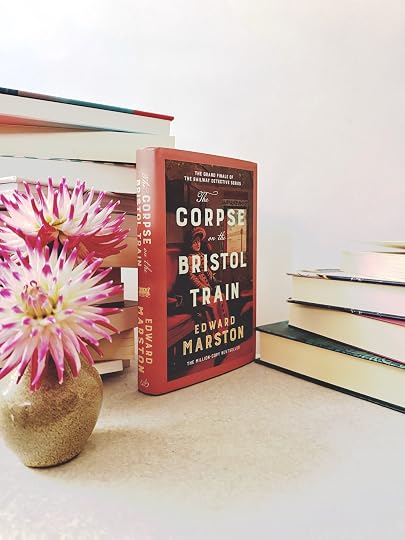
On the last train of the day London Paddington to Bristol, a young woman drifts into what appears to be a peaceful sleep - only to be discovered dead on arrival. With no sign of violence and no clue to her identity, the case threatens scandal for the Great Western Railway. Detective Inspector Robert Colbeck and Sergeant Victor Leeming are sent to uncover the truth behind the silent corpse. All witnesses agree on one she travelled with a devoted husband who vanished into the night. As the trail leads through railway stations, theatres and dark deception, Colbeck must expose a killer who hides behind superficial charm.
Perfect for fans of Anne Perry and Andrew Martin
Readers love The Railway Detective
'I recommend this story to all of the mystery lovers out there.'
'This talented, prolific author never disappoints in creating a fascinating mystery amidst a carefully reconstructed historical setting.'
'It kept me guessing until the very end.'
'This starts with a bang and kept me hooked and turning pages.'
The Railway Detective series has reached an incredible total of 25 books of mysteries and adventures, but each one can be read individually.
Keith Miles (born 1940) is an English author, who writes under his own name and also historical fiction and mystery novels under the pseudonym Edward Marston. He is known for his mysteries set in the world of Elizabethan theatre. He has also written a series of novels based on events in the Domesday Book, a series of The Railway Detective and a series of The Home Front Detective.
Hate leaving a low score for a series I stumbled upon and been a fan of for the last 16 years, but I felt this was a bit of a lazy end to a really good series.
There was a lot of going around in circles, feeling that no progress is being made in the investigation yet miraculously they catch the villain.
The ending left with a potential for at least 1 more in the series - the relationship between the detectives and Tallis's replacement could have left Colbeck questioning his own future and maybe having him leave Scotland Yard might have been a more fitting end. After all you can't have the Railway Detective series without the Railway Detective himself.
Colbeck and Leeming dash off at the end to another railway related crime. It would have been nice to see where that case led, and also had the detectives check in with Tallis to see how he was coping in retirement.
So many missed opportunities for a better end to the series...
This entire review has been hidden because of spoilers.
Somewhat of a let-down. Not that I was expecting a 'big finish,' but perhaps a more interesting investigation with some intriguing twists and turns could have been presented. This one was rather ho-hum. And, without giving out spoilers, no resolution as to the actual 'murder weapon,' as it were. The murderer isn't asked to explain. And while we may know what's going on with the settled relationship of Robert and Madeline, something else is left in limbo.
But I'm with another reviewer. I won't miss Caleb Andrews. Very tired of his antics. So, if this is indeed the end of the series, The Corpse on the Bristol Train was a solid, if mundane, finish.
Being the last in the series I expected a cracker of a storyline. While the ending was reasonably satisfying I was left wondering what actually happened in the trial of the man accused Throughout I found sections repetitive with some of the characters being portrayed slightly differently than in previous novels. It is a shame that after reading all of the Railway detectives adventures, rather than finishing with fond memories I was disappointed.
“The Grand Finale Of The Railway Detective Series” No. 25
The year is 1868. The passengers on the last train into Bristol Temple Meads from London disembark but a beautiful woman is found dead in one of the carriages. The notion that she might be asleep is soon dispelled.
Witnesses indicate that she was traveling with a male companion, very much her senior, who was seen to raise his top hat as he departed the station – and in a hurry. A post mortem is needed to verify the circumstances of her death and DI Robert Colbeck (the famed Railway Detective) is soon assigned to the case. He is accompanied by Sergeant Victor Leeming. They arrive in Bristol to begin their investigations.
The author has clearly carried out a great deal of research (true of all his novels) and mostly there is a fascinating collection of interesting elements, as he slides in snippets about architecture and Brunel and so forth, but on occasion it feels like he has gleaned some information and is determined to insert it into the text and inform his readers – it’s no bad thing but feels a touch forced at times.
There are backstories of family and relations, visits to be carried out and people to be interviewed, all adding colour and interest, as the investigations take their course. The story takes a compelling turn as they determine why and how the young woman might have died.
Edward Marston is a prolific author and among his titles and various series there is something for everyone.
This makes a nice conclusion to The Railway Detective Series.
OK, I've read the previous 24 books in the series, so I'm familiar with some of the recycled sentences and usual viputerive father in law. I didn't understand why the author used the American term 'blocks' when referring to how many streets a particular location was away. I'm sure that term was never used in 19th century England. And, another moan, why did the author continually fully name the detectives and friends with their full names? Alan Hinton, Victor Leeming, Robert Coltbeck, Lydia Quayle, Madeline Coltbeck, Edward Tallis. See, it becomes annoying. There are still questions to be asked at the end to suggest there might be one more story to write. The last chapter was rushed.