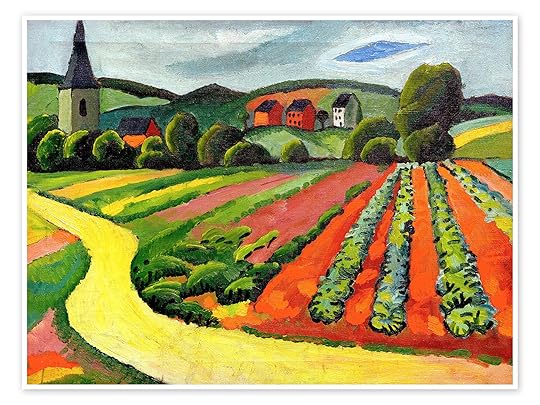
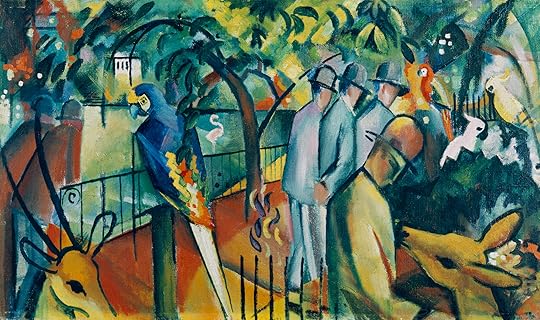
Las primeras tentativas artísticas de Macke provienen del año 1902. Las láminas del entonces joven de 15 años, primordialmente figuras paisajísticas y de animales, muestran ya un notable talento para el dibujo, y sorprenden por su marcada tendencia a la reducción esencial.
I visited the Lenbachhaus in Munich, which houses the largest collection of the Der Blaue Reiter group and thus, by extension, most of August Macke’s works, on an afternoon that marked the conclusion of a lengthy conference. The experience was the perfect antidote to what had frustrated me over the past few days. The conference had hosted major members of the Ljubljana School of Psychoanalysis (for the impressive speakers list beside Slavoj Žižek, look-up: “Knowledge without Comprehension? On Spirit after Hegel in the Age of AI”). Never have I been told in such a variety of convoluted ways that at the core of my person exists a (Lacanian) split, an unbridgeable rift which at once frustrates and propels; the task of the intellect gathered there being to square this thesis with old critical theories of society and newer theories of technology. I will not dwell on the ideas themselves, but suffice it to say that my reticence to abandon myself to the wash of French lexica was as much a consequence of my ignorance of its foundations as it was a rejection of the spirit behind the words: a lack of desire to begin undermining something that I hold onto, if only as a regulative ideal. This ideal is reflected in the works and philosophies of a variety of artists whose biographical footsteps I am quick to want to retrace: a greater faith in the transparent beauty of the mundane and in the capacity for self-knowledge than in the opaque aesthetics of the confused and contradictory subject.
August Macke, whose work in my mind embodies some part of this ideal, also recognised that this was by no means an easy hierarchy. Barring considerations of the political dimensions of art, he simply found more interesting those things that were harder to make interesting. Speaking in particular of Wassily Kandinsky, now perhaps the most famous member of the surprisingly short-lived Blaue Reiter, Macke curtly wrote: “they wrestle with form too much, in my view.” This kind of formal innovation was the sign of the Moderns who found their audience before the horrors of the First World War; following the example of the French Impressionists, their innovations were of a nature that altered the mode of subjectivity itself. Macke’s subject matter, however, the content of the piece, resisted abstraction, remained simpler, it was the same as that to which he had been taught to attend within the classical traditions of painting: portraits, street scenes, pastoral landscapes.
In this sense, Kandinsky drove formalism to new heights, utilising it to investigate the philosophical ideas he was developing concerning spiritualism and vitalism, in line with many contemporaries, think: Hilma af Klint, Edvard Munch, or Robert Delaunay. Macke, by contrast, allowed the banal, and yes bourgeois, everyday to be lived again: reappropriated and restructured, formally investigated, taken apart and pieced back together. Meseure writes that even in his famous paintings of the Cologne Botanical Gardens (below), which some have ventured to interpret as scenes of Paradise, Macke measures the themes of his paintings only to the extent of their formal refiguration, thus in some sense annulling the subject matter itself and allowing for the unexpected emergence of a strange kind of serenity.
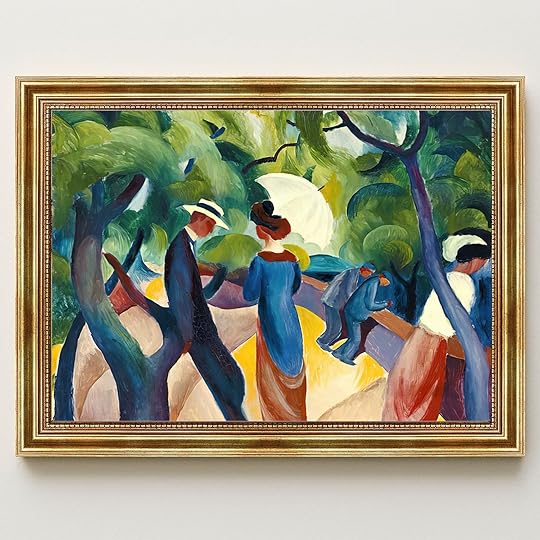
Macke never witnessed how everything would change after the war. Having died in battle at the age of twenty-seven, only eight years into his artistic career, those who were not cut down in the fields of Flanders were forced instead to attend to the rubble left behind. To become naïve again were precisely the scenes that Macke had had the privilege to capture so well. No doubt both his art and, later, his life story strike me as beautiful and, in a larger sense, tragic because of my avid reading of Stefan Zweig, who likewise captured all that Europe lost before the war in his memoir The World of Yesterday, I always return to one particular sentence of his, that the summer before the advent of war seemed "more luxuriant, more beautiful, and, I am tempted to say, more summery" Macke strikingly achieves this effect through the absence of shadow and through the contrast of flat surfaces rendered in striking Expressionist hues.
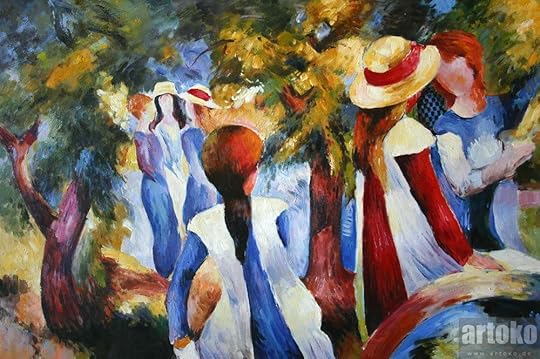
The paintings reflect for me the atmosphere found in one of the most moving fragments of W. G. Sebald's The Emigrants: the heart-wrenching diary fragments of a young Jewish couple who took regular turns around a park and found themselves engaged just before tragedy struck. It was in the final months of his life that Macke painted the most mature and impressive of such pastoral scenes. Take for example the one below: a Swiss park in the background and the girls in the foreground deeply interwoven through the brushwork; nature and humanity, in Macke’s world, were extensions of one another.
Concerning Macke’s eventual fate, one thinks of a lines from a poem by Czesław Miłosz, which warns humanity of its fate when it turns in violence against itself:
"Leave To poets a moment of happiness, Otherwise your world will perish."
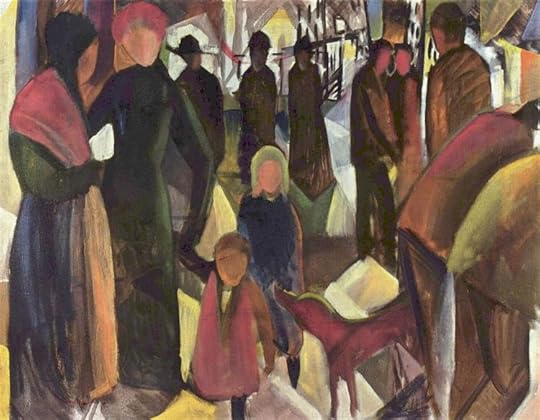
Though he may not have lived with any foresight of his this end, and is thus relegated to the position of a great but not visionary artist, it is the ideality of the subject, and then its suspension of in sudden cessation which Macke came to represent. Towards this books end Meseure directs the reader to the very last of his works: one that, despite the impossibility of knowledge, is shrouded in a dark suspense sharing a vague affinity with the metaphysical angst that I find so thrilling in the works of Giorgio de Chirico. It was retrospectively titled "Farewell (1914)".
Great artist. The book is a solid overview of his work as best as it can be represented on a page. And he’s another artist who died at 27 ( in war). Hendrix, Basquiat, Joplin, Morrison, and Robert Johnson being some others.
Macke is one of my favourite 20th century painters. This book is a wonderful discussion of both his life and his art with beautiful plates of his works. Included are reproductions of his watercolours from Tunisia, which are not often included in books about his work. Lovely book.