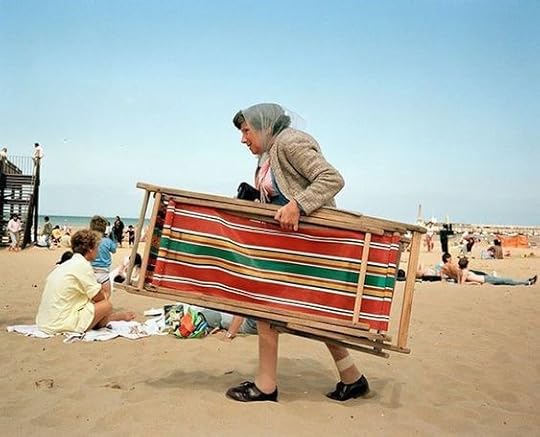
By the year 2000 tourism will be the biggest industry in the world. Even now an estimated 750 million "tourists" generate a massive $2,000 billion annual expenditure on accommodation, catering, transport and souvenirs. Parr's timely investigation looks at tourism worldwide from the overcrowding of popular "honeypot" sites - famous locations whose success in attracting visitors ultimately diminishes the quality of the visitor's experience - to the inevitable culture clashes as developing countries become tourist destinations.
Simon Winchester, OBE, is a British writer, journalist and broadcaster who resides in the United States. Through his career at The Guardian, Winchester covered numerous significant events including Bloody Sunday and the Watergate Scandal. As an author, Simon Winchester has written or contributed to over a dozen nonfiction books and authored one novel, and his articles appear in several travel publications including Condé Nast Traveler, Smithsonian Magazine, and National Geographic.
In 1969, Winchester joined The Guardian, first as regional correspondent based in Newcastle upon Tyne, but was later assigned to be the Northern Ireland Correspondent. Winchester's time in Northern Ireland placed him around several events of The Troubles, including the events of Bloody Sunday and the Belfast Hour of Terror.
After leaving Northern Ireland in 1972, Winchester was briefly assigned to Calcutta before becoming The Guardian's American correspondent in Washington, D.C., where Winchester covered news ranging from the end of Richard Nixon's administration to the start of Jimmy Carter's presidency. In 1982, while working as the Chief Foreign Feature Writer for The Sunday Times, Winchester was on location for the invasion of the Falklands Islands by Argentine forces. Suspected of being a spy, Winchester was held as a prisoner in Tierra del Fuego for three months.
Winchester's first book, In Holy Terror, was published by Faber and Faber in 1975. The book drew heavily on his first-hand experiences during the turmoils in Ulster. In 1976, Winchester published his second book, American Heartbeat, which dealt with his personal travels through the American heartland. Winchester's third book, Prison Diary, was a recounting of his imprisonment at Tierra del Fuego during the Falklands War and, as noted by Dr Jules Smith, is responsible for his rise to prominence in the United Kingdom. Throughout the 1980s and most of the 1990s, Winchester produced several travel books, most of which dealt with Asian and Pacific locations including Korea, Hong Kong, and the Yangtze River.
Winchester's first truly successful book was The Professor and the Madman (1998), published by Penguin UK as The Surgeon of Crowthorne. Telling the story of the creation of the Oxford English Dictionary, the book was a New York Times Best Seller, and Mel Gibson optioned the rights to a film version, likely to be directed by John Boorman.
Though Winchester still writes travel books, he has repeated the narrative non-fiction form he used in The Professor and the Madman several times, many of which ended in books placed on best sellers lists. His 2001 book, The Map that Changed the World, focused on geologist William Smith and was Whichester's second New York Times best seller. The year 2003 saw Winchester release another book on the creation of the Oxford English Dictionary, The Meaning of Everything, as well as the best-selling Krakatoa: The Day the World Exploded. Winchester followed Krakatoa's volcano with San Francisco's 1906 earthquake in A Crack in the Edge of the World. The Man Who Loved China (2008) retells the life of eccentric Cambridge scholar Joseph Needham, who helped to expose China to the western world. Winchester's latest book, The Alice Behind Wonderland, was released March 11, 2011. - source Wikipedia
para mí, este era mucho más repetitivo (compositivamente y en cuanto al sujeto, también) que the last resort. Muchos hombres con cámaras demasiado cerca. Aunque había unos cuantos spreads muy chulos
Capolavoro della fotografia - e più in generale della sociologia - contemporanea. Il minuzioso studio di Parr sull'ethos del turista, attuato con i suoi colori saturi e il non raro uso del flash, restituisce una umanità globale a tinte forti, affaticata dal "travel" (che in fondo è anche un travaglio, come nota la profonda introduzione di Simon Winchester) e dalla ricerca di sé intorno al mondo.
I got a copy of the newest version of Small World, I'm not sure if its 2024 or 2025, anyhow.
In Small World, Martin Parr presents us with some shots he got while travelling and touristing around the world. His photography here has nice vibrant colors and most of the time they are filled with genuine human expressions.
He doesn't take his photography too seriously in a sense that he isn't photographing scenes with a profound or obscure meaning. His pictures are simply engaging. Beautiful, entertaining and filled with meaning.
I love his work and this one particularly clicked with me. It inspires me to go out and shoot more. If this isn't a 5 star rating, I don't know what it is. But I can accept that his style might not be to everyone's taste and might look too simple or lazy. I guess people see what they want to see.
Martin is a genius and one of my faves ever. He’s always been more of an anthropologist than a photographer to me, capturing ordinary people and their behaviours in daily situations with tons of humour. In this collection Martin explores the tourist and “the touristic experience”, which places people out of their comfort zone, in a slightly vulnerable position. They came to have fun, but they’re also kind of lost, sometimes even helpless- like children that need a guiding hand. The photographs capture them looking puzzled and goofy, shameless and so so human.
The book suggests that in Parr's photographs, 'place' and visitor diminish each other; however, I disagree. In my view, people play a crucial role in shaping the essence of any location, and tourists contribute significantly to the allure of monuments, landscapes, and streets. But I do recognize that there can be something akin to too many tourists. That's me, a tourist, complaining about other tourists. Ironic.
Dyer's perspective concerning modern tourists, who may engage in more superficial or fleeting experiences reminiscent of faithless pilgrimages might have some merit.
This book has a wonderful introduction by Geoff Dyer. It's about traveling and tourism. The photos are all of tourists on vacation. Most are having their photo taken by someone else in the frame or are taking a photo. It has a sense of humor that isn't necessarily mean-spirited even if you don't have sympathy for the subjects of the photos. It appeals to me as a traveler, a photographer, and to my sense of humor and politics. This book is great.
This book has quite a literary introduction by Geoff Dyer. However, though book has some intriguing pictures of touristy places, somewhat mocking the tourists. There are several unconventional compositions with almost every frame featuring a tourist trying to pose or click. I missed that magical, pleasing quality that I seek in photography books.