

What do you think?

From Burnout to Bliss: Dissolve Your Ego, Fuel Your Success, and Find True Fulfillment
A New Blueprint for Success—Without the Burnout
In From Burnout to Dissolve Your Ego, Fuel Your Success, and Find True Fulfillment, Dr. Shaoqing Sun offers a powerful new path for entrepreneurs, leaders, and anyone ready to break free from ego-driven striving.
This is a guide for people who have achieved—but still feel unfulfilled. People who push hard but wonder what it’s all for. People ready for a quieter, clearer kind of power.
You’ll learn how
Release the mental habits that drive burnoutReconnect with your creativity, intelligence, and energy flowBuild a thriving business without sacrificing your well-beingMake decisions rooted in clarity and inner peaceEmbrace conscious leadership in work and lifeIf you feel depleted by constant striving, this book will help you recover your energy, reset your direction, and realign with your deeper self—without stepping away from your ambition.
In From Burnout to Dissolve Your Ego, Fuel Your Success, and Find True Fulfillment, Dr. Shaoqing Sun offers a powerful new path for entrepreneurs, leaders, and anyone ready to break free from ego-driven striving.
This is a guide for people who have achieved—but still feel unfulfilled. People who push hard but wonder what it’s all for. People ready for a quieter, clearer kind of power.
You’ll learn how
Release the mental habits that drive burnoutReconnect with your creativity, intelligence, and energy flowBuild a thriving business without sacrificing your well-beingMake decisions rooted in clarity and inner peaceEmbrace conscious leadership in work and lifeIf you feel depleted by constant striving, this book will help you recover your energy, reset your direction, and realign with your deeper self—without stepping away from your ambition.
- GenresSelf HelpNonfiction
177 pages, Kindle Edition
Published February 17, 2026
Ratings & Reviews
Friends & Following
Create a free account to discover what your friends think of this book!
Community Reviews
Displaying 1 - 20 of 20 reviews

July 27, 2026
From Burnout to Bliss is one of those books that arrived at exactly the right time for me. What I appreciated most was that Shaoqing Sun doesn't pretend there's a quick fix for burnout. Instead, the book encourages small, consistent changes that help you build a healthier and more sustainable way of living. The writing is calm, honest, and easy to connect with, making the advice feel practical instead of overwhelming. I finished the book feeling more hopeful than motivated, and honestly, that's exactly what I needed. If you're feeling stretched too thin or simply want a better balance between achievement and well-being, this is a worthwhile read.

July 23, 2026
This book offers a thoughtful and realistic approach to overcoming burnout without relying on unrealistic promises. Shaoqing Sun explains how small, intentional changes can make a meaningful difference in both work and personal life. I appreciated that the advice felt compassionate while still being practical enough to apply right away. The examples helped reinforce the ideas without feeling repetitive. If you've been feeling mentally drained or emotionally exhausted, this is a refreshing and encouraging read.

July 23, 2026
From Burnout to Bliss delivers exactly what the title promises, a path toward feeling more balanced and fulfilled. The author's insights are relatable, and the advice feels grounded in real-life experience rather than theory alone. I especially appreciated the emphasis on self-awareness and sustainable habits instead of quick fixes. The book left me feeling motivated to make small changes that could have a lasting impact. I would gladly recommend it to anyone looking to regain their energy and peace of mind.

July 24, 2026
I've read quite a few books on stress and burnout, but this one stood out because it focuses on building lasting well-being instead of just surviving tough times. The writing is easy to follow, and the concepts are presented in a calm, reassuring way. I found myself reflecting on my own habits as I read each chapter. The author encourages progress over perfection, which made the advice feel much more attainable. It's a book I'll likely revisit whenever life starts feeling overwhelming.

July 24, 2026
A grounded read
It's a grounded read. It hits right at that weird space so many ambitious people, including myself, end up in... where you've accomplished things, but you're just constantly exhausted and wondering why it doesn't feel better. We're always wanting more.
I actually think this is well worth picking up. I found it thought provoking and it opened my mind to many things.
It's a grounded read. It hits right at that weird space so many ambitious people, including myself, end up in... where you've accomplished things, but you're just constantly exhausted and wondering why it doesn't feel better. We're always wanting more.
I actually think this is well worth picking up. I found it thought provoking and it opened my mind to many things.

July 27, 2026
What I enjoyed most was the book's balanced approach to personal growth and mental wellness. Rather than pushing dramatic life changes, it emphasizes steady improvements that anyone can start making today. The tone is warm and supportive, making it feel like advice from someone who truly understands burnout. Every chapter left me with at least one practical takeaway I could put into practice. It's an uplifting read that offers hope without sounding overly idealistic.

Review of advance copy received from Netgalley
Can You Lead Without Ego in 2026? A Nuanced Review of “From Burnout to Bliss” and the Modern Hunger for Calm, Clarity, and Proof
By Demetris Papadimitropoulos | February 11th, 2026
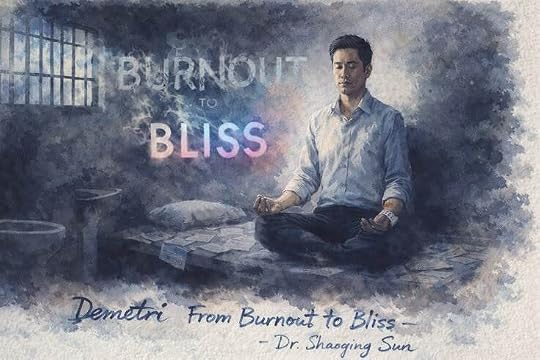
Watercolor Piece by Demetris Papadimitropoulos
In “From Burnout to Bliss: Dissolve Your Ego, Fuel Your Success, and Find True Fulfillment,” Dr. Shaoqing Sun introduces himself the way a certain kind of high-performing life prefers to be introduced: by credentials, by outputs, by the hard geometry of proof. Founder. Chief geoscientist. Creator of a platform with an acronym that sounds like a system you can stand inside of. Even the origin story of his company, C&C Reservoirs, reads like the industrial catechism of the last few decades: expertise turned into product, product turned into scale, scale turned into identity. And then, in a pattern familiar to anyone who has watched ambition metabolize into compulsion, the identity begins to consume the person who built it.
Sun’s book is part memoir, part leadership parable, part spiritual handbook, arranged like a long exhale that keeps turning itself into instruction. It wants to be an argument for egolessness, but it is also, unmistakably, an argument for a specific kind of modern salvation: the belief that if you adjust the inner instrument, the outer world will stop sounding so harsh. The premise is simple enough to fit on a retreat tote bag, yet the book is most persuasive when it refuses the tote-bag version of itself and stays down in the muck of lived consequence: lawsuits, market collapse, institutional betrayal, panic disguised as productivity, and the way “success” can become a room you cannot leave because you built it with your own hands.
Sun’s narrative arc is cleanly dramatic. There is early striving, the kind that feels virtuous because it produces results. There is a crisis that strips away illusions. There is a surrender that is not, in his framing, resignation but an upgrade of operating system. Then there is a second life in which decisions are made without fear, work becomes lighter without becoming less effective, and leadership shifts from control to clarity. In a certain sense, “From Burnout to Bliss” is a book about state management: how a person moves from one internal state to another, and how that interior shift changes what the person can build in the world.
The most vivid portions arrive when Sun tells the corporate story with the pacing of a man remembering what it cost. He recounts the oil price crash of 2015–2016 not merely as an industry event but as a wave forming in the distance, a slow gathering force that clarifies how fragile a business model can be when it depends on the wrong assumptions about permanence. He describes the DAKS platform as a house renovated too many times without checking its foundation, an image that does more than decorate the page: it becomes a critique of incrementalism, of the seductive belief that patching is the same as rebuilding.
His leadership decisions in that period are framed as the practical expression of spiritual change. He returns to a company he had nearly left behind, declines a proposal that would have eased him out, hires an imported executive team with corporate discipline, then later fires much of that team when he realizes their polished metrics cannot substitute for market understanding. A lesser book might present this as managerial drama. Sun treats it as a laboratory for consciousness. The question he keeps asking, sometimes explicitly and sometimes by implication, is not “What is the right strategy?” but “Who am I being while I choose?”
That question gives “From Burnout to Bliss” its texture and also its risk. For readers who have lived through modern work’s aesthetic of emergency, the language of “state of being” can feel like relief. But it can also feel like a sort of spiritual outsourcing, as if inner calm alone can metabolize structural pressures that are, in reality, indifferent to anyone’s enlightenment. Sun, to his credit, occasionally acknowledges the material scaffolding: cash reserves, loyal legacy clients, multiyear contracts, the practical luck of travel expenses disappearing during COVID. Yet the book’s gravitational pull is always toward the metaphysical interpretation. He repeatedly frames external disruption as invitation, chaos as disguised alignment, adversity as the universe’s curriculum.
The result is a work that belongs to a recognizable shelf of contemporary narrative self-transformation, where business memoir overlaps with spiritual testimony. You can see its cousins in “The Untethered Soul,” in “A New Earth,” in the business-spiritual hybrid tradition of “The Diamond Cutter,” and, in a more corporate register, the values-inflected leadership writing that tries to make ethics and performance rhyme. Sun is not interested in minimalism or irony. He writes with the earnest momentum of someone who believes he has found the lever that moves the world, and he wants you to put your hands on it.
His prose often adopts the cadence of a teacher addressing an exhausted room. He uses simple declarative sentences that stack into conviction. He repeats key oppositions: fear versus love, ego versus consciousness, control versus presence. At times, this becomes hypnotic. At other times, it becomes blunt. The book’s rhetoric is built for propulsion, not ambiguity, and you feel that in the way his metaphors do the heavy lifting: surfing, storms, waves, tsunamis. They are effective because they make emotional weather visible. They are also overused enough that a reader may start to wish for a different climate.
Still, the book’s most compelling claims emerge not from its metaphors but from its concrete episodes, especially in Chapter 6, “Egoless Leadership in Action,” where Sun presents a sequence of challenges that read like a stress test for his philosophy: IP theft in China, competition from larger “elephant” firms, the COVID-19 pandemic, and, in an almost surreal coda, a short prison sentence in Hong Kong after a quarantine violation. Here the book’s ambition broadens. It wants to say: this isn’t mindfulness as mood; this is mindfulness as operating principle under real threat.
The IP story is particularly instructive. Sun frames his decision to pursue legal action not as revenge but as precedent-setting, the defense of principle rather than pride. He describes the burden of proof, the slow accrual of evidence, the way narratives of national interest can be weaponized. The conflict is not merely about proprietary content but about legitimacy itself: who gets to claim authorship, who gets to stand as innovator, who gets to rewrite history with a government stamp. In an era of accelerating replication – and in a moment when generative tools make copying frictionless – this subplot lands with eerie relevance. The book doesn’t need to mention our current anxieties about originality and attribution; the reader will supply them.
Likewise, his account of COVID-19 has the odd clarity of hindsight: the choice to retain staff, the relief of lowered operating costs, the stability conferred by long contracts. But the personal story – India, Hong Kong, quarantine bands, isolation, then writing – is where Sun’s “written DNA” is most legible. He interprets confinement as gift, stillness as portal, solitude as a kind of forced retreat. Out of that retreat he produces academic papers, internal trainings, and product overhauls. It is a narrative that will resonate with anyone who felt their life re-sorted by the pandemic, though some will bristle at the book’s tendency to convert contingency into cosmic design.
Sun’s leadership theory, such as it is, rests on two intertwined notions. First: ego is the primary distorter, a “firewall” that blocks flow, creativity, empathy, and insight. Second: dissolving ego improves not only inner peace but also decision quality, relationships, and performance. This is not a new claim, but Sun gives it a business-case scaffolding that many spiritual texts avoid. He offers a portrait of an organization built around transparency, psychological safety, streamlined structures, and a preference for substance over marketing noise. He describes himself handing off responsibilities others can do more effectively, staying in his “zone of contribution,” and cultivating a culture that treats knowledge as something shared rather than hoarded. In the best passages, his philosophy is less about self-erasure than about de-centering: making room for the work to be larger than the worker.
Yet the book occasionally confuses egolessness with narratorial certainty. Sun’s voice is so assured, so committed to the moral geometry of his transformation, that the reader may long for a little mess: the admission that spiritual language can become another performance metric, another status marker, another way the ego smuggles itself back into the room wearing linen. Sun insists he is not writing to impress, and he often sounds sincere. Still, the story is staged as a series of triumphs achieved through a purified inner state. The “ego dissolved” self is presented as nearly frictionless – calm, joyful, consistently energized, immune to anxiety. For readers who have tried to live inside real bodies, with real hormones, real grief, real depression, this can feel less like inspiration and more like an impossible standard.
This is where the book’s rating lands for me: “From Burnout to Bliss” is a vigorous, often moving synthesis of business memoir and spiritual exhortation, and I would place it at 72/100. It succeeds as a narrative of transformation and as a set of practices that many readers will find genuinely stabilizing. It falters when it turns complexity into certainty, when it frames suffering as mostly a perceptual error rather than also a material condition, when it treats fear as something you can simply delete from your vocabulary as if the nervous system were a misbehaving app.
Still, even the book’s simplifications can be read as strategic rather than naive. Sun is writing for a certain kind of reader – the exhausted builder, the person who measures life in outputs and then wonders why the outputs feel hollow. He offers a path that is intentionally repeatable: name what no longer serves, stop waiting for permission, choose presence over perfection, build an inner circle, practice daily courage. These sections are not trying to be literature; they are trying to be usable. They read like the closing minutes of a talk where the speaker wants you to leave with something you can do tomorrow morning.
And yet, there is a literary impulse underneath the utility, particularly in the way Sun returns, again and again, to the image of waves. It is not merely metaphor. It is his cosmology. Life is not a plan; it is a swell. You do not control it; you ride it. You do not perfect it; you meet it fully. In the conclusion, where he reveals a prostate cancer diagnosis received without panic, that cosmology becomes personal in the most serious way. The book closes on a redefinition of success not as conquest but as alignment, not as a defended identity but as a loosening of attachment. It is hard not to be moved by the simplicity of that proposition, even if you question its universality.
There is also an implicit argument here about our era’s prevailing anxieties: the speed of change, the fragility of expertise, the disappearance of institutional memory, the pressure to digitize everything before it vanishes, the need to structure knowledge for AI systems that are only as good as the data they ingest. Sun’s professional story – building standardized documentation, migrating legacy systems, turning messy human experience into searchable intelligence – mirrors the broader cultural project of our time. The book doesn’t fully interrogate that mirror, but it glances at it often enough that the reader can feel the reflection.
In the end, “From Burnout to Bliss” is not a book that doubts itself. It is a book that testifies. Its strongest contribution is the insistence that leadership is not merely a set of behaviors but a form of inner architecture. Its weakest habit is the tendency to treat that architecture as if it can be installed the same way a platform can be re-architected: decide, rebuild, migrate, scale. A human being is not software. But a human being, like a company, can be undone by an old foundation that was never reinforced. Sun’s gift is making that structural truth feel intimate.
If you read this book as literature, you will notice its slogans and its repetitions, the places where it tells rather than shows, the moments when the universe arrives on cue to validate the lesson. If you read it as a field manual for the overdriven self, you may feel something else: permission to stop performing your own life, permission to choose a quieter kind of power, permission to build without burning. The most honest thing to say is that Sun’s book does both at once, imperfectly, and that its imperfections are part of what make it feel like it was written by a man who once believed in control – and now believes, with fervor, in release.
By Demetris Papadimitropoulos | February 11th, 2026
Watercolor Piece by Demetris Papadimitropoulos
In “From Burnout to Bliss: Dissolve Your Ego, Fuel Your Success, and Find True Fulfillment,” Dr. Shaoqing Sun introduces himself the way a certain kind of high-performing life prefers to be introduced: by credentials, by outputs, by the hard geometry of proof. Founder. Chief geoscientist. Creator of a platform with an acronym that sounds like a system you can stand inside of. Even the origin story of his company, C&C Reservoirs, reads like the industrial catechism of the last few decades: expertise turned into product, product turned into scale, scale turned into identity. And then, in a pattern familiar to anyone who has watched ambition metabolize into compulsion, the identity begins to consume the person who built it.
Sun’s book is part memoir, part leadership parable, part spiritual handbook, arranged like a long exhale that keeps turning itself into instruction. It wants to be an argument for egolessness, but it is also, unmistakably, an argument for a specific kind of modern salvation: the belief that if you adjust the inner instrument, the outer world will stop sounding so harsh. The premise is simple enough to fit on a retreat tote bag, yet the book is most persuasive when it refuses the tote-bag version of itself and stays down in the muck of lived consequence: lawsuits, market collapse, institutional betrayal, panic disguised as productivity, and the way “success” can become a room you cannot leave because you built it with your own hands.
Sun’s narrative arc is cleanly dramatic. There is early striving, the kind that feels virtuous because it produces results. There is a crisis that strips away illusions. There is a surrender that is not, in his framing, resignation but an upgrade of operating system. Then there is a second life in which decisions are made without fear, work becomes lighter without becoming less effective, and leadership shifts from control to clarity. In a certain sense, “From Burnout to Bliss” is a book about state management: how a person moves from one internal state to another, and how that interior shift changes what the person can build in the world.
The most vivid portions arrive when Sun tells the corporate story with the pacing of a man remembering what it cost. He recounts the oil price crash of 2015–2016 not merely as an industry event but as a wave forming in the distance, a slow gathering force that clarifies how fragile a business model can be when it depends on the wrong assumptions about permanence. He describes the DAKS platform as a house renovated too many times without checking its foundation, an image that does more than decorate the page: it becomes a critique of incrementalism, of the seductive belief that patching is the same as rebuilding.
His leadership decisions in that period are framed as the practical expression of spiritual change. He returns to a company he had nearly left behind, declines a proposal that would have eased him out, hires an imported executive team with corporate discipline, then later fires much of that team when he realizes their polished metrics cannot substitute for market understanding. A lesser book might present this as managerial drama. Sun treats it as a laboratory for consciousness. The question he keeps asking, sometimes explicitly and sometimes by implication, is not “What is the right strategy?” but “Who am I being while I choose?”
That question gives “From Burnout to Bliss” its texture and also its risk. For readers who have lived through modern work’s aesthetic of emergency, the language of “state of being” can feel like relief. But it can also feel like a sort of spiritual outsourcing, as if inner calm alone can metabolize structural pressures that are, in reality, indifferent to anyone’s enlightenment. Sun, to his credit, occasionally acknowledges the material scaffolding: cash reserves, loyal legacy clients, multiyear contracts, the practical luck of travel expenses disappearing during COVID. Yet the book’s gravitational pull is always toward the metaphysical interpretation. He repeatedly frames external disruption as invitation, chaos as disguised alignment, adversity as the universe’s curriculum.
The result is a work that belongs to a recognizable shelf of contemporary narrative self-transformation, where business memoir overlaps with spiritual testimony. You can see its cousins in “The Untethered Soul,” in “A New Earth,” in the business-spiritual hybrid tradition of “The Diamond Cutter,” and, in a more corporate register, the values-inflected leadership writing that tries to make ethics and performance rhyme. Sun is not interested in minimalism or irony. He writes with the earnest momentum of someone who believes he has found the lever that moves the world, and he wants you to put your hands on it.
His prose often adopts the cadence of a teacher addressing an exhausted room. He uses simple declarative sentences that stack into conviction. He repeats key oppositions: fear versus love, ego versus consciousness, control versus presence. At times, this becomes hypnotic. At other times, it becomes blunt. The book’s rhetoric is built for propulsion, not ambiguity, and you feel that in the way his metaphors do the heavy lifting: surfing, storms, waves, tsunamis. They are effective because they make emotional weather visible. They are also overused enough that a reader may start to wish for a different climate.
Still, the book’s most compelling claims emerge not from its metaphors but from its concrete episodes, especially in Chapter 6, “Egoless Leadership in Action,” where Sun presents a sequence of challenges that read like a stress test for his philosophy: IP theft in China, competition from larger “elephant” firms, the COVID-19 pandemic, and, in an almost surreal coda, a short prison sentence in Hong Kong after a quarantine violation. Here the book’s ambition broadens. It wants to say: this isn’t mindfulness as mood; this is mindfulness as operating principle under real threat.
The IP story is particularly instructive. Sun frames his decision to pursue legal action not as revenge but as precedent-setting, the defense of principle rather than pride. He describes the burden of proof, the slow accrual of evidence, the way narratives of national interest can be weaponized. The conflict is not merely about proprietary content but about legitimacy itself: who gets to claim authorship, who gets to stand as innovator, who gets to rewrite history with a government stamp. In an era of accelerating replication – and in a moment when generative tools make copying frictionless – this subplot lands with eerie relevance. The book doesn’t need to mention our current anxieties about originality and attribution; the reader will supply them.
Likewise, his account of COVID-19 has the odd clarity of hindsight: the choice to retain staff, the relief of lowered operating costs, the stability conferred by long contracts. But the personal story – India, Hong Kong, quarantine bands, isolation, then writing – is where Sun’s “written DNA” is most legible. He interprets confinement as gift, stillness as portal, solitude as a kind of forced retreat. Out of that retreat he produces academic papers, internal trainings, and product overhauls. It is a narrative that will resonate with anyone who felt their life re-sorted by the pandemic, though some will bristle at the book’s tendency to convert contingency into cosmic design.
Sun’s leadership theory, such as it is, rests on two intertwined notions. First: ego is the primary distorter, a “firewall” that blocks flow, creativity, empathy, and insight. Second: dissolving ego improves not only inner peace but also decision quality, relationships, and performance. This is not a new claim, but Sun gives it a business-case scaffolding that many spiritual texts avoid. He offers a portrait of an organization built around transparency, psychological safety, streamlined structures, and a preference for substance over marketing noise. He describes himself handing off responsibilities others can do more effectively, staying in his “zone of contribution,” and cultivating a culture that treats knowledge as something shared rather than hoarded. In the best passages, his philosophy is less about self-erasure than about de-centering: making room for the work to be larger than the worker.
Yet the book occasionally confuses egolessness with narratorial certainty. Sun’s voice is so assured, so committed to the moral geometry of his transformation, that the reader may long for a little mess: the admission that spiritual language can become another performance metric, another status marker, another way the ego smuggles itself back into the room wearing linen. Sun insists he is not writing to impress, and he often sounds sincere. Still, the story is staged as a series of triumphs achieved through a purified inner state. The “ego dissolved” self is presented as nearly frictionless – calm, joyful, consistently energized, immune to anxiety. For readers who have tried to live inside real bodies, with real hormones, real grief, real depression, this can feel less like inspiration and more like an impossible standard.
This is where the book’s rating lands for me: “From Burnout to Bliss” is a vigorous, often moving synthesis of business memoir and spiritual exhortation, and I would place it at 72/100. It succeeds as a narrative of transformation and as a set of practices that many readers will find genuinely stabilizing. It falters when it turns complexity into certainty, when it frames suffering as mostly a perceptual error rather than also a material condition, when it treats fear as something you can simply delete from your vocabulary as if the nervous system were a misbehaving app.
Still, even the book’s simplifications can be read as strategic rather than naive. Sun is writing for a certain kind of reader – the exhausted builder, the person who measures life in outputs and then wonders why the outputs feel hollow. He offers a path that is intentionally repeatable: name what no longer serves, stop waiting for permission, choose presence over perfection, build an inner circle, practice daily courage. These sections are not trying to be literature; they are trying to be usable. They read like the closing minutes of a talk where the speaker wants you to leave with something you can do tomorrow morning.
And yet, there is a literary impulse underneath the utility, particularly in the way Sun returns, again and again, to the image of waves. It is not merely metaphor. It is his cosmology. Life is not a plan; it is a swell. You do not control it; you ride it. You do not perfect it; you meet it fully. In the conclusion, where he reveals a prostate cancer diagnosis received without panic, that cosmology becomes personal in the most serious way. The book closes on a redefinition of success not as conquest but as alignment, not as a defended identity but as a loosening of attachment. It is hard not to be moved by the simplicity of that proposition, even if you question its universality.
There is also an implicit argument here about our era’s prevailing anxieties: the speed of change, the fragility of expertise, the disappearance of institutional memory, the pressure to digitize everything before it vanishes, the need to structure knowledge for AI systems that are only as good as the data they ingest. Sun’s professional story – building standardized documentation, migrating legacy systems, turning messy human experience into searchable intelligence – mirrors the broader cultural project of our time. The book doesn’t fully interrogate that mirror, but it glances at it often enough that the reader can feel the reflection.
In the end, “From Burnout to Bliss” is not a book that doubts itself. It is a book that testifies. Its strongest contribution is the insistence that leadership is not merely a set of behaviors but a form of inner architecture. Its weakest habit is the tendency to treat that architecture as if it can be installed the same way a platform can be re-architected: decide, rebuild, migrate, scale. A human being is not software. But a human being, like a company, can be undone by an old foundation that was never reinforced. Sun’s gift is making that structural truth feel intimate.
If you read this book as literature, you will notice its slogans and its repetitions, the places where it tells rather than shows, the moments when the universe arrives on cue to validate the lesson. If you read it as a field manual for the overdriven self, you may feel something else: permission to stop performing your own life, permission to choose a quieter kind of power, permission to build without burning. The most honest thing to say is that Sun’s book does both at once, imperfectly, and that its imperfections are part of what make it feel like it was written by a man who once believed in control – and now believes, with fervor, in release.

July 16, 2026
This book speaks directly to people who are constantly juggling responsibilities and feeling stretched too thin. Shaoqing Sun does a great job explaining how burnout develops and what we can do to prevent it before it becomes overwhelming. I liked that the strategies were simple enough to fit into everyday routines. The writing is engaging, and the message stays positive without ignoring the real challenges people face. It's a valuable resource for anyone looking to create a healthier relationship with work and life.
July 13, 2026
worth reading.
Good book with some interesting ideas. I liked the focus on finding balance instead of constantly chasing more.
Good book with some interesting ideas. I liked the focus on finding balance instead of constantly chasing more.

July 3, 2026
When Work Started Feeling Like Home
I related to this book. Like the author, I spent years working long hours, often unpaid, bringing work home and believing that working harder was the only way to be successful. Reading this felt like someone put into words what I am doing to myself. I remember the day I walked through the lobby of the agency where I worked and realized it felt like my living room. That was my wake-up call. This book helped me understand that burnout isn’t just about workload—it’s about disconnection. It offers a compassionate perspective on mindfulness, not as a lofty concept, but as a practical and necessary shift for lasting well-being. Mindfulness is something I will now intentionally practice, and I’m grateful this book helped me see why that matters.
I related to this book. Like the author, I spent years working long hours, often unpaid, bringing work home and believing that working harder was the only way to be successful. Reading this felt like someone put into words what I am doing to myself. I remember the day I walked through the lobby of the agency where I worked and realized it felt like my living room. That was my wake-up call. This book helped me understand that burnout isn’t just about workload—it’s about disconnection. It offers a compassionate perspective on mindfulness, not as a lofty concept, but as a practical and necessary shift for lasting well-being. Mindfulness is something I will now intentionally practice, and I’m grateful this book helped me see why that matters.
July 8, 2026
Just what I needed This book came at the right time for me.
I was feeling stressed and overwhelmed, and it helped me look at success in a different way. A lot of good insights packed into a short read.
I was feeling stressed and overwhelmed, and it helped me look at success in a different way. A lot of good insights packed into a short read.

February 21, 2026
Here is one man’s inspired account about changing your life from burnout to bliss and gently encourages us to do the same. It offers insight into finding your purpose, trading your ego for enlightenment, and improving leadership through communication. We learn about the relationship between spirit and consciousness, as well as science and God. A healthy mindset is a priority and wisdom is only gained through living. With several exercises and real life application of principles, the author teaches you how to achieve this mental success. It was very well written and straight to the point.
The biggest takeaway from the book:
“Your inner state creates your outer reality.”
P.s. thank you to Shaoqing Sun and Goodreads for the giveaway copy!
The biggest takeaway from the book:
“Your inner state creates your outer reality.”
P.s. thank you to Shaoqing Sun and Goodreads for the giveaway copy!

July 8, 2026
Burnout to Bliss by Dr. Shaoqinq Sun.
This is a book that talks about leadership and its struggles. Leaders are needed in every aspect of life, and there are challenges that come with it. The book brings steps to tackle the challenges associated with leadership. It details the transformation paths and necessary questions to ask as a leader. I read about the spiritual journey of the author, including some spiritual rites.
Besides, the idea of "ego less leadership" is of note in this book. The practice of letting go of ego as a leader. This would bring better results later on.
For me, it was great reading about the art of examining life’s purpose and the practice of being true to one self.
This is a book that talks about leadership and its struggles. Leaders are needed in every aspect of life, and there are challenges that come with it. The book brings steps to tackle the challenges associated with leadership. It details the transformation paths and necessary questions to ask as a leader. I read about the spiritual journey of the author, including some spiritual rites.
Besides, the idea of "ego less leadership" is of note in this book. The practice of letting go of ego as a leader. This would bring better results later on.
For me, it was great reading about the art of examining life’s purpose and the practice of being true to one self.

Review of advance copy received from Netgalley
I’m a little conflicted about this book because from the beginning the author comes across as quite unpleasant. This is actually part of the point. He turned his life around and changed the way he ran his business. For me there were no major lightbulb moments - but, what I really did like were the reflection questions at the end of each chapter. Plenty of thinking to get your teeth into. Thanks to NetGalley and Forbes Books for the ARC.

June 30, 2026
I really enjoyed reading this book because it talks about success from a different perspective, one that's certainly thoughtful. This book made me think about what really success means.
The writing style is simple, clear and calm and the author has an encouraging tone I really liked. I finished the book feeling more mindful about how I approach work, ambition, and well-being.
The writing style is simple, clear and calm and the author has an encouraging tone I really liked. I finished the book feeling more mindful about how I approach work, ambition, and well-being.

July 9, 2026
A different way to think about success
I really enjoyed this book. It reminded me that working harder isn't always the answer. Sometimes we need to slow down & pay attention to what's going on inside.
I really enjoyed this book. It reminded me that working harder isn't always the answer. Sometimes we need to slow down & pay attention to what's going on inside.

Review of advance copy received from Goodreads Giveaways
I appreciated the insight. It's easy to never feel fulfilled by any success and this really pointed inwardly on what we associate as success.

July 13, 2026
Easy and inspiring read
Easy to read and full of practical advice. I found myself highlighting several sections that really spoke to me.
Easy to read and full of practical advice. I found myself highlighting several sections that really spoke to me.
July 14, 2026
I could relate to this.
I could relate to a lot of what the author talked about. I've spent years pushing myself & feeling exhausted. This book helped me rethink a few things.
I could relate to a lot of what the author talked about. I've spent years pushing myself & feeling exhausted. This book helped me rethink a few things.

Review of advance copy received from Goodreads Giveaways
🔥🔥🔥🔥🔥
This entire review has been hidden because of spoilers.
Displaying 1 - 20 of 20 reviews