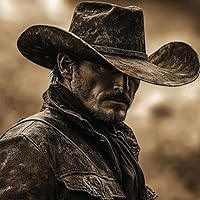
The cowboy — that enigmatic, larger-than-life icon of our culture —has long been considered a figure of fast hands, steel nerves, and few words. But according to Ramon Adams, cowboys, once among themselves, enjoyed a vivid, often boisterous repartee. You might say that around a campfire they could make more noise than “a jackass in a tin barn.” Here in one volume is a complete guide to cowboy-speak. Like many of today’s foreign language guides, this handy book is organized not alphabetically but situationally, lest you find yourself in Texas at a loss for words. There are sections on the ranch, the cowboy’s duties, riding equipment, the roundup, roping, branding, even square dancing. There are words and phrases you’ll recognize because they’ve filtered into everyday language — “blue lightnin’,” “star gazin’,” “the whole shebang” — plus countless others that, sadly, are seldom heard in current speech: “lonely as a preacher on pay night,” “restless as a hen on a hot griddle,” “crooked as a snake in a cactus patch.” As entertaining as it is authoritative, COWBOY LINGO captures the living speech of the Great Plains and serves as a window into the soul of the American West.
A Gold Mine of Grit and Grins This book’s a hoot—and a handy one at that. Cowboy Lingo ropes together the colorful slang of the Old West with wit and charm. It’s more than just fun reading; it’s a solid resource for any writer wanting authentic cowboy flavor. I’ve pulled plenty of expressions from it into my westerns, and it never fails to add the right punch. Whether you’re spinning yarns or just want to talk like a trail boss, this one belongs in the saddlebag.
Larry McMurtry once said he based "Lonesome Dove" on a handful of reference books about the Old West. This classic compendium of cowboy terminology first published in 1936 by Ramon Adams is surely one of them. In the chapter on cowboy nicknames, there is told the story of Dishwater Martin, who like Dish Boggett in the novel, got his name by mistaking dishwater for drinking water.
And if you've read "Lonesome Dove" much of the early material in this book will be a little familiar. Adams discusses at length the duties of cowboys on the job in open rangeland, on cattle drives, and on ranches. Their manners, habits, attitudes, and codes of behavior are discussed, especially the close bond between cowboys and their horses. And interwoven through all of this are the words, terms, and phrases borrowed and invented by cowboys, observed and noted by Adams over many years as an amateur lexicographer.
I found the reading got more interesting as Adams explored topics that spilled over into storytelling and something I guess we'd call socio-linguistics today. The chapter on cooks, cooking, food, meal-time etiquette, the chuckwagon itself, and the sharp wit of cooks is especially enjoyable. Adams also makes good reading out of his chapters on cattle rustling, guns, the afore-mentioned nicknames, and (much too briefly) cowboy dances, also known as 'hoe-digs,' 'shin-digs,' 'hoe-downs,' and 'stomps.' I learned square dancing as a boy but never heard calls as arcanely mystifying as the ones Adams records here.
While Adams observes that cowboys were also notoriously profane and wildly inventive in their profanity, the mores of 1936 prevent him from giving any examples. Sad to say, that's the only chapter I have to report as missing from this otherwise entertaining and informative book.
"Cowboy Lingo" is one of those rare reference books you can read for pleasure. It opens a wide and richly detailed window into a uniquely Western world.
Excellent reference for those who want to learn the facts about cowboys, or those who just love aquiring odd tidbits of Americana. Why is one color of horse less desirable than another for roping calves? Find out inside.