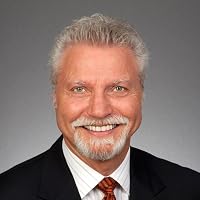
James Lee Haner writes under the Thought Boundary imprint from Nampa, Idaho, where his best plotting happens on long walks with his two Corgis. His debut novels — Shadows of the Kestrel, an espionage thriller following operative Tavian Corvus through the world of handlers, defectors, and Cold War-legacy tradecraft, and Consciousness Zero, a literary science fiction novel exploring grief, consciousness, and consent in the age of optimization — mark the beginning of two ongoing series.
A U.S. Air Force veteran who completed doctoral work at the University of Idaho, James also teaches program and project management, delivering PMP, PMI-ACP, and related certification exam prep through Brain Sensei. When he's not writing or teaching, he's active in a local storytelling group and book club and is currently developing a memorial piece honoring a friend who died in military service in Southeast Asia.
I'm sorry. So sorry. I got this as an ARC copy at a writer's fair, and I said I would write a review for it, so I am. I did not - could not- finish it. The idea was interesting, philosophical, and fascinating, but I had a hard time following the plot and the scientific terms were complicated. This is coming from a girl who reads Dickens for fun and watches Doctor Who. I'm used to tangled plots and complicated, timey-wimey science. This was too much. Then the writing style was choppy, lots of fragments and metaphors. I like metaphors! But I just couldn't get it. And then the theology...or lack of it...I don't know. I'm a Christian, and while I don't expect every book I read to be sermonizing and I read books by non-Christians, I do want the books to not be anti-Christian...and to be clear! If I can't tell, then I get frustrated, like in this book. Mr. Haner, if you are a Christian, forgive me. I am so sorry.
Consciousness Zero (The Luminous Heresy) immediately stands out as an ambitious and thought-provoking work of literary science fiction that explores the intersection of artificial intelligence, consciousness, grief, and what it truly means to remain human. Rather than treating AI as simply a technological threat, the novel raises profound philosophical questions that linger long after the final page.