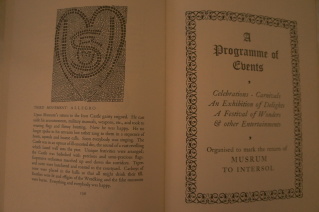
"Musrum condemned an adulteress to the electric blanket. Musrum is lying in wait for you inside these covers. Musrum's first important invention was the Crispine alphabet. It consisted of only one character which has not as yet been deciphered." (book jacket)
No time for a detailed review—in brief, a BURIED illustrated fable from an English surrealist-anarchist (Bradshaw) and his mate (Thacker). Imagine a delirious hybrid of Calvino, Spike Milligan and Theroux’s fable books. Replete with sumptuous prose describing a fictitious European nation and its warfare, leaders, enemies. Exquisite illustrations of the smile-making and oh-so-hilarious variety. Worth several spades to unBURY and desperately in need of a deluxe reprinting from Fantagraphics or similar.
Manic inventive mythologies for the late 60s/70s, springing up at the crossing point of Invisible Cities (I realize I'm borrowing that comparison, but this is earlier), psychedelia, the iterative surrealism of Anthony Earnshaw's illustration, and whatever indescribable angle his co-author and ordained minister, Eric Thacker, somehow brought to the table. Of its its times, yet timeless. All worlds should be constructed downwards from the attic.
I often thought of Invisible Cities while reading, and was surprised to see that Musrum predates Calvino's imaginative masterpiece by 3 years. I wonder, did Calvino have a chance to read it? At any rate, it feels unfair that, of the two, Musrum is forgotten when it deserves to be enjoyed just as much.
Thacker and Earnshaw clearly love words. This joy comes through throughout. I love how they break down their delicious nonsense words into Latin, Greek, or Anglo-Saxon roots. I kept a dictionary handy throughout and picked up a number of new words, serried and susurration for two.
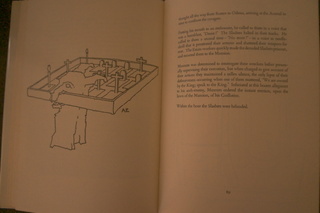
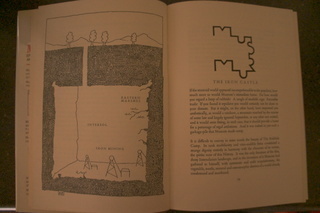
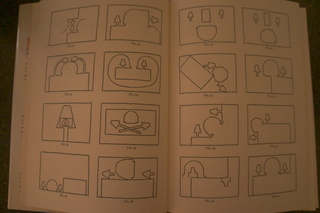
The illustrations are as much a part of the text at the text itself. This is one of the only books where I believe that flipping through to view the pictures constitutes a spoiler. A large part of my joy in this book was turning the page to reveal another stimulating design, and I sometimes wished that I had read the book sight unseen.
P.S. Forgot to mention this, but this book is Eco's The Infinity of Lists tier material. Excellent lists in this book, if that's your literary thing.
I have no idea whatsoever why this book disappeared into obscurity never to be seen again. As far as I can tell it was last in print in 1971, and only had a handful of printings – a couple US printings and maybe one UK printing – prior to that. I have to think that part of it is content – borderline insane story, skewed sense of humor, illustrations, published in the 60’s, and a title that’s derived from a mispronunciation of “mushroom”. You can’t help but nod smugly and knowingly, sure that you know what’s in store for you. And maybe old Eric Thacker was enjoying himself some mushrooms when he wrote this, but, as he was a Methodist minister, maybe not (now, that said, from his biography I'd say that Anthony Earnshaw is likely a different story). And that, in a way, is what really sets this apart from a lot of the other drug fueled experimental stuff that was flooding – alright, semi-flooding – the market at the time – is that this in its own way makes sense. There is an internal logic even in the absurdities of the book that tends to make me think that this was a work of careful consideration, and not just psilocybin-stream-of-consciousness. I think that it would be easy to dismiss this book at first glance, but I have to say that would be a mistake, as it’s one of the more original books I’m lucky enough to have read (and to own).
It’s the story of Musrum, a demigod of sorts, who has his mushroom tree stolen by the Weedking and wages war to get it back. No, seriously, that’s what it’s about.
And goddamn if it’s not a complete riot. This is one genuinely funny book, and it had me laughing out loud throughout. But it’s not its humor that sets it apart – though it would have been enough – it’s the absolutely stunning and original creative voice at work here that keeps dragging me back to the simple fact that this book is almost completely unknown and unread and unavailable.
If you like fantastic fiction you should read this. If you like “weird fiction” you should read this. You like Borges? Calvino? Read this. Just do it; you won’t regret it. It’s fun, it’s original, it needs an audience, and it damn well deserves to be praised, not forgotten.
Some quick images of the book itself, as it is really lovely:
***The images in this review are of the 1968 Grove Press hardcover book - I'm unsure if the Jonathan Cape version would be the same, I know at a minimum the covers are different.***
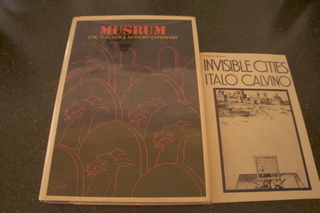
I'll get to the interior in a second, but I wanted to start by saying that the book itself is printed in a striking oversized hardcover, shown here next to a farily standard trade paperback for reference, and is all around a lovely book to look at it.
One of those love it or hate it bokks (and I bet you can tell which side I'm on). Wonderfully absurd from the outside and internally consistent—the fourth wall remains intact. I would say more, but it's been a decade at least since a copy last passed through my hands.