Laura Ingalls Wilder was a beloved children's author who wrote about her family's experience traveling west in a time where there were no towns, no stores, and no homes to move into.
They started in Pepin, Wisconsin, in a little log cabin and she eventually moved to Mansfield, Missouri with her husband, Almanzo.
This little guidebook takes the reader through each location the Ingalls family lived in, provides details about which structures have been preserved or reconstructed, and gives an overview of the town (including dining and other things to do while there).
A quick caveat: the edition I read was published in the early 2000s, so I cannot vouch for how many of the businesses mentioned or Laura Ingalls Wilder festivals are still up and running, but at the same time I did really enjoy reading about the "real" locations where Laura lived - they even threw in a few bonuses that weren't mentioned in the book series!
Pepin, Wisconsin
- Little House in the Big Woods
--This is the first place mentioned in Laura's books. Her family lived in a little cottage built by Pa. They actually sold the place when Laura was one year old, but returned to it when the buyer defaulted on the payments, the family lived in the cabin until she was about four.
--The events from book 1 occurred when they were in the home for the second time. Pa decided that the Big Woods of Wisconsin was becoming too crowded and so the family packed up and moved.
--The local library committee was able to locate the land owned by the Ingalls in the early 1960s. Since then, there was a replica homestead (the real one disappeared in the 1920s) placed on the property. Inside the little cabin is a living room, a bedroom, and a pantry but the rooms are unfurnished for fears of vandalism.
Independence, Kansas
- Little House on the Prairie
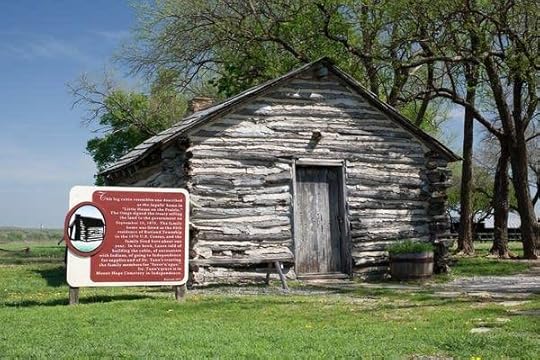
--The Ingalls family found a lovely spot in what is now Montgomery County, Kansas but unfortunately, Pa chose land that belonged to the Osage Diminished Reserve. This book says it's accidental (but I've also read that Pa had an idea that the land was owned by the Osage tribe, but was banking on the government taking more land for US citizens). Either way, Pa never officially filed for an homestead but the family was included in the 1870 census.
--A year after the family moved to the Little House on the Prairie, Pa "discovered" that their land belonged to the Osage and the family decided to move further west rather than to find a plot of land to claim in the area.
--The Kansas State Historical Society was able to track down the land that where the family lived, including foundation rocks and a well that Pa hand-dug (and nearly killed him). The log cabin is furnished. There's also a couple of other buildings that date back to Laura's time that you can visit (a post office, and Sunnyside School).
Walnut Grove, Minnesota
- On the Banks of Plum Creek
--This is the location of the infamous sod dugout that the family hunkered down in during the winter months, after which they moved into a 2-story house built by Pa. The family eventually had to leave after the grasshopper invasion ruined their crops.
--This site was made even more famous because it was mentioned in the first episode of the original television series. People flocked to Walnut Grove to visit the Ingalls's land.
--The Gordon family (who owned the land) would take people on tours to see the location of the dugout and other spots mentioned in the story. Unfortunately the two-story house is no longer standing and the dugout's roof collapsed in the 1920s but the impression is still there on the banks of the river.
Burr Oak, Iowa
- The Masters Hotel
--This location isn't mentioned in the book, but the Ingalls family lived with Pa's brother for a time in Wabasha County, Minnesota as they mourned the loss of Laura's little brother (Charles Frederic, who passed away as a baby and wasn't included in her books).
--The family then spent two years in Burr Oak and helped run the Masters Hotel. It wasn't until the 1970s when the town realized that Laura and her family lived there. They also discovered the original frontier hotel was found still standing.
--The family moved once again but this time due to Pa's job with the railroad.
De Smet, South Dakota
- By the Shores of Silver Lake, The Long Winter, Little Town on the Prairie, These Happy Golden Years, The First Four Years
--The family settled in the surveyor's house in De Smet for the winter. The Ingalls family became members of the town - participating in church and community activities. Laura also met and married Almanzo Wilder in this town.
--This town is the final resting place of Pa and Ma. You can see the inside of the Surveyor's house (which is also the oldest building in De Smet). The local library has a few relics from the Ingalls family, like Mary's raised-print bible.
---Many other locations from the stories can be seen, including the Ingalls Home - which began as a 2-room house but was added on by Pa to include three more bedrooms and a parlor. This is the fanciest house that Laura lived in with her family.
Mansfield, Missouri
- The Rocky Ridge Years
--After the events of the books, eventually Laura and Almanzo bought the Rocky Ridge farm and settled in for a peaceful life. You can go through it room-by-room to discover where Laura lived her adult life and where she penned her famous books.
--Pa's fiddle is at this home! And the book contains a full-layout of the house. You can see that the home was built a room at a time, cause often each room opened into the next (rather than there being a hallways of doors. The Kitchen opens to the dining room which goes to either a bedroom or a music room, which you can follow to the parlor or a porch.
--There's also the Rock House, which was built in 1928 and is on the same property. Rose (Laura's daughter) built the house for her parents and Laura wrote the first four books in it. This book said it is being restored and a quick look at the website says that it is open for tours!
Malone, New York
- Farmer Boy
--This is the childhood home of Almanzo Wilder (Laura's husband) who she wrote about in his own book. This is an 88-acre farm that Almanzo's father eventually sold but in 1987 the Laura Ingalls Wilder Association was able to purchase the Wilder Farm.
--After a very long restoration process, the 140-year-old farmhouse was returned to its original appearance (even going so far as to bring the doors and windows back to their original appearance).
--Many of the outbuildings have been lost to time but one of the goals mentioned in this guide was to re-build some of the barns (and a quick peek at the website confirmed this!). It's now a living history museum.
Overall Thoughts
--I really enjoyed this guidebook. I've wanted (for ages) to tour the Little House homes - to travel Laura's path and see what is left of her locations. And that goal is fairly far off for now but I feel like I have a good idea of what I'll see through this book.
--I loved the photographs - seeing Pa's fiddle, the handmade furniture, the little writing spots - they really fuel my desire to go out there and see the locations myself.
--If I'm ever able to tour these places, I'll check back in and let you all know how it goes!