In 1913, a young scientist finds himself changed after an affair with Lady Jane Savile, the leader of an English expedition, and several months alone in the African wilderness
Michel Rio is a french writer born in Brittany and who spent his childhood in Madagascar. He lives in Paris.
He studied semiology and published his first novel in 1972.
With more than twenty novels published, is body of work spans genres such as crime fiction, theater, essays, and short stories. His absolutely literary work, translated from the start in the United States, is now published in more than twenty languages.
Michel Rio has won several prizes (Prix du Roman and Grand Prix du Roman by the Société des Gens de Lettres, Prix des Créateurs, Premier Prix du C.E. Renault, Prix Médicis).
A naturalist from France (the book is translated from the French) goes into the West African jungle to study chimpanzees. He’s a young scientist, from the upper class of course, an arrogant know-it-all and a cynic who manages to offend everyone he deals with. The year is 1913 and looming World War I and its outbreak provide bookends to the action in the novel.
The African setting with the elite white Europeans coming to study makes the novel a bit Conrad-esque. The scientists’ camp is like an African colonial city in miniature with a European sector --- large individual tents -- and an African one – squalid group quarters. And of course, “camp” may be a bit of a misnomer since the wealth of the white Europeans provides them with all the luxuries of home – even fine dining by candlelight with food served by African cooks and waiters.
The camp is run by a beautiful, sexually liberated British woman scientist. Around the table the conversation is elaborate and focused on topics of evolution, science, altruism, consciousness, biology and the role of art. Dinner is a chance for the Europeans to joust intellectually by showing off their verbal dexterity. It’s a stretch to hear these folks talk to each other in mini-lectures, but we get things like “I really do not understand why we insist on systematically attributing to the mind what we consider noble in ourselves and to instinct what we consider base. It recalls the foolishness of dualistic philosophies which postulate a radical difference of essence between the soul and body.”
The man and the woman develop a relationship that reverses stereotypical roles. He quickly falls in love with her but she sees him as a sex object and tries to intellectualize their relationship. Here’s an example of some of the things she says to him (good break-up lines if you need them): “You make me feel vulnerable and scattered. Every day you are more and more of a burden on my mind. It comes at the wrong time. I would like to free myself of you, in vain. You are an unwelcome emotion for me, a pleasure that drives me to despair. I believe this amorous distraction is the main cause of my failure, and perhaps of my weakness in the face of illness.”
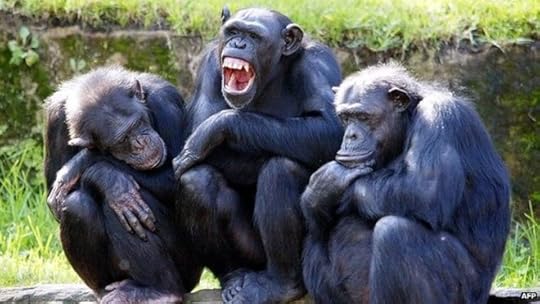
Faced with this hostility and to prove himself to her, the male scientist goes off for a year entirely on his own to live with and study the chimpanzees. This is his “year without words” and it changes his attitude, we might say.
This is a very short book (112 pages) and low-plot – pretty much what’s outlined above; the one bit of suspense being: do they stay together or not? It’s a good read but the blurbs are overblown: “incredible intensity,” “a classic,” “a perfect book.” Good, but not THAT good.
Wouldn't have bought this book if it hadn't been on clearance for $3.00. Wouldn't have read the book if I hadn't taken it on a long plane ride. Wouldn't have finished the book if I could have used it to start a fire on the plane.
Rio's (translated) prose is definitely on-point for the era he's portraying (1913). That said, my critique falls into two parts:
[1] Many novels excel because of their supple use of language to depict events or characters (and their evolution).
Not in this novel. The characters rarely receive description; all we learn about the main love interest of the book, Lady Jane Savile, is that she pleasures herself on the first date, she speaks "ironically," and she demands sex from the book's protagonist. Beyond that, the reader isn't given an inkling of specific insight for the protagonist's orgasmic reaction to her. Rather, Rio relies on flatulent generalizations:
She seemed happy, and I wondered whether this stemmed from action, closeness to the experiment, and the hope of discovery, or from an emotional state. There was a certain melancholy in this question (p. 74)
Which brings us to the next quarrel with the book. Remember how early writing teachers told us, "Show, don't tell!"? Well, one could make a drinking game out of violations of this yardstick:
"...experience tended to show me that an organism was not the simple support, the slave of its own genes, subject only to their will to propagate themselves (pp. 98-99)
Really? How, pray tell, did "experience" tend to "show" this? Examples? Ironically, the novel's protagonist is on a one-year safari to observe the behavior of chimpanzees --yet there's only one slender episode where he actually observes the chimps he's supposed to be studying (pp. 100-101)! Then again, perhaps this paucity of detail is to be expected when an author tries to cram 10 months of events into a bare 13 pages (pp. 87-102)!
Even more frustrating, the protagonist returns from his 10-month foray with "an enormous bundle of ink-blackened papers" which are said to be "the results of [his] observations" (p. 105). What a shame that none of them bled their way into the protagonist's masturbatory reveries!
[2] But maybe this is to measure the novel by the wrong yardstick. Perhaps Rio intends his book as a "novel of ideas," rather than a novel of events or characters. The book's inside flap indeed bills it as "a brilliant novel of ideas."
Problem is, the book falls flat on that score, as well. For starters, the author doesn't win a knowledgeable reader's trust by putting an anachronistic understanding of evolution theory into the mouths of his characters. The characters' vocabulary and conceptualization are more in line with the modern synthesis understanding of evolution-cum-genetics of the 1930s, rather than the understanding of Darwin's theory afoot in 1913. As a result, Rio's characters' dialogues on evolution ring anachronistically false (pp. 57-61, 68-72)
Rio also has one of his characters suggest the theory (now known as) "kin selection" (pp. 69-70) This again seems anachronistic, since the theory of kin selection wasn't really in realistic currency until much later than 1913.
Most amusingly, Rio has one of his characters ape the well-debunked allegation that Darwin's theory is a tautology (p.59). Astonishingly, none of the other interlocutors point out this sophistry's fatal flaw. In light of Rio's failure to grasp the state of Darwin's theory afoot in 1913, one wonders whether the author himself is scientifically literate enough to realize the error of the "tautology objection." This is not a good sign for a book pretending to be a "novel of ideas."
Anyhow, by now I've flogged this horse to death 10 times over. On to another book...