A gorgeously rendered graphic novel of Daniel Alarcón’s story City of Clowns.
Oscar “Chino” Uribe is a young Peruvian journalist for a local tabloid paper. After the recent death of his philandering father, he must confront the idea of his father’s other family, and how much of his own identity has been shaped by his father’s murky morals. At the same time, he begins to chronicle the life of street clowns, sad characters who populate the violent and corrupt city streets of Lima, and is drawn into their haunting, fantastical world.
This remarkably affecting story by Daniel Alarcón was included in his acclaimed first book, War by Candlelight, and now, in collaboration with artist Sheila Alvarado, it takes on a new, thrilling form. This graphic novel, with its short punches of action and images, its stark contrasts between light and dark, truth and fiction, perfectly corresponds to the tone of Chino’s story. With the city of Lima as a character, and the bold visual language from the story, City of Clowns is moving, menacing, and brilliantly vivid.
Daniel Alarcón’s fiction and nonfiction have been published in The New Yorker, Harper's, Virginia Quarterly Review, Salon, Eyeshot and elsewhere. He is Associate Editor of Etiqueta Negra, an award-winning monthly magazine based in his native Lima, Peru. His story collection, War by Candlelight, was a finalist for the 2006 PEN/Hemingway Foundation Award, and the British journal Granta recently named him one of the Best Young American Novelists. He is the recipient of numerous awards, including a Fulbright Scholarship (2001), a Whiting Award (2004), and a Guggenheim Fellowship (2007). He lives in Oakland, California, and his first novel Lost City Radio was published in February 2007.
If you have never read any of his open-ended and non-linear works, I suggest you start immediately. Not only is he an amazing novelist with Lost City Radio, but his short stories from War by Candlelight: Stories are just beautiful, and "City of Clowns" was originally published in that collection. It is an incredible story, and I thought it was powerful in short-story format, but it is even more so as a graphic novel/comic.
It follows the story of Chino, after his father's death, and he is finally able to confront his father's other wife and his half-brothers, and the question of why his mother is so calm and close to the other wife and her family. He feels as if his father did not care about him, because even though he was the first-born, his father decided to stay with his other family. Then he becomes a clown, for research, but he discovers much more about himself and others that way, he likes the anonymity. During the time of the story, Lima was at war between rebel groups and the government, and more often than not civilians were caught in the conflict.
It leads to many open-ended questions. Who are we? Are we all just clowns? How do we deal with family we don't know? Why do we make and break promises?
This is beautiful, Daniel Alarcón and Sheila Alvarado did a beautiful job.
I read this for a class, and as an exercise we first had to read the short story (by the same name, by Daniel Alarcón) this is based on, and then write down how we thought the graphic novel would look and how we’d visualize it if we had to.
I imagined something with very few colors, but it wasn’t in black and white, rather it was held in sand colors, pale yellow, orange and brown. And I imagined whatever color there was to be watercolors, so they’d bleed out onto the page and touch other things, like the couldn’t be contained by the lines that were meant to hold them.
I like the way Sheila Alvarado chose to do the graphic novel, although I wish it had less text, because I tend to forget to look closely at the images if there’s text catching my attention instead. However as her and Alarcón worked together one it, perhaps it was difficult to cut the text out.
And it’s a good story, perhaps better as a graphic novel than as a short story. Oscar (or “Chino”) has just lost his father, a father who left him and his mother for another family years ago. There are memories of their time together, building houses and robbing them as well, and there’s the present, Chino trying to deal with his grief over an alienated father and a mother acting in a way he doesn’t understand. The world itself seems to disintegrate, to present a different world than the one he thought he know.
He becomes interested in clowns. Clowns who walk around the city selling things, he used to not pay attention to them, but now he sees them everywhere. Are they fools or not? Are they ridiculous or people to be taken serious? What’s it like to see the world as a clown, to see the city, without the city seeing you? Chino can suddenly disintegrate with the world, blend into the background, become someone else or no one at all. And there’s something poignant, sad and wonderful about the use of clowns, with their ambivalent character and meaning.
I liked the short story, but wasn’t blown away by it, so seeing it combined with images was a plus, however I’ll repeat I wish there’d been less text, and that the images had gotten more ‘screentime’ so to speak. But it’s certainly a different take on grief, on coming to terms with the past, and all in all a very fascinating story, told in a bleak, dark, yet not quite pessimistic way. And it was refreshing to read a graphic novel that had both such a different story and such a different style. The combination of the two was striking and memorable, whereas I might have forgotten the short story had I read it only on its own.
Bijzonder, bijzonder, zo bijzonder... Deze City of Clowns blijkt, zo las ik in het nawoord, een 'verstripping' te zijn van een verhaal dat Daniel Alarcón jaren eerder al had geschreven (in Iowa of all places). Gelukkig hebben Sheila Alvarado en Alarçon heel nauw samengewerkt, zodat tekst en afbeeldingen fantastisch op elkaar zijn afgestemd.
Ik heb de Kindle-versie gelezen, in landscape, omdat dat de meest logische manier leek. Het is namelijk, zoals hierboven te zien is, vaak zo dat de tekening zowel de linker- als rechterpagina 'nodig' heeft. En zelfs als dat niet zo is, is het fijn om ze beide tegelijkertijd te kunnen zien, zoals hieronder.
Prachtig hoe de pagina's gespiegeld zijn, en hoe dat bijdraagt aan de sfeer van deze fijne striproman, dat het levensverhaal bevat van Chino, geboren op het hooggelegen platteland van Peru, maar getogen in Lima. Meer vertel ik niet, behalve dat er clowns en flapschoenen in voorkomen...
The story did not blow me away, but the illustrations were pretty impressive. I especially liked the different settings of Peru being pictured in this graphic novel.
Graphic fiction by the Peruvian writer Daniel Alarcón, deftly illustrated by Sheila Alvarado. The story is of a journalist thinking back on the gritty poverty of Lima and his grifter father, a man capable of robbing his wife's employers and making his son an apprentice criminal, as well as the great mystery of his mother, who finds solace in the company of her husband's lover.
This is a short story that became a graphic novel. The graphics are amazing. The story is dark, about a young journalist, who recounts his life growing up and his family's life in Lima, Peru. He explores who he has become as a result of family and society.
An interesting read about a man and his upbringing in Lima. The cultural differences between Peru and the U.S. are fascinating, but poverty is the same everywhere.
3.5 stars rounded up. I knew very little about Peru, but this offered a unique and personal perspective that I appreciated. The artwork was simplistic and enjoyable.
A nice little treat of a book from Riverhead--a single (previously published) short story remixed slightly, pared down, and illustrated with black and white drawings by Sheila Alvarado. Alarcon's narrator Oscar (aka Chino) is the son of a man who migrates from a remote, hopeless, rural Peruvian mining town to Lima, city of opportunity. Some of that opportunity comes in the form of doing honest construction work on people's homes, while the rest comes from casing those same homes and later going back to rob them. Meanwhile, Oscar's mother works as a maid in a household like the ones his father robs--a household in which Oscar comes to feel comfortably like another child of the family.
When Oscar is grown and working as a journalist, his father dies and Oscar learns his father had another wife and another family. That's a shock, as well as the news that his father's second family is Black. Worst of all is the fact that his mother and his father's second wife grow close after their husband's death. Oscar, feeling lost and betrayed, wanders Lima's politically unstable streets, notionally working on a story on street clowns for his editor. The clowns reflect back to him his own absurdity and haplessness, as well as that of his disintegrating city.
This is a rich, many-layered story to begin with, and the illustrations help to bring even more vividly to life. Alarcon is a heck of a writer.
A father with a secret family. A forgiving and loving mother. A chance to hide in plain sight and research clowns. All under the grey skies in Lima, Peru.
Alarcon's City of Clowns previously published as a short story and later adapted for this graphic novel with a friend and illustator, Sheila Alvarado. It's a melancholy story: musings and memories of childhood, a man stricken by grief after the death of his father - who had another family on the side. All of this comes to light while Oscar's newspaper asks him to write a piece on the street performer clowns that are working political protests in the plaza.
Oscar decides to join the clowns for a day, riding city buses, performing in silly clothes, shoes, and makeup, and marveling when people he knows do not recognize him in this attire. He finds some freedom in this, even going to the neighborhood of his father's other family and seeing his half brothers, finally seeing his mother, the only one who does recognize him in his costume.
The story flows in and out of present - intertwining stories of youth and memories of his father. This switch between times may have been more confusing in written word, but it flows well in graphic form.
It's a thoughtful book with beautiful art. I hope to see more work by both Alarcon and Alvarado.
Oscar "Chino" Uribe is a working as a tabloid journalist in Peru when he gets news of his father's death. Returning home, Chino discovers his father, a laborer and small-time criminal, had a whole other family with a mistress, a woman Chino's mother is now living with.
Chino's boss gave him the assignment to do a feature on the street clown community of Lima, Peru. While Chino is not really in the headspace to do much writing, as he tries to work through anger stemming from being reminded of his father's poor life choices, he does admit that the project might also serve as a welcome distraction from the discomfort of his personal life right now.
The story is interesting --- the combination of a troubled father / son relationship, Peruvian political unrest, and the topic of clowns all blended together --- but it's also kind of all over the place. It was sometimes a little hard to follow what scenes were present day and what was memory... it all just felt sort of mashed together. There's also some sexually explicit material within certain scenes, for those concerned with that.
I have my reservations about the merits of this book. The art was good and simple. The book is not set up like your regular graphic fictions, so that intrigued me. As I picked it on a whim, I did not know what to expect but I was slightly disappointed. It was a simple to understand story, the relationship between the main character and his father revisited and revised as well as his reaction to his mother and her relationship with the father’s mistress. Maybe I did not click well with the sombre tone of the main character, or the symbolic nuances of his language and that’s why I am still confused. Nevertheless, it read well and the rhythm was fine.
Desperately seeking books to interest sophomore boys, I grabbed a copy off the shelf for purchase at Barnes and Noble without really knowing the content between the covers. After two students gave this work enthusiastic reviews, I decided to read it myself. The story will haunt you the way childhood haunts its protagonist--turning him into a man who is most comfortable as a lone, anonymous or semi-anonymous observer (in the guise of clown and journalist, respectively) addicted to the stimulation of the intoxicatingly interesting, often lawless city of Lima, Peru.
Debo confesar que cuando leí "Guerra a la luz de las velas" el cuento que más me gustó fue precisamente este. Increíble como torna la atmósfera lúgubre de Lima en un personaje más de una historia genial.
I was lucky to get my hands on an advanced copy. The pace, atmosphere, precision and detail, and supporting art all concentrate together into an impactful and thought provoking story. One of the best graphic novels I've read.
Un relato que se puede analizar desde distintas aristas. Quizá se debió profundizar más en las tramas de la historia. La analogía de la ciudad con la tristeza de los payasos me pareció acertada. Las imágenes y la estructura del libro suman a la publicación.
I picked this up having previously read a few of Alarcon's novels and as someone who enjoys a wide range of graphic storytelling. As he relates in the afterword, the book has quite the past: based on time he spent in Peru, then written in an Iowa farmhouse, then published three years later in The New Yorker magazine, then almost ten years later, translated into Spanish for this collaboration with the Peruvian artists Alvarado, and then a few years later revised into this English-language edition. Phew! The book revolves around a 20something newspaper writer in Lima whose estranged father dies at the beginning. The story then moves back and forth between present-day and memory, as he struggles to process his anger at his father and the new realization that he had another family with three other sons. Even more confusingly, he mother has moved in with the woman he abandoned them for. Meanwhile. the journalist wanders the streets of Lima, as Fukimori's regime starts to crumble, and hangs out with poor street clowns for a feature he's supposed to be writing.
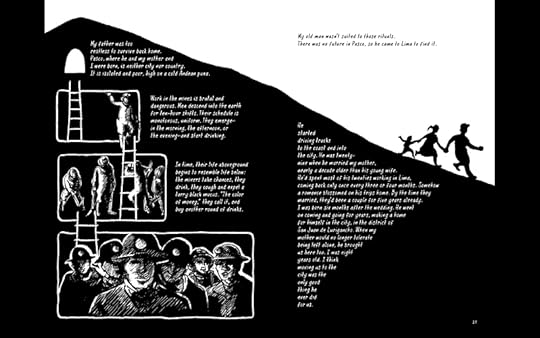
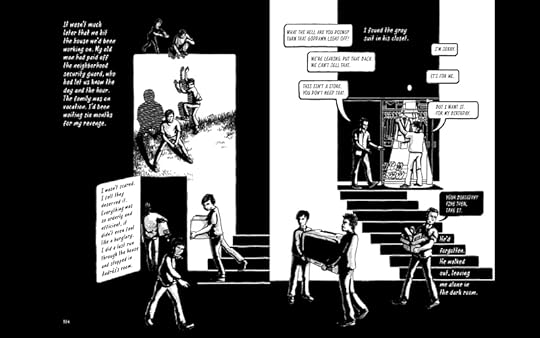
Like the rest of Alarcon's fiction that I've read, it's kind of interesting, and there are some scenes and moments that are powerful, but the overall story never really landed for me. However I suspect it works much better in this graphic format, than the purely textual story does. There are a lot of different illustration styles and techniques deployed, and you can tell that each two-page spread has been labored over. There's not the kind of regular grid or rhythm that most graphic novels have -- it's almost more like a series of paintings or triptychs. At times it can be somewhat distracting and disjointed, but it's a more interesting approach. All in all, the book is probably more of a curiosity than anything, but could be especially interesting to readers who haven't sampled graphic storytelling.
I'll be honest I picked this up because of the setting. I like to read books about other cultures and countries done by authors from those places. The contemporary setting did less for me. It reads a little like a memoir and opens with Chino, a Peruvian journalist, avoiding his father's funeral. Chino is a young man filled with rage. Starting life in the poor mountain mining communities, Chino came to Lima as a child and at one point admired his father.
Now, he's rightfully angry. Much of the time he was 'away working' his father was actually at his other wife's home with the multiple half siblings Chino didn't realize he had. He's angry that his father eventually left him and his mother for that family. He's angry at how his mother handled it (especially after his father's death) to the point of coming across very judgmental of Mom.
Much of the work his father and mother did was handyman and maid work for wealthy families. Much later we learn the reason for this is his father (mom didn't know) was casing the joints and he was capable of brutality.
Along with this personal tale is the story Chino is meant to be writing about clowns. I felt the story fell down a bit here. Were the clowns merely buskers? They also seemed to be part of the political unrest which is the backdrop for the whole story. Are they so poverty stricken this is all the clowns have? At one point Chino joins them, seems to like it.
Overall, I didn't connect with Chino much. I did think the dark heavy inked art served the dark story.
City of Clowns is a graphic novel written by Daniel Alarcon and illustrated by Sheila Alvarado following the life of Oscar “Chino” Uribe as he remembers his late father- a man of calloused hands and emotions- while researching the life of clowns within his home city of Lima, Peru. You may read the non-illustrated edition for free on The New Yorker website.
I breezed through this in less than an hour, and don’t feel the particular desire to re-read in order to glean more detail and information than the first read through. I’m sure there’s major symbolism between the street clowns and people in general, as we wear masks and feign emotions, even if we feel like forgotten ghosts and hide our true selves. I’m sure there’s deep meaning and parallels to the fictitious Lima and a politically tense, divided Peru. I just don’t feel compelled by the story enough to engage in more outside research.
I honestly thought I would find the story more compelling. The fisheye depiction of a city on the front cover, the hard abruptness of the red, white, and black color scheme, gave me a political revolution sort of vibe. Instead it is a story of a lost man, at last recognizing his abandonment issues due to a careless and- in my personal opinion- asshole father with no true resolve.
I clicked well with the narrator so I really enjoyed this. A story of yearning, class, and the vulnerability of connection. “We were ghosts in the multitude,” Daniel Alarcón writes. The “parallel heartbreaks” the narrator finds his mother and his fathers other wife, are on a linear plane the narrator does not feel aligned too. We lean into the narrator’s journey of reflection, mourning and trying to make sense of his grief of the loss of his father. This is a journey that is not avoidable, despite the narrators attempt to detach through his work as a journalist. His assignment, the clowns of Lima. The narrator first watches, gazes, listens, assists, then almost assimilates into the scene of clowns. A clown tells him this is not work that is settled on, it is just what happens. The complexity of the narrators grief dances perfectly with his assignment and we watch it begin to rain in the city of clowns.
I have been striking out with the graphic novels I’ve picked up recently. The art is ok in terms of execution, but too grim for my taste. I found the story aimless and rather depressing. His dad sucked, and he wandered around as a clown, there was random references to oral sex on a girl wearing stilts (though her “little hands and feet and breasts and legs” had lost their charm for him, the stilts apparently rekindled his interest) and going to a prostitute on Valentine’s Day because of his dad. These types of details felt so pointless.
His dad wasn’t particularly complicated from his POV. He worked hard on both his construction job and his burglary and had no problem betraying a trust if it benefited himself. MC had no ability to understand that actually his mom and the mistress probably had more in common with each other than with the man they both loved.
It felt like a waste of time.
This entire review has been hidden because of spoilers.
There are no words for how I adored this book. A friend recommended it to me and I read it all in one go. The illustrations are gorgeous, black and white, but so very rich and full of emotion. The storyline is all too familiar; a man learning to deal with grief and life as it comes towards him fast. The storytelling is fantastic; mixed into the main narratives are little reflections from the past, some of them good, some of them bad. The ambiguous ending left me feeling very vulnerable, perhaps because I'm going through some of the same things. It's always an experience to learn just how flawed family can be.
Un joven periodista pierde a su padre, quien llevaba una doble vida, mientras prepara un reportaje sobre los payasos de la ciudad… Interesante premisa, pero ¿qué más? Me quedé con la sensación de que la historia no me llevaba a ningún lado. Sí rescato, y mucho, el trabajo gráfico de la ilustradora Sheila Alvarado. Ella crea un mundo visual bastante atractivo (como la escena de los payasos en la carpa circo) y lúgubre (todas las viñetas en las que aparecen los edificios del Centro Histórico de Lima). El libro está disponible en la Biblioteca Pública Digital de la BNP, por si quieren revisarlo (vale la pena por los diseños).
(3.4) This book traces the backstory of Oscar, a journalist investigating the subculture of street clowns in Lima, Peru. His personal life unfolds in parallel to his assignment, mirroring the delicate balancing act his father once performed between two families and the lasting effects on those involved. Woven through the narrative are threads of political unrest, dark cynicism, and an unmistakable reverence for Peruvian culture. Though the story itself feels somewhat scattered—shifting between Oscar’s childhood and adulthood—the black-and-white artwork adds depth and striking detail that elevate the reading experience.