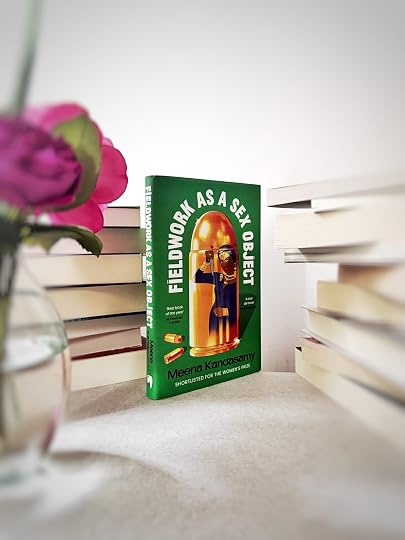
A new novel of incels, influencers and AK-47s – from the Women’s Prize-shortlisted poet and provocateur
‘One of the most urgent voices of tomorrow’ Harper’s Bazaar
I mute the audio. I replay the video four times. It is not me. It is my fucking face.
Amrita Chaturvedi goes by Amy. Amy identifies as a communist on Twitter (her profile omits a stint on Big Brother and a millionaire daddy running the show at the High Court of Delhi).
Then reality hits: a deepfake porno of her forwarded around by WhatsApp aunties goes viral. On her birthday, Amy wakes to a mob stoning in the digital town square that could cancel the likes of Kim Kardashian.
Her executioners? A cartel of unhinged virgins styling themselves after V for Vendetta – except these keyboard warriors are on a ruthless crusade to wipe out desi jezebels and Make India Hindu Again.
A muscular, monumental work of internet literature in which the online turns offline turns bloody, Fieldwork as a Sex Object is not a novel you read but a novel that reads you: what are you prepared to risk for what you claim to believe?
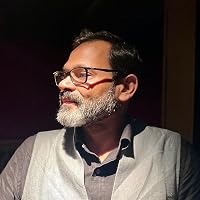
Dr Meena Kandasamy FRSL is a poet and provocateur who has spent two decades triggering the far right. She’s been translated into over 20 languages.
Her previous novel, When I Hit You, was shortlisted for the Women’s Prize, Jhalak Prize and Hindu Literary Prize. It was also Book of the Year in the Financial Times, Observer, Daily Telegraph and Irish Times. Her poetry collection, Ms Militancy, went viral across South Asia. In 2022, PEN Germany awarded her a medal for being ‘a fearless fighter for human rights.’
Meena has two sons. Her new novel, Fieldwork as a Sex Object, is out now.
You can be sure of one thing with this novel. As with her earlier works, Kandasamy does not flinch. She is loud, brave and voices facts without sugarcoating. In Fieldwork as a Sex Object, Amy/Amrita, an activist-communist comes across a deep fake sex video. She knows the woman in the video isn't her but she has her face. Hate towards her spread like a wildfire on social media—trolls, hate comments, you name it all. If you are a woman on social media, you will be all too familiar with the strategy of Indian trolls (either you being affected directly or you witnessing them tearing apart another woman on socials). This book puts that experience on the page.
Also interesting was how Amy, being a privileged person with an influential family, sees her views vs those of her parents. The privilege seeps in, sometimes she even welcomes it, but there is always that space where the reader can debate what path the protagonist should have followed. I also like how the novel shows Amy as someone fighting for a cause that is not her lived experience. And when she is responding back to the deep fake video, which is something that personally affects her, her privilege also makes an appearance.
Something I did not expect from the book was how funny it was. Some passages were dark and funny in equal measure. (for example her mom sounding relieved that Amy is alright and referencing sex videos in the same breath). Many laugh worthy moments in this one, sometimes sarcastic, sometimes dark, sometimes situational.
Read this for a peek into India's right wing troll army, right wing politics, classism and casteism, the world of incels, social media rage, cancel culture, sexual agency. I did wonder whether some parts of the politics subplot was needed/overdone. But then it wouldn't be a Meena Kandasamy book without it; she is fiercely unapologetic and proud of about her political views; so it is only natural that they find a mention in the novel.
What a brilliant fucking read. Any publisher who passed on this needs to go find their spine before they decide whose voice gets to be heard, and how loud.
The first few pages bear a tone and vocabulary you’ll recognize instantly if you’re a chronic hellsite user, and that worried me. I thought the whole book was going to coast on that register. I was wrong, and happily so.
Every choice in this book is like a planned trap that springs later. For instance, there is a frequent dropping of brand names that grated on me for almost the first third of the book. It later turns out to be the whole argument: a character eventually tells Amy (the protagonist) that you can’t love what you don’t know, and asks what she actually knows of the women she claims to fight for besides a lipstick shade or a sunglasses brand. After I read that, every logo in the book read like an indictment. The brad names are treated like a ceiling on how well anyone here is capable of knowing anyone else. The brilliance of the book only kept getting brighter and more fiery from thereon.
Underneath the chaotic plot, it’s a book about how fast a meme becomes a mob becomes a body. Deepfakes, Hindu nationalist incel armies, cancellation as blood sport, and a protagonist who learns there’s no such thing as a safe distance from any of it anymore. It’s also, somehow, insanely funny, the kind of funny that only comes from genuine rage.
Read it if you’re woman. Read it if you’re an Indian. Read it if you’re not. Read it before you vote, while you still have one.
This entire review has been hidden because of spoilers.
how the current state machinery works on the internet and the many questions we ought to think about is what the story is. existing in a world where old men want to relive or create glory days for their generation and gender by inciting or actually being violent against anyone daring to even look them in the eye with a defiant retort on their tongues is like walking on a minefield, onto which you were just pushed before you could even respond with a "hmm".
i would recommend this to anyone wanting to understand what is it like being on the Indian internet today.
Reading Kandasamy is akin to conversing with a gangster. There’s a conviction and boldness and ferocity in this novel that made me hold on.
Virality-internet deepfakes-caste-violence-misogyny-rightwingism-manosphere-privilege- ridden plot line maps carefully the stakes of being an educated, outspoken woman in [india]
This is you. This is me. This is about caste anxiety, but it's not the anxiety from discovering your caste or your place in a caste-riddled society surrounded by other caste-trapped characters, it's the suffocation of being trapped within caste while not being of a "lower" caste; it's the caste anxiety of the Creole white characters from Rhys' world; it's the caste anxiety of an upper-caste that is attempting to shrug off her caste while being unable to; it's the shame of being an upper-caste person; it's the conflict, the disgust, the self-hate, the self-doubt, the self-loathing, the loss of self, the fragmentation of self, that somehow cannot be wrenched apart from caste; it's a caste story of an upper-caste, and if that disgusts you, the idea of a caste story of an upper-caste, you're one of the reasons why this story has a conflict. Don't worry; the narrator's just as disgusted as you, but you get to own your disgust. I don't know. I don't know. I didn't expect it to end the way it did. The ending makes everything you've read for the first two hundred pages a bizarre, dystopian narrative. I don't know. I'm disgusted with what I feel while writing this review, but in that disgust lies the conflict of the story.
🫦Satirical bold thought provoking bold brave novel, such poetic prose 🫦
🫦'I wanted to be known for words like slow, well-placed kisses, and sentences like shared quilts. A writing, like sex, that derives its pleasure in the act. A writing, like love, that finds a home in another person.'
🫦"My writing, like me, is stubbornly particular because abstraction is just one more form of erasure when you’ve been cut down to parts.
🫦'The writing is all poetic prose, metaphors and sarcasm'
🫦Thought-provoking, satirical and relatable novel touching various topics such as s** ***uality, misogyny relationships, family, morality,loneliness, casteism, racism, extreme Hinduism, fascism,human rights violation and much more.
🫦A bold brave novel.
🫦The bi***ual morally grey heroine, sleeping with her friend's boyfriend is definitely not the good Indian girl but very human, heartbroken by unreciprocated love/ attraction.
🫦Sadly much would relatable in the contemporary dating scenario, sample, "The number one request I receive from men is: send me a picture of your p**** now"
🫦I loved the creative witty chapter titles
Some excerpts I highlighted:
🫦My silence is a snare, my wordlessness a sea into which she steps, reluctantly, toes first, ankles a little later.
🫦being unloved feels worse than being hated.
🫦(Indian people overshare when they like you, unlike Americans who overshare because they want you to like them).
🫦The more intelligent you appear, the more urgent, obsessive will be his need to possess you. Running underground, parallel to this thrill, lies his immense insecurity—so he will also want to lose you as soon as he has you.
🫦What petrifies me is how time-consuming it all is: there are no holidays, no working hours—because love is unpaid labour. I live in the past—running towards memories. I live in the future—fantasising. I lose the present.
🫦Of course, young men are increasingly drawn to alt-right algorithmic echo chambers because economic anxieties are being channelled into cultural grievances.
🫦Look, I’ve nothing to give you but love and all you need to do is not hurt me.
Content 🚧warning: words of pro*****y,depression
🫦Those who enjoy reading fiction related to contemporary soceity and culture can check it out.
I purchased this book blindly. I went into this with very high expectations, because it is a Tamil writer and I think I unconsciously expected relatability in the story. I did not really find that here, but that is not the book’s fault at all. This is Amy’s story, not mine.
The book is ambitious and tackles a lot, but at times it felt like too many ideas were introduced without being explored deeply enough. I also found almost every character frustrating, especially Amy, who I found extremely hypocritical and difficult to like. That said, I still completely sympathised with her in what she was going through and I was rooting for her to get justice all the way. The book managed to make me dislike its protagonist while still firmly rooting for her, which was probably the most interesting part of the reading experience.
Edit: I have a special love for unlikable narrators but in this case it was stress inducing.
The humour is impeccable. The writing, which is the best part of the book, is very sharp. Also the hard questions.
I hope the author gives us more. Rooting for her.
SPOILERS:
A jarring aspect of the book for me was how differently Amy was able to survive the fallout compared with how catastrophic the same kind of violation could be in a more restrictive social environment. Amy’s humiliation becomes massively public, but she still retains some ability to continue living her life. That made Nimmi’s point about it being “death for us” especially striking. The scale of exposure is not the only thing that determines the damage. Class, caste, family, community and social freedom can completely change what survival looks like. Looking at Amy’s world and the family fallout was un-relatable and fascinating at the same time.
What I struggled with much more was Amy. I found her extremely frustrating, hypocritical and often deeply unlikable. At some points I was genuinely furious with her, especially in the way she treated India (the white female character, not the country) after India welcomed her into her home, cooked for her and gave her a place to stay. Amy’s tendency to analyse everyone else’s privilege and motivations while constantly finding ideological excuses for her own behaviour drove me insane. And yet, I was still completely on Amy’s side when it came to what happened to her. She was the victim of an appalling violation, and I desperately wanted Vivek to rot in hell. Finding Amy unlikable did not make what happened to her any less horrific.
Almost every character irritated me in some way. Nimmi was one of the more understandable characters to me, especially in terms of caste and class resentment, but even she could be unnecessarily vicious towards Amy while Amy was already going through something traumatic.
India (the character) somehow ended up being one of the calmer characters in the book, despite how harshly Amy judged her. India may be privileged, performative, paternalistic or politically naive, but Amy’s reading of her is still Amy’s reading, not objective truth. Whatever India’s flaws are, they do not justify Amy betraying her after being welcomed into her home. What frustrated me most was Amy using critiques of race, class and saviourism to rationalise what was, at its core, a personal betrayal.
The book is incredibly ambitious. It takes on caste, class, misogyny, deepfakes, Hindutva, communism, online abuse, privilege, interracial relationships, sexual politics and more. But sometimes it felt like there were too many narratives happening at once, with several of them introduced without being explored deeply enough.
My biggest disappointment was the bleakness of the ending. I wanted Vivek to face some kind of real justice. Even exposure, humiliation or consequences of some kind would have given me more closure. I understand what the book is saying about impunity and how women can be destroyed while perpetrators move on, but understanding that choice did not make it any less frustrating to read.
I did like the ending conceptually, especially the idea that this would not be the last version of Amy to go viral and that she would eventually be remembered as something more than the woman in that video. There was something powerful in that.
Overall, I think this is a book I respected more than I loved. It is sharp, ambitious and provocative, but also emotionally alienating, frustrating and deliberately bleak. Amy is unquestionably the victim of the central crime, but she is also one of the most infuriating protagonists I have read in a while.
Meena Kandasamy’s Fieldwork as a Sex Object is a ferocious, blisteringly funny satire that captures the terrifying velocity of internet misogyny while refusing to offer easy, moralistic answers. By centering the story on a deeply flawed, hyper-privileged protagonist whose life is upended by a viral deepfake, Kandasamy avoids simple victimhood narratives to deliver a complex critique of both far-right digital mobs and hollow, performance-based activism. The book's significant takeaway is a sobering warning: in our modern digital landscape, the weaponisation of technology, specifically deepfake pornography, has become the ultimate tool to strip women of political agency, and a superficial, Western-style "girlboss" playbook is entirely unequipped to fight the deeply entrenched forces of caste, nationalism, and systemic patriarchy.
I didn’t think I’d DNF a Meena Kandasamy novel but well. 70 pages in, I could not fathom where the plot was going (if there is one at all). There are random statements made which are a commentary/ criticism of how the internet and the state function but they seem disjointed from the plot. I went in with very high expectations but life always has a way of humbling me. :3 arghhh. I wish this were better written or maybe I’m not evolved or woke enough to understand the book (??). I really did want to finish it but had no inclination to pick it up again and just do not see myself going back to it.
Meena Kandasamy holds nothing back in this sharp, unsettling exploration of digital misogyny, online harassment, and the price women pay for speaking their minds. What I found particularly compelling is how the protagonist turns the tables on her trolls, choosing to study the very people trying to silence her. The writing is fierce, biting, and laced with dark humour, making for an intense read that hits uncomfortably close to home. A provocative, relevant book that makes you think about power, privacy, and what it means to be a woman on the internet today.
The title is one of the quickest readings that I have done of a so-called work of fiction. This is a book that must be read for the effortless flow with which it integrates privilege and power shapes, sustains and destroys our lives. What stands out is how Amrita, aka, Amy, as a character never bereft of her gendered individuality, her political outlook and commitment to questions about duality and social or racial privileges that are often reduced to bantters and asides of hypocrisy of voyeuristic story telling.
What happens when a cool girl gets doxxed on the internet with a fake AI porno? Nothing good. As Amrita and her allies tries to manage the fallout with meddling Asian aunties, incels and really, just judgmental jerks overall, this read will generate so much talk about social media, strong women and cancel culture.
I received an arc from the publisher but all opinions are my own.
Deeply affective and made me question lots of thoughts re: agency, choice, what we let lie and what we respond to. I sometimes forget how women's lives tend to be purely driven by forces beyond our control.
An uncomfortable read exploring sexual politics and power dynamics that leaves you thinking about the many ways gender, privilege and power shape women's experiences.
So appreciative to Soft Skull, Edelweiss, and our author for advanced access before pub day in November 2026.
This fiction, isn’t necessarily fiction entirely as I’m sure this scenario happens allllll too frequently as the incel community has vilified AI to sexually exploit women and children on the daily.
In this tale however Amrita (Amy) has discovered a deep fake porno of herself circulating the internet and what’s at play is darker than the realities of a sex positive entity.
I loved the boldness of the book which was necessary considering the subject matter...the narration was really so good...I couldn't help smiling at the way the author writes about the protagonist's mother.
The ending was really sad though. Kudos to Meena Kandasamy for ensuring Amy's life has been recorded so well for posterity.
The best way to sum up my experience with this book is to quote it, during a moment where the narrator reflects on a piece she had written years earlier: The language is dense and impenetrable.
“Everybody’s digital footprint is a crime scene awaiting discovery”. That’s a scary thought!
Images of Amrita (Amy) Chaturvedi (“young & left-wing & out of India“) have gone viral. A deepfake of her face is plastered onto the naked body of a woman having sex. It is everywhere. She now has to work on damage limitation, with her best friend Nimmi helping to navigate this powerful and potentially annihilating intrusion into her life. And try and discover the identity of the person behind the abhorrent videos.
There is plenty of dialogue with her family back in the Delhi Defence Colony, her mother in particular has her own views, and mum sets the tone of the relationship with her daughter by always being the first to hang up on the phone. The inclusion of family dynamics in India adds an interesting element, given the conservative nature of Indian society when confronted by the terrible situation at this level. A “tamasha” is acknowledged to be erupting over there (a show, drama, spectacle – a loanword from Persian and Arabic) with Amy at its heart.
Amy holds all kinds of strong views, which she is keen to share. Her view on India: “India is all brown people and third world but it operates like Ghislaine Maxwell is running the show”. Nooooo, why would you use this venal woman to demonstrate a point, it’s not even shocking, it’s just cheap shorthand to express something horrible. Having said that, the author does have some pertinent, if rather predictable observations about India the country and India the do-gooder white crusader, whom she encounters in London, and who then takes Amy in when when things are escalating.
The author pontificates about women writers and how sexual politics dominate, not only in their world but ubiquitously; and those female authors who do survive when the odds are stacked against them “wear the tortured look of inmates in a concentration camp“. Another unfortunate and disrespectful comparison, what is going on in this novel?
The author is styled as a poet and provocateur. She breezes through the story, sliding all kinds of issues she wants to flag whilst coolly analysing the components and people involved. The story does have real energy. She has Amy having a to-and-fro about fascism with her ex lover “The Old White Prof”, and now he is briefly back in her orbit because of the unfolding drama surrounding her. It’s not a particularly edifying exchange but offers some insight into Amy’s modus operandi and beliefs. She has some fondness towards him but it is a struggle to understand why.
Amy is a Brahmin, with “spunk and courage“, who is not afraid to share her views. She has backbone and resilience, but all-in-all the story can feel chaotic as it butterflies through this dramatic period of her life. The prolific use of swear words leaves the reader in no doubt that she gives as good as she gets – this doesn’t usually bother me but here it became a stylistic imperative that loses its punch along the way and becomes tedious.
Amy almost feels like a sassy but slightly tawdry reincarnated figure from Indian mythology, who cleaves her way through life, wielding a sword (or some such implement). It is a novel of today and I fully understand I am not the demographic at which it is aimed. Nikesh Shukla says on the cover, this work is a “tour de force“, but for me not in a particularly good way, it rams things home, it shouts at the reader about patriarchy and incel culture and sexual politics and #metoo and the internet and the plight of women in India… all through Amy’s lens, as her story unfolds. To be fair, it does end on quite a thought-provoking note.
In the Afterword, the author highlights how multiple publishers rejected this book for a variety of reasons, to wit its scoffing style, excessive sharing etc., and she then suggests the publishers’ representatives who didn’t take the book on are “..repressed prudes who can’t handle all the sex“, which is a brave interpretation of the rejection and shows terrific self-belief. The sex, to be honest, isn’t that raunchy and there are plenty of novels out there that would distinctly turn heads much more than this – the rejections are probably more to do with the central character’s lack of development and the fractured storyline. I do, though, admire the author’s confidence in her own work. She acknowledges that this is “...not a book that you read. This book is reading you” – whatever that means.
in 2018 the author was shortlisted for the Women’s Prize for her novel: When I Hit You: Or, A Portrait of the Writer as a Young Wife
A Society That Condemns by Day and Consumes by Night
What happens when society publicly condemns women while privately consuming the very material used to destroy them? That uncomfortable contradiction lies at the heart of this thought-provoking book. It tackles a wide range of issues—misogyny, patriarchy, caste, racial supremacy, sex trafficking, and, of course, artificial intelligence. Among them, AI deepfakes stand out as one of its most timely and disturbing concerns.
The book shows how an ordinary woman can be left to endure the consequences of a deepfake with little attention or support, often facing humiliation, ostracism, and judgment from society. That led me to a glaring observation about the double standard surrounding such cases. When a celebrity becomes the victim of a deepfake, the system often seems quick to respond. But an ordinary woman may be left to deal with the damage largely on her own. The hypocrisy is hard to miss: society can publicly condemn these women while privately watching the same videos for their own enjoyment.
Another strong point is the book's take on how women writers are often dismissed with easy labels. Throughout literary history, women have been called too light, too dark, too strange—or simply not serious enough. Writers such as Jane Austen, Mary Shelley, and Emily Dickinson have all, in different ways, faced attempts to reduce their work to convenient labels. Sadly, that habit has not disappeared. Women writers are still often judged through labels that their male counterparts rarely have to carry.
The main character's eventual realization of reality, and the reflections that follow, reminded me of Dr. Jekyll's final account in Robert Louis Stevenson's Strange Case of Dr. Jekyll and Mr. Hyde. I will leave it at that, because saying more might take away from the reader's own discovery.
The book does have its weaknesses. Its treatment of caste-based outrage and minority concerns sometimes feels more polemical than thoughtful. To me, some of these passages felt more like moral assertions than a deeper exploration of the history, culture, and social complexities of the land. The book clearly has strong feelings about these issues, but at times it seems more interested in making a point than exploring the subject in all its complexity.
The ending was the bigger disappointment for me. In old Tamil movies, if a writer did not know what to do with a controversial lead character, they often fell back on the same familiar kind of ending. Unfortunately, this book seems to follow that old playbook. After raising difficult and genuinely interesting questions, it settles for a solution that feels too familiar and convenient. Without giving anything away, the book chooses a narrative shortcut instead of finding a more creative way to deal with the very problem it has built up.
That is what makes the ending especially disappointing. The book is bold when it comes to exposing social hypocrisy and raising uncomfortable questions about women, technology, and public morality. But when it is time to offer a truly original way forward, it retreats into familiarity.
A thought-provoking and timely read that asks some important questions and exposes some uncomfortable truths. I only wish the ending had been as bold and creative as the ideas that came before it.
“Dead bodies carry more dignity in this country than a shamed woman.” Witches. Shame. Spectacle. Ostracization. We resurface. The form and medium of our shared shame glares at us, glittering in new robes, at the turn of every century. The pain, however, is ancient. If you are a woman, it is your fate to witness your own annihilation continually. Your life completes (finishes) continually, a present-continuous state of destruction, a phenomenon that is set in motion even before the conscious development of mind and body.
Printing press and falsified rumours about witchcraft and promiscuity. AI and pornographic deepfakes. The hyper-reality of everything around us has made it really difficult to ascertain what is real, and what is not. A few clicks can ruin lives, cancel people. Reality can be augmented and fractured (now more so than before). Corporeal bodies leave traceable digital footprint that can be archived, archives can be falsified. Cyborgs in a post-human ethos, we half forget the tactile nature of ourselves and those around us.
Was 15 when I was first asked for a photo, I didn’t know what it meant back then. I said no and love was withdrawn. I saw men around me; in school, tuitions, everywhere, circulating photos of women amongst each other, laughing, making crass jokes. I did not understand the crassness considering that the demand was theirs, but I did understand the shame that they were curiously engineering. Shame no longer abstract. Sensuality became a taboo —- something that should have been art —- a shame. Men ask photos for immediacy, exactly as Dr. Kandasamy, mentions, now I alternate between acting dumb and saying no. Acting dumb has charms, no on the other hand, can be charged with selfishness, denying the right to our bodies to others, is something not expected of us.
Deepfake. It is me, it is not me, can’t say either. Amy Chaturvaedi wasn't able to. Words don’t really matter anyways, cursed that we are with the fate of Cassandra, our revelations, or prophesies, will always land on ears eternally deaf. Amy can be any of us.
I learned a lot about the politics of writing through this text. I often laud on how deeply off-putting and uncomfortable Meena Kandasamy’s writing can feel to people who are not used to the directness and ugliness of our reality, or as the author mentions that sometimes penises have to be called penises. We often take refuge in abstractions (I can’t write about love and desire without alluding to galaxies and roses, it has to change) to save us from codifying the shame that is a hidden yet ever present structure dictating our lives. Leaving abstractions can be liberating, our poetries should be just as disconcerting as our times. “This is not the writing I ever had in mind. I wanted to be known for words like slow, well-placed kisses, and sentences like shared quilts. A writing, like sex, that derives its pleasure in the act. A writing, like love, that finds home in another person. Some other day, in another life, I will be that writer” (217).
Fieldwork as a Sex Object is a sharp, provocative, and unsettling exploration of what happens when internet culture, political identity, misogyny, and real-world violence collide. Meena Kandasamy places Amy at the centre of a rapidly escalating digital nightmare, using her experience with deepfake pornography and online harassment to examine how easily a person can become a target when private identity and public technology collide.
What makes the novel particularly striking is its refusal to treat the online world as separate from reality. The movement from screens and social-media mobs into physical danger gives the story an urgent contemporary edge, while Kandasamy's attention to gender, power, ideology, and digital manipulation adds considerable depth beneath the provocative premise.
This is a timely and challenging novel for readers interested in feminism, literary fiction, internet culture, technology, political extremism, misinformation, and the increasingly blurred boundary between online and offline life. Fieldwork as a Sex Object feels designed to provoke discussion long after the final page.
So, this book is a fictional story, but it has a meta-fictional start and end, which means that the author - Meena Kandasamy - talks about the fictional protagonist - Amy - as if she is a real person. She is not. In the foreword, Amy hands Meena a novel she has written about a fake porn video that turns her life upside down. We then read this novel. And in the afterword, Meena sends this manuscript to publishers - one of whom says, the novel does not take you anywhere. I know it's meta, but I agree. I am finding it very hard to make sense of my response to this book. Somewhere in the middle of the novel, there is a line about something else, but a line that represents what I expected the book to be: A critical analysis (or commentary) on the intersections of sexuality, surveillance and public discourse. Unfortunately, the book didn't turn out to be anything even close to that. Sure, it has everything that the Internet is made up of today: social media, trolls, deepfakes, weaponization, digital harassment, misogyny, etc. But what it doesn't have is a strong plot and conclusion. There were too many random events and I was left wanting closure. I won't comment on the central idea of what a woman goes through when a deepfake porn video of hers goes viral, because I have no way of relating to that. But my high expectations from the novel weren't met. Overall only one favourite line from the book: All fascists sound the same because fascism is the enemy of individual expression.
Of the two books I have read by Kandasamy (so far), I've loved both. While "When I Hit You..." was a fascinating and oppressive look into the life of a woman trapped in a loveless and physically and mentally abusive marriage (complete with horror book level feelings of confinement and control), Fieldwork is more of an overall dissection, analysis, and scathing rebuke of the Indian caste system (and caste systems as a whole). In particular, it has a Millennial voice that I feel like captures my generation in ways few authors can. In particular, the way she bounces between online spaces, incel/black pill/manosphere spaces and behaviors, really connected with me and the daily exhaustion of being "too online" and all the self-inflicted bullshit that comes with it.
I would say I found "When I Hit You..." to be the more overall affecting of the two, I would recommend both, particularly to any and all Millennials.