Jump to ratings and reviews
Rate this book

Boxes

Rate this book
Brice and Emma had bought their new home together.

Then Emma disappeared. Now, he awaits her return. He gradually comes to know his new neighbors, including Blanche, an enigmatic woman in white, who has lived alone since the death of her father, to whom Brice bears a curious resemblance . . .

112 pages, Paperback

First published February 2, 2012

7 people are currently reading
356 people want to read

About the author

Pascal Garnier

84 books102 followers
Pascal Garnier, who died in March 2010, was a talented novelist, short story writer, children’s author and painter. From his home in the mountains of the Ardèche, he wrote fiction in a noir palette with a cast of characters drawn from ordinary provincial life. Though his writing is often very dark in tone, it sparkles with quirkily beautiful imagery and dry witted humour. Garnier’s work has been likened to the great thriller writer, Georges Simenon. Gallic books has now published many of his titles, including - The Panda Theory, How’s the Pain?, The Islanders, Moon in a Dead Eye, and The Front Seat Passenger.

Ratings & Reviews

What do you think?
Rate this book

Friends & Following

Create a free account to discover what your friends think of this book!

Community Reviews

5 stars
30 (12%)
4 stars
113 (45%)
3 stars
81 (32%)
2 stars
20 (8%)
1 star
6 (2%)
Displaying 1 - 30 of 46 reviews
Profile Image for Glenn Russell.
1,513 reviews13.3k followers
Read
August 25, 2023


Boxes is a psychological thriller that can be read in a day. Perhaps I should say devoured in a day - the novel is that compelling.

Boxes contains so many unexpected twists and turns, curves and curlicues, I’ll offer a few words regarding the tale’s starting point and immediately shift to a bushel basket of themes.

Framework - Fifty-something Brice Casadamont watches as four hefty men carry all the boxes stacked up in his Lyon apartment to their truck. Brice will meet up with the moving crew at their destination: his new home sweet home, a moldy old house in a quaint French village to the south.

With all those boxes, all the effort required to move, we could almost be reading about the trivial, everyday happenings in a novel by Jean-Philippe Toussaint. Almost but not quite - the first pages also provide hints that Brice’s backstory is anything but trivial; quite the contrary, the emerging picture of moody, taciturn Brice is dark and deeply disturbing.

Hard Drugs as Metaphor - Sprinkled throughout are such sweet and dangerous lines as "inured to boredom as others are to opium," and "plaster dust was gathering in his nose, making him want to throw up like after the first line of heroin." In his younger years, Brice indulged in more than his share of drugs, even the hard stuff. Although he's no longer injecting, popping, snorting or smoking, there's something hallucinogenic about Brice's new life as homeowner and village gentleman.

Fleeting Happiness - "He spent months trying to understand how this young gilded adventurer could have fallen for an old creature like him. She was beautiful, healthy, passionate about her work, made more money than him." Brice's honey, Emma, his wife for ten glorious years, was an international journalist hopping around the globe until tragedy hit - Emma, sweet Emma, happened to be in a building in Egypt that was blown to smithereens by terrorists. So sad. Emma's body was never found but Brice isn't about to give Emma up for dead.

Artist and Illustrator - Brice has made a career creating illustrations for children's books. There's a good bit of irony in this because when Brice was himself a child, he both feared and loathed other children. And even as an adult, he sees children as Nazis, ogres, vampires - sucking their parent's blood and wrecking adult lives. "They get us in the prime of life and ruin our secret gardens with their red tricycles and bouncy balls that flatten everything like wrecking balls."

Soulmate - As if drawn together like two powerful magnets, Brice meets and quickly develops a relationship with attractive Blanche Montéléger, age thirty-nine, a lady living alone in an old mansion at the edge of the village. Blanche has her own backstory, a murky, mysterious backstory. And Brice bears an eerie resemblance to Blanche's now dead father Louis. The plot thickens.

Cat's Eyes - The cover of the Gallic Books edition features a close-up photo of a cat's eyes - most appropriate since a cat turns up amid the boxes in Brice's house. Does the cat's presence help shift this Pascal Garnier tale to one of Gothic horror? A question worthy of any reader's consideration.

Brice on TV - "TV was TV. It was not what it showed you that mattered but the way you looked at it, like the ever-changing patterns of a kaleidoscope. It could still be watched when it was switched off."

Brice on the Beauty of Nature - "It was beauiful, and it was sad. It made you want to write a poem, or to shit."

Brice on Art and Life - "If you have an inner life you inevitably have a double life. It remained to be seen which of the two lives would gobble up the other." So muses Brice one evening. Brood, Brice, brood. I dare any reader to find a page in this thriller devoid of Brice's brooding.

Pascal Garnier's existential crime noir has been likened to Georges Simenon, Jean-Patrick Manchette and Albert Camus. With Boxes, by this reviewer's reckoning, the French author could also bring to mind Edgar Allan Poe. I urge you to pick up a copy to judge for yourself.


"He followed her up a stone staircase and found himself in a huge room lit by one miserable bedside lamp on a stool, beside an armchair with a book left lying on it. A portable heater struggled valiantly to warm the atmosphere in front of an immense fireplace as cold as the mouth of a corpse." Brice enters Blanche's mansion for the first time. I kept wondering right up until the final pages: What's the title of that book Blanche is reading?


French novelist Pascal Garnier, 1949-2010
Profile Image for Josh.
379 reviews263 followers
April 7, 2022
(2.5)

Look at the cover of that book. Those piercing cat's eyes. Along with the title, they both make appearances, but it's like Garnier couldn't be bothered caring. It's like he said "Hey, let's name this boxes and put a cat in here to make this guy feel better." I know the boxes are significant to the story, but it's like who the hell cares?

I think I've read too many Garnier's. I've read some of his most screwed up books a few years back (The A26, for one) and expect the same result each time, but like some have said, he's hit or miss. "Boxes" was in the middle. It sort of petered about at its own pace while the ending was much less of the traditional Garnier shock-value that I'm used to. It ended on a sad note, which usually is a good thing in my world, but this one was just 'eh'?

I'll probably eventually read all of Garnier's translated works, but I think it might be some time before I have a go at another one. Not bad, but not one I'd recommend.
Profile Image for Marina Sofia.
1,351 reviews287 followers
June 22, 2015
The gradual build-up of strangeness and menace - nobody does it better than Garnier. Nor the descent of mind and body into depression or madness. And yet there was something about this story which didn't quite work for me: perhaps the figure of Blanche and her relationship with all the men in her life.
Profile Image for Leah.
1,733 reviews290 followers
October 30, 2015
Quirky and unsettling...

Brice Casadamont has packed his life in boxes to move from Lyon into the country. This wasn't his idea – he agreed to the move to please his wife, Emma. But now Emma is missing, though Brice keeps hoping each day that she will come back. It's only gradually that the reader finds out what's behind Emma's disappearance. So here he is, on his own, in an empty house with all his belongings in boxes in the garage and without the motivation to unpack, since he knows Emma will want to decide where everything should go when she comes back.

This novella-length story is the first thing of Pascal Garnier's that I've read. It's a compelling little portrait of a man in grief and denial, gradually sinking into the lethargy and apathy of depression, and coming close to the edge of insanity. But the bleakness is broken up by many touches of humour, which makes it an enjoyable read despite the subject matter. It's very well written and the translation, by Melanie Florence, is excellent.

Although all the characters are quirky, almost with a touch of the type of strange villagers in a standard horror story, Garnier makes them just about credible. Brice has deliberately isolated himself from his old friends and can't bring himself to get to work on the illustrations for a children's book that he was working on before Emma disappeared. Garnier lets us see just enough of his old life through occasional contacts with other people for us to know that he was probably always a bit of a difficult person, but also that his current behaviour is abnormal even for him. Although the book is in the third person, we only see the other characters as they appear to Brice, so they are deliberately vague, leaving the reader in the unsettling position of not quite knowing how much they are being distorted by his state of mind.

There's a mild feeling of horror about a lot of the descriptions of nature and the countryside too, as Garnier slips from lyricism to brutality and back in the course of single sentences.
Now and again, down from a bird ripped open by a fox in the night was caught by the breeze, rising and falling like snowflakes on the bushes.

It all adds to the off-kilter, disturbing feeling of the whole thing. And then, when it feels it might be getting a bit dark, Garnier will throw in a bit of perfectly timed observational humour...
A little further on, he passed a young mother holding the hand of a little four- or five-year-old girl who was crying and had a hand up to her forehead.

“That's the way it is, Laura. Some doors open by themselves and some don't.”

Learning how the world works can be tough.

As Brice settles into his new home – well, into the garage of his new home – he makes friends with the rather strange Blanche, owner of the big house in the village, whose dead father he coincidentally resembles. Blanche has her own grief and denial thing going on, too, and for a while each seems to be good for the other. But Blanche's protective friend Élie is worried about their growing closeness, and as the story unfolds and the darkness grows, one feels he has good reason. Brice's only other friend is the stray cat who comes to live with him, bringing a welcome touch of warmth and normality into his life (and making me dreadfully afraid that something truly horrible was going to happen to the cat...).

I loved about 95% of this and then it all became incredibly silly at the end. Fortunately, since the book is short, that wasn't enough to spoil my overall enjoyment, and I'm looking forward to reading more of Garnier's work in the near future. Especially since those in the know tell me this isn't one of his best...

NB This book was provided for review by the publisher, Gallic Books.

www.fictionfanblog.wordpress.com
Profile Image for Daisy.
181 reviews24 followers
September 18, 2022
Boxes begins with Brice moving, and he is not happy.
He considers himself “the sole survivor of the natural disaster that at one time or another strikes us all, known as moving house”
As for the new place:
“For the first time in his existence he was an owner. But an owner of what? Of an empty universe, round which the crackling of the match struck for his cigarette echoed in a semblance of the Big Bang.”
What a bleak view! One might think that he is forced to downgrade and move into some cramped, dilapidated trailer. On the contrary, it’s a huge house in the countryside.
We later learn that Brice is mopey for a reason. His wife Emma, a journalist, is presumed dead after a terrorist attack in Egypt, yet, Brice is in denial and still holds out hope that Emma might come back.

Garnier conjures everything possible up to paint us a vivid picture of Brice’s depressive state.
“The days went by, or was it perhaps the same one again and again? Other than a minimum of maintenance – eating, drinking, sleeping – which necessitated brief commando raids on the supermarket, Brice did nothing.”
The church bell and the sky are gloomy:
“The timbre of the church bell varied, depending on the wind. It ranged from the whine of an electric saw to the radiating waves of a gong. Thus it not only told the time, but what kind of day it was. Today was a gong day, with a heavy bronze sky that weighed down on you.”
The house is cold and apathetic:
“Now stone walls and ceilings weighed down by enormous beams were leaning in on him, menacingly. It was extremely cold, and dim like in a cave. He opened the blinds in the dining room and living room, but the dishwater-coloured light which poured in did nothing to warm the atmosphere. It was like being in an aquarium without the fish. ‘A burial plot for life, that’s what we’ve bought ourselves.’”
There is this one time when the beauty of nature seems to be about to reignite some longing for life in him, yet, it only ends up with him breaking his leg.
( The prose in that part was so breathtaking that I was sure that that would be the moment he came out of the slump. However, Garnier is never predictable. Brice’s moment of epiphany comes much later, also in the wild, while he is taking a dump.)
As a result of his broken leg, he acquaints Blanche Montéléger at the pharmacy.
Blanche is somewhat socially awkward and lives alone in a huge house that she inherited.
“The Montéléger house stood out dark against the sky like a regret.”
(The Fall of the House of Usher comes to mind, that can’t be a good sign)
She seems to have instantly fallen for Brice and becomes a soothing constant in his life.
However, the reason behind that attraction is twisted to say the least. Towards the end , the dark crimes from the past are revealed and death ensues.

I loved the first 90-95% of this book very much and marvelled at not only the twists and turns of the plot but the raw genius of Garnier’s in language. The book also has lots of (darkly) funny bits that made me chuckle out loud.
I almost felt that Boxes was even better written than Moon In A Dead Eye until the very end. The ending just felt a little bit too rushed.
I have only read two books from Garnier, both books involve characters moving. He is exceptionally skillful at depicting the psychological impact the relocation exerts on his characters.
Fire also seems to be a recurring motif, I will have to find out if it appears in his other works as well.
Profile Image for Kathy.
3,873 reviews290 followers
June 1, 2019
Unique, brilliant story that packs a punch in its 169 pages that starts and ends with boxes.
Profile Image for Charles Dee Mitchell.
854 reviews68 followers
December 5, 2019
Once again, Garnier, anointed by John Banville as "The true heir to SImenon." provides an excellent afternoon read -- so long as you goal is not to put yourself in a good mood.
Profile Image for George.
3,267 reviews
May 7, 2025
3.5 stars. An intriguing, concisely written novella about Brice and his life after the disappearance in Egypt of his wife, Emma, a journalist. Brice and Emma had bought a new home in the French countryside, then Emma disappeared before they had moved into their new home. Brice is an illustrator for children’s books. He awaits the return of Emma and over the ensuing weeks gets to know his new neighbors, including the unusual Blanche. Blanche lives nearby in a big house by the graveyard since the death of her father. Brice has a striking resemblance to Blanche’s dead father.

I particularly enjoyed the character descriptions.

This book was first published in French in 2012.
Profile Image for Mary Lou.
1,124 reviews27 followers
August 15, 2018
I enjoy a descent into madness, and most of all when there is a concrete reason for it. In Boxes, Pascal Garnier provides a perfect blend of tangible and surreal. This comes close to my favourites.
Profile Image for Ray Nessly.
385 reviews37 followers
September 14, 2022
[edited Sept 12 2022]
“The situation was approaching a question of life or death, which can be a hard one to answer.”


Pascal Garnier is an amazing storyteller. I just love the hell out of this guy!
I've read three of his novels so far, devouring each in a handful of sittings. Not hard to do, even for a slow (make that deliberate) reader like myself. I pause often to marvel at his turns of phrase, to pencil-mark noteworthy passages, to study his technique, but the pages fly because his novels are so dang entertaining. Oh and it helps that they are short. (Link to my enthusiastic, 5 star review of Moon in a Dead Eye’s 127 near-perfect pages: https://www.goodreads.com/review/show...). I also just read Islanders, review to come. As for Boxes ....

The taut, 169 pg. novel, Boxes, begins and ends with … boxes. Surprised? No, you are not.
Our hero, Brice Casadamont, following a very funny opening sequence with Breton Movers, has just moved into a new house in a new town. Towering all around him are boxes, stacked so densely that he sets up camp in the garage, just a sleeping bag on a cot. The boxes are mostly unopened because he’s depressed, and understandably so. His wife, with whom he’d purchased the house, went missing a while back. A journalist, she was presumed kidnapped in a terrorist attack. Her parents fear she might well be dead. Can you imagine going through that? Quite a burden for someone. But for toppers, Brice hates his job. He’s a frustrated painter, paying the bills by doing illustrations for children’s books. He hates the author; loathes her books and the publisher.

He’s not a cat-lover, but in his loneliness, he gradually becomes (sort-of) attached to a stray.
p.67: “The look in its eyes was like that of Bombay beggars, disdainful and at the same time suffering.”

Oh but surely he loves dogs, right?, a few among you might wonder. Nope. "He loathed dogs, all dogs, for the good reason that they were man’s best friend."

Children?
p.44, a nearly full page rant begins and ends thusly:
“Those signs on the way into villages: ‘Beware children’. How were they to be interpreted? He feared them like the plague. ‘Children are ogres, vampires … Children are Nazis; they recognize only one race: their own.’”
Ouch.

Not someone I would want to live with, no. But a very interesting character, enduring a lot of stress, and he’s –trust me-- often funny, if an itty-bit darkly so.
As the days trudge on, he starts talking to himself. Forgets to shave, bathe, change his clothes.

To the rescue, sort of, comes Blanche. She “lived up to her name, being dressed in white from the toes of her shoes right up to her strange crocheted lace cap which reminded him of a tea cosy. All in white, but an off-white bordering on old ivory. She was like a bride who had been in the shop window for too long.” (p. 29)
p63: “Blanche kept up the conversation with the verbal incontinence of someone who hasn’t spoken to another human since the world ended.”

She’s a tad eccentric but at least now Brice has more than a cat for companionship. And he’s eating properly, enjoying such classics of French haute cuisine as bouillon, instant pea soup, canned sardines, crackers, and oh boy—“disgusting” muffins! Seasoned with this stuff:

‘Not many people like Viandox,’ Blanche says, misinterpreting Brice’s polite stoicism, perhaps? (Quite.)

She is attached to him in more ways than one, all of them complicated. It seems Brice strongly resembles her father, with whom she’d had —is there any other kind?—a complicated relationship.

I absolutely loved this story, the dark humor, the characters. 95% of it anyway. Up until the closing pages I felt it equal to Moon in a Dead Eye. But the closing disappointed a tad. Most of it is perfectly paced up, even a bit leisurely and in a good way, but there seemed to be a rush to fit in a few twists, reveals, especially about Blanche, that surely most readers had already anticipated.
4.5 stars.
............
BONUS stuff. Excerpts.
I was disappointed that there are zero quotes in GR for this very quotable book. So, you know, I could steal them. I’ll try to add some of these to the library. Sometimes, though, I have trouble convincing GR I am NOT a computer. Those fucking street lamps. Those bridges … I mean, the little bits of lamp posts and stray bits of bridges should be included, no?
Maybe I am a computer, and that’s the problem.
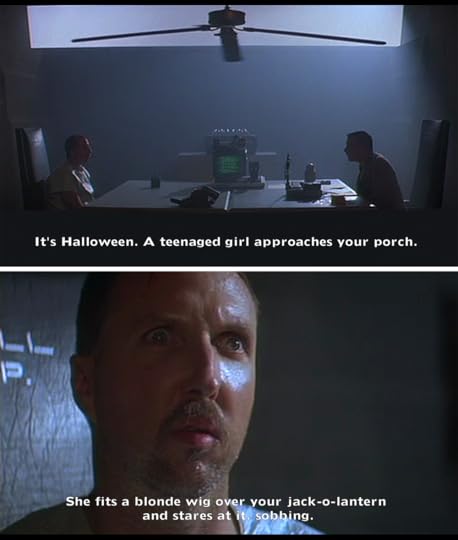
I should at least take the Voight-Kampff test, and rule out replicant. I hope I do better on it than I did the SATs.
edit: I successfully added six quotes. I'm human, apparently. Or at minimum, sentient. Yay, Ray!


Re: Breton Movers, p 12-14: (Illustrates in part, that there is nothing wrong with a well-placed adverb):
Supremely indifferent to the chorus of car horns behind them, they took their time maneuvering into position, displaying with their Herculean strength the utmost disdain for the rest of humanity … As in all good criminal bands, the shortest one was the leader. Mind you, what Raymond lacked in height he made up for in width… Each of them exuded a smell of musk, of wild animal escaped from its cage… Each worker made it clear that (Brice) had no business getting under their feet. At that point, the existential lack of purpose which had dogged him from earliest childhood assumed monumental proportions, and he suggested going to fetch them cold drinks.

p18: For the first time in his existence he was a (home) owner. But an owner of what? Of an empty universe, round which the crackling of the match struck for his cigarette echoed in a semblance of the Big Bang.

p 20: A few drops of rain splashed down on his feet, and spread like ink on blotting paper. No two fell in the same spot.

(“No two fell in the same spot”. A fascinating observation, no?)

p.57: He loathed dogs, all dogs, for the good reason that they were man’s best friend. In their dark cavernous mouths, foaming, and bristling with yellow fangs, and their eyes, which bulged from the pull of the chains, there was everything he hated in their masters.

p106: TV was TV. It was not what it showed you that mattered but the way you looked at it, like the ever-changing patterns of a kaleidoscope. It could still be watched when it was switched off.

p.109: Blanche to Brice: ‘Don’t believe what they tell you. There’s nothing above us, and nothing beneath. Just us, here and now, like survivors of a shipwreck.’
Profile Image for Andy Weston.
3,206 reviews226 followers
October 16, 2016
"Your room is very quiet. It looks out on to the cemetery."

It was a clear night. The rows of little tombs were reminiscent of an outdoor cinema auditorium.

"This was my father's room. No one has slept here since. He didn't go far. He's over there behind the cypress."

For those who have never read Garnier this is a fairly typical passage. Filled with imagery, dark and yet a little humour, I find everything he writes to be extremely rewarding to read. He has gained popularity only quite recently in the UK. Though he died in 2010 fortunately there are still quite a few of his books awaiting translation. I have read them all. They are novella length, so why might you ask does this only gain 4 stars.

Boxes is about Brice, a twenty something year old grieving for the recent death of his wife. He refuses to believe she is dead and this affects his work and relationship with her family. A new relationship with a neighbour, Blanche, helps him to recover, but as ever with Garnier's books, all is not what it seems.

I have always thought Garnier's books could be longer. It's a great criticism for him, as he has left the reader wanting more. In this case though, I felt the story could even have been condensed. There is a period in the middle of the 120 pages where the story doesn't really go anywhere. It remains though, a thoroughly rewarding read.
Profile Image for Melinda.
1,020 reviews
August 13, 2016
The language is beautiful only complimented by the stellar translation. The momentum of darkness purposefully unfolds as Brice precipices on the brink of depression to madness. You’re almost sucked into the darkness, the abyss of despair palpable. Intuition dismissed as Brice senses something isn’t quite right with Blanche. Mixed feelings regarding Blanche’s appearance, her confession came to quickly feeling untidy. No doubt her backstory was darker than I anticipated, nice touch to the overall plot and demented characterization. I enjoyed the suspense, however I felt the ending was abrupt, it left me wanting more. The journey was enjoyable more so than the destination, still well shaped.
Profile Image for Jim.
2,417 reviews799 followers
July 1, 2021
Another fantastic noir novel by Pascal Garnier, who is easily the French equivalent of Jim Thompson, David Goodis, and Charles Willeford. Boxes is, like most of Garnier's noir works, a quick read that leaves one panting for more when one reaches the last page.

Brice has moved to a large house in a provincial French village, but his wife, a foreign correspondent, has not returned. Brice does not know what to do, so he lives out of the boxes involved in the move. He gets involved with a very independent cat, who seems to have a secret entry into the house, and also with Blanche Montéléger, a 39-year-old woman who is rather odd. She always dresses in white, lives on package soups, and loves to watch junky television shows with Brice.

Brice's in-laws come to visit and are repelled by Blanche and Brice. They hint that his wife is not coming back, though not quite saying whether she is alive or dead. We never really know, but we do know that Brice is slowly sinking into the pit.
Profile Image for Cleopatra  Pullen.
1,560 reviews323 followers
October 5, 2015
From what I’ve gathered Pascal Garnier’s book Boxes was published posthumously following his death in 2010, also little birds have indicated that this probably isn’t the best example of his work, but I found plenty to enjoy, if enjoy is indeed the right word for such a grim and gloomy book.

Brice is moving to the country from the apartment he shared with his wife Emma in Lyon to the countryside, hence the title, all their lives are packed into labelled boxes ready for the removal men to arrive:

Perhaps it was an occupational hazard, but they were all reminiscent of a piece of furniture: the one called Jean-Jean, a Louis-Phillippe chest of drawers; Ludo, a Normandy wardrobe; and the tall, shifty looking one affectionately known as The Eel, a grandfather clock. This outfit of rascals with bulging muscles and smiles baring wolf-like teeth made short work of surveying the flat.

But despite the efficient way his life is hauled from Lyon to a small village there is something missing, Emma. At first Brice makes a stab at unpacking his boxes but not for long, he wants it to be right for Emma, his younger wife, a woman he isn’t entirely sure he deserves.

But women’s hearts are unfathomable and full of oddities as the bottom of their handbags.

And then we learn that she isn’t just away, she’s missing presumed dead in a terrorist attack in Egypt, while working as a journalist. Brice knows no-one in the small village although he gets adopted by a cat but his isolation from other humans aids his descent into depression, and worse, as he fails to accept the loss of his wife or to carry on with his illustration work for a children’s book. Illustrating Mabel Hirsch’s books about Sabine had been his bread and butter but Brice dislikes Mabel, Sabine and children.

The little brat, whose face he riddled with freckles for sport, was seriously taking over his life. As for her creator, he must have killed her at least a hundred times in the course of troubled dreams. He would throttle her until her big frogspawn eyes burst out of their sockets and then tear off all her jewellery. She could no longer move her poor arthritic fingers, they were so weighed down with gold and diamonds. Strings of pearls disappeared into the soft fleshy folds of her double chin. Old, ugly and nasty with it! Al that emerged from her scar of a mouth, slathered in bloodred honey, were barbed compliments which would themselves around your neck, the better to jab you in the back.

With Emma’s parents concern is spurned and it looks like Brice’s life can’t get any worse he meets Blanche, who is at best a little eccentric and constantly impresses on Brice how much he looks like her father who was also an artists. Let’s just say the story becomes even more weird!

This is a short book, easily read with wonderful language, especially considering that it is a work of translation which evokes many feelings, most of which are, admittedly at the grimmer end of the scale. I am absolutely sure I will be seeking out more of Pascal Garnier’s books as this evoked memories of the dark short stories written by the late Roald Dahl, that I loved in my teens.

I’d like to thank the publishers Gallic Books for my copy of this book in return for this honest review. Boxes was published in English in May 2015.
Profile Image for Lynn.
458 reviews4 followers
November 30, 2015
Thank you Pascal you have restored my faith in consistently good authors.
Profile Image for Jane.
107 reviews8 followers
June 15, 2016
Exquisite language for this beautifully noir histoire. (Beautifully grim as in a Hieronymus Bosch painting.)
Profile Image for Margaret.
904 reviews36 followers
November 21, 2024
I simply don't know what to make of this. Brice's wife Emma has disappeared, leaving him to manage alone the move into the countryside which she had wished for. In this book, we witness Brice's descent into depression and madness. We see his developing odd friendship with his neighbour Blanche. Various intriguing hints are dropped, but never ultimately satisfied. For instance, why does Brice so strongly resemble Blanche's father?

The house, the surrounding countryside are described in unsettling ways. Everything is alien. Brice's past life. His present life. His career, which he abandons, apparently on a whim. Everything's on a whim. His shopping choices; the gifts he offers; the decisions he makes, or fails to make about unpacking; the hole he stoves into the kitchen/dining room wall. It was all a bit like watching a certain kind of French film.

I kept on reading, intrigued by my own restlessness in the act of reading. It's tantalisingly, often beautifully written. But on the strenth of this book, will I read another Garnier? Unlikely.
Profile Image for LeastTorque.
955 reviews18 followers
July 24, 2023
Not the author’s best, but did a fair job of portraying the discombobulating effect of grief.
Profile Image for Best_books.
316 reviews3 followers
August 30, 2025
This was weird and enthralling and followed a distinctive pattern, language and themes beloved by this author.

V enjoyable couple of hours !
Profile Image for Nikki in Niagara.
4,386 reviews174 followers
December 1, 2015
The cover of this book caught my eye and then when I saw the author being compared with Georges Simenon's psychologicals I just had to give it a try. I am a huge fan of Simenon's psychological novels (though not Maigret). Boxes is described as "noir" and in this case, that word means dark, cynical and depressing. It is comparable to Simenon but doesn't come close to his brilliance. I won't get into the plot as the book is a novella and we only know what is happening as it unravels with the plot. We do know at the beginning that Brice has moved into a new home he and his wife Emma bought, but Emma is missing. Why is eventually slowly revealed. Brice is not a stable person and he meets an equally unstable younger woman in the village to which he has moved. The atmosphere, the characters and the twists of plot are all morbidly bleak but I 'enjoy' unhappy books so that didn't displease me. In fact, I found some brilliant quotes that resonated with me. I do, however, feel that something may have been lost in the translation from the original French as there were some stilted sentences that just didn't flow naturally for me. The ending was abrupt and jarring to say the least. I understand it though I thought it could have been more eloquently written, perhaps it, again, was lost in translation. I am intrigued by the author however and would like to try him again.
Profile Image for Kasa Cotugno.
2,758 reviews588 followers
April 16, 2016

Brice and his wife Emma, at her encouraging, have sold their city apartment and bought a house in the country. And this is not the romantic Provence-style France of imagination, but a suburbia that could just as well be in anywhere U.S.A. As Emma is not around, Brice is tasked with the job of performing the move. Dealing with the boxes. Boxes upon boxes. As with the only other Garnier book I've read so far, there is a smear of menace that hangs over the proceedings. Garnier has been called the most noir of contemporary writers in any language, and this is no exception. Brice is a loner, many of his inner musings are along the lines of "Children are Nazis. They recognize only one race: their own." So much exquisite writing here, with more than the usual black humor for noir: ("At his feet the spring babbled the mountain gossip...It was beautiful, and it was sad. It made you want to write a poem, or to shit. He opted for the second.")

I've only recently discovered Pascal Garnier, and have to space out his spare novels, almost novellas, so I don't run out soon since he died in 2010 and they are slowly being released in English editions. There are only 7 so far, with an 8th coming in June. I'd like to say I can't wait, but since the list is finite, will gladly wait.

Profile Image for Lisa.
1,719 reviews
June 6, 2016
This short novel has been on my reading list since a review in the Financial Times likened the author to Camus. It is fantastic as a study of grief and loss. It is an exploration of existentialism as a grieving man tries to redefine himself as a suddenly single man. The ending was too abrupt and bizarre to me but I will be playing this out in my mind for time to come. I've already ordered more of his novels. My only criticism is of the translation. I read foreign language novels to be immersed in culture but lament that I can't read in the original language. This is the first time I feel that I can comment on quality of the translation. I didn't like that it made me feel like the setting was England rather than France. The translator used very British slang such as "lad, how do I look then, on special offer, pheasant was done to a turn" rather than more neutral terms or even French terms. No doubt translation is difficult but it was too British to make it work.
Profile Image for Deborah.
419 reviews37 followers
November 4, 2016
In my review of Pascal Garnier's The A26, I complained that Melanie Florence's translation was too British for a book set in France, and the same flaw plagues her translation of Boxes, where we encounter a "brolly" and a "chap" among other things. Unfortunately, Garnier's story is not strong enough to overcome the flat tone. For its first 157 pages, Boxes is an unexciting tale of a man moving house while he waits for his journalist wife to return from an assignment. The plot takes an interesting turn on page 158, but with only 11 pages left in the book, it's too little, too late.

This review was based on a free ARC provided by the publisher.
Profile Image for Pascale.
1,366 reviews66 followers
January 2, 2015
This is the story of a man who lets himself go to pieces after his wife dies while doing a reportage in Egypt, even though he is in complete denial and pretends to others that he is still awaiting her return. Having only just moved to a house in a nondescript village, he finds himself unable to unpack his belongings, and starts living like a hobo in his own garage. Help comes to him in the form of a weird spinster who has lived pretty much like a recluse since her father died. Traumatized by the losses they have sustained, Brice and Blanche find a measure of comfort in each other's company. However, things end badly when Brice starts climbing out of his hole, and Blanche wants more from him than he is willing to give. Their story is told with a mixture of tenderness and sharp humor I found irresistible. Garnier's prose is fantastic, and I intend to read a lot more of him.
Profile Image for Kylie Combs.
652 reviews2 followers
April 29, 2016
This honestly was a pretty decent modern retelling of a Gothic ghost story I just, really kinda hated the protagonist. There was zero character development, which was also vastly disappointing. I really wish it would have been written from Blanche's point of view since she had a more interesting story and actual emotions, and you know, character development. There were a few references that I didn't understand, simply because I'm unfortunately not French. There were a few moments of brilliant descriptions, so his writing might be worth giving another try. My favorite line that was more beautiful than any I've read in awhile is proof of this. I adore it. "Time, in it's monotony, put scars on the wounds."
Profile Image for Mandy.
3,623 reviews333 followers
August 31, 2015
Unpredictable and often surprising, this short and original novel from acclaimed French author Pascal Garnier is deceptively simple. It tells of Brice and Emma who have recently bought a house in a small village and now moving day has arrived. Amidst the chaos this brings, Brice is left to cope alone as Emma is away somewhere. Gradually the chaos overwhelms Brice and his life starts to fall apart. Meeting his mysterious and enigmatic neighbour Blanche only adds to his disorientation. It’s an atmospheric and absorbing tale, an exploration of loss and abandonment, often quirkily amusing and sometimes very moving.
Displaying 1 - 30 of 46 reviews

Can't find what you're looking for?

Get help and learn more about the design.