Mestra, daughter of the King of Thessaly, is granted a unique gift by Poseidon: the ability to transform into any being she can imagine. Her father, on the other hand, is cursed: As punishment for disrespecting the goddess Demeter, he has an unnatural, insatiable hunger. Devoted Mestra suggests using her new gift to help her father. But if his hunger is bottomless, how much will he take from her? Soon she must decide: Will she keep helping her father survive, or finally break free?
Madeline Miller was born in Boston and grew up in New York City and Philadelphia. She attended Brown University, where she earned her BA and MA in Classics. For the last ten years she has been teaching and tutoring Latin, Greek and Shakespeare to high school students. She has also studied at the University of Chicago’s Committee on Social Thought, and in the Dramaturgy department at Yale School of Drama, where she focused on the adaptation of classical texts to modern forms. She currently lives in Cambridge, MA, where she teaches and writes. The Song of Achilles is her first novel.
No one to talk with, all by myself / No one to walk with, but I'm happy on the shelf (Ain’t Misbehavin’ – Carmen McRae).
It’s a special occasion, Mimi’s emancipation! Okay well, maybe not quite that, said event already happened, but it is a cause for celebration because there’s a new Madeline Miller book out! Was Circe really the last one that came out? Damn, even the wait for GTA 6 wasn't as torturous as this. And yes, it's that serious. You know how people are always like, “I would listen to [random actor here] read a phone book” and all that? Yeah well, Madeline Miller is that kind of author for me, because I’d totally read her tragic retelling of the phone book and be all annoying talking about the added nuance and the layers that her version expanded upon the original. I’m sure I’d walk away with a different point of view and a better understanding of life. I know I can be rather long-winded, but there’s something about Madeline Miller’s writing that leaves me speechless, which is good for my reading experience, but absolutely abysmal for my “review writing” ability. I’m rendered into caveman speak where all I can say is, “book… good.” Which I guess makes sense because reading her books feels like discovering fire. Anyway, if nothing else, I’m just glad she’s still writing books because even though I know that's her job as an author, I've noticed there’s something about people with acclaimed works under their belt that makes them want to never write again. It's the "Frank Ocean hasn't released an album since 2016" affliction, and I'm afraid it's terminal. It’s as if these artists get so obsessed with their legacy and the weight of how perfect their previous works were that they’re afraid that if they continue making art, eventually it’ll get more and more diluted. Loss of luster. Nobody wants to peak at their debut, and there’s nothing an artist fears more than being called washed by the general public.
I don't really want to talk about him because he grosses me out, but take Quentin Tarantino for example, that foot-faced foot lover has been so daunted by the idea of making sure his tenth film his Final Film to ensure he had a "perfect run of movies" that he has quite literally stalled in place for close to a decade now. Well, I’m off-topic already, so I'll just say it, when you've made the movie Hateful Eight, then your record is far from clean. And hey, I’ve got news for the director; he’s already made ten movies. Kill Bill one and two still count as two movies no matter how much you try to claim they were originally supposed to be one whole story, that’s not how it was released in theaters, my guy. Besides, if we’re already playing at semantics in order to keep within a strict set of rules that are completely made up, then you might as well continue making movies without restrictions anyway. Can you imagine if Martin Scorsese stopped at his tenth? Then we wouldn’t have had Goodfellas, The Age of Innocence, or Killers of the Flower Moon! All I’m saying is that the best way to counter-act whisperings that you’ve peaked as an artist is to just keep making art. People mostly only knowing the songs from Purple Rain never stopped Prince from creating decades worth of music, and you know why? Because he was a musician, and musicians make music. I believe Madonna said it best, “Don't try to distract me with numbers, I did it all for love!” Sure, I wouldn’t bet on anything ever beating out The Song of Achilles or Circe in my mind, but that doesn’t mean there’s no point in ever creating something beautiful again. Anyway, I’ve been avoiding getting too in-depth on today’s topic, Mestra, because I literally don’t know what else to say other than it was the best damn thing I’ve read in weeks. I would normally say “it was the best damn thing I’ve read in months” for emphasis… but I've actually read a lot of good books, so “weeks” is just going to have to suffice.
“Such scraps had kept me chewing for years. But I was no child to him, only the closest piece of meat.”
Hey, this is still a lovely retelling that showcases Madeline Miller’s prose at both its most optimistic and grotesque. The way she can repulse the reader with simple descriptions of mundane scenes about Mestra's king father grossly eating his food lets me know that she would absolutely kill it if she wrote a Lord of the Rings retelling. But you know, mainly that scene where Boromir's own king dad was eating those tomatoes like a freak. See, the thing I love about the way she writes Greek Mythology retellings is that there’s a rage at injustice overflowing from the page, but it’s still told through a deep well of understanding and respect for the source material. A lot of people will look at literature that's offensive to them and figure that they can "do better" without recognizing what the text did accomplish, and the problem with this approach is that when you "make things better" by erasing everything that made you uncomfortable, you lose the aspects of the story that incited such a passionate response in the first place. Retellings can be a hit or miss because you need to be able to capture the essence of the original while both adding your own spin on the tale and side-stepping repeated ventures. All I’m trying to say is that I’ve read a couple retellings of classics that feel like their own thing with known characters placed into roles that in no way reflect their original context. You know, like fanfiction. For example, the book Heartless by Marissa Myer is an Alice in Wonderland retelling from the perspective of the evil Queen of Hearts before she was, well, evil, and even though the book itself was great, I couldn’t find a strong connection between it and the original. Like, you might as well write your own thing if you have to change the characters so much that they don’t even resemble their original iteration.
On that note, the reason why I love retellings like The Song of Achilles, Circe, Galatea, and now Mestra, is because even though they’re written with the mission of giving a voice to the unheard, these characters still exist in their original context. Every one of Madeline Miller’s books is a protest song, but that doesn’t mean every depiction of evil is written with the express purpose to moralize. This is what literature is for, to make us feel injustice through prose or verse and let us decide what we’re going to about it. Retellings are an especially powerful tool in this regard because they can feel like a call-and-response across the eons. Mestra’s story has been around for thousands of years now, and it's through works like Mestra that we're able to recontextualize what we take away from it. In that sense, I’m sure you’re already aware of the myth, you’re well-read, but I totally didn’t know about this myth before reading this, so this is the definitive version in my mind. Performative Male Voice: hey, you know what’s really scary this Halloween season? Poor treatment of women and inborn systemic sexism! No but really, The way Mestra’s dad was cursed with insatiable hunger and the reveal that in a way, Mestra herself was cursed with the hunger of trying to please him due to her place as a “woman in society” is not only incredibly emotionally poignant, but also painfully reflective of our time, her time, any time. Performative Male Voice: because my fellow men, how can we treat women this way 😔. What gives Mestra its unique voice isn’t just that it depicts a great injustice that’s eventually made right through self-reflection and emancipation, but the fact that it doesn’t lecture its readers along the way. See, Madeline Miller understands that the job of an author isn’t to preach, but rather to give people the opportunity to think for themselves. Thanks to her, we’ve got options.
I don't stay out late, don't care to go / I'm home about eight, just me and my radio.
She has a remarkable gift for retelling Greek myths. No matter how much she reshapes the original stories, she draws me in and fully immerses me.
Although this is a short story, it feels complete and satisfying. I never wished it were longer or thought it needed additional pages to develop the plot or characters. It feels just right as it is.
We know relatively little about Mestra and her myth today, and she isn’t a figure many people know, so I’m glad the author chose to tell her story. The retelling does change some details, and now that I'm older, I can see how the author softens the gods' cruelty compared with the original myths. Even so, she continues to write thoughtful, compelling retellings.
Mestra is about a girl who gives everything to her greedy father while convincing herself that she is happy. Eventually, she comes to understand that true happiness means being free and able to live as her true self. The author beautifully develops Mestra from a lonely girl, hungry for her father's approval, into a woman who recognizes she deserves more than chasing the affection of a father who was never truly there for her.
In conclusion, this was a lovely, satisfying short story.
firstly, thank you to the publisher because i am extremely grateful to have received an ALC
of course, i was beyond excited for another retelling from THE mythology queen, madeline miller, and she did not disappoint with this quick bite of a story featuring mestra, the daughter of the king of thessaly.
she has been gifted the unique ability of meamorphosis, or shapeshifting, from poseidon. however, her father has been cursed by demeter to be unnaturally and insatiably hungry after disrespecting the goddess.
mestra is both a short story physically and as an audio, but is still full of the lush and lyrical writing readers are familiar with and expect from a modern classic author such as miller.
i cannot wait for her next full length novel, as the recent short stories are such a tease!
Thank you to HarperCollins for the ARC! Madeline Miller is genuinely on another level. She takes ancient myths and turns them into stories that touch you so deeply that you feel like you’ve always known them. If you enjoyed 𝘎𝘢𝘭𝘢𝘵𝘦𝘢, this is right up your alley. Perfect as always.
“This is not a feeling that can be given it can only be found.”
If I could make this book required reading for men, I would. It’s only 80 pages so I think they could handle it physically. Emotionally? I doubt it. This book is unfortunately timely, and it just becomes more relevant by the second.
Men will unapologetically rape women, sell women, and cut pieces off of women for their own gain. Until, of course, those women are no longer useful. Or until, against all odds, women learn to fight back.
I felt physically ill the entire time I read this. And now I am just so sad. No one tells a story like Madeline Miller.
One last thing, I don’t mean to be greedy, but I would do anything for a full length novel. I’ve already read this twice.
Fans hungering for another novel from Madeline Miller must be satisfied with this amuse-bouche.
On Tuesday, the fabulously popular classicist who published The Song of Achilles and Circe will release a short story titled Mestra. At your local bookstore, you’re likely to see stacks of this tiny $15 hardback near the register along with bookmarks, novelty mugs, and enamel pins (I♥BOOKS).
Mestra is drawn from a creepy Greek myth about King Erysichthon, who’s cursed with insatiable hunger as punishment for chopping down Demeter’s sacred trees.
After consuming everything in his kingdom, Erysichthon finally sells off his own daughter, Mestra, for seven chickens.
But Poseidon takes pity on her and gives her the gift of infinite transformation. Unfortunately, King Erysichthon sees his daughter’s new skill as the basis for an endless series of grifts.
Miller uses the bones of this tale to flesh out a fairy tale of self-destructive devotion and shocking parental exploitation. Mestra gives and gives; her father takes and takes — and finally demands so much more.
Though packaged as a little gift book, Mestra reads like a grisly parable for the children of addicts of all kinds. It also resonates with the debate about adult....
madeline miller is the QUEEN of retelling lost greek myths. 𝓶𝓮𝓼𝓽𝓻𝓪 is "blessed" by 🤮poseidon🤮 with the gift of transforming into who & whatever she has seen. unfortunately her ABUSIVE FKING DAD keeps telling her to change into women & cattle so that he can SELL her off in order for he, HIMSELF, to buy food to eat. HE NEVER LETS MESTRA EAT EVER AND absolutely horrifying & tragic, with an ending that'll have you clapping your hands
ᝰ.ᐟ 𝓭𝓲𝓪𝓻𝔂𓂃🐦🔥 ❤️ "my father sold me to the man for seven roasted chickens" WTAF 💛 FKING POSEIDON ❤️ BWHAHAA SHE TURNED INTO A MAN 💛 this transformation power is fun ❤️ her dad is such a bitch 💛 EWWWWWWWWWWWWWWW
⋆.ೃ࿔*:・ 𝓹𝓻𝓮𝓻𝓮𝓪𝓭 🐦🔥 will this be better than galatea???
𝓹𝓻𝓮𝓵𝓮𝓪𝓼𝓮 madeline miller are u gonna make me cry again? 🫶🏻🥹❤️🩹
madeline miller there is simply nobody like you. there is nothing to say about this author that hasn't been said before she's absolutely from another time. While i am craving for a full novel from her this was absolutely exceptional, her ability to make you feel So much in such a short amount of time is truly unique to her. Mestra is a gut-wrenching toxical parental relationship, as someone who can connect to this topic it was definitely emotional and difficult to read about, but in true madeline's fashion it's absolutely rewarding to see Mestra freeing and finding herself from it. Since she released tsoa there has been many people trying to recreate greek mythology in their own way but there is nothing like reading one of her retellings, she makes each and every character she writes about so full of personality and color. 10/10 recommend picking this up and everything else she's ever written.
thank you to edelweiss and the publisher for providing the advance review copy.
The dry writing suited the mythological retelling, but this was surprisingly easy to put down. It was disturbing as expected, but nowhere near as impactful as I’d hoped. I did like her touching upon the concept of identity theft, though.
This short story took about twenty minutes to read, but is a fascinating tale of Mestra, a woman whose father infuriated the Gods and whose insatiable hunger leads him to sell her into marriage. However, in her greatest moment of need, she finds that she has been given a gift by the Gods and it changes everything in her life.
I loved Mestra finding her power in this short read.
"Their slobber and handprints could not stick. When I changed, we were wiped clean."
Gut-wrenching and insightful, this short story explores the myth of Mestra whose father was cursed with incessant, unfulfilled hunger after he cut down goddess Demeter's sacred trees. This will, most definitely, make you angry. It might also break your heart. 😭
I love how Madeline Miller explores the notion of hunger and how it operates on multiple levels throughout this story. For example, hunger for sustenance, hunger for personal profit, hunger for love, hunger for justice, and hunger for freedom. All these versions coexist and they influence the decisions and actions of the characters. It also feels as if hunger is a character on its own; this constant presence looming over the narrative.
Shapeshifting, initially this god-given gift, creates the space for exploration and, at times, the deconstruction of identity. The ability to be everything juxtaposes the desire to have everything - shapeshifting versus hunger. The writing facilitates a wonderful discussion on what truly matters to the characters.
I wasn't familiar with the myth of Mestra and I researched it briefly prior to reading this story. The myth itself is heartwrenching; this story presents it in a way which elevates it further.
It's a really short read, which could explain why the ending wrapped up quickly. It didn't bother me per se, but I was left wanting a bit more. 😅
I'd recommend this story though, regardless of its length. 📚 Madeline Miller, I understand the hype now! Consider me, a fan. 🥰
I’ve been enjoying these short stories from Madeline Miller, Galatea was so good and I jumped into Mestra on its release day (thanks to my library having the audios)! Bite-size in length, the audio was 1 hour, but a full meal of a story.
In this Greek mythology retelling we follow Mestra, who is 15-years old and the daughter of a once-wealthy man. Her father has been cursed with insatiable hunger by the gods and has spent all of his wealth to feed himself. Now he turns to selling Mestra to men for payment for his food. But Mestra has also been visited by a god, Poseidon specifically who bestowed a gift of shapeshifting upon her. With this gift, Mestra is able to shift and get away from those her father sells her to and returns home, but of course that isn’t the end of that since her father sees it as a way to be able to con even more men quicker. And so the story goes!
What a ride and like any Greek mythology tale, so many things to be taken away from this story! Addiction, female resilience, greed, survival.
Mestra is a beautifully written but genuinely heartbreaking read. For such a short story, madelline miller yet again packed a surprising amount of emotional weight. Mestra’s situation becomes more devastating with every page, especially watching her own father reduce her to something he can sell, use, and eventually consume because of his endless hunger. The way her shapeshifting reflects her attempts to survive, escape, and eventually understand her own identity was probably my favorite part.
That said, I think the short length held the story back a little for me. There were so many emotional and interesting ideas—Mestra’s trauma, her relationship with her father, her connection to Arete, and her growing sense of freedom—that I sometimes wanted more time with them. Some moments felt like they could have hit even harder if they had been given more space to develop.
Still, the ending and the final idea of Mestra accepting all the different versions of herself really stayed with me. Not quite a five-star read for me, but absolutely a story that hurt in the best and worst way.
I am a simple woman. If Madeline Miller writes it, my eyeballs need it. I must read it immediately.
This is a very short but haunting retelling of yet another overlooked woman from Greek mythology who finally gets a voice of her own. The story is beautifully written, balancing myth and emotion while exploring themes of greed, survival, freedom and having power over your own fate. Despite its brevity, Mestra felt vivid and complex, and I was left battling a confusing mixture of extreme revulsion and a sense empowerment in its wake.
It never ceases to amaze me how much Miller manages to express in so few words.
😕sigh. i can’t say i cared for this story much. i feel so disappointed, i think after waiting for madeline miller to write and release something for…8 years..i just expected more? thank you to harpercollins for the arc.
It’s a bit too short to leave me with coherent thoughts, but I missed Madeline Miller’s writing a lot. I need more of a full-length book from her <3 :D
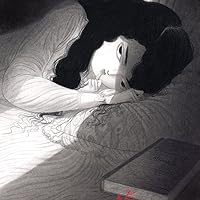
Dopo Galatea mi sono tuffata in questo nuovo retelling di Madeline Miller, di nuovo con le illustrazioni suggestive di Ambra Garlaschelli, tutte sulle sfumature di blu, un po' ombre cinesi, un po' figure nere o rosse su vasi antichi. La giovane Mestra, principessa di Tessaglia, scopre di aver ricevuto un dono dal dio Poseidone (o forse lo ha sempre avuto?): è in grado di trasformarsi in qualsiasi persona o animale su cui abbia posato lo sguardo almeno una volta. Suo padre già da tempo è afflitto da una terribile maledizione che lo costringe a ingerire quantità abnormi di cibo che tuttavia non lo saziano mai. Dato che le risorse auree scarseggiano il vecchio re decide così di sfruttare le capacità metamorfiche della figlia per venderla senza alcun riguardo in molteplici forme e continuare a nutrirsi. Mestra accetta e resta per senso del dovere, ma questo dono sembra accendere in lei una certa consapevolezza e voglia di libertà... Una storia sul corpo, sull'indipendenza, sull'appartenenza al proprio sé; una storia femminista breve e intensa.