

What do you think?

Win a free print copy of this book!
21 days and 08:25:37
20 copies available
U.S. only
The Weight of Angels
Win a free print copy of this book!
21 days and 08:25:37
20 copies available
U.S. only
'John Boyne is one of our best authors writing today. The Weight of Angels is wise, imaginative, funny, and extremely moving. Art and Life, Tragedy and Love, you’ll find them all here in this rich and magnificent novel' Tan Twain Eng, Booker longlisted author of The House of Doors
Can one rash decision prove the difference between a life well lived and a life destroyed?
When the Marquis of Queensbury left his calling card at the Albemarle Club in February 1895, it bore only his name and five words: ‘For Oscar Wilde, posing Somdomite’. The most feted playwright of his day famously sued for libel, which led to his arrest, criminal prosecution and ultimately prison. From then on, his gilded existence spiralled into public disgrace, humiliation and an early death.
But what if he had simply ignored the insult? What direction might his life have taken? This is the premise of John Boyne’s extraordinary new novel, The Weight of Angels.
Rather than dying in penury in Paris at the age of forty-six, what if he had lived to bear witness to the momentous events and cataclysmic changes of the first part of the twentieth century, and even influence some of them? What if the second half of his life were as celebrated, dramatic, tumultuous and exhilarating as the first?
In imagining the life that Oscar Wilde never had, John Boyne has written one of the great what-if stories of modern literature, giving the great Anglo-Irish poet and playwright a fresh new voice and the opportunity to take an entirely different path.
Can one rash decision prove the difference between a life well lived and a life destroyed?
When the Marquis of Queensbury left his calling card at the Albemarle Club in February 1895, it bore only his name and five words: ‘For Oscar Wilde, posing Somdomite’. The most feted playwright of his day famously sued for libel, which led to his arrest, criminal prosecution and ultimately prison. From then on, his gilded existence spiralled into public disgrace, humiliation and an early death.
But what if he had simply ignored the insult? What direction might his life have taken? This is the premise of John Boyne’s extraordinary new novel, The Weight of Angels.
Rather than dying in penury in Paris at the age of forty-six, what if he had lived to bear witness to the momentous events and cataclysmic changes of the first part of the twentieth century, and even influence some of them? What if the second half of his life were as celebrated, dramatic, tumultuous and exhilarating as the first?
In imagining the life that Oscar Wilde never had, John Boyne has written one of the great what-if stories of modern literature, giving the great Anglo-Irish poet and playwright a fresh new voice and the opportunity to take an entirely different path.
624 pages, ebook
Expected publication September 29, 2026
About the author
John Boyne
77 books16.8k followersI was born in Dublin, Ireland, and studied English Literature at Trinity College, Dublin, and Creative Writing at the University of East Anglia, Norwich. In 2015, I was awarded an Honorary Doctorate of Letters by UEA.
I’ve published 14 novels for adults, 6 novels for younger readers, and a short story collection. The Boy In The Striped Pyjamas was a New York Times no.1 Bestseller and was adapted for a feature film, a play, a ballet and an opera, selling around 11 million copies worldwide.
Among my most popular books are The Heart’s Invisible Furies, A Ladder to the Sky and My Brother’s Name is Jessica.
I’m also a regular book reviewer for The Irish Times.
In 2012, I was awarded the Hennessy Literary ‘Hall of Fame’ Award for my body of work. I’ve also won 4 Irish Book Awards, and many international literary awards, including the Que Leer Award for Novel of the Year in Spain and the Gustav Heinemann Peace Prize in Germany. In 2015, I was awarded an Honorary Doctorate of Letters from the University of East Anglia.
My novels are published in 58 languages.
My 14th adult novel, ALL THE BROKEN PLACES, a sequel and companion novel to THE BOY IN THE STRIPED PYJAMAS, will be published in the UK on September 15th 2022, in the US and Canada on November 29th, and in many foreign language editions in late 2022 and 2023.
I’ve published 14 novels for adults, 6 novels for younger readers, and a short story collection. The Boy In The Striped Pyjamas was a New York Times no.1 Bestseller and was adapted for a feature film, a play, a ballet and an opera, selling around 11 million copies worldwide.
Among my most popular books are The Heart’s Invisible Furies, A Ladder to the Sky and My Brother’s Name is Jessica.
I’m also a regular book reviewer for The Irish Times.
In 2012, I was awarded the Hennessy Literary ‘Hall of Fame’ Award for my body of work. I’ve also won 4 Irish Book Awards, and many international literary awards, including the Que Leer Award for Novel of the Year in Spain and the Gustav Heinemann Peace Prize in Germany. In 2015, I was awarded an Honorary Doctorate of Letters from the University of East Anglia.
My novels are published in 58 languages.
My 14th adult novel, ALL THE BROKEN PLACES, a sequel and companion novel to THE BOY IN THE STRIPED PYJAMAS, will be published in the UK on September 15th 2022, in the US and Canada on November 29th, and in many foreign language editions in late 2022 and 2023.
Ratings & Reviews
Friends & Following
Create a free account to discover what your friends think of this book!
Community Reviews
Displaying 1 - 30 of 146 reviews

Review of advance copy received from NetGalley
It was 1895 when the Marquis of Queensbury ( the father of Wilde’s lover) left a card at the Albemarle Club calling Oscar Wilde a “posing Somdomite, wrongly spelling sodomite.” Wilde’s decision to sue for libel backfired, leading to his arrest for gross indecency and a two year prison sentence.
But what if Wilde had ignored the insult? John Boyne has created an alternative and ambitious reality, showing what COULD have happened in Oscar Wilde’s life had he not spent two years in prison for his sexuality. In addition, he has bestowed upon Wilde, a much longer life than he actually had.
With so many quotable gems, and sweeping historical details, involving interactions between Wilde and royalty, literary greats, politicians, and stars of stage and screen, it makes for a fascinating read. The dialogue is brilliant, although I wouldn’t expect anything less from John Boyne. I loved the way he captured Wilde’s acerbic wit - just genius, and I can imagine Wilde chuckling his way through this novel. Humour aside though, it was exceptionally moving, and showed a sometimes compassionate side to Wilde.
*Thank you to Netgalley and Random House UK, Transworld Publishers for my ARC in exchange for an honest unbiased review *
But what if Wilde had ignored the insult? John Boyne has created an alternative and ambitious reality, showing what COULD have happened in Oscar Wilde’s life had he not spent two years in prison for his sexuality. In addition, he has bestowed upon Wilde, a much longer life than he actually had.
With so many quotable gems, and sweeping historical details, involving interactions between Wilde and royalty, literary greats, politicians, and stars of stage and screen, it makes for a fascinating read. The dialogue is brilliant, although I wouldn’t expect anything less from John Boyne. I loved the way he captured Wilde’s acerbic wit - just genius, and I can imagine Wilde chuckling his way through this novel. Humour aside though, it was exceptionally moving, and showed a sometimes compassionate side to Wilde.
*Thank you to Netgalley and Random House UK, Transworld Publishers for my ARC in exchange for an honest unbiased review *

Review of advance copy received from NetGalley
'You must never take anything I say seriously, unless I'm laughing. Then it's likely to be a topic of the utmost gravity.’
I had a really hard time settling on a rating for this book, and I'm honestly still not sure if I made the right decision. The thing is, I happen to think The Weight of Angels was extremely well done... yet it struggled to sustain my interest through almost 600 pages, a problem I never had with Boyne's equally lengthy The Heart's Invisible Furies.
The first quarter to third was fine, because I was still curious to know where Boyne was going with this and what he wanted to do by essentially reversing Wilde's and Bosie's fates. I know Oscar Wilde's tale well, and it is a miserable one: a brilliant man whose health never recovered after his time imprisoned for "gross indecency"— or being gay, in other words.
Boyne imagines what might have happened had Wilde never gone to prison, and lived on instead of succumbing to illness, producing works of genius and making waves.
The strengths of the book are that it is very readable, and that Boyne successfully recreates Wilde on the page with a brilliant voice that fully captures Wilde’s wit and playful demeanour. Wilde is one of the most quotable figures we have in English, and Boyne's own humour seems well-matched. He goes on to provide decades more of quotes that feel very much like something Oscar Wilde would have said. It is no mean feat to bring to life the voice of one of the wittiest people who ever lived, yet Boyne does a fantastic job.
But while this is true, I also grew tired of what is basically an endless stream of witty conversations. The amount of historical figures, writers, and politicians who make cameos is staggering. In this sense, it reminded me a bit of Haig’s How to Stop Time, where I also grew bored with all the celebrities constantly popping in and out.
It's like "look at all the cool people he could have met and funny stuff he could have said if he'd lived" which is fine to some extent, but it couldn't carry my interest through a book of this length. And, perhaps true to his character, Wilde is not especially emotionally expressive, and instead hides behind his wit and humour. So the book is very funny, but it lacks the emotional hook that Boyne can usually summon from chapter one. It wasn't until the later chapters when I felt the book truly got to the heart of the pain and loneliness experienced when a person is treated as a criminal just for loving someone of the same sex.
Conceptually, I love it, because Oscar Wilde suffered a grave injustice and to see him resurrected is deeply satisfying. I still don't think the story here justifies spending 600 pages on it.

Review of advance copy received from NetGalley
Who better to tackle Oscar Wilde than John Boyne? They share the same intelligent sense of humor. And Boyne totally captures Wilde’s snark.
“Are you deliberately trying to be rude?”
“No, it comes quite naturally to me.”
And so it does.
The Weight of Angels posits a what if. What if Oscar Wilde hadn’t sued the Marquess of Queensberry for libel? What if he hadn’t died a pauper, shortly after his release from prison? What if he had lived a long and prosperous life? This is a long book and I definitely think it could have been tightened up. But I mostly enjoyed Wilde’s encounters with all the worthies of the late 19th and early 20th Century - Shaw, Kipling, Yeats, Stoker, Bernhardt, Gide, Forster, Eliot, the Woolfs, Churchill and Hepburn. It’s a veritable who’s who of the literary, political and social world. And Boyne delights in making fun of most of them. The book also covers the meaningful events of the time - both World Wars, the Easter Uprising, the Spanish Flu, the abdication and three different coronations. I can’t imagine the amount of research necessary to be able to portray the sheer list of real people in this book. The what ifs aren’t confined to Wilde. Boyne does the opposite with Forster, imagining he does publish Maurice before his death and suffers the consequences. I can’t help but wonder if there were other major slices of history that were turned on their heads and I was too ignorant to pick up on them.
I had to wonder if Boyne was poking fun at himself when Oscar riles against authors who write long books. I was also left questioning if certain characters were truly as dense as portrayed (the Woolfs, the Prince of Wales, pre-Wallis) or if that was Boyne having a bit of fun.
But underneath all the humor and bon mots, we get to see Wilde’s sadness and remorse. He has lost the two greatest loves of his life, along with his son. He consistently tries to find a way to get the laws changed regarding homosexuality but no politician will take up the cause until late in his life. (Another what if, it would be another decade before the laws were really changed.)
My thanks to Netgalley and Henry Holt Co. for an advance copy of this book.
“Are you deliberately trying to be rude?”
“No, it comes quite naturally to me.”
And so it does.
The Weight of Angels posits a what if. What if Oscar Wilde hadn’t sued the Marquess of Queensberry for libel? What if he hadn’t died a pauper, shortly after his release from prison? What if he had lived a long and prosperous life? This is a long book and I definitely think it could have been tightened up. But I mostly enjoyed Wilde’s encounters with all the worthies of the late 19th and early 20th Century - Shaw, Kipling, Yeats, Stoker, Bernhardt, Gide, Forster, Eliot, the Woolfs, Churchill and Hepburn. It’s a veritable who’s who of the literary, political and social world. And Boyne delights in making fun of most of them. The book also covers the meaningful events of the time - both World Wars, the Easter Uprising, the Spanish Flu, the abdication and three different coronations. I can’t imagine the amount of research necessary to be able to portray the sheer list of real people in this book. The what ifs aren’t confined to Wilde. Boyne does the opposite with Forster, imagining he does publish Maurice before his death and suffers the consequences. I can’t help but wonder if there were other major slices of history that were turned on their heads and I was too ignorant to pick up on them.
I had to wonder if Boyne was poking fun at himself when Oscar riles against authors who write long books. I was also left questioning if certain characters were truly as dense as portrayed (the Woolfs, the Prince of Wales, pre-Wallis) or if that was Boyne having a bit of fun.
But underneath all the humor and bon mots, we get to see Wilde’s sadness and remorse. He has lost the two greatest loves of his life, along with his son. He consistently tries to find a way to get the laws changed regarding homosexuality but no politician will take up the cause until late in his life. (Another what if, it would be another decade before the laws were really changed.)
My thanks to Netgalley and Henry Holt Co. for an advance copy of this book.

Review of advance copy received from NetGalley
✰ 3.25 stars ✰
I don't know if it was a wise decision to have John Boyne's latest historical fiction as my second ever read of his, but as someone who has read a few of Oscar Wilde's works, the idea that had I made a different decision, my entire life might have taken a different course certainly sounded intriguing. After the point that would've been the end of Wilde's life, I paused my reading and did a quick Wikipedia read to get a brief insight into true historical facts. It certainly helped a little bit along the way to see how real-life personal events would make their appearance.
And it is an ambitious and creative alternate reality about the life that could've been. But, in attempting to cover such an expansive range, I found it difficult to be immersed in or care about any of the meet-and-greets. Hollywood bored me; some persons mattered little, and it was also aggravating that in the moments that deserved some emotional depth, as in some actual response from Wilde, the author switched to either meta snippets (letters or plays) or time jumps.
Where I could have gone into the heart of Oscar's emotions, it avoided that deep dive, dodging the emotional stages by switching to a different perspective to relay the moments. The painful parts never allowed us to fully feel the weight of certain losses. His admitted folly, the lusting desire for younger men, seemed to merit more of a mention, which makes me wonder, was it deliberate to put him in a bad light or silently admonishing him for his past urges that led to Bosie's eventual fate—the person who replaced him in fiction over reality?
“Love was hard found, after all, and should never be taken for granted.”
It was odd that I only really felt something with Oscar's scenes with Bosie, almost as if there was guilt for having him replace him as the one convicted of the crime he committed. The real-life person - not so much deserving. However, this fight for gay love being recognized and accepted is one of the prevailing themes that follows Wilde over the course of history, amidst his past follies—that not speaking up or taking action is in its own way denying his own existence as a gay man.
The continuous allusion to certain older men's penchant for younger men, if not boys, either for their flattery and admiration or simply companionship, was often perplexing and unnerving, if not sometimes unnecessary. If there was a valid reason, I wasn't able to find it. There was also one totally unrelated bathroom encounter that I could have lived without; I just could not understand the need for its inclusion. It may seem like I'm the kind of person who clutches her pearls at the slightest indecency, which I'm not, but I just saw no reason for it...
“Lengthy novels, I feel, are so self-indulgent. Can it really take six hundred pages to tell a story?”
I couldn't decide if this is sarcasm or some clever tongue-in-cheek from JB addressing the daunting and exhausting length of his own novel. (As if my review isn't exceeding the limits of what a review should be!) While I understand the need to cover a great length of his life had it lived, no way was there any real reason to have it span more than a half a century to allow him the window of opportunity to converse with and encounter various famous figures along the way - an impressive blend of notable literary, political, cultural, and historical figures of the arts and their illustrious careers.
But my heart never felt for these characters that popped in and out. I was never allowed enough time for the feelings and emotions to develop; rather, I was inundated with various vignettes of conversations and meetings, overwhelmed with pithy dialogue and candid smartness. Wilde's own influence and contribution as the years progressed were always depicted with a stifled hand, almost as if even with the what-if scenario, it didn't allow him to have that much of a say. Never an active participant, but restrained, simply watching from the sidelines where everything really is just a matter of opinion with words.
“I wanted to be a writer. And I became a writer. That is how I spent my life. Sometimes loved; sometimes scolded. Sometimes celebrated. Sometimes loathed. Sometimes a force for change; sometimes my own worst enemy. But I was always read.”
Through a lifetime of arguments, laughter, accusations, recriminations, there were some personal relationships that felt sincere and believable. Moments that made me chuckle at the subtle jabs at certain relevant persons; the slight humor in which Oscar poked fun at himself; the referral to the weight of angels that echoed his own heartache and regret, which made my own ache, as well.
It was his final deliverance that yielded his innermost truths that captured the longing for an acceptance of an intimacy so innate that to simply be criminalized for a reciprocal love between men who both desired and treasured each other is actually the only offense, one that serves as a bittersweet reminder of how opinions still have not changed entirely even today.
And what triumphs over all my gripes is the preservation of his legacy - that he's more than just a name but a voice that survives. The worth of his literary contribution continues to draw audiences to witness and indulge in the wit and charm that made him the irrevocable and widely regarded and quoted Oscar Wilde.
P.S. A strange thing to point out, but I was happy to find some editing errors. Yes, I know it shouldn't matter in an ARC, but idk, I found it humbling...
“I'll be remembered long after I'm gone.”
I don't know if it was a wise decision to have John Boyne's latest historical fiction as my second ever read of his, but as someone who has read a few of Oscar Wilde's works, the idea that had I made a different decision, my entire life might have taken a different course certainly sounded intriguing. After the point that would've been the end of Wilde's life, I paused my reading and did a quick Wikipedia read to get a brief insight into true historical facts. It certainly helped a little bit along the way to see how real-life personal events would make their appearance.
And it is an ambitious and creative alternate reality about the life that could've been. But, in attempting to cover such an expansive range, I found it difficult to be immersed in or care about any of the meet-and-greets. Hollywood bored me; some persons mattered little, and it was also aggravating that in the moments that deserved some emotional depth, as in some actual response from Wilde, the author switched to either meta snippets (letters or plays) or time jumps.
Where I could have gone into the heart of Oscar's emotions, it avoided that deep dive, dodging the emotional stages by switching to a different perspective to relay the moments. The painful parts never allowed us to fully feel the weight of certain losses. His admitted folly, the lusting desire for younger men, seemed to merit more of a mention, which makes me wonder, was it deliberate to put him in a bad light or silently admonishing him for his past urges that led to Bosie's eventual fate—the person who replaced him in fiction over reality?
“Love was hard found, after all, and should never be taken for granted.”
It was odd that I only really felt something with Oscar's scenes with Bosie, almost as if there was guilt for having him replace him as the one convicted of the crime he committed. The real-life person - not so much deserving. However, this fight for gay love being recognized and accepted is one of the prevailing themes that follows Wilde over the course of history, amidst his past follies—that not speaking up or taking action is in its own way denying his own existence as a gay man.
The continuous allusion to certain older men's penchant for younger men, if not boys, either for their flattery and admiration or simply companionship, was often perplexing and unnerving, if not sometimes unnecessary. If there was a valid reason, I wasn't able to find it. There was also one totally unrelated bathroom encounter that I could have lived without; I just could not understand the need for its inclusion. It may seem like I'm the kind of person who clutches her pearls at the slightest indecency, which I'm not, but I just saw no reason for it...
“Lengthy novels, I feel, are so self-indulgent. Can it really take six hundred pages to tell a story?”
I couldn't decide if this is sarcasm or some clever tongue-in-cheek from JB addressing the daunting and exhausting length of his own novel. (As if my review isn't exceeding the limits of what a review should be!) While I understand the need to cover a great length of his life had it lived, no way was there any real reason to have it span more than a half a century to allow him the window of opportunity to converse with and encounter various famous figures along the way - an impressive blend of notable literary, political, cultural, and historical figures of the arts and their illustrious careers.
But my heart never felt for these characters that popped in and out. I was never allowed enough time for the feelings and emotions to develop; rather, I was inundated with various vignettes of conversations and meetings, overwhelmed with pithy dialogue and candid smartness. Wilde's own influence and contribution as the years progressed were always depicted with a stifled hand, almost as if even with the what-if scenario, it didn't allow him to have that much of a say. Never an active participant, but restrained, simply watching from the sidelines where everything really is just a matter of opinion with words.
“I wanted to be a writer. And I became a writer. That is how I spent my life. Sometimes loved; sometimes scolded. Sometimes celebrated. Sometimes loathed. Sometimes a force for change; sometimes my own worst enemy. But I was always read.”
Through a lifetime of arguments, laughter, accusations, recriminations, there were some personal relationships that felt sincere and believable. Moments that made me chuckle at the subtle jabs at certain relevant persons; the slight humor in which Oscar poked fun at himself; the referral to the weight of angels that echoed his own heartache and regret, which made my own ache, as well.
It was his final deliverance that yielded his innermost truths that captured the longing for an acceptance of an intimacy so innate that to simply be criminalized for a reciprocal love between men who both desired and treasured each other is actually the only offense, one that serves as a bittersweet reminder of how opinions still have not changed entirely even today.
And what triumphs over all my gripes is the preservation of his legacy - that he's more than just a name but a voice that survives. The worth of his literary contribution continues to draw audiences to witness and indulge in the wit and charm that made him the irrevocable and widely regarded and quoted Oscar Wilde.
P.S. A strange thing to point out, but I was happy to find some editing errors. Yes, I know it shouldn't matter in an ARC, but idk, I found it humbling...

April 17, 2026
"Please, call me Oscar. All my enemies do.”
Before picking up The Weight of Angels, I knew next to nothing about Oscar Wilde’s personal life. After finishing it, I feel like an expert, despite the fact that this book is a reimagining of history. John Boyne explores a fascinating premise: What if Wilde had never spent those two torturous years in prison for his sexuality and didn't pass away as early as he did?
Boyne is a masterclass in writing. This 600-page clunker is essentially one long, brilliant conversation between Wilde and a rotating cast of historical icons. While the dialogue is brilliant, the epistolary sections were the true highlight for me. These letters provided an intimate, raw glimpse into Wilde’s mind that even the grandest dinner party conversations couldn't capture. I found myself in the room with figures I previously only knew from history books, including:
Katherine Hepburn
Bram & Florence Stoker (is it Dracula or Dribula?)
W.B. Yeats (Willie)
Winston Churchill
Rudyard Kipling
Sir Conan Doyle
The book serves as a rich historical tapestry viewed through Wilde’s eyes, spanning from the late 1890s to the mid-1950s. You witness the world change through two World Wars and the birth of new technologies, all while feeling like a literal fly on the wall during champagne soaked discussions of art and global affairs.
“We will drink champagne together, publicly, and discuss global affairs with the intelligence and wit for which we are both celebrated. Then we will make cruel comments about casual acquaintances, focusing on their hairstyles, which we secretly admire, and their infidelities, which we secretly envy.”
Yet, beneath the humor lies a profound sadness. The book highlights the enduring hatred directed toward the gay community, making Wilde’s search for reciprocal love feel both beautiful and tragic.
“A reciprocal love between men who both desired and treasured each other. Even the idea made him feel a wealth of sorrow, for such contentment, he was certain, would surely be impossible to find.”
If I’m being honest, there were times I felt the book might be, too smart for me. At 600 pages, I occasionally found myself confused or drifting, but I recognize that as a personal hurdle rather than a flaw in Boyne’s writing.
Regardless of the length, the book is a treasure trove of quotable gems.
“Happiness, like grammar, are overrated.”
"The modern world is riddled with hypocrisy, and it’s not just the men who suffer.”
"One must never remain too long in the city of one’s birth; it’s so much more romantic to live in exile.”
If Oscar Wilde is your favorite historical figure, this book will be a dream read. It is a stunning tribute to, what could have been, and I suspect Wilde himself would have absolutely loved it.
Thank you Henry Holt for the advanced copy!
Before picking up The Weight of Angels, I knew next to nothing about Oscar Wilde’s personal life. After finishing it, I feel like an expert, despite the fact that this book is a reimagining of history. John Boyne explores a fascinating premise: What if Wilde had never spent those two torturous years in prison for his sexuality and didn't pass away as early as he did?
Boyne is a masterclass in writing. This 600-page clunker is essentially one long, brilliant conversation between Wilde and a rotating cast of historical icons. While the dialogue is brilliant, the epistolary sections were the true highlight for me. These letters provided an intimate, raw glimpse into Wilde’s mind that even the grandest dinner party conversations couldn't capture. I found myself in the room with figures I previously only knew from history books, including:
Katherine Hepburn
Bram & Florence Stoker (is it Dracula or Dribula?)
W.B. Yeats (Willie)
Winston Churchill
Rudyard Kipling
Sir Conan Doyle
The book serves as a rich historical tapestry viewed through Wilde’s eyes, spanning from the late 1890s to the mid-1950s. You witness the world change through two World Wars and the birth of new technologies, all while feeling like a literal fly on the wall during champagne soaked discussions of art and global affairs.
“We will drink champagne together, publicly, and discuss global affairs with the intelligence and wit for which we are both celebrated. Then we will make cruel comments about casual acquaintances, focusing on their hairstyles, which we secretly admire, and their infidelities, which we secretly envy.”
Yet, beneath the humor lies a profound sadness. The book highlights the enduring hatred directed toward the gay community, making Wilde’s search for reciprocal love feel both beautiful and tragic.
“A reciprocal love between men who both desired and treasured each other. Even the idea made him feel a wealth of sorrow, for such contentment, he was certain, would surely be impossible to find.”
If I’m being honest, there were times I felt the book might be, too smart for me. At 600 pages, I occasionally found myself confused or drifting, but I recognize that as a personal hurdle rather than a flaw in Boyne’s writing.
Regardless of the length, the book is a treasure trove of quotable gems.
“Happiness, like grammar, are overrated.”
"The modern world is riddled with hypocrisy, and it’s not just the men who suffer.”
"One must never remain too long in the city of one’s birth; it’s so much more romantic to live in exile.”
If Oscar Wilde is your favorite historical figure, this book will be a dream read. It is a stunning tribute to, what could have been, and I suspect Wilde himself would have absolutely loved it.
Thank you Henry Holt for the advanced copy!
Review of advance copy
John Boyne has written a sweeping speculative historical novel about Oscar Wilde, imagining his life if he had not pursued the libel suit that led to his imprisonment and untimely death. Boyne speculates about what Wilde's life would have been in the twentieth century where he would have witnessed two world wars, the coronation of Queen Elizabeth and mingled with Hollywood society. Throughout the book we are aware of Wilde's sharp wit, his deep insecurities, and his consuming guilt about his inadequacies as a husband and father. Wilde is conflicted about living a life that brings shame and prison time to men who share his proclivities, while he remains unprosecuted. The angels whose weight he bears are those whom he feels he has failed. The title is genius.
As always, Boyne's prose is flawless. This book is a departure from his previous literary fiction but contains the same in-depth character depiction. It caused me to explore more about Oscar Wilde and wonder with John Boyne what the world may have lost with his death. I am grateful to Librarything and the publisher for this ARC by this incomparable author.
As always, Boyne's prose is flawless. This book is a departure from his previous literary fiction but contains the same in-depth character depiction. It caused me to explore more about Oscar Wilde and wonder with John Boyne what the world may have lost with his death. I am grateful to Librarything and the publisher for this ARC by this incomparable author.

Review of advance copy received from NetGalley
4.5, rounded up.
It's a deliciously audacious premise - when Oscar Wilde is accused of posing as a 'somdomite' (sic) by the Marquess of Queensbury, instead of what he did IRL - i.e., suing for libel, losing and spending two years at hard labor in Reading Gaol, which breaks his health and leads to his early death in 1900 - the author decides to ignore it and goes on to live to a ripe old 98 in 1953! His paramour, Lord Alfred 'Bosie' Douglas, the Marquess's son, therefor becomes incarcerated in his stead, and goes on to write The Ballad of Reading Gaol and Other Poems instead of Oscar.
Wilde thereafter becomes a sort of Zelig or Forrest Gump character, being on hand for many of the most important events of the 20th century and meeting with a wide variety of prestigious people - all of the expected literary greats: Yeats, Forster, Kipling, etc.; but also theatrical luminaries: Katherine Hepburn, Gielgud, Olivier, Bernhardt; and political stalwarts, including Churchill, Emma Pankhurst and QE2. He also goes on to write and publish many more plays, novels and essays - some of which are excerpted here, becoming a Lord, and winning both the Nobel Prize and an Academy Award.
It takes major cojones to even attempt to imitate Wilde's wit and offer up a surfeit of clever bon mots - but Boyne is more than up to the challenge, and though perhaps not as LOL funny as his masterpiece, The Heart's Invisible Furies, the book provides ample chuckles along the way.
Boyne has a larger agenda than mere frivolity, however, and much of the book details Wilde's various attempts to repeal England's draconian laws prohibiting homosexuality and thus becomes a beacon in the struggle for gay rights.
My only minor quibble is that some of these adventures stretch the limits of probability, and at 624 pages, it also could have used some judicious editing. A few of the encounters - most notably those with the Woolfs and Mickey Rooney - seem meanspirited and not based on any real facts, and the ending's descent into mawkish sentimentality seemed off to me. I somewhat preferred Boyne's previous work The Elements, which topped my 'Best of ...' list last year.
It will be interesting to see how this is received, after the author's 'cancellation' due to his controversial views on trans people, but if that can be overlooked, perhaps he will finally get some awards recognition by the Bookers and others. Fingers crossed, and my gratitude to Netgalley and Henry Holt for the ARC in exchange for this honest and enthusiastic review.
It's a deliciously audacious premise - when Oscar Wilde is accused of posing as a 'somdomite' (sic) by the Marquess of Queensbury, instead of what he did IRL - i.e., suing for libel, losing and spending two years at hard labor in Reading Gaol, which breaks his health and leads to his early death in 1900 - the author decides to ignore it and goes on to live to a ripe old 98 in 1953! His paramour, Lord Alfred 'Bosie' Douglas, the Marquess's son, therefor becomes incarcerated in his stead, and goes on to write The Ballad of Reading Gaol and Other Poems instead of Oscar.
Wilde thereafter becomes a sort of Zelig or Forrest Gump character, being on hand for many of the most important events of the 20th century and meeting with a wide variety of prestigious people - all of the expected literary greats: Yeats, Forster, Kipling, etc.; but also theatrical luminaries: Katherine Hepburn, Gielgud, Olivier, Bernhardt; and political stalwarts, including Churchill, Emma Pankhurst and QE2. He also goes on to write and publish many more plays, novels and essays - some of which are excerpted here, becoming a Lord, and winning both the Nobel Prize and an Academy Award.
It takes major cojones to even attempt to imitate Wilde's wit and offer up a surfeit of clever bon mots - but Boyne is more than up to the challenge, and though perhaps not as LOL funny as his masterpiece, The Heart's Invisible Furies, the book provides ample chuckles along the way.
Boyne has a larger agenda than mere frivolity, however, and much of the book details Wilde's various attempts to repeal England's draconian laws prohibiting homosexuality and thus becomes a beacon in the struggle for gay rights.
My only minor quibble is that some of these adventures stretch the limits of probability, and at 624 pages, it also could have used some judicious editing. A few of the encounters - most notably those with the Woolfs and Mickey Rooney - seem meanspirited and not based on any real facts, and the ending's descent into mawkish sentimentality seemed off to me. I somewhat preferred Boyne's previous work The Elements, which topped my 'Best of ...' list last year.
It will be interesting to see how this is received, after the author's 'cancellation' due to his controversial views on trans people, but if that can be overlooked, perhaps he will finally get some awards recognition by the Bookers and others. Fingers crossed, and my gratitude to Netgalley and Henry Holt for the ARC in exchange for this honest and enthusiastic review.

Review of advance copy received from NetGalley
The Weight of Angels, is the latest novel by one of my favourite authors John Boyne. This is an historical novel that is a what if imaginary story featuring the literary genius of Oscar Wilde that proved to be an emotional journey. John Boyne has created an alternative reality in this “what-if” epic that rescues Oscar Wilde from the crushing weight of history, offering him a second act that is as exhilarating as his first was celebrated.
In actual history, February 1895 marked the beginning of the end for Wilde. When the Marquis of Queensbury left a card at the Albemarle Club calling Wilde a “posing Somdomite,” Wilde’s decision to sue for libel backfired spectacularly, leading to his arrest for gross indecency and his eventual death in a Parisian hotel room at just forty-six. John Boyne creates the premise hinging on a single moment of restraint, What if Wilde had simply ignored the insult? By bypassing the trial that destroyed him, Wilde avoids the spiral of public disgrace and humiliation, instead stepping into a 20th century that is just beginning to roar.
The story extends Oscar Wilde’s life so that he experiences the changes of the early 1900s, allowing him to influence the world rather than be erased by it. There are many historical characters that feature in the novel, such as Winston Churchill, Houdini and Katherine Hepburn that add humour and interest. John Boyne has written an historical novel that is interesting, humorous and thought provoking. We are allowed to read a what if account of what Oscar Wilde’s life may have been if he had lived in this dramatic and tumultuous period, witnessing events he was never supposed to see. The second part of the book is almost a tribute to a life he never got to live.
This is a fascinating read by an author who manages to make any subject entertaining. This is not the first book by John Boyne that at first look is not to my taste, yet I have enjoyed every word when reading it. The story explore how Wilde’s genius might have reacted to the changes in the new century, such as the suffragette movement and the impending world wars.
The Weight of Angels is more than just a historical fantasy; it is an emotional story of a literary genius in a “what-if” premise.
The Weight of Angels is a poignant, witty, and deeply moving novel that reimagines the life of a literary genius whose life was cut short.
I would like to thank both Netgalley and Random House UK for supplying a copy of this novel in exchange for an honest review.
In actual history, February 1895 marked the beginning of the end for Wilde. When the Marquis of Queensbury left a card at the Albemarle Club calling Wilde a “posing Somdomite,” Wilde’s decision to sue for libel backfired spectacularly, leading to his arrest for gross indecency and his eventual death in a Parisian hotel room at just forty-six. John Boyne creates the premise hinging on a single moment of restraint, What if Wilde had simply ignored the insult? By bypassing the trial that destroyed him, Wilde avoids the spiral of public disgrace and humiliation, instead stepping into a 20th century that is just beginning to roar.
The story extends Oscar Wilde’s life so that he experiences the changes of the early 1900s, allowing him to influence the world rather than be erased by it. There are many historical characters that feature in the novel, such as Winston Churchill, Houdini and Katherine Hepburn that add humour and interest. John Boyne has written an historical novel that is interesting, humorous and thought provoking. We are allowed to read a what if account of what Oscar Wilde’s life may have been if he had lived in this dramatic and tumultuous period, witnessing events he was never supposed to see. The second part of the book is almost a tribute to a life he never got to live.
This is a fascinating read by an author who manages to make any subject entertaining. This is not the first book by John Boyne that at first look is not to my taste, yet I have enjoyed every word when reading it. The story explore how Wilde’s genius might have reacted to the changes in the new century, such as the suffragette movement and the impending world wars.
The Weight of Angels is more than just a historical fantasy; it is an emotional story of a literary genius in a “what-if” premise.
The Weight of Angels is a poignant, witty, and deeply moving novel that reimagines the life of a literary genius whose life was cut short.
I would like to thank both Netgalley and Random House UK for supplying a copy of this novel in exchange for an honest review.

September 27, 2026
What if Oscar Wilde had not sued the Marquess of Queensbury for libel? What if he hadn’t been famously convicted of lewd and deviant behavior and jailed, leading ultimately to his expulsion from British life and a death in poverty in Paris in 1900 with all the accolades for his writing gone? John Boyne has taken on the task of examining and building that “what if” into a fictional biography of what might have been Wilde’s life had he lived well into the 20th century, continuing his writing, continuing his flamboyant lifestyle, seeking love and success through decades filled with wars, social change and multiple coronations in England.
tbc…
Thanks to Henry Holt and NetGalley for an early copy of this book.
tbc…
Thanks to Henry Holt and NetGalley for an early copy of this book.

Review of advance copy received from NetGalley
" My dear fellow, there are some things that go without saying. But naturally they are always the things that should be shouted loudest."
"I've never been known for my wisdom. Only my genius. And, on occasion, my eyelashes have received compliments."
Imagine a world where Oscar Wilde went onto become the man who managed to change political legislation. Imagine a world where Oscar Wilde lived to a nearly 100 hundred and met so many icons of literature, stage and screen of the 20th century. Imagine a world where the one-liners and acerbic wit of Oscar Wilde continued to be delivered to the world around him causing adoration, surprise and shock
John Boyne undertakes such an enterprise and imagines the point in 1895 when Oscar Wilde receives a postcard upon which were written : "For Oscar Wilde, posing sodomite". The reality was a famous law case that resulted in prison, scandal and exile. But what would have happened if there had been no court case and life took new paths for Oscar Wilde.
John Boyne takes on a journey of Oscar's life- re-imagined and it is a rollercoaster of events and wonderful encounters. Taking us from the end of the 19th century until the early 1950s: four coronation spectacles; two world wars; travels within Europe and across to the USA and array of meetings, stories and personal events.
Told through recounted events, letters, scripts, newspaper articles, this is an epic read and from start to finish Oscar's larger than life, vivacious character is at the forefront. A story full of comical moments (and there are many) and tragic personal events ( and they are incredibly moving) against a backdrop of global and cultural events. At times, this is a seriously life-out-loud book - some of the best comical writing I've read in years- but equally the personal tribulations of Wilde are moving and unflinching.
This is a celebration of a queer icon but also a nod to times past when to speak freely- as Oscar did- was shocking but without cancellation. Whether this reflects recent events when John Boyne received a backlash for his 'trans-exclusionary' opinions, only the author could comment.
Oscar Wilde's character can appear to be aloof, conceited and arrogant but within this story there is a man who doesn't always understand the wider world and regrets bitterly some of his choices. At a point if ultimate loss , the man receives a sharp retort;; "For all your cleverness, wit and learning, you don't really understand the smallest thing about what it means to be human, do you?'
This is a lengthy read of 624 pages but well worth diving in. One quote from the book that brought a smile : "One of the good things about moving further from the nineteenth century is how little inclination novelists seem to have for inflicting six-, seven-, hight-hundred page books on us. If I were in charge of the world I would outlaw such novels , imprison their authors and send their wives and children into exile."
But following on from the 'Elements' Quartet which was challenging, raw and powerful, this new book demonstrates again that this is an author with a talent that will prevail and is certainly still worthy of attention and enjoyment.
One of 2026 most original, entertaining and moving stories.
Highly recommended.
Thank you to Doubleday Publishers and NetGalley for an honest and unbiased opinion.
Quotes:
"Oscar," said Thelma turning to him. "Your reputation enters the room while you're still outside on the street paying the taxi driver."
"In my experience," said Clementine,"it iOS the young, so firmly convinced of their moral rectitude, who are the quickest to condemn anyone who dares hold an opinion contrary to their own. I don't know why they bother going to university, at all, since they seem to understand everything about the world."
" Westminster Abbey always puts me in mind of a bar in a brothel. You never know who you're going to run into, but they're sure to have story to tell."
" Ambition," said Oscar, is like an orgasm. If it takes too long to achieve, one might as well give up the ghost."
"I've never been known for my wisdom. Only my genius. And, on occasion, my eyelashes have received compliments."
Imagine a world where Oscar Wilde went onto become the man who managed to change political legislation. Imagine a world where Oscar Wilde lived to a nearly 100 hundred and met so many icons of literature, stage and screen of the 20th century. Imagine a world where the one-liners and acerbic wit of Oscar Wilde continued to be delivered to the world around him causing adoration, surprise and shock
John Boyne undertakes such an enterprise and imagines the point in 1895 when Oscar Wilde receives a postcard upon which were written : "For Oscar Wilde, posing sodomite". The reality was a famous law case that resulted in prison, scandal and exile. But what would have happened if there had been no court case and life took new paths for Oscar Wilde.
John Boyne takes on a journey of Oscar's life- re-imagined and it is a rollercoaster of events and wonderful encounters. Taking us from the end of the 19th century until the early 1950s: four coronation spectacles; two world wars; travels within Europe and across to the USA and array of meetings, stories and personal events.
Told through recounted events, letters, scripts, newspaper articles, this is an epic read and from start to finish Oscar's larger than life, vivacious character is at the forefront. A story full of comical moments (and there are many) and tragic personal events ( and they are incredibly moving) against a backdrop of global and cultural events. At times, this is a seriously life-out-loud book - some of the best comical writing I've read in years- but equally the personal tribulations of Wilde are moving and unflinching.
This is a celebration of a queer icon but also a nod to times past when to speak freely- as Oscar did- was shocking but without cancellation. Whether this reflects recent events when John Boyne received a backlash for his 'trans-exclusionary' opinions, only the author could comment.
Oscar Wilde's character can appear to be aloof, conceited and arrogant but within this story there is a man who doesn't always understand the wider world and regrets bitterly some of his choices. At a point if ultimate loss , the man receives a sharp retort;; "For all your cleverness, wit and learning, you don't really understand the smallest thing about what it means to be human, do you?'
This is a lengthy read of 624 pages but well worth diving in. One quote from the book that brought a smile : "One of the good things about moving further from the nineteenth century is how little inclination novelists seem to have for inflicting six-, seven-, hight-hundred page books on us. If I were in charge of the world I would outlaw such novels , imprison their authors and send their wives and children into exile."
But following on from the 'Elements' Quartet which was challenging, raw and powerful, this new book demonstrates again that this is an author with a talent that will prevail and is certainly still worthy of attention and enjoyment.
One of 2026 most original, entertaining and moving stories.
Highly recommended.
Thank you to Doubleday Publishers and NetGalley for an honest and unbiased opinion.
Quotes:
"Oscar," said Thelma turning to him. "Your reputation enters the room while you're still outside on the street paying the taxi driver."
"In my experience," said Clementine,"it iOS the young, so firmly convinced of their moral rectitude, who are the quickest to condemn anyone who dares hold an opinion contrary to their own. I don't know why they bother going to university, at all, since they seem to understand everything about the world."
" Westminster Abbey always puts me in mind of a bar in a brothel. You never know who you're going to run into, but they're sure to have story to tell."
" Ambition," said Oscar, is like an orgasm. If it takes too long to achieve, one might as well give up the ghost."

Want to Read
June 7, 2026What if the author and playwright Oscar Wilde had never gone to prison? What if he didn't fall into disgrace, and instead lived into the 20th century, experiencing all of the changes that came with it? That's what this new historical novel imagines, and as a massive Wilde fan, I only wish it could have been the reality.
Click here to hear more about this book and my other anticipated releases of the upcoming quarter over on my Booktube channel, abookolive!
Click here to hear more about this book and my other anticipated releases of the upcoming quarter over on my Booktube channel, abookolive!

Review of advance copy received from Netgalley
So what would the literary world be like if Oscar Wilde had never gone to prison? In The Weight of Angels, John Boyne imagines this exact scenario.
Starting at the point where Wilde's life originally dropped out of his control, he decides not to take his lover's father to court for slander. Instead he takes a circumspect view thus enraging Bosie (Lord Alfred Douglas - Wilde's lover and the son of the belligerent Marquess of Queensbury) but ostensibly saving his life. It has devastating consequences for Bosie but Oscar continues his meteoric rise within literary circles and the book follows what might have been his entire life from that point on.
John Boyne has taken on a mammoth task with this novel and, on the whole, it works pretty well. I only know Wilde through his novel and plays which were works of genius. I know nothing of the man himself but John Boyne has created a flamboyant and witty genius who wasn't afraid to remind everyone what a great man he was.
There were some parts that felt a little forced or unbelievable (including Oscar's continued flaunting his sexuality) but I enjoyed 90% of the book and think Boyne has come up with an interesting premise.
Alternative histories are always a tricky thing to tackle but Boyne appears to have done his homework and I would definitely recommend this novel. It is definitely very entertaining and very funny in parts.
Thankyou to Netgalley and Transworld Digital for the digital review copy.
Starting at the point where Wilde's life originally dropped out of his control, he decides not to take his lover's father to court for slander. Instead he takes a circumspect view thus enraging Bosie (Lord Alfred Douglas - Wilde's lover and the son of the belligerent Marquess of Queensbury) but ostensibly saving his life. It has devastating consequences for Bosie but Oscar continues his meteoric rise within literary circles and the book follows what might have been his entire life from that point on.
John Boyne has taken on a mammoth task with this novel and, on the whole, it works pretty well. I only know Wilde through his novel and plays which were works of genius. I know nothing of the man himself but John Boyne has created a flamboyant and witty genius who wasn't afraid to remind everyone what a great man he was.
There were some parts that felt a little forced or unbelievable (including Oscar's continued flaunting his sexuality) but I enjoyed 90% of the book and think Boyne has come up with an interesting premise.
Alternative histories are always a tricky thing to tackle but Boyne appears to have done his homework and I would definitely recommend this novel. It is definitely very entertaining and very funny in parts.
Thankyou to Netgalley and Transworld Digital for the digital review copy.

Did Not Finish
August 12, 2026Early I enjoyed Oscar Wilde's voice, which seems so genuine and clear in this novel. Much of the novel is dialogue, conversations between Wilde and his gay friends, talking about their gay friends. It allows Wilde's wit to shine.
But it also didn't keep my interest.
I was also disturbed by the references to the 'boys', mostly faceless sex workers. There is little sympathy for their plight. The age was rife with sex workers of both sexes, reduced to the work by poverty. But these 'gentlemen' took advantage of their services with little concern.
I decided not to finish the novel.
But it also didn't keep my interest.
I was also disturbed by the references to the 'boys', mostly faceless sex workers. There is little sympathy for their plight. The age was rife with sex workers of both sexes, reduced to the work by poverty. But these 'gentlemen' took advantage of their services with little concern.
I decided not to finish the novel.

Read
September 9, 2026Note: I read a NetGalley ARC edition of this novel.
This review breaks my heart.
But it’s not John Boyne’s soon-to-be-released novel that’s responsible. The Weight of Angels is a rather clever reimagination of Oscar Wilde’s life had he decided to ignore the libelous insult thrown his way and just move on. The novel is, as you might expect of Boyne, beautifully written and engaging. But, it is simply too long and too . . . well . . . for lack of a better way around it . . . too Forest-Gump-ish. Reimagined-Wilde simply meets too many notables over too many years, and it all starts getting old by the mid-point of the (already overly-long) novel.
With about 200 pages remaining, I decided to take a break and read a few reviews of the book to see what other ARC readers were thinking – and darned if a lot of them didn’t agree with me: Too long. Too Gump-ish. I also read more than a few mentions of “Boyne’s recent controversy.” Which, of course, made me curious. What controversy?
So I Googled.
And THAT is what broke my heart. Because I discovered that John Boyne, a gay man who has written beautiful novels featuring gay men (including, of course, the very novel I was currently reading), does not extend his allyship or support to all members of the LGBTQ+ community, and in fact, identifies as a TERF.
I would not have agreed to read an ARC of this novel had I been aware of Boyne’s political views, and particularly his offensive stance toward trans people.
After a personal cognitive dissonance crisis, I ultimately decided to finish the novel. (The Gump-ish-ness only intensifies, just sayin.’) But I will not be star-rating this book, nor will I be recommending this novel to other readers.
Thank you to Henry Holt and NetGalley for providing an advance copy of this book in exchange for my honest review. The book will be published on September 29, 2026.
No star rating given.
This review breaks my heart.
But it’s not John Boyne’s soon-to-be-released novel that’s responsible. The Weight of Angels is a rather clever reimagination of Oscar Wilde’s life had he decided to ignore the libelous insult thrown his way and just move on. The novel is, as you might expect of Boyne, beautifully written and engaging. But, it is simply too long and too . . . well . . . for lack of a better way around it . . . too Forest-Gump-ish. Reimagined-Wilde simply meets too many notables over too many years, and it all starts getting old by the mid-point of the (already overly-long) novel.
With about 200 pages remaining, I decided to take a break and read a few reviews of the book to see what other ARC readers were thinking – and darned if a lot of them didn’t agree with me: Too long. Too Gump-ish. I also read more than a few mentions of “Boyne’s recent controversy.” Which, of course, made me curious. What controversy?
So I Googled.
And THAT is what broke my heart. Because I discovered that John Boyne, a gay man who has written beautiful novels featuring gay men (including, of course, the very novel I was currently reading), does not extend his allyship or support to all members of the LGBTQ+ community, and in fact, identifies as a TERF.
I would not have agreed to read an ARC of this novel had I been aware of Boyne’s political views, and particularly his offensive stance toward trans people.
After a personal cognitive dissonance crisis, I ultimately decided to finish the novel. (The Gump-ish-ness only intensifies, just sayin.’) But I will not be star-rating this book, nor will I be recommending this novel to other readers.
Thank you to Henry Holt and NetGalley for providing an advance copy of this book in exchange for my honest review. The book will be published on September 29, 2026.
No star rating given.
Review of advance copy received from Publisher
"Can one rash decision prove the difference between a life well lived and a life destroyed?
When the Marquess of Queensberry left his calling card at the Albemarle Club in February 1895, Oscar Wilde sued for libel, which led to his arrest, criminal prosecution, and ultimately prison. From then on, his gilded existence spiraled into public disgrace, humiliation, and an early death. But what if he had simply ignored the insult?
What direction might his life have taken?"
In The Weight of Angels, John Boyne reimagines Oscar Wilde's life in the pivotal years and landmark events of the twentieth century and how much more of an impact he would have had in history. With humor and emotional resonance, Boyne tells a brilliant story where Wilde interacts with important historical figures of the first half of the 1900s. The research is impeccable and the writing is fantastic. The reimagined life is mainly told through thought-provoking and witty conversations. Several important and controversial topics are explored throughout the novel. I was a bit entertained by Oscar Wilde sharing that novelists that write 600 or 700 page books really need to learn how to be more brief. The irony is that The Weight of Angels is about 600 pages. More evidence of the author's humor. Highly recommend for those who enjoy reading about historical figures and books of an intellectual nature.
Many thanks to NetGalley, Henry Holt Books and John Boyne for the gifted advance reader's copies. All opinions are my own.
When the Marquess of Queensberry left his calling card at the Albemarle Club in February 1895, Oscar Wilde sued for libel, which led to his arrest, criminal prosecution, and ultimately prison. From then on, his gilded existence spiraled into public disgrace, humiliation, and an early death. But what if he had simply ignored the insult?
What direction might his life have taken?"
In The Weight of Angels, John Boyne reimagines Oscar Wilde's life in the pivotal years and landmark events of the twentieth century and how much more of an impact he would have had in history. With humor and emotional resonance, Boyne tells a brilliant story where Wilde interacts with important historical figures of the first half of the 1900s. The research is impeccable and the writing is fantastic. The reimagined life is mainly told through thought-provoking and witty conversations. Several important and controversial topics are explored throughout the novel. I was a bit entertained by Oscar Wilde sharing that novelists that write 600 or 700 page books really need to learn how to be more brief. The irony is that The Weight of Angels is about 600 pages. More evidence of the author's humor. Highly recommend for those who enjoy reading about historical figures and books of an intellectual nature.
Many thanks to NetGalley, Henry Holt Books and John Boyne for the gifted advance reader's copies. All opinions are my own.

Review of advance copy received from NetGalley
This story by a favorite author of mine was a slow read. For some reason, I wasn’t interested or engaged. Mostly about a bunch of men with no morals. His other books were soooo much better. Thank you NetGalley for the ARC.
Review of advance copy received from NetGalley
The Weight of Angels by John Boyne is a powerful, emotional, and beautifully written story that completely pulled me in. The characters feel deeply human, with all their flaws, pain, and hope, and the writing carries so much heart.
I loved how the story balances heavy themes with tenderness and compassion. It’s the kind of book that makes you feel deeply and think long after you’ve finished. Every moment felt meaningful, and the emotional impact stayed with me. An unforgettable read and an easy five stars.
I loved how the story balances heavy themes with tenderness and compassion. It’s the kind of book that makes you feel deeply and think long after you’ve finished. Every moment felt meaningful, and the emotional impact stayed with me. An unforgettable read and an easy five stars.

Did Not Finish
August 12, 2026DNF @15%. Thanks netgalley and the publisher for the arc!
I'm not truly sure what it is about this book that didn't work with me. I did not like a few aspects, specially with how women were written: even in their POVs, it was so stiflingly focused on men (also hated the young poor boys falling into bed with these old gentlemen, but I can't say if something was made out of it later on, though I doubt it). Maybe I just don't think that Oscar Wilde, despite his talents, is a proper character for me to read 600 pages about. I was bored; he was boring. Maybe reading the speculative possible problems of an aristocratic man, even if a gay one, is not it for me. Sad, I really wanted to like this.
I'm not truly sure what it is about this book that didn't work with me. I did not like a few aspects, specially with how women were written: even in their POVs, it was so stiflingly focused on men (also hated the young poor boys falling into bed with these old gentlemen, but I can't say if something was made out of it later on, though I doubt it). Maybe I just don't think that Oscar Wilde, despite his talents, is a proper character for me to read 600 pages about. I was bored; he was boring. Maybe reading the speculative possible problems of an aristocratic man, even if a gay one, is not it for me. Sad, I really wanted to like this.

Review of advance copy received from NetGalley
This one's on me to be honest. I do not know why I requested this arc when I know that, controversy aside, I didn't like the author's writing style in 'The Boy in the Striped Pajamas' either. I was blinded by my interest in Oscar Wilde lol. I'm dnfing it 25% in. Thank you Henry Holt & Company for the arc.

August 4, 2026
This is John Boyne at his ultimate best! I’ve adored every book I’ve read by this author, but this one is something which I think is very special indeed.
It’s a book which asks the question: what if Oscar Wilde hadn’t died at the age of 46, in 1900, but lived on? In a narrative which runs from 1895 to 1953, we read Wilde’s story - as imagined by Boyne - and what a credible and compassionate one it is!
I love the way the narrative has been woven around the main events from the first half of the 20th century, alongside a myriad of personalities from that time - incorporating those who were ‘freer’ thinkers, and those who weren’t. It’s also a story of the plight of men who love men, and the battle to repeal the laws which criminalised sexual activity between them.
The narrative includes conversations, letters, newspaper extracts and a couple of scenes set out as short play scripts. We hear from royalty, politicians, members of ‘high society’, writers, actors of stage and film, and those on the outskirts too. The wealth of talent among those in the arts world at this time was vast, and we see who Wilde may have befriended, who he might have seen as adversaries, who he loved and who he lost.
I adored Wilde’s sharp, cutting wit and sardonic humour - which the author has captured perfectly. It was still there in Wilde’s twilight years as he befriended people like Katherine Hepburn, in Los Angeles, or joined forces with Winston Churchill to achieve legislative change.
The quotes from Wilde’s work, which preface each section, are so apt, and a reminder of the many works Wilde wrote which far outlived the man himself. Reading this book felt like witnessing something incredible - it’s one I relished, savoured and would quite happily give a standing ovation to. The finale, which included the coronation of Queen Elizabeth II, was a stroke of genius: such a poignant and fitting end to this remarkable book.
I was gifted a proof copy by the publisher in exchange for honest review. All opinions are my own.
It’s a book which asks the question: what if Oscar Wilde hadn’t died at the age of 46, in 1900, but lived on? In a narrative which runs from 1895 to 1953, we read Wilde’s story - as imagined by Boyne - and what a credible and compassionate one it is!
I love the way the narrative has been woven around the main events from the first half of the 20th century, alongside a myriad of personalities from that time - incorporating those who were ‘freer’ thinkers, and those who weren’t. It’s also a story of the plight of men who love men, and the battle to repeal the laws which criminalised sexual activity between them.
The narrative includes conversations, letters, newspaper extracts and a couple of scenes set out as short play scripts. We hear from royalty, politicians, members of ‘high society’, writers, actors of stage and film, and those on the outskirts too. The wealth of talent among those in the arts world at this time was vast, and we see who Wilde may have befriended, who he might have seen as adversaries, who he loved and who he lost.
I adored Wilde’s sharp, cutting wit and sardonic humour - which the author has captured perfectly. It was still there in Wilde’s twilight years as he befriended people like Katherine Hepburn, in Los Angeles, or joined forces with Winston Churchill to achieve legislative change.
The quotes from Wilde’s work, which preface each section, are so apt, and a reminder of the many works Wilde wrote which far outlived the man himself. Reading this book felt like witnessing something incredible - it’s one I relished, savoured and would quite happily give a standing ovation to. The finale, which included the coronation of Queen Elizabeth II, was a stroke of genius: such a poignant and fitting end to this remarkable book.
I was gifted a proof copy by the publisher in exchange for honest review. All opinions are my own.

June 13, 2026
5* The Weight of Angels - John Boyne. A superb reimagining of the life of Oscar Wilde with a pivotal sliding door moment.
John Boyne is a superb Irish novelist and in The Weight of Angels he reimagines the life of Oscar Wilde, one of Ireland’s most famous writers, assuming Wilde turns the other cheek to a slight from the Earl of Queensbury and, rather than suing losing, going to prison, ending up physically broken and dying a young man, he goes on to lead a rich life into a grand old age.
In a novel reminiscent of Boyne’s own seminal The Heart’s Invisible Furies, Wilde provides a literary view of the first half of the 20th century. Attending coronations, engaging with Forster, Kipling, the Woolfs, Bram Stoker and many others, we follow our main protagonist from London to Paris to LA amidst two world wars, the suffragette movement and a lifetime desire to change laws on homosexuality.
Lots happens in this character driven novel. The dialogue is an utter delight, with Boyne at his witty best. A chunkster of a book at 600+ pages, not a word is wasted and the ending is a triumph.
John Boyne is an auto-read for me. This is one of his best.
Huge thanks to Penguin and Netgalley for an ARC.
John Boyne is a superb Irish novelist and in The Weight of Angels he reimagines the life of Oscar Wilde, one of Ireland’s most famous writers, assuming Wilde turns the other cheek to a slight from the Earl of Queensbury and, rather than suing losing, going to prison, ending up physically broken and dying a young man, he goes on to lead a rich life into a grand old age.
In a novel reminiscent of Boyne’s own seminal The Heart’s Invisible Furies, Wilde provides a literary view of the first half of the 20th century. Attending coronations, engaging with Forster, Kipling, the Woolfs, Bram Stoker and many others, we follow our main protagonist from London to Paris to LA amidst two world wars, the suffragette movement and a lifetime desire to change laws on homosexuality.
Lots happens in this character driven novel. The dialogue is an utter delight, with Boyne at his witty best. A chunkster of a book at 600+ pages, not a word is wasted and the ending is a triumph.
John Boyne is an auto-read for me. This is one of his best.
Huge thanks to Penguin and Netgalley for an ARC.

Review of advance copy received from NetGalley
September 21, 2026In 1895, Oscar Wilde sued the Marquess of Queensberry for libel, which triggered a chain of events that led to his imprisonment and contributed to accelerating his death at 47. Boyne ambitiously reimagines Wilde’s life had he ignored the Marquess’s insult. I chose to read this novel based on the author rather than premise. Unfortunately, I grew weary from the endless conversations and interactions with every notable person that lived in the early 20th century, which eroded the emotional impact resulting in a DNF as I just couldn’t slog through 600 pages.
NetGalley and the publisher provided this book for review consideration, but all opinions are my own.
NetGalley and the publisher provided this book for review consideration, but all opinions are my own.

June 30, 2026
I genuinely think I was too dumb or uneducated to really enjoy this book. Which is crazy because I am actually the most overeducated person on the planet.
But really: the amount of historical figures in this book that make cameos! It's truly astounding. And it would be cool if I knew who they all were. But I didn't. And I would have spent literally half this book googling people if Oscar Wilde (in the context of this book, at least) didn't live until he was basically 100 and the book itself wasn't 600 pages.
This is a very strange book. It's sort of speculative historical fiction: what would happen if Oscar Wilde hadn't died when he had and instead lived to interact with all sorts of other historical figures and writers that came after him? There's *technically* a plotline that runs through this book and some character development for Oscar Wilde, but there's also 50% of this book that is just cameos from famous people. They show up, say a few things that would maybe make sense if you knew who they were, then disappear again into the ether without affecting the story in any meaningful way. I would have cut like 90% of that out and dedicated much more to Oscar Wilde instead.
Because here is what I expected this book to have based on the description:
✓ Great writing, excellent character development, and a moving plotline (because it's John Boyne)
✓ Sweeping historical detail
✓ LGBTQ relationships
✓ Great info about Oscar Wilde, whose work I absolutely love but whom I know relatively little about
What this book actually had:
✓ Great writing (it is John Boyne)
X Excellent characters and a moving plotline (hardly ever did I feel emotionally attached to anyone in this novel)
✓ Sweeping historical detail (I daresay TOO sweeping)
✓ LGBTQ relationships (but none that made me feel much, with the exception, sort of, of one)
X Great info about Oscar Wilde (Did I actually learn anything if everything that happens in this book is speculative and occurs after he dies?)
It's an extremely well-written book, and maybe I just wasn't the correct audience. If you're a classic literature nerd, this might be the best thing you've ever read! But for me, it was mostly a slog. And there's no one more disappointed than me.
But really: the amount of historical figures in this book that make cameos! It's truly astounding. And it would be cool if I knew who they all were. But I didn't. And I would have spent literally half this book googling people if Oscar Wilde (in the context of this book, at least) didn't live until he was basically 100 and the book itself wasn't 600 pages.
This is a very strange book. It's sort of speculative historical fiction: what would happen if Oscar Wilde hadn't died when he had and instead lived to interact with all sorts of other historical figures and writers that came after him? There's *technically* a plotline that runs through this book and some character development for Oscar Wilde, but there's also 50% of this book that is just cameos from famous people. They show up, say a few things that would maybe make sense if you knew who they were, then disappear again into the ether without affecting the story in any meaningful way. I would have cut like 90% of that out and dedicated much more to Oscar Wilde instead.
Because here is what I expected this book to have based on the description:
✓ Great writing, excellent character development, and a moving plotline (because it's John Boyne)
✓ Sweeping historical detail
✓ LGBTQ relationships
✓ Great info about Oscar Wilde, whose work I absolutely love but whom I know relatively little about
What this book actually had:
✓ Great writing (it is John Boyne)
X Excellent characters and a moving plotline (hardly ever did I feel emotionally attached to anyone in this novel)
✓ Sweeping historical detail (I daresay TOO sweeping)
✓ LGBTQ relationships (but none that made me feel much, with the exception, sort of, of one)
X Great info about Oscar Wilde (Did I actually learn anything if everything that happens in this book is speculative and occurs after he dies?)
It's an extremely well-written book, and maybe I just wasn't the correct audience. If you're a classic literature nerd, this might be the best thing you've ever read! But for me, it was mostly a slog. And there's no one more disappointed than me.
Review of advance copy received from Publisher
I have been a fan of John Boyne since reading his book 'Noah Barleywater Runs Away'. Boyne has such a way with words, and of course, storytelling. It seems that there is no genre that he doesn't excel in.
When I started reading The Weight of Angels, I had no idea what to expect. From the very first page, I was enthralled. This book is essentially about the famous writer, Oscar Wilde. But it is also about so much more. It is a trip through Irish, English, American and European history seen through the eyes of Wilde. While in real life he died at age 46, in this book he lives up to a remarkable 98. During this imagined extended life, he meets many other famous authors, actors, playwrights, and later on movie stars, and attends several coronations and lives a vivacious, full social life. While certain parts of Wilde's history are factually correct, most of the book is fiction. It brings to life a man who could have had a major impact on the advancement of literature and social structures. It brings alive the possibilities that could have arisen had Wilde actually been in the world for a longer time. He is witty beyond his era, and has a way with words that had me laughing out loud. Oscar Wilde was one of the best-known personalities of his time - albeit unconventional. He was homosexual during a period when it was considered a crime. He was sharp-witted and the greatest playwright of the Victorian era. He is portrayed as a man who got noticed wherever he went and who enjoyed being noticed. The book takes the reader to the end of WWII, and Wilde's extended life. And the weight of the angels, is all the people he had loved and lost during his 'long' life. It is a remarkable imaginary journey through time and place as only John Boyne can.
When I started reading The Weight of Angels, I had no idea what to expect. From the very first page, I was enthralled. This book is essentially about the famous writer, Oscar Wilde. But it is also about so much more. It is a trip through Irish, English, American and European history seen through the eyes of Wilde. While in real life he died at age 46, in this book he lives up to a remarkable 98. During this imagined extended life, he meets many other famous authors, actors, playwrights, and later on movie stars, and attends several coronations and lives a vivacious, full social life. While certain parts of Wilde's history are factually correct, most of the book is fiction. It brings to life a man who could have had a major impact on the advancement of literature and social structures. It brings alive the possibilities that could have arisen had Wilde actually been in the world for a longer time. He is witty beyond his era, and has a way with words that had me laughing out loud. Oscar Wilde was one of the best-known personalities of his time - albeit unconventional. He was homosexual during a period when it was considered a crime. He was sharp-witted and the greatest playwright of the Victorian era. He is portrayed as a man who got noticed wherever he went and who enjoyed being noticed. The book takes the reader to the end of WWII, and Wilde's extended life. And the weight of the angels, is all the people he had loved and lost during his 'long' life. It is a remarkable imaginary journey through time and place as only John Boyne can.

Review of advance copy received from NetGalley
The more I think about this novel the more I believe The Weight of Angels is an epic undertaking by John Boyne, but it is also epically long at roughly 600 pages. Though I am not a “What if…” person, how intriguing that Boyne chose a huge person like Oscar Wilde of whom to ask that question.
This re-imagined life of Wilde’s places him in the company of great literary and historical personalities and in the settings of major historical events, all while Wilde struggles with his homosexuality and resulting guilt within societal standards of the time and with loss.
I believe the breadth of the novel was attributable to Boyne’s opportunities to weigh in with social commentary, perspectives on the people and of the events that were featured, and I greatly appreciated his handling of all of them with humor and compassion. That this Oscar lived long enough to be a force for change was a terrific take on a fascinating life cut short.
Thank you to Henry Holt and Company for the e-ARC of this book through NetGalley in exchange for my honest review. The Weight of Angels by John Boyne is available Sept. 29, 2026.
#TheWeightofAngels #JohnBoyne #HenryHoltandCompany #NetGalley #books #bookreview #nerdventureswithbooks
This re-imagined life of Wilde’s places him in the company of great literary and historical personalities and in the settings of major historical events, all while Wilde struggles with his homosexuality and resulting guilt within societal standards of the time and with loss.
I believe the breadth of the novel was attributable to Boyne’s opportunities to weigh in with social commentary, perspectives on the people and of the events that were featured, and I greatly appreciated his handling of all of them with humor and compassion. That this Oscar lived long enough to be a force for change was a terrific take on a fascinating life cut short.
Thank you to Henry Holt and Company for the e-ARC of this book through NetGalley in exchange for my honest review. The Weight of Angels by John Boyne is available Sept. 29, 2026.
#TheWeightofAngels #JohnBoyne #HenryHoltandCompany #NetGalley #books #bookreview #nerdventureswithbooks

Review of advance copy received from NetGalley
Oscar Wilde Gets Another Fifty-Eight Years. Naturally, He Finds New Ways to Get Into Trouble.
John Boyne’s “The Weight of Angels” gives its hero freedom, love, literary glory and the twentieth century itself, then wisely refuses to let any of them cure his talent for self-destruction.
By Demetris Papadimitropoulos | September 5th, 2026
The Years in the Champagne Bucket: Oscar tears Queensberry’s card over a champagne bucket, trading the catastrophe history remembers for decades whose consequences he cannot yet see.
Decades, more than acquittal, are the real contraband in John Boyne’s “The Weight of Angels.” In February 1895, Oscar Wilde receives the Marquess of Queensberry’s infamous calling card, feels the tug of pride, listens to Bosie’s fury and then does what history says he did not: he declines to sue. He tears the card into pieces and drops them into a champagne bucket. At first the fantasy is brutally simple: Oscar gets to keep tomorrow. He keeps his liberty, his career, his sons and nearly six decades the real Wilde never had. Boyne’s sharper idea is that tomorrow keeps arriving, inconveniently and in quantity. More life does not cure character; it simply gives character more occasions to show itself. Oscar is spared the punishment that has come to define him in cultural memory, but Boyne does not let reprieve masquerade as improvement.
Elsewhere, the catastrophe has merely changed address. Bosie becomes the man prosecuted and imprisoned, then dies young in Paris after an uneasy reconciliation with Oscar. Constance dies too, leaving her husband to understand more clearly, because understanding often arrives after the funeral here, what her patience cost. Oscar’s career meanwhile continues to flower through invented plays, quarrels, reviews and triumphs. There is real pleasure in watching a famous life slip its appointed ending and stroll into the twentieth century with a full diary. Yet the losses matter more than the guest list. Even Boyne’s cheekiest revision, transferring “The Ballad of Reading Gaol” into Bosie’s hands, matters less as literary gamesmanship than as another debt Oscar carries forward. Each borrowed year gives him another chance to work, desire, wound, apologize or outlive someone who once seemed fixed in the furniture of his life.
More important than the glitter is Augustus Boone. Gus is a schoolteacher rather than an acolyte, a partner rather than an audience, and Boyne is shrewd enough to make their love domestic before he makes it tragic. Berkeley Square fills with meals, routines, teasing, exercise, family and the ordinary intimacy of knowing another person’s habits. Before moving there, Oscar stands in the emptied Tite Street house, remembers bringing Constance home as his bride and whispers an apology for having failed her. Love, he tells himself, is too difficult to find to take for granted. Boyne barely raises his voice here. The later echo is crueler for it.
Love Was Hard Found: Oscar enters Berkeley Square as Gus begins making a home, while the faintest trace of Constance remains behind the threshold of this second chance.
Enter Fionn Rillington, nineteen, beautiful and ambitious enough to mistake proximity for talent. Oscar can recommend him, cast him and open doors; Fionn can provide youth, flattery and the agreeable fiction that desire can be quarantined from consequence. Their affair lasts for years. When it finally breaks open, Gus refuses the consoling version in which Oscar was simply exploited by an opportunistic boy. He gives the repetition its proper name: he has become another Constance, the faithful partner displaced by a younger fascination. The man who escaped one disastrous decision in 1895 has not escaped himself.
That is when the alternate life stops feeling like compensation. Gus leaves. A police raid on a male brothel leads to his arrest, conviction and imprisonment for gross indecency. On the morning he is due to be released, Oscar and Gus’s father wait outside the prison and learn that Gus has killed himself. A simpler book could let an unjust law absorb all blame. Boyne refuses. The state has taken consensual sex between men and made it punishable by disgrace and incarceration; Oscar has already destroyed the relationship that gave Gus a home. Both facts remain. When campaigning eventually grows from the wreckage, it cannot erase the first one. Oscar cannot make himself innocent by becoming useful.
Outside Wandsworth: Oscar and Albert wait beneath a closed prison gate for Gus to emerge, before learning that no release will bring him home.
Remarkably, for a conception this extravagant, Boyne writes with little stylistic ostentation. His sentences are lucid, generally medium in length and impatient with description that stalls a scene. They clear the stage and let Oscar occupy it. Dialogue supplies much of the speed, which helps explain why so large a novel can feel brisk from page to page even when the whole journey occasionally sags. Boyne also lets comedy survive grief without treating the joke as an escape hatch. Sometimes it is simply oxygen. His surest tonal turns come when banter thins rather than vanishes and the room suddenly has less air in it. The narration, though, conducts the book’s energy more often than it creates it.
If there is music here, most of it comes from Oscar’s mouth. Boyne understands that hundreds of pages of manufactured Wildean epigram would become its own prison sentence, so the wit has several jobs: defense, seduction, camouflage, domination. Oscar jokes when bored, ashamed, attracted, frightened and bereaved. He can make almost anything amusing, which is his charm. He can make almost anything about Oscar, which is the problem. He becomes most interesting opposite people who decline to laugh. Emmeline Pankhurst calls him a fair-weather ally; Yeats attacks the cheapness of his principles; Magnus Hirschfeld asks why a celebrated man who knows the law is wrong will not risk his standing by opposing it. Oscar has never lacked words. What he lacks, for much of the book, is a willingness to pay for them.
Paperwork helps Boyne cross the decades. A Prologue, nine chronological chapters and an Epilogue provide the spine, but inside them letters, reviews, newspaper reports, play scenes and screenplay passages do years of narrative work at a time. Oscar’s nonexistent plays acquire critics; private scandals acquire headlines; an impossible life develops the paper trail of an actual one. Curtis Sittenfeld’s “Rodham” offers one analogue for the single altered decision that reroutes a famous biography, while Catherine Lacey’s “Biography of X” is a much stranger relative in its manufacture of cultural evidence. Boyne is after something less destabilizing. The documents let him skip months or years without reducing the intervening life to connective tissue, and they expose the difference between what Oscar experiences and what posterity would print about it. He wants the impossible to acquire filing cabinets.
As monarchs change, wars begin and end, and artistic generations replace one another, Oscar remains. The coronations strike like bells through the novel, each registering his increasingly improbable survival. A more painful clock is subtraction: Isola, Constance, Bosie, Cyril, Gus. The list lengthens as the rooms empty. By the time Oscar describes himself as suffocating beneath the “weight of angels,” longevity no longer looks much like a gift. To outlive everyone is to become the place where the dead continue their arguments.
Suffocated Beneath the Angels: In Stockholm, Oscar sits among incomplete traces of those he has outlived, discovering that longevity can become its own form of crowding.
Persecution does not make this Oscar innocent. He lives under laws designed to shame men like him, yet remains vain, class-conscious, sexually opportunistic and capable of exploiting the advantages of fame, money and age. The Fionn story is sharpest when Gus insists that a powerful older playwright and a nineteen-year-old aspirant do not enter a relationship on equal terms merely because both are men. Oscar is wronged. He also wrongs. His later advocacy matters because suffering has not purified him into authority. He becomes worth hearing when he stops treating his own suffering as the whole case.
A colder version of this problem runs through Tom Crewe’s “The New Life,” whose late-Victorian men confront the dangerous distance between private sexual freedom and public advocacy with far less champagne and considerably less room to maneuver. Boyne is warmer, more social and much readier to let personality bend history. Yet the pressure is similar. Oscar can recognize injustice perfectly well over lunch. The harder business is deciding when recognition obliges him to put his own comfort on the table.
Despite all this, Boyne’s appetite for company sometimes outruns his need for it. A life stretching into 1953 permits another writer, royal, politician or film star to enter Oscar’s orbit whenever the century produces one. Some encounters earn their seats. Rudyard Kipling matters because two quarrelsome writers become fathers grieving dead sons. Hirschfeld exposes Oscar’s evasions. Churchill gives private remorse a route into Parliament. Other visitors are chiefly excellent company, which is not quite the same thing as being necessary. Boyne plainly enjoys the social possibilities of his premise, and much of that pleasure is contagious. Still, at intervals the twentieth century begins to resemble a dinner party whose seating plan has been arranged so Oscar never draws the bore.
Ironically, Oscar supplies the joke at his creator’s expense when he mocks the self-indulgence of six-hundred-page novels. Knowing that one is overindulging is not the same as ordering less. The Hollywood sequence is lively, and Oscar winning an Academy Award has precisely the outrageous appeal one wants from this conceit, but the peerage, Nobel Prize, movie glory and political access begin to feel less like an alternate career than history composing an apology. Boyne sometimes seems unwilling to rescue Wilde from one humiliation without reimbursing him, with interest, for every lost opportunity.
History Composes an Apology: Hollywood gives Oscar another impossible prize, and the spectacle begins to look less like success than history paying back an old debt with interest.
More wearing than the famous faces is the queue of witnesses making the same case against Oscar. Pankhurst says his principles are convenient. Hirschfeld says prominence carries obligations. Yeats says his causes cost him too little. Gus tells him he has repeated the injury done to Constance. Albert later returns to the damage. Oscar eventually tells much of the story himself. The repetitions are not identical, and several scenes are individually excellent, but together they leave the book explaining a pattern it has already made difficult to miss. Boyne builds recurrence intelligently, then occasionally loses faith in the reader’s ability to hear it.
In Fionn, that loss of faith costs more. He initially forces the novel into difficult territory: age, patronage, sexual influence, professional dependency, the vanity with which powerful men redescribe appetite as generosity. As Fionn grows more coercive, threatening and conspicuously untalented, however, some of that discomfort drains away. The question begins as what Oscar’s power made possible and gradually competes with how much trouble Fionn is causing him. Oscar is not absolved, but the imbalance becomes easier to contemplate once the younger man has been made so unpleasant.
The late chapters gain weight from one fact Oscar cannot talk away: Gus is dead. There will be no reconciliation scene, no aged reunion, no opportunity for Oscar to turn remorse into another successful performance. His advocacy is not a conversion to ideas he once opposed. He knew the humane position years earlier. What changes is his willingness to be implicated by saying it aloud. In 1949 he identifies Gus publicly as his lover and argues that consensual intimacy should not belong to policemen or courts; later he tells legislators enough of his own shame to make the case personal. The journey is from agreement to exposure, a short distance on paper and a long one in life.
Risk is what separates those two states. Oscar can admire brave people, send money to worthy causes and produce the correct opinion over lunch with considerable flair. Public speech becomes more interesting once there is something to lose by making it. That pressure carries beyond Wilde’s England without the novel needing to advertise its relevance. Sympathy is abundant. Courage has a price.
The Price of Saying It Aloud: At Claridge’s, an ancient Oscar makes private shame public, finding that the distance between conviction and courage is measured by what speech can cost.
Once the law changes in Boyne’s invented Britain, the victory remains pointedly inadequate. Newspapers attach Oscar’s name to the reform; Oscar thinks of Gus instead. No vote can return Gus to Berkeley Square, keep Cyril alive or give Constance the marriage she should have had. Law can stop one mechanism of injury. It cannot reach backward and make the injured whole. Boyne is at his best when repair remains this small and unspectacular.
Past ninety-eight, Oscar reaches the end surrounded by evidence of his impossible extension: shelves of books, memories of the dead, another coronation on television. Then Constance appears. Decades earlier he had confessed one of the smallest regrets among the catastrophic ones: she loved to dance, and he always refused because he feared looking ridiculous. Now she asks again. He rises. They dance. The gesture works because it is too small to impersonate restitution. Nothing is repaired by a waltz. That is precisely why the scene can bear so much feeling without asking us to pretend the marriage has somehow been corrected. The right answer is simply being given late.
Nothing Is Repaired by a Waltz: After death, Oscar accepts the dance he once denied Constance; nothing is repaired, but the refusal is no longer repeated.
On death’s side of the threshold, the title reverses. The people who had pressed upon Oscar as the “weight of angels” become the company that receives him, almost an audience gathering for one last curtain call. The image flirts with absolution more eagerly than the rest of the book deserves; a sterner novelist might have withheld the applause. Constance has already supplied the better judgment. Some choices were good, some bad. Gus belonged among the good; Fionn among the bad. A life almost a century long resists cleaner arithmetic.
Under the peerage, prizes, champagne and impossible longevity, “The Weight of Angels” earns 86/100 and 4/5 stars because Boyne’s central experiment survives his indulgences. He saves Wilde from the catastrophe we know and then has the nerve to let him manufacture another. The extra fifty-eight years do not vindicate him. They give him time to discover that escaping ruin is different from deserving happiness, and that remorse matters only if it changes what one does next. At the end, the famous talker is offered no final epigram worth keeping. Constance holds out her hand. For once, Oscar has nothing clever to add.
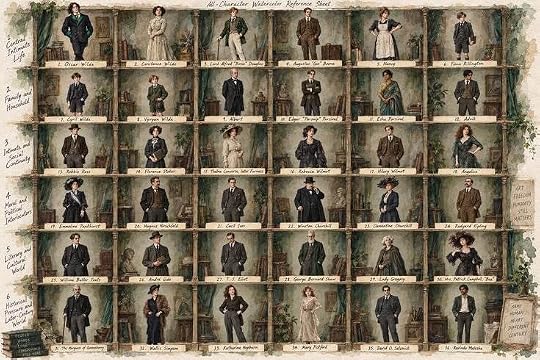
Full-Body All-Character Watercolor Study
Important-Items Watercolor Study
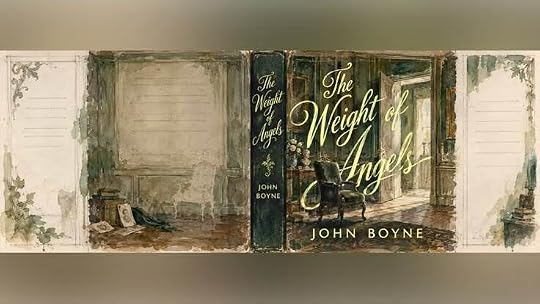
Alternate Full-Jacket Study
Cover-Palette Proportion Ledger
Cover-to-Watercolor Material Grammar
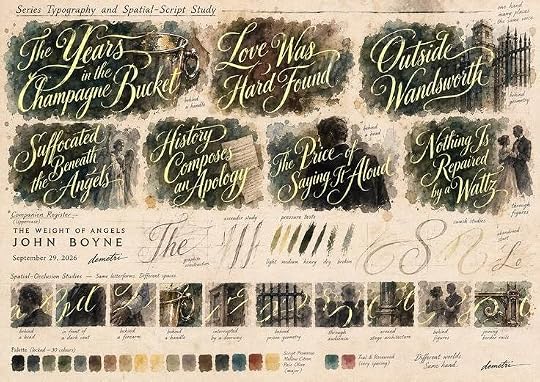
Series Typography and Spatial-Script Study
Ornate Border Architecture Atlas
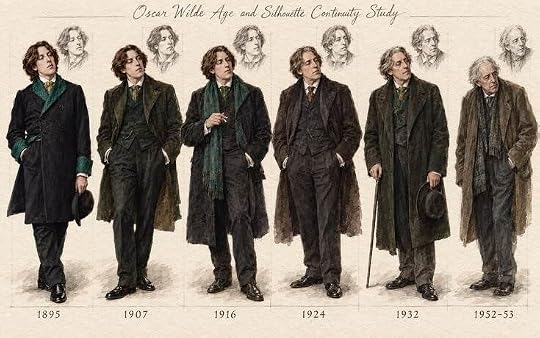
Oscar Wilde Age and Silhouette Continuity Study
Emblematic Composition Thumbnail Study
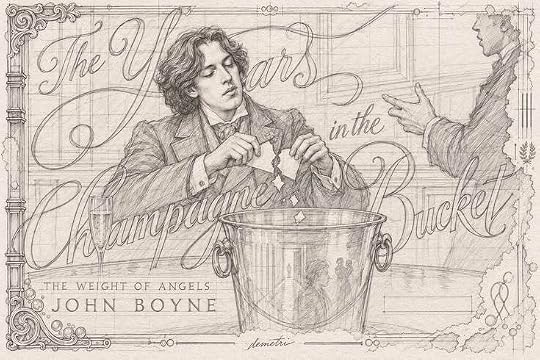
First Underdrawing
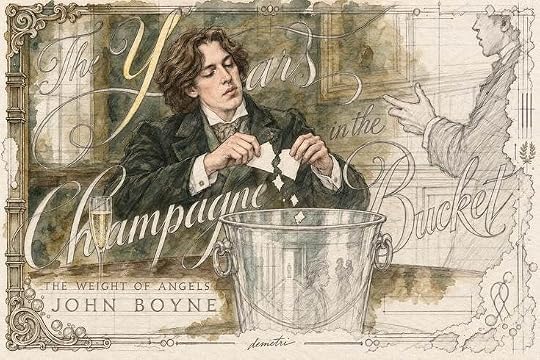
First-Wash Visualization
All watercolor illustrations by Demetris Papadimitropoulos.
Watercolors are done on 140lb vellum and then scanned into the computer using an Epson scanner. From there, they are finalized in Procreate. No AI was used in writing this review — all art and opinions are my own.
John Boyne’s “The Weight of Angels” gives its hero freedom, love, literary glory and the twentieth century itself, then wisely refuses to let any of them cure his talent for self-destruction.
By Demetris Papadimitropoulos | September 5th, 2026
The Years in the Champagne Bucket: Oscar tears Queensberry’s card over a champagne bucket, trading the catastrophe history remembers for decades whose consequences he cannot yet see.
Decades, more than acquittal, are the real contraband in John Boyne’s “The Weight of Angels.” In February 1895, Oscar Wilde receives the Marquess of Queensberry’s infamous calling card, feels the tug of pride, listens to Bosie’s fury and then does what history says he did not: he declines to sue. He tears the card into pieces and drops them into a champagne bucket. At first the fantasy is brutally simple: Oscar gets to keep tomorrow. He keeps his liberty, his career, his sons and nearly six decades the real Wilde never had. Boyne’s sharper idea is that tomorrow keeps arriving, inconveniently and in quantity. More life does not cure character; it simply gives character more occasions to show itself. Oscar is spared the punishment that has come to define him in cultural memory, but Boyne does not let reprieve masquerade as improvement.
Elsewhere, the catastrophe has merely changed address. Bosie becomes the man prosecuted and imprisoned, then dies young in Paris after an uneasy reconciliation with Oscar. Constance dies too, leaving her husband to understand more clearly, because understanding often arrives after the funeral here, what her patience cost. Oscar’s career meanwhile continues to flower through invented plays, quarrels, reviews and triumphs. There is real pleasure in watching a famous life slip its appointed ending and stroll into the twentieth century with a full diary. Yet the losses matter more than the guest list. Even Boyne’s cheekiest revision, transferring “The Ballad of Reading Gaol” into Bosie’s hands, matters less as literary gamesmanship than as another debt Oscar carries forward. Each borrowed year gives him another chance to work, desire, wound, apologize or outlive someone who once seemed fixed in the furniture of his life.
More important than the glitter is Augustus Boone. Gus is a schoolteacher rather than an acolyte, a partner rather than an audience, and Boyne is shrewd enough to make their love domestic before he makes it tragic. Berkeley Square fills with meals, routines, teasing, exercise, family and the ordinary intimacy of knowing another person’s habits. Before moving there, Oscar stands in the emptied Tite Street house, remembers bringing Constance home as his bride and whispers an apology for having failed her. Love, he tells himself, is too difficult to find to take for granted. Boyne barely raises his voice here. The later echo is crueler for it.
Love Was Hard Found: Oscar enters Berkeley Square as Gus begins making a home, while the faintest trace of Constance remains behind the threshold of this second chance.
Enter Fionn Rillington, nineteen, beautiful and ambitious enough to mistake proximity for talent. Oscar can recommend him, cast him and open doors; Fionn can provide youth, flattery and the agreeable fiction that desire can be quarantined from consequence. Their affair lasts for years. When it finally breaks open, Gus refuses the consoling version in which Oscar was simply exploited by an opportunistic boy. He gives the repetition its proper name: he has become another Constance, the faithful partner displaced by a younger fascination. The man who escaped one disastrous decision in 1895 has not escaped himself.
That is when the alternate life stops feeling like compensation. Gus leaves. A police raid on a male brothel leads to his arrest, conviction and imprisonment for gross indecency. On the morning he is due to be released, Oscar and Gus’s father wait outside the prison and learn that Gus has killed himself. A simpler book could let an unjust law absorb all blame. Boyne refuses. The state has taken consensual sex between men and made it punishable by disgrace and incarceration; Oscar has already destroyed the relationship that gave Gus a home. Both facts remain. When campaigning eventually grows from the wreckage, it cannot erase the first one. Oscar cannot make himself innocent by becoming useful.
Outside Wandsworth: Oscar and Albert wait beneath a closed prison gate for Gus to emerge, before learning that no release will bring him home.
Remarkably, for a conception this extravagant, Boyne writes with little stylistic ostentation. His sentences are lucid, generally medium in length and impatient with description that stalls a scene. They clear the stage and let Oscar occupy it. Dialogue supplies much of the speed, which helps explain why so large a novel can feel brisk from page to page even when the whole journey occasionally sags. Boyne also lets comedy survive grief without treating the joke as an escape hatch. Sometimes it is simply oxygen. His surest tonal turns come when banter thins rather than vanishes and the room suddenly has less air in it. The narration, though, conducts the book’s energy more often than it creates it.
If there is music here, most of it comes from Oscar’s mouth. Boyne understands that hundreds of pages of manufactured Wildean epigram would become its own prison sentence, so the wit has several jobs: defense, seduction, camouflage, domination. Oscar jokes when bored, ashamed, attracted, frightened and bereaved. He can make almost anything amusing, which is his charm. He can make almost anything about Oscar, which is the problem. He becomes most interesting opposite people who decline to laugh. Emmeline Pankhurst calls him a fair-weather ally; Yeats attacks the cheapness of his principles; Magnus Hirschfeld asks why a celebrated man who knows the law is wrong will not risk his standing by opposing it. Oscar has never lacked words. What he lacks, for much of the book, is a willingness to pay for them.
Paperwork helps Boyne cross the decades. A Prologue, nine chronological chapters and an Epilogue provide the spine, but inside them letters, reviews, newspaper reports, play scenes and screenplay passages do years of narrative work at a time. Oscar’s nonexistent plays acquire critics; private scandals acquire headlines; an impossible life develops the paper trail of an actual one. Curtis Sittenfeld’s “Rodham” offers one analogue for the single altered decision that reroutes a famous biography, while Catherine Lacey’s “Biography of X” is a much stranger relative in its manufacture of cultural evidence. Boyne is after something less destabilizing. The documents let him skip months or years without reducing the intervening life to connective tissue, and they expose the difference between what Oscar experiences and what posterity would print about it. He wants the impossible to acquire filing cabinets.
As monarchs change, wars begin and end, and artistic generations replace one another, Oscar remains. The coronations strike like bells through the novel, each registering his increasingly improbable survival. A more painful clock is subtraction: Isola, Constance, Bosie, Cyril, Gus. The list lengthens as the rooms empty. By the time Oscar describes himself as suffocating beneath the “weight of angels,” longevity no longer looks much like a gift. To outlive everyone is to become the place where the dead continue their arguments.
Suffocated Beneath the Angels: In Stockholm, Oscar sits among incomplete traces of those he has outlived, discovering that longevity can become its own form of crowding.
Persecution does not make this Oscar innocent. He lives under laws designed to shame men like him, yet remains vain, class-conscious, sexually opportunistic and capable of exploiting the advantages of fame, money and age. The Fionn story is sharpest when Gus insists that a powerful older playwright and a nineteen-year-old aspirant do not enter a relationship on equal terms merely because both are men. Oscar is wronged. He also wrongs. His later advocacy matters because suffering has not purified him into authority. He becomes worth hearing when he stops treating his own suffering as the whole case.
A colder version of this problem runs through Tom Crewe’s “The New Life,” whose late-Victorian men confront the dangerous distance between private sexual freedom and public advocacy with far less champagne and considerably less room to maneuver. Boyne is warmer, more social and much readier to let personality bend history. Yet the pressure is similar. Oscar can recognize injustice perfectly well over lunch. The harder business is deciding when recognition obliges him to put his own comfort on the table.
Despite all this, Boyne’s appetite for company sometimes outruns his need for it. A life stretching into 1953 permits another writer, royal, politician or film star to enter Oscar’s orbit whenever the century produces one. Some encounters earn their seats. Rudyard Kipling matters because two quarrelsome writers become fathers grieving dead sons. Hirschfeld exposes Oscar’s evasions. Churchill gives private remorse a route into Parliament. Other visitors are chiefly excellent company, which is not quite the same thing as being necessary. Boyne plainly enjoys the social possibilities of his premise, and much of that pleasure is contagious. Still, at intervals the twentieth century begins to resemble a dinner party whose seating plan has been arranged so Oscar never draws the bore.
Ironically, Oscar supplies the joke at his creator’s expense when he mocks the self-indulgence of six-hundred-page novels. Knowing that one is overindulging is not the same as ordering less. The Hollywood sequence is lively, and Oscar winning an Academy Award has precisely the outrageous appeal one wants from this conceit, but the peerage, Nobel Prize, movie glory and political access begin to feel less like an alternate career than history composing an apology. Boyne sometimes seems unwilling to rescue Wilde from one humiliation without reimbursing him, with interest, for every lost opportunity.
History Composes an Apology: Hollywood gives Oscar another impossible prize, and the spectacle begins to look less like success than history paying back an old debt with interest.
More wearing than the famous faces is the queue of witnesses making the same case against Oscar. Pankhurst says his principles are convenient. Hirschfeld says prominence carries obligations. Yeats says his causes cost him too little. Gus tells him he has repeated the injury done to Constance. Albert later returns to the damage. Oscar eventually tells much of the story himself. The repetitions are not identical, and several scenes are individually excellent, but together they leave the book explaining a pattern it has already made difficult to miss. Boyne builds recurrence intelligently, then occasionally loses faith in the reader’s ability to hear it.
In Fionn, that loss of faith costs more. He initially forces the novel into difficult territory: age, patronage, sexual influence, professional dependency, the vanity with which powerful men redescribe appetite as generosity. As Fionn grows more coercive, threatening and conspicuously untalented, however, some of that discomfort drains away. The question begins as what Oscar’s power made possible and gradually competes with how much trouble Fionn is causing him. Oscar is not absolved, but the imbalance becomes easier to contemplate once the younger man has been made so unpleasant.
The late chapters gain weight from one fact Oscar cannot talk away: Gus is dead. There will be no reconciliation scene, no aged reunion, no opportunity for Oscar to turn remorse into another successful performance. His advocacy is not a conversion to ideas he once opposed. He knew the humane position years earlier. What changes is his willingness to be implicated by saying it aloud. In 1949 he identifies Gus publicly as his lover and argues that consensual intimacy should not belong to policemen or courts; later he tells legislators enough of his own shame to make the case personal. The journey is from agreement to exposure, a short distance on paper and a long one in life.
Risk is what separates those two states. Oscar can admire brave people, send money to worthy causes and produce the correct opinion over lunch with considerable flair. Public speech becomes more interesting once there is something to lose by making it. That pressure carries beyond Wilde’s England without the novel needing to advertise its relevance. Sympathy is abundant. Courage has a price.
The Price of Saying It Aloud: At Claridge’s, an ancient Oscar makes private shame public, finding that the distance between conviction and courage is measured by what speech can cost.
Once the law changes in Boyne’s invented Britain, the victory remains pointedly inadequate. Newspapers attach Oscar’s name to the reform; Oscar thinks of Gus instead. No vote can return Gus to Berkeley Square, keep Cyril alive or give Constance the marriage she should have had. Law can stop one mechanism of injury. It cannot reach backward and make the injured whole. Boyne is at his best when repair remains this small and unspectacular.
Past ninety-eight, Oscar reaches the end surrounded by evidence of his impossible extension: shelves of books, memories of the dead, another coronation on television. Then Constance appears. Decades earlier he had confessed one of the smallest regrets among the catastrophic ones: she loved to dance, and he always refused because he feared looking ridiculous. Now she asks again. He rises. They dance. The gesture works because it is too small to impersonate restitution. Nothing is repaired by a waltz. That is precisely why the scene can bear so much feeling without asking us to pretend the marriage has somehow been corrected. The right answer is simply being given late.
Nothing Is Repaired by a Waltz: After death, Oscar accepts the dance he once denied Constance; nothing is repaired, but the refusal is no longer repeated.
On death’s side of the threshold, the title reverses. The people who had pressed upon Oscar as the “weight of angels” become the company that receives him, almost an audience gathering for one last curtain call. The image flirts with absolution more eagerly than the rest of the book deserves; a sterner novelist might have withheld the applause. Constance has already supplied the better judgment. Some choices were good, some bad. Gus belonged among the good; Fionn among the bad. A life almost a century long resists cleaner arithmetic.
Under the peerage, prizes, champagne and impossible longevity, “The Weight of Angels” earns 86/100 and 4/5 stars because Boyne’s central experiment survives his indulgences. He saves Wilde from the catastrophe we know and then has the nerve to let him manufacture another. The extra fifty-eight years do not vindicate him. They give him time to discover that escaping ruin is different from deserving happiness, and that remorse matters only if it changes what one does next. At the end, the famous talker is offered no final epigram worth keeping. Constance holds out her hand. For once, Oscar has nothing clever to add.
Full-Body All-Character Watercolor Study
Important-Items Watercolor Study
Alternate Full-Jacket Study
Cover-Palette Proportion Ledger
Cover-to-Watercolor Material Grammar
Series Typography and Spatial-Script Study
Ornate Border Architecture Atlas
Oscar Wilde Age and Silhouette Continuity Study
Emblematic Composition Thumbnail Study
First Underdrawing
First-Wash Visualization
All watercolor illustrations by Demetris Papadimitropoulos.
Watercolors are done on 140lb vellum and then scanned into the computer using an Epson scanner. From there, they are finalized in Procreate. No AI was used in writing this review — all art and opinions are my own.

Review of advance copy received from NetGalley
3.5 ⭐️
I love John Boyne’s writing (The Heart’s Invisible Furies, anyone?!), and I was eager to read his latest. I knew going in that this was an alternate history of Oscar Wilde’s life had he not gone to prison and subsequently died at a young age, but frankly I knew almost nothing about Oscar Wilde’s life going into this. If you don’t know much about Oscar Wilde, I’d encourage perusing his Wikipedia BEFORE starting this novel.
🩷 John Boyne has an obvious fondness for Oscar Wilde and his work that comes through so well.
🩷 Oscar experiences maturation and self-reflection throughout the novel, as one might hope of someone who lives to almost 100 years old.
🩷 If you love clever banter, this will be heaven for you.
Favorite witticism: When Oscar Wilde meets Billy Wilder, “Wilde and Wilder. Perhaps we could find a fellow named Wildest and ask him to complete the trio?”
⚠️ I do like some clever banter, but this is 600 PAGES of clever banter. About 25% in, I came to the realization that this was the entire book.
⚠️ Not much plot. It’s endless scenes of clever banter, letters, and scripts with appearances from some people I’ve heard of and many I haven’t.
⚠️ Would Oscar Wilde, had he not gone to prison, have lived to almost 100 years old and have a Forrest Gump-like experience of running into everyone from Katharine Hepburn to Prince/King Charles and single-handedly advance LGBTQ rights? Not likely, but it’s an interesting take.
If you like witty barbs being slung back and forth and appearances from writers, actors, other creatives, and royalty, then this novel could be right up your alley.
Thank you to NetGalley and Henry Holt and Co. for an Advance Reader Copy. My review is completely my own.
It publishes on September 29, 2026.
I love John Boyne’s writing (The Heart’s Invisible Furies, anyone?!), and I was eager to read his latest. I knew going in that this was an alternate history of Oscar Wilde’s life had he not gone to prison and subsequently died at a young age, but frankly I knew almost nothing about Oscar Wilde’s life going into this. If you don’t know much about Oscar Wilde, I’d encourage perusing his Wikipedia BEFORE starting this novel.
🩷 John Boyne has an obvious fondness for Oscar Wilde and his work that comes through so well.
🩷 Oscar experiences maturation and self-reflection throughout the novel, as one might hope of someone who lives to almost 100 years old.
🩷 If you love clever banter, this will be heaven for you.
Favorite witticism: When Oscar Wilde meets Billy Wilder, “Wilde and Wilder. Perhaps we could find a fellow named Wildest and ask him to complete the trio?”
⚠️ I do like some clever banter, but this is 600 PAGES of clever banter. About 25% in, I came to the realization that this was the entire book.
⚠️ Not much plot. It’s endless scenes of clever banter, letters, and scripts with appearances from some people I’ve heard of and many I haven’t.
⚠️ Would Oscar Wilde, had he not gone to prison, have lived to almost 100 years old and have a Forrest Gump-like experience of running into everyone from Katharine Hepburn to Prince/King Charles and single-handedly advance LGBTQ rights? Not likely, but it’s an interesting take.
If you like witty barbs being slung back and forth and appearances from writers, actors, other creatives, and royalty, then this novel could be right up your alley.
Thank you to NetGalley and Henry Holt and Co. for an Advance Reader Copy. My review is completely my own.
It publishes on September 29, 2026.
Review of advance copy received from NetGalley
My thanks to NetGalley and Henry Holt & Company for an advance copy of this novel that looks at what if a person didn't act rashly, didn't let others push him towards an action that while seemed to be a sure thing, could be easily corrupted and gone wrong, an action that could lead to a far longer and different creative life, and not one remembered for living a good quote about wallpaper.
My introduction to Oscar Wilde was probably a book of verse but I don't remember that well. I do remember reading about the death of Wilde in a comic book, Cerebus, a comic that was once known for being cutting edge and different, now for other things. One of the stories dealt with a character much like Oscar Wilde dying in a shanty little hotel room. There was something about this story that drew me in, though I knew little about it. Nor why it seemed such a loss. As my reading expanded I found out why. Oscar Wilde was a man of courage, conviction, a cunning cutter in conversation, and a man living a series of lies. Lies not to himself but to society. A society that hates a nail that sticks up, and one that loves to batter those that do. What if though instead of taking part in his own destruction, Wilde ignoring friends and lovers said no, not interested. Instead of a trial, gaol, and death by disease, Wilde lived on, writing, loving and losing as the twentieth century found itself. The Weight of Angels by John Boyne is a speculative novel about what might have been, taking Oscar Wilde into the future, past his death, detailing new works, new loves, and new guilts for this aesthete man of letters.
Oscar Wilde was a the toast of London, a champagne that many aspired too, and a taste that many found well distasteful. Wilde wrote plays that were witty, plays that were considered both bawdy and satiric, and even plays that couldn't be played in London. Wilde was considered a taste maker writing reviews that could make a writer, or erase an entire career. Though married with children, Wilde had a life that while known to many in the artistic community, was unknown to the world at large. Wilde was a homosexual, in a time where this was not only frowned on, but illegal and dangerous. Wilde was lovers with Lord Alfred Douglas, Bosie to his friends, whose father the Marquis of Queensbury was a bully, a brute and probably insane. The Marquis sent a note to Wilde that could be considered libelous. Many told Wilde to sue, to stop word of this getting out. In our world, Wilde did so, and found that justice doesn't always work, and never will when going against society and its norms. Here though Wilde ignores the note, and that makes all the difference. We follow Wilde as he ages through wars, and fascists, finding love, ignored by love, and losing those he loves. Wilde makes mistakes, makes art, makes enemies, but continues to live, guilty over his many sins, and yet striving to create a life that is honest to the art he feels in his heart.
This is my first time reading John Boyne, and what a book to start with. I have long been aware of Boyne and his books, selling quite a lot of copies as a bookseller over the years. I know this is a different book for him, but I really can't wait to read more. Boyne captures Wilde in full, a man full of skill, of brains, and a very, very emotional heart. One that wants what it wants, sometimes at the expense of others. Boyne is very good writer, capturing the different times, the historical characters that appear and making them shine. The dialogue is really witty, sometimes even laugh out loud, especially a scene with a bishop, a musical composer and Wilde at a coronation. Boyne captures the feeling of being Wilde, the sometimes confusion, the lack of emotion at the time, and the sentimentality that comes later.]
A really interesting and different book, an alternative Earth based on the life of one man. I really enjoyed this story, and look forward to reading more by two authors I have come to appreciate more, both Wilde and John Boyne.
My introduction to Oscar Wilde was probably a book of verse but I don't remember that well. I do remember reading about the death of Wilde in a comic book, Cerebus, a comic that was once known for being cutting edge and different, now for other things. One of the stories dealt with a character much like Oscar Wilde dying in a shanty little hotel room. There was something about this story that drew me in, though I knew little about it. Nor why it seemed such a loss. As my reading expanded I found out why. Oscar Wilde was a man of courage, conviction, a cunning cutter in conversation, and a man living a series of lies. Lies not to himself but to society. A society that hates a nail that sticks up, and one that loves to batter those that do. What if though instead of taking part in his own destruction, Wilde ignoring friends and lovers said no, not interested. Instead of a trial, gaol, and death by disease, Wilde lived on, writing, loving and losing as the twentieth century found itself. The Weight of Angels by John Boyne is a speculative novel about what might have been, taking Oscar Wilde into the future, past his death, detailing new works, new loves, and new guilts for this aesthete man of letters.
Oscar Wilde was a the toast of London, a champagne that many aspired too, and a taste that many found well distasteful. Wilde wrote plays that were witty, plays that were considered both bawdy and satiric, and even plays that couldn't be played in London. Wilde was considered a taste maker writing reviews that could make a writer, or erase an entire career. Though married with children, Wilde had a life that while known to many in the artistic community, was unknown to the world at large. Wilde was a homosexual, in a time where this was not only frowned on, but illegal and dangerous. Wilde was lovers with Lord Alfred Douglas, Bosie to his friends, whose father the Marquis of Queensbury was a bully, a brute and probably insane. The Marquis sent a note to Wilde that could be considered libelous. Many told Wilde to sue, to stop word of this getting out. In our world, Wilde did so, and found that justice doesn't always work, and never will when going against society and its norms. Here though Wilde ignores the note, and that makes all the difference. We follow Wilde as he ages through wars, and fascists, finding love, ignored by love, and losing those he loves. Wilde makes mistakes, makes art, makes enemies, but continues to live, guilty over his many sins, and yet striving to create a life that is honest to the art he feels in his heart.
This is my first time reading John Boyne, and what a book to start with. I have long been aware of Boyne and his books, selling quite a lot of copies as a bookseller over the years. I know this is a different book for him, but I really can't wait to read more. Boyne captures Wilde in full, a man full of skill, of brains, and a very, very emotional heart. One that wants what it wants, sometimes at the expense of others. Boyne is very good writer, capturing the different times, the historical characters that appear and making them shine. The dialogue is really witty, sometimes even laugh out loud, especially a scene with a bishop, a musical composer and Wilde at a coronation. Boyne captures the feeling of being Wilde, the sometimes confusion, the lack of emotion at the time, and the sentimentality that comes later.]
A really interesting and different book, an alternative Earth based on the life of one man. I really enjoyed this story, and look forward to reading more by two authors I have come to appreciate more, both Wilde and John Boyne.

Review of advance copy received from NetGalley
The premise of this book is that instead of pursuing a case of libel when the Marquis of Queensbury makes an insulting calling card for Oscar Wilde in 1895 he chooses to 'turn the other cheek' and ignores it as any court case is very likely to expose Oscar's homosexual lifestyle in public and incur heavy penalties and imprisonment for him as it was illegal. This is indeed what does happen to Oscar Wilde in real life but in this book the tables are turned and his young male lover., Lord Alfred Douglas aka Bosie, suffers the fate Oscar does in real life.
The book started well with this rearrangement of history but then started dragging as Oscar went on to live a very long life and seemingly met every well known gay man and woman that were living contemporaneously with him. He attended numerous Coronations and had a few ups and downs on the way but the plot is thin while the meetings with the rich and famous were at times contrived but could be vaguely amusing. I don't know enough of Oscar Wilde's real life to judge how well author, John Boyne, has written in Oscar's voice but I suspect he's done a good job and this book is certainly very well researched. It took me a while to read as I did get side tracked numerous times as I looked up the names of some I only knew as authors, playwright, actors, etc. and little of their lives.
The book dragged in the middle part but, once i accepted that it was basically a sequence of meetings or, letters of correspondence with, famous people, I enjoyed it more and took it as an educational book rather than a gripping plot.
I didn't care for some of the intimate scenes and found them salacious,. Did I really want to hear about Oscar Wilde and Prince Albert's intimacy while his mother, Queen Victoria, is in listening distance. No, I didn't. I also didn't need to visualise John Gielgud help Oscar Wilde urinate in a public toilet as Oscar did not have both hands available at the time. There was also a very odd and ridiculously inappropriate conversation between Oscar and an (extremely famous) four year old. My rating for this book could go quite down at times.
There was also a certain amount of revision of history in terms of dates of decriminalising homosexuality and doubtless other things I am not aware of. I am not always sure about books that are based on historical facts but change them as I wonder how many readers are left believing the wrong history of a person or event having believe a fiction version in a novel.
I can only believe that John Boyne was having a laugh to himself as he wrote "Lengthy novels, I feel, are so self indulgent. can it really take six hundred pages to tell a story" in his six hundred page novel. I would have preferred a shorter novel as it did drag at times as seemingly all these people had to be shoehorned into the narrative.
There was a lot I didn't like about this book but also a lot I did like and it will certainly encourage me to learn more about some of the people in it such as Edward Elgar, George Bernard Shaw, Sarah Bernhardt, Mary Richardson, Mrs Patrick Campbell, Charles Masterman, Rudyard Kipling, T S Eliot, Leonard and Virginia Woolf, E M Forster, Somerset Maugham, Noel Coward and Katherine Hepburn. Many other notable people such as various royal family members, Wallis Simpson, Winston and Clementine Churchill, Neville Chamberlain, Clement Attlee, Anthony Eden, Harold Wilson, Hugh Gaitskell, Charlie Chaplin. Laurence Olivier, Mary Pickford, Mickey Rooney, Ava Gardner and Billy Wilder also feature. Think of it as romp through the first half of the 19th century featuring the great and good of the time.
3.5 stars rounded up to 4. With thanks to NetGalley and Random House UK, Transworld Publishers for a free copy of this book in exchange for an honest review.
The book started well with this rearrangement of history but then started dragging as Oscar went on to live a very long life and seemingly met every well known gay man and woman that were living contemporaneously with him. He attended numerous Coronations and had a few ups and downs on the way but the plot is thin while the meetings with the rich and famous were at times contrived but could be vaguely amusing. I don't know enough of Oscar Wilde's real life to judge how well author, John Boyne, has written in Oscar's voice but I suspect he's done a good job and this book is certainly very well researched. It took me a while to read as I did get side tracked numerous times as I looked up the names of some I only knew as authors, playwright, actors, etc. and little of their lives.
The book dragged in the middle part but, once i accepted that it was basically a sequence of meetings or, letters of correspondence with, famous people, I enjoyed it more and took it as an educational book rather than a gripping plot.
I didn't care for some of the intimate scenes and found them salacious,. Did I really want to hear about Oscar Wilde and Prince Albert's intimacy while his mother, Queen Victoria, is in listening distance. No, I didn't. I also didn't need to visualise John Gielgud help Oscar Wilde urinate in a public toilet as Oscar did not have both hands available at the time. There was also a very odd and ridiculously inappropriate conversation between Oscar and an (extremely famous) four year old. My rating for this book could go quite down at times.
There was also a certain amount of revision of history in terms of dates of decriminalising homosexuality and doubtless other things I am not aware of. I am not always sure about books that are based on historical facts but change them as I wonder how many readers are left believing the wrong history of a person or event having believe a fiction version in a novel.
I can only believe that John Boyne was having a laugh to himself as he wrote "Lengthy novels, I feel, are so self indulgent. can it really take six hundred pages to tell a story" in his six hundred page novel. I would have preferred a shorter novel as it did drag at times as seemingly all these people had to be shoehorned into the narrative.
There was a lot I didn't like about this book but also a lot I did like and it will certainly encourage me to learn more about some of the people in it such as Edward Elgar, George Bernard Shaw, Sarah Bernhardt, Mary Richardson, Mrs Patrick Campbell, Charles Masterman, Rudyard Kipling, T S Eliot, Leonard and Virginia Woolf, E M Forster, Somerset Maugham, Noel Coward and Katherine Hepburn. Many other notable people such as various royal family members, Wallis Simpson, Winston and Clementine Churchill, Neville Chamberlain, Clement Attlee, Anthony Eden, Harold Wilson, Hugh Gaitskell, Charlie Chaplin. Laurence Olivier, Mary Pickford, Mickey Rooney, Ava Gardner and Billy Wilder also feature. Think of it as romp through the first half of the 19th century featuring the great and good of the time.
3.5 stars rounded up to 4. With thanks to NetGalley and Random House UK, Transworld Publishers for a free copy of this book in exchange for an honest review.

August 18, 2026
Every book John Boyne writes is different from all the others. It feels to me like he is continually challenging himself as an author by experimenting with style and construction. So, as a fan of both the author and of Oscar Wilde, I couldn't wait to get my hands on THE WEIGHT OF ANGELS.
This is a What IF book - in that Boyne is imagining what might have occurred had Irish writer Oscar Wilde (1854-1900) not sued John Douglas, 9th Marquess of Queensbury (father of Lord Alfred Douglas, aka "Bosie") for calling Wilde a sodomite. If you're familiar with Wilde's history you know that he was eventually tried and convicted of homosexual behavior, which was illegal in Britain in the 1890s. After spending two years in prison at hard labor, which severely impacted his health, Wilde died in 1900, at the age of 46, shortly after his release.
What is most remarkable to me about this book is how successfully Boyne has captured Wilde's voice. It can't have been easy writing such consistently clever dialog. Because reading this novel is like reading Wilde himself. It is full of the wit, humor, and sarcasm Wilde is famous for. Throughout the first half or so, I was captivated by my enjoyment of the language and the rich, though totally fictitious, life Boyne creates for Wilde. It all felt so plausible. A long love affair, exchanges with friends and colleagues, the relationships with assorted employees, and extensive professional success. It was fun reading how Wilde might have reacted to some of the major events of the 20th century - like multiple royal coronations, two world wars, and the birth of motion pictures.
However, THE WEIGHT OF ANGELS is a long book - nearly 600 pages. A little more than halfway through the book, I found myself slowly shifting. Instead of remaining immersed in Wilde's life, I began to feel I was reading a series of contrived and unrelated meet-ups between Wilde and famous people of the century. And not just literary and theater contemporaries like William Butler Yeats, E. M. Forster, George Bernard Shaw, Sarah Bernhardt, and Bram Stoker (all of whom appear).
Instead, I started to suspect Boyne had identified the figures HE found interesting in each decade and then fabricated some direct connection for each with Wilde. It simply didn't seem plausible that Wilde would become close to so many notable characters. Like befriending Lady Thelma Furness, hosting Wallis Simpson, planning a political campaign with Winston Churchill, and meeting so many Hollywood actors.
At first I resented this shift of plausible to not plausible. But as I continued on, I began to enjoy the fantasy of it. Boyne seemed to be playing, sharing his own opinions and observations. Through Wilde's character, Boyne was pointing out the irony, hypocrisy, or just plain silliness of the unfolding 20th century. Not to mention the ridiculously unfair legal prosecution of people simply for their sexual preference. THE WEIGHT OF ANGELS became sharp social commentary, concealed within Wilde's character.
There were a few times the book felt long and I personally feel it would not have suffered if it had ended sooner. But I did thoroughly enjoy the ride, loved the ending, and recommend THE WEIGHT OF ANGELS highly. In fact, if you're not familiar with him, I recommend you pick up any book by John Boyne. No matter what you choose, you won't be disappointed.
This is a What IF book - in that Boyne is imagining what might have occurred had Irish writer Oscar Wilde (1854-1900) not sued John Douglas, 9th Marquess of Queensbury (father of Lord Alfred Douglas, aka "Bosie") for calling Wilde a sodomite. If you're familiar with Wilde's history you know that he was eventually tried and convicted of homosexual behavior, which was illegal in Britain in the 1890s. After spending two years in prison at hard labor, which severely impacted his health, Wilde died in 1900, at the age of 46, shortly after his release.
What is most remarkable to me about this book is how successfully Boyne has captured Wilde's voice. It can't have been easy writing such consistently clever dialog. Because reading this novel is like reading Wilde himself. It is full of the wit, humor, and sarcasm Wilde is famous for. Throughout the first half or so, I was captivated by my enjoyment of the language and the rich, though totally fictitious, life Boyne creates for Wilde. It all felt so plausible. A long love affair, exchanges with friends and colleagues, the relationships with assorted employees, and extensive professional success. It was fun reading how Wilde might have reacted to some of the major events of the 20th century - like multiple royal coronations, two world wars, and the birth of motion pictures.
However, THE WEIGHT OF ANGELS is a long book - nearly 600 pages. A little more than halfway through the book, I found myself slowly shifting. Instead of remaining immersed in Wilde's life, I began to feel I was reading a series of contrived and unrelated meet-ups between Wilde and famous people of the century. And not just literary and theater contemporaries like William Butler Yeats, E. M. Forster, George Bernard Shaw, Sarah Bernhardt, and Bram Stoker (all of whom appear).
Instead, I started to suspect Boyne had identified the figures HE found interesting in each decade and then fabricated some direct connection for each with Wilde. It simply didn't seem plausible that Wilde would become close to so many notable characters. Like befriending Lady Thelma Furness, hosting Wallis Simpson, planning a political campaign with Winston Churchill, and meeting so many Hollywood actors.
At first I resented this shift of plausible to not plausible. But as I continued on, I began to enjoy the fantasy of it. Boyne seemed to be playing, sharing his own opinions and observations. Through Wilde's character, Boyne was pointing out the irony, hypocrisy, or just plain silliness of the unfolding 20th century. Not to mention the ridiculously unfair legal prosecution of people simply for their sexual preference. THE WEIGHT OF ANGELS became sharp social commentary, concealed within Wilde's character.
There were a few times the book felt long and I personally feel it would not have suffered if it had ended sooner. But I did thoroughly enjoy the ride, loved the ending, and recommend THE WEIGHT OF ANGELS highly. In fact, if you're not familiar with him, I recommend you pick up any book by John Boyne. No matter what you choose, you won't be disappointed.
Displaying 1 - 30 of 146 reviews