Jump to ratings and reviews
Rate this book

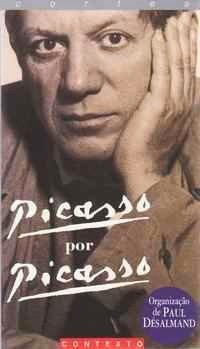
Picasso por Picasso

Rate this book
Compilação seleccionada de pensamentos e textos de Picasso, organizados por várias áreas temáticas.
Contém Biografia cronológica, Bibliografia sobre a obra de Picasso, ilustrações de várias obras, e Índice Onomástico.

Correia, Mário Dias (tradutor)
Désalmand, Paul, (editor literário)
Pellegrini, Anne (colaborador)

181 pages, Paperback

First published May 1, 1993

3 people are currently reading
148 people want to read

About the author

Pablo Picasso

987 books961 followers
Pablo Ruiz Picasso was a Spanish painter, sculptor, printmaker, ceramicist, and theatre designer who spent most of his adult life in France. One of the most influential artists of the 20th century, he is known for co-founding the Cubist movement, the invention of constructed sculpture, the co-invention of collage, and for the wide variety of styles that he helped develop and explore. Among his most famous works are the proto-Cubist Les Demoiselles d'Avignon (1907) and the anti-war painting Guernica (1937), a dramatic portrayal of the bombing of Guernica by German and Italian air forces during the Spanish Civil War.
Picasso demonstrated extraordinary artistic talent in his early years, painting in a naturalistic manner through his childhood and adolescence. During the first decade of the 20th century, his style changed as he experimented with different theories, techniques, and ideas. After 1906, the Fauvist work of the older artist Henri Matisse motivated Picasso to explore more radical styles, beginning a fruitful rivalry between the two artists, who subsequently were often paired by critics as the leaders of modern art.
Picasso's output, especially in his early career, is often periodized. While the names of many of his later periods are debated, the most commonly accepted periods in his work are the Blue Period (1901–1904), the Rose Period (1904–1906), the African-influenced Period (1907–1909), Analytic Cubism (1909–1912), and Synthetic Cubism (1912–1919), also referred to as the Crystal period. Much of Picasso's work of the late 1910s and early 1920s is in a neoclassical style, and his work in the mid-1920s often has characteristics of Surrealism. His later work often combines elements of his earlier styles.
Exceptionally prolific throughout the course of his long life, Picasso achieved universal renown and immense fortune for his revolutionary artistic accomplishments, and became one of the best-known figures in 20th-century art.

Ratings & Reviews

What do you think?
Rate this book

Friends & Following

Create a free account to discover what your friends think of this book!

Community Reviews

5 stars
18 (24%)
4 stars
19 (26%)
3 stars
31 (42%)
2 stars
5 (6%)
1 star
0 (0%)
Displaying 1 - 4 of 4 reviews
1 review
January 7, 2015
Found Picasso's quotes to be thought-provoking, and, though I'd never previously been a fan of Picasso's works, I was introduced to some pieces that I actually liked.
Profile Image for Cara.
69 reviews
January 3, 2024
I found this book at my parents’ house with an inscription from my grandfather to my grandmother in December 2003. I liked this book because it highlights how snarky Picasso was. I also enjoyed seeing the vast range of his paintings.

Page 24: If you know exactly what you are going to do, what’s the good of doing it? There’s no interest in something you know already. It’s much better to do something else.

Page 48: as we say in Spanish: love must be proved by facts and not by reasons. What one does is what counts and not what one had the intention of doing.
Profile Image for Steven.
Author 1 book114 followers
February 8, 2015
Cool little book that alternates prints of Picasso's paintings with quotes. Here's one:
Anything of great value - creation, a new idea - carries its shadow zone with it. You have to accept it that way. Otherwise there is only the stagnation of inactivity. There is no escaping it. Every positive value has its price in negative terms and you never see anything very great which is not, at the same time, horrible in some respect. The genius of Einstein leads to Hiroshima.
Profile Image for Dhātturā.
68 reviews10 followers
December 20, 2008
I like to look at the pics. Plus its interesting to see what artists say about their work.
Displaying 1 - 4 of 4 reviews

Can't find what you're looking for?

Get help and learn more about the design.