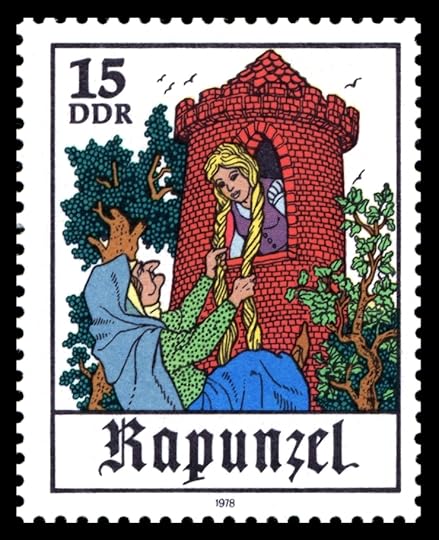
A hundred years before Rapunzel, there was Persinette. Before the Old Witch ever locked Rapunzel in a tower, a Fairy set out to change Persinette's destiny.
Read the French fairy tale that inspired the Grimm Brothers' "Rapunzel," learn about the authoress Mlle de La Force, and discover answers to questions such as why Persinette's father traded her for a fistful of parsley and how she survived for years alone in her wilderness.
Includes translations of the French tale "Persinette" (1698), the Italian tale "Petrosinella" (1634), and the German tale "Rapunzel" (1812-57), along with background information on each of the tales and their authors.
Charlotte-Rose de Caumont de La Force, or Mademoiselle de La Force (1654–1724) was a French novelist and poet. Her best-known work was her 1698 fairy tale Persinette, which was adapted by the Brothers Grimm in 1812 as the story of Rapunzel.
She was the daughter of François de Caumont de La Force (eighth son of Marshal de La Force), marquis de Castelmoron and of Marguerite de Viçose. Raised as a Huguenot Protestant, she converted to Catholicism in 1686 and received a pension of 1000 écus from Louis XIV. Like other famous women writers of the 17th century, she was named a member of the Academy of the Ricovrati of Padua.
Her first novels were in the popular vein of "histoires secrètes", short novels recounting the "secret history" of a famous person and linking the action generally to an amorous intrigue, such as Histoire secrete de Bourgogne (1694), Histoire secrète de Henri IV, roi de Castille (1695), Histoire de Marguerite de Valois, reine de Navarre (1696).
She is also well known for participating in the 17th century vogue of contes des fées along with Henriette-Julie de Murat, Marie Catherine d'Aulnoy, Marie-Jeanne Lhéritier, and Charles Perrault. She wrote Les Contes des Contes (1698) and Les Contes des Fées.
It was interesting to read this version of the Rapunzel fairytale.
It was so shocking to see that the fairy isolated Rapunzel for her protection, and kind of refreshing to see Rapunzel was perfectly content and happy there. It added an extra layer of the villain not necessarily being a villain until 'other' people decide that she is, and therefore it leads on to the fairy doing some more troublesome things.
I also found the true villain in the bgeginning to be the prince, actually. He pushes the perfectly happy fairy and Rapunzel into doing things which are more questionable. He loves and marries and does more with Rapunzel when she is still confused and not really sure of what is going on. In my opinion, that is him taking advantage of her and made me actually quite a bit angry to see in this story!
The ending has traces of the fairytale I grew up knowing, but does go in a different direction too. It is almost extended. The magic in this one made more sense than in the Grimm tale because the story is entwined with magic from the beginning and therefore Rapunzel's 'magic moment' makes a lot of sense.
But the moral of this story is what made my skin prickle a bit. It's a nice moral and it is lovely that they add it in in verse at the end. But I don't think it quite matches the story if you're talking about Rapunzel. She is taken advantage of and I think she would've been happy either way. I guess it applies to the Prince though ;.;
Can you tell I am taking a fairytale class and therefore am reading all of these fairytales?
My second reread of this fairy tale is the edition translated by Laura Christensen that includes all 3 Rapunzel tales: Petrosinella by Giambattista Basile (the original as far as we know), Persinette by Charlotte-Rose de Caumont de la Force (an expanded retelling of Basile's), and Rapunzel by the Grimms (the version everyone and their dog know).
Though I already knew each separately, I'd not read them side-by-side like I did this time, and it's been a good opportunity to make comparisons. The changes that I found curious & noteworthy were:
- That the villain changes from tale to tale: In Basile's, she's an ogress; in La Force's, she's a fairy; and in the Grimms', she's a witch. Why the changes is anyone's guess, but my own is that the one in Basile and the Grimms is just the archetypal Baddie, so there's nothing in it to look deeper into, whilst La Force's change makes sense given that hers is the only version in which there's redemption for the villain(ess). - Basile and La Force both say the greens the child was sold off to the ogress/fairy for was parsley, but the Grimms change it to radishes (rampion). The name of the heroine is derived from the plant in all three, however, so the change doesn't really impact the story. (Side note: I laughed out loud at Mlle. Charlotte-Rose's sardonic observation that "parsley must've been quite tasty in those days" after the line in which the pregnant mother's cravings lead to be unborn baby's being sold). - What the prince was doing in the vicinity of Rapunzel's tower varies by tale as well: in one, he's travelling through the wood nearby, in the next he's on a hunt, and in the other he just happens to be 'round because. - In Basile's tale, the one that goes parsley-thieving and sells the unborn baby is the girl's own mother, whereas in La Force's and the Grimms' versions it's the expecting mother's husband who does the thieving and selling off of the baby for love of his wife. Nobler, more palatable motives, I guess. - The age at which Rapunzel is given to the villainess varies: she's a 7-year-old in Basile's and a newborn baby in the other two. In all three, her hair is the product of magic but her loveliness is natural in Basile's and the Grimms, whilst in La Force's she's made beautiful by fairy magic. - Basile's original is the most moral and strait-laced of 'em all as far as sexual mores go. No boffin' yer newfound maiden in da tower and gettin' her preggo, m'lord! Ya have to just run off with the lass and make a honest woman out of her bien pronto. Or, in plain English: La Force is the one who invented the Rapunzel/Prince romance complete with kiddies (twins at that), and the Grimms, being the dutiful copycat souls they were, took it as such from her too, keeping prince and preggo Rapunzel in their version. - Basile's is also the one in which the lovers battle and vanquish the villainess to win their happily ever after, which they achieve with the help of magical acorns. La Force redeems the villainous fairy, though she doesn't give any other reason than her good little fairish heart was touched and moved to forgive the runaway lovers. The Grimms, on the other hand, chose to ruin it all by simply handwaving the ending with a "who knows what happened to the witch" one-liner. - It's the Grimms' fault that the tale has the implausible element of Rapunzel giving birth and surviving it in the desert. La Force says she gave birth in a nice cozy place by the seashore the fairy took her to, and Basile simply doesn't have this element at all. - The blind prince who recovers his sight with Rapunzel's tears is La Force's invention, and the Grimms kept it. A bit silly, if you ask me, it would have made more sense if the prince had broken a few bones from such a fall from the tower, but... fairy tale symbolism, people!
All three compared, I think the best version is Persinette. Yes, it's the most romantic and feel-good, so it may be a tad sugary for some tastes, but in this one there's structure, characterisation, and "meat" to the usually barebones storytelling style of fairy tales, which often tend to not explain motives and rely a lot on symbolic shorthand to get points across. Basile's is also good, but it's very much a traditional folktale with all the plotholes a fairy tale has. And the Grimms is just a poor copy of La Force's stripped of its meat and brought back to its barebones folktale origins without the logic or reason of Basile's. It's fun to explore all three, but if you only want to or have time for reading just one, it should be Persinette.
A hundred years before Rapunzel, there was Persinette and the brothers Grimm owe Charlotte-Rose de Caumont de La Force a lot. This version also makes me dislike the Prince, but overall it's mostly the same story I grew up reading.
This entire review has been hidden because of spoilers.
Rapunzel! Rapunzel! Let down your hair That I may climb thy golden stair!
Whenever Rapunzel hears that rhyme, she fastens her long braided hair to a hook in the window before letting it fall twenty yards to the ground, and the sorceress climbs up it. Many scholars have interpreted "Maiden in the Tower" stories, which Rapunzel is a part of, as a metaphor for the protection of young women from pre-marital relationships by overzealous guardians. Scholars have drawn comparisons of the confinement of Rapunzel in her tower to that of a convent, where women's lives were highly controlled and they lived in exclusion from outsiders.
It is a narrative about the transition from childhood to adulthood, the importance of personal decisions and family.
It was interesting to read an early version of Rapunzel and especially this, as I enjoyed reading more about the author, the time in which it was written and that a version of the Grimms Brothers retelling was also included. Translator notes were also interesting and I read this in tandem with a couple of fairy take textbooks and to prepare for a contemporary retelling as part of a personal curriculum, and for that this book is perfectly suited. I like Persinette best. Also loved the line, Parsley must have tasted excellent in those days.
Rating 'Persinette' specifically I would give that story a solid four stars. I found it to be absolutely fascinating to read this in comparison to the more well known story of 'Rapunzel'. I quite enjoyed this.
Disclaimer: I know the author and support her on Patreon.
I enjoyed reading another version of the Rapunzel story. This book opened my eyes to the long varied history of the story. Who knew that there was such a give and take in Europe with folk tales. Laura has included two public domain alternatives to the story, one Italian and one from the brothers Grimm in English translation. But what takes this short book from entertaining to informative is the commentary. Laura gives background information on the story, the author and the translation process. The commentary, explains how attitudes towards humoring pregnant women was so strong, how the Brothers Grimm likely came across the story and the changes in the many Grimm versions of Rapunzel. The background on the author was interesting showing her amazing life and times with ties to the Huguenot happenings with several kings and some of the other things she wrote. The notes on translation, explain what the names Rapunzel and Persinette mean and why they weren’t translated to anything recognizable in English. I recommend this highly to fairy tale fans, history buffs, and translators.
This little book was absolutely fascinating to me. If I learned one thing it's that I've never truly read Rapunzel! Apparently every version I've read has been extremely cleaned up in some ways, yet made more adventurous in others.
I loved having all three different versions side-by-side along with the commentary and research on them as I read through each tale. Laura put a lot of time and consideration into her research, and it shows. I kept thinking how fantastic it would be to have older kids read and compare the different versions, and do a bit of their own research into the histories of the stories and the "old wive's tales" that influenced such stories as these. This is truly a fantastic and fascinating read, and I would love to see more familiar fairy tales compared this way.
*I received a free copy in exchange for an honest review. All opinions are my own
Not only is this a solid and captivating translation of the lesser known Rapunzel tale, Persinette, by Mlle de La Force, but Christensen also provides several other versions of the story for comparison, and delves into the historical context of their respective authors. I especially enjoyed reading about how pregnancy essentially became a kind of power reversal between husband and wife; within this cultural framework, the stories of Persinette, Petrosinella, and Rapunzel make greater sense.