Drawing on deep, exclusive reporting, a veteran national security correspondent reveals how a new military-industrial complex is arising from the cradle of Silicon Valley, with vast implications for American democracy and the global balance of power.
Elon Musk, Peter Thiel, and Alexander Karp. These tech titans are fast becoming some of the most powerful figures in the realm of national security, with enormous implications for us all. As Sharon Weinberger reveals in this gripping account, the American military and spy agencies helped to create Silicon Valley as we now know it, and some of its biggest and most valuable companies today owe much of their success to the Pentagon and CIA. Beginning with the War on Terror and accelerating under Donald Trump, however, the old alliance between elected leaders in Washington and the unelected CEOs of Silicon Valley has grown increasingly uneasy as power has shifted to the private sector and Big Tech exerts greater and greater influence over its old patrons. Companies such as SpaceX and Palantir, along with newer entrants to the field such as Anduril, are proudly supporting—and quietly shaping—US national defense, whether by providing spies and soldiers with AI and cloud-computing tools or actual military hardware such as microwave weapons, hypersonic missiles, and advanced drones.
The implications of this historic shift are poorly understood and fraught with peril. What happens when mercurial billionaires like Elon Musk control weapons and technologies that were once the preserve of the US government? How will this new military-industrial complex affect the way wars are fought, or even which wars are fought? That is the urgent question before us today, at the dawn of this new era—and as Weinberger reveals, it is one on which our collective future might well hinge.
The Pentagon Went Shopping in Silicon Valley and Forgot to Ask About the Return Policy Sharon Weinberger’s “Valley of Death” is a dryly funny, deeply reported account of what happens when the military buys extraordinary technology from companies it may not be able to live without By Demetris Papadimitropoulos | August 27th, 2026
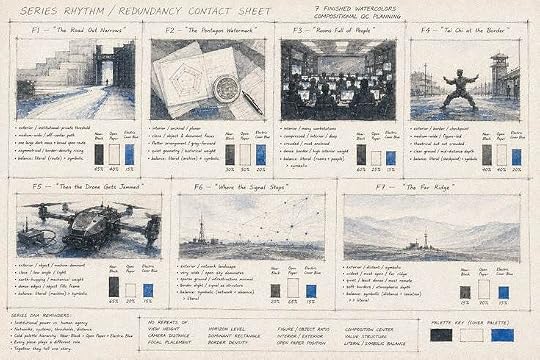
“The Road Out Narrows” turns the review’s central problem into architecture: a broad route contracts between public systems and privately controlled infrastructure until the remaining freedom to leave is little more than a strip of open paper.
Decades before today’s technology fortunes became large enough to rival national budgets, Pentagon strategists entertained a grotesquely simple question: could a billionaire build and sell a nuclear weapon? Sharon Weinberger opens “Valley of Death: How Big Tech Is Fueling the Future of War” with the government study that followed. The colder joke is that the bomb need never exist. A company acquires a slice of sovereign leverage whenever the state comes to depend on something that company controls and cannot readily replace. Weinberger’s history gradually turns the old nightmare inside out. The billionaire does not have to seize a power reserved for government if government discovers that one of its necessary powers now runs through the billionaire’s network.
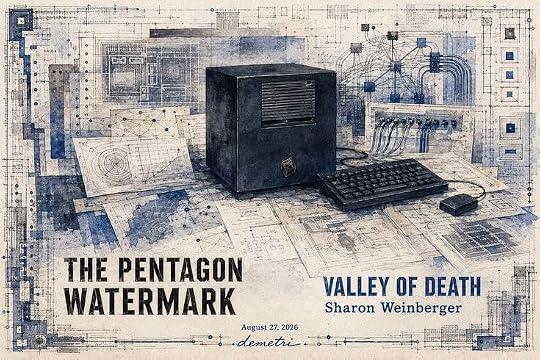
Even Silicon Valley’s origin story turns out to have a Pentagon watermark. Military research, intelligence work, semiconductors and federal spending helped nourish the region that would later market itself as bureaucracy’s impatient opposite. Steve Jobs’s NeXT enters Weinberger’s account through intelligence customers who saw uses for its networked machines when the commercial market remained doubtful. That prehistory changes the moral geometry of the familiar disruption tale. The state first appears as patron. Years later it returns as customer, buying access to capabilities developed beyond its walls by companies wealthy enough to finance their own bets.
“The Pentagon Watermark” places early commercial computing over the faint institutional plans beneath it, making the state less a backdrop to Silicon Valley than one of the buried structures on which its mythology of independence was built.
Much of Weinberger’s cast arrives with an argument the Pentagon has spent decades helping them make. SpaceX promises cheaper launches and cracks an expensive aerospace lock. Palantir offers software soldiers often find easier to use than the Army’s own systems. Anduril builds first and proposes that the military shop later, rather than spend years converting guesses about future war into exquisitely detailed requirements. Their case does not depend on caricaturing government incompetence. The Pentagon has supplied its own evidence: obsolete software, years-long acquisitions, prototypes that work without becoming purchases. Weinberger keeps the difficulty intact. A public institution can be accountable and still be bad at buying what it needs.
Every victory, though, alters the customer’s ability to walk away. SpaceX enters military launch as a challenger to concentration and grows hard to substitute. Palantir fights to make the government consider commercial software, then positions itself as the layer through which other companies can reach the military. Anduril attacks the old primes while aspiring to become a new kind of prime. Peter Thiel’s maxim that competition is for losers hangs over the sequence with almost indecent efficiency. Silicon Valley comes to Washington advertising speed, competition and choice. Venture capital rewards the firm that wins so decisively that choice can become yesterday’s market condition.
Traditional contractors have long profited from war, lobbied government, owned intellectual property and left the Pentagon with painfully few alternatives. Weinberger’s claim to novelty is narrower, and more interesting. Many of the newer firms raise private capital before the Pentagon orders anything, decide what to build, retain the underlying technology and then sell continuing access to what they have made. That can make a product faster to field and harder for the customer to possess in any meaningful sense. A satellite network, cloud service or software platform can be updated, repriced, restricted or withheld by the same company the military relies upon. The Pentagon may purchase capability without purchasing command. A rifle delivered to a warehouse is one kind of dependency; a mission running through somebody else’s servers or constellation is another.
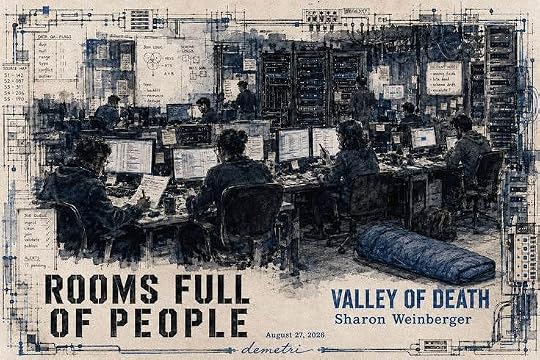
Rooms full of people, one intelligence official jokes, sit behind Palantir’s aura of an all-seeing stone. Engineers clean and integrate data; forward-deployed staff customize the product. Yet the punch line does not make Palantir useless. Soldiers in Afghanistan often prefer the software because it is easier to operate and because company engineers are nearby when military support is not. Weinberger’s skepticism earns its authority here. She is willing to find efficacy underneath the hype rather than treating demystification as exposure. A technology can work and still enjoy a reputation more supernatural than its code deserves.
“Rooms Full of People” looks behind the seamless interface at the engineers, cables, desks, servers and improvised sleeping arrangements that turn technological magic back into labor without denying that the resulting system can still work.
Inside the prose, claims keep meeting friction. A founder announces that he is saving Western civilization; the next concern is a contract. A company invokes artificial intelligence; somebody still has to label the data. A startup promises to reinvent battle. Then the drone gets jammed. Weinberger’s sentences are lucid, reportorial and largely uninterested in preening. She favors medium-length explanatory lines, then a shorter sentence that quietly alters the temperature. Her humor depends on sequence and restraint, not punch lines pasted on afterward. The future keeps showing up as server racks, ammunition pallets, repair crews and manufacturing tolerances. Procurement has already written the joke.
Palmer Luckey building a ramjet in a drained swimming pool scarcely needs embellishment. Neither does Alex Karp doing tai chi near the Ukrainian border while armed guards puzzle over him, or Ukrainian drone pilots demonstrating battlefield-derived machines above a California winery. These scenes carry their own pressure because the whimsy is never detached from consequence. A Lego model of a microwave weapon sits beside questions about who would own the real one. Executives speak Tolkien while pursuing contracts whose objects are considerably less imaginary. Weinberger notices the absurdity without letting absurdity become an alibi.
“Tai Chi at the Border” holds Alex Karp’s private ritual against the queues, fencing and armed watchfulness of a wartime crossing, letting the scene’s own oddness expose the distance between technology theater and the public consequences gathering around it.
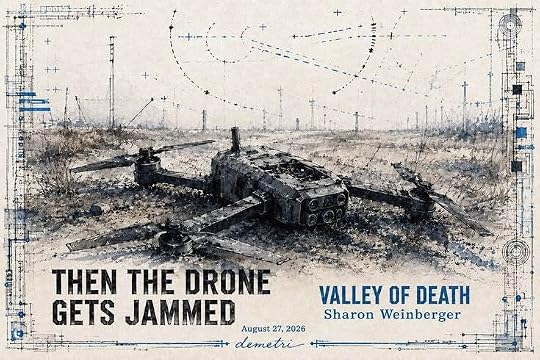
Actual war is less obliging than a demonstration. In Ukraine, Starlink supplies crucial communications; commercial imagery and cloud services answer immediate needs. American drones encounter Russian jamming and battlefield conditions less forgiving than investor presentations. Ukrainian manufacturers revise products beside the soldiers using them, sometimes faster than distant American firms can respond, and their advantage is almost embarrassingly old-fashioned: the engineer is close to the person whose life depends on the machine. The habits Silicon Valley claims as its birthright – proximity to users, iteration, speed – belong to anyone forced to practice them urgently enough. War has no obligation to respect the branding.
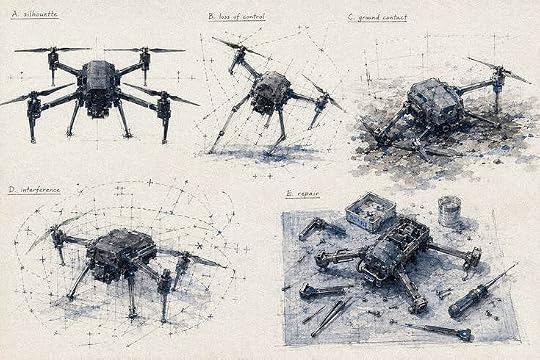
“Then the Drone Gets Jammed” leaves the machine intact but stranded, turning electronic interference into a quiet physical rebuke to the distance between technological promise and the conditions a battlefield is free to impose.
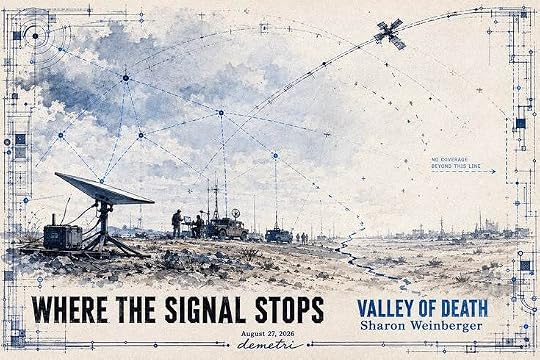
Private infrastructure becomes political the moment losing it would change what an army can do. Once Ukrainian forces rely on SpaceX’s network, Musk’s decisions about payment, territorial coverage and escalation cease to be commentary from a famous businessman. Pentagon officials find themselves negotiating with a founder who has his own views about Crimea, Russia and the risk of widening the war because losing the service would matter on the battlefield. His opinions acquire consequences for an operation. Dependence does not require villainy. It requires usefulness plus scarcity. The better the service and the fewer the substitutes, the harder it becomes to say where contracting ends and private discretion begins.
At first the Pentagon is patron; before long, some of its former supplicants look remarkably like infrastructure. Companies that once begged for admission learn to sue, lobby, embed engineers, cultivate users and make themselves difficult to route around. That change in status is the book’s closest thing to plot. The chronology matters because the same actors occupy different positions as it proceeds. A vendor asks for a chance. A successful vendor becomes a platform. Eventually the government has to calculate the cost of saying no.
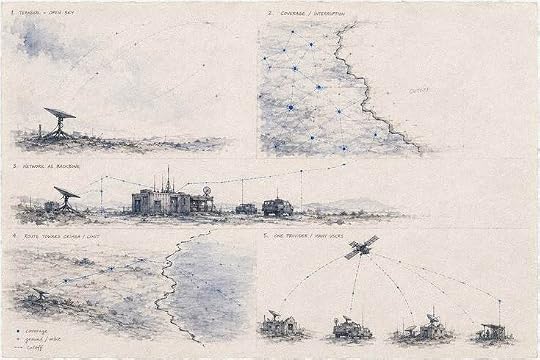
“Where the Signal Stops” makes dependence spatial: a communications network stretches across an enormous field until one boundary interrupts it, and the blank space beyond the line suddenly carries as much political weight as the technology itself.
Deep into the book, its two governing metaphors change jobs. The billionaire’s bomb begins as a sensational hypothetical and ends as shorthand for private control of a capability the state cannot readily replace. The Valley of Death first names the gap where startups die after producing prototypes the Pentagon never buys at scale. Near the end, former Pentagon official Will Roper worries that too few companies will cross it. Weinberger rotates the landscape: what if only a few survive, grow enormous and reproduce the concentration they were meant to disrupt? The danger is no longer only that promising firms perish in the valley. It is that the survivors own the road out.
In “Unit X,” Raj M. Shah and Christopher Kirchhoff describe the work of bringing commercial technology into the Pentagon; Christian Brose’s “The Kill Chain” argues for the urgency of a faster, more networked military. Weinberger writes the awkward sequel. Suppose the doors open. Suppose the technology works. Suppose the new firms win. The question is no longer how government gains access to Silicon Valley. It is whether government can still leave without losing something it now needs.
Military technology is usually discussed in terms of capability: whether a drone flies farther, a model finds targets faster, a missile survives interference. “Valley of Death” keeps asking what demonstrations rarely do: who controls the system once everyone agrees they need it? Palantir’s ambitions make the issue especially clear. The most powerful company may not build the most frightening machine. It may provide the layer through which everyone else’s machines must pass. The gate can be more valuable than whatever passes through it.
If Weinberger’s argument loses precision anywhere, it is at the boundary it makes unavoidable. The Pentagon’s acquisition process really is slow. Traditional contractors already are concentrated. Rebuilding every important technology inside government would be fantastically expensive and often foolish. But how little ability to switch suppliers is too little? Which capabilities deserve a second provider even when redundancy costs more? When should the state insist that it can continue a mission after one company says no? The answers might involve interoperability, duplicate suppliers, public ownership of selected infrastructure or simply paying more for an exit option. Weinberger need not write a procurement manual, but the absence of a firmer criterion matters. She identifies the danger more clearly than the threshold.
The missing boundary has another cost: once the challenger-to-gatekeeper pattern is established, repetition sometimes arrives dressed as escalation. Another startup, another valuation, another conference full of martial confidence can confirm what has already been demonstrated. The recurring “war bros” and “broligarchy” shorthand also compresses a field Weinberger’s reporting shows to be more various. Andy Lowery of Epirus is not Palmer Luckey; Ukrainian engineers do not share the incentives of American venture funds. Patriotism, ideology, profit and ambition mingle without becoming one creed. Her evidence is often subtler than her labels.
Read a few years from now, some of “Valley of Death” will inevitably look dated. Company valuations will move. Political alliances will mutate. Some heavily funded firms will fail magnificently, perhaps without leaving much more than an investor deck behind. The dependency Weinberger isolates is harder to age out of relevance. Government wants commercial speed without surrendering its ability to direct its own operations; companies want the returns and autonomy that come from owning what they build. Her late dispute over military use of a privately controlled artificial-intelligence model exposes the same bargain from another direction. A provider can object to certain uses; the government can object that military policy cannot depend on corporate conscience. Both positions are intelligible. That is why the conflict matters.
On my scale, “Valley of Death” earns 88/100, or 4/5 stars. Its repetitions and the boundary Weinberger never quite draws keep it below the highest tier, but the reporting, historical reversal and scrutiny of ownership make it much more than a chronicle of defense-tech swagger. She neither canonizes the insurgents nor asks us to become sentimental about the bureaucracy they attack. A company can solve a public problem so effectively that the solution changes who gets to say no.
Perhaps the most unsettling word in the book is therefore not “bomb” or “war” but “indispensable.” Contractors can be fired. Suppliers can be replaced. No substitute is another matter. Weinberger begins with the theatrical fear that a billionaire might acquire powers once reserved for states. She ends much nearer the quieter possibility that the state will acquire dependencies it cannot readily shed. The Valley of Death is supposed to be where fragile companies disappear before reaching the Pentagon. Weinberger leaves us instead looking toward the few who have reached the far ridge, standing beside technologies the government now needs, while the path behind them narrows to a single lane.
“The Far Ridge” turns the book’s closing metaphor outward: most routes fail or fade before crossing the valley, while the few structures that reach the other side stand beside the increasingly narrow road everyone else may have to use.
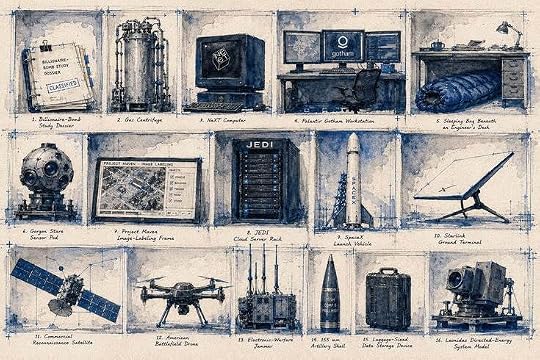
All-Character Watercolor Study
Important-Items Watercolor Study
Alternate Full-Jacket Study
Cover-Palette Pigment Ledger
Hand-Lettering Typography Study
Border Architecture Study
Inside-Out Systems Study
Starlink Spatial Dependency Study
Drone / Electronic-Warfare Study
Series Rhythm Contact Sheet
First Underdrawing
First-Wash Study
All watercolor illustrations by Demetris Papadimitropoulos. Watercolors are done on 140lb vellum and then scanned into the computer using an Epson scanner. From there, they are finalized in Procreate. No AI was used in writing this review — all art and opinions are my own.
Valley of Death is about Big Tech, but it is also a series of business stories about the founding of companies during a military defense spending boom. It answers questions like, what does the market for war look like? Who profits from global geopolitical conflict? What minds are at work on the technologies that will hold back any front lines of conflict the world faces? Who decided those should be the people and companies doing so? And perhaps most importantly, what does it mean when a democratic government gives so much public money and power to private interests? It is an excellent delineation of how Big Tech and military spending converge in the market of war in ways that, with figures like Elon Musk, Alex Karp, and Trump at the helm make it more like a theatre of war. It was such an informative book, and I certainly feel like I'm better versed on Big Tech in the defense economy.
While reading I felt like I was taken on a guided tour through a hall of democracy horrors, where there was one revelation after another, of jaw-droppingly questionable business practices claiming to be in everyone's best interests through national security initiatives. I thought I knew a tiny bit about defense contracting, having read Blackwater: The Rise of the World's Most Powerful Mercenary Army, but Weinberger's book humbled my assumption and I'm so grateful. After reading Weinberger's book I cannot help but wonder why details out of Russia of the Wagner group (Putin's Sledgehammer: The Wagner Group and Russia’s Collapse into Mercenary Chaos) would not slow the roaring speed of the U.S. government outsourcing military power into private hands on so grand a scale as with Big Tech. Weinberger shows though, that if anything, the current administration has placed this open-for-business ethos in an express lane. When looking for the logic in Big Tech's claims and urgency, among the enduring ones is a refrain espoused repeatedly by its figureheads: "saving the free world". From whom, is a question readers will need to determine for themselves (personally, I think we need to be saved from Big Tech). Weinberger reveals the depth of this self-serving messianism as a Silicon Valley best practice in this iterative look at Big Tech's foray into national security.
The research in the book covers a lot of ground: the beginnings of the market for war with Steve Jobs post-Apple-pre-Apple, as well as Palantir in the early 2000s, alongside military contractors like Oracle, IBM and Microsoft. It goes over Trump Administration key players in the Big Tech scene and how many private companies borrow from former Senators, and political leaders to line their executive and senior leadership hallways. It also covers the key companies shaping the military tech landscape (and their attendant capacities), as well as how they profit off of geopolitical conflict beyond North America, as with the War in Ukraine. There are far more reasons to read this book, but those are among a few that stood out as vitally important to learn about to understand the future of war in the United States.
If you like reading business stories, have an interest in American politics, and are perhaps even trying to comprehend democracy in application in the moment the world is in (like I am), this is a great book for you. It builds context around the ways that the Trump government is courting Big Tech suitors to assert its military presence on the world stage (and how previous democratic governments laid the groundwork for its present state). It also helps provide food for thought about China's threat to invade Taiwan by 2027-- I had no clue Jinping was so bold as to give an actual date, and thought they were just mocking the U.S. with occasional war games in the Taiwan Strait. Valley of Death delivers on its information promises, and leaves discerning readers with much more to consider once the book is finished--it's what makes it such an important book on tech.
A lot has been written about Silicon Valley, about individual tech bros, their arrogance and indifference to the common good. Weinberger may be the first to look at the overall fabric of which each oligarch is a part.
She paints a chilling picture of a gilded age of entitlement run amok on the defense industry, and thus on our safety, integrity, and stability as a nation.