Pearl is a thirty-something filmmaker balanced precariously on the edge of an addiction-fueled breakdown. But when she is invited to interview her idol and crush, lesbian cult filmmaker Mitch Meyer, her stilted life restarts.Buoyed and seduced by Mitch’s interest in her and her work, Pearl swaps alcoholism for romantic obsession and London for a summer in New York with Mitch. All the while she is haunted by a project she has been toying with for a film about Veronica Lake, a 1940s film star who drank herself into obscurity.
Oh boy oh boy oh boy do I have thoughts about this book. Can I promise that they will be coherent, logical, or even remotely sensible? Absolutely not. But I think that might actually be the appropriate response to Prairie Oyster because this is such a strange, feverish, slippery little book about addiction, desire, art, memory, obsession, and the terrifying experience of wanting something so badly that you slowly start rearranging your entire life around it.
I will admit that somewhere near the beginning, I genuinely thought some of the filmmakers being mentioned were real people and had to sit there like ;-; wow, way to expose me as a film noob. I love movies, but directors and filmmakers have never occupied quite the same corner of my brain as actors, books, or musicians, so a lot of the film-world references initially felt like being dropped into a conversation where everyone else had already read the syllabus. Weirdly, though, I think this made the reading experience more interesting for me. Pearl’s obsession with cinema becomes so all-consuming that the book almost demands that you enter her particular frequency, where films, filmmakers, old Hollywood, memories, desire, and reality all start bleeding into each other.
Speaking of Pearl, it is almost horrifying reading about a character and repeatedly thinking, why the fuck is she me? Obviously, minus the alcoholism and drugs, because I value my autonomy, consciousness, and general ability to remain in possession of my faculties WAY too much to willingly surrender them. But the rest? The waiting before replying to a message because you don’t want to seem too eager. Carefully editing texts so you achieve the exact ratio of affection to coolness. Looking at someone’s social media and pretending you are simply “checking” when you have actually been scrolling through their entire digital existence. Posting something because you know a particular person might see it. Reading meaning into a delayed response, a like, a picture, a word, a tiny shift in tone. Wanting to be wanted without ever having to directly ask to be wanted. Slowly losing the shape of your own life because somebody else’s attention has become the gravitational centre of it. Pearl does all of this, and Robinson makes it so painfully recognizable.
That is also what makes the book’s central idea of addiction so effective to me. Pearl gets (kinda) sober but sobriety does not magically make her whole. The addictive behaviour simply seems to find a new object. Alcohol becomes Mitch, the bottle becomes the phone, drinking becomes waiting, the chemical high is replaced by the tiny electric shock of a text, an Instagram notification, an invitation, a kiss, a photograph, any microscopic indication that Mitch is thinking about her. And that distinction between love and obsession becomes increasingly difficult to locate. Is Pearl in love with Mitch, or is she addicted to wanting Mitch? Maybe the novel’s answer is that these things can coexist, that love can become so distorted by longing that eventually you can no longer tell where one ends and the other begins. I think that is one of the most painfully sapphic things about the entire book. There is something almost canonically sapphic about the feeling of loving someone with an intensity that seems wildly disproportionate to whatever you are actually receiving in return, especially when the person is older, unattainable, admired, or somehow exists on a plane you desperately want access to. That kind of love can make you feel like the smartest person alive and the dumbest person alive within the exact same five-minute period. And of course, Robinson takes that familiar sapphic humiliation and turns the volume all the way up.
I also really loved the relationship between Pearl’s obsession with Mitch and her obsession with Veronica Lake. The book keeps asking what happens when we fall in love with an image, a person, a version of a person, or even a version of ourselves that we think exists somewhere in the past. Pearl becomes fascinated by Veronica because she cannot understand how somebody who was once so visible could simply disappear. A person can be loved, desired, watched, celebrated, documented, and still eventually become dust that nobody knows what to do with. For Pearl, making art is supposed to be a defense against that disappearance. If she can make The Lakes, if she can turn Veronica’s life into something visible and lasting, perhaps she can also make herself impossible to forget. Except the more she tries to preserve Veronica, the more she seems to dissolve herself into her.
This is where I think the lake, water, pearl, and drowning imagery becomes particularly fascinating. I am almost certain there are approximately seventy-seven layers of metaphors here that a much smarter person could notice. I would genuinely love for someone extremely intelligent to read this book, cradle me like a child, and explain every metaphor, juxtaposition, image, structural choice, recurring motif, narrative echo, symbolic object, and tiny weird literary trick to me ala Ms Rachel. Unfortunately, you are stuck with me and this review, trying to make sense of things, which probably only scratches the surface of the magnificence of what Robinson is doing here. The book keeps returning to water as something that carries, reflects, absorbs, drowns, preserves, destroys and connects. Pearl is constantly moving through rivers, lakes, oceans, pools, rain, swimming, drinking, floating. Alcohol itself becomes another form of water, something that she consumes until drinking begins to resemble drowning. Veronica is similarly surrounded by water, and the history of her life keeps folding back into Pearl’s own. Even Pearl’s desire seems aquatic. It pours into everything, surrounds her, pulls her under.
And then there are the pearls themselves. Pearl is literally named Pearl, as is her mother, while Veronica’s identity is itself fractured between names and versions of herself. Veronica Lake was Constance, and Veronica was also her mother’s name. Pearl keeps encountering versions of herself in mirrors, photographs, films, memories and eventually in Veronica. The string of pearls feels almost like a chain of identities extending backward and forward through time. A pearl is also something produced because an irritant gets inside an oyster and the oyster repeatedly coats it, layer after layer, until the thing hurting it becomes something beautiful. Which feels extremely relevant to a novel about turning pain, addiction, longing and obsession into art. Except the book also reminds us that pearls are parasites. They hurt the oyster. Beauty and injury are allowed to occupy the same space. It is ultimately so interested in the relationship between what nourishes us and what consumes us. Desire can sustain you. Desire can also become the thing that eats you alive.
And well…the secondhand embarrassment was INTENSE. I felt physically stressed reading a lot of this book. There were moments where I wanted to grab Pearl by both shoulders and scream THAT DID NOT HAPPEN. YOU INVENTED THAT. PLEASE GO HOME.
I did have a few issues, though. There were moments where I became genuinely confused about the timeline or where exactly Pearl was. There were several points where I was sitting there like wait, is she at home-home? Is she somewhere else? Who the hell is looking after the cat? What day is it? Some of that disorientation is probably intentional, and I can appreciate that but there were moments when it pulled me out of the story rather than drawing me further into Pearl’s fractured state of mind.
Up until particularly the last few pages, I was very close to giving this five stars. I understand why it ends the way it does. I understand the narrative and thematic logic behind it. I understand why a neat little resolution would almost betray what the book is trying to say about recovery, survival, grief, art, and the fact that life does not necessarily reward you with a satisfying conclusion simply because you have suffered enough to deserve one. I understand all of that. And yet…I wanted more.
I wanted Pearl to get her shit together. I wanted something concrete. I wanted to know what happened to The Lakes. I wanted some tiny indication that all of this had led somewhere. Instead, the ending is much more artful, ambiguous and haunting. I think it is probably exactly the kind of ending many readers will adore. For me though, it left me feeling almost hollow. Not devastated in the satisfying way a devastating ending can make you feel but just genuinely empty. I finished it and just sat there like...okay???? Maybe I was too dumb to get it. Maybe that is part of the point. Maybe the emptiness is the point. The final images are undeniably beautiful, though. Maybe being remembered was never actually the same thing as having lived.
Prairie Oyster is for the tortured creative, the obsessive lover, the person fascinated by the ugly underside of ambition, the person who likes their sapphic fiction a little messy and psychologically unwell and anyone interested in the strange ways addiction can simply change costumes. I especially appreciated how directly the book connects romantic obsession with recovery. Pearl’s story is not simply about getting sober, but about discovering that removing one destructive thing from your life does not automatically teach you how to live. You still have to learn what to do with all the space that remains. That is probably why this book stressed me out so much. I recognized too much of it. Not the addiction, thankfully, but the wanting. The embarrassing, irrational, deeply human desire to be chosen by someone you have already chosen with your entire body and mind. The desire to become interesting enough, talented enough, cool enough, lovable enough, hell even gay enough that somebody else will finally look at you and say, yes, you. The way we sometimes confuse being seen with being loved. The way we can turn another person’s attention into evidence that we matter.
Pearl spends so much of this book trying not to disappear. By the end, I am not entirely sure whether she succeeds, but maybe living was never about making sure you leave behind something permanent. Maybe it was always about being here long enough to feel the water, the fear, the desire, the grief, the ridiculousness, the beauty, the whole messy unbearable thing. And maybe that is enough.
Thank you to NetGalley and University of Iowa Press for providing me with an advance reader copy of Prairie Oyster.
This entire review has been hidden because of spoilers.
2.75 Lyrically written, this accurately captures how it feels to be in a one-sided relationship where the other person gives you just enough to feel minutely important, only then to be ignored—left on read. Later, at a chance meeting, they hold your hand. Such mixed signals. Such lack of care for your emotions. Between this and addiction problems, Pearl’s life definitely hits rock bottom. This story is well written, but it isn’t fun to read, and I did feel bored throughout. Thanks to NetGalley and University of Iowa Press for the chance to read it. Pub date in the US is Oct 6th.
I loved this book so much. Prairie Oyster was one of those books that hit a little too close to home in some ways... I connected with Pearl in a way I wasn’t necessarily expecting, especially in the way she keeps telling herself that if she can get sober, work harder, create something worthwhile, or become someone different, everything will finally fall into place.
Pearl is profoundly vulnerable, and I think that’s what made her hard to look away from. She makes choices that are frustrating and sometimes painful to read, but underneath it all, she's desperately trying to find her way back to herself. Her relationship with Mitch deepens the complexity of obsession and escapism, and I loved how the novel gradually makes it harder to tell where Pearl ends and the things consuming her begin.
There is more than I have the words for. I think I felt so much reading this book that I'm stuck on what else to say, but overall, I thought this was messy, uncomfortable and beautifully written. It made me feel things I wasn’t expecting, and I think that’s why it has stayed with me and will stay with me.
Thank you, UIowa Press, Sophie Robinson & NetGalley for the #gifted earc. All opinions are my own.
A compelling, vivid, well-crafted debut. I don’t think I’ve read anything like this before, for all its complex and human characterisation, its faithful account of queer desire alongside addictive behaviour - Prairie Oyster is a lyrical, clear, brilliant story.
I can struggle with novels, often losing stream a third of the way through, but this one I couldn’t put down, and finished in two days, sneaking time between work and sleep!
This is a superb novel, I wish I could read it for the first time again.
This should have worked much better for me than it actually did as I was all there for the subject matter of a woman on the verge of a breakdown, with her alcoholism, mental health issues and intense affair - but this is written in that dry and detached style that simply doesn't work for me. It feels very 'told' so that I was at arms' length from the narrative at all times - sorry, just a stylistic mis-match with this reader.
This book is the literary equivalent of watching a very elegant person slowly drive their life into a wall - and somehow you cannot look away.
Prairie Oyster follows Pearl, a London-based filmmaker who is deeply, enthusiastically self-destructing. Alcoholism, obsession, depression, creative ambition, rinse, repeat. It’s bleak! It’s exhausting! It’s also weirdly compelling in a “this is painful but I must keep going” way. I was completely absorbed, deeply uncomfortable, and emotionally drained - which honestly feels correct for a novel about addiction that refuses to flinch.
What this book does exceptionally well is capture the internal logic of addiction. The looping thoughts, the self-justifications, the tiny lies you tell yourself so you can keep going exactly as you are. At times I was physically cringing because the thought patterns felt so real. There’s no glamour here, no neat redemption arc - just the slow, grinding mess of someone who is very unwell and very aware of it.
Structurally, I loved it. Pearl’s fixation on a hard-drinking 1940s Hollywood star - woven through the book via documentary fragments and interview material - is genuinely clever. You can feel how she both idolises and consumes this woman’s myth, using it to make sense of (and excuse) her own spiral. It’s a powerful mirror, even if the rationale for that obsession sometimes felt a bit thin. Still, the way the form mirrors the obsession? Chef’s kiss.
The prose is controlled, hypnotic, and keeps you reading even when everything happening on the page is miserable. And Pearl herself is interesting because the book allows you to feel everything about her: sympathy, frustration, distance, tenderness, exhaustion. I can totally see readers reacting very differently to her - and I think that’s part of the point.
Is this doing something wildly new? Not necessarily. But the execution is strong, confident, and emotionally immersive, which counts for a lot. If you like dark, character-driven literary fiction - especially if The Bell Jar lives rent-free in your head - this will probably work for you.
Would I recommend it? Yes. Would I emotionally recover immediately after? Absolutely not.
Thank you to NetGalley and the publisher for the advance copy.
3.5 but i think i want to round it up because of the last act!
read for my own writing practice and found it very insightful; lots to think about motherhood, mental health, addiction, desire, and what it entails to be a human, and i enjoyed the pacing. i would've loved this book a lot more were it not for some of the editorial choices ie how the tenses kept switching between past and present, sometimes even within the same sentence, and the lack of quotation marks. i also found the third person pov kept me from entering pearl's mind; the story was very "told" if that makes sense and i was never as close to her as i would've liked.
Prairie Oyster is intense, messy, and gripping. It doesn’t try to tidy up addiction or make Pearl easier to root for. She makes bad choices, pushes people away, and spirals in ways that are often frustrating to watch, but the writing keeps you close to her experience, making it hard to disengage.
The novel plays with obsession, idolisation, and the thin line between creative drive and self-destruction. It won’t be a book for everyone, but if you’re drawn to character-led stories that are uncomfortable, emotionally raw, and a bit chaotic, this feels like a strong and assured debut.
This was absolutely incredible. Loved the narrator. The part where she texts 'fuck off' to someone trying to help her is so perfect. Love the Lana Turner monologues. Just an absolutely fantastic piece of work about sobriety, art, escape, and disappearing into the void vs trying to live life. Thank you Netgalley and the publishers for the ARC.
One More Drink, One More Text, One More Beautifully Bad Idea Sophie Robinson’s “Prairie Oyster” gives romantic obsession the rhythm of addiction, then lets its wayward filmmaker discover that a quieter life need not be a lesser one. By Demetris Papadimitropoulos | August 13th, 2026
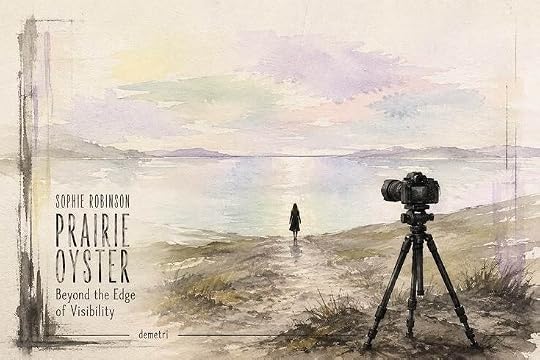
Pearl sets the camera running and walks toward the Icelandic fjord until she slips beyond its reach, turning the disappearance she once feared into an image she has chosen to make.
Desire keeps changing containers in Sophie Robinson’s “Prairie Oyster.” Alcohol first, then cocaine and pills, then the notice of an older artist, then sex, the hope of artistic resurrection, the dead glamour of Veronica Lake. Pearl, Robinson’s thirty-two-year-old filmmaker, has spent so long treating intensity as proof of life that sobriety presents an almost metaphysical nuisance: if the world is not lurching, glittering, collapsing, calling at midnight or withholding a reply, what is supposed to make it feel real? “Prairie Oyster” begins with what Pearl consumes. It becomes stranger, and better, when appetite stops naming a substance and starts describing a way of looking.
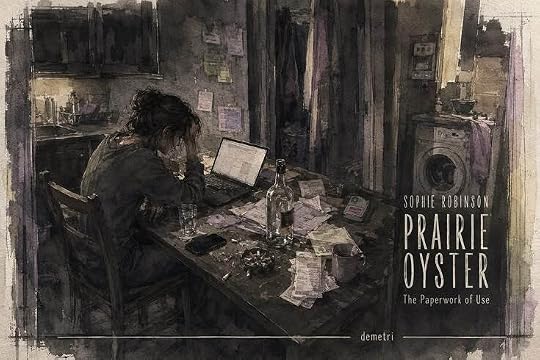
Early in the novel Pearl wakes on the floor after another blackout, her phone dead, vodka nearby, her academic job slipping beyond excuse. The room is crowded with the paperwork of use: stale beer, vomit, cigarettes, shaking hands, improvised lies, a nearly empty gas meter, the grim arithmetic of drugs and just-enough functionality. Robinson denies addiction the flattering mystery of the doomed artist. Pearl may once have been a promising experimental filmmaker, but catastrophe has become repetitive administration. She knows which story will buy time, which substance might level which symptom, which fresh start can be promised after one last drink. The comedy bites because dissolution has ceased to be dramatic even to the person dissolving.
In Pearl’s blackout aftermath, bottles, bills, screens and household obligations crowd the same small room, stripping addiction of doomed-artist glamour and revealing catastrophe as repetitive administration.
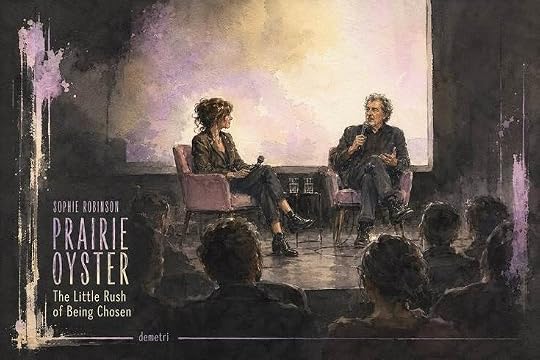
Mitch Meyer arrives when Pearl is desperate for a new plot. A cult lesbian filmmaker of an older generation, Mitch is Pearl’s idol, academic subject, crush and eventually lover, a person whose artistic authority carries the charge of queer history itself. When Mitch asks Pearl to interview them at a retrospective, listens without visible judgment to the wreckage of her life and urges her to try one sober day, Pearl begins going to meetings and rebuilding. For a while, Mitch’s attention warms Pearl’s bones in exactly the place alcohol used to reach. Robinson lets the resemblance gather without reducing one dependency to a metaphor for the other: anticipation, relief, the little rush of being chosen, the wish for one more dose.
Even so, “Prairie Oyster” is too alert to make Mitch a walking syringe. Their attraction is genuine; Mitch admires Pearl’s work; Pearl has not invented every tenderness. Nor has Mitch explicitly promised the future Pearl begins constructing from sex, messages, public affection and artistic encouragement. The murkier question is what responsibility survives when there has been no clean deception. Mitch can mean what they offer and still occupy far more room in Pearl’s imagination than they seem willing to acknowledge. Pearl starts rationing messages, reading silence as verdict, learning which version of herself might earn a reply. The phone becomes a pocket casino whose jackpot is somebody else’s attention.
At Mitch Meyer’s retrospective, professional recognition, public attention and private desire begin to share the same charge, making the pleasure of being selected feel dangerously close to another kind of dose.
The simplest account says Pearl swaps one addiction for another. That gets the mechanism right and the novel wrong by a few degrees. Mitch makes Pearl feel exceptional. Sinead, her AA friend, makes sandwiches, folds clothes, answers the phone and keeps being there. Björn, Mitch’s longtime producer, later tells Pearl that her films are tender, daring, juvenile in places, badly in need of a better editor, and worth continuing. That criticism matters as much as the praise. Björn can see Pearl clearly without needing her dependence in return. Robinson’s moral interest gathers around that difference: who looks at Pearl, what they see, and what their seeing asks her to surrender.
Robinson builds the same pressure into the prose. Her sentences often gather colors, textures, objects and sensations until syntax itself begins to crave. The opening catalogue of drinks does not explain alcoholism so much as perform its grammar: one more glass, one more setting, one more promise, one more gorgeous little exit from the self. Elsewhere, fragments interrupt long rushes of thought like jump cuts. Memory enters sideways. Broadcast cues, applause, dialogue and imagined television lighting interrupt the narrative without tidying it. Pearl edits life while living it, turning sensation into sequence before she has decided what any of it means.
If the style were merely lush, it would be much less interesting. Robinson is equally devoted to the clammy, sour, humiliating body. Pearl vomits, sweats, bleeds, shakes, snorts, pisses, sleeps badly and has sex in states that make transcendence look distinctly unhygienic. Film-school argument rubs against drug talk; sudden lyric beauty turns up beside cheap wine and bad breath. That range keeps the book from glamorizing collapse, but it also avoids the opposite falsification. Intoxication has to contain pleasure or Pearl’s return to it makes no sense. The thing ruining her keeps offering, briefly and convincingly, to rescue her from herself.
Pearl’s stalled third film, “The Lakes,” creates the novel’s riskiest complication. For years she has been obsessed with Veronica Lake, the Hollywood star whose beauty became an image, whose alcoholism became biography and whose later obscurity seems to Pearl almost cosmically unfair. Robinson threads an invented first-person interview with Lake through the novel, complete with stage directions, television cues and memories sliding between public record and imaginative reconstruction. Pearl keeps finding herself in Veronica, then finding Veronica in herself. The unease is concrete: Robinson is not simply writing about a dead actress but inventing her consciousness.
At first Pearl wants Veronica to prove something. If someone once so visible could disappear, then fame has failed its bargain. If Veronica drank herself toward oblivion, perhaps Pearl can understand her own collapse by tracing the pattern. Here “Prairie Oyster” comes near Catherine Lacey’s “Biography of X,” another book suspicious of the coherence imposed on artists after the fact. Robinson’s problem is sharper because Veronica Lake was real. Pearl risks treating a dead woman as usable material, and Robinson, by giving that woman an invented interior life, risks the same trespass one level above her.
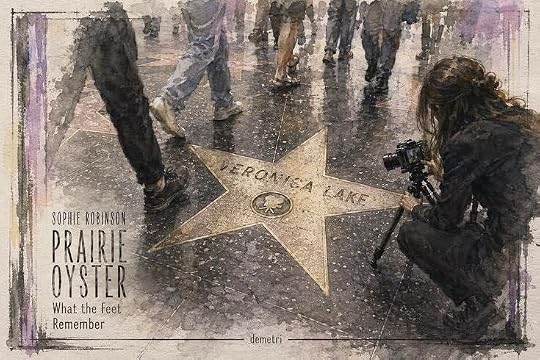
Pearl’s project eventually becomes evidence against Pearl. She begins “The Lakes” as a story about how a person falls apart into a thousand pieces, but the imagined Veronica will not stay inside that arrangement. Fame was not salvation; obscurity was not pure erasure; the life between those poles refuses the clean shape Pearl wants from it. Pearl is not only the person being watched badly. She watches, frames, selects and turns another woman’s life into material that might explain her own. A filmmaker cannot avoid framing. She can, however, learn that the frame is not the life.
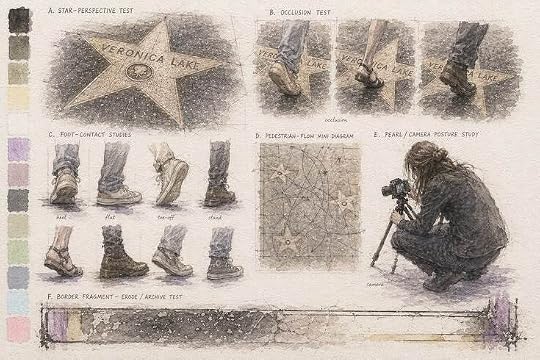
Pearl films Veronica Lake’s star as passing feet repeatedly hide and recover the name, turning public memory into a problem of who looks, what survives the frame and how another life becomes material.
Across England, New York, Los Angeles, New York again and finally Iceland, the five acts narrow and widen Pearl’s field of vision. Substances monopolize the early life. New York lets Mitch appear to organize the chaos. Los Angeles should enlarge Pearl’s world with research, producers, new friendships and possible work, yet nearly all of it becomes background noise to Mitch’s availability. Robinson’s sharpest structural trick is to starve competing plots. Interesting things happen to Pearl and she cannot invest in them. The loss is not simply that she wants Mitch too much; it is that everything else begins to look dramatically underexposed.
Distance does not cure this. In California, Pearl learns that Katja, another younger woman in Mitch’s orbit, once occupied a painfully similar position. Katja gives Pearl the sentence she has been resisting: what she kept thinking was the beginning may already have been the whole thing. Pearl understands the pattern and still cannot live according to the understanding. Like Leslie Jamison’s “The Recovering,” “Prairie Oyster” is interested in that humiliating delay between naming a pattern and being able to stop repeating it. Recognition can be instantaneous. A changed life is usually slower and considerably less photogenic.
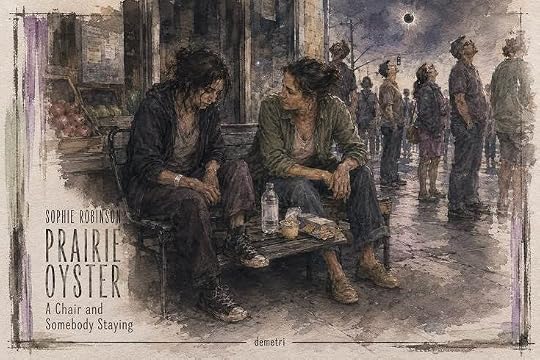
In New York again, romance and sobriety finally collapse into the same relapse. Pearl sees Mitch with somebody else, drinks and uses with Katja, and slides toward another physical crisis. By then the relapse hurts precisely because it has ceased to be surprising: Robinson has spent pages teaching us the machinery that will produce it. What follows is quieter. Pearl attends a meeting with a hospital bracelet still on her wrist. A woman gives her crackers, applesauce and seltzer. Rescue shrinks to food, a chair and somebody staying. No one in the room needs Pearl to be fascinating.
Mitch, meanwhile, resists the moral tidiness Pearl sometimes wants from them and readers may want on her behalf. Pearl turns some absences into promises and some intimacies into futures. Yet Katja’s history makes the pattern harder to dismiss as Pearl’s private delusion, and Mitch’s age, reputation and cultural authority remain present even when nobody names them. Robinson does not hand down a verdict. More interestingly, she leaves a residue of responsibility that cannot be settled by saying Mitch never promised enough. One person has more power to set the terms; the other keeps discovering those terms after the fact.
One day sober and still wearing her hospital bracelet, Pearl sits beside a stranger who brings food and remains while everyone else looks skyward, giving care the quiet scale of somebody simply choosing not to leave.
Iceland is where the novel risks becoming too tasteful for its own good. Remote residency, fjords, oysters, sheep, cold water, sober routines: the ingredients could have curdled into artisanal redemption. Robinson mostly avoids that fate by keeping Pearl compromised. She is not purified by scenery. She remains evasive, uses some of Björn’s Ambien without telling Sinead, and knows that unread messages and unfinished consequences still wait beyond the horizon. Yet the prose begins to cool. Food, weather, animals, research and work reclaim descriptive space. The change is modest but decisive: Mitch is no longer the only thing in focus.
To recover, here, is to regain plurality. More than one person can matter. More than one task can claim the day. A feeling can be terrible without becoming the only fact in existence. Sober life is not revealed as secretly more thrilling than cocaine and sex; it is allowed to be less total. Björn’s unseduced attention matters because it can include disappointment. He can admire Pearl’s films, call them imperfect, tell her she needs a better editor and still make room for her to continue. Praise no longer has to arrive carrying a hook.
Repetition is both the novel’s formal intelligence and its clearest weakness. The Mitch cycle – contact, exhilaration, interpretation, silence, panic, strategic communication, renewed contact – is psychologically exact, but Robinson sometimes continues it after the reader has learned its pressure. The motifs crowd one another too. Water, mirrors, stars, pearls, oysters, screens and doubles accumulate until one suspects every object has arrived with a small seminar tucked inside it. The late appearance of a two-headed lamb is unforgettable, moving and so perfectly suited to a novel about divided selves that it nearly winks.
Once the lamb arrives, Robinson is close to overplaying her hand, then finds a way out. The malformed animal dies shortly after birth, its two heads seeming to face different directions in burial, one toward earth and one toward sky. Pearl, who has spent the novel manufacturing doubles of herself and others, is left with an image too literal to solve. Then morning comes. She makes coffee, dresses in black, styles herself in deliberate echo of Veronica, places a camera on a tripod beside the fjord, presses record and walks.
Pearl moves farther from the camera until she becomes a dot and then vanishes from the frame. Earlier disappearance meant blackout, abandonment, death, cultural forgetting, lost artistic relevance, the terror that nobody powerful enough was looking. Now disappearance is composition. Pearl is not the woman erased by the image; she is the filmmaker who decided where the image would end. Veronica, too, slips free of the use Pearl had planned for her. She no longer has to prove that fame fails or addiction wins. She can simply have had a life, disorder and all.
On a 100-point scale, I land at 88/100, which corresponds to 4/5 Goodreads stars. The missing points are mostly a matter of restraint: the middle can repeat its revelation, the motifs sometimes arrive in battalions, and supporting figures such as Sinead, Katja and Björn occasionally reveal their structural jobs too plainly. None of that is cosmetic. It makes parts of the book feel more arranged than lived. But the formal choices that matter most – the starving of competing plots, Veronica’s resistance to Pearl’s thesis, the cooling of attention in Iceland, the final camera – hold.
Ultimately, Robinson’s best idea is not that Pearl must stop wanting. Desire survives; so do art, attraction, grief, vanity, appetite and the wish to be seen. The change is smaller and harder: no single object of desire gets to become the whole weather system. In the final image, Pearl walks toward the water until the camera can no longer find her. For most of the novel she would have understood that vanishing as catastrophe. Now the camera keeps running, the fjord remains, and somewhere beyond the edge of visibility, so does she.
In-Process Section Header
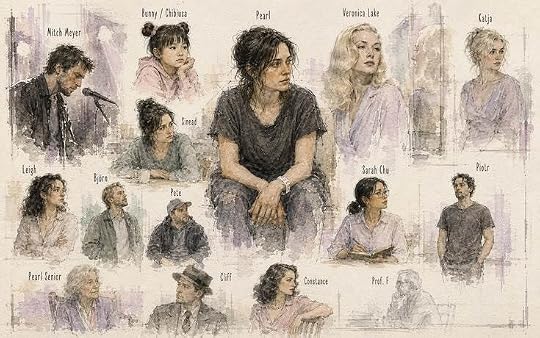
All-Character Watercolor Study
[image error] Composition, Scale and Contact Study
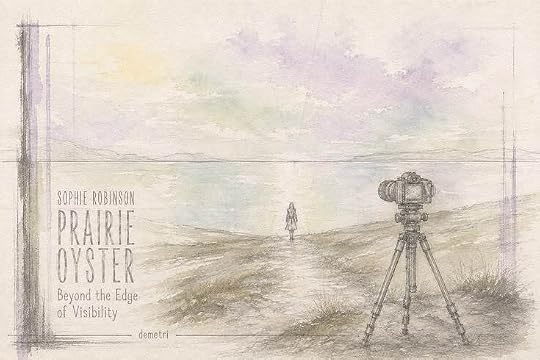
[image error] Cover-Palette and Fjord-Wash Study
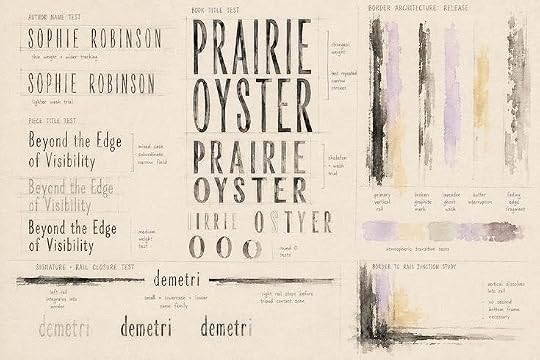
Border and Hand-Lettering Study
Walk-of-Fame Movement and Lettering Study
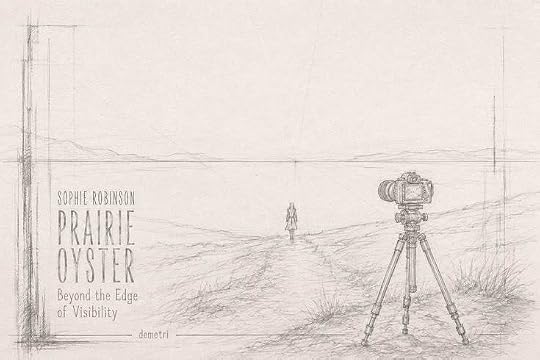
First Underdrawing Study
First-Wash Visualization
All watercolor illustrations by Demetris Papadimitropoulos. Watercolors are done on 140lb vellum and then scanned into the computer using an Epson scanner. From there, they are finalized in Procreate. All art and opinions are my own.
Prairie Oyster was an excruciatingly raw look at addiction and obsession. I looove books about lesbian obsession so this was right up my alley. This is at times a very difficult read, watching Pearl fall off the wagon again and again, but I never stopped rooting for her. I also loved the Veronica Lake interview woven throughout. This was a weird dreamy pearl of a novel that I gulped down in a single day.
3.5 stars. Our main character is unlikable and exceptionally flawed, self-destructive and immature, talented and uncomfortably insecure. And I think we can all see some bit of ourselves in her. Which makes this an uncomfortable read. I don’t mind unresolved endings, and WOW is this one of those. But also maybe not? It feels like autofiction…like the book is almost about what writing this book was like. Adds to the discomfort of reading such a frank and blunt story. Or alcoholic main character Pearl is the messy, moments away from rock bottom type of addict and I found that difficult to read about. But it all felt true. A short but hefty novel.
Thank you to NetGalley and the publisher for the digital ARC.
Man, I have been Pearl way too may times and still struggle with some aspects of her story to this day but I'm forever grateful that I have never hit the depths that she has.
I really enjoyed the pacing of this book. I never felt bored throughout it. I did often have to reread things because a sentence would hit my brain in a certain way and I'd catch myself trailing off in thought while reading and then I would realize I had not retained any of the information I had just read but I honestly think that's a positive and not a negative. Anything that encourages reflection is a win to me.
At times I wanted to grab Pearl and shake her and scream at her and then other times I wanted to wrap her up in a blanket and give her soup and tell her she was worth more than she was giving herself. I liked going back and forth between Pearl and Veronica.
I'm not sure exactly what I was expecting from the ending but it was something more than what was given. I feel like ending a book like this is kind of difficult so I understand.
Prairie Oyster is an emotional read that pulls you in from the very beginning. Pearl's struggle with her creativity while teaching and navigating life is real for those of us who've been in similar situations. Her self-imposed requirement to remain relevant while coming across as sophisticated and well-versed leads to unending heartbreak and cringeworthy moments throughout the story. Her relationship with Mitch, likewise, depicts how addictive behaviors can carry over beyond substances to relationships. Throughout the novel, we are presented with parallels between Pearl and the former movie star she is obsessed with, Veronica Lake. Veronica's own life is fraught, and the juxtaposition brings the reader further into the obsession Pearl has with her. In some ways, Pearl mimics Veronica's life and outlook despite knowing that Veronica lived a tragic life. Overall, I found this a heartfelt and engaging novel, albeit deeply sad. While a happy ending isn't required, I found the conclusion of the story flat as we are left to ponder if Pearl can ever find healing. I would say that it can be a tough read for those in recovery or who are deeply empathetic to the challenges depicted.
Prairie Oyster is a novel about an alcoholic filmmaker who finds herself chasing two things: the cult filmmaker she has a crush on, and her idea of a film about a 1940s star, Veronica Lake. Pearl is struggling, barely turning up for her teaching job in a film studies department because she's always hungover. When Mitch Meyer takes an interest in Pearl, with their interest not only in her work but also in Pearl herself, it seems like Pearl has finally found direction, but Mitch might not be the escape Pearl needs.
This book is told through Pearl's point of view, though in the third person, to give an unflinching look at addiction. In particular, the book gives a horrible insight into blackouts from drinking, and how destructive Pearl is even when trying to be sober. Her relationship with Mitch is also horrible to watch, as you can't help but see how things are going to unfold, and what it might mean for Pearl's self-destruction. I felt like I wasn't able to engage with the Veronica Lake side of the plot as well, as that is mostly told through interview snippets between bits of Pearl's narrative, but I liked how it sat alongside Pearl's story as well as being the focus of the film she's working on, and her quest in the US to find out more about Veronica.
Prairie Oyster wasn't what I expected going into it, turning out to be a book about alcoholism as well as a story about the complex relationships between people and their idols. I feel like maybe I could've gotten more out of it—other reviews talk about its references to The Bell Jar, which I didn't notice as it's a very long time since I've read it—but I still found it to be gripping and at times excruciating.
I like books where we can see the character spiraling downwards, and we see them reach rock bottom, and for me, this book is exactly that.
We follow Pearl as she tries to get sober, succeededs and, in my opinion, succeeded by changing an addiction with another - Mitch.
We see the development of a very weird and toxic adjacent maybe situationship between them and how this completely dominates her life to then see the mess of getting out.
I liked the narrative, but she frustrated me so much, and the part where Leigh talks about learned helplessness feels very spot on to this character. She really frustrated me during the book, and that is why the rating is this low. I saw that I enjoyed the plot.
I didn't care for the poetry-adjacent parts, but this is personal preference and not a dig at the story.
The writing is poetic while describing a very difficult and messy life.
Although an interesting exploration of addiction in many forms I wasn't able to really engage with the story. I was put off by how the story changed from the thoughts of one of the main characters, to their thoughts, and going back and forth in time. There were distinct decisions made in the editing and formatting that helped to add to my confusion.
I think it would be beneficial to add in content warnings for this book - the write up does discuss addiction - but there is also a sexual assault involving a minor and I would have liked to know that before finding it on the page. Had I known about that I wouldn't have requested this book.
Thank you to University of Iowa press for providing an advanced digital copy via NetGalley for me to read and review.
Confessional poet Sophie Robinson’s debut novel builds on earlier poetry collection Rabbit. Like that, it’s a searing study in intimacy and vulnerability. As before, Robinson mines aspects of her past blending raw realism with a more avant-garde sensibility. Rabbit detailed Robinson’s struggles with addiction, the long drawn-out process of bottoming out, her brief recovery followed by falling further than ever anticipated before clawing her way back. Robinson’s semi-autobiographical story expands on earlier material. It centres on experimental film-maker Pearl whose early success with lesbian romance Candy Kisses has left her riddled with insecurities, particularly after her latest piece bombed. Robinson’s narrative mirrors Pearl’s idea for her next film. One which would compare and contrast Pearl’s life with faded Hollywood star Veronica Lake who died from alcohol poisoning.
In order to work on her project Pearl’s taken up a residency at a nondescript university in an equally nondescript town. But she spends her time mired in drugs and alcohol, barely managing to deliver the required teaching sessions. Then an unexpected grant allows her to contemplate a variation on a road movie. Pearl travels to America ostensibly to research into Veronica Lake but her energies are devoted to her pursuit of director Mitch Meyer. Twice Pearl’s age, Meyer’s renowned for their ground-breaking contributions to queer cinema. Meyer – who bears more than a passing resemblance to poet Eileen Myles – is someone Pearl’s met before but now Pearl’s passionate attachment to non-committal Meyer threatens to become all-consuming. And their desultory affair will take Pearl to perilous places.
Robinson moves between Pearl’s everyday and a surreal re-imagining of Lake’s last interview, her 1971 appearance on the popular Dick Cavett Show. Lake’s career had long since stalled but a bit part in an obscure horror movie and the release of her autobiography brought her renewed attention. Pearl and Lake allow Robinson to explore the creative process alongside reflections on fame and gender; mortality; power relations and queer desire. Like countless first novels, Robinson tries to pack too much in here, so it can feel slightly unbalanced at times. The pacing can be uneven and there are repetitive stretches. But, at its height, Robinson’s combination of visceral and lyrical is moving, arresting and immersive, clearly the work of an accomplished, innovative writer.
Thanks to Netgalley and publisher Fleet for an ARC
Thank you to NetGalley and Little Brown for providing me with an ARC of this book in exchange for a review.
What a ride!
Prairie Oyster follows Pearl, a thirty-something filmmaker who is juggling staying sober with writing a screenplay about Veronica Lake, a forgotten starlet who once defined Hollywood noir. Somewhere along the way she meets Mitch, a cult lesbian filmmaker whom she idolises, and falls hard and fast for them. She follows them to America, hoping to win their heart and to finish the script—but the path to recovery is not linear, as Pearl soon discovers, and the lines between herself and Veronica begin to blur.
This novel alarmed me. At first, I wasn’t sure I could get on its level. The narrative is intense, fast-paced and, crucially, messy—but I don’t mean any of these things in a bad way. As I settled in, I realised how necessary they were. I bemoaned Pearl’s bad decisions only because they felt so real; it terrified me how much I related to her. I know how easy it is to do the exact opposite of what is good for you, when it feels like all you know. Robinson has an urgent way of writing that pulled me in and didn’t let go.
I felt the novel did well to represent the nuances of the parasocial relationship, whether that was with Mitch or Veronica Lake. We also feel Pearl’s dread in the blackouts, and catch flashes of her trauma, beginning to piece the cycle of addiction together. There is a third person narrative voice, but we remain entirely in Pearl’s head—I would maybe have preferred first person to make her unreliability clearer, but it still works. Other parts that didn’t quite rhyme also could have been my fault over Robinson’s—there were some characters that I didn’t like or found underdeveloped, and I don’t really like dropping quotation marks, as a rule, but these were minor beside the majority of the narrative, which I did really enjoy.
I liked how Pearl’s storyline flowed directly into the screenplay: it was especially impressive how smooth these transitions were, sometimes occurring mid-paragraph. Although fleeting, Veronica’s voice was distinct from Pearl’s, and I was charmed by her movie-inflected speech. My only qualm was that I would’ve liked a little more indication of what the film looked like visually.
Ultimately, Prairie Oyster is a compelling novel that marks a strong debut for Robinson in prose.
This was a fantastic read, it’s so messy but brilliant I could not put this down! The chaos, agony, betrayal, humour and obsession it’s so raw. The book is so well written it did not surprise me when I read that the author was a poet.
Pearl a 30 something who has given up London for a teaching post in the midlands, Pearl has some previous success in art house style films and now looking to start her next production an obsession she wants to bring to life of the 1940s femme fatale Veronica Lake.
It’s an interesting decision to make a film around this actress as Pearl is battling her own heavy drinking which turns into full blown alcoholism as well as starting an interesting and unhealthy bond with Mitch. Mitch who starts as a professional mentor to Pearl but soon takes a rather physical turn. I would not say romantic but passionate and at times obsessive.
I would say in my opinion Pearl is not a very likeable character, I can’t root for her but I can’t close my eyes at watching the toaster bath she has put herself in, all choices she has made are her own and you can feel her hitting her head against a brick wall time and time again. The writing of her attempted sobriety made me sweat, it was such a powerful section of the book going deeper into herself.
At times I cannot see where Pearl and Veronica differ, it’s tragic at times and you want to shake her. The wasted potential is painful, there is quite a lot of queer representation but not quoted as women loving women banner. This is not a love story nor a memoir or biography. It’s complex and at times slow given the acts the book is separated into where Pearl is always going deeper into herself and her attempted sobriety, never staying still UK, New York, LA, Iceland and at each stage the lakes film never gets any further but Pearl does drift further into herself or life imitating her art form.
I was given the opportunity to read via NetGalley and little brown book group uk, it’s out now and honestly give this a read, it is not what you would expect. You will have a laugh, feel the longing but also feel part of the pure obsession the book brings.
PRAIRIE OYSTER by Sophie Robinson feels hazy and a bit fractured at the beginning--and then we realize this is how Pearl, the main character, experiences her own life. She is unable to control her drinking (or her drug consumption) and what we (as readers) experience is intended to feel like the unsteady, fuzzy world Pearl occupies. As Pearl becomes sober, the language on the page becomes crisper, the images more clear, the characters' actions easier to understand or follow. Then we get Mitch, the much older filmmaker who has been a mentor to Pearl and, as the two reconnect, Mitch becomes Pearl's obsession. Pearl is an unlikeable character, an unreliable narrator--and she's not afraid to be real, especially on the page. Still, it's hard to see her become so determined to be the center of Mitch's attention. Even if it isn't clear to Pearl, it's obvious that no one will ever be as important to Mitch as Mitch is. They are a f*ckboi, though they pretend they aren't, and Pearl suffers mightily for her obsession with them.
Pearl is also a filmmaker, an Indie creator who had one film in particular catch the attention of the world of independent filmmaking. The way author Sophie Robinson describes these prior films makes them leap from the page. I felt like I had seen these films and could picture them in detail. I love the way Robinson writes about film and images on the screen; I was quite surprised to find that she is not a filmmaker. The Veronica Lake vignettes in PRAIRIE OYSTER were harder to "see." One reason for that may be that these vignettes or excerpts of Pearl's screenplay are introduced a bit too early, when Pearl's world is still so murky and fractured. (If the intent early in the book is to mix up the section of Veronica Lake with those of Pearl's life... it does not work.)
Overall, PRAIRIE OYSTER by Sophie Robinson is a harrowing and riveting portrayal of addiction, obsession, and sobriety. The ending of the novel feels so hard earned--and it's worth the read to get there.
*I received this arc in exchange for an honest review via NetGalley.*
I liked it! I think Robinson does something new in the current landscape of messy lesbian literature and the ‘hot girl fiction’ where it very deliberately does not romanticize substance abuse. The ugliness of Pearl’s alcoholism and substance abuse, the ouroboros of her ‘dating’ an absent older lesbian who is so similar to her absent alcoholic mother (even down to the fawning behavior she has to perform to get their attention), her self-sabotage and learned helplessness being bluntly challenged by everyone she impacts…. I want to compare it to Perfume and Pain by Anna Dorn for its modern lesbian take and substance use but it approaches the topics very very differently.
The pearl/oyster metaphors are very heavy-handed, but I enjoyed them. Pearl as the pearl of Pearl Sr.’s oyster, the oyster as the safe/familiar places, the oyster farm later on, the bodies of water, the lakes, Veronica Lake, her ashes being scattered in the ocean… It’s very obvious but still enjoyable.
I wish there was a bit more towards the end, though. I understand the entire book is Pearl suffering the consequences of her self-sabotage, obsession, and avoidance, but it does end quite abruptly with a lot still in the air. I wanted a conclusion, specifically, about what was going to happen with her previous life- she’d abandoned all of her bills, her best friend, her cat, and her professional career and ends the novel dodging phone calls and emails before the final scene. Another fifty pages of her returning home would’ve wrapped it up a little better, but I understand the appeal of an artistic finish, the final scene of her working project ‘The Lakes’.
This entire review has been hidden because of spoilers.
Thank you to NetGalley and the publisher, University of Iowa Press, for the opportunity to read the e-ARC of this memorable novel 🩵
Prairie Oyster is a novel in acts, interspersed with fragments of interviews with Veronica Lake, a forgotten movie star who got lost to time as a result of her alcoholism. The story talks of addiction, obsession, looking for a reason to live and choosing which dreams are worth the chase.
Pearl is a thirty-something filmmaker with a rich resume, which among other things includes a couple niche movies, alcoholism, drug addiction and a crush on Mitch Meyers, a cult lesbian filmmaker. When her long-distance feelings get the chance to become something more, Pearl feels like she's won the lottery and does everything to win her idol's love and exchanges substance abuse for obsession with her new lover. However, Mitch is unpredictable - one day the pinnacle of romance, the next cold and distance, ghosting Pearl for days on end, making it difficult for Pearl to reach inner peace and focus on her recovery.
Prairie Oyster is one of those novels where the reading experience is similar to that of meeting a new person - a Sally-Rooney-character messy kind of person. In the beginning you feel a little unsure, but you're curious too, so you keep reading. Later comes the stage of watching a trainwreck, you cover your eyes but you can't help peeking through your fingers... At some point you get invested, until suddenly you realize you can't live without her.
Thank you to NetGalley and University of Iowa Press for providing access to this ARC. What's exciting about having more queer literature and representation is the development of character archetypes, for example: the avoidant masculine non-binary love interest.
I began to wonder as devouring this book if I took have slept with Mitch.....and could commiserate and developed a trauma bond through every time lapse and silence that echoed loudly in my head while reading. Sophie Robinson seamlessly portrayed the dynamics of small community of exes being friends or new lovers already being acquaintance. The sapphic six degree of separation.
This book primarily focuses on addiction (sex, dugs, alcohol) rehabilitation and relapse. I cannot stress this enough you will not encounter more than two pages without this.
Unfortunately, while Robinson strongly creates and utilizes language, and to be fair this could be intentional or it could be self-sabotage- which in turn would all relate to the book - but the head-hopping creates whiplash that stings. It's just jarring - which once again may be intentional but its also really confusing at the beginning of the novel. Even an italics or different font would be helpful and less discombobulating.
Prairie Oyster has kindly been sent to us ahead of its publication at the end of February.
This is a dinky book that packs a punch and doesn’t shy away from the tricky subjects. It’s a tale of queer romantic obsession, a stalling career and serious substance abuse and addiction.
I must admit I was concerned at the beginning of this that it wouldn’t be for me. Pearl is a film maker in her mid thirties and is in the midst of an addiction fuelled breakdown. While trying to get herself sober and reignite her career, she embarks upon an obsessive relationship with Mitch, a lesbian cult filmmaker who is twice Pearl’s age and seems to have their own set of problems. The story is told in tandem with that of Veronica Lake, the 1940s film star, also plagued by alcoholism and the focus of Pearl’s next film making project.
It’s extremely messy, not at all glamorous and Pearl’s level of self sabotage and addiction made it tricky for me to root for her. A gritty take on an artistic career where things are often seen with rose tinted glasses, I was surprised by the depth of this read despite its small size. It wasn’t a relaxing read at all, but it was certainly very honest and captivating in a car crash can’t look away manner!
Pearl is waking up from a blackout. She will never know why there are troubling traces of the night around her. How she got to where she is. Why there is evidence of what she cannot remember on her body. But: “What she will know is that she is on a sinking ship made only of herself.”
Sophie Robinson, the author of Prairie Oyster, is a poet. This is clear in her surgical selection of words to tell the story of this filmmaker on the brink of an alcohol-induced crisis. When she gets the chance to work with queer film pioneer Mitch Meyer, Pearl swaps one addiction (alcohol and drugs) for another (Mitch). And this works, until it doesn’t.
Robinson layers the consequences of addiction through Pearl, her mother, and the subject of Pearl’s film research – Veronica Lake. We witness the consequences of addiction on ourselves and others. The novel asks us to offer people empathy and recognize their humanity without requiring their lives to become stories of redemption. I found this novel touching and thought-provoking. I highly recommend it.
Thank you to NetGalley and the University of Iowa Press for the ARC. All opinions are my own.