Jump to ratings and reviews
Rate this book

Mine

Rate this book
‘If he were to move there was the chance he might fall, perhaps this time to his death, there was no way to know, and for a long time his fear of the unknown kept him locked in place and counting; come, come, come, was it beckoning him over the precipice?’

While searching for inspiration for what will be his final work, an unnamed poet and defender of Tasmania’s wild places finds himself trapped down an abandoned mine in the island’s mountain rainforests. In the darkness he is visited by memories and voices both from his own past as well as the tortured history of the pillaged landscape to which he has devoted his life and work. Lost in a fever dream, in a single sentence that carries the reader effortlessly along, the poet journeys through a kaleidoscope of Tasmanian history, mining lore, hauntology, poetry, rain and rainbow trout, drilling deep into the contemporaneous horrors of the North Mount Lyell disaster and Mawson’s expedition becoming trapped in Antarctic pack ice.

An unparalleled reading experience, Mine is at once wondrous, terrifying and haunting; a story of environmental vandalism and exploitation as well as a luminous paean to the beauty which persists in a world spinning out of control.

288 pages

Published August 1, 2026

Loading...
Loading...

About the author

Adam Ouston

5 books3 followers

Ratings & Reviews

What do you think?
Rate this book

Friends & Following

Create a free account to discover what your friends think of this book!

Community Reviews

5 stars
5 (55%)
4 stars
3 (33%)
3 stars
1 (11%)
2 stars
0 (0%)
1 star
0 (0%)
Displaying 1 - 4 of 4 reviews
Profile Image for Paul Fulcher.
Author 2 books2,138 followers
August 31, 2026
coping with the confusion of undergrowth, broken branches, fallen trunks, entangled, random, knotted, repulsive, wounding, threatening, sweet-scented, consoling, unsettling, consuming, heartbreaking, and old, so old, too old, ancient, men at 700, men at 1,000, the pain that had by now become something of a consolation, if only he could make a note, for things were coming to him in streams of consciousness, or fluting up like smoke, too many ideas, too many memories, of journeying, exploring, fighting to retain in his mind at once though everything related to one another in a way he could not quite place, matted, knotted in gnarly confusion,

Adam Ouston's debut novel, Waypoints was my Novel of the Year for 2022, my review concluding: "This is a Sebaldian novel for the age of Wikipedia, written by a Bernard-like manically obsessively circular narrator, in lengthy sentences and one unbroken paragraph, except without the misanthropy (wonderfully the very last character in the novel is a "curmudgeonly" Austrian), and with a distinctive voice of Ouston's own."

And his second novel, Mine, will be a contender for the same title in 2026, a darker and more political work - the mine of the title referring both to the extractive pit but also the greed of those who name and claim territory and the earth's resources for their own - and is written in one single, propulsive sentence.

The novel opens:

The howl that enveloped him now adopted something like physicality and shook him, resonated inside him, rattled his teeth, a vibration that was at once consoling and terrifying; consoling in its frequencies, which in another setting might have been labelled healing, and terrifying in the sheer mass it had acquired, for it was, this howl, not so much something he’d done but something that was being done to him, as though the rock walls of the shaft had acquired the language, the means, the power with which to express themselves, and where he might have only a moment before emitted a long, sonorous, embittered sound that would have seemed to an observer (if anyone else was down here, which they weren’t; he was completely alone) more like the sound of a devil or a tiger or a tiger snake that had become ensnared in an iron trap, the sort with uncompromising teeth that bit with bone- shattering but not quite fatal jaws and held the creature in thralls of misery, from which it produced long, painful, hopeless sounds, a grievous signal that rolled through the forest, ...

The novel is primarily narrated in the third person, but from the close perspective of a man, often referred to in the narration as 'the poet'. He is in his 70s,regardless of what else he was, university lecturer, poet, bushwalker, activist, old, so old, he was also miserable, a condition he carried within him like a tombstone or a stone egg.

He finds himself fallen, at least 100 feet he believes, down an abandoned mine in Tasmania, and the early part of the novel has him, and hence the reader, reconstructing how he at least came to be in the mine's vicinity, even if how he finds himself in it is rather less clear to him:

because there was no way out, no negotiating with the rock- hard fact of the situation, that he was trapped at the bottom of an abandoned mine on the West Coast in the silver hills above the equally abandoned— or what he’d presumed was equally abandoned— town of Chester at Mount Kershaw, north of Rosebery on the far side of the Pieman River, founded 1909, abandoned c. 1921, which for a brief time had been the site of a pyrite mine, aka fool’s gold, owned by the Mount Lyell Mining and Railway Company which had operations all over the West Coast and in its 101 years, before it was wound up in the mid- 90s, turned out something to the tune of more than eight billion dollars (in today’s money) worth of materials, millions of tonnes of copper, silver, and gold, which for a tiny island at the bottom of the planet was really saying something,

Living in a suburb of Hobart with his wife, he had been possessed with the landscape of this remote part of the island, one extensively mined, for some decades, and had conceived of a project to write a hauntology of the area, one he is finally given impetus to start by the death, of natural causes, of his closest friend, an activist journalist a few years his junior, whose independent paper aimed to expose corruption, whether from local politicians, or industrial firms. He also thinks about the (real-life) journalist Richard Carleton who died of a heart-attack while covering the 2006 Beaconsfield gold mine disaster, his last words, to the mine manager at the press conference 'Why is it, is it the strength of the seam, or the wealth of the seam, that you continue to send men into work in such a dangerous environment?'.

As for the poet, and the hills on the West Coast of Tasmania:

mines sprang up like daffodils all over the island from the late nineteenth century, all over the island but especially on the West Coast, an unforgiving and remote pocket of Tasmania that could either be an inferno or paradise, making a jagged descent from the snowy caps of the ancient Central Highlands west across a deranged, eccentric topography made toothsome by a foliage that was something between dense bushland and suffocating rainforest, drenched in almost year-round rainfall and cloaked in never-lifting mists, freezing and hostile but mind-alteringly beautiful and something else, something he admitted to himself on more than one occasion, the word for which he could not dig up, because the first word that presented itself to him was atmospheric, but that seemed too cheap, too much of a buzzword used in tourism campaigns— [...] haunting was as close as he’d got,
[...]
it was the landscape that had placed this darkness inside him like a chessplayer a rook, the one he’d carried his entire life, almost eighty years, old, very old, men at 700, men at 1,000, one he’d hoped to capture with his final project; he’d come out here to write a hauntology of the West Coast, force it out if he had to, notes for which had been piling up on his desk at home and in his drawers and in haphazard compilations within plastic folders that lent lazily along bookshelves in the study, which was his way of keeping a part of the place with him even when he emerged from the forests and returned to his wife,


This 'men at 700, men at 1,000' a verbal tic, whose significance becomes clear later/below.

Just before the novel opens, he had made another journey to the inhospitable area - where it rains more than 300 days a year, another thing he habitually repeats in his thoughts - in particular in search of the Chester Mine Hut, near to Tullah, and the ghost mining town of Chester.

A local, although muttering ominously about a 'they' who will be pleased to see him, guides him to the hut (perhaps using this website!),

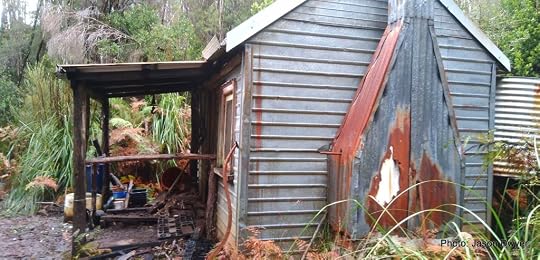
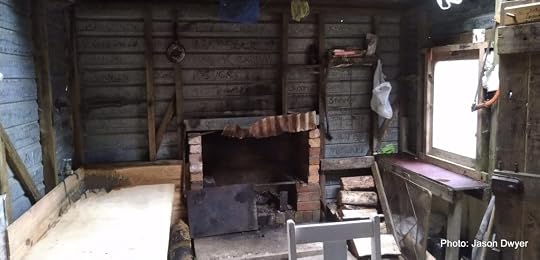
it was something of a relief to arrive at the hut, which was surprisingly well maintained, with a peaked tin roof, porch rails made of branches, door hinges that did not squeal, and stacks of dry wood for a fireplace that was too big for the cramped quarters, but better too big than too small thought the poet, and it could also sleep quite a few people, probably six or more, with two bunk beds and two loft beds above the fireplace, which would make it very hot, too hot, he thought

description

description
(from The Mountain Huts Preservation Society Inc)

but instead of sleeping there, the guide takes him on to Chester itself, where things get somewhat more ghostly. The guide leaves him in the care of one of the inhabitants of the town, Louisa Orr. But the town itself is completely overgrown, most of the other denizens appear to have been greviously wounded in mining accidents - and Orr herself lost her first husband in a disaster (see below) more than 100 years ago. And the last think the poet can remember is him asking Orr where he can stay the night.

Orr herself narrates, through his memory of the conversation, the story of the mining community in the area - and the various mining firms and magnates involved, including the Broken Hill Proprietary Company, which was later to become the BHP of BHP Billiton.

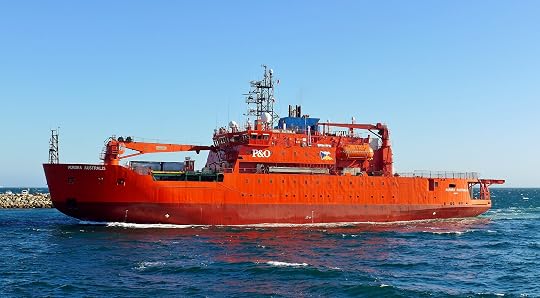
The poet also recalls a trip he made in 2013/14 to the Antartic in the Aurora Australis icebreaker. While there they both encountered a ghost ship, an abandoned whaler, but also became involved in a (real-life) rescue:

after arriving at Casey Station and beginning the resupply of food and fuel for the coming winter they received a mayday call from the Australasian Antarctic Expedition whose vessel, the Russian Akademik Shokalskiy, had on Christmas Eve 2013 become trapped in sea ice several miles off the coast of Antarctica, some 1,500 nautical miles south of his desk in Battery Point from which he often stood up to watch the bright orange icebreaker departing for or returning from its eternal destination,

description

The Akademik Shokalskiy had been chartered by the Australasian Antarctic Expedition to celebrate the centenary of an expedition led by Douglas Mawson, but as the poet points out the sledging part of Mawson's expedition in late 1912 was ill-fated, two of his three companions dying one, rather as the poet, falling down a crevasse and the other succumbing to an illness, which also impacted Mawson, potentially caused by a Vitamin A overdose from eating the livers of their husky dogs when their supplies ran out.

And as the poet observes: yet another disaster was unfolding at the same time though more than 1,500 nautical miles to the north in Tasmania, at the Mt Lyell mine to be precise, which suggested that the interlocking of fates was a circuit much vaster than anyone had thought, and it involved something greater and more nebulous than the existence of men,

That a reference to the North Mount Lyell disaster of October 1912, caused by a fire in a pump house at 700 feet. 42 of the 170 miners died in the mine, and another who escaped but re-entered the mine to rescue his colleagues later died in hospital, but a group down at 1,000 feet were rescued after four days - hence the 'men at 700, men at 1,000'. Those included Louisa Orr's first husband Valentine, who was one of the miners who perished at 700 feet, and who was the 'V' in a note that was found on one of the bodies:

Seven hundred level. North Lyell mine, 12-10-12.
If anyone should find this note convey to my wife.
Dear Agnes. - I will say good-bye. Sure I will not see you again any more.
I am pleased to have made a little provision for you and poor little Lorna.
Be good to our little darling.
My mate, Len Burke, is done, and poor old V. and Driver too.
Good-bye, with love to all.
Your loving husband, Joe McCarthy.



And while at times, the poet (and Louisa and other locals via his recollection) relay facts, at others his dehydration and confusion leads him into streams of tangled thoughts

was the music in him the same music he saw in those hills? and did it matter anymore? was its music falling, like rain, like that rain, acid, 300 days of it, on his deaf, elongated ears? so old now, far too old, as the hills, the black exhausted hills, as the air the choking air, come down for it, love this air, love it, love this sulphur, love these rocks, love this diamond drill, love this clear-fell, love, love, come down for it, love, love this sickness, too old, far too old, tomorrow I’ll be younger, tomorrow, good day for it, lovely day for it, 300 days a year for it, men at 800, apply yourself, like rain, like the burning rain, and the waste, all of it waste, a ghost ship, trash, beached whales, pack ice, trash, a burning pump, so young then so old, too old, speak into the nothing, cage stuck, lines of yesterday, tomorrow, be better, focus, stand up look at Orange Roughy, going down, out into the black, white, colours, us and them, teams, good and evil, no: Kubla Khan, Kubla Khan it was, you are trespassing, flash: origin of word, flash: speak name own mine, flash: mine, old as the hills, mine, the hills, breathe just breathe, hearing aid, turn it—the air, come down for it, all of it, come down for all of it, all of Ireland, the entire island, up big, but too old, now, tomorrow, and tomorrow, witness forgetting, forty-two coffins,

A compelling read - 5 stars.
Profile Image for Robert Wechsler.
Author 10 books156 followers
September 8, 2026
This short novel has some very good writing, but the author’s choices (most of them ones that appeal to me) did not work. One is the choice of a single sentence for a novel that did not, I think, benefit from the propulsion this choice provides. It made the novel seem like Albahari lite.

Another is the choice of filling the protagonist’s mine shaft to overflowing with Tasmanian history and anti-capitalism; the result is a work that is both too little (some dull sections in dull prose) and too much (a mining accident, an Antarctic expedition or two), a whole that is less than its parts.

But Ouston is talented, presumably young, and a risk-taker. I look forward to following his career.
Profile Image for BOof.
21 reviews3 followers
Read
September 5, 2026
If awards ceremonies are anything to go by, the one-sentence novel is having a moment.

The Norwegian Jon Fosse and Hungarian Laszlo Krasznahorkai, winners of the Nobel Prize for Literature in 2023 and 2025 respectively, see the humble full stop as a needless barrier to be banished from their richly textured and deeply introspective novels.

Lucy Ellmann’s Ducks, Newburyport, a Goldsmiths winner and Booker shortlistee, is composed of a single sentence detailing the protagonist’s far-reaching anxieties that persist over a thousand pages, held together with the refrain “the fact that”.

These writers are rule breakers. They dispense with full stops, scene breaks, and chapters by using an array of conjunctions and punctuation, both workmanlike and exotic, to keep the damn thing rolling. Each page is a formidable, handsome wall of text. They write the literary equivalents of a horror vacui, a painting afraid of emptiness, a canvas completely covered.

Despite these books being a single, unbroken sentence, I doubt anyone reads them in one sitting, nor that the authors indeed intend for us to do so. You would need a preternatural concentration or heroic dose of stimulants. Likely both. They offer no restorative pit stops, no spaces to breathe, nowhere obvious to rest a bookmark and take stock of everything that has come before. You must rip yourself away from the currents, forever amid a gathering thought.

Once the books get going, however, the effect is a degree of immersion beyond that of conventionally stylised fictions. Sure, they make demands on us, but difficulty (more than idle, easily absorbed fiction) rewards. I find myself switching between two mental states: one of hypervigilance, following every thread, and another that lets the stream of words wash over me.

I’m no proselytiser for the one-sentence novel. I trudged through Mathias Enard’s Zone like an explorer with a machete chopping through an overgrown path. I never finished Ducks, Newburyport. And yet, the new novel from Tasmanian writer Adam Ouston has me, if not converted, at least showing up for Sunday service.

Ouston’s debut, Waypoints, took as its subject the lesser-known history of Harry Houdini’s first controlled flight, which happened in 1910 in Diggers Rest, Victoria. His latest novel, Mine, also embraces smoke and mirrors, but this time on the level of the sentence.

It begins after a poet falls into an abandoned mineshaft. Injured and trapped in that elemental darkness, the ageing poet reminisces about his campaigns as an ecoactivist while other memories and voices start to intrude, hinting at “something bigger than him, a secret story beneath the apparent one”.

Appraising Ouston’s novel by what happens is about as illuminating as recounting Waiting for Godot. Ouston’s single sentence is not the poet’s life flashing before his eyes. It is a broad narrative frame to capture a deeper history. In this sense, the set-up shares more DNA with a poem than a plot-driven novel.

We learn that the poet has been exploring the West Coast of Tasmania to research his magnum opus, a collection inspired by hauntology, an attempt to capture the “island’s soul”. A hauntology: the past is a revenant in the present and therefore has not passed at all.

At first Ouston allows the hauntology to drift ill-defined, more spirit than flesh, until other stories rise in the poet’s mind. These include most notably the true histories of settler-colonial explorers and mining magnates laying claim to the land, alongside other accounts of exploration paired with environmental extremes, such as the Mawson and Mertz Antarctic expedition in the early 1900s. Dispersed among these are the poet’s own memories of his youthful days of climate action and a tender reflection upon the death and funeral of a dissident journalist friend.

The most vital of these non-fictional strains is Ouston’s lively reconstruction of the ascent and rivalry of two enterprising capitalists, Bowes Kelly and James Crotty, whose legacies culminated in the Mount Lyell Mining and Railway Company. We begin to suspect these historical anecdotes are not arbitrary and may, taken together, begin converging upon this “secret story beneath the apparent one”.

Ouston is at his best trawling through the history books. At times Ouston’s descriptions of the Tasmanian landscape reach for the grandeur “of desolation, ferocity, madness, and hopelessness, but also beauty, wisdom, protection and valour, and inspiration”. It’s classic romanticism: grandeur evoked abstractedly. But when he finds an original image – “whenever he heard of the plight of the South Pole he would picture a black rubber mask melting in the middle of an interminable stretch of outback highway, eye sockets collapsing, mouth hole shrivelling as though releasing an unending scream” – it’s magic.

Late in Mine, Ouston’s poet arrives at the conclusion that the battle for Tasmania’s environment has been lost. I realised that Ouston has written a dire allegory: an eco-poet howls at the bottom of a mineshaft, where no one can hear him.

Review originally appeared in Sydney Morning Herald/ The Age on 28 Aug 2026: https://www.smh.com.au/culture/books/...
445 reviews19 followers
Review of advance copy received from Publisher
June 20, 2026
Reviewed by Nan van Dissel for Transit Lounge Publications and Bluewolf Reviews.
Award winning Tasmanian author Adam Ouston has accepted the challenge of creating a literary work that flows continuously in one sentence; his second novel “Mine” has done just that. “Mine” explores the history of the destruction of Tasmania’s unspoiled pre white environment through the eyes of an aging ecowarrior, the ‘poet’, who is trapped in an unused Tasmanian mine.
Triggered by the death six months earlier, the almost eighty years old ‘Poet’, hoping to capture the landscape with his final project, decides to write a hauntology of the West Coast of Tasmania; a work which would bring together all his other works. When looking for the Chester Mine Hut, he found himself trapped in an old disused mine. It is here that his mind starts to reflect on his life.
While immobilised in the abandoned mine, the ‘Poet’ continuous thoughts travel to his past history as an environmentalist and that of those whose mines destroyed Tasmania’s pristine wildness; James Crotty, and Edward Edwin Bowes Kelly. Ouston through the narrative of ‘Poet’ also explores the calamitous Mawson Antarctic expedition and the Mt Lyell mining disaster; his own inevitable death nearer than he’d hoped.
While readers will find this well-researched history of Tasmania’s early mining exploration and that of Mawson’s Antarctic ‘adventures’ engaging, some might find this unconventional style of one long sentence and lack of narrative structure too challenging.
Displaying 1 - 4 of 4 reviews