

What do you think?

The Nature of the Physical World: Eddington Masterpieces #1 (Eddington Masterpieces
This is an illustrated version of a first-rate classic of physics and philosophy, with a carefully prepared clickable table of contents and clickable page references. THE ORIGINAL ILLUSTRATIONS ARE INCLUDED. We have also included a number of comments pointing out the ways in which philosophical and physical ideas in this book directly influenced Golden Age science fiction.
In his heyday between the two World Wars, Arthur Stanley Eddington was one of the first superstars of modern science, and his popular works were immensely successful and had a very wide sale. This was probably his most successful book of all. Eddington was the first English mathematician to understand General Relativity and to assimilate its ideas into his very bones, and here he gives a popular explanation that has never been surpassed in clearness. Then he proceeds to describing the ideas of modern quantum theory, which was developing rapidly even as he wrote. This book is a brilliant yet simple description of the efflorescence of theoretical physics in the revolutionary first three decades of the twentieth century, from the point of view of an insider. Eddington only uses two mathematical equations, one of which is "0=0".
But this book covers a much wider field than only science. Eddington was a committed Quaker, and his gentle yet radical religious philosophy illuminated his entire life and outlook. His religious beliefs were strengthened, not weakened, by his scientific career, and he synthesized science and religion in a unique manner, based upon his own idiosyncratic epistemological standpoint. He would certainly have received the Templeton Prize today.
Eddington described his philosophy of the world as a blend of "Selective Subjectivism" and "Structuralism". He came to the opinion that (in a manner of speaking) what most of us call "objective" is really subjective, and vice versa. And he claimed to "find no disharmony between a philosophy which embraces the wider significance of human experience and the specialized philosophy of physical science, even though the latter relates to a system of thought of recent growth whose stability is yet to be tested."
The book is written in beautiful and mellifluous English that is an example for the present day. [We have preserved the English spellings for authenticity.]
Tidbits:
"We do not ask how mass gets a grip on space-time and causes the curvature which our theory postulates. The mass is the curvature. The conception of matter, which we associate with these regions of unusual contortion, is a monument erected by the mind to mark the scene of conflict. When you visit the site of a battle, do you ever ask how the monument that commemorates it can have caused so much carnage?"
"'The succession of feelings which constitutes a man's consciousness is the reality which produces in our minds the perception of the motions of his brain."
"If the scientist were to repent and admit that it was necessary to include among the agents controlling the stars and the electrons an omnipresent spirit to whom we trace the sacred things of consciousness, we should suspect an intention to reduce God to a system of differential equations."
"The direction of time's arrow could only be determined by that incongruous mixture of theology and statistics known as the second law of thermodynamics. If physics cannot determine which way up its own world ought to be regarded, there is not much hope of guidance from it as to ethical orientation. We trust to some inward sense of fitness when we orient the physical world with the future on top, and likewise we must trust to some inner monitor when we orient the spiritual world with the good on top."
"I think that the 'success' theory of reasoning will not be much appreciated by the pure mathematician.
In his heyday between the two World Wars, Arthur Stanley Eddington was one of the first superstars of modern science, and his popular works were immensely successful and had a very wide sale. This was probably his most successful book of all. Eddington was the first English mathematician to understand General Relativity and to assimilate its ideas into his very bones, and here he gives a popular explanation that has never been surpassed in clearness. Then he proceeds to describing the ideas of modern quantum theory, which was developing rapidly even as he wrote. This book is a brilliant yet simple description of the efflorescence of theoretical physics in the revolutionary first three decades of the twentieth century, from the point of view of an insider. Eddington only uses two mathematical equations, one of which is "0=0".
But this book covers a much wider field than only science. Eddington was a committed Quaker, and his gentle yet radical religious philosophy illuminated his entire life and outlook. His religious beliefs were strengthened, not weakened, by his scientific career, and he synthesized science and religion in a unique manner, based upon his own idiosyncratic epistemological standpoint. He would certainly have received the Templeton Prize today.
Eddington described his philosophy of the world as a blend of "Selective Subjectivism" and "Structuralism". He came to the opinion that (in a manner of speaking) what most of us call "objective" is really subjective, and vice versa. And he claimed to "find no disharmony between a philosophy which embraces the wider significance of human experience and the specialized philosophy of physical science, even though the latter relates to a system of thought of recent growth whose stability is yet to be tested."
The book is written in beautiful and mellifluous English that is an example for the present day. [We have preserved the English spellings for authenticity.]
Tidbits:
"We do not ask how mass gets a grip on space-time and causes the curvature which our theory postulates. The mass is the curvature. The conception of matter, which we associate with these regions of unusual contortion, is a monument erected by the mind to mark the scene of conflict. When you visit the site of a battle, do you ever ask how the monument that commemorates it can have caused so much carnage?"
"'The succession of feelings which constitutes a man's consciousness is the reality which produces in our minds the perception of the motions of his brain."
"If the scientist were to repent and admit that it was necessary to include among the agents controlling the stars and the electrons an omnipresent spirit to whom we trace the sacred things of consciousness, we should suspect an intention to reduce God to a system of differential equations."
"The direction of time's arrow could only be determined by that incongruous mixture of theology and statistics known as the second law of thermodynamics. If physics cannot determine which way up its own world ought to be regarded, there is not much hope of guidance from it as to ethical orientation. We trust to some inward sense of fitness when we orient the physical world with the future on top, and likewise we must trust to some inner monitor when we orient the spiritual world with the good on top."
"I think that the 'success' theory of reasoning will not be much appreciated by the pure mathematician.
317 pages, Kindle Edition
First published January 1, 1920
About the author
Arthur Stanley Eddington
58 books56 followersSir Arthur Stanley Eddington, OM, FRS was a British astrophysicist of the early 20th century. The Eddington limit, the natural limit to the luminosity of stars, or the radiation generated by accretion onto a compact object, is named in his honour.
He is famous for his work regarding the Theory of Relativity. Eddington wrote a number of articles which announced and explained Einstein's theory of general relativity to the English-speaking world. World War I severed many lines of scientific communication and new developments in German science were not well known in England. He also conducted an expedition to observe the Solar eclipse of May 29, 1919 that provided one of the earliest confirmations of relativity, and he became known for his popular expositions and interpretations of the theory.
He is famous for his work regarding the Theory of Relativity. Eddington wrote a number of articles which announced and explained Einstein's theory of general relativity to the English-speaking world. World War I severed many lines of scientific communication and new developments in German science were not well known in England. He also conducted an expedition to observe the Solar eclipse of May 29, 1919 that provided one of the earliest confirmations of relativity, and he became known for his popular expositions and interpretations of the theory.
Ratings & Reviews
Friends & Following
Create a free account to discover what your friends think of this book!
Community Reviews
Displaying 1 - 19 of 19 reviews

July 15, 2021
ENGLISH: Unlike many modern scientists (such as, for example, Stephen Hawking), Eddington explains perfectly well in these lectures the difference between science and philosophy. It is curious how, in the more than 90 years since this book was published, this important distinction has come to be lost, perhaps due to the abandonment of humanistic studies in secondary education. The consequence is that scientists today know almost nothing about philosophy (and they screw up as soon as they get into that field, often not even realizing that they are doing so), while many philosophers know almost nothing about science. That is why the branch called "philosophy of science" is so important, one of whose pioneers was precisely Eddington.
It is surprising that almost everything Eddington said about the science of his time (1927) is applicable now. Sure, there are some things that he could not know, such as the quark theory, or the Big Bang theory, or the cosmic background radiation, which again introduced an absolute space-time frame of measurement. He didn't know it, but somehow he came to foresee it, as seen in these quotes from chapter 4:
If someone points out to you that your pet theory of the universe is in disagreement with Maxwell's equations—then so much the worse for Maxwell's equations. If it is found to be contradicted by observation—well, these experimentalists do bungle things sometimes. But if your theory is found to be against the second law of thermodynamics I can give you no hope; there is nothing for it but to collapse in deepest humiliation...
Travelling backwards into the past we find a world with more and more organisation. If there is no barrier to stop us earlier we must reach a moment when the energy of the world was wholly organised with none of the random element in it. It is impossible to go back any further under the present system of natural law. I do not think the phrase "wholly organised" begs the question. The organisation we are concerned with is exactly definable, and there is a limit at which it becomes perfect...
As a scientist I simply do not believe that the present order of things started off with a bang...
Whoever wishes for a universe which can continue indefinitely in activity must lead a crusade against the second law of thermodynamics...
I would feel more content that the universe should accomplish some great scheme of evolution and, having achieved whatever may be achieved, lapse back into chaotic changelessness, than that its purpose should be banalised by continual repetition. I am an Evolutionist, not a Multiplicationist. It seems rather stupid to keep doing the same thing over and over again.
Should we deduce that science has advanced almost nothing in the last 94 years?
The book revises the following scientific advances, most of them very close to the publication of this book: a) Rutherford atomic theory; b) special & general relativity; c) thermodynamics; d) quantum theory.
Against Einstein's ideas about time (he considered the course of time as an illusion), Eddington offers the following example: if we mix a deck of cards, its order disappears. If we reorder the deck, the ordering is restored. But if we reverse the direction of time after mixing a deck, the situation is not symmetric, because there is not an operation as "unshuffling." The actions (causes) of shuffling and ordering are different, rather than inverse. Human mind intervenes in ordering, not in mixing. When this happens, time cannot reverse direction, for what is got is meaningless.
An interesting quote from Chapter 5 raises the problem of the limits of physical science:
Thanks to clear-sighted pioneers in the last century science became aware that it was missing something of practical importance by following the inventory method of the primary scheme of physics. Entropy became recognised although it was not found in any of the compartments. It was discovered and exalted because it was essential to practical applications of physics, not to satisfy any philosophic hungering. But by it science has been saved from a fatal narrowness. If we had kept entirely to the inventory method, there would have been nothing to represent "becoming" in the physical world. And science, having searched high and low, would perhaps have reported that "becoming" is an unfounded mental illusion—like beauty, life, the soul, and other things which it is unable to inventory.
In chapter 8 ("Man's place in the universe") Eddington analyzes the possible existence of intelligent extraterrestrial life and concludes that we are probably alone in our galaxy, since other civilizations, assuming they are possible, either are already extinct, or won't have been born yet.
ESPAÑOL: Al revés que muchos científicos modernos (pienso, por ejemplo, en Stephen Hawking), Eddington distingue perfectamente entre ciencia y filosofía en estas conferencias. Es curioso como, en los más de 90 años transcurridos desde la publicación de este libro, esta distinción tan importante ha llegado a perderse, quizá debido al abandono de los estudios humanísticos en la enseñanza media. La consecuencia es que los científicos de ahora no saben casi nada de filosofía (y meten la pata en cuanto se meten en ese campo, pues a menudo ni se dan cuenta de que lo hacen), mientras muchos filósofos no saben casi nada de ciencia. Por eso es tan importante la rama de "filosofía de la ciencia", uno de cuyos pioneros fue precisamente Eddington.
Es sorprendente que casi todo lo que dijo Eddington sobre la ciencia de su tiempo (1927) es aún aplicable ahora. Claro, hay algunas cosas que él no podía conocer, como la teoría de los quarks, o la teoría del Big Bang, o la radiación cósmica de fondo, que introdujo de nuevo un marco de medida espacio-temporal absoluto. No lo conocía, pero de algún modo llegó a preverlo, como se ve en estas citas del capítulo 4:
Si alguien te dice que tu teoría favorita del universo está en desacuerdo con las ecuaciones de Maxwell, tanto peor para las ecuaciones de Maxwell. Si la observación te contradice, no te preocupes: quienes hacen experimentos, a veces cometen errores. Pero si se descubre que tu teoría va en contra de la segunda ley de la termodinámica, no puedo darte esperanzas; no te queda más remedio que caer en la más profunda humillación...
Viajando hacia atrás, hacia el pasado nos encontramos con un mundo cada vez más organizado. Si no hay una barrera que nos detenga antes, hay que llegar a un momento en el que la energía del mundo esté totalmente organizada, sin ningún elemento aleatorio. Es imposible retroceder más bajo el sistema actual de ley natural. No creo que la frase "totalmente organizado" sea una petición de principio. La organización que nos ocupa se puede definir con exactitud, y hay un límite en el que llega a ser perfecta...
Como científico, simplemente no creo que el orden actual de las cosas haya comenzado con una explosión...
Quien desee un universo que pueda continuar indefinidamente en su actividad debe liderar una cruzada contra la segunda ley de la termodinámica...
Me sentiría más contento si el universo realizara un gran plan de evolución y, habiendo logrado todo lo que pueda lograrse, vuelva a caer en una inmutabilidad caótica, y no que su propósito se banalice por la repetición continua. Soy evolucionista, no multiplicacionista. Parece bastante estúpido hacer lo mismo una y otra vez.
¿Debemos deducir que la ciencia no ha avanzado casi nada en los últimos 94 años?
El libro revisa los siguientes avances científicos, la mayor parte de los cuales se realizaron en fechas muy próximas a la publicación del libro: a) teoría atómica de Rutherford; b) relatividad especial y general; c) termodinámica; d) teoría cuántica.
Contra las ideas de Einstein respecto al tiempo (Einstein pensaba que el transcurso del tiempo es una ilusión), Eddington aduce el siguiente ejemplo: si mezclamos una baraja de cartas, el orden desaparece. Si reordenamos la baraja, se restablece el orden. Pero si invertimos el sentido del tiempo después de mezclar una baraja, la situación no es simétrica, porque no existe la operación "desmezclar". Las acciones (causas) de barajar y ordenar son diferentes, no inversas. En la ordenación interviene la mente humana, en la mezcla no. Cuando eso ocurre, el tiempo no puede invertir su sentido, porque lo que se obtiene carece de sentido.
Una cita interesante del capítulo 5 plantea el problema de los límites de la física:
Gracias a los clarividentes pioneros del siglo pasado, la ciencia se dio cuenta de que le faltaba algo de importancia práctica si seguía exclusivamente el método del inventario, el del esquema primario de la física. La entropía se reconoció, a pesar de que no cuadraba con ninguno de los compartimentos. Se descubrió y se exaltó porque era esencial para las aplicaciones prácticas de la física, no para satisfacer el hambre filosófica. Pero gracias a ella, la ciencia se ha salvado de una estrechez fatal. Si nos hubiéramos ceñido por completo al método del inventario, no habría habido nada que representara el "devenir" en el mundo físico. Y la ciencia, tras buscar por todas partes, tal vez habría decidido que "devenir" es una ilusión mental infundada, como la belleza, la vida, el alma y otras cosas que no puede inventariar.
En el capítulo 8 ("El lugar del hombre en el universo") Eddington analiza la posible existencia de vida extraterrestre inteligente, y llega a la conclusión de que lo más probable es que estemos solos en nuestra galaxia, pues otras civilizaciones, suponiendo que sean posibles, o bien se habrán extinguido ya, o aún no habrán llegado a nacer.
It is surprising that almost everything Eddington said about the science of his time (1927) is applicable now. Sure, there are some things that he could not know, such as the quark theory, or the Big Bang theory, or the cosmic background radiation, which again introduced an absolute space-time frame of measurement. He didn't know it, but somehow he came to foresee it, as seen in these quotes from chapter 4:
If someone points out to you that your pet theory of the universe is in disagreement with Maxwell's equations—then so much the worse for Maxwell's equations. If it is found to be contradicted by observation—well, these experimentalists do bungle things sometimes. But if your theory is found to be against the second law of thermodynamics I can give you no hope; there is nothing for it but to collapse in deepest humiliation...
Travelling backwards into the past we find a world with more and more organisation. If there is no barrier to stop us earlier we must reach a moment when the energy of the world was wholly organised with none of the random element in it. It is impossible to go back any further under the present system of natural law. I do not think the phrase "wholly organised" begs the question. The organisation we are concerned with is exactly definable, and there is a limit at which it becomes perfect...
As a scientist I simply do not believe that the present order of things started off with a bang...
Whoever wishes for a universe which can continue indefinitely in activity must lead a crusade against the second law of thermodynamics...
I would feel more content that the universe should accomplish some great scheme of evolution and, having achieved whatever may be achieved, lapse back into chaotic changelessness, than that its purpose should be banalised by continual repetition. I am an Evolutionist, not a Multiplicationist. It seems rather stupid to keep doing the same thing over and over again.
Should we deduce that science has advanced almost nothing in the last 94 years?
The book revises the following scientific advances, most of them very close to the publication of this book: a) Rutherford atomic theory; b) special & general relativity; c) thermodynamics; d) quantum theory.
Against Einstein's ideas about time (he considered the course of time as an illusion), Eddington offers the following example: if we mix a deck of cards, its order disappears. If we reorder the deck, the ordering is restored. But if we reverse the direction of time after mixing a deck, the situation is not symmetric, because there is not an operation as "unshuffling." The actions (causes) of shuffling and ordering are different, rather than inverse. Human mind intervenes in ordering, not in mixing. When this happens, time cannot reverse direction, for what is got is meaningless.
An interesting quote from Chapter 5 raises the problem of the limits of physical science:
Thanks to clear-sighted pioneers in the last century science became aware that it was missing something of practical importance by following the inventory method of the primary scheme of physics. Entropy became recognised although it was not found in any of the compartments. It was discovered and exalted because it was essential to practical applications of physics, not to satisfy any philosophic hungering. But by it science has been saved from a fatal narrowness. If we had kept entirely to the inventory method, there would have been nothing to represent "becoming" in the physical world. And science, having searched high and low, would perhaps have reported that "becoming" is an unfounded mental illusion—like beauty, life, the soul, and other things which it is unable to inventory.
In chapter 8 ("Man's place in the universe") Eddington analyzes the possible existence of intelligent extraterrestrial life and concludes that we are probably alone in our galaxy, since other civilizations, assuming they are possible, either are already extinct, or won't have been born yet.
ESPAÑOL: Al revés que muchos científicos modernos (pienso, por ejemplo, en Stephen Hawking), Eddington distingue perfectamente entre ciencia y filosofía en estas conferencias. Es curioso como, en los más de 90 años transcurridos desde la publicación de este libro, esta distinción tan importante ha llegado a perderse, quizá debido al abandono de los estudios humanísticos en la enseñanza media. La consecuencia es que los científicos de ahora no saben casi nada de filosofía (y meten la pata en cuanto se meten en ese campo, pues a menudo ni se dan cuenta de que lo hacen), mientras muchos filósofos no saben casi nada de ciencia. Por eso es tan importante la rama de "filosofía de la ciencia", uno de cuyos pioneros fue precisamente Eddington.
Es sorprendente que casi todo lo que dijo Eddington sobre la ciencia de su tiempo (1927) es aún aplicable ahora. Claro, hay algunas cosas que él no podía conocer, como la teoría de los quarks, o la teoría del Big Bang, o la radiación cósmica de fondo, que introdujo de nuevo un marco de medida espacio-temporal absoluto. No lo conocía, pero de algún modo llegó a preverlo, como se ve en estas citas del capítulo 4:
Si alguien te dice que tu teoría favorita del universo está en desacuerdo con las ecuaciones de Maxwell, tanto peor para las ecuaciones de Maxwell. Si la observación te contradice, no te preocupes: quienes hacen experimentos, a veces cometen errores. Pero si se descubre que tu teoría va en contra de la segunda ley de la termodinámica, no puedo darte esperanzas; no te queda más remedio que caer en la más profunda humillación...
Viajando hacia atrás, hacia el pasado nos encontramos con un mundo cada vez más organizado. Si no hay una barrera que nos detenga antes, hay que llegar a un momento en el que la energía del mundo esté totalmente organizada, sin ningún elemento aleatorio. Es imposible retroceder más bajo el sistema actual de ley natural. No creo que la frase "totalmente organizado" sea una petición de principio. La organización que nos ocupa se puede definir con exactitud, y hay un límite en el que llega a ser perfecta...
Como científico, simplemente no creo que el orden actual de las cosas haya comenzado con una explosión...
Quien desee un universo que pueda continuar indefinidamente en su actividad debe liderar una cruzada contra la segunda ley de la termodinámica...
Me sentiría más contento si el universo realizara un gran plan de evolución y, habiendo logrado todo lo que pueda lograrse, vuelva a caer en una inmutabilidad caótica, y no que su propósito se banalice por la repetición continua. Soy evolucionista, no multiplicacionista. Parece bastante estúpido hacer lo mismo una y otra vez.
¿Debemos deducir que la ciencia no ha avanzado casi nada en los últimos 94 años?
El libro revisa los siguientes avances científicos, la mayor parte de los cuales se realizaron en fechas muy próximas a la publicación del libro: a) teoría atómica de Rutherford; b) relatividad especial y general; c) termodinámica; d) teoría cuántica.
Contra las ideas de Einstein respecto al tiempo (Einstein pensaba que el transcurso del tiempo es una ilusión), Eddington aduce el siguiente ejemplo: si mezclamos una baraja de cartas, el orden desaparece. Si reordenamos la baraja, se restablece el orden. Pero si invertimos el sentido del tiempo después de mezclar una baraja, la situación no es simétrica, porque no existe la operación "desmezclar". Las acciones (causas) de barajar y ordenar son diferentes, no inversas. En la ordenación interviene la mente humana, en la mezcla no. Cuando eso ocurre, el tiempo no puede invertir su sentido, porque lo que se obtiene carece de sentido.
Una cita interesante del capítulo 5 plantea el problema de los límites de la física:
Gracias a los clarividentes pioneros del siglo pasado, la ciencia se dio cuenta de que le faltaba algo de importancia práctica si seguía exclusivamente el método del inventario, el del esquema primario de la física. La entropía se reconoció, a pesar de que no cuadraba con ninguno de los compartimentos. Se descubrió y se exaltó porque era esencial para las aplicaciones prácticas de la física, no para satisfacer el hambre filosófica. Pero gracias a ella, la ciencia se ha salvado de una estrechez fatal. Si nos hubiéramos ceñido por completo al método del inventario, no habría habido nada que representara el "devenir" en el mundo físico. Y la ciencia, tras buscar por todas partes, tal vez habría decidido que "devenir" es una ilusión mental infundada, como la belleza, la vida, el alma y otras cosas que no puede inventariar.
En el capítulo 8 ("El lugar del hombre en el universo") Eddington analiza la posible existencia de vida extraterrestre inteligente, y llega a la conclusión de que lo más probable es que estemos solos en nuestra galaxia, pues otras civilizaciones, suponiendo que sean posibles, o bien se habrán extinguido ya, o aún no habrán llegado a nacer.

Read
February 6, 2014Knocks 'A Brief History of Time' into a cocked hat.
It was great to see some of my all-time favourite quotes[1] in context; to have general relativity explained without the mass/rubber sheet analogy - because the mass *is* the deformation in the 'rubber sheet', d'oh; to have such a lucid exposition of the difference between primary physical law, which tell us what is impossible, and secondary physical laws, which tell us what is improbable, and the wondering realisation that maybe nature only has secondary laws; and to read an account of the new quantum mechanics written during the 'Cambrian Explosion' of the subject (what joy it was in that dawn to be alive) from someone who was across the latest developments in both quantum mechanics and cosmology.
It was also interesting to read of how the most recent (in 1927) modelling by the top names in physics assured us that the mass of the stars was quite sufficient to explain the behaviour of galaxies, and that formation of planets should be vanishingly rare. I wonder how many things we confidently assert nowadays will be equally wrong in another 85 years.
Eddington lost me in the last four chapters, alas. The dead hand of Schopenhauer did lay heavy upon the first half of that dreadful century. Any sentence that begins: 'But no one can deny that...' is likely to compel from me a passionate contrarian denial, and that is what happened about four chapters from the end of this book.
The copy I read was on a shelf in the Physics tearoom, and belonged to Don Walker's Honours Supervisor:
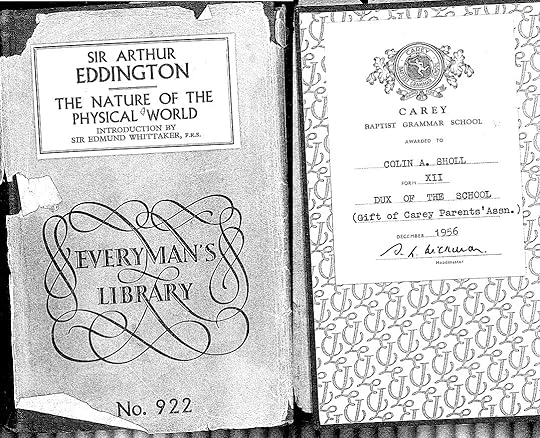
[1]: "The law that entropy always increases - the second law of thermodynamics - holds, I think, the supreme position among the laws of Nature. If someone points out to you that your pet theory of the universe is in disagreement with Maxwell's equations - then so much the worse for Maxwell's equations. If it is found to be contradicted by observation- will, these experimentalists do bungle things sometimes. But if your theory is found to be against the second law of thermodynamics I can give you no hope; there is nothing for it but to collapse in deepest humiliation." ; "We often think that when we have completed our study of one we know all about two, because 'two' is 'one and one'. We forget that we have still to make a study of 'and'."
It was great to see some of my all-time favourite quotes[1] in context; to have general relativity explained without the mass/rubber sheet analogy - because the mass *is* the deformation in the 'rubber sheet', d'oh; to have such a lucid exposition of the difference between primary physical law, which tell us what is impossible, and secondary physical laws, which tell us what is improbable, and the wondering realisation that maybe nature only has secondary laws; and to read an account of the new quantum mechanics written during the 'Cambrian Explosion' of the subject (what joy it was in that dawn to be alive) from someone who was across the latest developments in both quantum mechanics and cosmology.
It was also interesting to read of how the most recent (in 1927) modelling by the top names in physics assured us that the mass of the stars was quite sufficient to explain the behaviour of galaxies, and that formation of planets should be vanishingly rare. I wonder how many things we confidently assert nowadays will be equally wrong in another 85 years.
Eddington lost me in the last four chapters, alas. The dead hand of Schopenhauer did lay heavy upon the first half of that dreadful century. Any sentence that begins: 'But no one can deny that...' is likely to compel from me a passionate contrarian denial, and that is what happened about four chapters from the end of this book.
The copy I read was on a shelf in the Physics tearoom, and belonged to Don Walker's Honours Supervisor:
[1]: "The law that entropy always increases - the second law of thermodynamics - holds, I think, the supreme position among the laws of Nature. If someone points out to you that your pet theory of the universe is in disagreement with Maxwell's equations - then so much the worse for Maxwell's equations. If it is found to be contradicted by observation- will, these experimentalists do bungle things sometimes. But if your theory is found to be against the second law of thermodynamics I can give you no hope; there is nothing for it but to collapse in deepest humiliation." ; "We often think that when we have completed our study of one we know all about two, because 'two' is 'one and one'. We forget that we have still to make a study of 'and'."

February 7, 2024
Free download available at Project Gutenberg
Another brilliant reference on philosophy of science.
I made the proofing of this book for Free Literature and Project Gutenberg will publish it.
CONTENTS
_Preface_ vii
_Introduction_ xi
_Chapter_ I. The Downfall of Classical Physics 1
II. Relativity 20
III. Time 36
IV. The Running-Down of the Universe 63
V. "Becoming" 87
VI. Gravitation: the Law 111
VII. Gravitation: the Explanation 138
VIII. Man's Place in the Universe 163
IX. The Quantum Theory 178
X. The New Quantum Theory 200
XI. World Building 230
XII. Pointer Readings 247
XIII. Reality 273
XIV. Causation 293
XV. Science and Mysticism 316
_Conclusion_ 343
_Index_ 355
Another brilliant reference on philosophy of science.
I made the proofing of this book for Free Literature and Project Gutenberg will publish it.
CONTENTS
_Preface_ vii
_Introduction_ xi
_Chapter_ I. The Downfall of Classical Physics 1
II. Relativity 20
III. Time 36
IV. The Running-Down of the Universe 63
V. "Becoming" 87
VI. Gravitation: the Law 111
VII. Gravitation: the Explanation 138
VIII. Man's Place in the Universe 163
IX. The Quantum Theory 178
X. The New Quantum Theory 200
XI. World Building 230
XII. Pointer Readings 247
XIII. Reality 273
XIV. Causation 293
XV. Science and Mysticism 316
_Conclusion_ 343
_Index_ 355

May 14, 2014
I thoroughly enjoyed this series of lectures delivered in 1927 by Sir Arthur Stanley Eddington. These lectures give the layperson an insight into the theories of Relativity and Quantum in an engaging style and school the layperson to avoid identifying the real with the concrete and mixing incongruous conceptions of the world of consciousness with purely symbolic world of physics, and yet not “to pluck our eyes because things persist in deluding us instead of giving us the plain truth”. As for the latter, the author did a fantastic job!
Though I prefer the exposition of the Theory of Relativity given in Galloping with Light - Einstein, Relativity, and Folklore(without the rubber membrane analogy or ‘wrinkles’ in space-time!!!), I found Sir A.S. Eddington’s exposition of both Relativity and Quantum in this series of lectures highly enjoyable.
I also liked Sir Eddington’s attitude and the humorous analogies in the chapters that touch upon mysticism and religion, inviting their advocates either to develop some defensible method to give us reason not to regard such interpretations as anything more than “muddle-headed romancing’ or to engage in a discussion that would enable both sides to reach a better understanding as to the boundary between the proper domain of exact science and the proper domain of theological interpretations. And afterwards…, … well …, as the author said: “… science and theology can make what mistakes they please provided that they make them in their own territory.”
Though I prefer the exposition of the Theory of Relativity given in Galloping with Light - Einstein, Relativity, and Folklore(without the rubber membrane analogy or ‘wrinkles’ in space-time!!!), I found Sir A.S. Eddington’s exposition of both Relativity and Quantum in this series of lectures highly enjoyable.
I also liked Sir Eddington’s attitude and the humorous analogies in the chapters that touch upon mysticism and religion, inviting their advocates either to develop some defensible method to give us reason not to regard such interpretations as anything more than “muddle-headed romancing’ or to engage in a discussion that would enable both sides to reach a better understanding as to the boundary between the proper domain of exact science and the proper domain of theological interpretations. And afterwards…, … well …, as the author said: “… science and theology can make what mistakes they please provided that they make them in their own territory.”

June 2, 2014
Remarkable insight into Einstein's General Theory of Relativity. The writing is clear and forceful. The ending superb!

September 27, 2007
It's an old book, and hence the first half of the book, which describes the progress of science in Eddington's time, has to be read with care. As long as you know which of his statements on quantum mechanics and particularly astrophysics are dated you'll be fine!
Eddington aimed to give a course on the nature of the physical world without use of equations (ok, he uses one [p,q] = ih(bar) ), and his presentations of reletivity and the concept of the quanta are particularly clear.
To some extent it is unfair to criticise his philosophy, because a lot of it hinges on the use of quantum mechanics in descriptions of causality, determinism and general realism of the world, and there were many advances in QM after this book was written. However, the book was written post 1927, so many of the most important concepts had been introduced.
He focuses too heavily on the distinction between real and percieved for my liking, mainly because I do not take issue with the seeming inconsistency between the way that scientists break the world down into "meter readings" and symbols, whereas these are clearly not the things we percieve.
And interesting insight into basic philosophical science at the time, especially considering it is the lecture notes for a Cambridge undergraduate course!
Eddington aimed to give a course on the nature of the physical world without use of equations (ok, he uses one [p,q] = ih(bar) ), and his presentations of reletivity and the concept of the quanta are particularly clear.
To some extent it is unfair to criticise his philosophy, because a lot of it hinges on the use of quantum mechanics in descriptions of causality, determinism and general realism of the world, and there were many advances in QM after this book was written. However, the book was written post 1927, so many of the most important concepts had been introduced.
He focuses too heavily on the distinction between real and percieved for my liking, mainly because I do not take issue with the seeming inconsistency between the way that scientists break the world down into "meter readings" and symbols, whereas these are clearly not the things we percieve.
And interesting insight into basic philosophical science at the time, especially considering it is the lecture notes for a Cambridge undergraduate course!

June 5, 2014
دسم ، من نوع الكتب الذى يجبرك على القراءة بتأنى
و سيتركك مع نظرة مختلفة لطبيعة العالم أو ما نسميه الواقع
ما أساء للكتاب بحق هى مجموعة المقالات فى آخره
و سيتركك مع نظرة مختلفة لطبيعة العالم أو ما نسميه الواقع
ما أساء للكتاب بحق هى مجموعة المقالات فى آخره

November 4, 2019
السير ادنجتون الذي قال ان الحتميه المطلقه امر لا يمكن تقريره حيث انه لا يمكن تحديد الحركات والاوضاع ف ان واحد طبقا لقوانين الطبيعه. الكتاب أكثر من رائع وهو فعلا كتاب مختلف يتناول اهم نظريات القرن العشرين وهي نظريتي الكم والتسليه في اطار فلسفي عميق تستشعر وانت تقرأه وكأن رجل دين وعالم متعمق يفكر ويبدع

February 19, 2022
A fantastic exposure of the immense power of physics and its epistemological framework.
Eddington is an honest truth-seeker and, despite his renown as a scientist and educator, he has the courage to unapologetically explain the limits of science. I wish more people cared to read this stuff. Don't be discouraged by his mentions of 'aether' or talk of the mystical/religous, this book is a gem.
Eddington is an honest truth-seeker and, despite his renown as a scientist and educator, he has the courage to unapologetically explain the limits of science. I wish more people cared to read this stuff. Don't be discouraged by his mentions of 'aether' or talk of the mystical/religous, this book is a gem.

Want to Read
January 14, 2026A Book Owned by F. Scott Fitzgerald: https://static-prod.lib.princeton.edu...

June 28, 2021
مليئ بالمعلومات لكنه سهل الهضم

November 12, 2020
Este livro foi escrito em 1927 por uma das maiores autoridades da ciência moderna, o astrofísico Sir Arthur S. Eddington. Secretário da Sociedade Astronômica Real durante a I Guerra Mundial e dotado também de habilidades em matemática, foi um dos co-organizadores das expedições que fizeram, em 1919, o teste empírico comprobatório da teoria da relatividade geral de Einstein (observação do eclipse solar total de 29 de maio para medir a deflexão da luz ao passar pelo campo gravitacional do sol). Além de astrônomo, Eddington também se dedicou a escrever sobre filosofia da natureza e filosofia da ciência e a popularizar a ciência para leigos. Essas foram as pontes que me levaram até o livro dele, que é uma obra rara, da qual tomei conhecimento por meio do escritor austríaco-brasileiro Otto Maria Carpeaux em seu livro “Caminhos para Roma”, escrito nos anos 30. Apesar de ser antigo, o livro de Eddington oferece bons elementos para a compreensão do mundo/da natureza a partir do advento da física moderna (teorias da relatividade e quântica). A obra foi escrita em linguagem mais acessível para leigos, ainda que algumas partes ainda sejam de difícil entendimento (razão por que não a avaliei com cinco estrelas).

March 28, 2022
Well-written but outdated. Interesting mainly as an example of how to write clearly in a field that was changing so fast that much of what he said could be updated by the time the book was printed.

May 6, 2021
The Nature of the Physical World is an old book, although my particular copy of it is fairly new. It was first published in 1929. Usually with a book that old, I wind up reading either a library book or a used copy, or else resorting to a free or cheap copy available as an e-book. None of these options was available when I bought this book, but I did find this historical reproduction available for (not cheap) on Amazon.
Since this is an old science book, I expected its interest to be mainly historical, and that much of the information in it would be either outdated or extended by later discoveries. To some extent that appears to be true. If nothing else, it refers to some ideas and controversies that were current or only just being abandoned at the time that no longer seem to be relevant.
Since the subject is physics, it is unavoidably dense and difficult to understand. But I liked the style of the book more than I expected to. According to the author, it was based on a series of lectures he gave at the University of Edinburgh in 1927. Professor Eddington must have been a very interesting lecturer, because his style makes the difficult, and then very new, concepts of relativity and the quantum theory somewhat easier to understand. I can’t claim to have understood everything in the book, but I now have a better idea of what these ideas are all about, or at least how they looked in their earlier days.
The first part of the book deals with these new physical theories and some others. The last few chapters attempt to cover the relationship of these ideas to wider aspects of human experience, such as reality and religion. Ironically, these seem to me to be the most difficult chapters.
Since this is an old science book, I expected its interest to be mainly historical, and that much of the information in it would be either outdated or extended by later discoveries. To some extent that appears to be true. If nothing else, it refers to some ideas and controversies that were current or only just being abandoned at the time that no longer seem to be relevant.
Since the subject is physics, it is unavoidably dense and difficult to understand. But I liked the style of the book more than I expected to. According to the author, it was based on a series of lectures he gave at the University of Edinburgh in 1927. Professor Eddington must have been a very interesting lecturer, because his style makes the difficult, and then very new, concepts of relativity and the quantum theory somewhat easier to understand. I can’t claim to have understood everything in the book, but I now have a better idea of what these ideas are all about, or at least how they looked in their earlier days.
The first part of the book deals with these new physical theories and some others. The last few chapters attempt to cover the relationship of these ideas to wider aspects of human experience, such as reality and religion. Ironically, these seem to me to be the most difficult chapters.

July 31, 2021
Pretty good
A series of popular lectures on the state of the art back in the 1920s by one of the heavy weights of the time. Stunning presentation of relativity. The standard confused presentation of quantum theory. But Everyone was confused about it back then. Most still are. Some fairly standard discussion on statistical mechanics and the nature of time.
The most interesting part of the book is his extended discussion of consciousness where he wavers between physicalism, neutral monism with a strong subjectivist bent and operationalism / instrumentalism. Everyone is still confused about consciousness even now - except the ones who stridently deny there is any such thing. Which makes no sense at all.
He finishes up with a discussion of religion and mysticism. He is quite sympathetic and not at all dismissive.
A brilliant and accomplished mind striving to understand, to question and to communicate. What more could you possibly ask for?
A series of popular lectures on the state of the art back in the 1920s by one of the heavy weights of the time. Stunning presentation of relativity. The standard confused presentation of quantum theory. But Everyone was confused about it back then. Most still are. Some fairly standard discussion on statistical mechanics and the nature of time.
The most interesting part of the book is his extended discussion of consciousness where he wavers between physicalism, neutral monism with a strong subjectivist bent and operationalism / instrumentalism. Everyone is still confused about consciousness even now - except the ones who stridently deny there is any such thing. Which makes no sense at all.
He finishes up with a discussion of religion and mysticism. He is quite sympathetic and not at all dismissive.
A brilliant and accomplished mind striving to understand, to question and to communicate. What more could you possibly ask for?

July 18, 2023
احد افضل الكتب العلمية بوجه عام والفيزيائية بشكل خاص. ابدع السير ارثر في وصف المفاهيم الاساسية للفيزياء بشكل بسيط، من الجاذبية مرورا بالنسبية العامة و النسبية الخاصة وصولا الى ميكانيكا الكم "الكمومية" من خلال نظرة شاملة. كتاب رائع لفهم الكون و مكان الانسان في هذا الكون العظيم.
بكل تأكيد انصح بقراءة الكتاب.
بكل تأكيد انصح بقراءة الكتاب.
August 15, 2020
Never has a book made as much an impact on my scientifically inquisitive brain as this one. This book carries so much weight and its reach so vast that any reader after reading this book would discover that he can take on any sane human being proficient in any field.
June 14, 2022
An incredibly well thought out and balanced perspective between physics and philosophy. It's a bit dated, and some of the physics parts have changed a bit since 1927. Nevertheless, I strongly recommend it, even if for the last 3 chapters alone.
Read
April 17, 2020كتاب
This entire review has been hidden because of spoilers.
Displaying 1 - 19 of 19 reviews