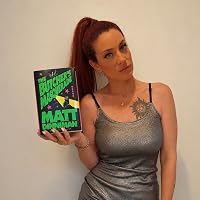
A genre-bending near-future tech nightmare that is as bitingly funny as it is horrifically believable, from the New York Times bestselling author of The Cabin at the End of the World.
Meet Julia Flang, a twenty-something former professional gamer, living with her retired uncle, and working two jobs she doesn't like. Out of the blue, her estranged mother, a CFO for one of the world's largest tech companies, offers her a temp job with a payday Julia can't refuse. One sham interview later, she's offered the job: to chaperone a man in a vegetative state from California to the East Coast. But he's not dead dead: he has an AI mind implanted in his head…
Meet a middle-aged man who wakes within a disorienting hellscape filled with monstrous grotesqueries. Worse than the fluid, morphing reality in which he's trapped, he has no memory of who he is. He certainly doesn't remember getting the rabbit tattoo on his arm. He only knows that he must find a certain person. Who? He can't remember.
Dead but Dreaming of Electric Sheep is a heady, terrifying genre-bender from one of the most groundbreaking voices in fiction today, exploring the 'I' in AI.
Paul Tremblay has won the Bram Stoker, British Fantasy, the Sheridan Le Fanu, and Massachusetts Book awards and is the author of the New York Times bestselling Horror Movie, The Beast You, Are, The Pallbearers Club, Survivor Song, Growing Things, Disappearance at Devil’s Rock, A Head Full of Ghosts, and the crime novels The Little Sleep and No Sleep Till Wonderland. His novel The Cabin at the End of the World was adapted as the Universal Pictures film Knock at the Cabin. An adaptation of A Head Full of Ghosts is currently filming. His novel Dead But Dreaming of Electric Sheep is coming in June 2026.
His short fiction and essays have appeared in the New York Times, Los Angeles Times, Entertainment Weekly online, and numerous year’s-best anthologies. He has a master’s degree in mathematics and lives outside Boston with his family. He is represented by Stephen Barbara, InkWell Management.
Philip K. Dick meets the Coen Brothers in this genre-bending near-future tech nightmare that is as bitingly funny as it is horrifically believable...
The above-line from the start of the Publisher's synopsis is a perfect description, and really tells you all you need to know about this latest Paul Tremblay novel.
In this novel, we're following Julia, a 20-something semi-professional gamer, whose estranged mother, Janice, is the CFO of one of the world's largest tech companies.
Julia lives with her Uncle and works two jobs she's not crazy about, so when her Mom offers her a high paying temp position perfect for her skill set, she can hardly say no. She goes to a fairly perfunctory interview and of course, is offered the job.
What is it, you wonder? Oh, no big deal. All she has to do is chaperone a man in a semi-vegetative state, who happens to have top-secret, proprietary AI implanted in his head, across the country from California to the East Coast.
It's very Weekend at Bernie's, if you can imagine that vibe, and the classic flick does get mentioned quite a bit. Not in an obnoxious way, but it certainly helps set the scene.
Except in this case, the man, who Julia actually calls Bernie, is remotely controlled via a cell phone controller that Julia uses essentially like one of her video games.
I won't say anything else about the plot. I feel like you can get the gist from that, but I will mention that we aren't just getting Julia's perspective. Oh no, Tremblay's not going to make it that easy for you.
This story is told from two perspectives: Julia and You. The You perspective, as you may assume, is told in 2nd-person, and I'm generally not a fan of that. I'll be honest, we start this story in a You perspective and it threw me for loop.
I wasn't sure I would be able to proceed. Not only is it 2nd-person, it's also very fever dream at the start. I know, I know, that completely makes sense in relation to the story, but yeah, it threw me at first.
I'm so, so, so happy that I stuck with it. Julia's perspective is great, and the further into the story I got, the more the whole 2nd-person thing started to make sense, and really match the overall story being told.
This is such a weird and compelling book. It's odd AF, and even though it took me a bit to settle into the narrative style, once I got my bearings, I was completely invested.
I found it funny, thought-provoking, emotional, and honestly, scary in its own way. As someone who gets freaked out thinking about the scope of potential future tech, that's not that far off, this definitely struck a cord in that regard.
I do feel like Tremblay took a risk with this one, and I'm really hoping it pays off for him. I respect the hell out of it.
It's part futuristic Frankenstein reimagining, part satire of the corporate tech industry and part horrifying tale of what our future could possibly hold.
There's so much going on, and it's quite nuanced. I'm looking forward to reading it again someday. Seriously, moments after finishing, I wanted to read it again. Knowing the ending, I want to go back to the start and see what other details I can pick up on. I feel like over time this could definitely bump up to a 5-star read for me.
Tremblay has a big ole' brain. I've known this of course, but this novel makes it even more clear than ever. I guarantee this story WILL NOT be for everyone, but I think for the Readers who are able to settle in and connect with it, it's going to have a lasting impact.
Thank you so much to the publisher, William Morrow, for providing me with a copy to read and review. This was easily one of my most anticipated reads of 2026 and I can honestly say, I have a strong feeling it will end up as one of my most memorable of the year.
Paul Tremblay is one of my favorite authors so I will always look forward to reading his new releases. Dead But Dreaming of Electric Sheep was no different. But despite my excitement and my predisposition to like anything Paul Tremblay writes, this one is probably and unfortunately my least favorite from his catalogue.
The premise and the set up at the beginning seemed promising. We follow a young woman who is assigned to accompany, or rather remote control, a man in a vegetative state with AI implanted in his head. It touches on topics such as morality and autonomy and we do get an interesting perspective from the man’s murky consciousness, lost in a hazy void. I also appreciate the references to The Pallbearers Club.
That said, my main issue with the story is how dragged out it is. There is a lot of repetition and a large part of the story was painfully boring to get through. It could have easily been cut down to a novella which would have made it a lot more impactful. I was also let down by the lack of any weirdness and ambiguity which I’ve come to expect from Paul Tremblay. The ending was also quite predictable.
Thank you to publisher William Morrow and NetGalley for providing me with an eARC in exchange for my honest review.
Starred review in the April 2026 issue of Library Journal
Three Words That Describe This Book: AI Horror, character centered, unique, disorienting (on purpose) and compelling narrative style.
I know that is a lot more words than 3, but this is my review and I get to make the rules. More words: unforgettable, overlapping narratives with dual POV, meta, existentially terrifying, biting satire, middle finger to the AI companies, heartwarming and full of love even in the face of evil.
Draft Review: Throwing down the gauntlet for AI horror, with a novel that would make Philip K. Dick beam with pride, Tremblay introduces readers to Julia, a semi-pro gamer short on cash, offered a job by her estranged, Silicon Valley, CEO mother to test a groundbreaking technology, controlling the AI bots implanted in a braindead employee as he is returned to his mom in Rhode Island. Told in alternating and overlapping narrations by Julia and “You,” the voice of what is left of the body Julia nicknames, Bernie, readers watch Julia contemplate the ethics of her task, while Bernie simultaneously fights the “clicks” overwhelming him and struggles to remember who he was. Quirky textual choices in Bernie’s chapters enhance the disorientation, unease, and heartbreaking beautiful tone. Readers are quickly and emotionally invested in Julia and Bernie, separately and together, as they “abide*” across the country, A masterpiece of storytelling, injected with a squirming worm of fear,** forcing all who encounter it to take a critical look at AI’s encroachment, how it is actively stripping away our humanity, and rushing us all down the road to ruin.
Verdict: A not-to-miss reading experience for fans of a wide range of chilling, darkly humorous, existentially terrifying titles like Sea of Rust by C. Robert Cargill, Lucky Day by Chuck Tingle, and The Wanderers Duology by Chuck Wendig.
This is THE standard for AI horror as of this moment and it will be for a long time to come. It is also the darkest buddy comedy you have ever read.
Are there more than 5 stars to give? Well I would if I could. Let me back up. I love the way Paul Tremblay writes. As a professional reviewer I am even tougher on the authors to whom I hold to the highest standard. This book exceeds that standard-- in every facet of its writing and as a superior horror novel.
The allusion to Philip K Dick is there to put you in the right frame of mine to read this book. There are also two characters with Richard in their name (one first and one last). They are both corporate shills. But I point this out because it adds to the dark humor here. This book is deadly serious and existentially terrifying-- readers will not be able to NOT see themselves as part of the horror. And yet, I need to say this before I write more-- Tremblay is able to tell this deadly serious story and still imbue it with heart and humor. This is key to why it is such a great read.
All you need to know about the plot is this-- Julia is a recent college grad whose mom is an executive for a HUGE computer company. Julia is a former semi-pro gamer and her mom calls her up to San Fran up to LA. They have a strained relationship, but Julia agrees because her mom is offering a job that pays very well. She is asked to help the company test a new AI that they have implanted in an employee who had a stroke. He is brain dead. She is supposed to pilot him across the country using a controller and bring him to RI, back to his mother.
This is a horror novel, so come on, you know the big tech company is not telling the truth about its motives.
Julia ia whole and real from the start, Without sacrificing the narrative pacing, we get a fully fleshed out woman while the action is moving briskly. So by the time she gets to San Fran, we know who she is.
But it is the alternating narrative-- which is why this novel goes from just terrifying to excellent.
The story fluctuates between chapters told by Julia and those told by "You." You is the man that this AI is implanted in. First of all, the choice to make it "you" is perfect! "You" as the narrator instantly makes the reader an intimate player in the story. The man, who Julia calls Bernie because it is like she is in the movie Weekend at Bernies, is for all intents and purposes all of us readers, or he could be, at first. His narration begins oddly to us the reader. We are seeing the story we get from Julia overlap with how it appears from inside "Bernies" head. As the story moves on, Bernie begins to remember more of who he was, even as the
This adds a level of heartbreaking emotion to the story. It also allows Julia to connect to Bernie as well-- even though she does not know what is happening in his head, she knows he is regaining himself as they move across the country, but our chapters in his head help.
Tremblay uses textual images to help make the "You" chapters easier to from his perspective. Trapped in his head, part the man he was and part AI technology, we need to be able to see how he is interacting insides his own head with himself. It works very well and helps to orient the reader into a perspective that is purposely disorienting and hard to understand. But again, as it moves along, the reader and Bernie get more comfortable. Great narrative choice.
I also enjoyed all the Big Lebowski references. It helped to flesh out Julia's character and get the reader to know her as a person before this story's events. I am going to add something about Julia and Bernie "abiding" in the review to make reference to this (I only get 200 words so I have to make them count).
Also Tremblay fans will chuckle as Bernie's real identity comes to light.
Julia and Bernie will come to feel like friends as they follow them across the country. The characters are so fully developed that you will miss them when it is over. This novel will make you laugh, it will make you cry, it will make you think long and hard about how AI is encroaching on our lives, stripping away our humanity and leading us down a road to ruin. It will make you feel a fear that will worm its way off the page and into your body, a fear you will not be able to shake. But all of this is the entire point.
And get ready for the ending because it is doozy. Terrifyingly realistic. And spoiler alert-- not really if you have ever read any AI horror (Sea of Rust is a good comp here)-- rise of the machines sf/horror never works out well for the humans.
For readers who enjoyed The Wanderers Duology by Wendig, Sea of Rust by Cargill, and the world of Blake Crouch. But in terms of the tone here, the dark humor mixed with existential terror but always centering love of Lucky Day or Bury Your Gays by Tingle. Also the real world horror being novelized in a way that makes is a good horror read but doesn't allow you to not think about the real world implications is similar to Mariana Enriquez.
And if you made it this far-- touche to Tremblay for the NOS4A2-esque use of the "Notes on the Type" to enhance the novel.
3 "WTAF was that" stars... I guess this is sort of "social horror" with it's evils of A.I. run amok theme but it was just depressing AF to me, a horrid road trip meets "Weekend at Bernies" - the ending, uh... less said the better. I chose it based on the title too, and there was zero here that reminded me of PKD, either. I'm sure it will have its fans, though I'm not sure exactly who they might be, but def. not me
Now this is the perfect book where you ask yourself WHAT IN TARNATION DID I JUST READ??? This book was so weird 🤣🤣🤣🤣. Seriously.
Julia is offered a temp job with the recommendation from her mother. The job, to move a guy in a vegetative state from California to the East Coast. The catch, is to remote control him while he has an AI remote in his head. Weird AF right?!
The story is told by Julie and You. You being in second person and you can guess who by. This story is weird, thought-provoking, scary, insane, and truly compelling.
I did the audio and forgot to throw in headphones. DO THE AUDIO! There are parts like a fever dream and inner monologues that are easier to follow this way.
At first, I didn’t know what to think but I actually liked it. I think his fans will enjoy it. However, this isn’t a horror story… it’s actually speculative fiction/ sci-fi.
I'm glad I listened to the audiobook for this read because it was produced well and Sophie Amoss is one of my favorite narrators—it's also the only reason I made it as far into this book as I did.
I suspect Dead But Dreaming of Electric Sheep is only being labeled as horror because of who wrote it, but it reads more like a literary dystopian novel. A case for psychological horror could be made, but I feel like that's a stretch.
I struggled to fully engage with the story's set up because of the lengthy, largely uneventful chapters, disorienting "You" chapters, and the niche pop culture references (The Big Lebowski is mentioned many times). I was especially put off by the patronizing “A Brief Interlude” chapter at the 36% mark. While I got the point and ultimately agreed with the sentiment, the interlude was a little too self-important for a book that, in my opinion, hadn’t done anything impressive enough to warrant that level of metafictional, fourth-wall-breaking snark.
My biggest issue with this read was its commentary on artificial intelligence. “AI bad” is a perfectly valid position, but it’s also a very simple one, so stretching it across 300+ pages with no complexity is an interesting choice; and by interesting, I mean anticlimactic. A deeper examination of AI and the ethics of its applications would have made for a more interesting narrative for me, but the novel presents a binary position that inspires nothing more than readers nodding along in unquestionable agreement—so mission accomplished I guess?
Conceptually, this book reminded me a lot of Immaculate Conception by Ling Ling Huang—another "sci-fi horror” that I personally classify as literary dystopian/speculative fiction. Both books use near-future technology and a morally compromised protagonist to grapple with AI, identity, autonomy, institutional exploitation, and the commodification of humanity. Comparing the two helped me pinpoint why Tremblay’s novel fell flat for me while Huang’s became a favorite of mine.
Immaculate Conception is intensely intimate. Everything is filtered through Enka’s deteriorating mental state, making its philosophical questions inseparable from her choices, relationships, and emotional decline. Conversely, Dead But Dreaming of Electric Sheep's "and then" storytelling, plentiful yet negligible detail, metafictional flourishes, philosophical digressions, dark humor and satirical elements, and pop culture references all create distance from the characters, making it feel less personal and human centered. I admired its ideas on a surface level, but I never felt the circumstantial weight of those ideas on Julia, "Bernie", or any other character. One would think strong characterization would be a priority in a novel commentating on AI technology—something being used intentionally to dehumanize people—but it's possible I just didn't "get it".
Both novels are also character-focused, but Immaculate Conception's execution arrives at its ideas through the characterization, whereas Dead But Dreaming of Electric Sheep's execution feels like it starts with the ideas, builds the characters around them, and then tells the story with a character-focused lens. Both of these executions can work, but the ideas-first execution puts more pressure on plot and momentum because you run the risk of stalling out (which is exactly what ends up happening for me), especially if the ideas are rudimentary and unambiguous to begin with (i.e., "AI bad"). In this case, a short story or novella format may have work better because the central concept(s) could've be explored before it starts to feel stretched thin and ineffectively propped up with filler.
To me, Immaculate Conception has a more poignant, holistic take on the shared themes because the character development and actions are conduits for the ideas and commentary instead of serving as a means to an end. But this doesn’t mean Dead But Dreaming of Electric Sheep doesn't have an audience.
This book will work well for readers who specifically enjoy most or all the following: - Literary fiction with dystopian/speculative elements - Slower-paced narratives - Longer, meandering chapters - Fever-dreamy, disorienting storytelling - Dream sequences - Straightforward sociopolitical commentary - Niche pop culture references Readers who struggle with any combination of these elements may have a difficult time connecting with this story.
I think those who enjoyed The Memory Police by Yoko Ogawa, The Ferryman by Justin Cronin, and The Merge by Grace Walker stand a good chance of this novel working a little better for them.
Conversely, if you're looking for a more plot-driven story with substantially more horror and bio-sci-fi, I recommend picking up Intercepts by T.J. Payne instead. Intercepts has tighter pacing, sharper bioethical commentary (focused more broadly on biotechnology and human experimentation rather than AI specifically), emotional stakes in the form of a father-daughter relationship, and far more engaging POV chapters from its “You” equivalent.
Thank you to Libro.FM and the publisher for the gifted ALC of this read. All opinions are my own.
I think this is the first real review I’ve left in 8 years and I was inspired because I really hated this book.
Tremblay has been on a downward slope since Cabin and now he’s finally plunged off the cliff.
Half the chapters are pretentious nonsense and the other half are endless descriptions of how a person moves.
There are two interludes that made me want to rip the book in half and the About the Type page made me throw the book across the yard (I read outside).
Find something more inspired to read, like a drug interaction warning sheet.
This book really had my thinking about the future of medicine (especially in the hands of billionaire CEOs). That's the real horror of this plot--the idea of weaponizing the bodies of incapacitated people or people in a vegetative state. It raises ethical and moral questions while amping up the tension as a young, unemployed gamer is put in charge of basically remote-controlling a supposedly brain dead patient across the county. Of course, our patient is trapped inside his head and will do anything to regain the ability to express himself. This is part dystopian, part sci-fi, part horror novel and I found it very compelling.
Disorienting and deceptively funny, this is a character study of late-stage techno-capitalism, which is to say the end of the world. This book is playful while still having an unrelenting sense of existential dread, which is a feat! This is largely (but not entirely) accomplished by the change in voice and tone across chapters. The chapters that follow Julia, presumably the main character, are told in a close third-person. They are witty and urgent, and she is an incredible character (more on that later). The other chapters, which are labeled “You,” are told in, unsurprisingly, second-person. The unknown narrator is filling in gaps in your memory as you struggle to understand what is going on, a struggle reflected in visually striking formatting decisions that really make the physical copy of this book the standout choice. Ostensibly each chapter is telling the same bit of narrative action, each sequence of events is told twice through these two perspectives, but they look nothing alike. Aside from the disorientating narration style the You chapters have a world that feels like traveling through an acid trip curated by the lovechild of Hieronymus Bosch and Salvador Dali. it is predatory and confusing and entirely dysregulating. The constant movement across these two narration styles and the comparison between two different depictions of the same world/events leaves the reader in a perpetual state of confusion and dread.
That said, it is hard to call this a horror story. Yes, it deals with an existential dread, a fundamental tension plaguing humanity at the moment. That is the subtext and the supra-text, it flows through every part of this story. But even thinking of the wide variety of horror modalities that Tremblay has played with across his other books, varied but all distinctly horror, and this doesn’t fit. It is a dark satire that relies upon existential discomfort to comment on technology, society, capitalism, the nature of art, the nature of humanity, and apathy, among other things. But it is not a horror novel, in any normative sense of the category. It also isn’t really a techno-thriller, either, but instead it is plowing its own lane. Sometimes, in doing this, it stumbles, if I am being honest. The pacing for the first half of the book is a little rough. There is very little that happens from a narrative point of view, and while there is a lot of character and world-building/atmosphere-setting work being done there it felt like a was fighting against the current, sometimes. Just after the halfway point things start moving a little faster, not in the sense of answers being revealed, necessarily, but in characters making decisions and things actually happening in the plot.
The saving grace for those slow chapters was the main character, who is incredibly delightful and complicated and not a perfect protagonist in any way. When her economic precarity comes into conflict with her innate morality she struggles, and it is easy to find a part of yourself in that inner tension. She has a well-crafted history and feels like a genuine character, including in her dialogue and the ways that she uses sarcasm to mask insecurities while still keeping an ember burning for genuine human connection. There is not a lot of Mystery (capital M intended) to the novel; the ideas and politics and priorities of the novel are clear from the very beginning. There is no narrative tension, in that regard, even if you don’t anticipate everything that is going to happen. Having characters that were enjoyable to spend time with did keep this just on the side of feeling like art instead of polemic, but the pacing didn’t help. Tremblay’s writing is witty and incisive, as usual, and he does the muddy complexity and contradiction that defines humanity really well, again balancing humor and despair in his prose as well as his characters. If we recognize sci-fi as being far more descriptive than predictive, a chance to magnify and examine contemporary anxieties, this does that well. If you are hoping for some of the tightly paced, contemplative horror that Tremblay is known for then this will likely miss the mark for you. If, however, you pick it up expecting a dark, satirical sci-fi novel that is disorienting, funny, and sardonic in equal measure, while never shying away from an epistemic dread about the potential end of humanity, you will be not just satisfied but rewarded.
Dead But Dreaming of Electric sheep is a homage to Philip K Dicks novel Do Androids Dream of Electric Sheep except Tremblay flips the story. In Dick’s novel, the threat comes from androids who look human but lack an empathetic soul. They are trying to break into the human world. Instead of a machine pretending to have a soul, Tremblay gives us a machine inside a body, trapping whatever humanity is left inside a mental prison. The embodiment of humans losing control to AI.
The story is told from alternating points of view from Julia, an ex pro gamer and daughter of a high tech Silicon Valley CEO, and the “brain dead” man who she is in charge of moving across the west coast via remote control of highly sophisticated technology and AI implanted in “Bernie’s” brain. I’ve heard the audio narrative is really effective with clucking sounds and other noises. The Julia chapters are told in a normal third person narrative whereas the Bernie chapters are told in a fragmented disoriented second person point of view giving a feeling of being trapped in a Fever dream.
I fell in love with the very sarcastic main character Julia, who runs on references to The Big Lebowski and other pop culture. The chapters told by Bernie start as dark painful jibber ish and pull you into his tormented world as he is transported across the east coast as a proof of concept for large tech corporations.
This is not a horror novel full of monsters, gore, and non stop scares. It is an exploration of what it means to be human in the current digital age, full of ever expanding AI. It explores themes of death, consciousness, the ills of large corporations and unfettered capitalism. It is very different from Trembleys previous horror novels in terms of writing style and genre. It blends psychological horror, science fiction, and dystopian/speculative fiction. Do not disregard if you have not liked his previous novels, this is a very unique reading experience.
Dead But Dreaming of Electric Sheep is Tremblay’s latest surrealist science-fiction-horror, exploring themes of bodily autonomy, human consciousness, and the dangers of combining biology and technology into one. The story follows Julia Flang, daughter of the CEO of one of the worlds largest tech-companies, as she is tasked with escorting a man called ‘Bernie’ from one end of the country to the other. The catch: ‘Bernie’ is dead, and his every movement manipulated via AI Julia controls. What is initially a moral dilemma becomes even worse as we come to realise that not all of ‘Bernie’ may be completely gone.
While a truly excellent premise, I am sad to say that this book just did not work for me at all. It unfortunately follows a trend of the last few books Tremblay has released, one in which style is seemingly put before substance. I felt very much the same reading this as I did reading Horror Movie last year - unbothered.
This feeling of being ‘unbothered’ or ‘unengaged’, was something that I felt throughout pretty much the entire story. Julia’s chapters were slightly more enjoyable, as I thought that the way in which Tremblay described her guiding of ‘Bernie’ was quite compelling. However Julia as a character was a massive miss for me, and I found her to be veering towards the quirky manic-pixie-dreamgirl end of the women-written-by-men-spectrum at times. ‘Bernie’s’ chapters were, personally, an absolute slog for me to get through. Not only did I just not care at all about him as a person, and was honestly given little reason to other than simply because he was in a bad situation, but I found that the surrealist / dream elements that made up his chapters added very little to the overall narrative. The only parts of his point of view I actually somewhat liked was when I was able to compare what he saw in his AI-overridden mind to what was actually happening around him in the real world. Even so, this was not enough to keep my interest, and I found myself wishing his chapters would end the minute they started.
The overarching plot was purposelessly confusing, with next to zero payoff at the supposedly climactic ending. I finished this book with the simple thought, ‘was that it?’, which was just such a shame. I find myself wishing Tremblay would return to his original supernatural horror roots, rather than this strange move into literary-sci-fi.
Overall, Dead but Dreaming of Electric Sheep gets 2.5/5 stars rounded up to 3/5 stars for Goodreads and Netgalley. I think after the disappointment that was this, Horror Movie, The Disappearance at Devil’s Rock, AND The Pallbearer’s Club, I really need to rethink how I perceive and purchase Tremblay’s book.
thank you to Netgalley and the publisher for an e-arc in exchange for an honest review! <3
So I loved the way this was written. I'm not usually a fan of "you" in books but it works really well in this case, along with all the other formatting decisions that were so fun to read (and listen to!). I highly recommend checking out the audiobook for this one, it is a really cool experience, especially with reading along. It makes the You chapter more creepy than they already are.
The story though... I have no idea if I liked it. lol. It's creative, and different, and prescient for today's technology. It was like a particularly spooky episode of Black Mirror. Julia's temp job of "driving" a "almost dead" man across the country was really tense, as Tremblay spends a lot of very specific details on describing precisely every step of the travel. It's kind of a lot, but given what she's doing you also kind of want to know every step.
As the narrative escalates, so does the language. It just gets more and more tense and suspenseful, and kind of confusing in just what is going on? I've read this whole thing, in two ways, and I'm still not sure what happens at the end. I'm reminded a bit of an SCP story that really triggered some deep fear in me and gives me nightmares to this day, years and years after I read the entry: SCP-093. Read all the color tests, it's very reminiscent. Dead But Dreaming of Electric Sheep freaked me out for being even just a little similar to it - though it is wholly it's own thing. It's also reminding me of another story I can't place a finger on. It's one of those stories that just sticks with you, worms its way into your head, and hangs out in your subconscious waiting for when you're not expecting a scare to remind you that it exists and give you a heart attack.
It's also a deeply sad story, about the value of human life versus human progress versus what is human. Not a perfect story, because it does drag at times and it can be confusing, but it's such an interesting and different read. Definitely one of the most unique horror stories I've ever read. It's not in your face horror either, it's a subtle underlying horror that culminates in the horrific.
I feel a little sick for reading this, but I was already not feeling great, so perhaps make sure you're feeling well or in the right head space when reading this one.
Afraid of AI? No? Well you will be after reading Dead But Dreaming of Electric Sheep.
I’m a huge fan of Paul Tremblay’s work and this is both his most unique novel to date and also one of his scariest, despite not being a “traditional” horror novel on the surface.
Julia, a Big Lebowski loving young woman, is tasked by her tech company mother with transporting a man she calls “Bernie” (ha ha, get it?) across the country with the goal to get him home to his family. The catch: “Bernie” is in a coma and has been implanted with AI in his brain.
This novel is told in alternating POVs, limited third person from the POV of Julia as a more traditional narrative, and You chapters that are told in 2nd person with “you” as the man implanted with AI. I especially loved these (intentionally) disorienting sections as they make the reader feel culpable with what is happening. It’s similar to how tech companies foist AI upon as against our will, whether we want it or not.
On the surface this is a sci-fi buddy road trip kind of story with lots of humor and lots of heart, which is an excellent counterbalance to the bleak horror of the AI and the implications of what is happening to Bernie and the incredible dilemma that Julia faces as she learns more about the intentions of the tech company. I think what makes this even scarier than many other tech horror or sci-fi stories is that this novel doesn’t feel far off at all in the future. It feels like the now and a major warning for what we are doing to ourselves by feeding into this terrible technology.
Dead But Dreaming of Electric Sheep is Paul Tremblay at his absolute best - smart, witty, humorous, and outright scary. It is an incredibly important novel that is unfortunately way too relevant and will continue to be.
Wake us up from this nightmare.
Thank you to the author and the publisher for an ARC for review.
What the hell happened to my boy Paulie T? This book was SO bad. Like, egregiously bad. So bad that I don't even know where to start, I just want to keep saying "that sucked" over and over again.
Okay, to begin with, there's the plot. As in, there's barely any of it. The concept is idiotic and the action scenes are just our main moron fiddling with a remote control. And yes, the main character is a moron of the highest order. One of the worst fictional people I've ever spent time with. She's the type where, if you ask her if she's okay, she'll reply "No. I'm never okay. You shouldn't be okay, either." Like, fuck allllll the way off with your constant emo bullshit. Not only is she annoying, but freaking EVERYONE is. Nobody in this book talks like a real human being. If I met people who talked like this, I would think they were having a series of strokes. It's worse than Joss Whedon quippiness, it's a whole new level of everyone framing their dialogue like Twitter posts. And this author is old. Like, older than me. Why the hell is he writing like a Gen Z teen girl? Grow up, dog. Go back to writing horror, because this book represents everything I hate about the modern sci-fi scene. This book is so bad, it will probably win a Hugo, an award that I treat as an "avoid at all costs" list. RIP.
This book caught my eye with it's captivating cover, Philip K. Dick inspired title and a rather comedic promotional blurb. With all of that said it was still destined to languish on the TBR pile for a long time waiting it's turn, but seeing positive reactions from friends here and other socials it got bumped up in priority. Boy, am I glad of that decision.
But, before I start the review properly I have to say you are in for a trip and you should go in as blind as possible. I will give no spoilers, but I don't want even my review to influence your experience.
As per the promotional blurb the story starts with Julia who gets the job too well paid to be anything but trouble. In her own words: You want me to remote control this dead dude across the country. In a word, yes. But he’s not dead dead. She isn't even told the name of our poor sap she has to pilot around and in order to give him a semblance of humanity she names him Bernie after the movie: Weekend at Bernie's. This creates the expectation that we are in for a weird light hearted comedy. Nothing wrong with sci fi comedies, but this made the book a bit of a slow starter for me.
Then we switch to "Bernie's" perspective. The completely disjointed metaphorical dreamscape he is forced to walk through against his will is mesmerizing. This is where we see the horror of his situation and his struggle to fight for the last shreds of his own personality and bodily autonomy that was taken from him. This is where the author flexes his writing muscle. So when he switches back to Julia's perspective and we see what is happening in the real world it feels almost like being handed the cheat sheet to find out the "solution" to Bernie's perspective and it kinda disappoints. Forget Julia and her ethical struggle I want to see Bernie fight in his dreamscape.
This juxtaposition slowly but surely turns our comedy into horror. Bernie's loss of bodily autonomy is addressed and put on full display. And this point is not lost on ether characters or us. We join Julia as she goes on a doomed quest to help Bernie. And even as we know there will be no happy ending, we still want to hope.
And then we have the Authors Interludes. This is where he pierces the veil of his writing and takes a chance to taunt the reader with where the story is actually going. These are entertaining in their own right, but I can see why his smug gloating might not sit well with many readers. Hell I remember my own thoughts when reading these: "Shut up you smug bastard, you think I can't see where this story is going. I am a veteran of sci fi and PKD I can see it a mile away. Now stop gloating, yes I like what you did, yes that was funny. You are alright let's do this again soon."
Did that paragraph bring this review to a halt? Yes, and that is why this book is only 4 out of 5. This constant switching between perspectives and tones can create a dissonance, that might have been the point, but really makes you wish the author would focus. This book was a real trip. It has taken me on a journey of visuals, made me laugh, made me dread and made me think and I want YOU to get on this ride as well.
I don't typically read sci-fi, and apparently my imagination wasn't up to the task.
That said, the writing was, as always, fantastic. If you're into tech-heavy stories and dreamlike sequences, I have a feeling you'll appreciate this one a lot more than I did.
I was really looking forward to this book because I thought I was getting into some kind of technological horror-thriller version of Weekend at Bernie’s and that was one of the most interesting ideas for a book I had heard in a long time.
And sure, it was a little bit that, but unlike Weekend at Bernie’s, this was boring. Boring enough that I resent myself for making me finish it.
It’s books like these that make me wish we reviewers could read a page or two sample before we request a title, because I likely would’ve skipped this title once I heard the very first reference to The Big Lebowski (a movie I hate and is quoted and referenced repeatedly in this book).
It wasn’t just the lack of humor and the prevalent use of The Dude that had me disliking this book. The dual POV felt repetitive, even if the two characters were operating on two different planes of existence. “Bernie’s” plane was supposed to be terrifying and mind-melting, but it was just a total miss in that area for me.
I know there was suppose to be some philosophical and emotional weight to this book besides “AI BAD”, but all I got was hot air. 2⭐️
Thanks to NetGalley and the publisher for granted me early access to this title.
An eerily disturbing read that reflects on the pitfalls of technology gone wrong. This dual POV book had a unique setup, with one character having a remote control programmed to control the other. The power imbalance and the lust for tech advances, no matter the human cost, is truly mindblowing. Fans of unique sci-fi and horror will enjoy this one. Thank you, Librofm, for the gifted ALC.
Thank you William Morrow for my free ARC of Dead but Dreaming of Electric Sheep by Paul Tremblay — out Jun 30!
» READ IF YOU « 🤖 know AI horror is the most timely and terrifying sub-genre 🎮 love a protagonist who is deeply, relatably in over her head ✈️ have ever had an layover-gone-wrong at the Denver Airport
» SYNOPSIS « Julia is a former semi-pro gamer working two jobs she hates when her estranged tech bro mom offers her a short gig with a windfall payday. The job? Chaperone a comatose man across the country via cell phone controller, connected to the AI implants in his brain. Huh? it's Weekend at Bernie's, but corporate billionaire nightmare. Julia dubs him Bernie, and things get wilder from there.
» REVIEW « First, I want to be super upfront that sci-fi is generally not my genre, but Paul Tremblay still got me with this one! The AI horror here doesn't feel speculative so much as it feels like a glance at next week's news headlines—surveillance, evil tech trillionaires, lying to families, oh and can't forget the casual horror of what happens when humanity becomes proprietary technology. It made me furious in all the right ways.
Julia is a fun FMC; she's sassy and scrappy but still has a ton of empathy and wants to do what's right, even with a fortune dangling over her head if she completes this job. And the Denver airport scenes?! As a local, I can confirm that DIA is already operating on a different and slightly sinister plane of reality, so Tremblay making it the setting for peak chaos felt deeply, personally correct. Blucifer approves.
Our favorite math teacher has built something genuinely great here—it's darkly funny, but bleak, but heart-wrenching all at the same time. Damn him.
My review is based on the physical ARC I received, thank you to William Morrow Books! This title releases on June 30, 2026.
Estranged from her mother and at a dead-end job, twenty-something Julia Fang is given an interview that changes two lives: her own and the basically dead man she's remote controlling.
I've never read from Paul Tremblay before, and the only thing I ever knew about him is that his books are divisive even amongst his die-hard fans. While I really liked the overall storyline and execution, I agree with other reviewers that say this should've been a novella! It's a short book, but, personally, it lagged a lot for me in the middle 100 pages. I wanted more from this, and while I'm a fan of open endings, I don't think I quite understood it all (user error, for sure!)
I was a big fan of the formatting and characterization. I loved that "Bernie" still had his sapience (is that the right term, oops) and was aware of everything that was going on and being controlled, yet still on the hunt for the person he's been searching for. There's excellent multimedia in his chapters, as well as a second-person element that really elevates the book!
Paul Tremblay has built a career writing clever, terrifying horror novels like A Head Full of Ghosts, The Cabin at the End of the World, and Horror Movie. Time and again, I've been impressed by his ability to pair horror with richly drawn characters, making him one of my automatic "must-read" authors. His latest, Dead but Dreaming of Electric Sheep, explores a very different kind of horror. This isn't the supernatural, keep-the-lights-on kind of terror readers have come to expect from Tremblay. Instead, he sets his sights on artificial intelligence and the unsettling ways our growing reliance on it could reshape what it means to be human. It leans more toward science fiction than horror, but it still packs quite the punch.
Julia is a down-on-her-luck twenty-something and former semi-professional gamer who's struggling to figure out what comes next. She lives with her uncle while juggling two jobs, neither of which she particularly enjoys. Then, out of the blue, her estranged mother calls with an unexpected opportunity. The tech company where she serves as CFO is looking for temporary help, and the paycheck is too good to ignore.
She's hesitant. Her relationship with her mother has never been easy.
But money talks.
After flying to the company's West Coast headquarters and breezing through an interview that feels more like a formality than an actual hiring process, Julia lands the job. It's just not the job she was expecting.
Her assignment is to chaperone a man in a vegetative state on a cross-country trip. Only he isn't lying in a hospital bed.
The company has implanted an experimental AI-powered chip into his brain, allowing employees to control his movements with what's essentially a video game controller. Perfect for Julia, right? Her task is simple. She just has to escort him safely from the West Coast to the East.
What could possibly go wrong?
While the title Dead but Dreaming of Electric Sheep is clearly inspired by Philip K. Dick, the novel imagines a future that feels much closer to the present day than we'd probably like to admit. Artificial intelligence has already worked its way into many aspects of our everyday lives, and it's impossible to know what its long-term impact will be. As the novel progresses, Tremblay alternates between Julia's perspective and that of the man she's controlling. The effect is fascinating, forcing readers to wrestle with questions of consent, morality, and whether we've really stopped to consider the consequences of handing so much of ourselves over to emerging technology.
Spoiler: we haven't.
Tremblay also includes brief interludes written in his own voice, stepping outside the narrative to reflect on artificial intelligence and the act of writing itself. AI may be able to generate words, he argues, but writing is about far more than stringing sentences together. It takes iteration. It takes wrestling with ideas, throwing them away, and reshaping them until they become something meaningful. As if determined to prove that point, Tremblay fills this novel with moments that feel unmistakably human. They're strange, inventive, and unlike anything I've encountered before. You'll know them when you get there.
The result is a novel that's fun, chilling, occasionally absurd, and ultimately a thoughtful cautionary tale about our race toward an increasingly automated future. It's another original, thought-provoking work from an author who continues to surprise me with every new release.
Reading this book is an uncategorizable experience. It is DEFINITELY horror, but it is Sci-fi, it is meta, it is tech horror/grief horror, it is a thriller and it is, most importantly, a raging anti-AI manifesto.
Thrilling and heartbreaking, frustrating and confusing, the reader is sucked into not-Bernie and Julia’s quest to bring him home. But then we are violently and purposefully flung out of the story, forced to be aware of what is happening to all of us in the world right now. It is more than an unreliable narrator. Tremblay is telling you YOUR ENTIRE READING EXPERIENCE is becoming unreliable with the current infusion of AI into our lives.
There were times in this book I had no idea what was happening, much like Bernie’s experience. This book is a raw and violent attack on AI. There is anger in this book, despair and paranoia, and very little hope. But it is an important experience, no matter how confounding.
I read roughly 55% of this one and skimmed the rest. The 1.5 stars is for the idea itself - sci-fi-esque AI tech implanted in a brain-dead person's brain that's then used to control their body via a video game-like remote controller.
The writing was...awkward and told in a strange, clunky way, and often the dialogue seemed so stilted and unnatural. I thought Bernie's chapters were nonsensical and boring, and eventually I found Julia's POV to be filled with so much unnecessary detail about every little movement second-by-second. For such a popular author I thought this book would be better, but after the halfway point it really frustrated me and I wanted nothing more than to be done with it.
This entire review has been hidden because of spoilers.