Jump to ratings and reviews
Rate this book

Tintin #8

تان تان و صولجان الملك أوتوكار

Rate this book
One of the most iconic characters in children’s books

Hergé’s classic comic book creation Tintin is one of the most iconic characters in children’s books. These highly collectible editions of the original 24 adventures will delight Tintin fans old and new. Perfect for lovers of graphic novels, mysteries and historical adventures.
The world’s most famous travelling reporter faces the task of helping to protect a monarchy?

Tintin travels to the Syldavia and uncovers a plot to dethrone King Muskar XII. But can he help the head of state before it’s too late?

Join the most iconic character in comics as he embarks on an extraordinary adventure spanning historical and political events, and thrilling mysteries. Still selling over 100,000 copies every year in the UK and having been adapted for the silver screen by Steven Spielberg and Peter Jackson in 2011.

The Adventures of Tintin continue to charm more than 80 years after they first found their way into publication. Since then an estimated 230 million copies have been sold, proving that comic books have the same power to entertain children and adults in the 21st century as they did in the early 20th.

Hergé (Georges Remi) was born in Brussels in 1907. Over the course of 54 years he completed over 20 titles in The Adventures of Tintin series, which is now considered to be one of the greatest, if not the greatest, comics series of all time. 

Have you collected all the graphic novel adventures?

Tintin in the Land of the Soviets
Tintin in America
Tintin: Cigars of the Pharaoh
Tintin: The Blue Lotus
Tintin: The Broken Ear
Tintin: The Black Island
Tintin: King Ottakar’s Sceptre
Tintin: The Crab with the Golden Claws
Tintin: The Shooting Star
Tintin: The Secret of the Unicorn
Tintin: Red Rackham’s Treasure
Tintin: The Seven Crystal Balls
Tintin: Prisoners of the Sun
Tintin: Land of Black Gold
Tintin: Destination Moon
Tintin: Explorers of the Moon
Tintin: The Calculus Affair
Tintin: The Red Sea Sharks
Tintin in Tibet
Tintin: The Castafiore Emerald
Tintin: Flight 714 to Sydney
The Adventures of Tintin and the Picaros
Tintin and Alph-Art

Unknown Binding

First published September 1, 1943

75 people are currently reading
1756 people want to read

About the author

Hergé

1,027 books1,937 followers
Georges Prosper Remi (22 May 1907 – 3 March 1983), better known by the pen name Hergé, was a Belgian comics writer and artist.
His best known and most substantial work is The Adventures of Tintin comic book series, which he wrote and illustrated from 1929 until his death in 1983, leaving the twenty-fourth Tintin adventure Tintin and Alph-Art unfinished. His work remains a strong influence on comics, particularly in Europe.

"Hergé" is the pseudonym of George Remí, making a game with the initials of his name inverted. Throughout the evolution of his star character, Tintin, we can see the progress of this author: from the first titles marked by the ultraconservative doctrine of the director of the newspaper Le Petit Vingtième, to the breaking of conventions embodied from The Blue Lotus , as well as the evolution of the society of his time. The research carried out by Hergé to historically contextualize his Adventures, as well as his implicit social criticism, have made Tintin a masterpiece of the 20th century.

Series on Goodreads:
* The Adventures of Tintin
* Quick & Flupke
* The adventures of Jo, Zette and Jocko

Ratings & Reviews

What do you think?
Rate this book

Friends & Following

Create a free account to discover what your friends think of this book!

Community Reviews

5 stars
4,661 (34%)
4 stars
5,192 (38%)
3 stars
3,083 (22%)
2 stars
406 (3%)
1 star
65 (<1%)
Displaying 1 - 30 of 464 reviews
Profile Image for Luís.
2,371 reviews1,363 followers
January 12, 2023
In this adventure, Tintin will escape on each page from plane crashes, roll into ravines, and be stunned several times. But it will solve a far-fetched enigma and save the local king.
But the most important is the Syldavians' borders, in these mountainous states of a not-so-distant Europe, with its mafias, wrens, crooks, and usurpers.
The scenario is compelling, and the drawing is tasty, especially when it launches into local history. The landscapes are superb! A book to look in.
Profile Image for Dream.M.
1,038 reviews652 followers
August 23, 2025
اگه فکر می‌کنی دزدیدن یه عصا چیز مهمی نیست، صبر کن تا «عصای سلطنتی » رو بخونی! توی کشور خیالی سایلداویا، شاه فقط وقتی می‌تونه حکومت کنه که تو جشن بزرگ سالانه، عصای سلطنتی دستش باشه. حالا فکر کن این عصا گم بشه یا بدتر از اون، بیفته دست دشمن‌های کشور!
ماجرا از همین‌جا شروع می‌شه. تن‌تن اتفاقی سر از نقشه‌ی خطرناک بورداویاها درمیاره. اونا می‌خوان شاه رو جلوی مردم تحقیر کنن تا بتونن کشور رو تسخیر کنن. تعقیب و گریز، جاسوس‌بازی، کلی صحنه‌های خنده‌دار و البته لحظات پرهیجان، همه با هم قاطی می‌شن تا تن‌تن و میلو بتونن عصا رو درست سر موقع به جشن برسونن.
این داستان برای بچه‌ها عالیه چون هم پر از ماجراجوییه و هم یه جور درس غیرمستقیم درباره‌ی تاریخ و سیاست داره. شاید اولش به نظر فقط یه ماجرای سرگرم‌کننده باشه، ولی پشتش حرف بزرگی هست: این‌که یه نماد (مثل همون عصا) می‌تونه سرنوشت یک ملت رو عوض کنه.
Profile Image for Sam Quixote.
4,801 reviews13.4k followers
October 20, 2016
King Ottokar’s Sceptre is one of only two Tintin books I surprisingly never read as a kid (the other being In the Land of the Soviets) and, having read it now, I can say I didn’t miss out on anything back then!

Set in the fictional country of Syldavia (I think it’s based on Albania), if the King doesn’t brandish his sceptre on St Vladimir’s Day, he must step down - and some nefarious neighbouring country is sending agents to steal the sceptre for just that to happen! Tintin stumbles across another witless old geezer who’s inexplicably a professor (he seems to attract this type likes flies!) and gets involved with what he’s doing in Syldavia because there wouldn’t be a book otherwise!

This one feels like Herge on autopilot. The contrived nature of the storytelling was really apparent to me now I'm no longer an uncritical-thinking kid. The plot points are very clunkily assembled and fit awkwardly with one another to get to where Herge wants things to be. I could list all the silly moments but I know this is meant for kids so I won’t overkill with the criticisms. Suffice it to say that it’s a very repetitive and boring read with Tintin being captured, escaping, getting re-caught, escaping again, etc. for most of the story.

I’ve revisited Tintin as an adult and found some of them still hold up (like The Calculus Affair), and it’s nice to see Herge’s beautiful ligne claire art again, but King Ottokar’s Sceptre is definitely not one of the great books in the series.
Profile Image for Manybooks.
3,815 reviews101 followers
July 25, 2024
So when I read Hergé's originally penned in 1939 graphic novel King Ottokar's Sceptre (in 1975 and in German), I pretty vividly recall NOT AT ALL enjoying my reading time and with my nine year old self finding Hergé's text majorly frustrating (and the accompanying artwork presenting way too much clearly gratuitous violence). And indeed, according to my nine year old eyes and my ways of thinking as a nine year old, Hergé's entire storyline for King Ottokar's Sceptre was therefore awkward, much too male-oriented (and with the one main female character appearing as totally annoying and clown-like), often rather difficult to understand and with far too many strange and out of the proverbial blue coincidences (as well as disgustingly cardboard like villains) for me to get any reading pleasure at all out of King Ottokar's Sceptre, except for maybe laughing a tiny bit at the accident prone Thompson and Thomson duo and how Snowy often gets himself into trouble but also kind of ends up saving Tintin multiple times. But really, the above was not nearly enough for me to consider King Ottokar's Sceptre in any manner as a fun and an engaging story in 1975, and that in retrospect, I just had far too many textual issues following Hergé's narrative flow and found the whole scenario of the made-up Central European countries of Syldava and Borduria and their many squabbles massively tedious and wholly uninteresting.

And while as an older adult, I do now see and understand that much of King Ottokar's Sceptre is obviously meant to be a biting political satire (against in particular Nazi expansion into Central and Eastern Europe and with the country of Borduria clearly meant to represent Germany and Müsstler more than likely Adolf Hitler), sorry, but I still have not really enjoyed rereading and reencountering King Ottokar's Sceptre as an older adult reader and also think that the political satire featured in King Ottokar's Sceptre majorly tends to go above and escape from younger readers, so that in particular with this book, with King Ottokar's Sceptre, I do have to wonder who Hergé's intended audience is meant to be. Because for me and in my humble opinion, the political satire of King Ottokar's Sceptre is much too advanced for readers below the age of twelve or so, and that Hergé's featured narrative is in and of itself not interesting and engaging enough to keep younger readers/listeners amused and focussed if they do not yet understand that basically King Ottokar's Sceptre is meant to satirise late 1930s Europe and National Socialism.
Profile Image for Piyangie.
626 reviews769 followers
April 14, 2020
King Ottokar's Sceptre is one of my favourite Tintin adventures. I have watched the cartoon number of times when I was a kid and read it even more number of times as a young adult. No matter how many times I read, I can still get back to it and read it as if for the first time.

This one is perfect in its story, just right in its adventure and suspense, and interesting in its characters. The writing has a touch a comicality with the detectives Thomson and Thompson constantly running into mishaps! Also, I loved the introduction of madame Bianca Castafiori, who is one of my loved characters.

It is very pleasant to indulge yourself with childhood favorites. At a time when fear, panic, and grief reins, a treasure as such can provide you with a wealth of comfort.
Profile Image for Alan.
719 reviews287 followers
February 25, 2024
Sometimes life takes over. And life is still here, and it’s not going anywhere. But my copies of Tintin have been sitting there, still looking at me, wondering why I stopped my in-depth exploration of their content in 2022. Michael Farr’s companion is still there as well. What isn’t there, perhaps, is the patience I had when I was writing my other reviews on the first 7 volumes. But I want to continue the deep reading. It’s time for King Ottokar's Sceptre.

Last time around (in The Black Island), we were in Scotland. This time, we are in Syldavia. Quick stop over in Prague and we are off. I remember this volume being “meh” when I was a kid. Isn’t that just apt? The political intrigues happening in the background bored me. I found the actual chases in car and on foot to be the most exciting parts of this adventure. Slightly different now.

I have appreciated learning more about the historical and political backdrop of this story. Hergé was writing this while Hitler was going about the Anschluss and annexing Austria. At the same time, we had the handiwork of naive Neville Chamberlain. We also had a host of other tensions in the region, including a focus on Slovakia, Czechoslovakia, and finally, Poland. Why is this relevant? Tintin travels to the fictional Syldavia (itself inspired by various nations in the region, which included Poland and Albania), and his adventure is focused almost exclusively on stopping a fascist takeover of Syldavia by the neighbouring (and equally fictional) Borduria. Farr mentions the following: “So, on September 1, 1939, just three weeks after the Syldavian adventure concluded with Tintin saving the kingdom from a fascist takeover, Nazi tanks rolled over the Polish border and began Hitler’s well-planned Blitzkrieg, provoking the Second World War. Despite hopelessly valiant resistance, Poland was crushed in less than a month. Once again world events had been anticipated by Hergé with extraordinary insight.”

I’ll continue to quote from Farr:
Asked years later by Numa Sadoul about his creation of Borduria, Hergé noted that there were in this adventure “insignia that very clearly denoted the SS.”

“At the time,” he continued, “Germany was of course in mind; Ottokar’s Sceptre is nothing other than the tale of a failed Anschluss. But one can take it to be any other totalitarian regime. Colonel Sponsz appears as well to be typically German, an Erich von Stroheim type. Moreover, isn’t the villain of Ottokar’s Sceptre called Müsstler, evidently a combination of Mussolini and Hitler? It strikes me as a clear allusion.”
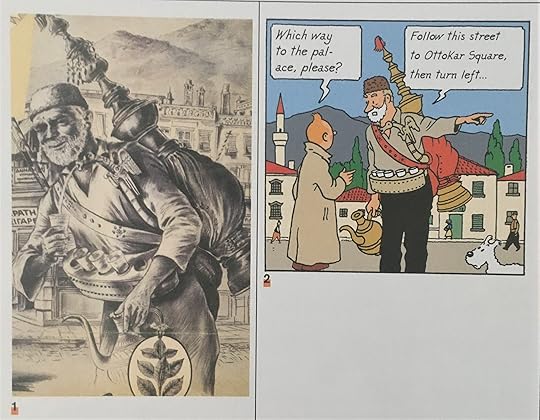
The Syldavian landscape itself is wonderfully quaint. I found a picture of Farr’s book online and I put it here now, as I am far too lazy to take a picture myself and upload it:

Syldavian Lemonade Seller

You can clearly see the inspirations for Hergé’s characters. The Syldavian lemonade seller is an almost exact replica of a Macedonian lemonade seller.

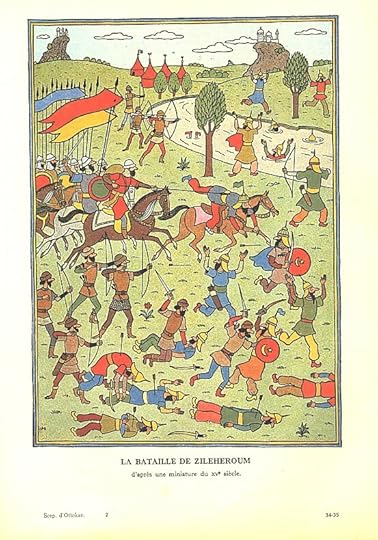
As Tintin is flying out to Syldavia with Professor Alembick, he reads a brochure about the nation on the flight. A standout moment of the book for me personally, as we are introduced to some history and myth, specifically The Battle of Zileheroum:

Battle of Zileheroum

This is “in the style of Persian miniatures of the [XVth century] with a flattened perspective and rather balletic warriors prancing, or elegantly lying dead, between pretty flowers and trees”.

Of course, the creation of Syldavia (and Borduria) was too useful for Hergé, as it was a direct one-to-one parallel to what continued to unfold in the real world. So we will come back to this location in a few other adventures.

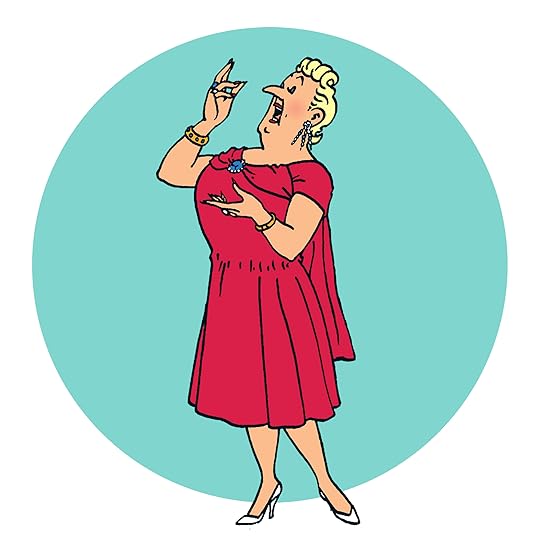
Finally, a very important canon character is introduced: Signora Bianca Castafiore of La Scala, Milan. She will be with us for the remainder of the series, more or less (even lending her name to one of my favourite late adventures). When I was a kid, I used to think that her singing was horrible, because that’s truly how Hergé depicts his characters’ reactions to Castafiore’s singing. Turns out, not necessarily – it’s just top level opera, and as Hergé mentioned, “Opera bores me, to my great shame. What’s more, it makes me laugh”. Okay. That makes more sense.

Bianca Castafiore
Profile Image for Hákon Gunnarsson.
Author 29 books162 followers
June 5, 2022
Tintin was one of the comic book heroes of my childhood. I'm going to read my way through the series again as I listen to a radio program about him, and his creator, Hergé. And I'm at book 8 that is the third in a row that has no connection to the previous one. It begins with Tintin finding a lost briefcase in the park. He returns it to its owner, the sigillographer Professor Hector Alembick, who tells our hero that he plans to travel to the Balkan nation of Syldavia. Of course Tintin has to come along, and finds adventures, much to Snowy's dismay. The whole thing turns out to be a plot by the leaders of the neighbouring country Borduria to be able to annex Syldavia.

Historically speaking, this book is very interesting. It is written / published in 1938-1939, and it is an satire on the way Nazi Germany annexed Austria in March 1938. One of the people Tintin has to deal with in this adventure is an agitator by the name Müsstler which comes from combining the names Mussolini and Hitler. Hergé begins writing whit book not long after Austria is annexed, and completes it shortly before the invasion of Poland. The fact that he is writing it at that point in history is quite interesting.

It feels like a brave book on his part, but it also shows just how far he has got in terms of storytelling. It is plotted quite well, and he writes an convincing backstory of these fictional countries. If one is to compare that to the first one, Tintin in the Land of the Soviets, or even the second, Tintin in the Congo, one can see that Hergé has developed extensively as a storyteller. The writing is much more complex, and deeper than it had been in the beginning of his career. And for some this book marks the beginning of the golden age of Tintin.

But I don't really see it that way. I find it interesting for both of the reasons I've just gone into, but to me he becomes too wordy. There is so much text that it slows the action down too much, and most of the humour is a slapstick scenes involving Thomson and Thompson. Granted, those to two really give the book a great ending. On the whole I find it more interesting than entertaining. Maybe it's not fair to ask for something more similar to The Black Island where adventure and humour go hand in hand. After all the subject here is much more serious, but I can't help it, I like The Black Island just better.

Basically I find King Ottokar's Sceptre historically interesting, but not quite as fun as for example The Black Island. If I was writing about this book from a different angle, for example if I was writing about the way Hergé was influenced by the world around him, then King Ottokar's Sceptre would be on top. Or if I was writing about this in my previous role as a literary theory student, I would have gone for King Ottokar's Sceptre. But I'm revisiting this comic book hero mostly for entertainment sake, so to me this was a slight let down from the previous volume. One side note, this is the first book where the majestic opera singer, Bianca Castafiore, appears.
Profile Image for Noella.
1,252 reviews78 followers
March 2, 2023
Koning Muskar, de koning van Syldavië, moet elk jaar op een feestdag voor het volk verschijnen met de scepter van koning Ottokar, een van zijn voorgangers. Doet hij dit niet, dan kan hij gedwongen worden af te treden.
Kuifje ontdekt een complot om de scepter te stelen, en zo het land in te lijven bij buurland Bordurië. Helaas komt hij te laat en zijn de boeven en de scepter verdwenen. Jansen en Janssen worden er bij gehaald, en samen proberen ze te achterhalen waar de scepter gebleven kan zijn.
Het is uiteindelijk Kuifje die met de hulp van Bobbie de zaak oplost.

Goed verhaal.
Profile Image for Sara.
1,801 reviews559 followers
October 31, 2020
تکه ای که اسنویی استخوان دایناسور رو برداشته بود!:)))
حدود یک ربع داشتم می‌خندیدم، خیلی یاد جودی خودم انداختتم اونجا.🤦‍😂
Profile Image for Ehsan'Shokraie'.
763 reviews222 followers
December 15, 2020
صداقت,از خود گذشتگی و تلاش برای انجام کار درست..درس هایی فراموش شده در دنیای امروز..
Profile Image for Mohsen M.B.
227 reviews32 followers
April 4, 2019
تو بچگی که اصلا با تن‌تن حال نمی‌کردم؛ به‌نظرم خیلی خسته‌کننده بود و سرم درد می‌گرفت از خوندنش
اما تازه حالا که توفیق اجباری شده دوباره خوندنش، می‌فهمم قضیه چیه.ـ

اول اینکه ترجمه‌ی هیچ‌کدوم از نشرها روان نیست. (ترجمه‌ی سه‌تا نشر رو خوندم.) ویراستار هم فقط اسمش صفحه اول کتاب نوشته شده، جای دیگه اثری ازش نیست.ـ
دوم اینکه شکسته‌نویسی توی کتاب مصوّر خیلی مهمه ولی در این ترجمه‌ها درست انجام نشده و باعث میشه داستان خسته‌کننده و مصنوعی بشه.ـ
سوم اینکه اندازه‌ی قلم بسیار کوچک و حجم مطالب زیاده؛ باز شکر که در چاپ‌های جدید کمی اصلاح شده.ـ
چهارم هم اینکه خب واقعا داستان‌هاش زیاد جذاب نیست؛ بعد از خوندن یکی‌دوتا داستان بیشترشون تکراری میشن.
Profile Image for Gary.
1,022 reviews257 followers
August 25, 2017
irst published in French in 1939, and written at the time that Europe was under the thumb of totalitarianism: Hitler, Mussolini, and Stalin.
Tintin is taken through a sequence of strange vents to the mythical Kingdom of Syldavia, which we learn much about in this book. The drawings and information which bring this country to life : a combination between Zenda and Albania , are amazing .
A plot by Fascists based in neighboring Borduria is hatched to unseat King Muskar, involving the seizure of the symbol of the Syldavian monarchy, the mediaeval King Ottokar's Scepter.
Tintin is called to the rescue. Once more these charming comics are an interesting commentary on events at the time, through the eyes of Herge.
Profile Image for David Sarkies.
1,931 reviews383 followers
January 12, 2015
Our first journey into Syldavia
5 February 2012

There have been some who have suggested that this album is where Tintin is finally developed, though as I have suggested, I consider that album to be the Cigars of the Pharaoh. This album though develops a number of elements that are going in reappear in later albums, the most important being the country of Syldavia, as well as introducing the Milanese Nightingale, Bianca Castafiore.
Syldavia is a fictional country that Herge developed, and I suspect that it was so that he could move away from the criticism doesn't truly understanding other cultures. As such, the best way to escape from that is to develop a culture all of your own. Syldavia is basically a small monarchy located somewhere in the Balkans and borders the country of Borovia, which is a military dictatorship. This album actually has a three page spread, as well as beautifully drawn pictures, of this country that Herge created.
I originally believed that Syldavia and Borovia were supposed to represent Eastern and Western Europe, however having noted that this album was completed in 1939, before Europe was split between the Eastern and Western block, I suspect that there is a little more to it. Obviously, being Belgium, Herge could have been using the two countries to represent the Third Reich and the rest of Europe, with Syldavia being your average small European nation. It is also noticeable that the portrayal of Borovia is nowhere near as extensive as that of Syldavia.
This album is contains a lot of political intrigue. The story is that the king of Syldavia has a sceptre, called King Ottokar's Sceptre, which must remain in his possession. It is suggested that if he is not able to produce the sceptre on St Vladmir's Day then he must abdicate the throne. As can be expected, there are a number of elements that seek to remove the king from the throne, most particularly Borovia. I note that the intrigue includes starting riots that target Borovian interest to give them an excuse to invade.
This album was completed on the eve of World War II. Hitler had already added Austria and Czechoslovakia to his empire, and was now eyeing off Poland. There was a lot of intrigue in Europe at this time as the various countries began to shift the alliance towards the coming conflict. Already Italy and Romania had joined the German camp, and Russia had made it clear that they were not interfering. Similar intrigue happened prior to World War I, in particular with the spies that were travelling between the belligerents, and I suspect that the same was happening here.
This was probably the first Tintin album that I ever read as a kid, though it does not rank as high as some of the other ones. It is still quite entertaining, and very amusing when Tintin first encounters the Milanese Nightingale.
Profile Image for Maria Carmo.
2,052 reviews51 followers
June 17, 2020
These adventures get more and more funny... King Ottokar's Scepter recovery had a main role for Milu! But in order to find out which exactly, you will have to read the book! Tin-tin goes on in his globe trotter activities, where he is also forced to face danger and malevolence... And our already customary friends, the Dupond and Dupont, continue to be completely absent minded, falling over and tripping all over the place and never understanding things at first sight...

Maria Carmo,

Lisbon, 7 January 2015.
Profile Image for Wulf Krueger.
513 reviews126 followers
June 19, 2022
Tim und die Politik - nicht immer eine gelungene Mischung. In diesem Fall aber gilt es zu bedenken, daß “König Ottokars Zepter” im Original zwischen dem 8. August 1938 und dem 10. August 1939 erschien.

Jetzt greifen wir zurück in diese dunkle Epoche deutscher Geschichte: Der von Hitler-Deutschland sogenannte “Anschluss Österreichs” fand am 12./13. März 1938 statt. Am 15. März 1939 ließ Hitler die Tschechoslowakei besetzen.

Der mit Hitler verbündete faschistische Diktator Mussolini fiel am 7. April 1939 wiederum mit italienischen Truppen in Albanien ein.

Unter den Eindrücken dieser Ereignisse also verfaßt Hergé diesen Band und verbindet Elemente all dieser weltpolitischen Katastrophen zu einer spannenden Geschichte, in der Tim und Struppi eine Staatsstreich und den “Anschluß” des fiktiven Syldavien an das Nachbarland Bordurien verhindern müssen.

In zahlreichen Etappen kann Tim seinen Häschern immer wieder: Gegen Ende mit einer vom feindlichen Nachbarland gestohlenen Messerschmitt mit Flugzeugkokarde, die trotz anderer Form ein wenig an das deutsche “Schwarze Kreuz” erinnert, das die deutsche Bundeswehr (leider) bis heute verwendet…

Detailreich gezeichnet und - auch in der deutschen Übersetzung - gelungen getextet, ist dieser Band wieder gut rezipierbar und angesichts seiner geschichtlichen Einbettung noch immer interessant und dennoch auch sehr unterhaltsam. Enthält dieser Band neben dem Syldawischen Pelikan doch auch eine wunderbare Schlüsselszene, in der ein Tri-gespaltener Struppi vor einer äußerst schwierigen Entscheidung steht…


Natürlich sind auch Schulze und Schultze wieder dabei und Bianca Castafiore hat - buchstäblich - ihren ersten Auftritt.

Für Hergé wurde das Happy-End dieses Bandes leider nicht wahr: Exakt drei Wochen und einen Tag nach Abschluß der Veröffentlichung, am 1. September 1939, überfällt Hitler Polen und löst damit den Zweiten Weltkrieg aus. Hergé wird eingezogen und kämpft bis Mai 1940 für Belgien und wird danach aus der Armee entlassen.

Trotz seiner Kritik gegenüber dem Nationalsozialismus und dem Faschismus und einem Rückzug zu eher fantastischen Themen während des Krieges, kann sich Hergé jedoch nicht ganz vor Vereinnahmung schützen und wirkt leider auch zeitweise an anti-semitischen Machwerken mit. Nie wieder wird Hergé danach politisch nennenswert in Erscheinung treten.

Insgesamt ein interessanter, unterhaltsamer Band - allerdings war die Recherche zu dieser Rezension kaum weniger spannend!

Vier von fünf Sternen.


Blog | Facebook | Twitter | Instagram


Ceterum censeo Putin esse delendam
Profile Image for Pavle.
143 reviews8 followers
August 19, 2025
Klasična Tintin avantura, konstantno iz tiganja na vatru pa se izvuče, nekad svojom zaslugom, a često i što je glavni lik pa mora plot armor da radi. Zabavno je što ovaj put ide na Balkan, u neku izmišljenu zemlju, i uniforme vojnika te zemlje mnogo lepo izgledaju.

S obzirom na to koliko su Tintin stripovi stari, očekivao bih da radnja ide sporije, ali oni skoro kao da su pisani za Tiktok generaciju, konstantno se nešto dešava, bez trena odmora.

Bila mi je pomalo kratka ova priča. Zamerka (nepravedna?) je što još nema Kapetana Hadoka kojeg se sećam kad sam čitao Tintina na srednjim stranama Zabavnika pre 100 godina i sve se nadam da će konačno da se pojavi (mislim da se pojavljuje od sledećeg izdanja).
Profile Image for Preetam Chatterjee.
6,784 reviews357 followers
August 18, 2025
#Read 1992-1996

January 1994—Christmas vacations were just about to fold, and the winter air still carried the festive cheer of the season. For me, the holidays had always been a mixture of schoolwork, family gatherings, and the quiet indulgence of reading. That year, however, the end of the vacation brought an unexpected delight: my uncle, a colleague of my mother, gifted me a copy of Tintin #8: King Ottokar's Sceptre by Hergé.

I remember the crispness of the pages, the bold cover art depicting Tintin confronting danger, and the thrill of holding a story I had been anticipating almost as much as my schoolbooks.

Receiving this comic felt like a bridge between the ordinary and the extraordinary. Winter afternoons in my hometown were often quiet and introspective, but Tintin’s adventures promised excitement, mystery, and the subtle lessons embedded in clever detective work.

Hergé’s meticulous artistry immediately drew me in. The illustrations were precise yet vibrant, filled with detail that made every panel an invitation to linger. Unlike ordinary books, where the narrative might drift slowly, Tintin’s story demanded attention—every frame a clue, every character a potential source of surprise.

King Ottokar's Sceptre opens with Tintin uncovering a plot to overthrow the monarchy of the fictional kingdom of Syldavia. A stolen royal sceptre becomes the focal point of an intricate conspiracy, and Tintin, as always, is propelled into a race against time. I remember being captivated by the combination of suspense, politics, and adventure.

Hergé’s skill lies not just in creating action, but in making the reader feel the stakes: the sceptre is not merely a symbol of power, but a tangible object whose theft threatens a nation. Even as a child, I felt the tension and urgency, my heart racing alongside Tintin as he navigated hidden corridors, suspicious characters, and sudden confrontations.

Snowy’s wit and loyalty added charm and humour, while Captain Haddock’s fiery temperament provided both comic relief and emotional depth. Haddock’s exaggerated exclamations and bluster contrasted beautifully with Tintin’s calm intelligence and careful reasoning, creating a balance that made the story both thrilling and engaging.

As I turned the pages, I was drawn not just into the plot, but into the rhythm of Hergé’s storytelling: suspense punctuated by humour, danger softened by ingenuity, and heroism tempered with humanity.

Reading this comic in the quiet of a post-holiday afternoon made the experience even more immersive. While the celebrations outside were winding down, I was swept away into Syldavia’s palaces, forests, and secret hideouts. Tintin’s courage, attention to detail, and relentless curiosity inspired me in subtle ways.

I began to notice that adventures did not always need to be physical; they could be mental, intellectual, and moral as well. The story encouraged me to value observation, patience, and creative problem-solving, all while being entertained by a narrative that moved with precision and flair.

Looking back, this gift was formative. It reinforced my growing love for Tintin’s world and introduced me to stories where suspense, logic, and human complexity coexisted harmoniously.

The comic’s narrative structure, its careful pacing, and its balance of tension and humour taught me to appreciate how storytelling could shape perception and imagination. It was a lesson that extended beyond the pages: that life itself could hold mysteries, challenges, and moments of discovery, if approached with curiosity and courage.

Even now, I recall that winter afternoon vividly. The thrill of opening King Ottokar’s Sceptre, the quiet concentration as I traced each panel, and the exhilaration of following Tintin through political intrigue and danger remain etched in my memory.

That gift from my uncle, small yet significant, became more than a comic; it was a key to a world of adventure and imagination, a companion in my childhood, and a benchmark for the stories that would continue to shape my love for literature.
Profile Image for Hany Adeeb.
Author 7 books161 followers
May 25, 2022

قصص جميلة ، شيقة الى ابعد حد .. شعرت للحظة انها تفسر نظريات الموامرة من بعض الدول .. و احداث روسيا و اوكرانيا .. كارتون .. مفيش مشكلة ..بس استمتعت بيها
Profile Image for Sherrymoon.
70 reviews33 followers
March 11, 2018
Since i am living wit a cute Shih Tzu girl Snowy is my principal actor in these comics. Excellent how Herge draws attention to that lovely dog! Of course i like tintin with his knickebockers too very much. As i was in the age of 8 to 10 years, we boys used to wear such knickebockers in wintertime! (* in the 50's)

Struppi-Milou-Snowy for ever!http://espacemilou.over-blog.com/albu...
Profile Image for Alireza.
170 reviews1 follower
April 2, 2016
از خوب های تن تن است. هم معقول شروع می شود، هم معماهای جذاب زیاد دارد واشارات سیاسی مناسبی هم در آن گنجانده شده.
Profile Image for Elessar.
296 reviews66 followers
June 24, 2021
3,5/5

Las aventuras de El cetro de Ottokar tienen lugar en el ficticio reino de Syldavia, una monarquía del este de Europa también conocida como "El Reino del Pelícano Negro". En las primeras páginas es introducido de tal forma que el lector acaba convencido de su existencia. Tintín acabará llegando a este país para acabar con una conspiración por el robo del cetro del monarca y para impedir la invasión de la nación vecina de Borduria, un estado que recuerda al de la Alemania nazi en sus políticas expansionistas. Esta similitud con el país de Hitler se ver confirmada por el contexto en que fue publicado este álbum.
Un número lleno de entretenimiento, aunque la resolución forzada de alguna de las situaciones me impide darle una mejor puntuación. Aún así, su lectura no desmerece.
Profile Image for Nadja.
1,913 reviews85 followers
January 21, 2022
Kurzum: Tim rettet wie so oft wiedermal ein Staatsoberhaupt vor der Revolution.
Profile Image for Marcelo.
66 reviews206 followers
Read
July 1, 2022
Muchísimo texto y no he entendido nada!
Profile Image for Harish Challapalli.
268 reviews106 followers
November 23, 2011
Interesting book!! Very nicely narrated!! The book has some stuff which is not needed!! It gives some boredom feeling to the reader! The plot begins to unfold slowly but it can be guessed quite well by a regular reader!!

Certainly not the best of the franchise but a good read is definitely assured!!
Profile Image for Abián Torres.
289 reviews12 followers
May 12, 2019
Qué maravilla! Este me ha tenido muy enganchado hasta el final. Cómo mola que el autor cree un país y se lo curre hasta el punto de hacer un folleto informativo de las costumbres, tradiciones, contexto histórico, ropas, paisajes... Y que encima luego esas cosas vayan apareciendo en el resto del cómic. Y qué bonitos algunos dibujos del entorno natural, momentos en los que la "cámara" se aleja y vemos a Tintín en un verdadero cuadro.
Profile Image for Roberto Carrasco.
Author 23 books92 followers
January 9, 2025
Muy emocionante la aventura de Tintín en este país ficticio que recuerda a Turquía. ¿Por qué a veces va a países reales y otras veces a países que no existen? Como curiosidad, sale por primera vez la Castafiore, creo que el único personaje femenino de toda la serie.
Profile Image for Schahin.
123 reviews
March 31, 2025
داستان با این دیالوگ شروع شد که : بیا چند لحظه روی این نیمکت بشینیم» و تقدیر تن تن رو به ماجرای عصای شاه اتوکار می‌بره.
هرکدام از داستان های هرژه به مسائل پیچیده سیاسی پرداخته و شاخص بودن داستان عصای شاه اتوکار به دلیل داشتن زمینه تاریخی قوی در آستانه‌ی جنگ و وجود فضای ترس و نارضایتی فزاینده در اروپاست.
کشور سیلداوی (که بنظرم شبیه بالکان اومد) پر از مناظر زیباست که پشت هرکدام از آنها یک دسیسه و جریان پنهانی در حال انجامه. لب کلام این قسمت در مورد یک بازی بزرگه برای الحاق یک کشور کوچک توسط یک دولت نظامی بزرگ ( دیکتاتور اون کشور اسمش ماسلره (موسولینی+‌‌ هیتلر)) دیالوگ هاشون هم مثل نازی هاست. اینکه «باید سرزمین مادری مون رو پس بگیریم» و از این قبیل که باعث میشه به خودشون حق کشور گشایی و گسترش رو بدن و ادعای خودشون رو از جایی که به آن حمله می کنند بالاتر بدونن.
واقعا دوست داشتم بدونم ماسلر چه شکلیه و چه ترکیب ظاهری داره؟ اما تو این قسمت شبیه موریاتی بود، دسیسه ها رو میچید ، اما هیچوقت دیده نشد.
عصای شاه اتوکار یکی معدود کتاب های تن‌تن‌ است که واقعا محصول خودشه و این اصلا چیز بدی نیست چراکه اون زمان،‌ زمانی بسیار غنی برای هرژه بوده که می‌توانسته یک ماجراجویی خوب با زمینه تاریخی قدرتمند به وجود بیاره.
Displaying 1 - 30 of 464 reviews

Can't find what you're looking for?

Get help and learn more about the design.