Jump to ratings and reviews
Rate this book

Library of Yiddish Classics

Tevye the Dairyman and the Railroad Stories

Rate this book
Of all the characters in modern Jewish fiction, the most beloved is Tevye, the compassionate, irrepressible, Bible-quoting dairyman from Anatevka, who has been immortalized in the writings of Sholem Aleichem and in acclaimed and award-winning theatrical and film adaptations.
And no Yiddish writer was more beloved than Tevye’s creator, Sholem Rabinovich (1859–1916), the “Jewish Mark Twain,” who wrote under the pen name of Sholem Aleichem. Beautifully translated by Hillel Halkin, here is Sholem Aleichem’s heartwarming and poignant account of Tevye and his daughters, together with the “Railroad Stories,” twenty-one tales that examine human nature and modernity as they are perceived by men and women riding the trains from shtetl to shtetl.

320 pages, Hardcover

First published January 1, 1894

250 people are currently reading
3198 people want to read

About the author

Sholom Aleichem

290 books186 followers
Russian-born American humorist Sholem Aleichem or Sholom Aleichem, originally Solomon Rabinowitz, in Yiddish originally wrote stories and plays, the basis for the musical Fiddler on the Roof .

He wrote under the pen name, Hebrew for "peace be upon you."

From 1883, he produced more than forty volumes as a central figure in literature before 1890.

His notable narratives accurately described shtetl life with the naturalness of speech of his characters. Early critics focused on the cheerfulness of the characters, interpreted as a way of coping with adversity. Later critics saw a tragic side. Because of the similar style of the author with the pen name of Mark Twain, people often referred to Aleichem as the Jewish version of Twain. Both authors wrote for adults and children and lectured extensively in Europe and the United States.

Ratings & Reviews

What do you think?
Rate this book

Friends & Following

Create a free account to discover what your friends think of this book!

Community Reviews

5 stars
644 (42%)
4 stars
555 (36%)
3 stars
275 (18%)
2 stars
34 (2%)
1 star
8 (<1%)
Displaying 1 - 30 of 140 reviews
Profile Image for Jan Rice.
585 reviews517 followers
July 24, 2022
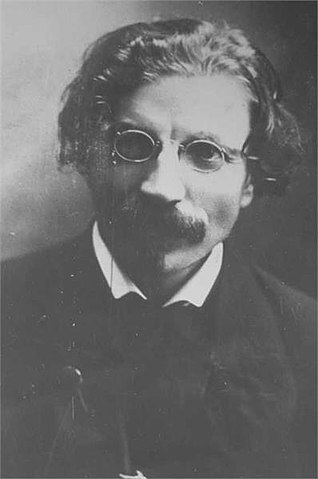
Sholem Aleichem, previously known as Sholem Rabinovich

A photo a little different from the one(s) usually seen; younger, sadder
By צלמי קק"ל (KKL Photographers per Google Translate). Reused from Wikipedia.

I had some initial resistance to this book club selection. It usually strikes in the form of everything I'd rather be reading instead. Even a dash of revulsion.

Where was it coming from? Boredom, since it started out reminiscent of Fiddler on the Roof? Resentment at something I was expected to revere whether I did or not? Something to be crammed down my throat?

Fortunately another group member took umbrage at the fact it had been voted in as a comforting read and on the surface, at least, wasn't. Now instead of being tangled up inside I could externalize my conflict -- which became a challenge, a problem to be solved.

The translator is an author in his own right. I took up his introduction. What could have been construed as spoilers plot-wise were too abstract to be so without the stories themselves.

The review of recent history helped. What with scapegoating and pogroms, good times for the Jews these were not.

Most helpful was the look at Sholom Aleichem's style and that he was at his best when having Tevye give a monologue. I could get a handle on my resistance by imagining Tevye's monologue on late night TV. This was not going to be the sentimentalized Fiddler on the Roof, although the author himself was not above sentimentalizing when his livelihood was at stake. Some explanation on the uses of humor, although those fell short in that I just couldn't see.

Sholom Aleichem (which Hillel Halkin in this book transliterates as "Sholem") was born in 1859 near Kyiv. He began writing early and used a variety of silly pseudonyms before settling on this one by which he became known after starting his Tevye cycle. In fact he started it after losing the fortune he inherited by marrying into a rich family, losing it in a stock market speculation. (Sound familiar?) These stories bore a rough autobiographical correspondence to his life; his protagonist aging over 20 years as he himself did, with what began as humor ended up in tragedy.

Yet Sholom Aleichem became the most acclaimed Yiddish writer of his day. How come, if he was telling such unhappy news?

The translator falls back on laughter as tension release, but that's too general -- an explanation that is not an explanation. No, Sholom Aleichem has Tevye hit his audience with the truth. Not merely the truth of being an old fogy in changing times, but the truth of being caught in the middle as the future foreshadows the impending end to a way of life -- although not even Sholom Aleichem could imagine the full scope. It wasn't good, though, and he himself (the author) had to flee in 1905.

So at first we get humor, before, with the passing of years and the advancing stories, we are plunged into outright tragedy -- before we know it, like a frog in water that is not yet boiling. Even then the truth is a relief.

Confusion and fuzziness shockingly replaced by truth: it's all in the contrast.

It helps that the story is being told by a schlimazel.* In my translation Tevye often calls himself that.

Speaking of translation, mine is from 1987 by a native American English speaker who made aliyah to Israel in 1970 when he was 30. He's now in his early 80s but was still in his 40s when he translated these stories. I compared where I could to the examples from Adam Kirsch's 2016 The People and the Books: 18 Classics of Jewish Literature. The translator from whom Kirsch quotes is said by her publisher to be the foremost translator of Sholom Aleichem.

Aliza Shevrin, Tevye the Dairyman and Motl the Cantor's Son, 2009, as quoted in Adam Kirsch's book:
The crumbs that fell off the table would have fed my children for a week, at least till Saturday. God Almighty, compassionate, faithful one, is a great God and a good God, a God of mercy and justice. Why did He grant this one everything and the other nothing? This one got butter rolls, the other the ten plagues. But then I thought I was a great fool. I was giving Him advice on how to run the world? Most likely, if He wanted it that way, that was it should be. The proof was that if it were meant to be otherwise, it would be otherwise.... A Jew must exist on hope and faith. He has to believe, above all, that there is a God and he has to have faith in Him who lives forever and hope that someday,with His help, perhaps things will be better.

Hillel Halkin, Tevye the Dairyman and The Railroad Stories:
The crumbs that fell from that table alone would have been enough to feed my kids for a week, with enough left over for the Sabbath. Oh, my dear Lord, I thought: You're a long-suffering God, a good God, a great God; they say you're merciful and fair; perhaps You can explain to me, then, why it is that some folk have everything and others have nothing twice over? Why does one Jew get to eat butter rolls while another gets to eat dirt? A moment later, though, I said to myself, ach, what a fool you are, Tevye, I swear! Do you really think He needs your advice on how to run the world? If this is how things are, it's how they were meant to be; the proof of it is that if they were meant to be different, they would be. It may seem to you that they ought to have been meant to be different ... but it's just for that you're a Jew in this world! A Jew must have confidence and faith. He must believe, first, that there is a God, and second, that if there is, and if it's all the same to Him, and if it isn't putting him to too much trouble, He can make things a little better for the likes of you ...

And again,
Shevrin: Those daughters of mine--when they fall in love, it's with body and soul and heart and life itself!

Halkin: (Damn them all), every one of these daughters of mine--when they fall for someone, they do it hook, line, and sinker!

And finally,
Shevrin: "Don't compare me to Hodl," she (Beilke) says. "Hodl lived at a time when the whole world was in chaos ... and people were worrying about that and forgetting themselves. But now that the world is calm again, everyone is worried about himself, and they've forgotten about the world."

Halkin: "Don't go comparing me to Hodl," she says. "In Hodl's day the world was on the brink. There was going to be a revolution and everyone cared about everyone. Now the world is its own self again, and it's everyone for his own self again, too."


*https://www.newsweek.com/penny-marsha...
Profile Image for Adrian Stumpp.
59 reviews12 followers
February 5, 2010
Sholem Aleichem, a Yiddish idiom which basically means, “Hey, what’s up?” is the pseudonym of Sholem Rabinovich, who has been heralded as the Jewish Mark Twain and who, in my opinion, favorably deserves the comparison. I became interested in reading this book when I learned it was the inspiration for Fiddler on the Roof, one of a precious few Broadway musicals my stomach is strong enough to endure. The novel runs just 131 pages, made up of eight episodes written and published over a twenty-three year period, from 1894 to 1917. As an episodic novel, or a novel told in a cycle of short-stories, it is exemplary. Each episode manages to both build on the previous installments and still remain self-sustaining unto itself.

The episodes happen in real time. That is to say, if five years have passed since the publication of the previous episode, Tevye is five years older at the onset of the next one, so that by the end of the novel Tevye has aged twenty-three years since the first, just as the author has aged twenty-three years, and, theoretically, just as the reader has aged. How effortlessly Alecheim sustains the narrative over such a span is one of the interesting things about the novel, for me. Tevye’s maturation seems seamless, natural, and believable. The reader can sense throughout the narrative that Tevye is changing, sometimes subtly, sometimes dramatically, and not necessarily in response to major events in the plot, but just as a matter of course, because he is aging.

Tevye as a character and as a narrator becomes a joyous treat. The narrative mode is a series of monologues in which Tevye directly speaks to Sholem Aleichem, who apparently writes the stories down at a later date. This makes the voice conversational, homey, colorful, and occasionally digressive. The style is easy to read and quickly absorbing, as the reader feels as if he is listening to an old man spinning a clever yarn. The effect is that we think of Tevye, and not necessarily the author, as an entertaining storyteller. Tevye fancies himself a scholar and constantly misquotes scripture or quotes it humorously out of context. “Tevye is no woman,” is the most often repeated phrase in the novel, humorous because, as Ryan pointed out to me, if Tevye had been more inclined to behave “womanly,” he might have avoided the misadventures that provide the basis of the plot. But Tevye, like many men, is only superficially a misogynist. The most compelling aspect of the story is his powerful, constant affection for his daughters and his unflinching pursuit of their happiness.

Aleichem, like Twain, uses humor as a means toward social criticism, and like Twain avoids ideological preachiness or scathing bitterness. His satire is warm and compassionate with a firm eye to the story. However, none of the sentimentalism of the musical is found in Tevye the Dairyman. Injustice, ignorance, and even death take important roles in the tales, and while the novel is far darker and more human than the musical, Aleichem’s triumph is the harmony with which he mingles comedy and tragedy, and the befuddled amusement with which his protagonist relates all his sad experiences. Despite his many flaws and sorrows Tevye’s good-will, humor, and charm ultimately carry the day.

A tremendous short novel.
Profile Image for Miles.
305 reviews21 followers
June 5, 2012
So who is this Shalom Aleichem and how dare he rip off Fiddler on the Roof? Couldn't he at least come up with some original material?

What?! Oh. I see. I'm being told that... I understand.

If you read "Today's Children" and a few other stories in this volume you'll get the core stories of Fiddler on the Roof with lots of extra details. It's great! Tevye in the original Shalom Aleichem (pen name of Solomon Naumovich Rabinovich) has a bit more vinegar, drinks a good bit more, and throws around the nonsense Talmud with even greater abandon than he does on film. He's dirtier, and poorer too. But the spirit that actor Chaim Topol brought to the film's character is still spot on. Shalom Aleichem's Tevye is a man with a good heart and a world of troubles, who will endure this world's trials with sharp humor. The words he speaks and the attitudes he cultivates are his survival secret and Shalom Aleichem's magic. Was Shalom Aleichem the "Jewish Mark Twain"? Yeah, I think it fits.

Sometimes the details are almost too much. I imagine that the endless detail of the originals was a valued part of the experience in 1890 or 1900 when first published. The same leisurely pace in 2012 is occasionally tiresome. I didn't read every story, or even every word of some of the stories that I did read, but I enjoyed the experience. Like any American Jew who has seen Fiddler on the Roof more than once, and who has never read much of Shalom Aleichem, I could only read these stories with the film version playing in my mind, helplessly noticing when the text overlapped the film (really, vice versa), and when it ran off in its own playful direction.

Watching the hash Tevye makes of Hebrew phrases (presented in transliteration) is one of the special delights for those who know a little Hebrew, but not being able to do so takes away little from the overall pleasure. Having recently re-watched Fiddler on the Roof, now a basic cultural artifact of American Jewish life, with my children it was a delight to return to the source material and experience Shalom Aleichem's world in three dimensions and high definition.
Profile Image for Chrissie.
2,811 reviews1,421 followers
May 16, 2012
I finished "Tevye the Dairyman" part of the book. Tevye does take on the form of a perfect Jewish father. I definitely enjoyed meeting him. Some of the lines are great. Each chapter, each about a different daughter, all lead to the last chapter which imparts a wonderful message. I certainly was smiling at the end.

I doubt if I end up giving this a ton of stars, but nevertheless I think it could be called a classic and would recommend all to read it. I am glad I met Tevye...and his daughters too. He is such a schlimazel (a chronically unlucky person). The stories and the humor is at times repetitive.

I assume you know that this is the book from which Fiddler on the Roof was conceived.

I cannot imagine a better translation than that done by Hillel Halkin.

Now I am off to read the second section: "The Railroad Stories".

I have found them less entertaining and too repetitive. I suppose one should not read more than one story a day. Books of short stories always give me trouble.

Profile Image for david.
494 reviews23 followers
December 30, 2021
Eastern Europe and Russia in the nineteenth century. Short stories by a master.
Profile Image for Sherril.
332 reviews67 followers
April 29, 2019
Ok. So I didn’t actually read Sholem
Aleichem ‘s, Tevye the Dairyman and The Railroad Stories. I will. I promise. I did read
Isaac Bashevis Singer’s Stories for Children, a story a night to my daughter who was then perhaps 9 or 10 and now 38. They were stories of a town's foolish elders in the shtetls of Eastern Europe in the late 1800’s. She loved the stories. So did I. Though I haven’t read Tevye the Dairyman (I did buy it on my kindle) I recently saw Fiddler on the Roof in Yiddish. That’s even better than reading the book and here’s why.

Over the years there have been 4 Broadway revivals since the original Fiddler on the Roof with Zero Mostel which opened in 1964. The others were: 1976, 1981, 1990, 2004. The newest iteration, number 6, is Fiddler on the Roof in Yiddish, or “Fidler Afn Dakh” and it marks the first time the musical is being performed in Yiddish in the United States, and only the second time in its history (a Yiddish version ran for about four weeks in Israel in 1965).

I have seen Fiddler 4 times (with the Playbills to prove it): 1966 (Herschel Bernardi) 1991 (Topol), 2005 (Harvey Feierstein) and now in 2019 (Steven Skybell). You may ask, why would I go to see it for the 5th time? Why? Because, this newest version was in Yiddish and I had received rave reviews from friends. I was not disappointed!

It has been said by others and I resoundingly agree, this Fiddler on the Roof, in Yiddish, is the most authentic of them all. The story is about a shtetl in Russia and the people it represents spoke Yiddish. They were pious people who prayed in Hebrew. They lived amongst the “goyim”, so perhaps they knew a bit of Russian. But among themselves Yiddish was the lingua franca. Yiddish was the mamaloshen, the language of our mothers and hearing it being spoken on a broadway stage when in the past people would make fun of Yiddish, or not want to associate themselves with it in order to feel safe or to feel American,
“It’s a balm to hear it spoken openly, freely, funnily, heartbreakingly, and to know that it’s the real thing”. Most American Jews are Ashkenazim and in a broad view these people speaking this language are who we came from.

Fiddler on the Roof is based on a series of short stories by Solomon Naumovich Rabinovich, better known by his pen-name, Sholem Aleichem. They were originally written in Yiddish, and first published in 1894. The stories are based on the fictional characters, Tevye, the pious Jewish milkman in Tsarist Russia with his wife, Golde and their 6 daughters: Tzeitel, Hodel, Chava, Shprintze, Beilke, and Teibel (5 in the show).
In this Current production, the “Fiddler” is perfectly played by a young woman (Lauren Jeanne Thomas) and by perfectly I mean she looks like she’s stepped out of one of Marc Chagall’s iconic paintings (Green Violinist (1924), Le Mort (1924), The Fiddler (1912)). I loved “Der Fidler’s” costume and the way she was on the one hand ever so slightly bent over to suggest her precarious position on the proverbial roof, yet on the other hand, sprite and light on her feet, suggesting her energy and perseverance.
The Fiddler is a metaphor for survival in a life of uncertainty, “precarious as a fiddler on a roof, trying to scratch out a pleasant simple tune without breaking his neck” (in this case, her neck).
The fiddler also represents “Tradition”, that Tevye sings of in the opening number, the traditions that Tevye is trying to hold onto. In the final scene, when the Jews are expelled from their homes in Anatevka, Tevye beckons with a nod, and the fiddler, their symbolic backbone, follows them out of the village. The poignancy is felt by everyone in the audience.

Steven Skybell is a less physically robust Tevye than what we are used to in the traditional productions, but he is no less robust in his portrayal of the over burdened dairy man, father and husband who has his own personal discussions with God trying to make sense of what God has given him. He plays the part with equal earnestness and humor. I was mesmerized when Tevye raises his arms and fingers and shakes them in that “Yiddish” way to the heavens as he sings (think Tradition!) and dances (think the celebration scene when Tzeitel’s wedding is announced, To Life!). This physicality brought to my mind a memory of my first trip to Israel in 1968. As Tevye reaches deep into his soul, so do his fingers reach out to heaven, bringing to mind the branches of the bare olive trees, stretching up and outward, also to heaven, as if also beseeching God, one after the other lining the Israeli countryside. Tevye pleads with his God, questioning how much can he bend and stray from tradition before he, like the taut tree branch, breaks?

What’s interesting in this production is that even while not understanding most of them the Yiddish, the humor comes across with no language barrier at all, particularly in the roles of Tevye and Yente the matchmaker (Jackie Hoffman). “Yiddish, which is based on German with elements taken from Hebrew and other languages and is written with the Hebrew alphabet, was once spoken by millions of Eastern European Jews but fell victim both to the Holocaust and the pull of assimilation. Isaac Bashevis Singer, who won a Nobel Prize for his stories written in Yiddish, famously said the language “has been dying for a thousand years, and I’m sure it will go on dying for another thousand.”

The dialogue and the songs were translated into English and Russian using “Super-Titles”. Being so familiar with the dialogue and especially the music and lyrics to the songs, I thought I would have no problem understanding and I was right. When I did read the titles (on the sides of the stage, not above it, as I thought they would be) there were two problems. The lighting structures obscured them a bit from our seats, which otherwise were excellent, and if I read the translation, I’d begin to forget to watch the actors. I had to actually remind myself to stop. Translation or no translation, the meaning, the drama and the exuberant music came through loud and clear!

The production itself, regarding everything from the singing and dancing
to the klezmer-inflected score, played by a lively 12-piece orchestra sitting in two locations on the stage behind yellowish-beige sheets, which allow for partial viewing of the musicians to the acting to the costumes to the simple, minimalist scenery (which spoke volumes) to the creative and stirring dream sequence with Fruma Soreh and Grandma Tzeitel to every subtle and forthright aspect was excellent, outstanding, exceptional! I had a few complaints (more about the audience than the show), but they were too few to mention.

I dare not forget to acknowledge the Director of this Yiddish production of Fiddler on the Roof, Joel Grey (best known for Cabaret). He was asked to direct this show by the National Yiddish Theatre Folksbiene, a professional theater company in New York City which produces both Yiddish plays and plays translated into Yiddish. He responded, “So I thought very hard. And then I stopped thinking. I said, ‘I love this piece, I’ve loved it all my life, and I think I can do this. I don’t know how right now, but I think I can.’” And he did.

What Joel Gray brought to his direction was that he came to it from an acting standpoint. He, like most of the cast surprisingly did not speak Yiddish, though his father was a great Yiddish comedian. When deciding whether to accept the challenge Joel Grey thought, O.K., there’s a Yiddish word I do know—beshert [destiny]. And I said yes, I’m going to do this.
He had his actors rehearse all of the scenes in English first with him. They sat around a table and read the text in English, then they read the literal Yiddish translation, and then they read it in Yiddish. They’d go back and read it in English, and then go back and read it in Yiddish. It was a long arduous process and Joel really wanted the actors to get to the root of the characters and the scenes that are so beautifully written.
As the director, Joel Grey had a passion for the production which was just incredible and which resulted in a most incredible Fiddler.
Profile Image for Stefanie.
148 reviews
February 3, 2022
Oh, my heart. Fiddler on the Roof has been my favorite musical since childhood and I never knew it was based on a book until I was digging through lists of books published in the early 1900s for my 20th century reading project. This book was a bit of a cheat … I counted it as my book for 1907 because it was difficult to pin down exactly when some of Sholom Alecheim’s works were published and he seems to have done a lot of writing during this decade. Listening to this book was like suddenly getting to know an old friend in a deeper way and getting to see a different side of them. In many ways it was the same Tevye I have loved for 30 years, but with stories and heartaches I hadn’t known about until now.
104 reviews
May 19, 2022
Only read Tevye the Dairyman. Read out loud with Flora but we weren't very diligent so it was hard to get invested.
Profile Image for Anjum Choudhury.
221 reviews
May 26, 2018
Okay, this is really two books in one, and I think pretty drastically different things about these two different tales. I'll start with Tevye.

Tevye is obviously going to be more popular and more beloved, what with Fiddler on the Roof and all, but it's also just a better story collection. Tevye is an interesting character who has a lot happen to him and, generally, we really care about how he's doing. I think that Golde and the daughters are lacking in specific characterization--pretty much any daughter could be traded out for any other--and this book isn't great for women in general, but, you know, it's over 100 years old. Hard to fault it too much for that.

Largely, Tevye is enjoyable. Things are missed when reading the English rather than Yiddish, and not being Sholem Aleichem's target audience. As people not from his time and place, we miss out on the nuances of current events that he's including, as well as a number of jokes lost in translation. Luckily, this book has translations of Tevye's many quotes to clear that up, but it certainly does take away somewhat from the reading experience.

Then we have the Railroad Stories. Some were enjoyable...most were pretty boring. I just kind of scanned through them, reading as fast as I could because so few of the stories pulled me in. I'd probably recommend another reader just skip them. There were some gems, but it wasn't really worth digging for them.
Profile Image for Rissie.
593 reviews56 followers
October 29, 2017
Equal parts hilarious, heartbreaking, and heartwarming. I think the translation had a lot to do with that. Here’s an example …

“If you’re meant to strike it rich, you may as well stay home with your slippers on, because good luck will find you there too. The more it blow the better it goes, as King David says in his Psalms – and believe me, neither brains nor brawn has anything to do with it. …. A man slaves, works himself to the bone, is ready to lie down and die – it shouldn’t happen to the worst enemy of the Jews. Suddenly, don’t ask me how or why, it rains gold on him from all sides. In a word, revakh vehatsoloh ya’amoyd layehudim , just like it says in the Bible!"

Honestly, I loved Tevye the Dairyman, but the Railroad Stories didn't hold my interest. Together, they averaged three stars.
Profile Image for Frieda Vizel.
184 reviews129 followers
October 17, 2012
From the first story, this became an all time favorite. Sholom Aleichem created stories the likes of which I've never read in Yiddish. It was the kind of reading that stayed with me long after I closed the book.

The Tevya the Dairyman character is ingenious - he is at once lovable but with so much human flaw, and his internal monologues are full of humor but also beautifully insightful. Tevya's tendency to quote the bible adds so much to his personality. He is the real shtetl man who despite his simple life is beautifully complex and full of life.
Profile Image for Illiterate.
2,776 reviews56 followers
July 5, 2023
Humane, comic, folksy tales. The best are conflicts that arise when the narrator’s family challenges his traditional views.
Profile Image for Anna.
1,525 reviews31 followers
December 12, 2018
I have been familiar with the musical Fiddler on the Roof for most of my life, but only recently learned that it was based on a book. These stories are both funnier and much sadder than the musical. Tevye's voice is quite compelling, but Golde is not kindly portrayed. There is of course more to the book than was portrayed in the musical, the stories of two more daughters as well as an extension on the eldest daughters story, but I can easily see why these were not included.
The second half, The Railroad Stories, were generally lighter in tone and were something of a mixed bag, some were interesting and fun to read others were rather a drag.
Popsugar challenge 2018: a book that is also a stage play or musical
Profile Image for George P..
479 reviews85 followers
September 22, 2022
Tevye the Dairyman was the basis of the later play Fiddler on the Roof. It's a fairly short novel, much of it telling of Tevye's travails with his several daughters and their boyfriends and husbands. There is a lot of sarcastic wit in the novel but also a lot of commentary on Jewish culture that is amusing. This book also has a collections of stories that the author purportedly was told or experienced while traveling on trains amongst other Jews that are also amusing.
The author could speak and write in at least five languages (Russian, Yiddish, Hebrew, Polish, Ukrainian). When he died in New York city in 1916, an estimated 100,000 people turned out to see his hearse pass by. There is a small monument to him in Kyiv, Ukraine and another in Moscow.
Profile Image for Shannon.
39 reviews4 followers
February 8, 2025
3.5/5 stars. I probably would have never read this book if it weren’t for the book club I read it for. It was so helpful to understand the historical context behind the story and the author, and having that historical context gave me more empathy & understanding for Tevye. I’m excited to watch Fiddler on the Roof during our next meeting (this book is the source material for the musical).
Profile Image for Christopher Bassett MD.
171 reviews4 followers
December 22, 2021
Gotta love Tevye, always seeking the brighter side. His constant scripture references are annoying as heck but that’s just part of his charm. Good stuff.
Profile Image for Jamie Collins.
1,556 reviews307 followers
February 27, 2017
“What’s new with a Jew?” I really liked this collection of stories, written between 1894-1911 by the so-called “Jewish Mark Twain”. There’s a long introduction, written by the translator, which provided valuable information to put the stories into historical context.

I picked this up for the first collection, about Tevye the Dairyman and his daughters, which was the inspiration for the musical Fiddler on the Roof, but in the end I enjoyed the Railroad Stories even more.

There are eight stories featuring Tevye, the garrulous dairyman who annoys everyone by constantly quoting from the holy books; who moans bitterly about his poverty in one breath, then philosophically shrugs it off in the next.

“In those days, with God’s help, I was poor as a devil.”

“It’s like it says in the bible, I not only have no money, I also lack health, wealth and happiness.”

“If from now until autumn the two of us earned a tenth of what it would take to make me half as rich as Brodsky, we wouldn’t be doing half badly.”

Also recognizable from the musical are Golde, his long-suffering wife; his daughter Tsaytl, who marries the poor tailor instead of the rich butcher; his daughter Hodl who leaves her family to follow the revolutionary into exile; his daughter Chava, who breaks Tevye’s heart by marrying outside the faith. There are more daughters in the text, and more sad tales.

The second set of stories are narrated by a man who travels across Russia in the third class compartment of a train which is crowded with Jews who pass the time telling each other possibly tall tales.

My favorite is the farcical story told by the man whose son is named Itsik, “that’s short for Avrom-Yitzchok, though he really goes by Alter, which is what his mother, God bless her, took to calling him for good luck, being an only child and all that” after the death of their older son, Eisik. This confusion of names leads to the circumstance where “an only son, with an automatic, a guaranteed, a one-hundred-percent lifetime exemption,” is repeatedly called before the army draft board.

My next favorite is the story of the Jew who was sentenced by the Russian governor to be flogged. His village raised money for bribes and went to great lengths to fake his death for the authorities, and helped him flee the country. Soon he began sending letters home, asking for money or else “only one choice would be left: either to drown himself on the spot… or come hell-bent back to Kaminka”, which is of course an unsettling prospect for his neighbors who had sworn he was dead.
Profile Image for Jordon Gyarmathy.
155 reviews4 followers
May 21, 2023
This book was a deep dive into Jewish culture, especially Russian/Eastern European Jewry around the turn of the century. I enjoyed the immersion in Yiddish vocabulary and the lively cast of characters. Tevye is an exciting set of stories and the Railroad selections are very eclectic and enjoyable. Overall enjoyable read!
Profile Image for Joel.
79 reviews
July 6, 2022
It's hard to rate Sholem Aleichem, one to five stars. Tevye, the Dairyman was written and serialized over a period of 20 years, and is the basis for the wildly popular stage and movie adaptations, "Fiddler on the Roof" the most notable. It chronicles the end of a culture, in the Pale of Settlement, that included the author's own departure (to New York City). Tevye chats with the author, and that allows Sholem Aleichem to unfold a tale of a wise man, a good man who loves his six (or seven) daughters, maybe a little bit too much.

The Railroad Stories, the second half of this collection, are overheard or told in the 3rd class car of a train traveling through The Pale (Ukraine) -- again 20 stories unfolding in first person. The chatter is unwavering, as Hillel Halkin introduces the stories, with the philosophical assumption "I talk, therefore I am." Is Jewish life in Eastern European unwavering verbosity, language as strength as well as pathology? Perhaps, but as all freedoms and pleasures were taken away from the Jews, the telling of stories might be the best instrument left in the toolbox.

It took me a long time to chew through these stories, pleasantly so, as I imagined my ancestors in Kyiv, Vitebsk, Warsaw, as life narrowed with Russian regimes, as anti-Semitism reached unthinkable levels... until the Nazi machine introduced an entirely new scale. It's said that Sholem Aleichem's collected works were published in 28 volumes after his death! These 300 pages offer a lovely smattering, with a taste of Hebrew, a dash of Yiddish, oylim veyordim, as God's angels continue to climb and descend the heavenly ladder!
Profile Image for Marcus.
257 reviews7 followers
October 15, 2019
Wonderful and extremely funny, but also much sadder than the musical version, which can be difficult. Theodore Bikel can really break your heart with his voice.
Profile Image for Rachel.
246 reviews11 followers
July 24, 2009
This collection of short stories is really two separate collections put together: the Tevye the Dairyman Stories, and the Railroad Stories. The first set comprises the short stories that were the inspiration for the Broadway musical Fiddler on the Roof. Written over a span of twenty years, these stories offer fragments of Tevye's life as he comes to terms with the changing times and the growth of his daughters. The Railroad Stories do not feature Tevye, and are instead a disjointed collection of narratives it seems Sholem Aleichem has collected on his many travels by railroad throughout Europe. There's no overwhelming theme to these collected stories, except perhaps koyl yisro'el khaveyrim ("all Jews are brethren") -- wherever you go, a Jew is a Jew.

I was surprised to find that Tevye's world in these stories is so different from what is portrayed in Fiddler on the Roof (the play and the movie). For one thing, society is much more varied, and there are Jews on all levels and in all sorts of roles, not only in the shtetl living as peasants. Secularization plays a much more significant role in these stories than the play/movie would suggest, and Tevye finds himself straddling the gap between the religious and secular world even more precariously. Speaking of precarious, though, there's a noticeable lack of any fiddling; the image of the rooftop fiddler, Halkin's introduction explains, actually comes from a Marc Chagall painting.

Perhaps the most colorful element of this collection is the language used. I really have to commend Halkin's translation -- it does a marvelous job of capturing the "feel" of Yiddish as I remember my grandparents speaking it. Halkin also does a great job of navigating the blended Yiddish, Russian, Polish, and Hebrew to craft a translation that keeps the essence not only of the meaning, but of Sholem Aleichem's famous wordplay and colorful turns of phrase. I don't read nearly enough Yiddish to be able to read the original and offer a line-by-line comparison to endorse the translation more fully, but this translation certainly had the right "feel," and evokes images of the world that so many immigrant Jews left behind to move to America (and elsewhere) at the turn of the last century. No wonder Sholem Aleichem received such a warm reception here when he emigrated!
Profile Image for Yenta Knows.
619 reviews2 followers
August 23, 2016
I read the Tevye stories but only a few of the railroad stories.

It's hard to review these stories as I would a typical book. It would be like critiquing my dear auntie Fay (née Stern) when she told how she and her mother and brother just barely made it past the immigration official in Halifax. You might, if you were not family, notice that the ending was weak. You would certainly notice that she never told it the same way twice. But if you dared -- dared -- to criticize, a squadron of angry Sterns would be ready to remove you from that warm, crowded, noisy living room.

So these aren't stories in the usual sense. They aren't entertainment. They are stories that tell me who I am.

Just one warning. They differ dramatically from the story line in "Fiddler on the Roof". Characters not in the musical appear in the stories, the "America gonif" theme, so central to the musical, barely appears in the stories.

But that does not matter at all.
Profile Image for Evanston Public  Library.
665 reviews67 followers
Read
October 4, 2010
The hardworking, Bible-quoting, comically Job-like Tevye (made famous in the 1960s and '70s by the Broadway and film versions of "Fiddler on the Roof") was created a century ago by Aleichem, aiming to personalize the disintegration of traditional Eastern European shtetl life. (A shtetl was a Jewish village or ghetto.) In three of the early stories, Tevye's headstrong and much-adored daughters challenge him with their marital preferences--each preference a rejection of Tevye's beloved world of tradition. Other tales show us how shtetl life fostered humor and hope amidst oppression and squalor. Aleichem's Tevye is perhaps less charming and less memorable than Zero Mostel's or Topol's. But he remains one of the great voices in fiction, and his creator is understandably considered the Jewish Mark Twain. (Jeff B., Reader's Services)
Profile Image for Cindy Stein.
789 reviews13 followers
May 29, 2021
We all know Tevye from Fiddler on the Roof, but the original stories come from writer Sholom Aleichem along with a second series of stories narrated by a long-time railroad passenger. All are translated from the original Yiddish with an incredibly helpful and interesting introduction and a glossary at the back.

Tevye's stories trace the history of Jews in Pale of Settlement during the end of the 19th century into the beginning of the 20th. They include the stories we know best through Fiddler along with other Tevye stories that go beyond the play's plot that focuses on the eldest 3 daughters.

For anyone who wants to delve into the best of Yiddish literature, I highly recommend this book. The Tevye stories outshine the Railroad stories but there gems in the latter that make them worth reading.
Profile Image for Amy.
Author 2 books160 followers
Read
November 27, 2016
A Stanford Book Salon selection for 2012-2013. I cannot speak for others, but for my own part, this book is an emotional journey into my heritage. The village Tevye is from, if real, would have been directly on top of the one my maternal grandparents were from. Since my mother's death a few years ago, I've had no one with whom to speak Yiddish. Now, I have Tevye. Plus, I found the copy I'm reading in a box of my mother's, with several other books of Aleichem's, letters from my grandparents (in Yiddish), and other memorabilia from the old country. I'm far too lost in my own history to be much use of anything in any Salon discussion right now. But I am loving all this book has brought me.
Profile Image for Becca.
169 reviews93 followers
March 3, 2019
Okay, so this book took me a really long time to read, but it was worth it. The pieces in this book are beautiful and smart and funny and also really upsetting sometimes. I used to think that the only good Jewish literature was written in the late 20th to early 21st century, but I've definitely been proven wrong. It's so nice to read a poignant and fun piece on Jewish people. There's so much content about the Jews as suffering and dark, that you tend to forget the funny bits and compassion and love between Jews, even through the suffering.
Profile Image for Kathy.
330 reviews7 followers
June 11, 2022
I’ve wanted to read this book for decades, but never got around to finding a copy. I finally found it, in a new translation, and got it! Hooray!

As the translator notes, Sholem Aleichem’s book “Tevye the Dairyman” is known mostly to American audiences as the basis for the musical “Fiddler on the Roof.” This is true, and this is the main reason why I wanted to read it. However, the translator (a very fine scholar, I’m certain) clearly had never really seen the musical himself, as he says that the play only gives Tevye three daughters (as if it weren’t a running joke throughout the play that Tevye has FIVE daughters); in the stories, sometimes he has five, sometimes seven, but the five who have names -- Tzeitel (Tsaytl), Hodel (Hodl), Chava, Shprintze, and Bielke – are all in the play, although at the time that the play is set, the two youngest are still young, and their stories aren’t related in the play (which, if you read the tales for Shprintze and Bielke, you might know why!).

In any case, in the stories, Tsaytl & Motl’s story is related almost word for word – including Tevye’s dream and the dialogue for Fruma Sarah (Frume Soreh) (Pearls!). Although there is no Yente in the stories (there is a matchmaker, later, but it’s not Yente, it’s Efrayim the Matchmaker). But Layzer Wolfe asks for Tsaytl's hand, Tevye agrees, and then Motel speaks up for himself. Tevye has to finagle Golde with a dream, and happy ending.

Then we have Hodl’s story. This also was transcribed reasonably closely from story to musical, only Perchik (Pertchik, the cigarette maker's boy) was actually a local boy, well known to Tevye (and bearing the diminutive “Peppercorn,” as he was small and peppery). This story moved along quickly, with Hodl falling for her radical revolutionary and then leaving home to join him in Siberia when he’s arrested. (Sorry, spoiler.)

But then we get to Chava’s story, and things change drastically. It’s not surprising that the main goy in the stories gets extremely short shrift in Aleichem’s stories – Fyedke doesn’t really exist (he’s a completely different man in the stories, a non-entity named Chvedka); he’s also not given any dialogue of his own, so the gentle fellow we meet in the play was the whole creation of Joseph Stein (as was Yente, and a few other characters).

One main thing that is completely different is that Tevye and his family don’t live in Anatevka. There are multiple villages mentioned, including Yehupetz and Boiberik – the only mention Anatevka gets is in Tsaytl's story as the village where Motl Komzoyl and Layzer Wolfe live. Tevye makes deliveries to all the villages around.

It's there the play ends – Tevye’s stories continue, but not as I sort of expected. I thought maybe we’d see stories about Tevye and family in America, maybe meet Hodl and Pertchik again… but nope. They actually get to stay in Ukraine as the problems happen around them. There is talk about Jews being forced from various villages, but for now, Tevye gets to stay in his home. He works as more than just a dairyman – he tries to make his fortune several times. There is always humor and always hijinks. But then the flavor of the stories changes.

Shprintze’s story comes up next, and it hurts the heart to read. She falls in love and is spurned; what happens next is heartbreaking. Then the last daughter, beautiful Bielke, meets a handsome and rich man and Tevye is over the moon about her good fortune… until the love fades and her unhappiness means she comes back to Tevye’s home. Tevye tries to go to the Holy Land, but doesn’t quite make it there. Tevye bids farewell to his beloved (yes, he loves her) Golde and becomes a widower. Tsaytl comes home with her children after her Motl dies (another tragedy). THEN the family is evicted from their village, and we bid farewell to Tevye the Dairyman. That is how it ends, and I felt strangely bereft when I finished.

The second half of the book is Aleicheim’s railroad stories, a collection of humorous short stories that one might hear while traveling in the third-class car of the rail train throughout and across Ukraine. Some are poignant, some are silly, all of them are wonderful reads.

Sholem Aleichem is practically required reading for anyone Jewish – he’s also a delight for anyone, goy or otherwise. (I was raised Christian but these days I’m merely a deist.) My adoration of a stage play brought me to this book (and it’s not the first time – I also read Les Miserables, War and Peace, and Hunchback of Notre Dame because they were made into musicals…); but it was more than worth the read.

I have to give it five stars.

This entire review has been hidden because of spoilers.
Profile Image for Lenny Husen.
1,111 reviews23 followers
September 26, 2024
3.0. Positives: this is a classic book, written in Yiddish in the 1880's. Translator I am sure is fine but I was annoyed at his choice to have some phrases in Yiddish (awesome, totally good) and yet NO footnotes, so the reader is forced to hunt in the back of the book for the translation. Real Low Class Move, Hillel.
This is the source material for The Fiddler On The Roof, and I am a big fan of the musical and almost literally play a song from it every day. So it was interesting to read the source of the story and educational as far as understanding the culture of Jews in Russia in the 19th Century and the pogroms. It is a sexist society where women are oppressed, and the author is clearly sympathetic to the women and pokes satirical fun at the men's attempts at power, when they themselves are so beat down by the Christians and Russian rulers.
I love Jewish people and have wished I were one, because there is so much that is wonderful in Semitic society.
This book is actually two parts that are unrelated:
First part, Tevye the Dairyman, a set of short stories about Tevye and his daughters and wife. Tevye, as in FOTR is a loveable and kind man.
Second part, The Railroad Stories, a set of 21 short stories about Jewish passengers on a commuter train. Most of them are not fun or terribly good stories. Themes are swindling, gambling, stealing, arson, no good deed goes unpunished, selfish people make their own hell, whining/venting to strangers provides relief to the teller and amusement to the listener.
I just f*ck*ing hate short stories, except for the ones that aren't frustrating, depressing, miserable, manipulative, which is maybe 1% of all short stories. I actually remember the ones with happy or safistying endings because they are few and far between.
It took me months to finish the book, simply because it wasn't enjoyable.
Bottom line: FOTR is MUCH better than these stories and the 3 authors of the musical (Sheldon Harnick lyrics and music by Jerry Book, book by Joseph Stein) mined everything of worth from the original material, however fans of the former should definitely read the Sholem Aleichem version.
I would probably rate that part 3.5, and the Railroad Stories 2.5.
The greatest achievement of any writer, I believe, is to craft even one memorable or original character and bring them to life, a character that the reader remembers years later with fondness. Tevye is that character.
Displaying 1 - 30 of 140 reviews

Can't find what you're looking for?

Get help and learn more about the design.