New York Times bestselling author Isaac Fitzgerald sets off to the heart of America, following the path of the legendary Johnny Appleseed on an epic journey that both takes him far from home and brings him closer to it.
As a child, Isaac Fitzgerald was captivated by Johnny Appleseed, drawn to the legend by family ties, his father’s larger-than-life stories, and a shared restlessness to leave home and discover what lay beyond.
In American Rambler, he sets out on a year-long journey to follow Appleseed’s path, walking (okay, sometimes driving, and at one point, even floating downstream) from Massachusetts to Indiana. On this journey, Fitzgerald turns a childhood fascination into a profound reckoning of loss and grief, ritual and faith, grimy gas station bathrooms and scenic apple picking. He is followed by a mysterious creature, camps in hostile environments, trespasses more than once, and is warmed by the generosity of strangers at every turn.
A moving blend of memoir, history, and travelogue, American Rambler is at once an ode to the American heartland, a meditation on escaping the breakneck pace of modern life, and a clear-eyed look at the myths—often violent, sometimes hopeful, frequently romanticized—at the very core of American identity and history.
Isaac Fitzgerald appears frequently on The Today Show and is the author of the bestselling children’s book How to Be a Pirate as well as the co-author of Pen & Ink: Tattoos and the Stories Behind Them and Knives & Ink: Chefs and the Stories Behind Their Tattoos (winner of an IACP Award). His writing has appeared in The New York Times, The Guardian, The Best American Nonrequired Reading, The Boston Globe and numerous other publications. His debut memoir, Dirtbag, Massachusetts, is forthcoming in July, 2022. He lives in Brooklyn.
American Rambler indeed. Emphasis on “ramble.” My silly little brain expected this to be heavier on the Johnny Appleseed life history. But when little is known about a historical figure, there’s still space to fill in with…something. Enter the rambling. Yes, the writer is philosophical and introspective, but a reader can only zig so many zags before it becomes tiresome.
This advanced copy was sent to me by NetGalley in exchange for my honest review.
This book is all over the place. He's supposed to be walking the Johnny Appleseed Trail which makes it sound like he's going from one place to another on a clear path with a clear narrative arc. Nope. I suppose the title of the book says a lot: Isaac Fitzgerald is just rambling.
American Rambler: Walking the Trail of Johnny Appleseed by Isaac Fitzgerald is memoir mixed with a history lesson that follows Isaac along the path of the legendary Johnny Appleseed (John Chapman)
With charm and humanity, Isaac recalls the stories of his youth, the history of John Chapman, and the tales of his current pilgrimage. This doesn’t feel like a history lesson though; it feels like a trusted friend is guiding you from state to state recalling stories of his childhood while also coming to a reckoning about his own life.
Isaac brings a vulnerability to his writing that makes you wish you were walking along side him. His warmth and openness with the people he meets along the way shows that no one escapes a conversation unchanged.
American Rambler will take you on a journey of the faith and friendship that connects more than divides.
I'm not sure what to say about this one. It was okay. Not memorable. I listened to the audio and what I'll remember is that Fitzgerald should have hired a narrator instead of doing it himself. He makes pauses. Where no. Pauses. Should be.
Isaac is fascinated by the path of the legendary John Chapman ( Johnny Appleseed). He retraces his trail across the East and into the Midwest, meeting a whole slew of fascinating and kind people along the way. To say this book is about Johny Appleseed would be to write it short. American Rambler is an exploration of mental health, processing loss, and learning to embrace the challenging parts of life when shit gets real. Chapman's story is simply the motivation for this adventure. The real crux of this book is confronting how challenging life can be, but that, in the end, we are in it together.
"Stories mixed with facts. The soul of this country, a wad of myths and barely-agreed-upon rules strapped together to make up these United States of America. A country built to hold room for--or perhaps cover up, or even purposefully forget--the shifting sands of history."
I don't really have any interest in the myth of Johnny Appleseed, and if you don't either, that's okay. I loved Fitzgerald's Dirtbag, Massachusetts, and if you enjoyed that book, this will appeal to you as well. Yes, it's about John Chapman, but it's also about the myth of the United States and how malleable history can be. It's about the changing landscape of this country and how it's progressed, for better or for worse depending on who you ask. Reading this book feels like cozying up to a bar in a non-descript strip center in the middle of the middle of America and sharing a cold beer with a friendly stranger.
I found the author to be exhausting in how little he thought about this trek. Although I do appreciate his honesty regarding his lack of preparedness and that he’s not a historian. I just found him annoying.
This was fine. A little pedestrian (heh), but Isaac Fitzgerald seems genuinely charming. Big golden retriever, goofy older brother energy. I’m not sure what my takeaway was, if any, but I didn’t mind tagging along.
I got an early ARC of American Rambler from NetGalley. I’m a fan of Bill Bryson and journey memoirs, so I was excited to dive in. I didn’t know much about Johnny Appleseed before this, so learning about that bit of history and legend was really interesting. That said, I wish Fitzgerald had leaned more deeply into his own story. I felt a bit disconnected from the emotional core of the book. The journey also felt somewhat fragmented since it isn’t continuous (he drives between sections), and that lack of continuity isn’t really explained upfront. Still, it was an enjoyable read overall and I’d recommend it if you’re drawn to this kind of memoir-meets-travelogue.
The Trail That Was Only a Road Isaac Fitzgerald’s “American Rambler” follows Johnny Appleseed into the uneasy country between myth, grief, cider, and home. By Demetris Papadimitropoulos | May 12th, 2026
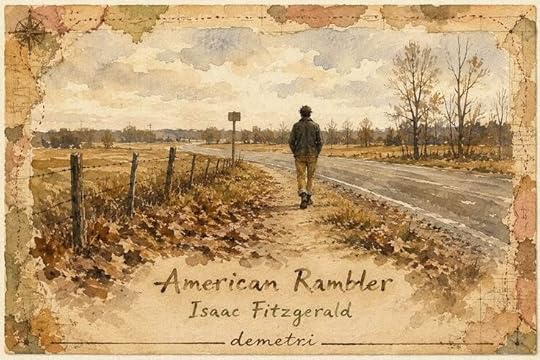
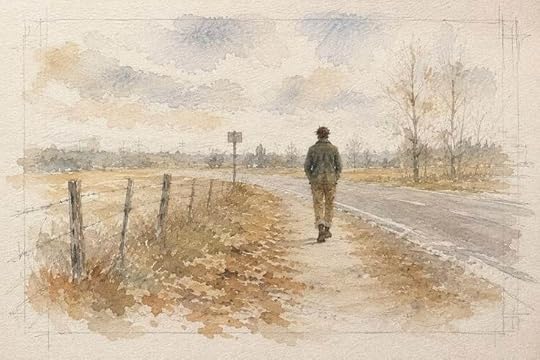
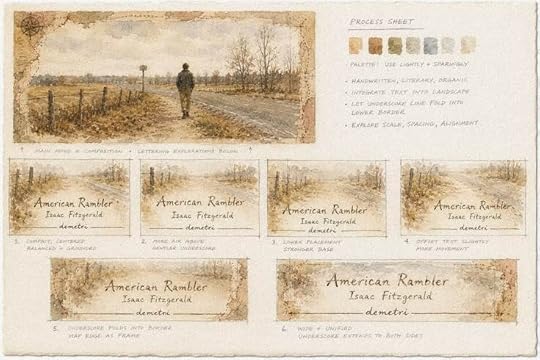
“The Trail That Was Only a Road” – the top-of-review watercolor distills “American Rambler” into a solitary walker, a roadside shoulder, and the quiet irony of a country that kept Johnny Appleseed’s legend while making the path itself disappear.
Isaac Fitzgerald begins “American Rambler” by looking for a trail that does not exist. The metaphor has the decency to wait a few pages, though not many. He arrives at the Johnny Appleseed Visitors’ Center in Massachusetts ready to walk the Johnny Appleseed Trail, only to learn that the “trail” is a tourist highway meant “for motorists.”
The joke is small, local, and quietly incriminating: America has kept the walker’s name while paving over the conditions that made walking possible. Fitzgerald, being Fitzgerald, does not respond by revising his plan. He slips through a hole in a fence, cuts through tire-strewn woods, wanders onto active train tracks, hides from a railway cop while praying, and begins a yearlong pursuit of Chapman’s trace.
That false trail becomes the method: start with an official story, then find the hole in the fence. “American Rambler” will not sit where it is shelved – too much barroom for a walking book, too much grief for a road book, too much cider and theology for a folklore errand in clean shoes. Fitzgerald follows John Chapman from Leominster, Massachusetts, toward Fort Wayne, Indiana, and discovers that wandering’s old temptation is also its danger: the dream of moving until the bill stops arriving, until a mother, a father, a childhood, and a country finally lose the address.
The public Johnny Appleseed is a cheerful schoolroom saint: tin-pot hat, seed bag, bare feet, benevolent seed-scattering, the frontier fit for bulletin boards. Fitzgerald knows that version. He grew up with it through classroom folklore and the old Disney film “Melody Time,” but also through a more private split inheritance. His father gave him high-flying legends to keep his small legs moving on childhood hikes. His mother gave him dates, sources, and the useful suspicion that enchantment usually edits the bill. “American Rambler” is pitched between them. It loves a good story and keeps checking the receipt.
The John Chapman who emerges here is less useful and more alive than the mascot. He was a devout follower of Emanuel Swedenborg, a nurseryman, a landholder, a man who embraced poverty by choice rather than necessity, and a figure whose apples were less lunchbox innocence than cider and applejack. Fitzgerald does not file him neatly under fraud or saint. Chapman remains too odd to be domesticated: religious eccentric, entrepreneur, wanderer, folk emblem, settler-adjacent figure, warning. If Michael Pollan’s “The Botany of Desire” helped teach readers that apples carry human appetite and cultural history far beyond sweetness, Fitzgerald asks what happens when the schoolroom apple starts hiding cider. The fruit is wholesome until it ferments. So is the legend.
Fitzgerald organizes the journey by season – Spring, Summer, Fall, Winter – and the chapters are numbered rather than titled. They count steps instead of hanging signs. Spring sets the first stones in the shoe: childhood poverty, family volatility, a father’s stories, a mother’s facts, the old Massachusetts farm, work collapse, heartbreak, and walking as a way to keep the mind from chewing through its own leash. Summer opens westward into Pennsylvania, Ohio, rivers, bars, strangers, apple lore, and Chapman’s ledger marks, nurseries, and rumors. Fall darkens into festivals, fatigue, old-growth forest, roadside unease, a black dog with the timing of an unpaid debt, and the approach to Chapman’s grave.
Winter does not extend the journey; it makes the earlier jokes colder. Fitzgerald’s mother dies by suicide, and the road snaps back toward a house, a father, a phrase, and the grief that had been traveling with him before he knew its name.
The ending lands because the book has been carrying its weather from the first pages. Fitzgerald places walking, prayer, and drinking too close together for comfort. Each is a ritual; each can quiet the mind; each can become a way of getting out of one’s own head. He is “drinking a bit less and praying a lot more,” though he qualifies the claim almost immediately, as if virtue might spoil if left unattended. Whiskey stays in the pack. Bars remain attractive. Hospitality and harm sometimes arrive in the same glass. A bar can be refuge, trap, theater, chapel – occasionally all four before last call.
The book runs on Fitzgerald’s voice: shaggy on the surface, sneakily exact under the mud. His sentences swerve from anecdote to memory, from history to joke, from joke to hurt without polish. He lets himself look foolish: underprepared, hungry, startled by dogs, susceptible to questionable bars, loyal to bad plans. He can find a little holiness where a tidier writer would be busy scrubbing the restroom scene out of the manuscript. The jokes do moral work. They keep pain from dressing too formally for the occasion.
The prose at its best has a heel-to-toe rhythm. It advances, detours, notices, forgets, remembers, circles, and returns. A public bathroom in Warren becomes a civic marvel. A hole in a fence becomes the true trailhead. Susie Q, a barking dog behind a property fence, becomes a test of trust across a boundary. A minor-league baseball team in Fort Wayne becomes local mythmaking in cleats and apple logos. Fitzgerald notices places usually asked to stand in the background: rest stops, diners, riverbanks, damp campsites, parking lots, and bars lit by the democracy of bad decisions. He likes them without sentimentalizing them. Charm beside threat. Kindness beside both.
Its bravest risk is trusting that a detour can think. Fitzgerald sees a thing, follows its history, remembers his own life, corrects a legend, makes a joke, gets cold, gets fed. Then he keeps moving. The repetition is the pulse. Walking repeats. Drinking repeats. Prayer repeats. Family fear repeats. So do the flattering national stories, the ones with clean hats and no blood on the map. The seasonal design gives those repetitions weather: thaw, heat, ripening, rot, frost.
The freedom of the form has a toll. “American Rambler” sometimes keeps moving before the last scene has tightened. Its middle passages have all the pleasures and dangers of a long conversation with someone funny who has one more story, and then one more after that. Most are good enough that you keep listening. Some bars, roadside encounters, and historical asides feel essential. Others feel like material gathered but not fully milled. The sprawl is the gait and sometimes the drag. A stricter shape might have sacrificed some charm, but it also might have sharpened the middle third.
That critique matters because Fitzgerald’s looseness is not accidental. It is the book’s argument under stress. To walk is to repeat, to drift, to think sideways, to pass through dullness as well as revelation. The question is whether the dullness has been shaped. Often it has. Sometimes it has merely been carried along. The book is strongest when the road does not simply produce material but alters it – when a town, a dog, a grave, or a meal changes the pressure of the journey rather than merely extending the itinerary.
The looseness also permits Fitzgerald’s best scenes, the ones that carry a joke, a ghost, and a claim at once. The abandoned Johnny Appleseed amphitheater is one of the book’s finest images: an abandoned theater of belief, built to stage a national folk saint and left to weeds, metal apple logos, empty seats, and the black dog that has begun to seem less like a symbol than like something the book itself has failed to outrun. No single mood gets custody of the scene. It says more about myth than a lecture could. America built a venue for the legend; the legend did not show up for the run.
Fitzgerald is especially alert to memory bolted into public view. He keeps finding names nailed to things: plaques, jerseys, festival banners, monuments, tanks, graves. Chapman’s birthplace, veterans’ memorials, historical markers, Fort Wayne’s Appleseed celebrations, the TinCaps’ apple-branded baseball pleasures, and Chapman’s uncertain grave all ask what remembrance does, whom it comforts, and whom it politely omits. The question is not only whether the story is true. The sharper question is why a community needs a certain version to be true enough. Fitzgerald does not sneer at festivalgoers, re-enactors, small-town pride, or souvenir history. He sees the sweetness in public memory and the cost of making it too sweet to taste the alcohol.
The present enters through pavement: the trail is a road, and the walker is treated as a design mistake. “American Rambler” speaks to a country engineered for cars and nostalgic for walkers. It also speaks to a culture still polishing settlement and dispossession until they can sit neatly under the apple tree. Chapman’s story opens onto westward expansion, property, faith, commerce, and the national habit of turning hard history into inspirational décor. Fitzgerald is not writing a classroom correction, and the book would be worse if he were. His method is quieter and more affecting: he keeps placing the tin-pot emblem beside the messier fact until the emblem starts to wobble.
The family material is not a side road; father’s gear and mother’s phrase give the book’s argument a body. Fitzgerald’s father is myth, faith, story, and age. His mother is fact, severity, generosity, mental illness, home, and the old phrase “Spring will come.” That phrase begins as a survival charm and returns with grief caught in its teeth. When his mother dies, the earlier scenes of walking away, family damage, prayer, and the unstable border between freedom and abandonment become newly charged. The road does not save him; it proves how much of the self can keep pace.
It has literary neighbors, but no twin. Bill Bryson’s “A Walk in the Woods” has comic outdoor misadventure, but Fitzgerald is more spiritually bruised. William Least Heat-Moon’s “Blue Highways” offers American back-road encounter, but Fitzgerald is less map-minded and more haunted by family weather. Cheryl Strayed’s “Wild” is the obvious market cousin for physical journey as emotional reckoning, but “American Rambler” is shaggier, funnier, less redemptive, and more suspicious of damage becoming lesson. Fitzgerald’s best pages do not claim that walking fixes a life. They suggest that walking gives a life enough rhythm for the unsolved things to speak.
The book’s great achievement is its refusal to pretend the wound has closed on schedule. It begins with the old fantasy: what if a person simply walked west and did not stop? It ends with a harder recognition. At Chapman’s grave, Fitzgerald understands that he wants the wildness of the rambler but not the loneliness of dying on someone else’s floor. The insight would be moving even without the winter epilogue. With it, it becomes the hinge. The desire to leave is real. So is the obligation to return. The difference between the two is not always clear until someone is gone.
“American Rambler” does not hide its scuffed boots. It repeats itself. Its appetite for Americana occasionally overfills the plate. Its reflections on the country are strongest when rooted in object and scene, weaker when the word America swells into a shapeless container. A few episodes depend more on Fitzgerald’s charm than on necessity. Yet charm is not a minor gift here. It is how the book brings grief into the room without making everyone stand at attention. It is how the prose stays loyal to ordinary ridiculousness, which is where life does most of its business.
I’d rate it 86/100, or 4/5 Goodreads stars – high praise for a book whose finest passages are excellent, even when the middle occasionally chooses another mile over a sharper turn. Perfection would be a strange demand for a ramble. A perfectly disciplined “American Rambler” might have arrived sooner and understood less.
By the end, west is no longer the saving direction. Fitzgerald has followed Johnny Appleseed far enough to see that the folk saint was never the destination. He was the figure walking just ahead, seed bag over shoulder, leading Fitzgerald toward the harder country: the father waiting, the mother gone, the road underfoot, and the body, at last, turning back.
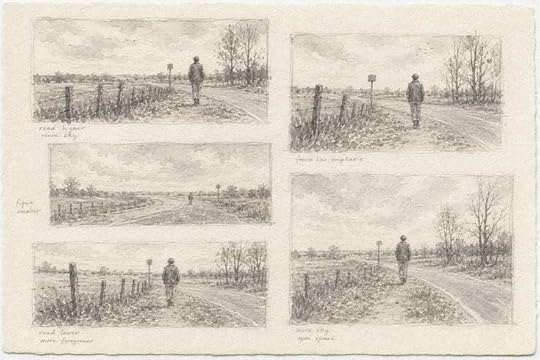
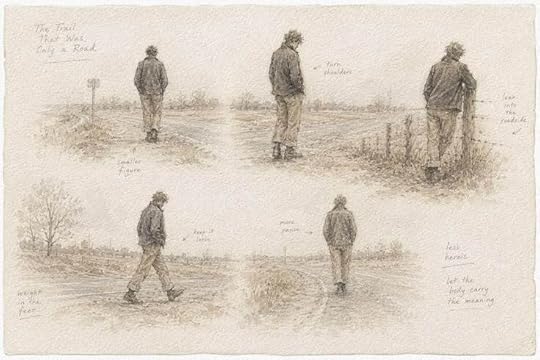
Early thumbnail studies for “The Trail That Was Only a Road,” testing how road, fence, figure, and negative space could turn a false trail into the visual argument of the review.
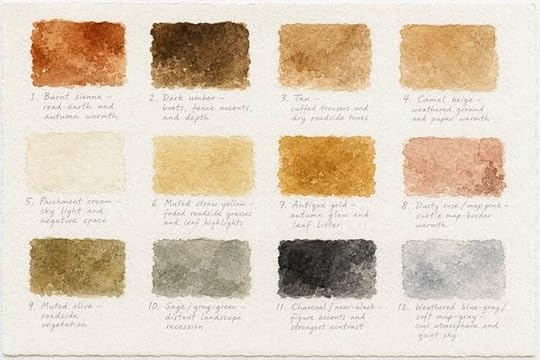
Cover-palette swatches for the emblematic watercolor, mapping the burnt sienna, weathered gray, parchment, olive, ochre, and near-black tones that hold the image to “American Rambler.”
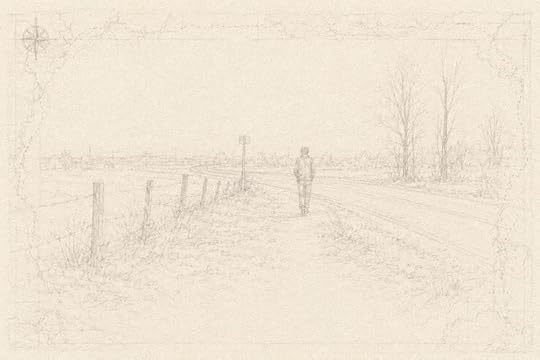
The faint pencil underdrawing establishes the bones of the finished piece – the roadside geometry, the small walker, the absent trail, and the lower space reserved for title and signature.
The first watercolor wash begins to set the image’s weather – pale sky, road edge, autumn ground, and the first emotional distance between the walker and the path that is not there.
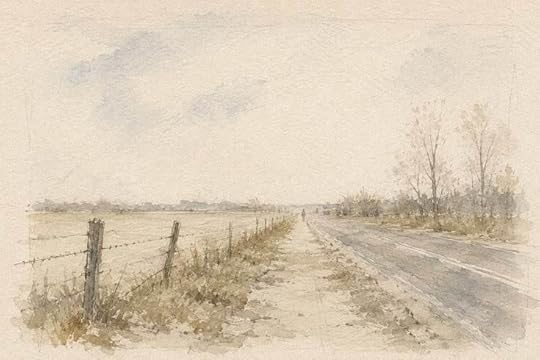
A focused study of road, fence, and emptiness, refining the central tension of the watercolor: the promise of movement interrupted by infrastructure and open, uneasy space.
A posture study for the solitary walker, keeping the face unresolved while letting boots, shoulders, and stance carry the book’s tension between forward motion and doubt.
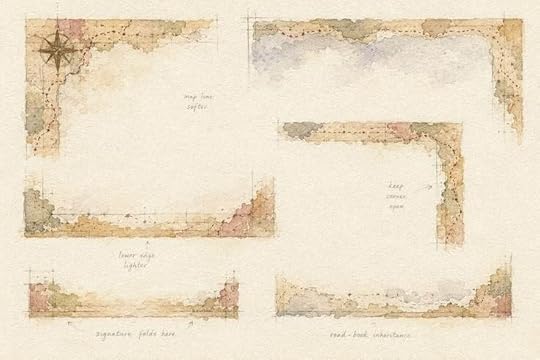
A border study in faded map tones and weathered-paper washes, testing how the frame could suggest route, inheritance, and old travel documents without becoming decorative clutter.
A lettering study for the title, author name, and “demetri” signature line, integrating the hand-painted text into the border as part of the watercolor’s road-worn design.
All watercolor illustrations by Demetris Papadimitropoulos. Watercolors are done on 140lb vellum and then scanned into the computer using an Epson scanner. From there, they are finalized in Procreate. All art and opinions are my own.
This book is so interesting and entertaining. The author is following the travels of Johnny Appleseed starting in his birthplace of Leominster, Massachusetts. I learned so much about him in this book that I never knew.
I also learned something about the national highway system:
There are 70 primary interstate highways in the system. The major interstates run east west and you know you’re on one because the sign’s Blue Shield will have the letter I along with a double digit number ending in zero. The longest and most northern of the interstate highways is I-90, which goes from Boston to Seattle. The southernmost is I-10 which goes all the way from Jacksonville to Santa Monica. The bigger the number the farther north you are. I-80 goes from Teaneck, New Jersey to San Francisco. I-70 connects Baltimore with Cove Fort, Utah. I-40 takes you from Wilmington, North Carolina to Barstow. If you are moving north south you look for a Blue Shield that has a double digit number ending in five. I-95 goes from Miami all the way to Houlton, Maine, where it stops at the Canadian border. On the West Coast, we have I-5 which goes from San Diego to Blaine, Washington. I-15 goes from San Diego to Sweet Grass, Montana. Then you have interstate minors that split off from interstate majors and have three numbers. The last two numbers are the same as the interstate major they diverged from. If the first digit is even, it means it will eventually reconnect. If the first number is odd, they will not reconnect.
I also learned that the San Diego Padres have a minor league team in Indiana called the Tin Cups in honor of Johnny Appleseed. Cool.
Breaking my Goodreads hiatus to say that I REALLY just don’t see the appeal! Also: for a book that’s ostensibly about walking, this dude sure does drive a lot.
DNF at around 60%, right around the TMI story about Fitzgerald's travel bathroom misadventures.
In the 2026 travelogue American Rambler, American writer Isaac Fitzgerald sought to travel the path of the American traveler, preacher, and planter Johnny Appleseed (born John Chapman; 1774-1845). In the first 60% of the book that I listened to, Fitzgerald hiked, camped, rafted, and drove around Pennsylvania and Ohio; I didn't stick around to see if he made it to Indiana and Illinois as well. I found the book, true to its title, to be rambling, occasionally telling stories about Appleseed but mostly telling stories about the author's own travel misadventures and the interesting characters he met along the road.
Fitzgerald must be a cool guy because he is bffs with Saeed Jones, but dude. A lot of the critical reviews are because there is less Johnny Appleseed than advertised in this book. While I would be interested in an actual story of walking the trail of Johnny Appleseed (they are correct, this is not that), Fitzgerald is using the trail as a backdrop for a personal memoir which I'm not mad at. I love a memoir. I didn't realize it was going to have so many religious overtones, and that took me a minute to get past, but whatever, that's my own bias. BUT. Fitzgerald quickly started to take shape as a dude type we have all met as women. He thinks that being a giant child is charming in some way. He wants a stupid ass car that makes no sense and his girlfriend puts up with it and, with the patience I do not possess, keeps trying to steer him in a more reasonable direction. He decides to do this big hike with Timbs and no gear and his dad has to stop what he is doing to figure out how to make sure he doesn't wander off into a bush with no shoes on like an idiot. He shows up at a "trailhead" not realizing there is no trail and the woman working there has to inform him that it is a highway and not a trail and he goes through the fence clearly there to keep people out and sets off into the woods next to the highway anyway. He sees bear poop IN THE MIDDLE OF THE WOODS and is so ill equipped to deal with the fact that black bears exist that he full sprints back out of the woods. I'm not even going to deal with the shitpants fiasco. And he tells all these stories obviously knowing he is the dumbass and still marching forward happily in all of his dumbassery thinking it is cute and totally confident that making his complete incompetence someone else's problem will work out just fine for him. Maybe I am just perimenopausal and tired of that guy, but I didn't find it charming. There were some really great moments, but damn dude. I would be so embarrassed to tell anyone ONE of these stories never mind stringing it together with some Johnny Appleseed lore and sending it to a publisher. But it's on a bunch of best of 2026 nonfiction lists, so I guess it hit for someone. Probably someone whose wife has to make sure they don't accidentally wander into traffic on their way to work...
Like America itself, this is somewhat of a mixed bag. I liked the descriptions of the author's encounters with ordinary people, who seemed real and authentic, and these captured both the strengths and frailties of the national character. Some real poignancy was delivered along with the rambles. There were some pithy reflections on the current state of the nation that I liked. I was less enthused by the way the publishers have misrepresented the book. The close-up photo of boots on the cover, and the subtitle "Walking the trail of Johnny Appleseed" create the expectation that this would be a journey of discovery largely undertaken on foot. This was far from the case. Overall, however, this was an enjoyable quick read.
I was excited to hear about this book since the university where I worked had a Johnny Appleseed Museum (Surprise! It's mentioned in the book a couple of times.) The university closed with COVID, but the museum continues. The book is a memoir of the author's following Jonathan Chapman's (Appleseed's birth name) trail from Massachusetts near Fitzgerald's home territory to Indiana. Once that trail enters Ohio, I am quite familiar with the area. (Who doesn't love to read about familiar geography?) Fitzgerald's travels presented him with historical recognition of not just the man whose journey was being echoed, but also about the people and towns discovered along the way. Fitzgerald captivated me with his nuanced text - once referring to his life as "being more gutter than strikes." Nothing hackneyed here. I was surprised by how much I liked this book since I felt a previous work by this author was meh. However the six years I spent working proximate to Johnny Appleseed was a strong pull vs my previous read.
I'll read any new book about John Chapman (Johnny Appleseed) that doesn't superficially look to be terrible - he's been my guy since I was a kid. Because that is a theme of the book, I would call Isaac Fitzgerald's American Rambler OK. It's autobiography, mixed with history, mixed with travelogue - heavy on the the author's personal experience. Though he wants to talk about living outdoors and Johnny Appleseed, I left with the impression that the author most enjoys striking up conversations with strangers in bars and then writing about it. Though he does some Johnny Appleseed style rambling and sleeping outdoors, it comes across alternately as a stunt or temporary torture to be endured, vs. a communion with something worthy or transcendent. He says he prays, but I never find out why he prays or who he prays to, which would be natural, since he writes about Chapman's Christianity at length. The places he chooses to go seem intended to convey hope in the resilience of small town America or despair at an American sickness he gestures vaguely at. It seems like a bunch of things that happened, and I'm not sure what it adds up to.
Author try’s to follow the Johnny Appleseed trail. But spoiler alert there really isn’t one and he ends up driving a lot. We learn more about author than John Chapman.
This entire review has been hidden because of spoilers.
I started this book skeptical. I thought, here we go, another dude who's trying to be a modern Jack Kerouac. (Even got more skeptical when he quoted Dharma Bums), but the author won me over. By the end of the journey, I was crying on my couch.
Isaac Fitzgerald is a good writer. American Rambler was an easy read, even when he did ramble, which, I think, was kind of the point. He's aging, reflecting, and thinking about the country he lives in –ingredients for a self-important, nauseating memoir. But that's not the journey we went on with Isaac. Instead, he keeps a nondualistic mind throughout. Whether that's drinking Bud in a racist bar in Pennsylvania, retelling the story of Johnny Appleseed, or zooming out to American culture and life as a whole. It's rare that you see white authors write with such balance.
He toes the line of self-deprecating, but has restraint and never fully topples into it. The reader gets to know him because we realize, as he does, who he is.
I began the book expecting to eye-roll my way through and ended up with what felt like a new friend.
I crossed life paths with Isaac Fitzgerald long enough to become FB friends about 20 years ago, and I have always remembered him as being infectiously likable and enthusiastic. He continues to come across that way in American Rambler. However, the bumbling, ill-prepared aspect of himself ends up feeling too much to forgive when it comes to this memoir. There are so many great hiking/walking memoirs out there that you don’t get to join that pantheon without demonstrating some basic common sense re: outdoor preparedness. Right off the bat, for example, he sets out on the Johnny Appleseed Trail, somehow failing (or not bothering) to realize—with all the powers of the Internet circa 2021—that the Johnny Appleseed Trail is not a hiking trail, but rather the name given to a section of highway in the area. So he finds himself, in March in Massachusetts with snow on the horizon, underdressed and under-equipped, walking 30+ miles along highways and railroad tracks to get home from the nonexistent “trailhead.”
And the thing is, he should have just left that part out of his book. Hoofing it home in the snow from a nonexistent trailhead does not contribute to a narrative of following in Johnny Appleseed’s footsteps; it just becomes a puzzling story about Isaac drinking hard cider and being really cold. That’s actually what the majority of the book ends up being about—the adventures of Isaac Fitzgerald driving around in a Jeep, drinking in many Midwestern bars, sleeping in many unsavory places, and, at one point, literally shitting his pants. He also rambles into a lot of narrative tangents, thanks to a self-described “itchy mind” that does not get editorially reigned in.
For a book that is clearly meant to be about Johnny Appleseed, I’d say Johnny Appleseed content constitutes about 5% of the book, which leaves me scratching my head over what the book is actually about.
This is my first non-fiction ARC! I listened to a podcast recently where Fitzgerald was talking about this book and I’ve been so excited to read it. So when I saw it available as an ARC, I jumped on it. Thank you Knopf and NetGalley for the opportunity to read this one a little early.
#AmericanRambler is Isaac Fitzgerald’s tale about following the trail of John Chapman, also know as Johnny Appleseed. From the first page, I'm hooked on Fiztgerald’s narrative voice, ready to buy all of his previous books and recommend him to several of my family members.
Fitzgerald sets off on Massachusetts’ Johnny Appleseed trail only to realize it's not a hiking trail, just a name for that stretch of the highway; but he stays on the path, hiking alongside the highway and through backyards; buying a jacket from the Salvation Army, only to return it to a donation bin down the road once he finds a crumpled up tissue inside the pocket; sleeping outside despite his fear of coyotes -- all to stay true to his Johnny Appleseed journey, but all while clarifying that John Chapman didn't live quite as nomadic of a life as legends have claimed.
After Massachusetts, he makes separate trip to Pennsylvania, Indiana, and Ohio. There are so many quirky stories along the way, as he journeys through several small towns, meeting lots of people and learning about each town’s history.
One of my favorite parts of this book were all the very fascinating tidbits I learned while reading - like how apples were involved in and affected by prohibition and the logistics of rebranding a Minor League Baseball team.
And while this was more about Fitzgerald’s journey and these small towns than it was about Chapman, I learned way more about Johnny Appleseed than I ever have anywhere else.
3.5 This book wasn’t bad, but it wasn’t really about John Chapman, aka Johnny Appleseed, like I wanted. It’s a memoir that centers more on Fitzgerald’s journey as he follows the paths of Chapman, much of it on foot, and does a decent job of describing important Native American history and some must-visit corners of the US, like the Allegheny region and several revitalized cites, like Ft. Wayne Indiana (who knew?). What I didn’t care for was his focus on his mental health—though I was sympathetic to stories of his mother’s struggles. He’s essentially walking to “ find himself”, and that’s not the journey I signed up for. I was in it for the American history, not Issac Fitzgerald’s history of drinking and smoking weed as a teen, even if the stories were good, especially as he discusses relationships with several writers, including the brilliant Saeed Jones. Fitzgerald’s an interesting guy, kind and introspective, and he does visit some cool spots, the last-living apple tree “supposedly” (He uses the word a lot—much of Chapman’s history is word-of-mouth.) planted by Chapman, a Johnny Appleseed themed minor league baseball stadium, home of the Tincaps, and a Johnny Appleseed fair that includes a woodsman competition, among other rural areas that I’ve put on my travel wishlist, but he really jaws on about being a nomad, and the black dog that “follows” him from state-to-state is a poorly-crafted symbol for the weight of his mental struggles. I didn’t hate the book; I just wouldn’t recommend. Wanna learn about John Chapman, read Michael Pollan’s, The Botany of Desire.
If you are looking for a straight up history of John Chapman, aka Johnny Appleseed, this isn’t it. If you are looking for a memoir that starts at point A and moves to point B and on, this isn’t for you. This book is, however, a book that lets you ramble with the author as he searches for something he can’t quite identify by trying (and sometimes failing) to follow the path John Chapman took from the east coast to Indiana. The hilarity, grief, stupidity, confusion, fright, and love he finds along the way hold up a mirror to our own lives as he attempts to understand Chapman and why, after all these decades since his death, his life (the myth and the truth) still holds sway in America. I grew up in NE Indiana and have been to a number of places he visited so I had a ready made connection with the story. There were times when Fitzgerald’s actions mystified and frustrated me but they often mystified and frustrated him too. He knows he’s flawed, he knows his mental health is not perfect, but he keeps going in spite of it all, and writes about what he experiences—the good, the bad, and everything in between. The last chapter is gut wrenching in a way I was not expecting but was somehow perfect.
This book is a mess. You think it's about Johnny Appleseed when it is really about the author bar hopping from place to place and getting drunk. You get a couple paragraphs about Appleseed or some history then it's page after page of woe is me. Every minority mentioned is great, every white character, which the author points out "white" quite often, seems to be a secret racist or overt racist. Most of the encounters are probably made up or greatly embellished.
If you want to learn about Johnny Appleseed, you should skip this rambling tail and take up one of the other books he mentions about Appleseed.
I received an advance copy from Penguin Random House Let me say I really really loved this book!! Walking the trail of Johnny Appleseed , Isaac Fitzgerald explores and learns all while doing some reflecting on his unusual upbringing and his personal struggles that he is so very honest about. The love for staying outdoors , sleeping under the stars and just walking. His witty stories about people , especially people he’s had life experiences with are entertaining….. he has such honesty. literature and deep thinking is at his core of knowledge I appreciated his story
4.5 stars, this is a very good "road trip" book following the trail of Johnny Appleseed, meeting people who live in his legacy, and experiencing the events and locations dedicated to him. The author is a character in his own right, you feel like he might be too well drawn to be real, but it makes this excellent.
This was a fantastic read. A modern day take on a picaresque narrative, but one in which the author exudes empathy and optimism in the face of the hardscrabble conditions of contemporary small-town America. The prose is clear-eyed and haunting, following the author on a cross country pilgrimage that serves as a mediation on solitude, loneliness, and finding community.
I have no idea why this book was so good but it was. Maybe the author’s voice or the previously unknown (to me) history he relates. So many interesting places and people he meets. So similar to how we like to see the country (not the walking miles and miles part). The small towns and local communities, the history of a place and the old mixed with the new.