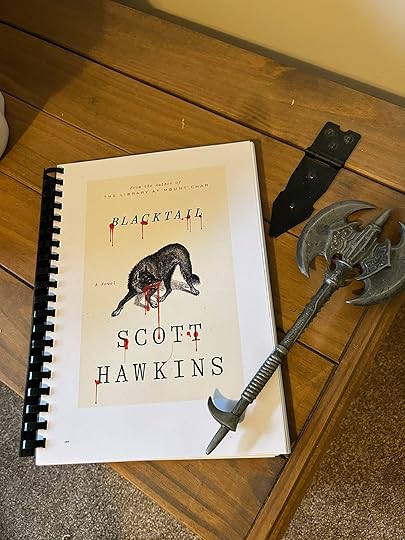
A visceral dark fantasy novel, Blacktail is the long-awaited second novel from Scott Hawkins, the critically acclaimed author of The Library at Mount Char.
Who does your dog pray to?
Blacktail is a half-breed wolf, born to hunt. When he finds love beyond a garden wall, he dares to imagine a peaceful life – until men butcher his mate and unborn pups in a surgical act of cruelty. His grief ignites a rampage of torn throats and shattered bone, a slaughter so absolute it draws the gaze of an ancient feline witch. She sends him south to wake the sleeping Forest God and end the age of reason.
Fuelled by a rage that frightens Hell itself, Blacktail wages war against men and the beasts who dare defend them. From a gore-soaked wilderness to a burning confrontation with Heaven, Blacktail is a feral odyssey of vengeance.
The Forest God sleeps. But what will be the price of waking him?
This is a very different book from TL@MC and also from almost every other book I know.
It does have strong vibes of Watership Down and The Plague Dogs, both by Richard Adams. The focus is on a particular wolf/dog half-breed, the eponymous Blacktail. And there is definitely an element of the chaotic/weird mythology that we saw in TL@MC. There is mention of the tiger Nobununga, and there are large scale mythology-level events/conflicts that echo the climax of TL@MC. But it's very definitely a different book without a single human point-of-view (that I remember).
Speaking of point-of-view: the book's written in an unusual style that's part fairytale/story telling and we do slide from one point-of-view to another in-paragraph on occasion. Also, we're given a handful of minor points-of-view alongside the main one (Blacktail).
It's an engaging tale that takes us in unexpected directions. It's at many times pretty gory with violence from and against animals. Although there's an over-riding "humans bad" message, it's delivered from an animal point-of-view and the harsh justice can seem ... harsh ... given the reader's greater (or different) understanding of the various encounters.
Like TL@MC there's a deeply uncompromising thread running through the story with harsh justice dispensed, the good/innocent suffering as they're variously steamrollered by chance, malice, or in the name of a greater cause.
The net effect is touching, horrifying, and entertaining. In many places it's impossible - as with any well written account of animals suffering because of our deeds - to not be moved. But the undercurrents of humour, and the wildly unpredictable paths Hawkins' imagination takes us down, mean that this is far from a mawkish look at animals enduring the cruelty of men.
It's one of those books I'll have to sit with to fully understand my feelings about it - but there's zero doubt that it's a 5* read, so I can hit the rating button right now.
You should all get excited for this book and hope that Mr Hawkins doesn't keep us waiting 10 years for another one.
It's very definitely a stand-alone though, so you'll not be left hanging. It's a completely complete story that has left me satisfied and with plenty to think on.
ur telling me the author of library at mount char is releasing another book after TEN YEARS?? and it’s like a funky wolf pov?? we used to pray for days like these
I truly am in awe of Scott Hawkins. He wrote a fantastic debut novel, then he disappeared for over ten years and now he returned with this absolutely wild book about talking animals. I've never read anything even remotely similar to this strange horror fable. The best comparison I can come up with is the Erin Hunter books, but R-rated and on some serious drugs that induce religious hallucinations. Make of that what you will. It's the story of the wolf Blacktail and his journey from a puppy whose fierce mother was shot and killed to a famous lord of the hunt with a taste for human meat. At first Blacktail sets out to seek revenge for his dead family and to bring ruin to mankind, but the story later turns into his search for the sleeping Forest God. It was more of a spiritual journey than I ever expected from this book and for a long time I was unsure if Blacktail was even looking for his God or if he was turning into wolf Jesus himself. I followed his path with great interest and I liked that it was told in an episodic way. Blacktail meets many different animals, wild ones and pets alike, and he keeps being sent onto random side quests. He hides from the humans who hunt him with the help of a clever fox, he encounters dogs who love their owners deeply even though they are abused by them, or he fights a grizzly to save a pack of starving wolves. It's the story of Blacktail travelling the land, his name being known among all animal folk and slowly becoming a ray of hope against the overwhelming power of mankind. While the brutality of nature is often shown in visceral ways here, it is humankind that poses the biggest threat to all creatures. It was quite powerful how human actions were shown through animal perspectives here and how unnatural human behavior is compared to animal one. At the same time, the animals were majorly personified in this novel, twisting the roles of man and animal even further. The animals portrayed the full range of emotions while human motives were often incomprehensible, for instance. It was a clever exploration of the relationship between predator and prey, but it also was a weird story full of quirky elements. From animals marking their territory with scent poems and gossip-loving rodents to animal religions and powerful cat witchcraft. My emotions were thoroughly confused while reading. The story went from fun to devastating to gross to religious, and I never knew what would happen next. But I do know that I liked it and that I can't wait for the next book by Scott Hawkins, when it's released in 2040 or so.
Huge thanks to NetGalley and Crown Publishing for providing a digital arc in exchange for an honest review.
⭐️ 3.5 ⭐️ Blacktail is a story about a half-wolf living in wilderness encroached by humans. He wants a peaceful life but upon experiencing human violence, Blacktail responds with rage and revenge, calling on the sleeping Forest God to help him bring down humanity and their dominion.
The story is entirely told through animals perspective and gets very dark and violent. It's not a simple 'animals vs humans' story, it's about what happens when grief literary consumes you.
Hawkins imagination is weirdly wild. It's not gentle, it's not kind. It's gory, blood thirsty, vengeful and cruel. It's a story that may come off as grotesque and graphically violent, but I think deep down, this is a story about pain we feel when something unimaginable happens to us. When hurt and pain is too much to bear and when our darker, inner thoughts take over.
Many thanks to NetGalley, Crown Publishing and the author, Scott Hawkins for an early ARC.
Every single sentence in this book is my sweet puppy who I love forever and ever.
🐺Blacktail is a half-wolf, killer of Hate, previous Lynx-king of his territory. Blacktail grieved the loss of his mother as a young pup. He gained many skills in the law of the hunt. Blacktail finds a mate and is expecting puppies when he is heinously betrayed by the Two-Legs. His revenge echoes across the land and is picked up by the old kitty-mother, a witch with her two cougar body-guards. Kitty mother has long observed attempted plagues on the two-legs brought about by animals. One rat in particular came very close, as in the Bubonic Plague. But kitty-mother now seeks Blacktail to quest for the long forgotten Forest-God, he who rules the hunt, unlike the god of Reason, the god of the two-legs.
🐺“The Forest God—or courage, if you prefer—sleeps in all places, all hearts. Some, I grant you, more so than others, but each of us must find Him all on our own.”
🐺The Forest-God is not an an entity to be sought through traditional means. Blacktail's quest spans great distances but it is a spiritual quest, meeting characters along the way who speak the language of the hunt, and even those who would seek Mercy against it. He meets a two-legs who can speak the language of the hunt and belongs to the god of Lost Things, a starving half-wolf abandoned by his human mate, and a band of domesticated dogs who sit on the lap of Mercy, a two legs who offers shelter and food-pellets and has saved them from dangers. Blacktail's revenge against the two-legs must be absolute, so his mission involves no-Mercy. Some insane gruesome scenes--let's just say trail-hiking will never be quite the same for me again.
🐺Here is where the allegory becomes magical. Mercy has an illness that she will die from, and the animals can smell it. Through his process of awakening the forest-god, Blacktail takes on the disease from Mercy, and it is transferred from her to him. Blacktail continues hunting humans, training his buddy Raze in the ways of the hunt. Blacktail becomes a legend, Raze continues his legacy, finds the old kitty mother and delivers her from her witch's curse. There can be so many interpretations to the ending. Did Blacktail find the forest god, become the forest god, awaken the forest god, or something else? As with allegory there is a layer to this story beneath what is seen. To me, this was story-telling perfection, and worthy of even more than five stars. A phenomenal and memorable book.
This story initially caught my interest due to the novelty of the protagonist being animal rather than human, but I did not expect quite how unique and enjoyable of a reading experience this little horror story would end up being.
We accompany Blacktail, a wold/dog hybrid, who initially sets upon his journey with a desire for revenge and retribution against the humans who killed his mate and unborn puppies. He soon comes to the attention of The Great Kitty Mother, a strong and powerful witch who tasks Blacktail with discovering, and waking, the slumbering Forest God. The story is structured through a series of vignettes which allow us to witness Blacktail’s encounters with different animals and humans who all play a part on this journey he undertakes. My favourite chapter was ‘The God of the Lost’ and Blacktail’s interactions with The Hider; that shit got real intense real quick.
A slight diversion, now this might be a bit of a niche comp, but for me it was completely inescapable during this reading experience. When I was younger, one of the shows that I loved and still remember fondly was an animated show called ‘The Animals of Farthing Wood’. It followed a cast of Animals on their journey to find a new home following the destruction of their Woods at the hands of human industrialisation. The show managed to explore a number of similar thematic notes that Blacktail tackles such as the negative impacts humans have on wildlife and the environment, as well as interpersonal relationships which exist between predator and prey animals, who are at times forced to work together. (Side note but this show was responsible for some of the most intense, media induced, crying I ever experienced as a child lol I was DEVASTATED in a way that I don’t think modern media really does anymore). So I perhaps had an ingrained fondness for the vibe of this book due to the mental association.
I must say that MacLeod Andrews gave an absolutely exceptional audio performance and I would definitely encourage people who enjoy audiobooks to give this one a try. His voice acting gave a weight to the emotion and gravity of the story that really elevated the whole reading experience.
I knocked a star off cause I have to admit that I think the ending let it down a bit. It was fine? But considering how intense the rest of the story had been, I just fell a bit flat for me by comparison.
It should be noted that this story was gruesome and probably not suitable if you have a sensitive stomach for gore as it features significant violence and cruelty towards both to humans and animals. However, if you are after a unique and disturbing read for the spooky season this one could deliver the vibes you are after.
I've struggled so much with how I could possibly even describe Blacktail, let alone my feelings and criticisms of it. I cannot describe how disappointed I was in this experience. Scott Hawkins is not afraid to alienate a reader. He will write events that are inexplicable, strange, and off-putting. This aspect of his writing persists in Blacktail, but in a much more confusing, disgusting, and difficult-to-accept way. Everything from the line-by-line writing to the characters to the world-building is significantly worse, and despite the amount of sex and violence, more immature. It's a crazy comparison, but I legitimately felt like I was reading the Warrior Cats series by Erin Hunter, just with more dog sex.
A young wolf named Blacktail is the last of his kind in the forest he calls home. Encroachment from the world of men shrinks his territory every year, and these men bring weapons that no wolf can counter. The wolf follows a scent down from the mountain and into the territory of men, meeting a house dog named Renren. He offers to take her away from her world and into his, but before he can, Renren is killed by humans. Blacktail fills with a rage he has never felt before and swears vengeance on all humankind, starting with Renren's owners.
His fury calls out to an ancient feline witch, The Great Kitty Mother, who believes Blacktail might finally fulfill a long-held desire for the animals of The Hunt. She offers him the opportunity to kill the human race if he can find and wake the ancient Forest God. Blacktail's bloodlust is not sated, so he agrees. His journey takes him across hundreds of miles and encounters with strangers who all seek the same goal: the end of the human race and the rise of the Forest God.
I wrote a very long review about Blacktail, so if you'd like to read my in-depth thoughts with many evidentiary quotes, check out my blog, A Literary Apothecary, through the link below. https://aliteraryapothecary.com/2026/...
There are a LOT of characters in Blacktail, but they aren't overwhelming. Each set of characters is typically featured for only a single chapter as they meet and influence Blacktail, and then they disappear from the story. I did like the personification of the animals. Lower, prey animals refer to hunters as Lord, and Blacktail is considered the Lord of his forest as the apex predator on the mountain. I especially liked some of the characterization of marking behavior. Wolves mark using poetry and lyricism.
Blacktail himself is a character that I feel conflicted about. I found him likable at first. He's young, and he's unsure about his belief in the Forest God. He's certainly not devoted to him, even once he begins his journey to wake the god. Many of the characters that he runs across are devout, and Blacktail does begin to adopt these beliefs. However, halfway through the novel, there's a very jarring pivot in Blacktail's beliefs and he becomes a deeply entrenched, dogmatic despot for The Forest God and The Hunt.
Blacktail's actions are also confusing in their morality. I don't know what kind of character he's supposed to be, but Blacktail regularly abuses his power to rain violence down upon others. He kills innocents over and over, and the narrative never really interrogates it. It's incredibly easy to hate Blacktail by the end of the story, and I'm not sure if the audience is supposed to hate him.
There is a significant problem that marred the reading experience for me and was incredibly distracting. The number of times urine or urinating is mentioned is truly unacceptable. After a while, it felt like Hawkins couldn't think of any other way to express fear except by someone pissing. I actually counted how many mentions of piss there were because it was starting to become genuinely shocking. There are sixteen mentions of "piss," three mentions of "urine," four mentions of "wetting oneself," and 4 mentions of "pee." That's twenty-seven mentions of urine in some way or another. That's one mention every ten pages!
The other thing that was fairly uncomfortable to read about was the amount of dog horniness contained in these pages. The actual sex itself isn't necessarily described in graphic detail, but the insinuation is still more than I would prefer. It's natural. Sex is natural. However, I can hold all of those opinions and still be uncomfortable reading about how pleasurable sex was for an animal.
There are some passages of prose that I enjoyed, and overall the writing maintains a level of gravitas that makes the story feel like a fable or myth. That works quite well with the way the story is framed. The dialogue between characters is more noble than everyday vernacular. All of that contributes to making the world of the animals feel much different and antiquated compared to the modernity of the humans in the novel.
The pacing of the story is a bit odd. This is structured less like a traditional novel and more like The Odyssey, with several vignettes following a central character through an overarching journey. That's not necessarily a bad thing. Some of the vignettes are more enjoyable than others, but they do contribute to the overall plot and development of Blacktail as a character. It does mean that the book is very segmented, and Blacktail can occasionally feel like a very different character between chapters.
The world-building of Blacktail is one of the highlights. The Library at Mount Char had so many fantastic concepts, and this book is no different. This author is entirely unafraid of his own ideas, and it makes the world entirely unique.
I did also enjoy many of the more supernatural elements, to a point. Cats in this world are essentially witches, able to weave spells, literally. All cats are of a coven who serve one known as The Great Kitty Mother. Their magic is literally able to affect the world. Heaven exists, Hell exists, angels exist. Again, this book has never met an idea that it turned away. That's all quite fun, and this level of absurdity is totally acceptable and expected to me. The absurdity that I couldn't abide lay with the themes.
The section on themes ended up being incredibly long and detailed, so this is going to just be the basics, but I deeply elaborated on them in my longer review. There will be some spoilers in this section.
Renren is the female dog that Blacktail mates with. When she falls pregnant, he offers to take her away from her home and into the woods with him to start a wolf pack. Renren agrees to this, but before she's able to leave with him, she dies. Renren's death is not tied to any human action that is evil. Her owners take her to the vet to be spayed, and as is the case with many dogs, the vet aborted her and Blacktail's puppies to perform the procedure. There was an issue with the surgery, and Renren dies from internal bleeding.
I'm not accusing the author of any specific political leanings, but there is a certain reading of this story that is anti-abortion. The dog fetuses are always referred to as Blacktail's children or his puppies. They're described as being murdered by humans. These are the talking points and language that anti-abortion activists use to try to make pregnant people seeking abortions feel guilty and to enact legislation banning abortion access.
There are two factions that are warring within these pages: The Hunt and Reason. The Forest God is of The Hunt and believes that all creatures should follow the laws of the natural world. The Christian God is of Reason, which has allowed humanity to think and create tools that subvert The Hunt, like weapons, traps, cars, etc. Blacktail's journey to embrace The Hunt and wake the Forest God is the core of the story, and as I've said, each vignette provides a deeper exploration of the principles of The Hunt.
My problem with this entire concept is that The Hunt makes no sense. Humanity, without Reason, falls into a very particular spot in the hierarchy of The Hunt. We don't have sharp teeth or claws. We specifically evolved Reason to build our arsenal of tools. The logic of The Hunt doesn't allow for that. How would a rabbit ever rise up against a wolf? It's impossible. So, within the philosophy of the Forest God, some creatures are just better and more powerful than others, and the ones who don't have power should simply submit to those who do. Attempting to counter oppression goes against the natural order and must be punished with near eradication.
The chapter about Mercy, more than anything else in the book, filled me with confusion, anger, and disappointment. Mercy is a human woman who feeds the animals of the forest, and she takes in any stray, hurt, or lost animals to nurse them back to health and provide a good home for them. Obviously, these animals love and want to protect Mercy. Blacktail, with darkness and vengeance in his heart, vows to kill Mercy and all those who protect her because they are violating the natural order.
This is a very difficult scene to witness because Blacktail is explicitly in the wrong here. This human was no threat to him and was causing no harm to him or any other animals. Among the crowd of animals is a beagle named Babykins. While the other animals are attempting to hold off Blacktail, Babykins runs to Mercy to try to warn her about Blacktail, telling her to run. Blacktail fatally injures the beagle, but keeps him alive to watch as he mauls Mercy, an act of abject cruelty.
Babykins keeps yelling for Mercy to run, and Blacktail allows her to, trying to prove to Babykins that Mercy never really cared about the animals. She does run from the room, and Blacktail turns to the beagle, expecting him to be heartbroken that his mother has left him to die, but all Babykins feels is relief. He would rather his mother, whom he loves deeply, survive than try to save him.
And then, Mercy comes back for him.
The love and fearlessness of Mercy as a protector is something that touches Blacktail deeply, and he lets her live. I thought this was going to be a turning point for Blacktail as he realized that humans are not an emotionless, evil monolith. They can love and protect just as fiercely as he was able to, and perhaps his quest is not as righteous as he believed. However, this event doesn't affect him beyond the last two pages of this chapter. Blacktail literally never mentions any deeper thoughts about the confrontations with Mercy.
Blacktail's belief and dogma do not eventuate in the world becoming a paradise for the Animal, predator or prey. So, in that way, was his quest doomed? Is this a tragedy in disguise? Is the audience supposed to differentiate the consequences for Blacktail—that being a happy, peaceful ending with his loved ones—and the consequences for those he left behind: starvation and overpopulation? What in the hell is this book trying to say?
Everything about it thematically is so confused, and I became very quickly frustrated with the book as a whole. If you're trying to make a point, make it. Interrogate it. Have your protagonist grapple with the implications of his stance. I just need something that indicates what all of this was for. The worst answer, in my opinion, is that it's for nothing. This doesn't mean anything. It's just a story, and anything you're trying to read into it is overthinking.
I have no idea if I recommend Blacktail or not. It was a difficult, slow read with little to no reward at the end, and the plot rose to a level of ridiculousness that didn't feel engaging or interesting. It was like the Sharknado of books, except that Sharknado is aware of its own ridiculousness.
Trigger Warnings Animal death, animal cruelty, blood, abortion, death of a child, cannibalism, car accident, death, starvation, murder, medical content, violence.
4.5 ⭐️ An absolute unexpected delight! A unique work of speculative fiction that is such a breath of fresh air! So much was packed into a relatively short book but it never felt rushed. Instead there was an episodic or dreamlike quality to each chapter especially as we got closer to the end. The ending was the main reason I knocked half a star off. It was fine but it didn’t have me glued to the page like the rest of the book.
TW Cruelty & violence against animals are main themes and are portrayed liberally. If graphic depictions turn your stomach stay away!
Omg, OHH MAH GAWDDDD. You know sometimes I would randomly think "Library at Mt Char was such a banger, has he written anything else yet?", and then I would check and it would just be that darn Linux manual. NOT TODAY, I'm so excited.
GROTESQUE. 🦴 PHILOSOPHICAL. 💭 FEROCIOUS. 🐺 BIZARRE. 🌀 This is one of the strangest and most memorable books I've read in a long while, and I absolutely adored it; Hawkins has written a wildly imaginative fantasy that can be outrageously funny while confronting some genuinely heartbreaking realities about our relationship with the natural world.
Set in a world where animals possess their own societies and spiritual beliefs, the novel follows Blacktail, a wolf whose life has been devastated by human beings and whose forest is steadily disappearing beneath their expansion. Driven by grief and a desperate desire for justice, he ventures beyond the wilderness he knows in search of the sleeping Forest God, undertaking a journey through a landscape inhabited by creatures both familiar and fantastical. The premise is wonderfully peculiar, but the emotional foundation of the story is painfully recognizable, and I loved the freedom Hawkins gives his imagination without losing sight of the suffering that motivates Blacktail's journey.
The characters were an enormous part of why I fell so hard for this book, and I was continually delighted by the personalities Hawkins created for the creatures inhabiting his world. Each has its own understanding of existence, shaped by experiences and beliefs that extend well beyond the moments we spend with them, while their often ridiculous interpretations of the world contribute to a mythology I found fascinating. The narrative unfolds somewhat episodically, and although I understand why readers looking for more conventional momentum might find that frustrating, I genuinely wouldn't have wanted Blacktail's journey told any differently. Spending time with him through these encounters allows us to understand who he is beyond the expectations other creatures place upon him, whether those expectations come from those who fear him or from others who believe they know what he is meant to become. We learn about his character through the way he treats his community, how he responds to vulnerability, and the relationships he develops along the way; I appreciated how these experiences establish Blacktail as an individual rather than allowing the larger ideas surrounding him to define him entirely. The creatures he meets feel as though their lives extend far beyond his involvement in them, and I became attached to this peculiar assortment of animals.
I also loved just how thoroughly bizarre this book is, and I can understand how some of its stranger elements might lose readers who aren't prepared for the direction Hawkins takes his imagination. It's dark, grotesque, frequently absurd, and incredibly entertaining, with an elaborate mythology that draws on religious ideas while challenging our understanding of divinity and the authority we grant to it. I get the impression that religious traditions have informed quite a bit of Hawkins's approach to storytelling here (he has said himself that parts of the new testament influenced this story) and I found his willingness to explore those ideas engaging. I have seen a few people express disdain over this, but I've rarely felt that I need to agree with every perspective a book presents to appreciate what it's exploring, nor do I think the presence of religious beliefs or symbolism in fiction should automatically be interpreted as an attempt at indoctrination—part of the pleasure of fantasy is allowing ourselves to experience unfamiliar belief systems and consider ideas that may exist well outside our own understanding of the world. Blacktail gives readers plenty of opportunities to do exactly that, and I had a lot of fun with the strange, sometimes unsettling possibilities Hawkins introduces. Beneath the adventure, he's also examining grief and the desire for justice, along with humanity's presumed authority over the natural world; I appreciated how these questions emerge through the characters' experiences without diminishing the entertainment of the story itself.
I found Blacktail immensely powerful and refreshingly original, with an emotional complexity that stayed with me beyond the pleasure of simply reading it. I would wholeheartedly recommend it to anyone willing to surrender to its unusual perspective and embrace the very strange world Hawkins has created, because the book has an enormous amount to offer readers who enjoy a fantasy that isn't afraid to challenge their expectations.
I could easily leave my review there, but after finishing this book, I spent quite a bit of time reading other people's reactions, and some of the criticisms led me to consider the book from another perspective. What follows is more of a personal reflection on its themes and the expectations we bring to stories about animals, because I think this particular novel invites conversations that extend well beyond the experience of reading it. (There are no spoilers, just further thoughts.)
One of the more interesting things I noticed in those reviews was how frequently readers expressed frustration with the animal perspective itself, particularly the constant pissing, scent marking, and unabashed horniness of its inhabitants... 🤣 I understand that those details aren't going to appeal to everyone, but I found much of it hilarious and, frankly, pretty recognizable; anyone who has spent considerable time around an intact male dog knows just how much of his existence can revolve around smells and sexual instinct, often to an absolutely ridiculous degree. Hawkins has spent years rescuing and fostering dogs, and I imagine living alongside so many different animals has given him considerable familiarity with the less dignified peculiarities of their behavior. 😅
What interests me about these criticisms is how readily we accept animals behaving like people in fantasy, yet their recognizable animal instincts can become a source of frustration when they interfere with our expectations of how those characters should behave. We can suspend our disbelief for wolves who speak and participate in elaborate mythological systems, but apparently a wolf preoccupied with his own bodily urges is where things become a little too strange...?? Hawkins is anthropomorphizing animals to tell this story, certainly, but I think the novel also challenges the anthropomorphism WE bring to it as readers, particularly our tendency to project human expectations onto creatures whose lives are fundamentally different from our own. Fantasy asks us to accept the impossible all the time, and I think we can extend that same willingness to an unfamiliar perspective without insisting that everything about it be made more comfortable or recognizable. (Let it be weird; the weirdness is half the fun.)
Reading those reactions also made me consider how thoroughly we've romanticized the natural world, often without recognizing just how distant we've become from its ordinary realities. We've made wolves into magnificent, almost mythical representations of freedom and nobility, but their existence is bound to hunger and the constant necessity of hunting, killing, and consuming other living things. Predation is neither an act of malice nor a moral failing; it's an ordinary part of survival, however brutal or upsetting it might be to witness. Most of us are so removed from these realities, even from the origins of the food we eat, that we've grown accustomed to experiencing nature from a comfortable distance, appreciating its beauty without confronting everything that sustains it. And to be clear, I don't believe recognizing the necessity of predation means we should become indifferent to suffering, because compassion is an entirely reasonable response to witnessing another creature in pain... but I do think we need to distinguish between being emotionally disturbed by violence and interpreting that violence through a distinctly human understanding of cruelty. We can love wolves without needing them to be gentle, and respecting wild animals ought to involve accepting the entirety of what they are rather than only those qualities we've decided are worthy of admiration. You cannot separate a predator from the act of predation and expect to understand the animal, and I think our struggle to reconcile those realities reveals how much our understanding of nature has been shaped by our own comfort.
That separation from the natural world is worth considering in relation to the novel's questions about human dominion. We've grown accustomed to thinking of ourselves as somehow superior to the other creatures with whom we share this planet, although our ability to control their lives doesn't necessarily make us responsible or compassionate stewards of them. I found the exploration of the relationship between love and ownership particularly compelling, because genuine affection for an animal doesn't erase the enormous authority we may hold over its existence, nor does our certainty that we're acting in its best interests guarantee that we always are. We make decisions about where animals live, what freedoms they have, and how their bodies are treated, often without questioning the degree of control we've come to regard as perfectly ordinary. I think Hawkins understands how complicated these relationships can be, and how easily good intentions can coexist with arrangements that primarily serve human needs. Our intelligence has afforded us extraordinary power over other forms of life, but whether that makes us more morally deserving of such authority is a question I don't think we examine nearly enough.
The book's examination of grief and vengeance raises another difficult question about cruelty, particularly when we're sympathetic to the suffering that motivates someone's actions. It's easy to recognize the desire for justice when we understand why someone is angry, but our willingness to excuse behavior can change considerably depending on whose pain we identify with and whose suffering we're prepared to overlook. I found this fascinating to consider while reading Blacktail, because our attachment to its characters inevitably influences how we interpret their choices, even when those choices challenge the moral principles we may or may not ordinarily defend. It also complicates our understanding of heroism and monstrosity, since the same actions can carry very different meanings depending on whose experiences we're considering. I appreciate that Hawkins leaves room for these contradictions, allowing readers to question their own sympathies without insisting upon a single interpretation of what justice should look like.
I don't expect everyone to love Blacktail the way I did, and I wouldn't want to dismiss the discomfort or frustration other readers experienced, because those reactions can be just as valuable to a discussion as enthusiasm. I'm personally interested in understanding why we respond to certain ideas the way we do, and whether encountering a different interpretation might encourage us to reconsider a belief we've never really examined. That's why I'd have loved to read this with a book club; I can imagine spending an entire evening hearing how differently people experienced the story, what they disagreed with, and whether someone else's perspective changed the way they understood it.
A fun, strange, weird, sad, beautiful book.
----------
Original placeholder review:
What gives humanity the right to dominate the natural world, and does our intelligence make us morally superior to the creatures we control?
What separates a savior from a monster, and who gets to decide which one someone becomes?
At what point does justified anger become the very cruelty it seeks to destroy?
Can we truly love another living being while denying it the freedom to determine its own existence?
A beautiful, gruesome, unique, original, strange book.
I've read many reviews where the message seems to have been muddled / lost by people. This would be an excellent book club pick for deeper discussions.
More thoughts to come, I have many notes to dig through!
Blacktail is a wolf whose world is being slowly eroded by the encroachment of men. He meets a domesticated dog who becomes his mate. Learning she is pregnant, he makes plans to help her escape from her owners so that they can live together in the wild. Before the plan can be implemented both his mate and their puppies are killed, sending Blacktail into a rage. He quickly enacts revenge against her human owners and finds himself fleeing for his life. Blacktail then meets an ancient cat who convinces him to continue his war against humanity by waking the Forest God. His goal is nothing less than the eradication of humans. He meets animals along his journey and reminds them that their true nature does not consist of being subjugated to humans, but rather being part of the hunt.
This book is very thought provoking and is told completely from the perspective of Blacktail and other animals. While there are a few humans in the story who treat animals with love and kindness, most are presented as cruel and sadistic. Sections of the book are emotionally difficult to read due to descriptions of violence committed against the animal characters or toward one another. The other major theme of the book centers around the frequent lack of concern for how the growth of human infrastructure negatively impacts natural habitats. Something as simple as the building of roads can have significant consequences for the life of animals.
Blacktail is a story that will linger with me for some time. Recommended for fans of folk horror and dark fantasy.
Thanks to NetGalley and the publisher for an advance reading copy of this book.
Blacktail is such a unique Dark Fantasy story. Admittedly, not something I would typically gravitate towards, however, I've heard such great things about Scott Hawkins writing, I had to jump on board for his latest work.
This story follows a wolf named Blacktail, in a world beseiged by men, who sets out on a journey of revenge for the death of his mate.
The entirety of the story is told via a cast of animal characters. I know books like this exist, but this is the first one I've ever read. I'm generally super sensitive to animal content, so never really dare, but this kept me captivated.
The tone is that of a Dark Fable, and while I feel like the meaning went way over my head, I was enamored by the quality of the writing and the uniqueness of the content.
I loved how we followed Blacktail on this journey, and it felt like every place he stopped, the other animals he encountered, he was always learning something new. Through those experiences it almost felt like little vignettes. I enjoyed that.
I'm truly in awe of how Hawkins made these characters feel so stunningly realistic. Here I am reading from a perspective of a squirrel like, yeah, that makes sense.
So, while I wouldn't chose to the lead the discussion in book club on this one, I still had a great time with it. It did make me feel a little simple. LOL
Thank you to the publisher, Crown Publishing, for providing me with a copy to read and review. This was certainly a unique reading experience!
Bloodily beautiful and very brutal. This is absolutely not my genre, though I'm not sure if you can even pigeonhole this book into a genre at all... it's definitely one of a kind. I can't say I enjoyed it—it's just far too gruesome for that. But it's really beautifully written and had tiny details that were truly gorgeous. Aside from that, it's a disturbing story ... Yeah, that's about all I can say about it. Fascinating.
“You know about mating, right?” “I, ah, that is to say…no.” She looked at him for a moment and saw that he wasn’t kidding. “Wow. You really are from the woods, aren’t you?” 🤭
Blacktail’s muzzle was a whisker’s length from the cat’s nose, all blood and fangs. “I…eat…cats,” he snarled. “Frequently. With great pleasure.” 😳
”They say the two-legs use the fur of foxes to warm themselves in the winter. That can’t be true, can it? Not even the two-legs would kill someone just to cut the fur off them, would they? Do you think?” 😢
I went in mostly blind, ignoring the book flap and previews but not dodging advance knowledge that it's narrated by a wolf (a half-wolf, really), but the book reveals its nature quickly. By the end of Chapter Two you'll know exactly what you're in for, should you continue.
Did you read The Library at Mount Char? Do you remember it well? Do you remember the oven? Because this new book is all oven. It's been seven years and I remember so many things from Mount Char, but what brought me back to it most acutely was the sense of dread, fascinating, captivating dread and horror that this story also produced.
It's brutal, to animals and humans alike, and when I tried to look the book up on https://www.doesthedogdie.com/ my computer starting screaming and crying and I had to turn the power off.
It's propelling, horrific, and undeniable in its examination of humanity's relationship with animals and nature, both individually and collectively. It's weird and unpredictable fantasy from an obviously stable and intelligent mind.
I kind of hope that there's another 10 years until Hawkins' next book comes out, because I will immediately put aside all other books when it does and I have a lot of lingering reading to work through.
Three Words That Describe This Book: animal point of view, dark fantasy quest/journey, nature is not happy with us
First things first, this is not Library at Mount Char, it is very different but it is also very good. It is lyrical and fairytale/mystical. But it is also practical in many ways.
Blacktail, a wolf who is out for revenge against all humans, is the main narrator. He is not the only narrator, but he is the main one. No humans get the pov, only animals.
This book makes us humans look VERY bad. All of us. And Hawkins meters out judgement and punishment on all humans through Blacktail and there is no mercy. None. I cannot stress this enough. Even humans who we readers think don't deserve to die, will be brutally hunted by Blacktail. Animals are hunted too, but it all makes sense through Blacktail's world view-- which is very clear to readers.
To see him react to seeing "car" kill animals and leave them on the pavement -- killing just for fun and not a reason. To see the way he looks at houses, people's impact on the land. His reaction to pets who he calls slaves. How the animals work, interact and communicate and the spirits and witches that bind them all. It is riveting and original.
I also loved that Hawkins uses Blacktail's journey to break the story into vignettes. Each of his stops/passing through a new territory, gives readers the chance to meet new animal characters. The rhythm of this keeps the story moving at a good pace.
There is one "good human" here and kudos to Hawkins for sticking with the POV and Blacktail's sense of right and wrong because wow is it uncomfortable for the human reader.
Seething with rage and seeking vengeance -- appetite for revenge not satiated, only growing. This is a violent, in your face revenge novel.
The storytelling has a mystical/dark fairy tale feel.
Very similar to Watership Down by Adams in the storytelling, the dark fantasy, the environmentalism, but it is dark and filled with blood thirsty revenge of Pearl by Josh Malerman. A great mix of the two.
I thought about Lord of the Rings as well. Frodo's quest seems impossible but it is dire. Many will help or hurt him along the way.
I really enjoyed The Library at Mount Char for its originality, and Blacktail gave me that same feeling of never knowing where Scott Hawkins was going to take me. Just when I thought I understood what sort of book I was reading, something happened that made me reconsider.
My favourite part was seeing the world through the animals’ eyes. They all talk to each other, but their understanding of things comes from scent, hunting, territory and which animals they trust. I loved how they interpreted things we take for granted. They don’t understand cars, for example. They see them as creatures that help humans for mysterious reasons and kill other animals without consuming them. From their perspective, that makes no sense. It's just cruel.
I also liked discovering their mythology. There’s feline witchcraft, strange rituals and a Forest God. The animals believe in “The Hunt,” which is something like a natural order, or survival of the fittest, while the humans’ “God of Reason” seems unnatural to them. I don’t want to give much more away, because discovering how strange this world gets is part of the fun.
There’s a lot of graphic animal violence, though. I’m talking about animals hunting and fighting each other, and the fact that they can speak makes some of it harder to read in places.
I struggled a bit with the middle, too. Blacktail arrives somewhere, meets an animal, has an encounter and moves on. Then the next chapter starts somewhere new with another character. I enjoyed plenty of those sections, especially the chapter called “Mercy,” which had me gripped, but the pattern became repetitive. At times it felt like a collection of short stories about Blacktail’s adventures, and I lost some of the urgency I’d felt earlier.
The ending almost went too far for me. I felt something similar with The Library at Mount Char. As the story reaches its climax, the weirdness keeps increasing. I don't know if the ending was earned. It felt like maybe there was a scene missing or something?
Still, I’d much rather Hawkins keep writing whatever strange thing comes into his head. He's the one writer who is totally unpredictable, which is a rare and cool thing.
The Library at Mount Char is one of my all-time favorites, so after eleven years of waiting, I was very curious to see what Scott Hawkins would come up with next. Following up a book as strange and brilliant as TLaMC is no easy task.
Blacktail is a very different book, but it still feels unmistakably like Hawkins. It's whimsical, brutal, philosophical and absurd, sometimes all within a few pages. It's also weird, with the kind of ideas and turns that made me keep wondering where the hell he was going to take the story next.
This time we're following Blacktail, a half-wolf who sets out on a rather bloody quest after losing his mate and unborn pups. The entire story is told from animal perspectives, which works well. Hawkins gives the animals their own way of understanding the world, and seeing humans from that perspective is... well, we're not exactly coming out of this looking good.
Most humans in this book are pretty much scum. We destroy habitats, hurt animals, kill for convenience and generally behave like the planet belongs to us. And because we're mostly seeing the story through the eyes of animals, some of the things that humans consider completely normal suddenly look rather horrifying. There are exceptions, of course, but Hawkins clearly isn't interested in giving humanity the benefit of the doubt.
The book is also very violent. Animals get hurt and animals die, sometimes in pretty horrible ways, so if you're particularly sensitive about that, be warned. At the same time, there's a lot of humor and absurdity mixed into all the brutality. Squirrels have a death cult, cats have witches, dogs worship food, and all of this fits together into the same story.
I also loved how the story gradually takes on a more mythic quality. What starts as a fairly straightforward story of grief and revenge grows into something much bigger, while still keeping almost fairytale-like quality throughout.
So yes, Blacktail worked for me. It's not The Library at Mount Char, and I wouldn't want it to be. But it has that same sense that you're reading something completely unlike whatever else is sitting on your shelf, and that's exactly what I was hoping for.
Whatever Hawkins writes next, I'll be reading it. Hopefully we don't have to wait another eleven years this time.
Bat-shit crazy, beautiful and dark, poetic, emotive and at times, very funny. Blacktail is the story of a wolf-dog fighting against the rise and destruction of humans. It can tread some very familiar ground at times, can get a little repetitive, but I guarantee you will be thinking of this book a LOT after you turn the final page.
A lupine, lucid phantasmagoria, a bloodthirsty and diseased beastial fable that portrays both the ending and the beginning of all things.
Honestly, I'm still reeling from this reading experience! Eleven years was well worth the wait for Scott Hawkins' second novel. I just hope we don't have to wait that long for a third!!
My hopes and prayers have been answered. September can’t come soon enough.
Edit 09/26/2026:
Everyone say thank you to Scott Hawkins for gifting us once more with his writing.
What a fucking wild read. I really appreciated the ride that was Blacktails ascension. There is something pleasant in knowing the ending and just focusing on the journey towards it. I know that’s not everyone’s cup of tea, but it certainly is mine. In typical Hawkins fashion, he made it brilliantly gruesome, bizarre, and hilarious. Like genuinely laugh out loud funny. A fucking squirrel death cult? Yes. Sign me up. I’m all for that shit.
They say all dogs go to heaven. But that’s a myth, because Blacktail fucked gods shit up and made a haven of his own.
This entire review has been hidden because of spoilers.
A dark tale told from a wolf’s perspective about the horror of encroaching two-legs - aka humans.
This book is bloody and bold. An orphaned wolf called Blacktail is set on a tail (tale😉) of revenge. It follows a predictable travelling journey of entering a new territory, meeting the animal inhabitants, conveying some sort of message with blood and guts, and then continuing on bigger and badder.
My main issue was with this repetitive structure. However, Hawkins keeps it fresh by changing perspectives to keep the story intriguing and unique.
The use of language was a highlight for me. Hawkins really gets into the head of a wolf and this is shown through the thoughtful wording. Adjectives, nouns, even measures of time.
‘Car’ is a bloodthirsty beast that kills but doesn’t eat, pets are slaves, veterinary is magic.
These bodies had not been shown the respect of a hunter for his prey. They had only been destroyed. One in particular caught his eye. From the ribs down to about the middle of the tail, the squirrel’s body was squashed flat. Its guts had been squeezed up into its torso, bloating it. The little beast’s eyes had popped from their sockets. Now they dangled on stalks of about the length of Blacktail’s foreclaws.
This gets quite gruesome. Humans are depicted as evil with little redemption. Blacktail becomes like the black hound of death in his quest for revenge.
The fantastical part was the weakest part. Mentions of Gods, angels, and dream sequences, especially in the latter half, made this hazy and confusing rather than horrifying.
This might have worked better as a novella because the latter half felt weaker, repetitive, and went off the rails in the last 15%. The tightly controlled narrative felt like a fever-induced nightmare which isn’t my personal preference, although it is common for horror book endings.
"Perhaps a creature may have more than one nature, and each of them be true," Little One suggested in his small, soft voice. "Perhaps a creature may have only one true nature . . . but hide it. Even from himself."
Overall, this didn’t live up to the refreshing magic of The Library of Mount Char, but it was wild (lol) and uniquely bizarre. 3.5 stars.🌟
Hawkins spins a tale that's like if Watership Down was a revenge story. A wolf seeks old gods in order to make a pact that will destroy his greatest enemy: mankind. It's a doozy!
God may forgive them for this but if so I will kill Him, too.
5/5
This book... is dementedly fantastic.
Blacktail is not a bedtime story. It is a new mythology, a previously untold odyssey that feels as though it crawled from some dark pit of ancient mysticism in a forest untouched by man, first told in the language of the hunt until Scott Hawkins shed his paws to become its translator. And thank the Forest God because his narrative prose is fucking spectacular; the precision with which it evolves across the novel until the voice itself feels transformed by each stage of the plot is unreal. Feral, haunting, charming, brutal, witty, devastating, occasionally hilarious, and unrelentingly wise. It is intentionally challenging in places, but the difficulty is part of the experience; this book asks the reader to abandon familiar narrative expectations and submit to its mythology on its own terms. I want to take off my shoes and run to the woods, hold vigil for the death cult of the squirrels, swear fealty to Old Kitty Mother, huddle for warmth with Little One's pack, weep with Mercy's congregation, find a man in Snow's name and lay him in the desert cave, leave a warm meal for Raze, follow Karakaa into the moonless night, and drag bolt cutters & matches through the Cathedral of Reason. Fuck off at how good this book is. I think I have rabies or something now, take your five stars.
Thank you to Scott Hawkins and Crown Publishing for the ARC copy of this game-changer, it took my breath away and I am honored to have received it. Blacktail is phenomenal novel and has set a high bar for everything I read next.
This is one of the most imaginative books I have ever read while also being one of the most thematically confusing. I understand that the POVs are through the eyes of animals, but unless things have changed without my knowledge, animals can’t read, and that’s where this book loses me. Since humans are going to be the ones reading this book, I have to assume the messaging is ultimately meant for them. But what, exactly, was the message?
That animals are just as bad as humans? That spaying and neutering is evil and having multiple children is the way to go? That a blood-borne pathogen and lack of “purity” will lead to the demise of humanity? That serial killers who kill with a knife are worthy of becoming elevated beings, but a woman who rescues animals deserves to be mauled? That reason, logic, and science need to be wiped off the face of the Earth?
I am genuinely at a loss as to what the author was trying to convey to the humans reading this book. When I finished Tender Is the Flesh, I felt sick at how humans use and abuse animals. I finished this book feeling like, “They’re just like us, and not in a good way.”
Blacktail’s introduction comes on the heels of the death of his mother and littermates, and while he does make a name for himself, he is also incredibly lonely. Enter Renren, a dog who lives outside her owner’s house without any shelter and is constantly chained. I genuinely thought this section was lovely and incredibly well written. I felt that punch to the gut and genuine sadness as the inciting moment occurs, and I could understand Blacktail’s grief and rage. And then he does what any egotistical man would do: he makes it about himself and does something diametrically opposed to how Renren behaved. The book even states “ ‘What they did to me was a sin against the hunt. It was an abomination.’ “ Not what they did to her, nope me. Using sin in a book about animals was also when my red flag system turned on.
This was when a book I thought would be five stars immediately dropped to four. And then kept dropping the further along I read.
The book anthropomorphizes its animals so heavily and then tells us, essentially, that we can’t view their actions through a human lens because they’re still animals. Pick a lane. Viewed purely as an animal, Blacktail’s actions make sense. Viewed through the lens in which these animals believe in marriage and refer to themselves as husband and wife, those same actions become deplorable. You can’t have it both ways.
Even with those misgivings, I was still on board and enjoying the story, and THAT scene was truly fantastic. Then the truly impactful novella ended, and it seemed the author decided they wanted a full-length book instead and downhill the book went for me.
As the story shifts from Blacktail’s POV to that of the creatures he encounters on his quest to awaken the Forest God, it becomes increasingly religious. What I had initially brushed off as “animal POV,” despite feeling uncomfortable with it, becomes much harder to ignore when yet more commentary about the evils of spaying and neutering is introduced. Again, who is the messaging in this book for if not the humans reading it? And what message are we supposed to take from it? The ending then seems to prove the humans right anyway. So, what was the point?
We have an entire chapter where Blacktail is shown that humans can love animals enough to risk their own lives for them, and then it is followed by a chapter in which an innocent couple is mauled to death. Transparently, I still loved the whole scene. But it left me wondering what the point of the previous chapter was. If we flip the narrative, then humans killing animals “just because” isn’t necessarily a big deal, because apparently it isn’t a big deal when animals do it either. It’s just survival of the fittest, right?
I also can’t say the religious overtones did much to quell my feelings. Blacktail being conceived through some sort of immaculate conception was not on my bingo card, but I guess it should have been considering he is constantly referred to as Lord. Once we move past his POV, the story is essentially him roaming from place to place gathering disciples and healing animals, at one point even giving a chihuahua his balls back. Oh, and he can’t forget the matchmaking. Apparently, healing an animal isn’t enough of a thank-you to a devout believer; Black Tail also needs to find him a mate.
“‘Oh, and I almost forgot. Last night I heard a female calling to me from just over the mountain. You see that one, there, just south of the sun? She’s in much the same hell as you were, though not quite so deep. Not yet, anyway.’
Chester thought on this for a moment. ‘Calling to you … as I once called?’ ‘O Lord, receive me in my penitence….’
‘Yes. The same. Can you help her? I’d do it myself, but I think I’ve little time left. She might make a mate for you, Chester. In time you might even start a pack.’”
I guess females of every species will always be seen as less than and as property. It’s also interesting that despite same-sex relationships being well documented in the animal world, not a single one is represented in this book. Considering how heavily the author anthropomorphizes the animals by giving them concepts like marriage, religion, morality, monogamy, and social hierarchies, the absence is glaring. If the goal was truly to portray animals as they are, why selectively reproduce human social conventions while leaving out a behavior that exists across so many animal species? But it sure does love to present straight husband and wife relationships. It further adds to my feeling that the book isn’t really interested in exploring animal behavior so much as using animals to selectively reinforce a particular view of humanity.
Another religious overtone I noticed is that, even in this fantasy world, suicide is treated as a sin because it goes against the Forest God’s directives. The argument that all of this is meant to show the absurdity of religion doesn’t satisfy me because there is no foil, no contrast to any of the beliefs and actions carried out by this religion. There is no interrogation after each vignette closes. No alternative worldview presented to challenge it. When there is nothing else to compare it to, absurdity becomes the norm. Whether intentional or not, these patterns are present in the text, and the book doesn't give me enough evidence to interpret them as satire rather than as part of its actual worldview.
If you’re looking for a book where animals rise to the top of the food chain and treat humans the way humans treated them, this will probably be for you. The body horror is excellent, and I do love a good revenge plot. Unfortunately for me, I couldn’t help but notice everything else.
But hey, at least the “right” god was in charge.
This entire review has been hidden because of spoilers.
Have you ever read a book and then wished it could become a book club pick?! I would love to unpack everything that I just read with someone else, and I think this one will sit with me for a while.
There are lots of horror subgenres from body, supernatural, slasher to many more. In the case of Blacktail, it's a mixture of dark fantasy and eco-horror. This is the book that all the other eco-horror books wish it could be. It just went hard as f*ck.
Scott Hawkins's new book is about the revenge of a half-breed wolf named Blacktail. His mate and litter have been killed in the beginning (not a spoiler!), and it’s just as brutal, engaging and uncompromising as it should be with this type of plot.
Blacktail is written entirely from the animals’ point-of-view and I loved everything about that.
Blacktail sets a course of revenge on all Two-Legs (that's you and me!) over the murder of his pack. As the book continues, the reader understands his quest is more complicated then when it started and becomes a spiritual one while searching for the Forest-God. The Forest-God rules the hunt, and animals have forgotten the old ways.
On this quest, he runs into many animal friends and teaches them how to hunt again. At the end, I was not expecting it to turn out the way it did. Yeah, like I said earlier. It's a lot to unpack and think about.
If Watership Down is rock music, Blacktail would be heavy metal.
Lynx that speak in platitudes, wolves that write poetry in urine, and house cats that worship the Forest God. In Blacktail, Scott Hawkins’s (very) dark fantasy, we see our world through the eyes of a wolf-dog whose personal quest for revenge becomes much stranger and more mythic as it moves toward its conclusion.
There’s an intentional discordance between the brutality and disturbing imagery of the main quest and the absurdity interwoven throughout the narrative. House cats with names like “Miss Prissy Pants” show up. Dogs worship their piles of “food-rocks” (kibble). Car demons controlled by “two-legs” (humans) stalk the “black path” (road). This discordance is amusing but often jarring, as these sillier elements undercut the dark edge of the story.
It’s a quest novel, but the pacing is somewhat stilted, with Blacktail jumping from one interaction to another as new creatures are placed in his path. This keeps the quest from gaining enough narrative momentum to earn its final denouement. Ultimately, I was consistently engaged and quite gripped by the tale, but it never quite fulfilled its promise for me.
My thanks to NetGalley and the publisher for an advanced reader copy in exchange for an honest review.